Proceedings of the 2019 Conference on Empirical Methods in Natural Language Processing 3163
Referring Expression Generation Using Entity Profiles
Meng Cao Jackie Chi Kit Cheung
School of Computer Science, McGill University, Montreal, QC, Canada MILA, Montreal, QC, Canada
{meng.cao@mail, jcheung@cs}.mcgill.ca
Abstract
Referring Expression Generation (REG) is the task of generating contextually appropriate references to entities. A limitation of exist-ing REG systems is that they rely on entity-specific supervised training, which means that they cannot handle entities not seen during training. In this study, we address this in two ways. First, we propose task setups in which we specifically test a REG system’s ability to generalize to entities not seen during training. Second, we propose a profile-based deep neu-ral network model, PROFILEREG, which en-codes both the local context and an external profile of the entity to generate reference real-izations. Our model generates tokens by learn-ing to choose between generatlearn-ing pronouns, generating from a fixed vocabulary, or copy-ing a word from the profile. We evaluate our model on three different splits of the WebNLG dataset, and show that it outperforms competi-tive baselines in all settings according to auto-matic and human evaluations.
1 Introduction
Entities can be expressed by various types of lin-guistic expressions, including by their names (e.g.,
Barrack Obama), a definite description (e.g.,the former president of the United States), a pronoun (e.g., he, him, his), or a demonstrative (e.g., that person). Many factors play a role in determining what type of expression is appropriate in a partic-ular context (Henschel et al.,2000), including in-formation status, familiarity with the entity, and referential clarity. In this study, we aim to design a model that can generate appropriate referring ex-pressions of entities in an extended passage. Such a system is useful in a variety of natural language generation settings, from dialogue systems to au-tomatic summarization applications (Reiter and Dale,2000;Krahmer and Van Deemter,2012).
Referring expression generation (REG) can be broken into two steps. The first is to decide the
form of referring expression; that is, what type of reference should be used (e.g., a proper name). The second is to determine thecontent of the re-ferring expression (e.g.,Ernest Hemingway).
Many computational approaches, both rule-based and machine-learning-rule-based, have been proposed for REG. Rule-based models use pre-defined heuristics and algorithms to determine referential form (Reiter and Dale, 2000; Hen-schel et al., 2000; Callaway and Lester, 2002). Machine learning-based approaches require train-ing on samples to predict referrtrain-ing expressions (Nenkova and McKeown,2003;Greenbacker and McCoy, 2009; Ferreira et al., 2016, 2017), often as a classification task.
The common limitation of previous REG sys-tems is that they are incapable of generating refer-ring expressions for new, unseen entities. Previous REG setups have tended to focus on form selection rather than content generation, or else they provide a static list of attributes or realization options for models to select from (Belz et al.,2010;Gatt and Belz, 2008). The recent NeuralREG model gen-erates referring expressions in an integrated, end-to-end setup, but it requires seeing instances of the entity being referred to in the training set (Ferreira et al.,2018).
In this work, we address this problem by proposing new REG task setups which test for REG systems’ ability to handle new entities at test time. We also develop a REG system which can handle entities not seen during training using ternal knowledge about them, generated using ex-tracts of their Wikipedia page.
should be handled by an in-domain NLG system. We make the minimal assumption that the profile contains just a few sentences about the entity, so that these profiles can easily be written by non-experts or be automatically extracted.
Our model, PROFILEREG, uses a learned
switch variable to decide whether to generate a to-ken from a fixed vocabulary, generate a pronoun, or use information from the profile in order to gen-erate appropriate referring expressions in context. We evaluate our model on the WebNLG corpus (Gardent et al.,2017a). Experimental results show that our model is capable of handling unseen en-tities that prior work simply cannot handle in our new evaluation setups, while also outperforming them in the original setting.1
Our contributions are as follows. First, we ad-dress an important limitation in prior REG stud-ies by creating new test setups that evaluate neural REG models specifically on entities that are not seen in the training set. Second, we propose a new REG model, PROFILEREG, which outperforms existing REG models in all tested settings accord-ing to automatic and human evaluation measures.
2 Related Work
Previous work in REG can be divided into two groups: rule-based and machine learning-based.
Rule-based approaches use pre-defined rules or algorithms to determine the form or content of generated referring expressions. For example, Re-iter and Dale (2000) proposed a straightforward heuristic for REG: a proper name should be used in the first mention of an entity and a pronomi-nal form should be used for the subsequent ref-erences if there is no mention of any other entity of the same gender between the reference and its antecedent.Henschel et al.(2000) presented an al-gorithm for the pronominalization of third person discourse entities.
Machine learning-based approaches predict the form or content of referring expressions using fea-tures extracted from the context. Commonly used context features include syntactic position, refer-ential status (initial or a subsequent mention) and distance. For instance, Nenkova and McKeown (2003) built a Markov chain model to capture how the subsequent referring expressions are condi-tioned by earlier mentions. Frank and Goodman (2012) proposed a rational speaker-listener model
1https://github.com/mcao610/ProfileREG
based on the assumptions that speakers attempt to be informative and that listeners use Bayesian in-ference to recover the speakers’ intended referents. Orita et al.(2015) extended the previous model by introducing the referent’s discourse salience and a cost term. Ferreira et al.(2016) proposed a naive Bayes model to predict the probability of a par-ticular referential form given a set of feature val-ues, including syntactic position, referential status and recency of references. Similarly,Ferreira et al. (2017) used a naive Bayes model based on syn-tactic position and referential status to predict the form of a proper name reference.
In recent years, deep neural networks have achieved great success in a variety of NLP appli-cations (e.g., machine translation (Bahdanau et al., 2014) and automatic summarization (Rush et al., 2015;See et al.,2017)). To the best of our knowl-edge, there have only been two models that use deep neural networks for REG. The first is by Fer-reira et al. (2016), who use recurrent neural net-works (RNNs) to predict the form of referring ex-pressions. They use RNNs to encode a sequence of discourse features and apply a softmax layer to generate referential form distribution.
The other is the NeuralREG model proposed by Ferreira et al. (2018), an end-to-end system that predicts both the form and content of the referring expression. NeuralREG has an encoder-decoder structure, using LSTM units to encode contextual information and to decode referring expressions. Since each entity is represented as an embedding vector in the model, it cannot handle new entities that are outside the training set.
Generating entity descriptions based on source data has also been explored in the context of concept-to-text generation Lebret et al. (2016). We focus here on generating referring expressions from unstructured source data, which may be more readily available in some settings.
3 Data
The WebNLG corpus (Gardent et al.,2017a) was initially introduced in the WebNLG challenge 2017 (Gardent et al., 2017b). The WebNLG dataset is made up of (data, text) pairs where the data is a set of triples that consists of entities and their relationships and the text is a verbalisation of these triples. In this challenge, the participants are asked to map the triple data to text.
Triples:
Elliot See|almaMater|University of Texas at Austin Elliot See|deathPlace|St. Louis
Elliot See|birthPlace|Dallas ...
Text: Elliot See was born on July 23 , 1927 in Dallas .He attended the U of Texas at Austin which is part of the U of Texas system . See was a test pilot . He died on Feb 28 , 1966 in St. Louis .
Wikipedia ID: elliot see
Referring expression: He
Delexicalized text: elliot see was born on 1927-07-23 in dallas . elliot see attended the univer-sity of texas at austin which is part of univer-sity of texas system . elliot see was a test pilot . elliot see died on 1966-02-28 in st. louis .
Pre-context: elliot see was born on 1927-07-23 in dallas .
Post-context: attended the u of texas at austin which is part of the U of texas system . see was a test pilot . he died on 1966-02-28 in st. louis .
Table 1: A sample in the original WebNLG dataset (above) and the delexicalized dataset (below). In this case, referring expression “He”, which refers to El-liot See, is first delexicalized as elliot see and then ex-tracted from the text.
of WebNLG corpus introduced by Ferreira et al. (2018). The authors manually extracted each re-ferring expression in the text and kept only the ones referring to Wikipedia entities. As a result, each sample of the delexicalized dataset consists of a Wikipedia ID, a true-cased tokenized refer-ring expression (extracted from the text) and a lowercased, tokenized discourse context preced-ing and followpreced-ing the target reference (referred as the pre- and post-context). Table 1shows one sample from the corpus. The dataset consists of 78,901 referring expressions for 1,501 Wikipedia entities. Among the expressions, 71.4% (56,321) are proper names, 5.6% (4,467) are pronouns, 22.6% (17,795) are descriptions and 0.4% (318) are demonstratives.
In the delexicalized version of WebNLG cor-pus, references to other discourse entities in the pre- and pos-contexts are represented by their one-word ID removing quotes and replacing white spaces with underscores. Since our model does not rely on any entity ID, we replaced each ID with its corresponding referring expression.
3.1 Profile Generation
We create a profile for each entity that appears in the corpus as a form of external knowledge for REG. The profile consists of the first three
sen-tences of the entity’s Wikipedia page, which is re-trieved automatically using the entity’s Wikipedia ID and the Python wikipedia 1.4.0 library. We choose the first three sentences of the Wikipedia page since they usually contain the most impor-tant information about an entity such as its name, country, or occupation.
We tokenized the crawled Wikipedia sentences and removed all phonetic symbols as well as other special characters. For the Wikipedia IDs that are ambiguous (e.g., New York may refer to New York City or New York (State)), we manually checked the discourse context to determine which entry was appropriate. For the entities that are constant numbers or dates which have no meaningful pro-files, we make the profile content the same as the entity ID but replaced each underscore in the ID with white spaces. We generated a total of 1,501 profiles, one per entity in the dataset.
3.2 Setups
In the current way that WebNLG is set up for REG, entities in the training set and test set are over-lapped, which makes it impossible to examine the effect that previously unseen entities have on REG performance. To address this limitation, we split the dataset in three different ways as follows:
Original. The original split of data fromFerreira et al.(2018). There are63,061, 7,097and8,743
referring expressions in the training, development and test set respectively. In this dataset, all entities in the development and test set also appear in the training set.
Entity-separated. We separated the entities in the training, development and test set by splitting the delexicalized WebNLG dataset by entity IDs. The ratio of the number of entities in the training set, validation set, and test set is 8:1:1. As a re-sult, there are63,840, 7,978and 7,083referring expressions of different entities in each dataset.
Random. We randomly split all referring ex-pressions in WebNLG with ratio 8:1:1. The fi-nal training, development and test set contains
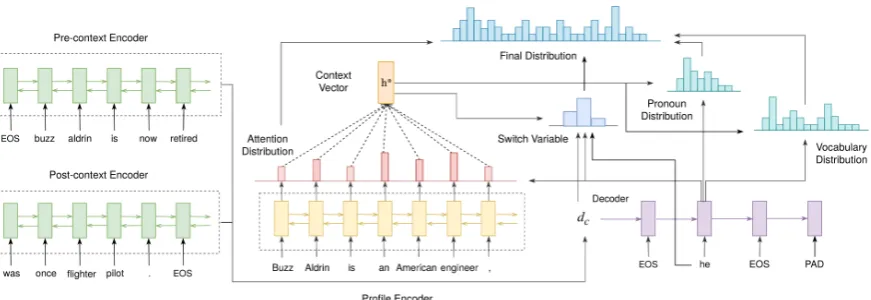
Figure 1: Our PROFILEREG model. The model uses two bi-directional LSTMs (green) to encode the pre- and post-context and one bi-directional LSTM (yellow) to encode the profile. At the decoding step, we calculate three distributions: attention distribution, pronoun distribution and vocabulary distribution. These three distributions together with the switch variable are used to determine the final distribution.
4 Model
In this section, we present our model, PROFIL
-EREG (Figure1). In our task setup, the input of the model consists of pre- and post-context texts of lengthsHandN, and an entity profile of length L. The output is a sequence of tokens that make up the referring expression. We use three bidirec-tional LSTM (Hochreiter and Schmidhuber,1997) encoders to encode the pre- and post-context and the profile, and a unidirectional LSTM decoder to generate the output at inference time. We also ap-ply an attention mechanism and a switch variable to calculate the final output distribution. We now introduce each component in more detail.
4.1 Context Encoders
We use two bi-directional LSTMs to encode the pre- and post-contexts, which are the entire se-quences of tokens before and after the referring ex-pression in the discourse context. The pre-context, a sequence of tokens {w1(pre), ..., w(Hpre)}, is first mapped to a distributed vector space through an embedding layer, resulting in a sequence of vec-tors {x(1pre), ..., x(Hpre)}. Then, the word embed-dings are given to a bidirectional LSTM. We call the forward and backward hidden-state vectors at time t −→h(tpre) and ←−h(tpre) respectively. We ex-tract the two hidden-state vectors at the last step time H, and concatenate them to form the final vector representation h(Hpre) = [−→hH(pre);←−h(Hpre)], which summarizes the information in the entire pre-context. The same process is repeated for the post-context using another bi-directional LSTM. This results in h(Npost) = [−→hN(post);←−h(Npost)].
Fi-nally, we concatenate the pre- and post-context vector representations and pass them through a hidden layer:
dc= tanh(Wd[hH(pre);h(Npost)]) (1)
whereWdis a weight matrix mapping the
concate-nated hidden state vectors into a joint vector rep-resentationdc, which is used as the initial state of
the decoder.
4.2 Profile Encoder
The profile encoder is another bi-directional LSTM that receives a series of profile words {w1, ..., wL} as input. All words in the
pro-file are first converted to lowercase and mapped to a sequence of word embeddings {x1, ..., xL}
through the same embedding layer as for the pre-and post-contexts. Then the embedded sequence are passed through the bi-directional LSTM, re-sulting in forward and backward hidden states {−→h1, ...,
− →
hL} and {
←− h1, ...,
←−
hL}. At each word
positiont, the forward and backward representa-tions are concatenated as the final representation ht= [
− →
ht;←h−t].
4.3 Attention-based Decoder
Our referring expression decoder is a unidirec-tional LSTM. At each decoding stept, the decoder receives the word embedding of the previous word and generates a decoder hidden statest. Then, we
calculate the attention distributionatover the
en-tity profile using the attention mechanism intro-duced byBahdanau et al.(2014):
eti =vTtanh(Whhi+Wsst+battn) (2)
at= softmax(et), (3)
where hi is the sequence of profile encoder
hid-den states, Wh, Ws, vT andbattn are all trainable
parameters. The attention distribution, at, deter-mines the degree of contribution of each token in the profile at expression generation stept. A final summaryh∗t is calculated by summing the profile encoder stateshiweighted by the attention
proba-bilitiesat:
h∗t =X i
atihi (4)
Then,h∗t is concatenated with the decoder hidden statestand passed through a linear layer,
produc-ing the vocabulary distributionPvoc:
Pvoc= softmax(V[st;h∗t] +b) (5)
where V and b are both trainable parameters in the model. Pvoccontains the generation
probabil-ity of each word in the vocabulary. We will actu-ally modify this distribution to account for out-of-vocabulary items and pronouns by introducing a copying mechanism, which we will discuss in the next section. This results in the final generation probability, P(w∗t) of the target (gold-standard) word at timet.
During training, we take the negative log likeli-hood of the target word in the gold standard,wˆ∗t, as the loss of the model at stept. The overall loss is the sum of the loss at each time step:
loss = 1
T
T X
t=0
−logP( ˆw∗t) (6)
At test time, the word with the highest gener-ation probability will be the output at the current time step and the input to the next step.
4.4 Switch Mechanism
In PROFILEREG, we apply a switch mechanism
that allows the model to generate different refer-ential forms, inspired by the pointer-generator net-work ofSee et al.(2017). In particular, our model
can choose to: i) copy a word from the profile, which is especially useful for named entities with rare names which are not part of a fixed vocabu-lary, ii) generate apronoun, or iii)generatefrom a fixed vocabulary. Although pronouns are part of our fixed vocabulary, we choose to distinguish them as a separate category to model, due to their importance and frequency in the REG task.
We define a switch variable Σwhich can take on one of three values, COPY, PRO, and GEN, corresponding to the three decoder actions. Let the associated probabilities be σCOPY, σPRO, and
σGEN. After computing h∗t and vocabulary
distri-butionPvocat time stept, we compute these
prob-abilities using the summary vectorh∗t, the encoder final statedc, the decoder hidden statest and the
inputxt:
[σCOPY, σPRO, σGEN] = softmax(
Hh∗h∗t+Hddc+Hsst+Hxxt+bs),
(7)
where Hh∗, Hd, Hs, Hx andbs are learnable
pa-rameters with output dimension of three. The fi-nal generation probability of the target wordw∗t is then computed as follows:
ifwt∗is a pronounthen
P(wt∗) =σPROPvoc(w∗t) +σCOPY
P
i:wi=wt∗
at i
else ifw∗t is a vocabulary wordthen
P(wt∗) =σGENPvoc(wt∗) +σCOPY
P
i:wi=w∗t
ati
else
P(wt∗) =σCOPY
P
i:wi=w∗t
ati
end if
In the formula, at is the attention distribution
computed in the previous section. When w∗t is a pronoun or vocabulary word, the probability P(w∗t)consists of two terms since the word in the vocabulary could also be in the profile.P(w∗t)will be used in the Equation6.
One important difference between our model and the pointer-generator network is that the pointer-generator model only computes one gen-eration probability pgen ∈ [0,1], which is used
to decide whether generate a word or copy a token from the source document. In our model, however, we compute a probability distributionSswitchover
5 Experiments
We evaluate our model and the baselines on three different data splits mentioned in Section 3.2:
Original,Entity-separatedandRandom, where the entities are overlapped, all separated and ran-domly mixed in training, validation and test set.
5.1 Baselines
We compared our model against three baselines:
OnlyName, Ferreira andNeuralREG. In our first
OnlyNamebaseline, we use the name of the entity as the final realization regardless of the context. This baseline is inspired by the fact that 71.4% of the referring expressions in WebNLG are proper names. Given the Wikipedia profile of an entity, we obtain the name of the entity by extracting the first few capitalized words in that profile. If the name cannot be found in this way, we will use the first word of the profile (except articles).
Our second baseline makes use of the Naive Bayes model proposed by Ferreira et al. (2016), dubbed Ferreira. This model takes features in-cluding syntactic position, referential status (ini-tial or a subsequent mention at the level of text and sentence) and recency (distance between ref-erences) as input. The original model is only used to determine the form of the referring expression. We adapt the model by adding a content gener-ation component. Once the form of the referent is decided, the content of the referential expres-sion is decided as follows: we use theOnlyName
model to get the name of the entity and find the most frequent pronoun expressions in the profile as the content for pronoun form (using “it” if no pronoun expressions can be found). We use the gold-standard content for the demonstrative and description categories from the WebNLG dataset, which provides an upper bound on the potential performance of this system.
Our third baseline is the NeuralREG model pro-posed by Ferreira et al. (2018). NeuralREG is a sequence-to-sequence neural network model with an attention mechanism. All words and entities in NeuralREG are represented as embeddings which are randomly initialized and learned during train-ing. We tested the best-performing CAtt version of NeuralREG.
5.2 Metrics
Following prior work, we calculate the overall ac-curacy and the String Edit Distance (SED)
be-tween the generated and the reference expressions. The overall accuracy is calculated by comparing the generated string with the real referring ex-pression. We post-processed the output to ig-nore differences in capitalization, accent and cer-tain non-alphabetic characters (e.g., “Desteapta-te” vs. “Des¸teapt˘a-“Desteapta-te”, and “Tranmere Rovers FC” vs. “Tranmere Rovers F.C.”).
We also evaluate the performance of our model with regard to a particular referential form. We computed name accuracy, pronoun accuracy, pre-cision, recall and F1-score. The name and pro-noun accuracy are computed by comparing names and pronouns in the test set with the generated re-ferring expressions. Pronoun classification evalu-ation takes all generated referring expressions as two forms: pronoun or non-pronoun and do not consider the actual content.
5.3 Experiment Setting
For all experiments, our model has 100-dimensional hidden states for the encoder and de-coder LSTMs and 50 dimensional for the charac-ter LSTM. The word and characcharac-ter embeddings are both set to 100-dimensional. We initialize the word embeddings using pre-trained GloVe vectors (Pennington et al., 2014) and all character em-beddings are randomly initialized. The model is trained for up to 35 epochs, or until the perfor-mance on the development set does not improve for 5 epochs. We set the learning rate to 0.0037 and the batch size to 64. We apply gradient clip-ping with a maximum gradient norm of 5. We adopt dropout training with a dropout rate of 0.5. At test time, all referring expressions are gener-ated using greedy decoding. These settings were selected by tuning on the development set.
6 Results
6.1 Automatic Evaluation
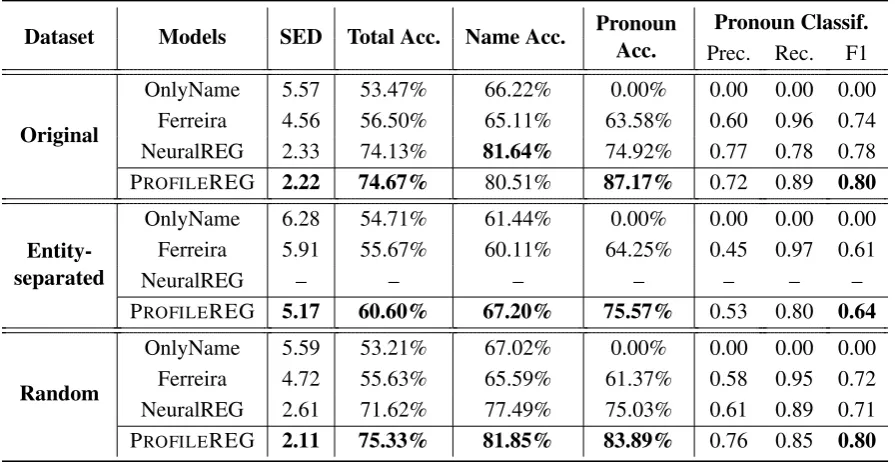
As shown in Table 2 PROFILEREG outperforms the three baselines in all experiments. Our model in particular excels at the measures of pronoun ac-curacy and pronoun classification.
Dataset Models SED Total Acc. Name Acc. Pronoun Acc.
Pronoun Classif.
Prec. Rec. F1
Original
OnlyName 5.57 53.47% 66.22% 0.00% 0.00 0.00 0.00 Ferreira 4.56 56.50% 65.11% 63.58% 0.60 0.96 0.74 NeuralREG 2.33 74.13% 81.64% 74.92% 0.77 0.78 0.78
PROFILEREG 2.22 74.67% 80.51% 87.17% 0.72 0.89 0.80
Entity-separated
OnlyName 6.28 54.71% 61.44% 0.00% 0.00 0.00 0.00 Ferreira 5.91 55.67% 60.11% 64.25% 0.45 0.97 0.61
NeuralREG – – – – – – –
PROFILEREG 5.17 60.60% 67.20% 75.57% 0.53 0.80 0.64
Random
OnlyName 5.59 53.21% 67.02% 0.00% 0.00 0.00 0.00 Ferreira 4.72 55.63% 65.59% 61.37% 0.58 0.95 0.72 NeuralREG 2.61 71.62% 77.49% 75.03% 0.61 0.89 0.71
PROFILEREG 2.11 75.33% 81.85% 83.89% 0.76 0.85 0.80
Table 2: REG performance on the original, entity separated and random dataset. PROFILEREG is the model proposed in this work. Note that NeuralREG cannot be applied to the entity-separated dataset.
Entity-separated demonstrates our model’s ability to handle new entities, compared to the baselines. There is a clear drop on most metrics compared to the original dataset, but this is ex-pected since the test set consists of unseen entities. As previously explained, the NeuralREG model cannot be applied to this dataset without exten-sive modifications. On Random, PROFILEREG
outperforms NeuralREG. For the unseen entities, NeuralREG generates a random string, since the embeddings of unseen entities are not updated by training. Our model, however, is capable of pro-ducing accurate referring expressions for both pre-viously mentioned and new entities.
Table3shows an example of the generated text of each model. The entity in this example is
Acharya Institute of Technology. Note that only the bold text is generated by the models. The out-put of the OnlyName model is clearly the least readable one.
6.2 Seen Entities vs. Unseen Entities
In the evaluation, we also distinguished the results for seen and unseen entities. We trained the model on a training set contains 64,353 referring expres-sions and evaluate the model on a test set with 3,591 referring expressions related to seen enti-ties and 2,955 expressions related to unseen en-tities. Table4shows the evaluation results. From Table4, it is easy to see that the model performs
better when generating referring for seen entities. Among four referring expression types, the ac-curacy of description type drops dramatically for unseen entities, from 48.72% to 20.54%. This is probably due to the fact that compared with name and pronoun, description type is often hard to identify and more flexible. For instance, one of the gold-standard descriptions in the test set isthe comic character , amazing-man. The model’s gen-eration for this referring expression is amazing-man.
Also notice that the accuracy of demonstrative type is zero for both seen and unseen entities. We think this is because the dataset is unbalanced and there are too few demonstrative samples in the training set. The model did not have enough sam-ples to learn to identify demonstratives.
6.3 Human Evaluation
Method. In addition to automatic evaluation, we also performed a human evaluation, comparing our model to the original text and to the three base-line models. We concatenated the pre- and post-contexts with the generated referring expression to form an overall passage. We showed partici-pants the output of our model and a comparison model, and asked them to make a pairwise prefer-ence judgment between the two passages.
[image:7.595.76.524.63.294.2]Original:Acharya Institute of Technologyis affiliated with Visvesvaraya Technological University which is in Belgium . The institute itself is in India ’s Karnataka state andits full address is In Soldevanahalli , Acharya Dr. Sarvapalli Radhakrishnan Road , Hessarghatta Main Road , Bangalore – 560090 .Itwas created in 2000 anditsdirector is Dr. G. P. Prabhukumar .
OnlyName:Acharya Institute of Technologyis affiliated with Visvesvaraya Technological University which is in Belgium .Acharya Institute of Technologyis in India ’s Karnataka state andAcharya Institute of Technologyfull address is In Soldevanahalli , Acharya Dr. Sarvapalli Radhakrishnan Road , Hessarghatta Main Road , Bangalore – 560090 .Acharya Institute of Technologywas created in 2000 andAcharya Institute of Technologydirector is Dr. G. P. Prabhukumar .
Ferreira:Acharya Institute of Technologyis affiliated with Visvesvaraya Technological University which is in Belgium . Itis in India ’s Karnataka state anditsfull address is In Soldevanahalli , Acharya Dr. Sarvapalli Radhakrishnan Road , Hessarghatta Main Road , Bangalore - 560090 .Itwas created in 2000 anditdirector is Dr. G. P. Prabhukumar .
NeuralREG:Acharya institute of technologyis affiliated with Visvesvaraya Technological University which is in Belgium . Itis in India ’s Karnataka state anditsfull address is In Soldevanahalli , Acharya Dr. Sarvapalli Radhakrishnan Road , Hessarghatta Main Road , Bangalore – 560090 .It ’swas created in 2000 anditsdirector is Dr. G. P. Prabhukumar .
PROFILEREG:The Acharya Institute of Technologyis affiliated with Visvesvaraya Technological University which is in Belgium .The instituteis in India ’s Karnataka state anditsfull address is In Soldevanahalli , Acharya Dr. Sarvapalli Radhakrishnan Road , Hessarghatta Main Road , Bangalore – 560090 .Itwas created in 2000 anditsdirector is Dr. G. P. Prabhukumar .
[image:8.595.73.291.356.520.2](Entity profile)Acharya Institute of Technology , or AIT , is a private co-educational engineering and management college in Bengaluru , India , affiliated with the Visvesvaraya Technological University and accredited by the National Board of Accreditation . Established in 2000 , it offers eleven undergraduate courses and eight postgraduate courses . The college has links and collaborations with various industries and universities across the world .
Table 3: Example of original text and generated text of each model.
Type Acc. Support
Seen
demonstrative 0.00% 22 description 48.72% 862
name 79.11% 2547
pronoun 90.00% 160 total 71.82% 3591
Unseen
demonstrative 0.00% 3 description 20.54% 409
name 74.74% 2423
pronoun 88.33% 120 total 67.72% 2955
Table 4: Evaluation for seen and unseen entities.
passages in random order, asking participants to consider the readability, grammaticality and flu-ency of texts. We then asked them to select the passage that they prefer, or to say they are equally good. We recruited 20 participants, each evaluat-ing 20 samples.
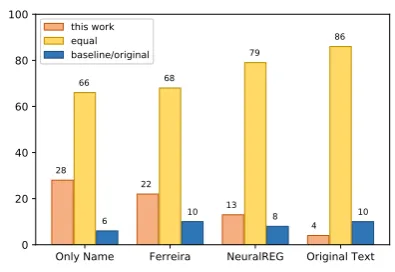
Results. Figure 2 shows the human evaluation results. The most common choice made by par-ticipants is “equal”. This is because many gener-ated referring expressions by the models are ac-tually identical. When our model was compared to the original text, 86 of the 100 generated texts are identical or very similar to the original text. This demonstrates our model’s ability to generate
Only Name Ferreira NeuralREG Original Text 0
20 40 60 80 100
28
22
13
4 66 68
79 86
6 10 8 10
this work equal baseline/original
Figure 2: Human evaluation results. Comparison of our model with three baselines and original text.
high quality referring expressions. Also, we can see from the chart that our model tends to be pre-ferred over the three baseline models.
6.4 Analyzing Switch Variable Behaviour
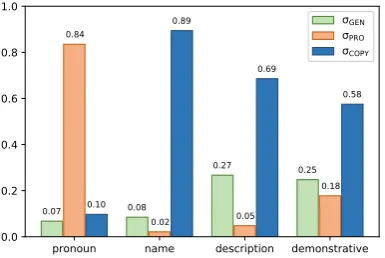
We now examine the behaviour of the switch vari-able,Σ. As mentioned in Section4.4, each word is generated with a probability distribution (σCOPY,
σPRO and σGEN). We expect this distribution to
vary based on the form of the referring expression. For instance, when a proper name expected,σCOPY
should be relatively high if the model copies words from the entity profile.
[image:8.595.318.516.367.503.2]pronoun name description demonstrative 0.0
0.2 0.4 0.6 0.8 1.0
0.07 0.08
0.27 0.25 0.84
0.02 0.05
0.18 0.10
0.89
0.69
0.58
σGEN
σPRO
[image:9.595.88.281.78.207.2]σCOPY
Figure 3: The average probabilities of the switch vari-able values for each referential form on the Random
test set.
Context: The 3rd runway at Ardmore Airport ( New Zealand )is made of Poaceae . (...)
Entity Profile: Ardmore Airport is an airport 3 NM south-east of Manurewa in Auckland , New Zealand . (...)
Realization: Ardmore(COPY 0.968) Airport(COPY 0.971)
in(GEN 0.908) New(COPY 0.969)Zealand(COPY 0.947)
Context: Curitiba is part of Parana State in the South Re-gion , Brazil and is served by Afonso Pena International airport . It is led bythe Democratic Labour Party.
Entity Profile: The Democratic Labour Party is a social democratic political party in Brazil . (...)
Realization: the(GEN 0.895) Democratic(COPY 0.938)
Labour(COPY 0.987)Party(COPY 0.966)
Context: Elliot See was born on July 23 , 1927 in Dallas . Heattended the U of Texas at Austin which is part of the U of Texas system . (...)
Entity Profile: Elliot See was an American engineer , naval aviator , test pilot , and NASA astronaut . He was selected for NASA ’s second group of astronauts in 1962 .
Realization: he(PRO 0.987)
Table 5: An example of how the switch variable works in referring expression generation.
variable. We put the gold-standard referring ex-pression, pre- and post-context together in Con-text. The words in yellow, green and orange high-light are copied words, vocabulary words and gen-erated pronouns respectively and each word is fol-lowed by the corresponding switch value. These examples show that our model is able to switch between the three actions to generate a coherent, fluent referring expression. We further show the average value of the switch variable on the Ran-domtest set separated by the gold-standard refer-ential form (Figure3).
7 Conclusions
In this work, we have proposed new test setups on WebNLG dataset that evaluate the performance of
REG models when dealing with previously unseen entities. We also introduced PROFILEREG, an end-to-end deep neural network model for REG. Unlike previous REG models that only model the local context, PROFILEREG incorporates both the context information and an entity profile that al-lows it to generate references for unseen entities. Our results show that PROFILEREG can accu-rately generate referring expressions for both new and previously mentioned entities, outperforming three strong baselines. One future direction is to model larger contexts with this approach. It would also be interesting to integrate our model into an existing language generation system (e.g., as part of an abstractive summarization system).
Acknowledgments
We would like to thank the reviewers for their valuable comments. This research was supported by the Mitacs Globalink Program and the Canada CIFAR AI Chair program.
References
Dzmitry Bahdanau, Kyunghyun Cho, and Yoshua Ben-gio. 2014. Neural machine translation by jointly learning to align and translate. arXiv preprint arXiv:1409.0473.
Anja Belz, Eric Kow, Jette Viethen, and Albert Gatt. 2010. Generating referring expressions in context: The GREC task evaluation challenges. In Empiri-cal Methods in Natural Language Generation, pages 294–327. Springer.
Charles B Callaway and James C Lester. 2002. Pronominalization in generated discourse and dia-logue. InProceedings of the 40th annual meeting on association for computational linguistics, pages 88–95. Association for Computational Linguistics.
Thiago Castro Ferreira, Emiel Krahmer, and Sander Wubben. 2016. Towards more variation in text gen-eration: Developing and evaluating variation models for choice of referential form. InProceedings of the 54th Annual Meeting of the Association for Compu-tational Linguistics (Volume 1: Long Papers), vol-ume 1, pages 568–577.
Thiago Castro Ferreira, Emiel Krahmer, and Sander Wubben. 2017. Generating flexible proper name ref-erences in text: Data, models and evaluation. In
Proceedings of the 15th Conference of the European Chapter of the Association for Computational Lin-guistics: Volume 1, Long Papers, volume 1, pages 655–664.
NeuralREG: An end-to-end approach to referring expression generation. In Proceedings of the 56th Annual Meeting of the Association for Computa-tional Linguistics (Volume 1: Long Papers), vol-ume 1, pages 1959–1969.
Michael C Frank and Noah D Goodman. 2012. Pre-dicting pragmatic reasoning in language games. Sci-ence, 336(6084):998–998.
Claire Gardent, Anastasia Shimorina, Shashi Narayan, and Laura Perez-Beltrachini. 2017a. Creating train-ing corpora for NLG micro-planners. In Proceed-ings of the 55th Annual Meeting of the Association for Computational Linguistics (Volume 1: Long Pa-pers), volume 1, pages 179–188.
Claire Gardent, Anastasia Shimorina, Shashi Narayan, and Laura Perez-Beltrachini. 2017b. The WebNLG challenge: Generating text from RDF data. In Pro-ceedings of the 10th International Conference on Natural Language Generation, pages 124–133.
Albert Gatt and Anja Belz. 2008. Attribute selection for referring expression generation: New algorithms and evaluation methods. InProceedings of the Fifth International Natural Language Generation Confer-ence, pages 50–58. Association for Computational Linguistics.
Charles F Greenbacker and Kathleen F McCoy. 2009. Feature selection for reference generation as in-formed by psycholinguistic research. In Proceed-ings of the CogSci 2009 Workshop on Production of Referring Expressions (PRE-Cogsci 2009).
Renate Henschel, Hua Cheng, and Massimo Poesio. 2000. Pronominalization revisited. InProceedings of the 18th conference on Computational linguistics-Volume 1, pages 306–312. Association for Compu-tational Linguistics.
Sepp Hochreiter and J¨urgen Schmidhuber. 1997. Long short-term memory. Neural computation, 9(8):1735–1780.
Emiel Krahmer and Kees Van Deemter. 2012. Compu-tational generation of referring expressions: A sur-vey. Computational Linguistics, 38(1):173–218.
R´emi Lebret, David Grangier, and Michael Auli. 2016.
Neural text generation from structured data with ap-plication to the biography domain. In Proceed-ings of the 2016 Conference on Empirical Methods in Natural Language Processing, pages 1203–1213, Austin, Texas. Association for Computational Lin-guistics.
Ani Nenkova and Kathleen McKeown. 2003. Refer-ences to named entities: A corpus study. In Pro-ceedings of the 2003 Conference of the North Amer-ican Chapter of the Association for Computational Linguistics on Human Language Technology: com-panion volume of the Proceedings of HLT-NAACL 2003–short papers-Volume 2, pages 70–72. Associ-ation for ComputAssoci-ational Linguistics.
Naho Orita, Eliana Vornov, Naomi Feldman, and Hal Daum´e III. 2015. Why discourse affects speak-ers’ choice of referring expressions. InProceedings of the 53rd Annual Meeting of the Association for Computational Linguistics and the 7th International Joint Conference on Natural Language Processing (Volume 1: Long Papers), volume 1, pages 1639– 1649.
Jeffrey Pennington, Richard Socher, and Christopher Manning. 2014. GloVe: Global vectors for word representation. InProceedings of the 2014 confer-ence on empirical methods in natural language pro-cessing (EMNLP), pages 1532–1543.
Ehud Reiter and Robert Dale. 2000. Building natural language generation systems. Cambridge university press.
Alexander M. Rush, Sumit Chopra, and Jason Weston. 2015. A neural attention model for abstractive sen-tence summarization. In Proceedings of the 2015 Conference on Empirical Methods in Natural Lan-guage Processing, pages 379–389, Lisbon, Portugal. Association for Computational Linguistics.