Proceedings of the 2019 Conference on Empirical Methods in Natural Language Processing 1741
Data-Ef
fi
cient Goal-Oriented Conversation with Dialogue Knowledge
Transfer Networks
Igor Shalyminov†, Sungjin Lee‡, Arash Eshghi†, and Oliver Lemon† †Heriot-Watt University, UK
‡Amazon Alexa AI, USA
†{is33, a.eshghi, o.lemon}@hw.ac.uk, ‡[email protected]
Abstract
Goal-oriented dialogue systems are now be-ing widely adopted in industry where it is of key importance to maintain a rapid prototyp-ing cycle for new products and domains. Data-driven dialogue system development has to be adapted to meet this requirement — therefore, reducing the amount of data and annotations necessary for training such systems is a cen-tral research problem.
In this paper, we present the Dialogue Knowl-edge Transfer Network (DiKTNet), a state-of-the-art approach to goal-oriented dialogue generation which only uses a few example dialogues (i.e. few-shot learning), none of which has to be annotated. We achieve this by performing a 2-stage training. Firstly, we performunsupervised dialogue representation pre-trainingon a large source of goal-oriented dialogues in multiple domains, the MetaLWOz corpus. Secondly, at the transfer stage, we train DiKTNet using this representation to-gether with 2 other textual knowledge sources with different levels of generality: ELMo en-coder and the main dataset’s source domains. Our main dataset is the Stanford Multi-Domain dialogue corpus. We evaluate our model on it in terms of BLEU and Entity F1 scores, and show that our approach signifi -cantly and consistently improves upon a se-ries of baseline models as well as over the previous state-of-the-art dialogue generation model, ZSDG. The improvement upon the lat-ter — up to10%in Entity F1 and the average of 3% in BLEU score — is achieved using only 10% equivalent of ZSDG’s in-domain training data.
1 Introduction
Machine learning-based dialogue systems, while still being a relatively new research direction, are experiencing increasingly wide adoption in indus-try. Large-scale dialogue assistant platforms such
as Google Assistant, Amazon Alexa, and Apple Siri provide a unified conversational user inter-face (CUI) for third-party applications and ser-vices. Furthermore, products like Google Di-alogflow, Wit.ai, Microsoft LUIS, and Rasa offer means for rapid development of a dialogue sys-tem’s core modules. In addition, with the re-cently adopted technique of training dialogue sys-tems end-to-end data-efficiency of such systems becomes the key question in their adoption in practical applications. Currently, while being ex-tremelyflexible and requiring little to no program-ming of in-domain business logic (see e.g. Ultes et al.(2018); Wen et al. (2017); Rojas-Barahona et al. (2017)), such systems have too high data consumption — including both collection and an-notation effort — in order for them to be used in rapidly paced industrial product cycles. There-fore, approaches to training such systems with ex-tremely limited data (i.e. zero-, one- and few-shot training) are a priority research direction in the di-alogue systems area.
In this paper, we present the Dialogue Knowl-edge Transfer Network(or DiKTNet), a generative goal-oriented dialogue model designed for few-shot learning, i.e. training only using a small num-ber of complete in-domain dialogues. The key un-derlying concept of this model is transfer learn-ing: DiKTNet makes use of the latent text rep-resentation learned from several sources ranging from large-scale general-purpose textual corpora to similar dialogues in the domains different to the target one. We use the evaluation framework of
respect to in-domain utterances) while requiring no annotations whatsoever.
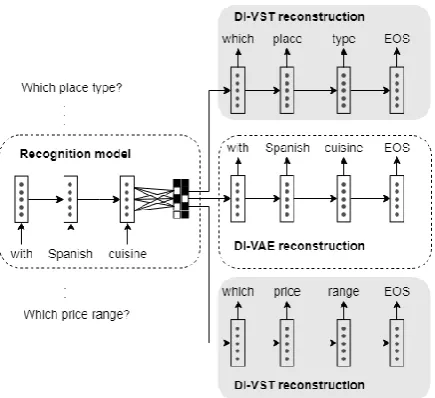
Figure 1: DI-VAE and DI-VST (DiKTNet Stage 1)
2 Related Work
The problem of data efficiency of dialogue sys-tems has been extensively researched in the past. Starting with domain adaptation of a dialogue state tracker (Henderson et al.,2014) approached using Bayesian Processes (Gasic et al.,2017) and Recur-rent Neural Networks (Mrksic et al.,2015), there has been significant work on training different di-alogue system components using as little data as possible. As such, Williams et al. (2017) intro-duced a dialogue management model designed for bootstrapping from limited training data and fur-ther fine-tuning. A recent paper by Vlasov et al.
(2018) introduced a dialogue management model which uses a unified embedding space for user and system turns allowing efficient cross-domain knowledge transfer.
There also exist approaches to end-to-end dia-logue generation. Eshghi et al.(2017) proposed a linguistically informed model based on an incre-mental semantic parser (Eshghi et al.,2011) com-bined with a reinforcement learning-based agent. The parser was used for both maintaining the agent’s state and pruning the agent’s incremen-tal, word-level generation actions (only the actions leading to syntactically correct word sequences were allowed for the agent to take). While outper-forming end-to-end dialogue models on bAbI Di-alog Tasks in a zero-shot setup (Shalyminov et al.,
2017) due to its prior linguistic knowledge in the
form of a dialogue grammar, this method inher-ited the limitations of it as well. Specifically, it’s limited to a single domain until a wide-coverage grammar is available.
Meta-learning has also gained a lot of attention as a way to train models for maximally efficient adaptation to new data. As such, Qian and Yu
(2019) presented such approach for fast adapta-tion of a dialogue model to a new domain. While highly promising, its main result was achieved on a synthetic dataset and would ideally need more testing on real data.
Finally, the method we directly compare our approach to is that ofZhao and Esk´enazi (2018) who introduced the Zero-Shot Dialogue Genera-tion (ZSDG) task and the corresponding model. In their work, they use a unified latent space for user utterances, system turns, anddomain descriptions in the form of utterance-annotation pairs. Since they only used such utterances and no full dia-logues for the target domain, they presented this approach as “zero-shot” learning. In our approach, we do use complete in-domain dialogues, but with significantly less data with respect to the number of in-domain utterances. Moreover, our method requires no annotation whatsoever.
Recent research in Natural Language Process-ing has shown that the transfer of text representa-tion learned on larger data sources benefits target models’ performance, just as was the case with ImageNet-based computer vision models (Deng et al.,2009).
For text, the main means for transfer was Word2Vec and GloVe embeddings (Mikolov et al.,
dif-ferent contexts.
In this paper, we will work withautoencoders, a class of unsupervised text representation mod-els working via reconstructing the input — specif-ically, a Variational Autoencoder (VAE) was con-sidered the main means to learn robust text rep-resentations (Bowman et al., 2016). Although the model itself was challenging to train and was mainly used with plenty of workarounds, and re-cently there started to appear variants of this model with improved stability. One such model we will use in this paper is that ofZhao et al.(2018) (see Section4.1for more detail).
3 Few-Shot Dialogue Generation
Wefirst describe the task we are addressing in this paper, and the corresponding base model. Specifi -cally, we have a set of dialogues in source domains and just a few seed dialogues in the target domain. And the model’s task is, having been trained on all the available source data, tofine-tune on the tar-get data to be further evaluated on the full set of target-domain dialogues.
We are basing our model for this task on a Hi-erarchical Encoder-Decoder (HRED) architecture with attention-based copying (Merity et al.,2017). The base optimization objective is as follows:
LHRED= logpFd(xsys | Fe(c,xusr)) (1)
wherexusr is user’s query,xsys is the system’s response,cis the dialogue context, andFeandFd
are respectively hierarchical encoder and decoder. We work with goal-oriented dialogues, so it’s natural in our setting to take into account an under-lying Knowledge Base (or API) providing results on the user’s queries. Given that such KB informa-tion may contain unseen token sequences for the most part, especially in the target domain, we use a copy mechanism in order to be able to use this in-formation in the system’s responses. More specif-ically, we represent KB info as token sequences and concatenate it to the dialogue context simi-larly to CopyNet setup of Eric et al.(2017). Our copy mechanism’s implementation is the Pointer-Sentinel Mixture Model (Merity et al.,2017;Zhao and Esk´enazi,2018):
p(wt|st) =gpvocab(wt|st) + (1−g)pptr(wt|st)
(2)
In the formula above,wtandstare respectively
the output word and the decoder state at stept;pptr is the probability of attention-based copying of the wordwt, andgis the mixture weight:
pptr(wt|st) = �
kj∈I(w,x)
αkj,t (3)
g=Softmax(uT tanh (Wαsi)) (4)
whereαkj,tis the attention weight forkth token
inflattened dialogue context at the decoding stept anduis the sentinel vector — for more detail, see (Zhao and Esk´enazi,2018).
4 Dialogue Knowledge Transfer Network Transfer learning is considered the key means for efficient training with minimal data, and our DiKTNet model essentially introduces sev-eral knowledge-transfer augmentations to the base HRED model described above. DiKTNet training is performed in two stages described below. 4.1 Stage 1. Dialogue representation
pre-training
Dialogue structure — e.g. word sequences — is highly specific to a given domain or task, and the meaning of conversational utterances is highly contextual, i.e. similar utterances may have dif-ferent meanings depending on the context. Nev-ertheless, there is a lot of similarity in dialogue structure — i.e. sequences of dialogue actions — across domains, e.g. a conversation normally starts with a mutual greeting and a question is very often followed by an answer. Here, we propose to exploit this phenomenon in the form of learning a latent dialogue action representation in order to better capture the dialogue structure by abstracting away from surface forms. Crucially, we learn such representation from MetaLWOz (Lee et al.,2019), a dataset specifically created for the purposes of meta-learning and transfer learning and consisting of human-human conversations in 51 unique do-mains (for more detail, see Section6).
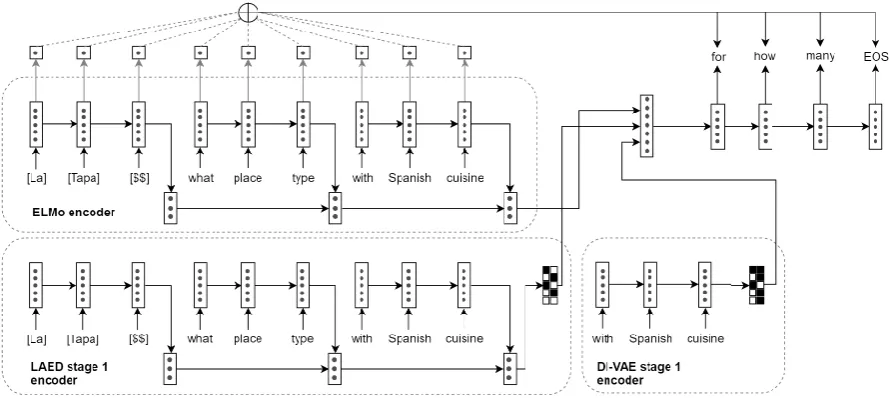
Figure 2: DiKTNet Stage 2 (tokens in brackets are KB data)
two modifications. Firstly, its optimization ob-jective accounts for the mutual informationI be-tween the input and the latent variable which is implicitly discouraged in the original VAE objec-tive (see Eqs.5and6).
LV AE =Ex[EqR(z|x)[logpG(x|z)]
−KL(q(z)�p(z))] =
Eq(z|x)p(x)[logpG(x|z)] −I(Z, X)−KL(q(z)�p(z)),
(5)
LDI-V AE =LV AE+I(Z, X)
=EqR(z|x)p(x)[logpG(x|z)] −KL(q(z)�p(z))
(6)
where x is the input utterance, z is the latent
variable (X and Z corresponding to their batch-wise vectors), R and G are the recognition and generation models (implemented as RNNs) re-spectively, andq(z) =Ex[qR(z |x)].
Secondly, the latent variablezin DI-VAE is dis-creteas opposed to the continuous one in a vanilla VAE. The discrete latent code lends itself well to interpretation and can be viewed as a form of un-supervised dialogue act tagging. The discrete na-ture also makes the calculation of the KL-term more tractable via theBatch Prior Regularization technique (Zhao et al.,2018):
KL(q�(z)�p(z)) = K �
k=1
q�(z=k) logq�(z=k)
p(z=k)
(7)
where K is the number ofz’s possible values andq�(z)is the approximation toq(z)overNdata points:
q�(z) = 1
N
N �
n=1
qR(z|xn) (8)
In addition, we employ DI-VST, DI-VAE’s counterpart working in a Variational Skip-Thought manner (Hill et al., 2016) and reconstructing the inputx’s previous (xp) and next (xn) context
ut-terances instead:
LDI-V ST =
EqR(z|x)p(x)[logpGn(xn|z)ppG(xp|z)]
−KL(q(z)�p(z))
(9)
DI-VAE and DI-VST models are visualized in Figure1.
In the downstream DiKTNet model, we use DI-VAE autoencoder in order to obtain the represen-tation of the user’s query:zusr=DI-VAE(xusr).
In turn, DI-VST is used to obtain a prediction of the system’s action zsys in the discretized la-tent form given the user’s input xusr as well as the full dialogue contextc. For that, DI-VST
objective is as follows:
LLAED(θF,θπ) =EqR(zsys|xsys)p(xsys,c)[
logpπ(zsys |c) + logpF(xsys |zsys,c)] (10)
whereθF is the set of parameters of the context-aware encoder and decoder,θπis the set of param-eters of the policyθπ.θπis the component trained to directly predictzsysfrom the contextc.
We use different models for different aspects of the dialogue: DI-VAE for user’s utterance rep-resentation, and DI-VST-based LAED — for the system’s action prediction. In that, we follow the intuition of Zhao and Esk´enazi (2018) who said that DI-VAE is better at capturing specific words of an utterance, while DI-VST represents the over-all dialogue action better.
We train these two models on MetaLWOz in an unsupervised way with the objectives as described above, and use their discretized latent codes zusr andzsys respectively in the downstream model at the next stage of training.
4.2 Stage 2. Transfer
At this stage, we train directly for our target task, few-shot dialogue generation, and thus go back to the model described in Section3. While the training procedure of this model naturally as-sumes domain transfer, we will provide it with more sources of textual and dialogue knowledge of varying generality described below.
As opposed to direct domain transfer, we in-corporate domain-general dialogue understanding from the LAED representation trained on Met-aLWOz at the previous stage. LAED captures the background top-down dialogue structure: se-quences of dialogue acts in a cooperative conver-sation, latent dialog act-induced clustering of ut-terances, and the overall phrase structure of spo-ken utterances. We incorporate this information into the model by conditioning HRED’s decoder on the combined latent codes from Stage 1 and re-fer to this model asHRED+LAED.
LHRED+LAED =
Ep(xusr,c)p(zusr|xusr)pπ(zsys|xusr,c)[
logpFd(xsys |�Fe(xusr,c),zusr,zsys�)]. (11)
wherezusrandzsysare respectively samples ob-tained from the DI-VAE user utterance model and
LAED/DI-VST system action model, and{}is the concatenation operator.
The last, most general source of knowledge we use is a pre-trained ELMo model (Peters et al.,
2018). Apart from using an underlying bidirec-tional RNN encoder, ELMo captures both token-level and character-token-level information which is es-pecially crucial in understanding unseen tokens and KB items in the underrepsesented target do-main. HRED model with ELMo as the utterance-level encoder is referred to asHRED+ELMo.
Finally, DiKTNet is HRED augmented with both ELMo encoder and LAED representation.
DiKTNet is visualized in Figure2. The model (as well as its variants listed above) is imple-mented in PyTorch (Paszke et al.,2017), and the code is openly available1.
5 Baselines
We perform an exhaustive ablation study of DiKTNet by comparing it to all its variations mentioned above: HRED, HRED+ELMo, and HRED+LAED. In addition to that, we have the
HRED+VAE —a version of HRED+LAED for which we use a regular, continuous VAE behind DI-VAE and DI-VST in order to see the impact of discretized latent codes (see Eq5for the corre-sponding objective function).
Furthermore, we compare DiKTNet to the pre-vious state-of-the-art approach, Zero-Shot Dia-logue Generation (Zhao and Esk´enazi,2018). This model didn’t use any complete in-domain dia-logues but instead it relied on annotated utterances in all of the domains. We use it as-is (ZSDG) as well its variation as follows.
We make use of its central idea of ‘domain de-scriptions’ bridging dialogue understanding across domains, but instead of using manually annotated utterances, we employ automatic Natural Lan-guage Understanding markup. Our NLU annota-tions include:
• Named Entity Recognition — Stanford NER model ensemble of sensitive and case-less models (Finkel et al.,2005),
• date/time markup — Stanford SUTime (Chang and Manning,2012),
• Wikidata entity linking — Yahoo FEL (Blanco et al.,2015;Pappu et al.,2017).
Model Domain BLEU, %NavigationEntity F1, % BLEU, %WeatherEntity F1, % BLEU, %ScheduleEntity F1, %
ZSDG 5.9 14.0 8.1 31 7.9 36.9
NLU ZSDG 6.1±2.2 12.7±3.3 5.0±1.6 16.8±6.7 6.0±1.7 26.5±5.4
NLU ZSDG+LAED 7.9±1 12.3±2.9 8.7±0.6 21.5±6.2 8.3±1 20.7±4.8
HRED@1% 6.0±1.8 9.8±4.8 6.9±1.1 22.2±10.7 5.5±0.8 25.6±8.2
HRED@3% 7.9±0.7 11.8±4.4 9.6±1.8 39.8±7 8.2±1.1 34.8±4.4
HRED@5% 8.3±1.3 15.3±6.3 11.5±1.6 38.0±10.5 9.7±1.4 37.6±8.0
HRED@10% 9.8±0.8 19.2±3.2 12.9±2.4 40.4±11.0 12.0±1.0 38.2±4.2
HRED+VAE@1% 3.6±2.6 9.3±4.1 6.8±1.3 23.2±10.1 4.6±1.6 28.9±7.3
HRED+VAE@3% 6.9±1.9 15.6±5.8 9.5±2.6 32.2±11.8 6.6±1.7 34.8±7.7
HRED+VAE@5% 7.8±1.9 12.7±4.2 10.1±2.1 40.3±10.4 8.2±1.7 34.2±8.7
HRED+VAE@10% 9.0±2.0 18.0±5.8 12.9±2.2 40.1±7.6 11.6±1.5 39.9±6.9
HRED+LAED@1% 7.1±0.8 10.1±4.5 10.6±2.1 31.4±8.1 7.4±1.2 29.1±6.6
HRED+LAED@3% 9.2±0.8 14.5±4.8 13.1±1.7 40.8±6.1 9.2±1.2 32.7±6.1
HRED+LAED@5% 10.3±1.2 15.6±4.5 14.5±2.2 40.9±8.6 11.8±1.9 37.6±6.1
HRED+LAED@10% 12.3±0.9 17.3±4.5 17.6±1.9 47.5±6.0 15.2±1.6 38.7±8.4
HRED+ELMo@1% 5.8±1.9 18.2±3.8� 7.3±2.6 38.5±11.1 6.3±2.6 36.3±9.2
HRED+ELMo@3% 8.0±1.3 17.2±4.2 10.6±1.1 42.0±11.0 9.5±2.0 39.6±9.2
HRED+ELMo@5% 9.4±0.8 21.5±7.3 12.1±2.0 39.0±12.8 11.3±2.1 40.0±5.6
HRED+ELMo@10% 9.9±1.1 24.3±5.7 14.9±2.7 41.4±12.0 14.5±1.4 43.4±3.9
DiKTNet@1% 8.4±0.7∗ 15.2±4.0 11.5±1.7∗ 43.0±10.5∗ 8.1±0.8∗ 40.5±6.3∗
DiKTNet@3% 10.4±1.2 19.2±4.8 15.7±2.1 44.0±11.7 11.1±1.3 38.2±5.8
DiKTNet@5% 11.5±1.1 23.9±2.9 15.5±2.1 39.5±14.8 13.7±2.0 41.1±3.8
[image:6.595.72.535.59.317.2]DiKTNet@10% 12.9±1.0 26.8±4.2 20.4±1.2 48.0±5.6 17.5±1.3 42.8±2.6
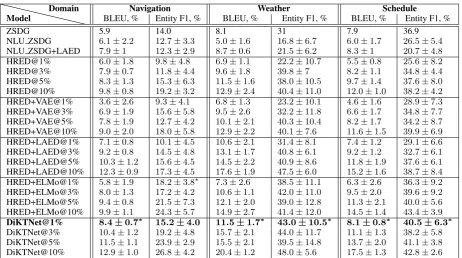
Table 1: Evaluation results. Marked with asterisks are individual results higher than ZSDG’s performance which are achieved with the minimum amount of training data. In bold is the model consistently outperforming ZSDG in all domains and metrics with minimum data.
We serialize annotations from these sources into token sequences and make domain description tu-ples out of all the utterances in the source and tar-get domains. This way, most of our domain de-scriptions share the structure and content of the original ones.
For example, for the phrase ‘Will it be cloudy in Los Angeles on Thursday?’, the original ZSDG annotation is of the form
"request #goal cloudy #location Los Angeles #date Thursday". Our NLU annotation for this phrase is "LOCATION Los Angeles DATE Thursday".
We have two models in this setup, with (NLU ZSDG+LAED) and without the use of LAED representation (NLU ZSDG) respectively.
6 Datasets
Number of Domains: 51 Number of Dialogues: 40,388 Mean dialogue length: 11.91
Table 2: MetaLWOz dataset statistics
We use the Stanford Multi-Domain (SMD) dialogue dataset (Eric et al., 2017) containing human-human goal-oriented dialogues in three
do-Statistic Domain Navigation Weather Schedule
Dialogues 800 797 828
Utterances 5248 4314 3170
[image:6.595.307.534.383.440.2]Avg. dialogue length 6.56 5.41 3.83
Table 3: Stanford multi-domain dataset statistics (train-set)
mains: appointment scheduling, city navigation, and weather information. Each dialogue has to do with a single task queried by the user and thus comes with additional knowledge base infor-mation coming from implicit querying of the un-derlying domain-specific API. Although sharing some common features (the setting of an intelli-gent in-car assistant and the use of the underly-ing KB), the dialogues differs significantly across domains which makes doamin transfer sufficiently challenging.
for the participants, and in the actual dialogues they were free to usefictional names and entities in a consistent way. The dataset’s statistics are shown in Table2. All the domains available in the Met-aLWOz dataset are listed in the Table6of the Ap-pendix A.
7 Experimental setup and evaluation Our few-shot setup is as follows. Given the tar-get domain, wefirst train LAED model(s) on the MetaLWOz data — here we exclude from train-ing every domain that might overlap with the tar-get one. Specifically, for theNavigationdomain in SMD, it’sStore Details, forWeatherit’sWeather Check, and forScheduleit’sUpdate Calendarand Appointment Reminder.
In ourfinal setup, at Stage 1 we used a DI-VST-based LAED and a DI-VAE, both of the size10× 5.
Next, having trained and frozen Stage 1 mod-els, we train DiKTNet on all the source domains from the SMD dataset. We use a random sample of the target domain utterances together with their contexts and KB info, varying the amount of those from 1% to 10% of all available target data.
For the NLU ZSDG setup, we annotated all available SMD data and randomly selected a sub-set of 1000 utterances from each source domain, and 200 utterances from the target domain. For source domains, this number amounts to roughly a quarter of all available training data — we chose it in order to make use of as much annotated data as possible while keeping the domain description task secondary. For the target domain, we made sure to keep under roughly the same in-domain data requirements as the ZSDG baseline.
For evaluation, we follow the approach ofZhao and Esk´enazi(2018) and report BLEU and Entity F1 scores. Given the non-deterministic nature of our training setup, we report means and variances of our results over 10 runs with different random seeds.
We also perform an additional evaluation of DiKTNet’s performance with extended amounts of target data and compare it to the original Key-Value Retrieval Network (KVRet) by Eric et al.
(2017) which was originally trained with all the available data. In this case we average BLEU scores across all 3 SMD domains in order to be consistent with the form the corresponding results are presented in the original paper.
We train our models with the Adam optimizer (Kingma and Ba, 2014) with learning rate 0.001.
Our hierarchical models’ utterance encoder is an LSTM cell (Hochreiter and Schmidhuber, 1997) of size256, and the dialog-level encoder is a GRU
(Cho et al.,2014) of size512.
8 Results and discussion
Our results are shown in Table1— our objective here is maximum accuracy with minimum training data required.
8.1 Results for the few-shot setup
It can be seen that few-shot models with LAED representation are the best performing models for this objective. While improvements upon ZSDG can already be seen with simple HRED in a few-shot setup, the use of the LAED representation and domain-general ELMo encoding helps signif-icantly reduce the amount of in-domain training data needed: at 1% of in-domain dialogues, we see that DiKTNet consistently and significantly improves upon ZSDG in every domain. In SMD, with its average dialogue length of 5.25 turns, 1% of training dialogues amounts to approximately 40 in-domain training utterances. In contrast, the ZSDG setup used approximately 150 traing utterance-annotation pairs for each domain, in-cluding the target one, totalling about 450 anno-tatedutterances.
Although in our few-shot approach we use full in-domain dialogues, we end up having signifi -cantly less in-domain training data, with the cru-cial difference that none of those has to be anno-tated for our approach. Therefore, the method we introduced attains state-of-the-art in both accuracy and data-efficiency.
In turn, the results of the ZSDG NLU setup demonstrate that single utterance annotations, if not domain-specific and produced by human ex-perts, don’t provide as much signal as full dia-logues, even without annotations at all. Even the significant number of such annotated utterances per domain didn’t make a difference in this case.
Domain Context Gold response Predicted response
schedule <usr> Remind me to take my pills Ok setting your medicine Okay, settinga reminder to take
<sys> What time do you need appointment for 7pm your pills at 7 pm.
to take your pills?
<usr> I need to take my pills at 7 pm.
navigate <usr> Find the address to a hospital Have a good day No problem.
<sys> Stanford Express Care is at 214 El Camino Real. <usr> Thank you.
weather <usr> What is the weather forecast For what city would you For what city would you like
for the weekend? like to know that? the weekend forecast for?
Table 4: DiKTNet’s selected responses
Where can I go shopping? Where does my friend live? Where can I get Chinese food? Where can I go to eat?
Can you please take me to a coffee house?
I’d like to set a reminder for my meeting at 2pm later this month please. What is the time and agenda for my meeting, and who is attending? Schedule a lab appointment with my aunt for the 7th at 1pm. Schedule a calendar reminder for yoga with Jeff at 6pm on the 5th.
Car I’m desiring to do some shopping: which one is it the nearest shopping ... ... center? Anything within 4 miles?
Get the address to my friend’s house that i could get to the fastest
Car I need to get to my friends house, it should be within 4 miles from here
Table 5: Selected clusters of utterances sharing the same LAED codes
the alternative models at the same percentage of seed data. And in the extreme case with 1% target data, DiKTNet improves on all the other models in terms of both means and variances.
8.2 Discussion of the latent representations
The comparison of the setups with different latent representations also gives us some insight: while the VAE-powered HRED model improves on the baseline in multiple cases, it lacks generalization potential compared to the LAED setup. The rea-son for that might be inherently more stable train-ing of LAED due to its modified objective func-tion which in turn results in a more informative representation providing better generalization. In order to have a glimpse into the LAED-produced clustering, in Table5 we present a snippet of the utterance clusters sharing the same, most frequent latent codes throughout the dataset (the clustering is obtained with LAED model trained on every do-main but ‘Store details’, i.e. the one for the evalua-tion on ‘Navigate’ SMD domain). From this snip-pet, it can be seen that those clusters work well for domain separation, as well as capturing dialogue intents.
8.3 Results with extended data
We performed an additional experiment with ex-tended target data (see Figure 3of AppendixA). It showed that DiKTNet, when trained with as lit-tle as 5% of target data, can outperform a KVRet trained using the entire dataset. Furthermore, with 50% of the target data, DiKTNet becomes more than twice as good as KVRet in terms of overall language generation.
However, goal-oriented metrics such as En-tity F1 are more challenging to bootstrap. As such, DiKTNet outperforms KVRet on ‘Weather’ domain starting at 10% of the target data, but only has a trend on narrowing down the perfor-mance gap with KVRet on ‘Navigate’, and cer-tainly needs more training data in ‘Schedule’ do-main.
8.4 Discussion of the evaluation metrics We use BLEU as one of the main evaluation met-rics in this paper — we do it in order to fully conform with the setup of Zhao and Esk´enazi
(2018) which we base our work on. But while be-ing widely adopted as a general-purpose language generation metric, BLEU might not be sufficient in the dialogue settings (seeNovikova et al.(2017) for a review). Specifically, we have observed several cases where the model would produce an overall grammatical response with the correct di-alogue intent (e.g. “You are welcome! Anything else?”), but BLEU would output a lower score for it due to word mismatch (e.g. “You’re welcome!”; see more examples in Table 4). This is a general issue in dialogue model evaluation since the vari-ability of possible responses equivalent in mean-ing is very high in dialogue. In future work, we will put more emphasis on the meaning of utter-ances, for example by incorporating external dia-logue act tagging resources in the evaluation setup which, together with general language generation metrics like perplexity, can make for more robust evaluation criteria than word overlap.
9 Conclusion and future work
In this paper, we have introduced DiKTNet, a model achieving state-of-the-art dialogue genera-tion performance in a few-shot setup, without us-ing any annotated data. By transferrus-ing latent dia-logue knowledge from multiple sources of varying generality, we obtained a model with superior gen-eralization to an underrepresented domain.
Specifically, we showed that our few-shot ap-proach achieves state-of-the art results on the Stan-ford Multi-Domain dataset while being more data-efficient than the previous best model, by requiring significantly less data none of which has to be an-notated.
While being state-of-the-art, the accuracy scores themselves still suggest that our technique is not ready for immediate adoption for real-world production purposes, and the task of few-shot gen-eralization to a completely new dialogue domain remains an area of active research. In our own fu-ture work, we will try andfind ways to improve the unsupervised representation (Shi et al.,2019) in order to increase the transfer potential. We will also explore ways to enable more efficient copy-ing from the input which is crucial for correctly handling entities and therefore attaining high
goal-oriented performance of the system.
Apart from that, we will consider alternative evaluation criteria to account for rich surface vari-ability of natural speech.
References
Roi Blanco, Giuseppe Ottaviano, and Edgar Meij. 2015. Fast and space-efficient entity linking in queries. InProceedings of the Eight ACM Interna-tional Conference on Web Search and Data Mining, WSDM 15, New York, NY, USA. ACM.
Samuel R. Bowman, Luke Vilnis, Oriol Vinyals, An-drew M. Dai, Rafal J´ozefowicz, and Samy Ben-gio. 2016. Generating sentences from a continuous space. InProceedings of the 20th SIGNLL Confer-ence on Computational Natural Language Learning, CoNLL 2016, Berlin, Germany, August 11-12, 2016, pages 10–21.
Angel X. Chang and Christopher D. Manning. 2012. Sutime: A library for recognizing and normalizing time expressions. InProceedings of the Eighth In-ternational Conference on Language Resources and Evaluation, LREC 2012, Istanbul, Turkey, May 23-25, 2012, pages 3735–3740.
Kyunghyun Cho, Bart van Merrienboer, C¸aglar G¨ulc¸ehre, Dzmitry Bahdanau, Fethi Bougares, Hol-ger Schwenk, and Yoshua Bengio. 2014. Learning phrase representations using RNN encoder-decoder for statistical machine translation. InProceedings of the 2014 Conference on Empirical Methods in Nat-ural Language Processing, EMNLP 2014, October 25-29, 2014, Doha, Qatar, A meeting of SIGDAT, a Special Interest Group of the ACL, pages 1724– 1734.
J. Deng, W. Dong, R. Socher, L.-J. Li, K. Li, and L. Fei-Fei. 2009. ImageNet: A Large-Scale Hierarchical Image Database. InCVPR09.
Jacob Devlin, Ming-Wei Chang, Kenton Lee, and Kristina Toutanova. 2018. BERT: pre-training of deep bidirectional transformers for language under-standing.CoRR, abs/1810.04805.
Mihail Eric, Lakshmi Krishnan, Francois Charette, and Christopher D. Manning. 2017. Key-value retrieval networks for task-oriented dialogue. InProceedings of the 18th Annual SIGdial Meeting on Discourse and Dialogue, Saarbr¨ucken, Germany, August 15-17, 2017, pages 37–49.
A. Eshghi, M. Purver, and Julian Hough. 2011. Dylan: Parser for dynamic syntax. Technical report, Queen Mary University of London.
Jenny Rose Finkel, Trond Grenager, and Christo-pher D. Manning. 2005. Incorporating non-local information into information extraction systems by gibbs sampling. InACL 2005, 43rd Annual Meeting of the Association for Computational Linguistics, Proceedings of the Conference, 25-30 June 2005, University of Michigan, USA, pages 363–370.
Milica Gasic, Nikola Mrksic, Lina Maria Rojas-Barahona, Pei-Hao Su, Stefan Ultes, David Vandyke, Tsung-Hsien Wen, and Steve J. Young. 2017. Dialogue manager domain adaptation using gaussian process reinforcement learning. Computer Speech & Language, 45:552–569.
Matthew Henderson, Blaise Thomson, and Jason D. Williams. 2014. The third dialog state tracking chal-lenge. In2014 IEEE Spoken Language Technology Workshop, SLT 2014, South Lake Tahoe, NV, USA, December 7-10, 2014, pages 324–329.
Felix Hill, Kyunghyun Cho, and Anna Korhonen. 2016. Learning distributed representations of sentences from unlabelled data. In NAACL HLT 2016, The 2016 Conference of the North American Chapter of the Association for Computational Linguistics: Hu-man Language Technologies, San Diego California, USA, June 12-17, 2016, pages 1367–1377.
Sepp Hochreiter and J¨urgen Schmidhuber. 1997. Long short-term memory. Neural Computation, 9(8):1735–1780.
Diederik P. Kingma and Jimmy Ba. 2014. Adam: A method for stochastic optimization. CoRR, abs/1412.6980.
Sungjin Lee, Hannes Schulz, Adam Atkinson, Jianfeng Gao, Kaheer Suleman, Layla El Asri, Mahmoud Adada, Minlie Huang, Shikhar Sharma, Wendy Tay, and Xiujun Li. 2019. Multi-domain task-completion dialog challenge.
Stephen Merity, Caiming Xiong, James Bradbury, and Richard Socher. 2017. Pointer sentinel mixture models. In5th International Conference on Learn-ing Representations, ICLR 2017, Toulon, France, April 24-26, 2017, Conference Track Proceedings.
Tomas Mikolov, Ilya Sutskever, Kai Chen, Gregory S. Corrado, and Jeffrey Dean. 2013. Distributed rep-resentations of words and phrases and their com-positionality. In Advances in Neural Information Processing Systems 26: 27th Annual Conference on Neural Information Processing Systems 2013. Pro-ceedings of a meeting held December 5-8, 2013, Lake Tahoe, Nevada, United States., pages 3111– 3119.
Nikola Mrksic, Diarmuid ´O S´eaghdha, Blaise Thom-son, Milica Gasic, Pei-hao Su, David Vandyke, Tsung-Hsien Wen, and Steve J. Young. 2015. Multi-domain dialog state tracking using recurrent neural networks. InProceedings of the 53rd Annual Meet-ing of the Association for Computational LMeet-inguistics
and the 7th International Joint Conference on Natu-ral Language Processing of the Asian Federation of Natural Language Processing, ACL 2015, July 26-31, 2015, Beijing, China, Volume 2: Short Papers, pages 794–799.
Jekaterina Novikova, Ondrej Dusek, Amanda Cercas-Curry, and Verena Rieser. 2017. Why we need new evaluation metrics for nlg. In Proceedings of the 2017 Conference on Empirical Methods in Natural Language Processing (EMNLP).
Aasish Pappu, Roi Blanco, Yashar Mehdad, Amanda Stent, and Kapil Thadani. 2017. Lightweight multi-lingual entity extraction and linking. InProceedings of the Tenth ACM International Conference on Web Search and Data Mining, WSDM 17, New York, NY, USA. ACM.
Adam Paszke, Sam Gross, Soumith Chintala, Gre-gory Chanan, Edward Yang, Zachary DeVito, Zem-ing Lin, Alban Desmaison, Luca Antiga, and Adam Lerer. 2017. Automatic differentiation in pytorch. InNIPS-W.
Jeffrey Pennington, Richard Socher, and Christo-pher D. Manning. 2014. Glove: Global vectors for word representation. In Proceedings of the 2014 Conference on Empirical Methods in Natural Lan-guage Processing, EMNLP 2014, October 25-29, 2014, Doha, Qatar, A meeting of SIGDAT, a Special Interest Group of the ACL, pages 1532–1543. Matthew E. Peters, Mark Neumann, Mohit Iyyer, Matt
Gardner, Christopher Clark, Kenton Lee, and Luke Zettlemoyer. 2018. Deep contextualized word rep-resentations. In Proceedings of the 2018 Confer-ence of the North American Chapter of the Associ-ation for ComputAssoci-ational Linguistics: Human Lan-guage Technologies, NAACL-HLT 2018, New Or-leans, Louisiana, USA, June 1-6, 2018, Volume 1 (Long Papers), pages 2227–2237.
Kun Qian and Zhou Yu. 2019. Domain adaptive dia-log generation via meta learning. InProceedings of the 57th Conference of the Association for Compu-tational Linguistics, ACL 2019, Florence, Italy, July 28- August 2, 2019, Volume 1: Long Papers, pages 2639–2649.
Lina Maria Rojas-Barahona, Milica Gasic, Nikola Mrksic, Pei-Hao Su, Stefan Ultes, Tsung-Hsien Wen, Steve J. Young, and David Vandyke. 2017. A network-based end-to-end trainable task-oriented dialogue system. In Proceedings of the 15th Con-ference of the European Chapter of the Association for Computational Linguistics, EACL 2017, Valen-cia, Spain, April 3-7, 2017, Volume 1: Long Papers, pages 438–449.
Weiyan Shi, Tiancheng Zhao, and Zhou Yu. 2019. Un-supervised dialog structure learning.Proceedings of NAACL.
Stefan Ultes, Pawel Budzianowski, I˜nigo Casanueva, Lina Maria Rojas-Barahona, Bo-Hsiang Tseng, Yen-Chen Wu, Steve J. Young, and Milica Gasic. 2018. Addressing objects and their relations: The conversational entity dialogue model. In Proceed-ings of the 19th Annual SIGdial Meeting on Dis-course and Dialogue, Melbourne, Australia, July 12-14, 2018, pages 273–283.
Vladimir Vlasov, Akela Drissner-Schmid, and Alan Nichol. 2018. Few-shot generalization across dia-logue tasks.CoRR, abs/1811.11707.
Tsung-Hsien Wen, Yishu Miao, Phil Blunsom, and Steve J. Young. 2017. Latent intention dialogue models. InProceedings of the 34th International Conference on Machine Learning, ICML 2017, Syd-ney, NSW, Australia, 6-11 August 2017, pages 3732– 3741.
Jason D. Williams, Kavosh Asadi, and Geoffrey Zweig. 2017. Hybrid code networks: practical and efficient end-to-end dialog control with supervised and rein-forcement learning. InProceedings of the 55th An-nual Meeting of the Association for Computational Linguistics, ACL 2017, Vancouver, Canada, July 30 - August 4, Volume 1: Long Papers, pages 665–677.
Tiancheng Zhao and Maxine Esk´enazi. 2018. Zero-shot dialog generation with cross-domain latent ac-tions. In Proceedings of the 19th Annual SIGdial Meeting on Discourse and Dialogue, Melbourne, Australia, July 12-14, 2018, pages 1–10.