Proceedings of the 2019 Conference on Empirical Methods in Natural Language Processing and the 9th International Joint Conference on Natural Language Processing, pages 4853–4863,
4853
Recursive Context-Aware Lexical Simplification
Sian Gooding
Dept of Computer Science and Technology University of Cambridge
Ekaterina Kochmar ALTA Institute Unversity of Cambridge
Abstract
This paper presents a novel architecture for recursive context-aware lexical simplification, REC-LS, that is capable of (1) making use of the wider context when detecting the words in need of simplification and suggesting alter-natives, and (2) taking previous simplification steps into account. We show that our system outputs lexical simplifications that are gram-matically correct and semantically appropri-ate, and outperforms the current state-of-the-art systems in lexical simplification.
1 Introduction
Text simplification (TS) is aimed at reducing the reading and grammatical complexity of text while retaining the meaning and grammaticality ( Chan-drasekar and Bangalore, 1997). This is usually achieved by a series of transformations at the lex-ical and syntactic level. A number of systems in the recent years have approached this task in an integral manner (Zhu et al.,2010;Kauchak,2013; Zhang and Lapata, 2017). Such comprehensive systems can perform a number of simplification operations at once, but the results are sometimes ungrammatical and meaning can be changed, ar-guably making the original text less clear and more complex (Siddharthan,2014).
In this paper, we assume the lexical and syn-tactic components of a TS system to be indepen-dent and complementary to each other, and focus on thelexical simplification(LS) component for a number of reasons. First, it has been shown that
lexical simplificationtechniques positively impact the readability of text and improve reader under-standing and information retention (Leroy et al., 2012). Secondly, it has been argued that a large number of people with reading difficulties, in-cluding those with disabilities, low-literacy, non-native backgrounds or non-expert knowledge ben-efit from LS (Xu et al.,2015). For instance,James
(1998) shows that vocabulary of the non-native language plays central role in second language ac-quisition. As we aim to make information more accessible to such readers, the quality of the sim-plified text is of a paramount importance.
We stress the importance of three key points of quality assessment in LS: it is vital for the simpli-fied text to beof a lower complexity, while being
semantically equivalentto the original, and gram-matically correct. Context plays a central role in fulfilling these requirements. For instance, con-sider the different uses ofsituationin the complex word dataset collected byYimam et al.(2017):
(1) the gravity of theeconomicsituation
(2) thesituationhas remained unchanged
This example demonstrates two types of contex-tual effects: first of all, in (1) botheconomicand
situation are marked as complex in mutual con-text, but whensituationoccurs in a different con-text it is not annotated as complex. Secondly, this example illustrates the impact of the context on the choice of the appropriate substitution: substituting
climateforsituationwill work for (1), but will re-sult in a semantically different expression in (2).
In addition, we argue that as word complexity depends on context, the order and choice of ap-plied simplifications matters. For instance, con-sider the following simplifications for the sentence ‘This is a problem in the contemporary world’:
(3) This is a problem in themodern earth
(4) This is a problem in themodernworld
Example (3) shows an output of a system that tries to simplify all words, which results in a nonsen-sical sentence, while (4) exemplifies the result of recursive word replacement in context.
novel approach to LS that addresses these issues. In particular, we make the following contributions:
1. As each simplification step changes the com-plexity of the output sentence, our LS algo-rithm applies simplification recursively tak-ing word complexity in context into account;
2. To ensure grammaticality and meaning equivalence to the input in the output, our algorithmtakes context both at the complex word identification and substitution selection steps into account. We use a novel sequence labelling component for the former step, and assess semantic equivalence at the latter us-ing deep contextualized word representations provided by ELMo (Peters et al.,2018).
3. To facilitate reproducibility, we release the code and the output of our system at github.com/siangooding/ lexical_simplification.
2 Previous work
2.1 Approaches
Early approaches to TS have mostly relied on rule-based systems (Carroll et al.,1998;Canning et al., 2000;Siddharthan, 2006), with many of the ear-lier systems prioritising syntactic operations, such as sentence splitting, deletion or reordering. Some work combined lexical simplification with syn-tactic operations (Zhu et al., 2010; Coster and Kauchak, 2011a;Kauchak, 2013). The availabil-ity of parallel corpora of “normal” and simpli-fied text has inspired a number of approaches that treated TS as a monolingual machine translation problem (Zhu et al., 2010;Coster and Kauchak, 2011a,b) or allowed the researchers to apply lan-guage modelling (Kauchak,2013).
Building on this line of work, Zhang and Lap-ata(2017) combine a novel sequence-to-sequence encoder-decoder model with a deep reinforcement learning framework that rewards the system for providing simple, fluent output, similar in mean-ing to the input. However, one of the main chal-lenges for such comprehensive end-to-end sys-tems is the ability to address specific types of errors independently. For instance, the DRESS -LS model (Zhang and Lapata, 2017) sometimes changes the meaning of the input to the opposite as in “Inspections, she said,rarelycost more than $ 1,400”→“Inspections, she said,oftencost more than $ 1,400”, or produces nonsensical output as
in “Archaeologists digging on thegrounds”→ Ar-chaeologists digging on thezebras”.
A number of approaches focused on generation and assessment of lexical simplification (Yatskar et al.,2010;Biran et al.,2011;Horn et al.,2014; Glavaˇs and ˇStajner, 2015). Paetzold and Spe-cia(2016a) note the lack of consistent evaluation for text simplification, and in particular lexical simplification, and introduce an evaluation dataset BENCHLS, on which they perform benchmarking
of several LS systems. They argue that lexical sim-plification consists of a number of steps, includ-ing substitution generation, substitution selection and ranking. They show that the unsupervised sys-tem ofPaetzold and Specia(2016b) outperforms a range of other systems in all steps, with the only exception of the feature-based system by Horn et al. (2014), which performs better in terms of precision in a round-trip system evaluation.
Finally, Shardlow (2013) introduced complex word identification (CWI) as the first step in an LS pipeline to detect words within text that require simplification. He showed that systems’ perfor-mance on this stage is crucial for the overall per-formance, as low recall of this component might result in an overly difficult text with many missed complex words, while low precision might result in meaning distortions. The recent shared task on CWI shows that most systems rely on classifica-tion approaches using features that pertain to in-dividual words, not taking wider context into ac-count (Yimam et al.,2018).
2.2 Datasets
Until recently, parallel Wikipedia and Simple Wikipedia datasets have been the most widely used data for training and evaluating TS sys-tems (Zhu et al., 2010; Yatskar et al., 2010; Coster and Kauchak,2011a,b;Biran et al.,2011; Kauchak, 2013; Horn et al., 2014). Wikipedia allows free access to large quantities of data, and Simple Wikipedia represents a simplified ver-sion of original articles that uses simpler vocabu-lary and syntactic structures (Coster and Kauchak, 2011a). Researchers in the past applied mono-lingual alignment techniques to construct parallel versions of the two Wikipedias and learn the trans-formations from these parallel versions using such tools as GIZA++ (Och and Ney,2000).
datasets for TS research, Xu et al. (2015) argue that focusing on Wikipedia limits simplification research and propose using a dataset based on news articles. They use a dataset from Newsela as an example, where the texts are simplified by professional editors at 4 levels of simplificity in accordance with the grade levels defined by the Common Core Standards (Porter et al.,2011).
In their benchmarking study, Paetzold and Specia (2016a) introduce an evaluation dataset BENCHLS that combines two previously released datasets for TS – LexMTurk (Horn et al., 2014) and LSeval (De Belder and Moens, 2012). This dataset contains 929 instances with an original sentence, a target complex word, and several can-didate substitutions ranked by English speakers from the U.S. according to their simplicity. Paet-zold and Specia(2016a) additionally filter out mis-spelled candidates and inflect all candidates to the grammatical form of the target word. The dataset contains an average of7.37candidate substitutions per complex word.
Finally, the CEFR-LS dataset (Uchida et al., 2018) contains simplifications, which not only represent a semantically good fit and are gram-matically correct, but are also at different lev-els of simplicity annotated with respect to non-native speakers. Simpler candidates at lower lev-els of language proficiency (A1-B1) according to the Common European Framework of Refer-ence for Languages (CEFR) (Council of Europe, 2011) are provided for the original words that are at higher levels of language proficiency (B2-C2). The dataset contains 406 target words and 4912 possible substitutions. Unlike BENCHLS,
substi-tute candidates within this dataset may not be cor-rect for the given context, and if a substitute can-didate is not appropriate in context it is labelled as such. The dataset contains an average of2.35 candidate substitutions per complex word.
3 Data
In this study we implement an LS system that includes complex word identification, substitute generation, filtering and ranking as steps in a sim-plification pipeline. To train our CWI system, we use the CWI 2018 shared task dataset (Yimam et al., 2017), which contains texts on three gen-res – professionally written NEWS, amateurishly written WIKINEWS, and WIKIPEDIAarticles. The words in the dataset are annotated as complex or
not by10native and10non-native speakers of En-glish.
We evaluate each step of the LS pipeline on two datasets – BENCHLS and CEFR-LS. We select the BENCHLS dataset because it contains multi-ple simplification alternatives ranked with respect to their simplicity by a number of human annota-tors. The CEFR-LS dataset is a useful resource for evaluation because, in addition to contextually suitable, grammatically correct, simpler alterna-tives, it also contains substitution candidates that do not fit the context. Furthermore, this dataset is aimed at non-native speakers of English which we view as the future target group for our LS system. For further details on datasets collection and anno-tation, we refer the readers to the original papers.
Finally, we evaluate our LS system in an end-to-end manner and compare its performance to that of the current state-of-the-art systems, includ-ing those reported inPaetzold and Specia(2016a) and the DRESS-LS system of Zhang and Lapata (2017). In contrast to Zhang and Lapata (2017), we perform lexical simplification only. For fair comparison of the two systems, we extract only lexical simplifications from the parallel “normal” to simplified versions of the data used in Zhang and Lapata (2017), as well as from the original “normal” text and the DRESS-LSsystem output.
To extract the lexical transformations from the data, we use GIZA++ (Och and Ney,2000) simi-larly to previous research (Coster and Kauchak, 2011b; Xu et al., 2015). Following Horn et al. (2014), we extract the examples that constitute one-to-one word correspondences between the two sides identified by the automatically induced word alignment, where the part-of-speech tag of the two words is the same while the lemmas are different. In addition, we filter out the instances involving modification of stopwords on the orig-inal, “normal” side as well as rewrites involving proper nouns. All preprocessing steps for our algorithm are performed using the RASP parser (Briscoe et al.,2006).
4 Lexical Simplification Pipeline
Figure 1: Recursive Simplification (REC-LS) pipeline:xis a complex word andyiare the generated substitutes
4.1 Complex Word Identification (CWI)
The first stage of the algorithm is complex word identification (CWI), which aims to identify which words should be simplified within the text and, thus, allows for a personalisable and targeted ap-proach to LS. Furthermore, it helps to reduce the number of unnecessary and potentially “harm-ful” simplifications performed by a ‘simplify all words’ approach. To train and test our CWI com-ponent we use the dataset byYimam et al.(2017). Word complexity depends on the surrounding context: for instance, between 3% and 10% of lexical items (depending on genre) in theYimam et al. (2017) dataset receive different annotations in different contexts. However, most CWI systems to date have approached this task on an individual word basis (Yimam et al.,2018). For instance, the 2018CWI shared task winning system CAMBuses
a classification-based approach with27word-level features (Gooding and Kochmar, 2018). As con-text impacts the perceived complexity of con-text, we argue that CWI should be framed as a sequence la-belling task and propose a novel architecture SEQ
based on this idea (Gooding and Kochmar,2019). We extend the implementation of a sequence la-beller byRei(2017),1which achieves state-of-the-art results on a number of NLP tasks. The de-sign of this architecture is highly suitable for CWI as: (1) it uses bi-directional long short-term mem-ory units (BiLSTM) (Hochreiter and Schmidhu-ber,1997), which allow the system to learn about both the left and right context of a target word; (2) the context is combined with both word and character-level representations (Rei et al., 2016) which helps capture complexity due to rare char-acter sequences as well as morphological struc-ture; (3) this architecture uses a language mod-elling objective, which enables the model to take one of the highly informative complexity factors of word frequency into account.
1https://github.com/marekrei/ sequence-labeler
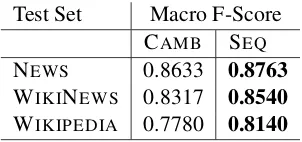
Test Set Macro F-Score CAMB SEQ
NEWS 0.8633 0.8763
WIKINEWS 0.8317 0.8540
[image:4.595.341.492.181.252.2]WIKIPEDIA 0.7780 0.8140
Table 1: SEQvs. CAMBsystem results on CWI
DATASET Precision Recall F-Score CEFR-LS 0.9327 0.7936 0.8575 BENCHLS 0.5000 0.4025 0.4460
Table 2: SEQresults for CWI on the two datasets
SEQ uses 300-dimensional GloVe embeddings as word representations (Pennington et al.,2014). The model is trained to predict the binary com-plexity of words as annotated in the dataset of Yi-mam et al.(2017). Training is performed over20 iterations on randomly shuffled sentences from all genres included within the dataset. To test this novel architecture on CWI, we apply it to the CWI 2018 shared task test data (Yimam et al., 2018) and compare the results to the current state-of-the-art (SOTA) CAMB system. Table1shows that the
SEQmodel outperforms the current SOTA system on all three text genres for binary CWI (statisti-cally significant using McNemar’s test,p=0.0016,
χ2=9.95).
The proposed SEQ model (Gooding and
Kochmar,2019) has a number of additional advan-tages: it takes context into account, helps avoid the necessity of extensive feature engineering re-lying on word embeddings as the only input in-formation at run time, and generalises well across all three datasets. To further assess generalisabil-ity of the model, we test it on CEFR-LS, as well as BENCHLS for consistency (see Table2). How-ever, as the words in BENCHLS dataset were
4.1.1 Lexical Complexity Threshold
The SEQ system labels each word with a lexical
complexity score. This score represents the like-lihood (p) of each word belonging to the complex class. Whether a word is considered as complex is set according to a predefined threshold for p, which allows the ‘aggressiveness’ of the algorithm to be tailored according to the application. For in-stance, consider the following example:
(5) I believe that ignoring public opinion
discredits0.89 theauthorities0.79and
destabilises0.84 the situation.
The SEQ labeller assigns complexity probabil-ity p>0.80 to the words discredits and desta-bilises, whereas for authorities p=0.79. If the complexity threshold in the simplification pipeline is set to0.80, the wordauthoritieswould not be a candidate for lexical simplification. Our simplifi-cation pipeline will attempt to simplify words one at a time, starting with the highestpvalues above this predefined threshold.
4.2 Substitute Generation
Substitute generation refers to the process of gen-erating candidates that can be used as simpler al-ternatives to the target word. The goal of the sys-tem at this stage is to generate a diverse set of po-tential substitutions that can be filtered and ranked according to different criteria at later steps. We note that the use of multiple resources for substi-tute generation at this step is crucial as each in-dividual resource has only a limited coverage. To this end, we first use traditional approaches, which do not take the context of the target word or the simplicity of substitutes into account. In summary, we rely on the following resources:
• we extract synonyms from WordNet ( Fell-baum,2012), followingDevlin(1998); • we use Big Huge Thesaurus2 to find
can-didates by querying for the word form and lemma;
• following Glavaˇs and ˇStajner (2015), we use word embeddings to create substitutions. Synonyms are identified by finding10words with the highest cosine similarity to the tar-get word in the vector space. These are obtained for both GloVe (Pennington et al., 2014) and Word2Vec embeddings (Mikolov
2https://words.bighugelabs.com
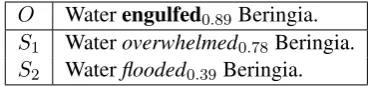
O Waterengulfed0.89Beringia.
S1 Wateroverwhelmed0.78Beringia.
[image:5.595.323.508.62.105.2]S2 Waterflooded0.39Beringia.
Table 3: Contextual simplicity scores for2possible al-ternatives (S1-S2) for the originalO
et al.,2013), using the Gensim library.3 The candidate lemmas retrieved using these re-sources are added to the candidate substitutions set. To match the grammatical form of the original word, we convert all candidates to the appropriate word forms using NodeBox English Linguistics li-brary.4
4.3 Substitution Filtering and Ranking
Following substitute generation, the next step in the LS pipeline is to choose one of the generated candidates to replace the original target word. This is done by filtering and ranking the candidates us-ing a set of criteria, and choosus-ing the top candi-date. Previous work has framed this task as rank-ing words accordrank-ing to simplicity (Paetzold and Specia, 2016a). However, a system that is only aimed at selecting the simplest candidate may re-turn a substitution that does not fit the surround-ing context, is ungrammatical or not semantically equivalent to the original. Therefore, we consider all three aspects of high-quality substitution selec-tion: contextual simplicity, semantic equivalence
andgrammaticality, which are outlined below.
Contextual Simplicity: The complexity of each candidate is calculated using our sequential CWI model from Section 4.1. We calculate the com-plexity for each substitution within context and re-fer to this as the simplicity scoreS. Table3shows 2possible substitutions forengulfed, with their re-spective simplicity scores.
Contextual Semantic Equivalence: To assess whether a substitution is semantically equivalent to the original we use ELMo embeddings (Peters et al.,2018), which to the best of our knowledge have not been used for LS before. ELMo provides deep contextualized word representations, which are learned from the internal states of a deep bi-directional language model. As a result, these em-beddings are able to model complex syntactic and
3
https://github.com/RaRe-Technologies/ gensim
O Thisillustrateshow sociologists [...]
S1 Thisdemonstrates0.10how sociologists [...]
S2 Thisshows0.16how sociologists [...]
[image:6.595.333.500.62.159.2]S3 Thisdraws0.44how sociologists [...]
Table 4: Contextual semantic equivalence scores for3
candidate substitutions (S1-S3) for the originalO
O Oak is strong and alsogivesshade g.c. Oakgivesshade
Table 5: Original sentenceOand the grammatical con-text (g.c.) used to calculateCGfor the wordgives
semantic characteristics of word use, as well as how these word uses vary across linguistic con-texts. In addition, contextualised embeddings help filter out antonyms that might be included in the set of potential substitutes by the previous step.
The similarity of words in a given sentential context is calculated using the ELMo embeddings associated with the target word and each of the substitutes. The contextual similarity score (CS)
is calculated by taking the cosine distance between the ELMo word vectors associated with the origi-nal wordvoand the substitutevs. This allows us to
reason about the likelihood that the substitution is semantically equivalent to the original in the given context: the smaller the distance the more likely
this word fits the context. Table4 provides some examples for this score.
This technique works particularly well when the target word appears in the immediate context of the words grammatically related to it, for example when a verb is surrounded by its subject and ob-ject. To counteract the effect of long range depen-dencies in sentences, we constrain the context to the grammatical dependents and calculate a sec-ond contextual score CG using cosine distance.
Table5provides an example of a full sentenceO
and the grammatical context for the wordgives.
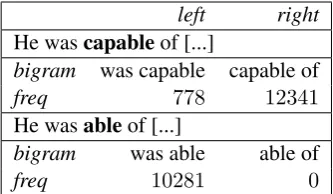
Grammaticality: To assess whether a substitution results in a grammatically correct sentence, we calculate bigram frequencies of the candidate sub-stitute and one word to the left and to the right of it using the520million word COCA corpus (Davies, 2014). If either of these frequencies equals0, it is assumed that the substitute is not a valid grammat-ical fit or is extremely rare, making it a poor can-didate for simplification. Table6shows one such example.
left right
He wascapableof [...]
bigram was capable capable of
freq 778 12341
He wasableof [...]
bigram was able able of
freq 10281 0
Table 6: Bigram frequencies for left and right contexts of a candidate substitute
Here, we use the bigram frequencies as a proxy for grammaticality: although “able” and “capable” are semantically similar, it is the grammatical con-straints, captured by the bigram frequencies, that rule one of the alternatives out.
4.3.1 Threshold-based filtering
Threshold-based filtering is performed by remov-ing all substitutes that are unlikely to be grammat-ical or do not fit the target context. First, sub-stitutes are removed from consideration if their right or left bigram frequency equals 0. Then, we remove substitutes if either of their contextual ELMo scores is below a given threshold t (CS ∨ CG < t), as this implies the substitute is not
equivalent in this context. We test our filtering approach on the CEFR-LS dataset as it contains annotations for contextually suitable (value1) as well as unsuitable (value0) substitutions. We em-pirically find the optimal threshold value on the CEFR-LS dataset to be 0.175. With this opti-mal value, we can identify contextually suitable and grammatically correct substitutes on CEFR-LS with theprecisionof0.7968,recallof0.8081 andF1=0.8014. As we show in Section5, this fil-tering technique generalises well to other datasets.
4.3.2 Ranking Algorithm
Once filtering has been performed we then rank substitutes. In order to rank substitutes, the sim-plicity and contextual semantic equivalence scores are combined to produce an overall suitability score. We evaluate our ranking techniques on the BENCHLS and CEFR-LS datasets.
We perform ranking using the sum of the contextual simplicity score (S) and the aver-age contextual semantic equivalence score C¯ =
avg(CS, CG), and evaluate the results using the
f
ul
l(929)
BENCHLS n=1 n=2 n=3 MRR
S 0.4974 0.7381 0.8899 0.6648 ¯
C 0.3509 0.5885 0.7877 0.5998
S+C¯ 0.5602 0.8064 0.9428 0.7219
test
(464)
S 0.5839 0.7546 0.9302 0.7083 ¯
C 0.4086 0.7142 0.8950 0.6563
[image:7.595.74.280.62.150.2]S+C¯ 0.6774 0.7857 0.9308 0.8218 P&S 0.4841 0.5596 0.7004 0.6615
Table 7: Ranking results on BENCHLS dataset
CEFR-LS n=1 n=2 n=3 MRR
S 0.2166 0.3357 0.5271 0.4182 ¯
C 0.3754 0.6137 0.7689 0.5857
[image:7.595.76.272.182.234.2]S+C¯ 0.4624 0.5906 0.7314 0.6582 P&S 0.2129 0.4339 0.5760 0.4736
Table 8: Ranking results on CEFR-LS dataset
r≤nis ranked first by the system. For instance, our best performing ranking technique on the full BENCHLS dataset forn=1is based on the com-bination of S+ ¯C scores and achieves TRank-at-n=0.5602. This means that for approximately 56% of the test instances the top ranked substi-tute in the gold standard is correctly ranked first. In addition, we report the mean reciprocal rank (MRR)(Voorhees,1999), which takes into account the rank of the substitutes proposed by each rank-ing technique.
We report the results on the full BENCHLS
dataset in the upper half of Table7. In the lower half, we compare our results on the test set of 464 instances to those running the Paetzold and Specia (2016a) system (P&S) on the same test splits. Since the P&S system was trained on half of BENCHLS we cannot run it on the full dataset.
Table7shows that ranking withS+ ¯C works best according to all measures and across both sets.
Table 8 reports the ranking results on the CEFR-LS data. We observe a decrease in perfor-mance, however this is expected: as all substitutes within the BENCHLS dataset are valid, ranking by simplicity is more informative; in contrast, the CEFR-LS dataset contains irrelevant substitutes, so contextual fit has more pronounced effects.
4.4 Recursive Step
Following CWI, substitute generation, filtering and substitute ranking steps, the system is able to perform a simplification. As outlined in Sec-tion 4.1.1, our system attempts to simplify one word at a time, starting with the word considered most complex. Since word complexity depends on the context, each individual lexical
simplifica-tion made to a sentence has a subsequent impact on the perceived complexity of the surrounding words. Such sequential effects cannot be modelled by systems that apply several simplification steps at once. For instance, when considering examples (6) and (7) we see that the wordsituationis given a high likelihood of being complex in the context of another complex wordhazardous. However, once
dangerousis substituted forhazardous, the subse-quent complexity ofsituationis reduced as well. (6) It was ahazardous0.90situation0.87 (7) It was a dangerous0.30situation0.35
Our lexical simplification algorithm is applied to a sentence recursively: it starts by identifying and simplifying the most complex words in the sentence. Once the simplification is applied in step
n, the algorithm reassesses word complexity in stepn+1, which, in light of the simplifications ap-plied in previous steps, might have changed. This prevents unnecessarily simplifyingsituationin ex-ample (7), which is no longer necessary after sim-plifyinghazardous→dangerous. The simplifica-tion algorithm stops when there are no words with the complexity score above the predefined thresh-old left within the sentence, set to0.5.
Table9exemplifies the benefit of using the re-cursive simplification approach REC-LS. We see
that both the ‘Simplify CW’, aimed at individu-ally identified complex words, and ‘Simplify all’ approaches result in unnecessary simplifications, whilst REC-LS stops when it recognises that the surrounding words are no longer complex.
Original prepare
0.32
for a hazardous
0.81
journey
0.52
REC-LS prepare for adangerous 0.35
journey 0.45 Simplify CW prepare for adangerous trip
Simplify all arrangefor adangerous trip
Table 9: Recursive simplification compared with sim-plifying only complex words and simsim-plifying all words
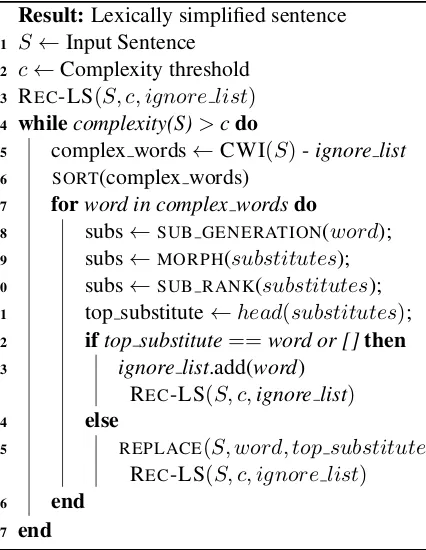
We note that the only consequence of perform-ing simplification recursively is that fewer words, or potentially different words, are simplified, and highlight that it does not lead to any error propa-gation. Table10presents the entire REC-LS
algo-rithm including the recursive simplification step.
5 End-to-end System Performance
Result:Lexically simplified sentence 1 S ←Input Sentence
2 c←Complexity threshold 3 REC-LS(S, c, ignore list) 4 whilecomplexity(S)>cdo
5 complex words←CWI(S)-ignore list 6 SORT(complex words)
7 forword in complex wordsdo
8 subs←SUB GENERATION(word); 9 subs←MORPH(substitutes); 10 subs←SUB RANK(substitutes);
11 top substitute←head(substitutes); 12 iftop substitute==word or []then 13 ignore list.add(word)
REC-LS(S, c,ignore list)
14 else
15 REPLACE(S, word, top substitute) REC-LS(S, c, ignore list) 16 end
17 end
datasets. The CWI step of our recursive LS algo-rithm identifies77%of the target complex words in the BENCHLS and 86% of the target complex words in the CEFR-LS dataset. Next, the sub-stitution generation and ranking produce lists of simplification candidates. We evaluate these steps using precision and measuring the percentage of times that our system ranks one of the gold stan-dard candidates as its top choice for substitution.
The best precisionP=0.7945on BENCHLS is achieved with threshold-based filtering of the un-suitable candidates and ranking of the candidates according to the combination of contextual sim-plicity (S) and contextual fit (C¯) scores. We note that this result outperforms the previous SOTA system by Horn et al. (2014), which is reported to haveP=0.5460(Paetzold and Specia,2016a), by a large margin.
With a similar approach, we achieveP=0.4628 on the CEFR-LS, and to the best of our knowl-edge, this is the first time an LS system is bench-marked on this dataset. We note that the preci-sion on this dataset is lower, which can be at-tributed to the smaller set of gold standard sub-stitutes per word (an average of 2.35 in CEFR-LS vs7.37in BENCHLS). We also note that in a
[image:8.595.74.287.70.345.2]number of cases our system generates valid substi-tutes, which are not included in the gold standard. For example,wealthy→richin “could participate
Table 10: REC-LS Algorithm Steps
(4) Check if complexity of any word inS is above the thresholdc
(5) Check sentence for complex words minus those which are inignore list
(6) Sort complex words according to confidence score
(8) Generate substitutes for the top complex word
(9) Convert substitutions to correct word form (e.g., tense for verbs)
(10)
Rank substitutes according to grammaticality, contextual semantic equivalence and simplicity
(11) Take the top substitute
(13)
If no appropriate substitutes found, or best fit is original word, then retain original word and add word toignore list
(15) Otherwise replace word and call function with new sentence
in government just as wealthy men could”. We present more examples of such cases in the Ap-pendix.
We also run our entire recursive simplifica-tion system REC-LS on the three simplification datasets: WikiSmall, WikiLarge and Newsela, used inZhang and Lapata(2017). We then com-pare the results to the SOTA simplification sys-tems DRESS-LS by Zhang and Lapata (2017),
which contains a specialised LS model, and the P&S simplification system (Paetzold and Specia, 2016a). As DRESS-LSis trained using the above datasets, we test using the649sentences that are reserved for testing only. Simplifications are as-sessed using the gold standard for lexical substitu-tions. For each dataset, the number of lexical sim-plifications performed by the systems is recorded. We then compare the simplifications performed by the system with the gold standard simplifications and calculate therecall,precisionandcorrect pro-portion as follows:
• Forrecallwe estimate the number of simplifi-cations present in the gold standard|G|, and the total number produced by the systemS, which are in the gold standard|S∩G|. Re-call is then calculated as|S∩G|/|G|. • For precision, we identify the proportion of
Newsela WikiSmall WikiLarge
DRESS-LS P&S REC-LS DRESS-LS P&S REC-LS DRESS-LS P&S REC-LS Precision 0.1673 0.0836 0.3000 0.0000 0.0602 0.1275 0.2258 0.0697 0.2778
[image:9.595.86.523.61.130.2]Recall 0.2389 0.9721 0.2393 0.0000 0.9743 0.4815 0.0004 0.9763 0.1856 Correct 0.3256 0.0402 0.5238 0.0000 0.0526 0.4615 0.4286 0.0787 0.4001
Table 11: Lexical substitution results for DRESS-LS, P&S and our system (REC-LS) on three genres
• Finally,correct stands for the proportion of instances where the top lexical substitution returned by the system is exactly the same as the gold standard one.
The results show that the recall for REC-LS is higher than that of DRESS-LS across all datasets, while the P&S system performs the best in terms of recall as it applies a ‘simplify all’ approach. The difference is especially pronounced in the WikiSmall dataset, where the DRESS-LS system
does not perform any required lexical substitu-tions. REC-LS outperforms both DRESS-LS and P&S systems across all datasets in terms of pre-cision, which indicates that the CWI stage of the algorithm is able to narrow down simplifications to relevant words. Finally, the three systems show different results in terms of correct proportion: REC-LS outperforms other systems on Newsela and WikiSmall, and DRESS-LS has a higher
cor-rect proportion on WikiLarge.
Finally, we note that there are many instances where the REC-LS system performs substitu-tions with valid alternatives that are not contained within the gold standard. For instance, consider the word “separated” in the following context:
(8) The island chain forms part of the He-brides,separatedfrom the Scottish main-land.
The gold standard substitution suggested by the human annotators in this context is “demar-cated”, whereas REC-LS substitutes this word with “split”. We argue that, in this context, “split” would be both grammatically correct and seman-tically appropriate, while also being simpler than the original word and, arguably, the substitute sug-gested by the human annotators. However, as it is not an exact match with the gold standard sub-stitution in the dataset, cases like this negatively impact precision of our system. We provide more examples of the system’s output and compare the simplifications from the three systems in the Ap-pendix.
6 Conclusions
In this paper, we have presented a novel recur-sive context-aware lexical simplification architec-ture REC-LS.5 We summarise the main contribu-tions of this work as follows:
1. our model takes the surrounding context into account at the complex word identification step, using a novel sequence labelling ap-proach;
2. it filters and ranks the substitution alterna-tives taking contextual fit and grammaticality of the output into account;
3. the novel architecture performs simplification recursively and can be adapted to different levels of language complexity in the future; 4. as a result, REC-LS outperforms the current
state-of-the-art systems in lexical simplifica-tion on various datasets.
We note that REC-LS can be used as a stand-alone lexical simplification system as well as an LS com-ponent as part of an integral TS system.
In this paper, we focus on intrinsic evaluation of our system, and we show that it outperforms SOTA in terms of the widely accepted set of mea-sures, which we believe to be important for bench-marking purposes. In the future, we plan to ex-tend this work with a syntactic simplification com-ponent and test the architecture extrinsically with non-native readers.
Acknowledgments
We thank Cambridge English for supporting this research via the ALTA Institute. We are grateful to the anonymous reviewers for their valuable feed-back. We also gratefully acknowledge the support of NVIDIA Corporation with the donation of the Titan V GPU used for this research.
References
Or Biran, Samuel Brody, and Noemie Elhadad. 2011.
Putting it Simply: a Context-Aware Approach to Lexical Simplification. InProceedings of the 49th Annual Meeting of the Association for Computa-tional Linguistics: Human Language Technologies, pages 496–501.
Ted Briscoe, John Carroll, and Rebecca Watson. 2006. The second release of the RASP system. In Pro-ceedings of the COLING/ACL on Interactive presen-tation sessions, pages 77–80. Association for Com-putational Linguistics.
Yvonne Canning, John Tait, Jackie Archibald, and Ros Crawley. 2000. Cohesive generation of syntactically simplified newspaper text. In Proceedings of the Third International Workshop on Text, Speech and Dialogue (TDS ’00), pages 145–150.
John Carroll, Gido Minnen, Yvonne Canning, Siobhan Devlin, and John Tait. 1998. Practical simplification of English newspaper text to assist aphasic readers. InProceedings of AAAI Workshop on Integrating AI and Assistive Technology, pages 7–10.
Raman Chandrasekar and Srinivas Bangalore. 1997. Automatic induction of rules for text simplification.
Knowledge Based Systems, 10:183–190.
William Coster and David Kauchak. 2011a. Learn-ing to Simplify Sentences UsLearn-ing Wikipedia. In Pro-ceedings of the Workshop on Monolingual Text-To-Text Generation, pages 1–9.
William Coster and David Kauchak. 2011b. Simple English Wikipedia: A New Text Simplification Task. InProceedings of Annual Meeting of the Association for Computational Linguistics (ACL), pages 665– 669.
Mark Davies. 2014. N-grams data from the Corpus of Contemporary American English (COCA).
Jan De Belder and Marie-Francine Moens. 2012. A dataset for the evaluation of lexical simplification. InInternational Conference on Intelligent Text Pro-cessing and Computational Linguistics, pages 426– 437. Springer.
Siobhan Devlin. 1998. The use of a psycholinguis-tic database in the simplification of text for aphasic readers. Linguistic databases.
Council of Europe Council of Europe. 2011. Common European Framework of Reference for Languages: Learning, Teaching, Assessment.
Christiane Fellbaum. 2012. WordNet. The Encyclope-dia of Applied Linguistics.
Goran Glavaˇs and Sanja ˇStajner. 2015. Simplifying lexical simplification: do we need simplified cor-pora? In Proceedings of the 53rd Annual Meet-ing of the Association for Computational LMeet-inguistics
and the 7th International Joint Conference on Natu-ral Language Processing (Volume 2: Short Papers), volume 2, pages 63–68.
Sian Gooding and Ekaterina Kochmar. 2018. CAMB at CWI Shared Task 2018: Complex Word Identifica-tion with Ensemble-Based Voting. InProceedings of the Thirteenth Workshop on Innovative Use of NLP for Building Educational Applications, pages 184–194.
Sian Gooding and Ekaterina Kochmar. 2019. Complex Word Identification as a Sequence Labelling Task. InProceedings of the 57th Conference of the Asso-ciation for Computational Linguistics, pages 1148– 1153.
Sepp Hochreiter and J¨urgen Schmidhuber. 1997. Long short-term memory. Neural computation, 9(8):1735–1780.
Colby Horn, Cathryn Manduca, and David Kauchak. 2014. Learning a Lexical Simplifier Using Wikipedia. In Proceedings of the 52nd Annual Meeting of the Association for Computational Lin-guistics (Short Papers), pages 458–463.
Carl James. 1998. Errors in Language Learning and Use: Exploring Error Analysis. London: Longman.
David Kauchak. 2013. Improving Text Simplification Language Modeling Using Unsimplified Text Data. In Proceedings of the 51st Annual Meeting of the Association for Computational Linguistics (Volume 1: Long Papers), pages 1537–1546.
Gondy Leroy, James E. Endicott, Obay Mouradi, David Kauchak, and Melissa L. Just. 2012. Improving perceived and actual text difficulty for health infor-mation consumers using semi-automated methods. In Proceedings of the American Medical Informat-ics Association (AMIA) Fall Symposium, pages 522– 531.
Tomas Mikolov, Ilya Sutskever, Kai Chen, Greg S Cor-rado, and Jeff Dean. 2013. Distributed representa-tions of words and phrases and their compositional-ity. InAdvances in neural information processing systems, pages 3111–3119.
Franz Josef Och and Hermann Ney. 2000. Improved Statistical Alignment Models. InProceedings of the 38th Annual Meeting on Association for Computa-tional Linguistics (ACL ’00), pages 440–447.
Gustavo Paetzold and Lucia Specia. 2016a. Bench-marking lexical simplification systems. In Pro-ceedings of the Tenth International Conference on Language Resources and Evaluation (LREC 2016), pages 3074–3080, Paris, France. European Lan-guage Resources Association (ELRA).
Jeffrey Pennington, Richard Socher, and Christopher Manning. 2014. Glove: Global vectors for word representation. InProceedings of the 2014 confer-ence on empirical methods in natural language pro-cessing (EMNLP), pages 1532–1543.
Matthew E. Peters, Mark Neumann, Mohit Iyyer, Matt Gardner, Christopher Clark, Kenton Lee, and Luke Zettlemoyer. 2018. Deep contextualized word rep-resentations. InProceedings of NAACL-HLT 2018, pages 2227–2237.
Andrew Porter, Jennifer McMaken, Jun Hwang, and Rui Yang. 2011. Common Core Standards: The New U.S. Intended Curriculum. Educational Re-searcher, 40:103–116.
Marek Rei. 2017. Semi-supervised multitask learn-ing for sequence labellearn-ing. In Proceedings of the 55th Annual Meeting of the Association for Compu-tational Linguistics (Volume 1: Long Papers), pages 2121–2130.
Marek Rei, Gamal K.O. Crichton, and Sampo Pyysalo. 2016. Attending to characters in neural sequence labeling models. InProceedings of COLING 2016, the 26th International Conference on Computational Linguistics: Technical Papers, pages 309–318.
Matthew Shardlow. 2013. A Comparison of Tech-niques to Automatically Identify Complex Words. InProceedings of the Student Research Workshop at the 51st Annual Meeting of the Association for Com-putational Linguistics (ACL), pages 103–109.
Advaith Siddharthan. 2006. Syntactic Simplification and Text Cohesion. Research on Language and Computation, 4:77–109.
Advaith Siddharthan. 2014. A survey of research on text simplification. Special issue of International Journal of Applied Linguistics, 165:259–298.
Satoru Uchida, Shohei Takada, and Yuki Arase. 2018.
CEFR-based Lexical Simplification Dataset. In Pro-ceedings of the Eleventh International Conference on Language Resources and Evaluation (LREC-2018), pages 3254–3258.
Ellen M. Voorhees. 1999. TREC-8 Question Answer-ing Track Report. In Proceedings of the 8th Text Retrieval Conference, pages 77–82.
Wei Xu, Chris Callison-Burch, and Courtney Napoles. 2015. Problems in Current Text Simplification Re-search: New Data Can Help. Transactions of the Association for Computational Linguistics, 3:283– 297.
Mark Yatskar, Bo Pang, Cristian Danescu-Niculescu-Mizil, and Lillian Lee. 2010. For the sake of sim-plicity: Unsupervised extraction of lexical simplifi-cations from Wikipedia. InHuman Language Tech-nologies: The 2010 Annual Conference of the North American Chapter of the Association for Computa-tional Linguistics, pages 365–368.
Seid Muhie Yimam, Chris Biemann, Shervin Mal-masi, Gustavo Paetzold, Lucia Specia, Sanja ˇStajner, Ana¨ıs Tack, and Marcos Zampieri. 2018. A Report on the Complex Word Identification Shared Task 2018. InProceedings of the 13th Workshop on In-novative Use of NLP for Building Educational Ap-plications, pages 66–78.
Seid Muhie Yimam, Sanja ˇStajner, Martin Riedl, and Chris Biemann. 2017. CWIG3G2 - Complex Word Identification Task across Three Text Genres and Two User Groups. InProceedings of the Eighth In-ternational Joint Conference on Natural Language Processing (Volume 2: Short Papers), pages 401– 407.
Xingxing Zhang and Mirella Lapata. 2017. Sentence Simplification with Deep Reinforcement Learning. In Proceedings of the 2017 Conference on Empiri-cal Methods in Natural Language Processing, pages 584–594.