Proceedings of the 2019 Conference on Empirical Methods in Natural Language Processing and the 9th International Joint Conference on Natural Language Processing, pages 4590–4600,
4590
Transferable End-to-End Aspect-based Sentiment Analysis with
Selective Adversarial Learning
Zheng Li1, Xin Li2, Ying Wei3, Lidong Bing4, Yu Zhang5, Qiang Yang1 1The Hong Kong University of Science and Technology, Hong Kong
2The Chinese University of Hong Kong, Hong Kong 3Tencent AI Lab, Shenzhen, China
4R&D Center Singapore, Machine Intelligence Technology, Alibaba DAMO Academy 5Southern University of Science and Technology, Shenzhen, China
{zlict, qyang}@cse.ust.hk, [email protected], [email protected] [email protected], [email protected]
Abstract
Joint extraction of aspects and sentiments can be effectively formulated as a sequence label-ing problem. However, such formulation hin-ders the effectiveness of supervised methods due to the lack of annotated sequence data in many domains. To address this issue, we firstly explore an unsupervised domain adap-tation setting for this task. Prior work can only use common syntactic relations between aspect and opinion words to bridge the do-main gaps, which highly relies on external linguistic resources. To resolve it, we pro-pose a novel Selective Adversarial Learning (SAL) method to align the inferred correla-tion vectors that automatically capture their latent relations. The SAL method can dy-namically learn an alignment weight for each word such that more important words can pos-sess higher alignment weights to achieve fine-grained (word-level) adaptation. Empirically, extensive experiments1demonstrate the effec-tiveness of the proposed SAL method.
1 Introduction
End-to-End Aspect-Based Sentiment Analysis (E2E-ABSA) aims to jointly detect the aspect terms explicitly mentioned in sentences and pre-dict the sentiment polarities over them (Liu,2012; Pontiki et al.,2014). For example, in the sentence “TheAMD Turin Processorseems to always per-form much better than Intel”, the user mentions two aspect terms, i.e., “AMD Turin Processor” and “Intel”, and expresses positive and negative sentiments over them, respectively.
Typically, prior work formulates E2E-ABSA as a sequence labeling problem over a unified tagging scheme (Mitchell et al.,2013;Zhang et al.,2015; Li et al., 2019a). The unified tagging scheme
1The code is available at https://github.com/
hsqmlzno1/Transferable-E2E-ABSA
connects a set ofaspect boundary tags(e.g., {B, I, E, S, O} denotes the beginning of, inside of, end of, single-word, and no aspect term), and
sentiment tags (e.g. {POS, NEG, NEU} denotes positive, negative or neutral sentiment) together to constitute a joint label space for each word. As such, “AMD Turin Processor” and “Intel” should be tagged with{B-POS,I-POS,E-POS} and{S-NEG}, respectively, while the remaining words are tagged withO. This formulation makes two sub-tasks joint modeling easier, and mean-while, tend to be low-resource. There usually exist few annotated data for each new domain, where la-beling each word with a unified tag could be more time-consuming and expensive.
To alleviate the dependence on domain supervi-sions, we explore an unsupervised domain adapta-tion setting for E2E-ABSA, which aims to lever-age knowledge from a labeled source domain to improve the sequence learning in an unlabeled tar-get domain. The challenges in fulfillment of this setting are two-fold: (1) there exists a large fea-ture distribution shift between domains since as-pect terms in different domains are usually dis-joint. For example, users usually mention “pizza” in the Restaurant domain while “camera” is of-ten discussed in the Laptop domain; (2) Unlike domain adaptation in traditional sentiment clas-sification (Blitzer et al., 2007) that learns shared sentence or document representations, we need to learn fine-grained (word-level) representations to be domain-invariant for sequence prediction.
as-pect words→nsubj→opinion words). Inspired by this, existing studies use general syntactic re-lations as the pivot to bridge the domain gaps for cross-domain aspect extraction (Jakob and Gurevych,2010;Ding et al.,2017), or aspect and opinion co-extraction (Li et al., 2012;Wang and Pan, 2018). Unfortunately, these methods highly rely on prior knowledge (e.g., manually-designed rules) or external linguistic resources (e.g., depen-dency parsers), which are inflexible and prone to bringing in knowledge errors. Instead, we intro-duce a multi-hop Dual Memory Interaction (DMI) mechanism to automatically capture the latent re-lations among aspect and opinion words. The DMI iteratively infers the correlation vectors of each word by interacting its local memory (LSTM hid-den state) with both the global aspect and opinion memories, such that the inter-correlations between aspects and opinions, and the intra-correlations in aspects or opinions can be derived.
Second, how to transfer for this sequence pre-diction task? One straightforward way is to ap-ply domain adaption methods to align all words within the sentence, however, it is observed that it will not yield significant improvements. Actually, not all the words contribute equally to the domain-invariant feature space though fine-grained adap-tation is required. Thus, we propose a novel Selective Adversarial Learning (SAL) method to dynamically learn an alignment weight for each word, where more important words can possess higher alignment weights to achieve a local se-mantic alignment based on adversarial training. Empirically, the proposed model outperforms the state-of-the-art fine-grained adaptation methods by a large margin on four benchmark datasets. We also conduct extensive ablation studies to quantita-tively and qualitaquantita-tively demonstrate the effective-ness of the selectivity of adversarial learning.
Overall, our main contributions are summarized as: (1) to the best of our knowledge, an unsuper-vised domain adaptation setting is firstly explored for E2E-ABSA; (2) an effective SAL method is proposed to conduct a local semantic alignment for fine-grained domain adaptation; (3) extensive experiments verify the effectiveness of the pro-posed SAL method.
2 Task Definition
Single-domain: E2E-ABSA involves both
as-pect detection (AD) and aspect sentiment (AS)
classification tasks, which are formulated as a unified sequence labeling problem. Given an input sequence of words x={w1, w2, ..., wT} and its
word embeddingse={e1, e2, ..., eT}, the goal is
to predict a tag sequencey={y1, y2, ..., yT}over
theunified tags, withyi∈ YU={B-POS,I-POS,
E-POS, S-POS, B-NEG, I-NEG, E-NEG, S-NEG, B-NEU, I-NEU, E-NEU, S-NEU,
O}. Cross-domain: Here we are performing
in a more challenging unsupervised domain adaptation setting. Given a set of labeled data
Ds={(xis,yis)} Ns
i=1 from a source domain and a set of unlabeled data Dt={(xjt)}
Nt
j=1 from a target domain, we aim to transfer the knowledge ofDsto improve the sequence learning inDt.
3 Model Description
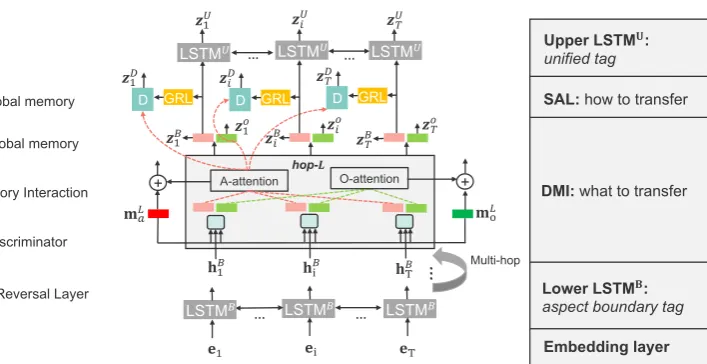
Overview: As shown in Figure 1, we adopt
two stacked bi-directional LSTMs as the base model (Li et al.,2019a) for E2E-ABSA. The up-per LSTMU is for the high-levelADS (AD+AS) task and it predicts theunified tagsas output, while the lower LSTMBis for the low-levelADtask and predicts theaspect boundary tagsas the guidance. To adapt the base model, we design different com-ponents in terms of the two problems, i.e., what to transfer and how to transfer, respectively.
(1) To automatically capture the latent relations between aspect and opinion words as transferable knowledge across domains, we introduce a multi-hop Dual Memory Interaction (DMI) mechanism between the two LSTMs. At each hop, e.g., the
1st hop, each local memoryhBi will interact with both the global aspect and opinion memories, i.e., m1a and m1o based on the DMI, to produce two correlation vectors for aspect and opinion words co-detection, where the opinion detection is used as an auxiliary task for the AD task. The “lo-cal” memory denotes the hidden representation (LSTMB hidden state) of each word within the sentence. Whereas the two “global” memories are globally shared by all input sentences, which are commonly used in memory networks (Sukhbaatar et al.,2015;Kumar et al.,2016) and can be seen as high-level representations for aspect and opin-ion words, respectively. The A-attentopin-ion and O-attention then aggregate most relevant aspect or opinion words information to refine the two global memories for the next hop.
LSTM,
LSTM,
=#4 =4%
1# 12 13
… …
…
Dual Memory Interaction
+#, +2, +3,
()< (*<
A-attention
=%/
=7/
=#/
=#, =7, =%,
… …
=74
hop-?
O-attention GRL
=#>
D GRL
=7>
D GRL
=>%
D
Gradient Reversal Layer
GRL
LSTM,
Domain discriminator
D
+ +
Lower LSTM@: aspect boundary tag Upper LSTMA: unified tag
DMI: what to transfer
SAL: how to transfer Aspect global memory
Opinion global memory
Multi-hop
LSTM4 LSTM4 LSTM4
[image:3.595.144.498.59.241.2]Embedding layer
Figure 1: The framework of the proposed model.
method to dynamically focus on aligning the as-pect words between domains. This is because the informative aspect words contribute more to the shared feature space than the unmeaning words tagged withOin the sentence (Zhou et al.,2019b). As such, an aspect tagger trained on a source main can work well when applied to a target do-main. Specifically, at the final hop, we adopt a domain discriminator for each word with a gra-dient reversal layer (Ganin et al., 2016) to per-form domain adversarial learning over its corre-lation vector (alignment). While the A-attention module provides an aspect attention distribution as a selector to control a learnable alignment weight for each word (selectivity). Finally, each aligned correlation vector will be used to predict aspect boundary tags(AD task) and fed to the LSTMU for theunified tagsprediction (ADS task). In the following sections, we detail each component.
3.1 Base Model
We adopt two stacked bi-directional LSTMs as the base model. We link these two LSTM layers so that the hidden representations generated by the LSTMBcan be fed to LSTMU as the guidance in-formation. Specifically, their hidden representa-tionshBi ∈RdimBh andhU
i ∈Rdim U
h at thei-th time
step (i∈[1, T]) are calculated as follows:
hBi = [−LSTM−−−→B(ei);
←−−−− LSTMB(ei)],
hUi = [−LSTM−−−→U(hiB);←LSTM−−−−U(hBi )].
The probability scoreszBi ∈R|YB|
over the aspect boundary tagsYB={B,I,E,S,O}are calculated by a fully-connected softmax layer:
zBi =p(yBi |hBi) = Softmax(WBhBi +bB).
Similarly, the scores zUi ∈R|YU| over the unified tagsYU defined in Section2are obtained as:
zUi =p(yUi |hUi ) = Softmax(WUhUi +bU).
3.2 Global-Local Memory Interaction
Before detailing the DMI module, we firstly intro-duce Global-Local Memory Interaction (GLMI) that describes the interaction between a lo-cal memory hi∈Rdimh and a global memory
m∈Rdimh. Formally, we parameterize the GLMI f(hi,m;Θ,G), withΘ={W,b}andG, which
consists of a residual transformation and a ten-sor product operation. Specifically, we firstly in-corporate the global memory informationminto each local position with a residual transformation ash˜i=hi+ ReLU(W[hi:m] +b), where[:]
de-notes the vector concatenation. As such, the global memory can distill more correlated local informa-tion and they are mapped into the same space. Then we compute a correlation vector ri ∈ RK that encodes the strength of correlations between the global memory m and the transformed local memoryh˜ithrough a tensor product operation as:
ri=mTGh˜Bi ,
where the tensor G∈Rdimh×dimh×K can be seen
as multiple bilinear matrice that model K kinds of latent relations between two objects. Thek-th slice of theG, i.e.,Gk∈Rdimh×dimh denotes one type of latent relation that interacts with 2 vectors to constitute one type of composition.
3.3 Dual Memory Interaction
Following the notations in Section 3.2, we fur-ther define a global aspect memoryma∈Rdim
B
7 𝐦𝑎𝑙 𝐦o𝑙
FC Layer
𝐡i𝐵 + ሚ𝐡𝑎,𝑖𝐵
𝐡𝑖𝐵 +
ሚ𝐡𝑜,𝑖𝐵 𝐦𝑎𝑙 𝐦o𝑙
𝐆a 𝐆ao 𝐆o 𝐫a,𝑖𝑙 𝐫o,𝑖𝑙 Dual Memory Interaction
FC Layer
Aspect memory
[image:4.595.96.269.64.208.2]Local memory Opinion memory
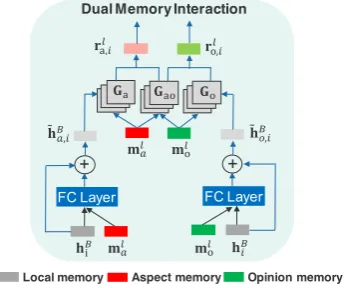
Figure 2: The Dual Memory Interaction (DMI).
global opinion memorymo∈Rdim B
h, and LSTMB
hidden states HB={hBi }Ti=1 as the local memo-ries. The global aspect and opinion memories are able to capture highly correlated aspect or opin-ion words from the local memories, respectively. Based on the observation that aspect words are of-ten collocated with opinion words across domains, thus their associations can act as the pivot infor-mation to bridge the domain gaps. To automati-cally capture their latent relations within the sen-tences, at thel-th hop, each local memoryhBi will interact with the global memoriesmlaandmlo by the Dual Memory Interaction (DMI) shown in Fig-ure2, to produce two correlation vectors for aspect and opinion co-detection:
rla,i= [f(hBi,mla;Θa,Ga) :f(hBi,mol;Θo,Gao)],
rlo,i= [f(hBi,mlo;Θo,Go) :f(hBi,mla;Θa,G>ao)],
where Ga,Go and Gao denote the composition
tensors of modeling the latent relations between aspect and aspect, opinion and opinion, and aspect and opinion, respectively.
The correlation vector measures the associa-tion strength between local and global memories; e.g., If hBi for the word wi is both highly
intra-correlated with the aspect memoryma and
inter-correlated with the opinion memory mo, wi is
more likely to be an aspect term. Then the two correlation vectors can be transformed to a scalar
aspect attention (A-attention) and opinion atten-tion (O-attention) weightαlp,i, respectively, with
p∈ {a, o} denoting the aspect or opinion, which indicates the possibility of each word in the sen-tence being an aspect word or an opinion word as:
αlp,i= exp(Wpr
l p,i)
PT
j=1exp(Wprlp,j) ,
whereWp is the weight of the attention module.
The aspect or opinion attention weight αp,il will summarize the local memories to update the global aspect and opinion memories, respectively, for the next hop, i.e., mlp+1=mlp+PT
i=1αlp,ihBi . The
updates gradually refine the global memories to incorporate more relevant candidates based on the attention mechanism. In the DMI, all parameters are shared in different hops and domains.
At the final L-th hop, we use rLa,i for the AD task and feed it to the LSTMU for the ADS task. For the auxiliary opinion detection task, we feed rLo,i into a softmax layer for predicting the
prob-ability scoreszOi ∈R|Y O|
over the opinion labels2 YO, i.e., a word is an opinion word or not, as:
zOi =p(yOi |rLo,i) = Softmax(WOrLo,i+bO).
3.4 Selective Adversarial Learning
To adapt the captured relations to be domain-invariant, we propose a Selective Adversarial Learning (SAL) method to dynamically align the words with high probability to fall into the aspect boundaries, i.e., being an aspect word. Specif-ically, we introduce a domain discriminator for each word, which aims to identify the domain la-belyDi ∈R|Y
D|
of the input word, i.e., the word in the sentence is from the source or the target do-main. While the feature extractor is to produce the domain-invariant correlation vectorrLa,i that can-not be distinguished by the domain discriminator via a Gradient Reversal Layer (GRL) (Ganin et al., 2016). Mathematically, we formulate the GRL as a ‘pseudo-function’Rλ(x) =xwith a reversal
gradient ∂Rλ(x)
∂x =−λI, whereλis the adaptation
rate. The correlation vectorrLa,iwill be fed to the GRL before the domain discriminator, which is used to predict the probability scoreszDi ∈R|Y
D|
over the domain labelsYDas:
zDi =p(yDi |rLa,i) = Softmax(WDRλ(rLa,i)+bD).
And meanwhile, the aspect attention weightαLa,iat the final hop serves as a selector to be a learnable alignment weight for each word. Thus, the selec-tive domain adversarial loss is a weighted cross-entropy loss `for all the words from the labeled source dataDsand unlabeled target dataDt:
LD =
X
Ds∪Dt T
X
i=1
αLa,i`(zDi ,yDi ). (1)
2The opinion lexicon (http://mpqa.cs.pitt.
Existing studies (Yosinski et al.,2014;Mou et al., 2016) have already shown some evidence that low-level neural layer features (i.e., low-low-level task) are more easily transferred to different tasks or do-mains. Thus, we choose the rLa,i from the low-level AD task to be aligned instead of the feature hUi from the high-level ADS task to transfer. Our ablation studies also confirm this assumption.
3.5 Alternating Training
The primary task loss consists of the cross-entropy losses ` for both the guided AD and main ADS tasks for the labeled source dataDs:
LM =X
Ds X
Q∈{B,U }
T
X
i=1
`(zQi ,yQi ). (2)
The auxiliary opinion detection loss is the cross-entropy loss for the labeled source data Ds and
unlabeled target dataDtas follows:
LO =
X
Ds∪Dt T
X
i=1
`(zOi ,yiO). (3)
Traditionally, we can directly optimize the joint loss of Eqs. (1)-(3), i.e., E=LM+ρLO+γLD to obtain both discriminative and domain-invariant word representations, whereρandγare the trade-off factors. However, we found the optimization process tends to be unstable since it may be hard to jointly optimize many objectives. Thus, we pro-pose an empirically alternating strategy to train the LM+ρLOandLDiteratively, which separates the whole word representation learning into a discrim-inativestage and adomain-invariantstage. Letθf,
θw,θddenote the parameters for feature learning
of each word, word predictors for AD, ADS and opinion detection tasks, and domain discrimina-tors, respectively. Based on our strategy, we are seeking the parameters (θˆ(1)f ,θˆf(2),θˆw,θˆd) that
de-liver a saddle point ofEamong two stages:
( ˆθf(1),θˆw) = arg min θf,θw
LM+ρLO
( ˆθf(2),θˆd) = arg min θd
max
θf
LD.
At the saddle point, the feature learning parame-tersθf minimize the word prediction losses (i.e.,
the features are discriminative) for the first stage. For the second stage, the domain classification loss is minimized by the domain discriminator pa-rametersθdwhile maximized by the feature
learn-ing parametersθf via GRL (i.e., the features are
Dataset Domain Sentences Training Testing
L Laptop 1,869 1,458 411
R Restaurant 3,900 2,481 1,419
D Device 1,437 954 483
[image:5.595.307.528.63.118.2]S Service 2,153 1,433 720
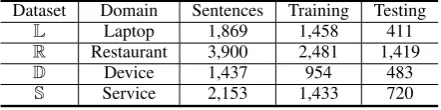
Table 1: Statistics of the datasets.
domain-invariant). As such, we can achieve easier and more stable optimization for feature learning.
4 Experiments
4.1 Experimental Setup
Datasets:Our experiments are conducted on four benchmark datasets: Laptop (L), Restaurant (R), Device (D), and Service (S). Lcontains reviews from the laptop domain in SemEval ABSA chal-lenge 2014 (Pontiki et al., 2014). Following the setup in (Li et al., 2019a), R is the union set of the restaurant datasets from SemEval ABSA chal-lenge 2014, 2015, and 2016 (Pontiki et al.,2014, 2015, 2016). D is a combination of device re-views from 5 different digital products provided by (Hu and Liu,2004).Sis introduced by (Toprak et al., 2010) and contains reviews from web ser-vices. Detailed statistics are shown in Table1.
Settings: We construct 10 transfer pairs like
Ds→Dtwith the four domains mentioned above,
and we do not use the pairsL→Dand D→L as these two domains are very similar. Note that for the unsupervised domain adaptation setting, no la-bels are available for the target domain. There-fore, for each transfer pair, its training dataset is the combination of the labeled training data of the source domain and the unlabeled training data of the target domain. Meanwhile, it employs the test-ing data of the source domain with labels as the validation set and the testing data of the target do-main as the evaluation set. We report the results for both AD and ADS tasks. The evaluation met-ric is the Micro-F1 score under theexact match, which means that an output segment is considered to be correct only if it exactly matches with the gold standard span of the aspect term for the AD task or the aspect term and its sentiment for the ADS task. All experiments are repeated 5 times and we report the average results over 5 runs.
4.2 Implementation details
The word embeddings are 100-dimensional
Transfer Pair TCRF RAP Hier-Joint Hier-Joint
+ RNSCN RNSCN+ Ours
AD ADS AD ADS AD ADS AD ADS AD ADS AD ADS AD ADS
S→R - 14.84 - 25.41 - 32.81 46.39 31.10 - 30.56 48.89 33.21 52.05 41.03 L→R - 16.06 - 31.05 - 31.90 48.61 33.54 - 31.85 52.19 35.65 56.12 43.04
D→R - 17.05 - 28.37 - 30.03 42.96 32.87 - 31.41 50.39 34.60 51.55 41.01 R→S - 15.20 - 13.17 - 15.20 27.18 15.56 - 23.31 30.41 20.04 39.02 28.01 L→S - 12.34 - 13.72 - 15.33 25.22 13.90 - 16.73 31.21 16.59 38.26 27.20
D→S - 13.49 - 16.80 - 18.74 29.28 19.04 - 18.93 35.50 20.03 36.11 26.62
R→L - 14.59 - 15.69 - 19.17 34.11 20.72 - 25.54 47.23 26.63 45.01 34.13 S→L - 9.56 - 12.38 - 21.80 33.02 22.65 - 19.15 34.03 18.87 35.99 27.04
R→D - 19.84 - 17.50 - 22.91 34.81 24.53 - 32.43 46.16 33.26 43.76 35.44
S→D - 13.43 - 15.74 - 20.04 35.00 23.24 - 19.98 32.41 22.00 41.21 33.56
Average - 14.64 - 18.98 - 22.79 35.66 23.72 - 24.99 40.84 26.09 43.91† 33.71† (∆) - (19.07) - (14.73) - (10.92) (8.25) (9.99) - (8.72) (3.07) (7.62) -
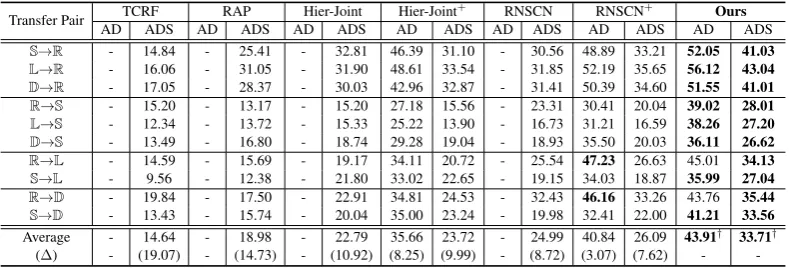
-Table 2: Main results (%). ∆refers to the improvements of the full model over baseline methods. The marker† means that our model significantly outperforms the best baselineRNSCN+withp-value<0.01.
dataset3 and the electronics dataset from Amazon reviews4. For out-of-vocabulary words, we ran-domly initialized them with a uniform distribution
U(−0.25,0.25). The dimensions of two LSTM layers dimBh and dimUh are all set to 100. The number of hops L is set to 2. The number of bilinear interactions K is set to 50. The weight matrices are initialized with a uniform distribution
U(−0.2,0.2). The adaptation rateλis 0.1 and the trade-off factorρ is 1.0. For training, the model is optimized by the Adam algorithm (Kingma and Ba,2014) with the initial learning rate 0.001. The batch size is 64, with a half coming from the source and target domains, respectively. Gradients with the `2 norm larger than 40 are normalized to be 40. To alleviate the overfitting, we apply the dropout on the word embeddings ei and the learned word representations rla,i,
rlo,i, and hUi with dropout rate 0.5. We use the same hyper-parameters, which are tuned on 10% randomly held-out training data of the source domain inR→L, for all transfer pairs.
4.3 Baselines
We compare with several state-of-the-art fine-grained adaptation methods.
• TCRF(Jakob and Gurevych, 2010): Trans-ferable CRF that uses a linear-chain CRF for sequence prediction based on shared non-lexical features across domains, e.g., POS tags and dependency relations.
• RAP(Li et al., 2012): A cross-domain Re-lational Adaptive Bootstrapping method that iteratively expands target aspect and opinion
3
http://www.yelp.com/datasetchallenge
4http://jmcauley.ucsd.edu/data/amazon/
links.html
lexicons according to common opinion words and syntactic relations.
• Hier-Joint (Ding et al., 2017): A recurrent neural network (RNN) with manually de-signed rule-based auxiliary tasks based on common syntactic relations among aspect and opinion words.
• RNSCN (Wang and Pan, 2018): a recur-sive neural structural correspondence net-work that incorporates syntactic structures and exploits an auto-encoder to denoise re-lation labels generated from the parser.
As the first to address cross-domain E2E-ABSA, we have to adapt all the baselines which are originally proposed for cross-domain aspect detection, or aspect and opinion co-detection to return the ADS results by replacing their aspect boundary tagswith theunified tags. Absent of the proposed stacking architecture, all the baselines fail to accomplish the auxiliary AD task mean-time. Thus, we only report their ADS results. Besides, E2E-ABSA aims to simultaneously learn aspect terms along with their sentiments. Thus, the ADS is exactly our main task while the AD is only an auxiliary task used for the guidance.
To be more convincing, we extend neural mod-els (i.e., Hier-Joint and RNSCN) to more power-ful baselines named Hier-Joint+ and RNSCN+
with the proposed stacking architecture, respec-tively. Both of them stack an additional RNN layer on top of the original framework to produce the
unified tagswhile the lower layer is to predict the
[image:6.595.102.497.62.196.2]Transfer Pair
Lower bound Ablation Models Full Model Upper bound
Base Model (SO) Base Model+DMI AD-AL ADS-SAL AD-SAL Base Model (TO)
AD ADS AD ADS AD ADS AD ADS AD ADS AD ADS
S→R 30.32 19.74 45.68 37.10 48.28 37.65 51.29 41.03 52.05 41.03
81.84 67.26
L→R 33.99 28.34 46.25 36.49 51.79 38.63 55.50 42.00 56.12 43.04 D→R 31.59 27.25 46.56 36.89 46.39 37.34 46.43 38.35 51.55 41.01 R→S 15.63 8.61 21.88 16.85 25.13 18.61 37.11 25.84 39.02 28.01
68.28 41.12
L→S 22.45 16.07 28.67 21.53 28.18 20.74 30.35 23.73 38.26 27.20 D→S 16.79 9.49 31.91 22.14 32.88 24.89 32.51 21.45 36.11 26.62
R→L 38.45 23.40 42.27 30.52 40.52 28.77 44.56 33.34 45.01 34.13 75.95 52.62 S→L 24.69 14.48 36.38 27.48 32.96 25.16 33.87 24.22 35.99 27.04
R→D 34.87 25.79 36.90 27.71 41.61 31.88 43.97 34.50 43.76 35.44 70.37 57.62 S→D 27.73 17.73 38.03 31.21 39.54 32.28 40.40 33.26 41.21 33.56
Average 27.65 19.09 37.45 28.79 38.73 29.60 41.60 31.77 43.91† 33.71† 74.11 54.66
(∆) (16.26) (14.62) (6.46) (4.92) (5.18) (4.11) (2.31) (1.94) - - -
-Table 3: Ablation results (%).∆refers to the improvements of the full model over ablation methods. The marker
†means that the full model significantly outperforms the best ablation modelADS-SALwithp-value<0.01.
fair comparison, all baselines use the same ptrained word embeddings and the baselines that re-quire opinion labels use the same opinion lexicon.
4.4 Main Results
Based on the results in Table2, we have the fol-lowing observations:
• Our model consistently and significantly achieves the best results on almost all trans-fer pairs, outperforming the strongest base-line RNSCN+ by 3.07% and 7.62% Micro-F1 on average for the AD and ADS tasks, respectively. Our model can automatically model complicated relations among aspect and opinion words via the DMI as trans-ferable knowledge. Besides, the proposed SAL method can dynamically learn an align-ment weight for each word to achieve a lo-cal semantic alignment, which distills a bet-ter shared feature space and further improves the performances.
• Traditional non-neural methods like TCRF and RAP perform very poorly due to the re-liance on hand-crafted features. Our model outperforms Hier-Joint and RNSCN, which are neural models, by 10.92% and 8.72% Micro-F1 on average for the ADS task, re-spectively. Both of them rely on the depen-dency parser to exploit syntactic relations, which are inflexible due to the no end-to-end manner and may bring in external errors.
• The extended version Hier-Joint+ and RNSCN+ can further improve the per-formances, which shows the benefits of the guidance from the low-level AD task. However, our model can still outperform
them by a large margin, which demonstrates the effectiveness of the proposed methods.
4.5 Ablation Study
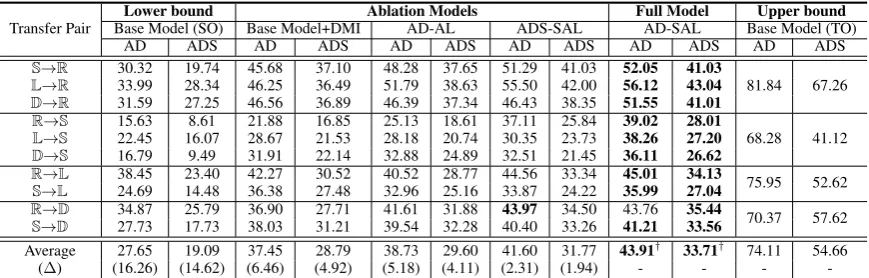
To investigate the effectiveness of each compo-nent, we conduct the ablation study to compare our full model with different ablation variants:
• Base Model (SO / TO): it uses two stacked Bi-LSTMs as the Base Model. SO (Source Only) and TO (Target Only) denote that the base model is only trained on the labeled data from the source and target domain, respec-tively. We usually refer to them as a lower bound and a upper bound, respectively.
• Base Model+DMI: it uses two stacked Bi-LSTMs with a multi-hop dual memory inter-action (DMI) between them.
• AD-AL: it performs pure adversarial learning (removing the selective weightαLa,ifrom the Eq. (1)) on each correlation vectorrLa,ifor the low-level AD task.
• AD-SAL: it advances the AD-AL by con-ducting selective adversarial learning.
• ADS-SAL: it conducts selective adversarial learning on each word representationhUi for the high-level ADS task.
Note that, the AD-AL, AD-SAL (Full model) and ADS-SAL all use the same architecture as the Base Model+DMI. Based on the Table3, we have the following observations to give us evidences:
• No DMI v.s. DMI: Base Model+DMI
[image:7.595.83.518.62.201.2]Input: (Target domainL) Base model+DMI AD-AL AD-SAL
AD ADS AD ADS AD ADS
1. This laptop has only 2[usb ports]NEG, and they are both on the same side .
ports(7),
side(7) NONE(7) NONE(7) NONE(7) usb ports [usb ports]NEG 2. It is very easy to integrate[bluetooth
devices]POS, and[usb devices]POSare recognized almost instantly .
devices(7),
devices(7)
[devices]POS(7),
[devices]POS(7) NONE(7) NONE(7)
bluetooth devices,
usb devices
[bluetooth devices]POS, [usb devices]POS
3. I also wanted[windows 7]POS, which this
one has . NONE(7) NONE(7) NONE(7) NONE(7) windows 7 [windows 7]POS
4. The[speed]POS, the[simplicity]POS, the
[design]POSit is lightyears ahead of any pc i have ever owned .
speed,
design
[speed]POS, [design]POS
speed,
design,pc
(7)
[speed]POS, [design]POS, [pc]POS(7)
speed,design,
simplicity
[speed]POS, [design]POS, [simplicity]POS 6. The[battery life]POSis excellent , the
[display]POSis excellent and[downloading apps]POSis a breeze .
battery(7),
display,
[image:8.595.304.526.252.429.2]apps(7)
[battery]POS(7),
[display]POS,
[apps]POS(7)
battery(7),
display,
apps(7)
[battery]POS(7),
[display]POS,
[apps]POS(7)
battery life,
display,
downloading apps
[battery life]POS,
[display]POS,
[downloading apps]POS
Table 4: Case analysis for theR→Lpair. Note that we only show the sentiment part of the unified labels (i.e., POS,NEG, andNEU) and use brackets to indicate the boundary. The marker7denotes an incorrect prediction.
that the original word hidden representations (LSTMB hidden states) are not suitable for transfer. Thus, we need to resort to the corre-lation vectors inferred by the DMI that mod-els the transferable latent relations between aspect and opinion words.
• No SAL v.s. SAL: AD-SAL significantly and consistently exceeds Base Model+DMI by 6.46% and 4.92% Micro-F1 on average for the AD and ADS tasks, respectively. Without any adaptation, the captured rela-tions by the DMI may not work well across domains, while the proposed SAL method can effectively align these latent relations to be domain-invariant.
• No Selectivity v.s. Selectivity: AD-SAL outperforms AD-AL by 5.18% and 4.11% Micro-F1 on average for the AD and ADS tasks, respectively. This proves the necessity to conduct the selective alignment. The SAL method can dynamically learn to control an alignment weight for each word to achieve a local semantic alignment, which captures a better domain-invariant feature space than pure adversarial learning that treats all words equally for the fine-grained adaptation.
• Low-levelv.s.High-level: AD-SAL exceeds ADS-SAL by 2.31% and 1.94% Micro-F1 on average for the AD and ADS tasks, respec-tively. The label space of theunified tagsfor the high-level ADS task is more complicated than that of theaspect boundary tag for the low-level AD task. This gives the evidence that low-level neural features are more easily to transfer than high-level features.
It is very easy to integrate [bluetooth device]𝐏𝐎𝐒
and[usb device]𝑷𝑶𝑺are recognized almost instantly.
It is very easy to integrate bluetooth [device]𝑷𝑶𝑺
and usb[device]𝑷𝑶𝑺are recognized almost instantly.
It is very easy to integrate bluetooth device and usb device are recognized almost instantly.
Base Model+DMI
O-attention A-attention
AD-SAL AD-AL
GT: [bluetooth device]𝐏𝐎𝐒, [usb device]𝐏𝐎𝐒
❌
❌
✔ ✔
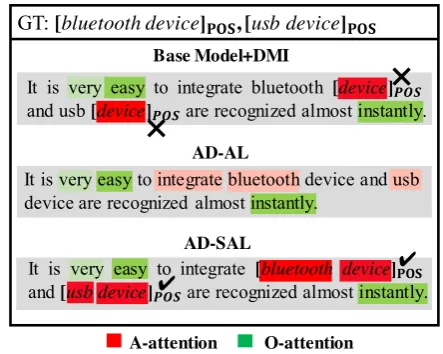
Figure 3: Visualization of attention for theR→Lpair.
4.6 Case Analysis
by the Base Model+DMI (e.g.,ports,devices), or wrongly identifies some non-aspect words (e.g.,
pc). The reason is that pure adversarial learn-ing treats all the words equally for the alignment, which may bring in noises of uninformative words into the shared feature space. To solve that, the full model AD-SAL performs a local semantic alignment to dynamically focus on aligning aspect words that contribute more to the domain-invariant feature space. Hence, AD-SAL model can pre-cisely and completely identity all the aspect terms and make correct unified tag predictions.
Moreover, in Figure 3, we visualize the at-tentions from these models, where deeper col-ors denote larger weights. Compared with the Base model+DMI, the full model AD-SAL can precisely attend the complete aspect words from the target domain (A-attention), i.e.,bluetooth de-viceandusb device, and make correct predictions, while the AL cannot achieve that. The AD-AL can only align all the words equally, which hinders the model to attend the aspect words, while the A-attention of the AD-SAL model can be used for both discriminative word tags predic-tions and acting as a learnable alignment weight for each word. This shows that the proposed SAL method can learn to align important aspect words to improve the transferability of the model for the fine-grained adaptation.
5 Related Works
E2E-ABSA can be broken into two sub-tasks, namely, aspect detection and aspect sentiment classification. The aspect detection aims to extract the aspect terms mentioned in the text and it has been actively studied (Qiu et al.,2011;Liu et al., 2015;Poria et al., 2016; Wang et al., 2016a;He et al., 2017;Wang et al., 2017;Majumder et al., 2018;Li et al.,2018b;Xu et al.,2018). The aspect sentiment classification is to predict the sentiment polarities of the given aspect terms and has also received a lot of attention recently (Dong et al., 2014;Tang et al.,2016;Wang et al.,2016b; Ma et al.,2017;Chen et al.,2017;Ma et al.,2018;He et al.,2018b;Li et al.,2018a,2019b). For practi-cal applications, a typipracti-cal way is to pipeline these two sub-tasks together, which becomes ineffective due to the accumulated errors across tasks. These two sub-tasks have strong couplings and thus a unified formulation (Mitchell et al., 2013;Zhang et al., 2015; Li et al., 2019a) to handle them
to-gether in an end-to-end manner becomes a more promising direction. Despite its importance, ex-isting studies are only exploring the performance in a single domain, while ignoring the transfer-ability across domains. To address this problem, unsupervised domain adaptation methods can be applied. While existing methods focus on tra-ditional cross-domain sentiment classification to learn shared representations for sentences or doc-uments, including pivot-based methods (Blitzer et al., 2007; Pan et al., 2010; Bollegala et al., 2013;Yu and Jiang,2016), auto-encoders (Glorot et al.,2011;Chen et al.,2012;Zhou et al.,2016), domain adversarial networks (Ganin et al.,2016; Li et al.,2017,2018c), or semi-supervised meth-ods (He et al., 2018a). Due to the difficulties in fine-grained adaptation, there exist very few meth-ods for cross-domain aspect extraction (Jakob and Gurevych, 2010; Ding et al., 2017), which acts as a sub-task of E2E-ABSA, or aspect and opin-ion co-extractopin-ion (Li et al., 2012;Wang and Pan, 2018) that focuses on detecting aspect and opinion words, while E2E-ABSA needs to analyze more complicated correspondences between them. Be-sides, those methods can only rely on general syn-tactic relations between aspect and opinion words to bridge the domains. Different from them, our method leverages the attention mechanism ( Bah-danau et al.,2014;Sukhbaatar et al., 2015;Shen et al.,2018,2019) as a dynamic selector to auto-matically achieve the selective alignment.
6 Conclusion
The effectiveness of supervised methods for E2E-ABSA is limited due to the data scarcity. Our wok is the first attempt to resolve cross-domain E2E-ABSA by leveraging knowledge from other related domains to enhance the sequence learning of the target domain. Extensive experiments show the effectiveness of the proposed SAL method. Ablation studies also prove the necessity to per-form selective alignment. In the future, the pro-posed SAL method can be potentially extended to other domain adaptation methods and applied to more general sequence labeling tasks includ-ing named entity recognition (Zhou et al.,2019c), part-of-speech tagging (Zhou et al.,2019a), etc.
Acknowledgement
References
Dzmitry Bahdanau, Kyunghyun Cho, and Yoshua Ben-gio. 2014. Neural machine translation by jointly learning to align and translate. arXiv preprint arXiv:1409.0473.
John Blitzer, Mark Dredze, and Fernando Pereira. 2007. Biographies, bollywood, boom-boxes and blenders: Domain adaptation for sentiment classi-fication. InACL, pages 440–447.
Danushka Bollegala, David Weir, and John Carroll. 2013. Cross-domain sentiment classification using a sentiment sensitive thesaurus. TKDE, pages 1719– 1731.
Minmin Chen, Zhixiang Xu, Fei Sha, and Kilian Q Weinberger. 2012. Marginalized denoising autoen-coders for domain adaptation. In ICML, pages 1627–1634.
Peng Chen, Zhongqian Sun, Lidong Bing, and Wei Yang. 2017. Recurrent attention network on mem-ory for aspect sentiment analysis. InEMNLP, pages 452–461.
Ying Ding, Jianfei Yu, and Jing Jiang. 2017. Recur-rent neural networks with auxiliary labels for cross-domain opinion target extraction. In AAAI, pages 3436–3442.
Li Dong, Furu Wei, Chuanqi Tan, Duyu Tang, Ming Zhou, and Ke Xu. 2014. Adaptive recursive neural network for target-dependent twitter sentiment clas-sification. InACL, pages 49–54.
Yaroslav Ganin, Evgeniya Ustinova, Hana Ajakan, Pascal Germain, Hugo Larochelle, Franc¸ois Lavi-olette, Mario Marchand, and Victor Lempitsky. 2016. Domain-adversarial training of neural net-works. JMLR, pages 2096–2030.
Xavier Glorot, Antoine Bordes, and Yoshua Bengio. 2011. Domain adaptation for large-scale sentiment classification: A deep learning approach. InICML, pages 513–520.
Ruidan He, Wee Sun Lee, Hwee Tou Ng, and Daniel Dahlmeier. 2017. An unsupervised neural attention model for aspect extraction. In ACL, pages 388– 397.
Ruidan He, Wee Sun Lee, Hwee Tou Ng, and Daniel Dahlmeier. 2018a. Adaptive semi-supervised learn-ing for cross-domain sentiment classification. In EMNLP, pages 3467–3476.
Ruidan He, Wee Sun Lee, Hwee Tou Ng, and Daniel Dahlmeier. 2018b. Exploiting document knowledge for aspect-level sentiment classification. In ACL, pages 579–585.
Minqing Hu and Bing Liu. 2004. Mining and summa-rizing customer reviews. InKDD, pages 168–177.
Niklas Jakob and Iryna Gurevych. 2010. Extracting opinion targets in a single-and cross-domain setting with conditional random fields. InEMNLP, pages 1035–1045.
Diederik P. Kingma and Jimmy Ba. 2014. Adam:
A method for stochastic optimization. CoRR, abs/1412.6980.
Ankit Kumar, Ozan Irsoy, Peter Ondruska, Mohit Iyyer, James Bradbury, Ishaan Gulrajani, Victor Zhong, Romain Paulus, and Richard Socher. 2016. Ask me anything: Dynamic memory networks for natural language processing. InICML, pages 1378– 1387.
Fangtao Li, Sinno Jialin Pan, Ou Jin, Qiang Yang, and Xiaoyan Zhu. 2012. Cross-domain co-extraction of sentiment and topic lexicons. InACL, pages 410– 419.
Xin Li, Lidong Bing, Wai Lam, and Bei Shi. 2018a. Transformation networks for target-oriented senti-ment classification. InACL, pages 946–956.
Xin Li, Lidong Bing, Piji Li, and Wai Lam. 2019a. A unified model for opinion target extraction and target sentiment prediction. InAAAI, pages 6714–6721.
Xin Li, Lidong Bing, Piji Li, Wai Lam, and Zhimou Yang. 2018b. Aspect term extraction with history attention and selective transformation. In IJCAI, pages 4194–4200.
Zheng Li, Ying Wei, Yu Zhang, and Qiang Yang. 2018c. Hierarchical attention transfer network for cross-domain sentiment classification. InAAAI.
Zheng Li, Ying Wei, Yu Zhang, Xiang Zhang, Xin Li, and Qiang Yang. 2019b. Exploiting coarse-to-fine task transfer for aspect-level sentiment classifi-cation. InAAAI, pages 4253–4260.
Zheng Li, Yu Zhang, Ying Wei, Yuxiang Wu, and Qiang Yang. 2017. End-to-end adversarial memory network for cross-domain sentiment classification. InIJCAI, pages 2237–2243.
Bing Liu. 2012. Sentiment analysis and opinion min-ing. Synthesis Lectures on Human Language Tech-nologies.
Pengfei Liu, Shafiq Joty, and Helen Meng. 2015. Fine-grained opinion mining with recurrent neural net-works and word embeddings. In EMNLP, pages 1433–1443.
Dehong Ma, Sujian Li, Xiaodong Zhang, and Houfeng Wang. 2017. Interactive attention networks for aspect-level sentiment classification. arXiv preprint arXiv:1709.00893.
Navonil Majumder, Soujanya Poria, Alexander Gel-bukh, Md. Shad Akhtar, Erik Cambria, and Asif Ek-bal. 2018. IARM: Inter-aspect relation modeling with memory networks in aspect-based sentiment analysis. InEMNLP, pages 3402–3411.
Tomas Mikolov, Ilya Sutskever, Kai Chen, Greg S Cor-rado, and Jeff Dean. 2013. Distributed representa-tions of words and phrases and their compositional-ity. InNIPS, pages 3111–3119.
Margaret Mitchell, Jacqui Aguilar, Theresa Wilson, and Benjamin Van Durme. 2013. Open domain tar-geted sentiment. InEMNLP, pages 1643–1654.
Lili Mou, Zhao Meng, Rui Yan, Ge Li, Yan Xu, Lu Zhang, and Zhi Jin. 2016. How transferable are neural networks in NLP applications? InEMNLP, pages 479–489.
Sinno Jialin Pan, Xiaochuan Ni, Jian-Tao Sun, Qiang Yang, and Zheng Chen. 2010. Cross-domain senti-ment classification via spectral feature alignsenti-ment. In WWW, pages 751–760.
Maria Pontiki, Dimitris Galanis, Haris Papageor-giou, Ion Androutsopoulos, Suresh Manandhar, AL-Smadi Mohammad, Mahmoud Al-Ayyoub, Yanyan Zhao, Bing Qin, Orph´ee De Clercq, et al. 2016. Semeval-2016 task 5: Aspect based sentiment anal-ysis. InSemEval, pages 19–30.
Maria Pontiki, Dimitris Galanis, Haris Papageorgiou, Suresh Manandhar, and Ion Androutsopoulos. 2015. Semeval-2015 task 12: Aspect based sentiment anal-ysis. InSemEval, pages 486–495.
Maria Pontiki, Dimitris Galanis, John Pavlopoulos, Harris Papageorgiou, Ion Androutsopoulos, and Suresh Manandhar. 2014. Semeval-2014 task 4: As-pect based sentiment analysis. In SemEval, pages 27–35.
Soujanya Poria, Erik Cambria, and Alexander F. Gel-bukh. 2016. Aspect extraction for opinion mining with a deep convolutional neural network. Knowl.-Based Syst., 108:42–49.
Guang Qiu, Bing Liu, Jiajun Bu, and Chun Chen. 2011. Opinion word expansion and target extraction through double propagation. Computational Lin-guistics, pages 9–27.
Tao Shen, Tianyi Zhou, Guodong Long, Jing Jiang, Shirui Pan, and Chengqi Zhang. 2018. Disan: Di-rectional self-attention network for rnn/cnn-free lan-guage understanding. InAAAI, pages 5446–5455.
Tao Shen, Tianyi Zhou, Guodong Long, Jing Jiang, and Chengqi Zhang. 2019. Tensorized self-attention: Efficiently modeling pairwise and global dependen-cies together. InNAACL, pages 1256–1266.
Sainbayar Sukhbaatar, arthur szlam, Jason Weston, and Rob Fergus. 2015. End-to-end memory networks. InNIPS, pages 2440–2448.
Duyu Tang, Bing Qin, and Ting Liu. 2016. Aspect level sentiment classification with deep memory net-work. arXiv preprint arXiv:1605.08900.
Cigdem Toprak, Niklas Jakob, and Iryna Gurevych. 2010. Sentence and expression level annotation of opinions in user-generated discourse. InACL, pages 575–584.
Wenya Wang and Sinno Jialin Pan. 2018. Recursive neural structural correspondence network for cross-domain aspect and opinion co-extraction. In ACL, pages 2171–2181.
Wenya Wang, Sinno Jialin Pan, Daniel Dahlmeier, and Xiaokui Xiao. 2016a. Recursive neural conditional random fields for aspect-based sentiment analysis. InEMNLP, pages 616–626.
Wenya Wang, Sinno Jialin Pan, Daniel Dahlmeier, and Xiaokui Xiao. 2017. Coupled multi-layer attentions for co-extraction of aspect and opinion terms. In AAAI, pages 3316–3322.
Yequan Wang, Minlie Huang, Li Zhao, et al. 2016b. Attention-based lstm for aspect-level sentiment clas-sification. InEMNLP, pages 606–615.
Hu Xu, Bing Liu, Lei Shu, and Philip S. Yu. 2018. Double embeddings and cnn-based sequence label-ing for aspect extraction. InACL, pages 592–598.
Jason Yosinski, Jeff Clune, Yoshua Bengio, and Hod Lipson. 2014. How transferable are features in deep neural networks? InNIPS, pages 3320–3328.
Jianfei Yu and Jing Jiang. 2016. Learning sentence em-beddings with auxiliary tasks for cross-domain sen-timent classification. InEMNLP, pages 236–246.
Meishan Zhang, Yue Zhang, and Duy Tin Vo. 2015. Neural networks for open domain targeted senti-ment. InEMNLP, pages 612–621.
Guangyou Zhou, Zhiwen Xie, Jimmy Xiangji Huang, and Tingting He. 2016. Bi-transferring deep neu-ral networks for domain adaptation. InACL, pages 322–332.
Joey Tianyi Zhou, Hao Zhang, Di Jin, and Xi Peng. 2019a. Dual adversarial transfer for sequence label-ing.TPAMI, pages 1–1.
Joey Tianyi Zhou, Hao Zhang, Di Jin, Xi Peng, Yang Xiao, and Zhiguo Cao. 2019b. Roseq: Robust se-quence labeling. IEEE Transactions on Neural Net-works and Learning Systems, pages 1–11.