Proceedings of the 2019 Conference on Empirical Methods in Natural Language Processing 5123
What You See is What You Get:
Visual Pronoun Coreference Resolution in Dialogues
Xintong Yu♥∗, Hongming Zhang♣∗, Yangqiu Song♣, Yan Song♠, and Changshui Zhang♥
♥
Institute for Artificial Intelligence, Tsinghua University (THUAI), Department of Automation, Tsinghua University
♣
Department of CSE, The Hong Kong University of Science and Technology
♠
Sinovation Ventures
[email protected], [email protected], [email protected], [email protected], [email protected]
Abstract
Grounding a pronoun to a visual object it refers to requires complex reasoning from var-ious information sources, especially in conver-sational scenarios. For example, when peo-ple in a conversation talk about something all speakers can see, they often directly use pro-nouns (e.g., it) to refer to it without previous introduction. This fact brings a huge chal-lenge for modern natural language understand-ing systems, particularly conventional context-based pronoun coreference models. To tackle this challenge, in this paper, we formally de-fine the task of visual-aware pronoun corefer-ence resolution (PCR) and introduce VisPro, a large-scale dialogue PCR dataset, to investi-gate whether and how the visual information can help resolve pronouns in dialogues. We then propose a novel visual-aware PCR model, VisCoref, for this task and conduct compre-hensive experiments and case studies on our dataset. Results demonstrate the importance of the visual information in this PCR case and show the effectiveness of the proposed model.
1 Introduction
The question of how human beings resolve pro-nouns has long been an attractive research topic in both linguistics and natural language process-ing (NLP) communities, for the reason that pro-noun itself has weak semantic meaning (Ehrlich, 1981) and the correct resolution of pronouns re-quires complex reasoning over various informa-tion. As a core task of natural language under-standing, pronoun coreference resolution (PCR) (Hobbs,1978) is the task of identifying the noun (phrase) that pronouns refer to. Compared with the general coreference resolution task, the string-matching methods are no longer effective for pro-nouns (Stoyanov et al.,2009), which makes PCR
∗ Equal contribution.
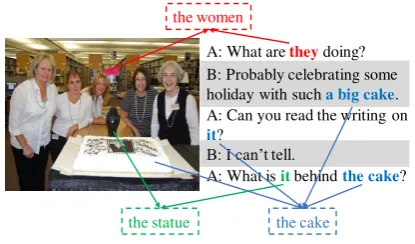
A: What are theydoing? B: Probably celebrating some holiday with such a big cake. A: Can you read the writing on
it?
B: I can’t tell.
A: What is itbehind the cake? the women
[image:1.595.313.521.230.352.2]the cake the statue
Figure 1: An example of a visual-related dialogue. Two people are discussing the view they can both see. Pro-nouns and noun phrases referring to the same entity are marked in same color. The first “it” in the dialogue la-beled with blue color refers to the object “the big cake” and the second “it” labeled with green color refers to the statue in the image.
more challenging than the general coreference res-olution task.
not even appear in a conversation, and thus one needs to ground the pronouns into something out-side the text, which is extremely challenging for conventional approaches purely based on human-designed rules (Raghunathan et al.,2010) or con-textual features (Lee et al.,2018).
A visual-related dialogue is shown in Figure1. Both A and B are talking about a picture, in which several people are celebrating something. In the dialogue, the first “it” refers to the “the big cake,” which is relatively easy for conventional models, because the correct mention just appears before the targeting pronoun. However, the second “it” refers to the statue in the image, which does not appear in the dialogue at all. Without the support of the visual information, it is almost impossible to identify the coreference relation between “it” and “the statue.”
In this work, we focus on investigating how vi-sual information can help better resolve pronouns in dialogues. To achieve this goal, we first cre-ate VisPro, a large-scale visual-supported PCR dataset. Different from existing datasets such as ACE (NIST,2003) and CoNLL-shared task ( Prad-han et al., 2012), VisPro is annotated based on dialogues discussing given images. In total, Vis-Pro contains annotations for 29,722 pronouns ex-tracted from 5,000 dialogues. Once the dataset is created, we formally define a new task, visual pronoun coreference resolution (Visual PCR), and design a novel visual-aware PCR model VisCoref, which can effectively extract information from im-ages and leverage them to help better resolve pro-nouns in dialogues. Particularly, we align men-tions in the dialogue with objects in the image and then jointly use the contextual and visual informa-tion for the final predicinforma-tion.
The contribution of this paper is three-folded: (1) we formally define the task of visual PCR; (2) we present VisPro, the first dataset that focuses on PCR in visual-supported di-alogues; (3) we propose VisCoref, a visual-aware PCR model. Comprehensive experi-ments and case studies are conducted to demon-strate the quality of VisPro and the effective-ness of VisCoref. The dataset, code, and mod-els are available at: https://github.com/
HKUST-KnowComp/Visual_PCR.
Figure 2: Example syntax parsing result of the sentence “A man with a dog is walking on the grass.”
2 The VisPro Dataset
To generate a high-quality and large-scale visual-aware PCR dataset, we select VisDial (Das et al., 2017) as the base dataset and invite annotators to annotate. In VisDial, each image is accompanied by a dialogue record discussing that image. One example is shown in Figure 1. In addition, Vis-Dial also provides a caption for each image, which brings more information for us to create VisPro1. In this section, we introduce the details about the dataset creation in terms of pre-processing, survey design, annotation, and post-processing.
2.1 Pre-processing
To make the annotation task clear to annotators and help them provide accurate annotation, we first extract all the noun phrases and pronouns with Stanford Parser (Klein and Manning, 2003) and then provide the extracted noun phrases as candi-date mentions to annotate on. To avoid the over-lap of candidate noun phrases, we choose noun phrases with a height of two in parse trees. One example is shown in Figure2. In the syntactic tree for the sentence “A man with a dog is walking on the grass,” we choose “A man,” “a dog” and “the grass” as candidates. If the height of noun phrases is not limited, then the noun phrase “A man with a dog” will cover “A man” and “a dog,” leading to confusion in the options.
Following (Strube and M¨uller,2003;Ng,2005), we only select third-person personal (it, he, she, they, him, her, them) and possessive pronouns (its, his, her, their) as the targeting pronouns. In to-tal, the VisPro dataset contains 29,722 pronouns of 5,000 dialogues selected from 133,351 dialogues in VisDial v1.0 (Das et al.,2017). We choose di-alogues in which the number of pronouns ranges from four to ten for the following reasons. For one thing, dialogues with few pronouns are of
Figure 3: Distribution of pronouns in VisPro.
tle use to the task. For another, dialogues with too many pronouns often contain repeating pronouns referring to the same object, which makes the task too easy. The dialogues selected contain 5.94 pro-nouns on average. Figure3 presents the distribu-tion of different pronouns. From the figure we can see that “it” and “they” are used most frequently in the dialogues.
2.2 Survey Design
We divide 29,722 pronouns from 5,000 dialogues into 3,304 surveys. In each survey, besides the normal questions, we also include one checkpoint question to control the annotation quality2. In to-tal, each survey contains ten questions (nine nor-mal questions and one checkpoint question). Each question is about one pronoun.
The survey consists of three parts. We begin by explaining the task to the annotators, including how to deal with particular cases such as multi-word expressions. Then, we present examples to help the annotators better understand the task. Fi-nally, we invite them to provide annotations for the pronouns in the dialogues.
One example of the annotation interface is shown in Figure4. The text and the image of the dialogue are displayed on the left and right panel, respectively. For each of the targeting pronoun, the workers are asked to select all the mentions that it refers to. If any of the noun phrases is se-lected, the reference type of the pronoun on the right panel will be set to “noun phrases in text” au-tomatically, and vice versa. If the concept that the pronoun refers to is not available in the options, or the pronoun is not referring to anything in
par-2We design the checkpoint dialogue straightforward and unambiguous such that any responsive worker can easily pro-vide the correct annotation.
Figure 4: Annotation interface on MTurk. Workers are asked to select the anaphoricity type of the highlighted pronoun in the right panel and all the antecedents of an anaphoric pronoun on the left panel.
ticular, workers are asked to choose “some con-cepts not present in text” or “the pronoun is non-referential” on the right panel accordingly. The nine normal questions in each survey are consecu-tive so that pronouns in the same dialogue are dis-played sequentially.
2.3 Annotation
We employ the Amazon Mechanical Turk plat-form (MTurk) for our annotations.
We require that our annotators have more than 1,000 approved tasks and a task approval rate more than 90%. They are also asked to pass a simple test of pronoun resolution to prove that they un-derstand the instruction of the task. Based on these criteria, we identify 186 valid annotators. For each dialogue, we invite at least four different workers to annotate. In total, we collect 122,443 annota-tions at a total cost of USD 3,270.80. We sup-port the multiple participation of annotators by en-suring that subsequent surveys are generated with their previously-unlabelled dialogues.
2.4 Post-processing
Before processing the annotation result, we first exclude the annotation of workers who fail to an-swer the checkpoint questions correctly. As a re-sult, 116,300 annotations are kept, which is 95% of the overall annotation results. We then decide the gold mentions that pronouns refer to using the following procedure:
[image:3.595.85.271.75.202.2]worker to find out the coreference clusters he annotates for each dialogue. To achieve this goal, we merge the intersecting sets of noun phrase antecedents for pronouns in the same di-alogue. We observe that annotators often make the right decision for noun phrases near the anaphor pronoun, but neglect antecedents far away. It also happens in the annotation of other coreference datasets (Chen et al.,2018). There-fore, we generate clusters from different pro-nouns in the same dialogue rather than merging antecedents for each pronoun separately. If an entity is mentioned and referred to by pronouns for multiple times in the dialogue, combining the antecedents for all pronouns could create a more accurate coreference cluster for the entity.
• Step two: We adjudicate the coreference clus-ters for the dialogue by majority voting within all workers.
• Step three: We then decide the anaphoric type of all pronouns by voting. If a pronoun is consid-ered to refer to somef noun phrases in the text, we find out the coreference cluster it belongs to and choose the noun phrases in the cluster that precede it as its antecedents.
• Step four: We randomly split the collected data into train/val/test sets of 4,000/500/500 di-alogues, respectively.
After collecting the data, we found out that 73.43% of pronouns act as an anaphor to some noun phrases, 5.67% of pronouns do not have a suitable antecedent, and the rest 20.90% are not referential. Among all the pronouns that have noun phrases as antecedents, 13.45% of them do not have an antecedent in the dialogue con-text.3 For anaphoric pronouns, each has 2.06 an-tecedents on average. In the end, we calculate the inner-annotator agreement (IAA) to demonstrate the quality of the resulting dataset. Following con-ventional approaches (Pradhan et al., 2012), we use the average MUC score between individual workers and the adjudication result as the evalu-ation metric. The final IAA score is 72.4, which indicates that the workers can clearly understand our task and provide reliable annotation.
3The antecedent labeled by the worker is provided by the caption.
is he wearing What
Object Detection
man A
+
?
[image:4.595.314.524.72.225.2]
Person Pizza
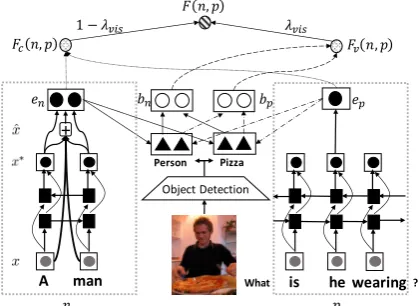
Figure 5: Overall structure of the VisCoref model. Text embeddingeis acquired via LSTM and inner-span at-tention mechanism. Object labels are detected from the image and the possibilitybof each text span referring to them is calculated. The contextual and visual score
Fc(n, p)andFv(n, p)are calculated upon the features,
and the final scoreF(n, p)is their weighted sum.
3 The Task
In this work, we focus on jointly leveraging the contextual and visual information to resolve pro-nouns. Thus, we formally define the visual-aware pronoun coreference resolution as follows:
Given an image I, a dialogue record Dwhich discusses the content inI, and an external mention set M, for any pronounp that appears inD, the goal is to optimize the following objective:
J =
P
c∈CeF(c,p,I,D) P
s∈SeF(s,p,I,D)
, (1)
where F(·) is the overall scoring function of p refers to c given I and D. c and s denote the correct mention and the candidate mention, andC andS denote the correct mention set and the can-didate mention set, respectively. Note that in the case where no golden mentions are annotated, the union of all possible spans inDandMare used to formS.
4 The Model
The overall framework of the proposed model Vis-Coref is presented in Figure 5. In VisCoref, we want to leverage both the contextual and visual in-formation to resolve pronouns. Thus we split the scoring function into two parts as follows:
F(n, p) = (1−λvis)·Fc(n, p) +λvis·Fv(n, p),
where Fc(·) and Fv(·) are the scoring functions
based on contextual and visual information re-spectively. λvis is the hyper-parameter to control
the importance of visual information in the model. The details of the two scoring functions are de-scribed in the following subsections.
4.1 Contextual Scoring
Before computingFc, we first need to encode the
contextual information into all the candidates and targeting pronouns through a mention representa-tion module, which is shown as the dotted box in Figure5.
Following (Lee et al.,2018), a standard bidirec-tional LSTM (BiLSTM) (Hochreiter and Schmid-huber,1997) is used to encode each span with at-tentions (Bahdanau et al., 2015). Assume initial embeddings of words in a span si are denoted as
x1, ...,xT, and their encoded representation after
BiLSTM asx∗
1, ...,x∗T, the weighted embeddings
of each spanxˆiare obtained by
ˆ xi =
T
X
t=1
at·xt, (3)
whereatis the inner-span attention computed by
at=
eαt PT
k=1eαk
, (4)
in whichαtis obtained by a standard feed-forward
neural network4αt=N Nα(x∗t).
After that, we concatenate the embeddings of the starting word (x∗start) and the ending word
(x∗
end) of each span, as well as its weighted
em-bedding (ˆxi) and the length feature (φ(i)) to form
its final representatione:
ei= [x∗start,x∗end,xˆi, φ(i)]. (5)
On top of the extracted mention representation, we then compute the contextual score as follows:
Fc(n, p) =N Nc([ep,en,ep⊙en]), (6)
where[ ]represents the concatenation,epanden
are the mention representation of the targeting pro-noun and current candidate mention, and ⊙ indi-cates the element-wise multiplication.
4We use
N Nto represent feed-forward neural networks.
4.2 Visual Scoring
In order to align mentions in the text with objects in the image, the first step of leveraging the visual information is to recognize the objects from the picture. We use a object detection module to iden-tify object labels from each imageI, such as “per-son,” “car,” or “dog.” After that, we convert the identified labels into vector representations fol-lowing the same encoding process in4.1. For each image, we add a label “null,” indicating that the pronoun is referring to none of the detected ob-jects inI. We denote the resulting embeddings as
ec
1,ec2, ...,ecK, in whichci denotes the detected labels, andKis the total number of unique labels in the corresponding image.
After extracting objects from the image, we would like to know whether the mentions are re-ferring to them. To achieve this goal, we calculate the possibility of a mention ni corresponding to
each detected objectck:
βni,ck = NNβ(NNo(eni)⊙NNo(eck)). (7)
Then we take the softmax ofβni,ckas the final pos-sibility ofnialigned with the object labelck:
bni,ck =
eβni,ck
PK
l=1eβni,cl
. (8)
If ni corresponds to a certain object in I, the
score of that label should be large. Otherwise, the possibility of “null” should be the largest. There-fore, we use the maximum of possibility scores among allKclasses except “null”
mi= max
k=1,...,Kbni,ck (9)
as the probability ofnirelated to some object inI.
Similarly, given two mentionsniandnj, if they
refer to the same detected object ck, then both
bni,ck andbnj,ckshould be large. Thus, we can use the maximum of their product among all K classes except “null”
mi,j = max k=1,...,Kbni,ck
·bnj,ck (10)
as the probability ofniandnj related to the same
object inI.
In the end, we define the visual scoring function as follows:
Fv(n, p) =N Nv([mp, mn, mp·mn, mp,n]).
5 The Experiment
In this section, we introduce the implementation details, experiment setting, and baseline models.
5.1 Experiment Setting
As introduced in Section 2.4, we randomly split the data into training, validation, and test sets of 4,000, 500, and 500 dialogues, respectively. For each dialogue, a mention pool of size 30 is pro-vided for models to detect plausible mentions out-side the dialogue. The pool contains both men-tions extracted from the corresponding caption and randomly selected negative mention samples from other captions. All models are evaluated based on the precision (P), recall (R), and F1 score. Last but not least, we split the test dataset by whether the correct antecedents of the pronoun appear in the dialogue or not. We denote these two groups as “Discussed” and “Not Discussed.”
5.2 Implementation Details
Following previous work (Lee et al., 2018), we use the concatenation of the 300d GloVe embed-ding (Pennington et al.,2014) and the ELMo ( Pe-ters et al., 2018) embedding as the initial word representations. Out-of-vocabulary words are initialized with zero vectors. We adopt the “ssd resnet 50 fpn coco” model from Tensorflow detection model zoo5as the object detection mod-ule. The size of hidden states in the LSTM module is set to 200, and the size of the projected embed-ding for computing similarity between text spans and object labels is 512. The feed-forward net-works for contextual scoring and visual scoring have two 150-dimension hidden layers and one 100-dimension hidden layer, respectively.
For model training, we use cross-entropy as the loss function and Adam (Kingma and Ba, 2015) as the optimizer. All the parameters are initialized randomly. Each mention selects the text span of the highest overall score among all previous text spans in the dialogue or the mention pool as its antecedent, so that all mentions in one dialogue are clustered into several coreference chains. The noun phrases in the same coreference cluster as a pronoun are deemed as the predicted antecedents of that pronoun. The models are trained with up to 50,000 steps, and the best one is selected based on its performance on the validation set.
5https://github.com/tensorflow/models/
tree/master/research/object_detection
5.3 Baseline Methods
Since we are the first to proposed a visual-aware model for pronoun coreference resolution, we compare our results with existing models of gen-eral coreference resolution.
• Deterministic model (Raghunathan et al.,2010) is a rule-based system that aggregates multiple functions for determining whether two mentions are coreferent based on hand-craft features.
• Statistical model (Clark and Manning, 2015) learns upon human-designed entity-level fea-tures between clusters of mentions to produce accurate coreference chains.
• Deep-RL model (Clark and Manning,2016) ap-plies reinforcement learning to mention-ranking models to form coreference clusters.
• End-to-end model (Lee et al.,2018) is the state-of-the-art method of coreference resolution. It predicts coreference clusters via an end-to-end neural network that leverages pretrained word embeddings and contextual information.
Last but not least, to demonstrate the effective-ness of the proposed model, we also present a vari-ation of the End-to-end model, which can also use the visual information, as an extra baseline:
• End-to-end+Visual first extracts features from images with ResNet-152 (He et al.,2016). Then it concatenates the image feature with the con-textual feature in the original End-to-end model together to make the final prediction.
As the Deterministic, Statistical, and Deep-RL model are included in the Stanford CoreNLP toolkit6, we use their released model as baselines. For the End-to-end model, we also use their re-leased code7.
6 The Result
The experimental results are shown in Table 1. Our proposed model VisCoref outperforms all the baseline models significantly, which indicates that the visual information is crucial for resolving pro-nouns in dialogues. Besides that, we also have the following interesting findings:
6https://stanfordnlp.github.io/
CoreNLP/coref.html
Model Discussed Not Discussed Overall
P R F1 P R F1 P R F1
Deterministic 61.16 25.54 36.03 17.39 8.26 11.20 56.65 24.01 33.73
Statistical 79.37 26.65 39.90 6.10 1.03 1.77 76.18 24.23 36.76
Deep-RL 72.69 26.97 39.35 32.86 14.46 20.09 68.51 25.93 37.62
End-to-end 89.65 63.69 74.47 67.33 64.76 66.02 86.94 63.79 73.59
End-to-end+Visual 89.78 66.31 76.28 65.17 62.38 63.75 86.91 65.95 74.99
Viscoref 85.95 72.45 78.63 67.04 71.67 69.28 83.78 72.38 77.66
[image:7.595.84.519.63.213.2]Human 95.03 81.82 87.93 86.18 93.57 89.73 94.02 82.91 88.12
Table 1: Experimental results on VisPro. Precision (P), recall (R) and F1 scores are presented. The best performed F1 scores are indicated with bold font.
1. For all the conventional models, the “Not Dis-cussed” pronouns whose antecedents are absent in dialogues are more challenging than “Dis-cussed” pronouns whose antecedents appear in the dialogue context. The reason behind is that if the correct mentions appear in the near con-text of pronouns, the information about the cor-rect mention can be aggregated to the targeting pronoun through either human-designed rules or deep neural networks (Bi-LSTM). However, when the correct mention is not available in the near context, it is quite challenging for conven-tional models to understand the dialogue and correctly ground the pronoun to the object both speakers can see, as they do not have the sup-port of visual information.
2. As is shown in the result of the “End-to-end+Visual” model, simply concatenating the visual feature to the contextual feature can help resolve “Discussed” pronouns but may hurt the performance of the model on “Not Discussed” pronouns. Different from them, the proposed Viscoref can improve the resolution of both the “Discussed” and “Not Discussed” pronouns. There are mainly two reasons behind: (1) The visual information in our model is first con-verted into textual labels and then transformed into vector representation in the same way as the dialogue context. Thus the vector space of contextual and visual information is perfectly aligned. (2) We introduce a hyper-parameter λvisto balance the influence of different
knowl-edge resources.
3. Even though our model outperforms all the baseline methods, we still can observe a huge
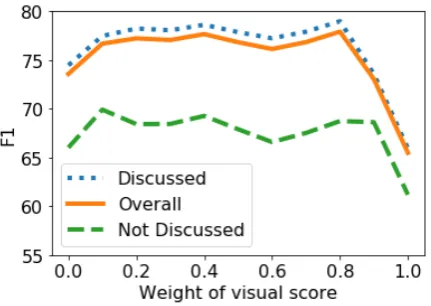
Figure 6: Effect ofλvis. F1 scores of all categories are
reported.
gap between our model and human being. It in-dicates that current models still cannot fully un-derstand the dialogue even with the support of visual information and further proves the value and necessity of proposing VisPro.
6.1 Hyper-parameter Analysis
We traverse different weights of visual and con-textual information from 0 to 1, and the result is shown in Figure 6. Along with the increase of λvis, our model puts more weight on the visual
in-formation. As a result, our model can perform bet-ter. However, when our model focuses too much on the visual information (whenλvisequals to 0.9
[image:7.595.310.526.266.419.2]Correct Antecedent a blue, white and red train
Prediction by End-to-end any writing
Prediction by VisCoref a blue, white and red train Dialogue A: Any writing or numbers on it? B: Yes - but it is too small to read. A: Are there peopleat the station? B: There is 1 lonely guy.
Mention pool from corresponding caption
a blue, white and red train; a train station
Mention pool from other captions
a reader, a hard court, men, a pair of scissors, legs, a woman skiing, his cellphone,
a killer, a champagne glass, a pink vase, a flower arrangement, a toy stroller, etc.
a blue, white and red train
people
1 lonely guy
it any writing
(a)
Correct Antecedent 2 zebras
Prediction by End-to-end the people
Prediction by VisCoref 2 zebras Dialogue A: Are theystanding on green grass ? B: No .
A: Are they standing on dirt? B: Yes .
A: Are they the only 2animals you see ? B: Yes .
Mention pool from corresponding caption
2 zebras, each other, their necks
Mention pool from other captions
the people, a paved road, large vehicles, a pedestrian, few people, her hands, a yellow motorcycle, the walls, skis and mountains, the beds, a black and silver fire, etc. 2 zebras
the people
they
[image:8.595.90.518.74.238.2](b)
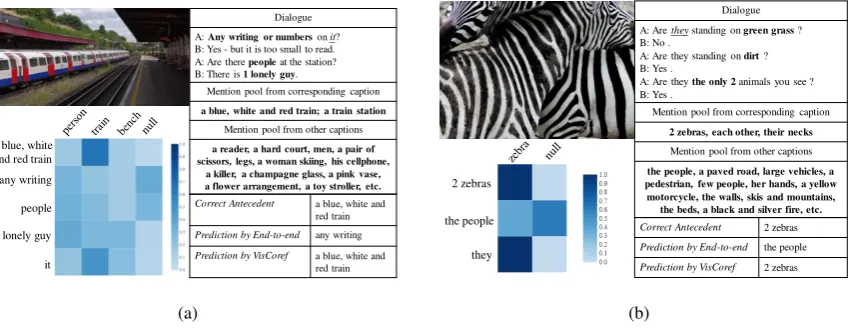
Figure 7: Randomly selected examples from VisPro. The image, dialogue record, prediction result, and heatmap of the mention-object similarity are provided. We indicate the target pronoun with theunderlined italicsfont and the candidate mentions withboldfont. Only relevant parts of dialogues are presented. The row of the heatmap represents mentions in the context, and the column means detected object labels from the image.
6.2 Case Study
To further investigate how visual information can help solve PCR, we randomly select two examples and show the prediction results of VisCoref and End-to-end model in Figure7.
In the first example in Figure 7(a), given the pronoun “it,” the End-to-end model picks “any writing” from the dialogue, while the VisCoref model chooses “a blue, white and red train” from the candidate mention sets. Without looking at the picture, we cannot distinguish between these two candidates. However, when the picture is taken into consideration, we observe that there is a train in the image and thus “a blue, white and red train” is a more suitable choice, which proves the im-portance of visual information. A similar situa-tion happens in Figure7(b), where the End-to-end model connects “they” to “the people” but there is no human being in the image at all. On the contrary, as VisPro can effectively leverage the vi-sual information and make the decision that “they” should refer to “2 zebras.”
7 Related Work
In this section, we introduce the related work about pronoun coreference resolution and visual-aware natural language processing problems.
7.1 Pronoun Coreference Resolution
As one core task of natural language understand-ing, pronoun coreference resolution, the task of identifying mentions in text that the targeting
pro-noun refers to, plays a vital role in many down-stream applications in natural language process-ing, such as machine translation (Guillou,2012), summarization (Steinberger et al., 2007) and in-formation extraction (Edens et al., 2003). Tra-ditional studies focus on resolving pronouns in expert-annotated formal textual dataset such as ACE (NIST,2003) or OntoNotes (Pradhan et al., 2012). However, models that perform well on these datasets might not perform as well in other scenarios such as dialogues due to the informal language and the lack of essential information (e.g., the shared view of two speakers). In this work, we thus focus on the PCR in dialogues and show that the information contained in the shared view can be crucial for understanding the dia-logues and correctly resolving the pronouns.
7.2 Visual-aware NLP
dataset, and introduce VisCoref to demonstrate how to leverage information hidden in the shared view to resolve pronouns in dialogues better and thus understand the dialogues better.
Another related work is the comprehension of referring expressions (Mao et al.,2016), which is inferring the object in an image that an expres-sion describes. However, the task is formulated on isolated noun phrases specially designed for dis-criminative descriptions without putting them into a meaningful context. Instead, our task focuses on resolving pronouns in dialogues based on im-ages as the shared view, which enhances the un-derstanding of dialogues based on the comprehen-sion of exprescomprehen-sions and images.
8 Conclusion
In this work, we formally define the task of visual pronoun coreference resolution (PCR) and present VisPro, the first large-scale visual-supported pro-noun coreference resolution dataset. Different from conventional pronoun datasets, VisPro fo-cuses on resolving pronouns in dialogues which discusses a view that both speakers can see.
Moreover, we also propose VisCoref, the first visual-aware PCR model that aligns contextual in-formation with visual inin-formation and jointly uses them to find the correct objects that the targeting pronouns refer to. Extensive experiments demon-strate the effectiveness of the proposed model. Further case studies also demonstrate that jointly using visual information and contextual informa-tion is an essential path for fully understanding hu-man language, especially dialogues.
Acknowledgements
This paper was supported by Beijing Academy of Artificial Intelligence (BAAI), the Early Ca-reer Scheme (ECS, No. 26206717) from Research Grants Council in Hong Kong, and the Tencent AI Lab Rhino-Bird Focused Research Program.
References
Stanislaw Antol, Aishwarya Agrawal, Jiasen Lu, Mar-garet Mitchell, Dhruv Batra, C. Lawrence Zitnick, and Devi Parikh. 2015. VQA: visual question an-swering. In Proceedings of ICCV, pages 2425– 2433.
Dzmitry Bahdanau, Kyunghyun Cho, and Yoshua Ben-gio. 2015. Neural machine translation by jointly
learning to align and translate. In Proceedings of ICLR.
Hong Chen, Zhenhua Fan, Hao Lu, Alan L. Yuille, and Shu Rong. 2018. Preco: A large-scale dataset in preschool vocabulary for coreference resolution. In
Proceedings of EMNLP, pages 172–181.
Kevin Clark and Christopher D. Manning. 2015. Entity-centric coreference resolution with model stacking. InProceedings of ACL, pages 1405–1415.
Kevin Clark and Christopher D. Manning. 2016. Deep reinforcement learning for mention-ranking coref-erence models. In Proceedings of EMNLP, pages 2256–2262.
Abhishek Das, Satwik Kottur, Khushi Gupta, Avi Singh, Deshraj Yadav, Jos´e M. F. Moura, Devi Parikh, and Dhruv Batra. 2017. Visual dialog. In
Proceedings of CVPR, pages 1080–1089.
Richard J. Edens, Helen L. Gaylard, Gareth J. F. Jones, and Adenike M. Lam-Adesina. 2003. An investiga-tion of broad coverage automatic pronoun resoluinvestiga-tion for information retrieval. InProceedings of SIGIR, pages 381–382.
Kate Ehrlich. 1981. Search and inference strategies in pronoun resolution: an experimental study. In Pro-ceedings of ACL, pages 89–93.
Liane Guillou. 2012. Improving pronoun translation for statistical machine translation. In Proceedings of EACL, pages 1–10.
Kaiming He, Xiangyu Zhang, Shaoqing Ren, and Jian Sun. 2016. Deep residual learning for image recog-nition. InProceedings of CVPR, pages 770–778.
Jerry R Hobbs. 1978. Resolving pronoun references.
Lingua, 44(4):311–338.
Sepp Hochreiter and J¨urgen Schmidhuber. 1997. Long short-term memory. Neural computation, 9(8):1735–1780.
Diederik P. Kingma and Jimmy Ba. 2015. Adam: A method for stochastic optimization. InProceedings of ICLR.
Dan Klein and Christopher D. Manning. 2003. Accu-rate unlexicalized parsing. InProceedings of ACL, pages 423–430.
Satwik Kottur, Jos´e M. F. Moura, Devi Parikh, Dhruv Batra, and Marcus Rohrbach. 2018. Visual corefer-ence resolution in visual dialog using neural module networks. InProceedings of ECCV, pages 160–178.
Junhua Mao, Jonathan Huang, Alexander Toshev, Oana Camburu, Alan L. Yuille, and Kevin Murphy. 2016. Generation and comprehension of unambiguous ob-ject descriptions. In Proceedings of CVPR, pages 11–20.
Vincent Ng. 2005. Supervised ranking for pronoun res-olution: Some recent improvements. InProceedings of AAAI, pages 1081–1086.
US NIST. 2003. The ace 2003 evaluation plan. US National Institute for Standards and Technology (NIST), pages 2003–08.
Jeffrey Pennington, Richard Socher, and Christo-pher D. Manning. 2014. Glove: Global vectors for word representation. In Proceedings of EMNLP, pages 1532–1543.
Matthew E. Peters, Mark Neumann, Mohit Iyyer, Matt Gardner, Christopher Clark, Kenton Lee, and Luke Zettlemoyer. 2018. Deep contextualized word rep-resentations. InProceedings of NAACL-HLT, pages 2227–2237.
Sameer Pradhan, Alessandro Moschitti, Nianwen Xue, Olga Uryupina, and Yuchen Zhang. 2012. Conll-2012 shared task: Modeling multilingual unre-stricted coreference in ontonotes. InProceedings of EMNLP-CoNLL, pages 1–40.
Karthik Raghunathan, Heeyoung Lee, Sudarshan Ran-garajan, Nate Chambers, Mihai Surdeanu, Dan Ju-rafsky, and Christopher D. Manning. 2010. A multi-pass sieve for coreference resolution. In Proceed-ings of EMNLP, pages 492–501.
Josef Steinberger, Massimo Poesio, Mijail A. Kabad-jov, and Karel Jezek. 2007. Two uses of anaphora resolution in summarization.Inf. Process. Manage., 43(6):1663–1680.
Veselin Stoyanov, Nathan Gilbert, Claire Cardie, and Ellen Riloff. 2009. Conundrums in noun phrase coreference resolution: Making sense of the state-of-the-art. InProceedings of ACL, pages 656–664.
Michael Strube and Christoph M¨uller. 2003. A ma-chine learning approach to pronoun resolution in spoken dialogue. In Proceedings of ACL, pages 168–175.
Kelvin Xu, Jimmy Ba, Ryan Kiros, Kyunghyun Cho, Aaron C. Courville, Ruslan Salakhutdinov, Richard S. Zemel, and Yoshua Bengio. 2015. Show, attend and tell: Neural image caption generation with visual attention. In Proceedings of ICML, pages 2048–2057.
Hongming Zhang, Yan Song, and Yangqiu Song. 2019a. Incorporating context and external knowl-edge for pronoun coreference resolution. In Pro-ceedings of NAACL-HLT, pages 872–881.