Proceedings of the 2019 Conference on Empirical Methods in Natural Language Processing
1962
CoSQL: A Conversational Text-to-SQL Challenge Towards
Cross-Domain Natural Language Interfaces to Databases
Tao Yu† Rui Zhang† He Yang Er† Suyi Li† Eric Xue† Bo Pang† Xi Victoria Lin¶ Yi Chern Tan† Tianze Shi§ Zihan Li‡ Youxuan Jiang‡
Michihiro Yasunaga† Sungrok Shim† Tao Chen† Alexander Fabbri† Zifan Li† Luyao Chen‡ Yuwen Zhang‡ Shreya Dixit† Vincent Zhang† Caiming Xiong¶ Richard Socher¶ Walter S. Lasecki‡ Dragomir Radev†
†Yale University¶Salesforce Research
‡University of Michigan§Cornell University
{tao.yu, r.zhang, dragomir.radev}@yale.edu
{xilin, cxiong, rsocher}@salesforce.com
Abstract
We present CoSQL, a corpus for building cross-domain, general-purpose database (DB) querying dialogue systems. It consists of 30k+ turns plus 10k+ annotated SQL queries, ob-tained from a Wizard-of-Oz (WOZ) collection of 3k dialogues querying 200 complex DBs spanning 138 domains. Each dialogue simu-lates a real-world DB query scenario with a crowd worker as a user exploring the DB and a SQL expert retrieving answers with SQL, clarifying ambiguous questions, or otherwise informing of unanswerable questions. When user questions are answerable by SQL, the ex-pert describes the SQL and execution results to the user, hence maintaining a natural interac-tion flow. CoSQL introduces new challenges compared to existing task-oriented dialogue datasets: (1) the dialogue states are grounded in SQL, a domain-independent executable rep-resentation, instead of domain-specific slot-value pairs, and (2) because testing is done on unseen databases, success requires generaliz-ing to new domains. CoSQL includes three tasks: SQL-grounded dialogue state tracking, response generation from query results, and user dialogue act prediction. We evaluate a set of strong baselines for each task and show that CoSQL presents significant challenges for future research. The dataset, baselines, and leaderboard will be released at https:// yale-lily.github.io/cosql.
1 Introduction
Natural language interfaces to databases (NLIDB) have been studied extensively, with a multitude of different approaches introduced over the past few decades. To this end, considerable progress has been made in querying data via natural language (NL). However, most NL query systems expect the
D1 : Database about student dormitories containing 5 tables
Q1 :
S1 :
A1 : (Result table with many entries)
R1 :
Q2 :
S2 :
A2 : (Result table with many entries)
R2 :
Q3 :
R3 :
Q4 :
S4 :
A4 : Fawlty Towers
R4 :
Q8 :
R8 :
SELECT T1.dorm_name FROM dorm AS T1 JOIN has_amenity AS T2 ON T1.dormid = T2.dormid JOIN dorm_amenity AS T3 ON T2.amenid = T3.amenid WHERE T3.amenity_name = ‘TV Lounge’ EXCEPT SELECT T1.dorm_name FROM dorm AS T1 JOIN has_amenity AS T2 ON T1.dormid = T2.dormid JOIN dorm_amenity AS T3 ON T2.amenid = T3.amenid WHERE T3.amenity_name = ‘Study Room’
What are the names of all the dorms? INFORM_SQL
This is the list of the names
of all the dorms. CONFIRM_SQL
SELECT dorm_name FROM dorm
Which of those dorms have a TV lounge? INFORM_SQL
This shows the names of dorms
with TV lounges. CONFIRM_SQL
SELECT T1.dorm_name FROM dorm AS T1 JOIN has_amenity AS T2 ON T1.dormid = T2.dormid JOIN dorm_amenity AS T3 ON T2.amenid = T3.amenid WHERE T3.amenity_name = ‘TV Lounge’
What dorms have no study
rooms as amenities? AMBIGUOUS
Do you mean among those
with TV Lounges? CLARIFY
Yes. AFFIRM
Fawlty Towers is the name of the dorm that has a TV lounge but not a study room as an amenity.
CONFIRM_SQL
...
Thanks! THANK_YOU
[image:1.595.309.527.263.587.2]You are welcome. WELCOME
Figure 1: A dialog from the CoSQL dataset. Gray boxes separate the user inputs (Qi) querying the database (Di) from the SQL queries (Si), returned an-swers (Ai), and expert responses (Ri). Users send an input to the expert, who writes the corresponding SQL query (only seen by the expert) if possible and sends an answer and response description back. Dialogue acts are on the right-hand side (e.g.,Q3is “ambiguous” and
R3is “clarify”).
Wang et al.,2018;Yu et al.,2018b,c). In reality, complex questions are usually answered through interactive exchanges (Figure 1). Even for sim-ple queries, peosim-ple tend to explore the database by asking multiple basic, interrelated questions (Hale,2006;Levy,2008;Frank,2013;Iyyer et al., 2017). This requires systems capable of sequen-tially processing conversational requests to ac-cess information in relational databases. To drive the progress of building a context-dependent NL query system, corpora such as ATIS (Hemphill et al.,1990;Dahl et al.,1994) and SParC (Yu et al., 2019)1 have been released. However, these cor-pora assume all user questions can be mapped into SQL queries and do not include system responses. Furthermore, in many cases, multi-turn interac-tion between users and NL systems is needed to clarify ambiguous questions (e.g., Q3 andR3 in
Figure1), verify returned results, and notify users of unanswerable or unrelated questions. There-fore, a robust dialogue-based NL query agent that can engage with users by forming its own responses has become an increasingly necessary component for the query process. Such systems have already been studied under task-oriented dia-logue settings by virtue of continuous effort of cor-pus creation (Seneff and Polifroni, 2000; Walker et al., 2002; Raux et al., 2005; Mrksic et al., 2015;Asri et al.,2017;Budzianowski et al.,2018) and modelling innovation (Artzi and Zettlemoyer, 2011; Henderson et al., 2013; Lee and Dernon-court, 2016; hao Su et al., 2016; Dhingra et al., 2016;Li et al., 2016; Mrksic et al., 2017). The goal of these systems is to help users accomplish a specific task, such as flight or hotel booking or transportation planning. However, to achieve these goals, task-oriented dialogue systems rely on pre-defined slots and values for request pro-cessing (which can be represented using simple SQL queries consisting of SELECT and WHERE
clauses). Thus, these systems only operate on a small number of domains and have difficulty cap-turing the diverse semantics of practical user ques-tions.
In contrast, the goal of dialogue-based NLIDB systems is to support general-purpose exploration and querying of databases by end users. To do so, these systems must possess the ability to (1) de-tect questions answerable by SQL, (2) ground user
1SParC task is available at https://yale-lily.
github.io/sparc
questions into executable SQL queries if possible, (3) return results to the user in a way that is eas-ily understood and verifiable, and (4) handle unan-swerable questions. The difficulty of constructing dialogue-based NLIDB systems stems from these requirements. To enable modeling advances in this field, we introduce CoSQL, the first large-scale cross-domainConversational text-to-SQLcorpus collected under the WOZ setting (Budzianowski et al., 2018). CoSQL contains 3,007 dialogues (more than 30k turns with annotated dialogue acts and 10k expert-labeled SQL queries) querying 200 complex DBs spanning across 138 different do-mains. For each dialogue, we follow the WOZ set-up that involves a crowd worker as a DB user and a college computer science student who is familiar with SQL as an expert (§3).
Like Spider2 (Yu et al.,2018c) and SParC (Yu et al., 2019), the cross-domain setting in CoSQL enables us to test the ability of systems to gener-alize on querying different domains via dialogues. We split the dataset in a way that each database only appears in one of train, development, or test set. This setting requires systems to generalize to new domains without additional annotation.
More importantly, unlike most prior work in text-to-SQL systems, CoSQL demonstrates greater language diversity and more frequent user focus changes. It also includes a significant amount of questions that require user clarifica-tion and quesclarifica-tions that cannot be mapped to SQL queries, introducing the potential to evaluate text-to-SQL dialog act prediction. These features pose new challenges for text-to-SQL systems. More-over, CoSQL includes system responses that de-scribe SQL queries and the returned results in a way that is easy for users with different back-grounds to understand and verify, as faithful and comprehensible presentation of query results is a crucial component of any NLIDB system.3
We introduce three challenge tasks on CoSQL: (1) SQL-grounded dialogue state tracking to map user utterances into SQL queries if possible given the interaction history (§5.1), (2) natural language response generation based on an ex-ecuted SQL and its results for user verification
2Spider task is available at https://yale-lily.
github.io/spider 3
The DB community has developed query
visualiza-tion (Li and Jagadish,2014) and other techniques to provide
(§5.2) and (3) user dialogue act prediction to detect and resolve ambiguous and unanswerable questions (§5.3). We provide detailed data anal-ysis and qualitative examples (§4). For each of the three tasks, we benchmark several competitive baseline models (§6). The performances of these models indicate plenty of room for improvement.
2 Related Work
Text-to-SQL generation Text-to-SQL genera-tion has been studied for decades in both DB and NLP communities. (Warren and Pereira, 1982; Zettlemoyer and Collins, 2005; Popescu et al., 2003;Li et al.,2006;Li and Jagadish,2014;Iyer et al., 2017;Zhong et al., 2017;Xu et al., 2017; Yu et al.,2018a;Dong and Lapata,2018; Finegan-Dollak et al.,2018;Guo et al.,2019;Bogin et al., 2019). However, the majority of previous work fo-cus on converting a single, complex question into its corresponding SQL query. Only a few datasets have been constructed for the purpose of mapping context-dependent questions to structured queries. Price (1990); Dahl et al. (1994) collected ATIS that includes series of questions from users inter-acting with a flight database.Yu et al.(2019) intro-duced SParC, a large cross-domain semantic pars-ing in context dataset, consistpars-ing of 4k question sequences with 12k questions annotated with SQL queries over 200 complex DBs. Similar to ATIS, SParC includes sequences of questions instead of conversational interactions. An NL question and its corresponding SQL annotation in SParC are constructed by the same expert. Recent works (Suhr et al., 2018;Zhang et al., 2019) have built context-dependent text-to-SQL systems on top of these datasets.
In contrast, CoSQL was collected under a WOZ setting involving interactions between two parties, which contributes to its diverse semantics and dis-course covering most types of conversational DB querying interactions (e.g. the system will ask for clarification of ambiguous questions, or inform the user of unanswerable and irrelevant questions). Also, CoSQL includes a natural language system response for the user to understand and verify the systems actions.
Task-oriented dialog systems Task-oriented di-alog systems (Henderson et al., 2014;Wen et al., 2016; Mrkˇsi´c et al., 2017; Budzianowski et al., 2018) have attracted increasing attention espe-cially due to their commercial values. The goal
is to help users accomplish a specific task such as hotel reservation, flight booking, or travel infor-mation. These systems (Bordes and Weston,2017; Zhong et al., 2018; Wu et al., 2019) often pre-define slot templates grounded to domain-specific ontology, limiting the ability to generalize to un-seen domains. In comparison, our work is to build a system for general-purpose DB exploration and querying. The domain-independent intent repre-sentation (SQL query) enables the trained system to work on unseen domains (DB schemas).
While most task-oriented dialog systems need to actively poke the user for information to fill in pre-defined slot-value pairs, the primary goal of system responses in CoSQL is to offer users a re-liable way to understand and verify the returned results. If a question can be converted into a SQL query, the user is shown the execution result and the system will describe the SQL query and the result in natural language. In case sthe user ques-tions are ambiguous or unanswerable by SQL, the system either requests the user to rephrase or in-forms them to ask other questions.
Data-to-Text generation Response generation in CoSQL takes a structured SQL query and its corresponding result table to generate an NL de-scription of the system’s interpretation of the user request. Compared to most dialogue-act-to-text generation tasks, the richer semantics of SQL queries makes our task more challenging – be-sides generating natural and coherent descriptions, faithfully preserving the logic of a SQL query in an NL response is also crucial in our task. Further-more, this component is related to previous work on text generation from structured data ( McK-eown, 1985; Iyer et al., 2016; Wiseman et al., 2017).
3 Data Collection
Reference goal selection We pre-select a ref-erence goal for each dialogue to ensure the in-teraction is meaningful and to reduce redundancy within the dataset. Users are asked to explore the given DB content to come up with questions that are likely to naturally arise in real-life scenarios and reflect their query intentions as specified by the reference goals. Following Yu et al. (2019), we selected the complex questions classified as medium, hard, and extra hard in Spider (Yu et al., 2018c) as the reference goals.4 In total, 3,783 questions were selected on 200 databases. After annotation and reviewing, 3,007 of them were fin-ished and kept in the final dataset.
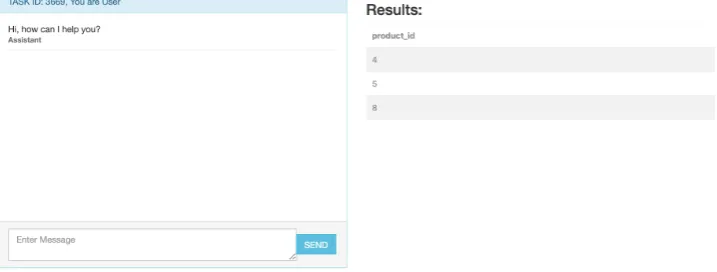
User setup We developed online chatting inter-faces to pair the user with the expert (Figure6and 7 in Appendix). When a data collection session starts, the user is first shown multiple tables from a DB to which a reference goal is groundedand is required to read through them. Once they have ex-amined the data stored in the tables, the reference goal question will be revealed on the same screen. The user is encouraged to use the goal question as a guide to ask interrelated questions, but is also allowed to ask other questions exploring the DB. We require the user to ask at least 3 questions.5 In each turn, if the user question can be answered by a SQL query, they will be shown the result ta-ble, and the expert will write an NL response in-terpreting the executed SQL query based on their understanding of the user’s query intent (Figure8 Appendix). If the user question is ambiguous or cannot be answered with SQL, they will receive clarification questions or notice to rephrase from the expert (detailed in expert setup).
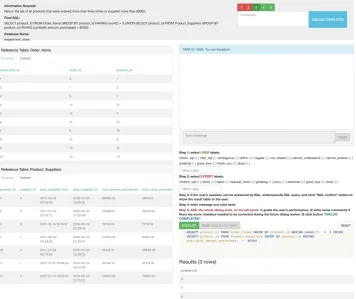
Expert setup Within each session, the expert is shown the same DB content and the reference goal as the user (Figure8in Appendix). For each dia-logue turn, the expert first checks the user ques-tion and labels it using a set of pre-defined user dialog action types (DATs, see Table 4). Then the expert sets the DAT of his response accord-ing to the user DAT. Both the user and the expert can have multiple DATs labels in each turn. If
4Yu et al.(2019) also includes 12.9% of the easy questions
in Spider in order to increase dataset diversity. In this work we prioritize the complex questions that trigger more inter-esting interactions and do not include any easy questions.
5The worker is paid $1.20 USD for each dialog. To
en-courage interaction, we offer $0.50 USD bonus for each di-alogue if the user asks more than 4 interesting, interrelated questions.
the user question is answerable in SQL (labeled asINFORM SQL, e.g.Q1in Figure1), the expert
writes down the SQL query6, executes it, checks the result table, and sends the result table to the user. The expert then describes the SQL query and result table in natural language and sends the response. If the user question is ambiguous, the expert needs to write an appropriate response to clarify the ambiguity (labeled as AMBIGUOUS, e.g. Q3 in Figure 1). Some user questions
re-quire the expert to infer the answer based on their world knowledge (labeled as INFER SQL, e.g. Q3 in Figure 10). If the user question
cannot be answered by SQL, the expert will in-form them to ask well-in-formed questions (labeled as NOT RELATED, CANNOT UNDERSTAND, or
CANNOT ANSWER). In other cases (labeled as
GREETING, THANK YOU, etc.), the expert re-sponds with general dialogue expressions (Q8 in
Figure1).
User quality control Because of the real-time dialogue setting and the expensive annotation pro-cedures on the expert side, conducting quality con-trol on user is crucial for our data collection. We use LegionTools7(Lasecki et al.,2014) to post our tasks onto AMT and to recruit and route AMT workers for synchronous real time crowd sourc-ing tasks. We specify that only workers from the U.S. with 95% approval rates are allowed to ac-cept our task. Before proceeding to the chat room, each AMT worker has to go through a tutorial and pass two short questions8 to test their knowledge about our task. Only the user who passes the quiz proceeds to the chat room. Throughout the data collection, if a user ignores our instructions in a specific turn, we allow the experts to alert the user through chat and label the corresponding turn as
DROP. If a user’s actions continue to deviate from
instructions, the expert can terminate the dialog before it ends. After each dialogue session termi-nates, we ask the expert to provide a score from 1 to 5 as an evaluation of the user’s performance. Dialogues with a score below 3 are dropped and the user will be blocked from future participation.
6
We use the same SQL annotation protocol as Spider (Yu
et al., 2018c) to ensure the same SQL pattern was chosen
when multiple equivalent queries were available.
7
https://www.cromalab.net/LegionTools/
8One is on how to ask interrelated questions and the other
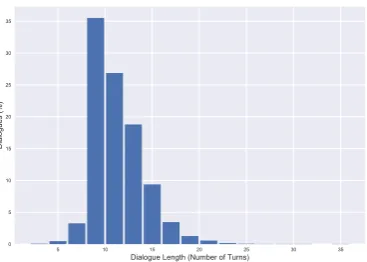
5 10 15 20 25 30 35 Dialogue Length (Number of Turns)
0 5 10 15 20 25 30 35
Di
alo
gu
es
(%
[image:5.595.311.511.66.208.2])
Figure 2: Distributions of dialogue lengths.
Data review and post-process We conduct a multi-pass data reviewing process.9 Two student conducted a first-round review. They focus on cor-recting any errors in the DATs of the users and the experts, checking if the SQL queries match the user’s questions, and modifying or rewriting the expert’s responses to contain necessary in-formation in the SQL queries in case they miss any of them. Also, they re-evaluate all dialogues based on the diversity of user questions and re-ject any dialogues that only contain repeated, sim-ple, and thematically-independent user questions (about 6% of the dialogs). After the first-round review, another two student experts reviewed the refined data to double check the correctness of the DATs, the SQL queries, and the expert re-sponses. They also corrected any grammar errors, and rephrased the user’s questions and the expert’s responses in a more natural way if necessary. Fi-nally, we ran and parsed all annotated SQL queries to make sure they were executable, following the same annotation protocol as the Spider dataset.
4 Data Statistics and Analysis
We report the statistics of CoSQL and com-pare it to other task-oriented dialog and context-dependent text-to-SQL datasets. We also conduct detailed analyses on its contextual, cross-domain nature, and question diversity.
Data statistics Table 1 and 2 summarize the statistics of CoSQL. CoSQL contains 3k+ dia-logues in total (2,164 in training), which is compa-rable to or bigger than most commonly used task-oriented dialogue datasets. Figure 2 shows the
9The review interface is shown in Figure9(Appendix).
0 2000 4000 6000 8000 10000
Frequency of dialogue acts NOT_RELATED
[image:5.595.93.277.78.209.2]NEGATE CANNOT_UNDERSTAND GREETING GOOD_BYE CANNOT_ANSWER INFER_SQL AFFIRM AMBIGUOUS THANK_YOU INFORM_SQL
Figure 3: Distributions of user dialog action types.
distribution of dialogue length in the corpus, ap-proximately 80% of dialogues involve 8 or more turns, with a total of 31,148 turns.10 The average number of tokens in each turn is 11.21. Notice-ably, the domain of CoSQL spans over 200 com-plex databases, overshadowing most other task-oriented dialogue datasets. Comparing to existing context-dependent text-to-SQL datasets, CoSQL contains significantly more turns, out of which 11,039 user utterances are convertible to SQL. In contrast, all NL utterances in ATIS and SParC can be mapped to SQL. CoSQL also has a much larger NL vocabulary.
Dialogue act distribution As shown in Fig-ure3, CoSQL contains a fairly diverse set of user dialogue action types (DATs). Unsurprisingly,
INFORM SQLandTHANK YOU are the two most commonly seen DATs. Among the rest of DATs, approximately 40% are AMBIGUOUS, demon-strating the paramount importance of system clar-ification in the DB querying process in general. Another 20% of this subgroup is INFER SQL, which signifies questions that cannot be answered without the aid of human inference.
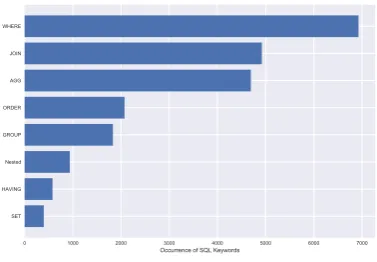
Semantic complexity As shown in Table 1, if we consider the column names of the 200 DBs of CoSQL as slots and their entries as values, the number of slot-value pairs far exceed those de-fined in other task-oriented dialogues. Figure 4 shows the total number of occurrences of different SQL keywords in the SQL queries corresponding to these questions. The SQL queries in CoSQL cover all common SQL keywords as well as com-plicated syntactic structure such as nesting
(Fig-10FollowingBudzianowski et al.(2018), in the statistics
DSTC2 WOZ 2.0 KVRET MultiWOZ CoSQL
# dialogs 1,612 600 2,425 8,438 2,164
Total # turns 23,354 4,472 12,732 115,424 22,422
Total # tokens 199,431 50,264 102.077 1,520,970 22.8197
Avg. # turns/dialog 14.49 7.45 5.25 13.68 10.36
Avg. # tokens/turn 8.54 11.24 8.02 13.18 11.34
Total # unique tokens 986 2,142 2,842 24,071 7,502
# databases 1 1 1 7 140
# Slots # 8 4 13 25 3,696
[image:6.595.98.266.226.345.2]# Values # 212 99 1,363 4,510 >1,000,000
Table 1: Comparison of CoSQL to some commonly used task-oriented dialogue datasets. The numbers are com-puted for the training part of data in consistency with previous work (Budzianowski et al.,2018).
CoSQL SParC ATIS
# Q sequence 3,007 4298 1658
# user questions 15,598∗ 12,726 11,653
# databases 200 200 1
# tables 1020 1020 27
Avg. Q len 11.2 8.1 10.2
Vocab 9,585 3794 1582
Avg. # Q turns 5.2 3.0 7.0
Unanswerable Q X 7 7
User intent X 7 7
System response X 7 7
Table 2: Comparison of CoSQL with other context-dependent text-to-SQL datasets. The number are com-puted over the entire datasets. ∗For CoSQL we count the total # user utterances.
2FFXUUHQFHRI64/.H\ZRUGV
6(7 +$9,1* 1HVWHG *5283 25'(5 $** -2,1 :+(5(
Figure 4: SQL keyword counts.
ure5).
Semantic changes by turns We compute the frequency of occurrences of common SQL key-words in different turns for both CoSQL and SParC and compare them in Figure 5 (upper: CoSQL, lower: SParC). Here we count the turn # based on user utterance only. Since CoSQL and SParC span the same domains, Figure 5 re-veals a comparison of semantic changes between context-dependent DB questions issued by end
2
FFX
UH
QFH
IUH
TX
HQ
F\
1 2 3 4 5
Question turn number 0.0
0.2 0.4 0.6
Oc
cu
ren
ce
fr
eq
ue
nc
[image:6.595.308.515.231.444.2]y WHEREAGG JOIN GROUP ORDER Nested
Figure 5: Percentage of question sequences that con-tain a particular SQL keyword at a specific user utter-ance turn. The keyword occurrences in CoSQL (upper) slightly fluctuates as the interaction proceeds while that in SParC (lower) demonstrates a clear increasing trend.
[image:6.595.88.277.433.564.2]sug-gests that questions in SParC have stronger inter-dependency, as the purpose of this corpus is to study text-to-SQL in context.
Cross domain As shown in Table 3, the dia-logues in CoSQL are randomly split into train, de-velopment and test sets by DB with a ratio of 7:1:2 (the same split as SParC and Spider).
Train Dev Test
# Dialogs 2164 292 551
# Databases 140 20 40
Table 3: Dataset Split Statistics
5 Tasks and Models
CoSQL is meant to be used as the first bench-mark for building general-purpose DB querying dialogue systems in arbitrary domains. Such sys-tems take a user question and determine if it can be answered by SQL (user dialogue act prediction). If the question can be answered by SQL, the sys-tem translates it into the corresponding SQL query (SQL-grounded dialogue state tracking), executes the query, returns and shows the result to the user. To improve interpretability and trustworthiness of the result, the system describes the predicted SQL query and result tables to the user for their verifi-cation (response generation from SQL and result). Finally, the user checks the results and the system responses and decides if the desired information is obtained or additional questions shall be asked.
Some components relevant to the process above are beyond the scope of our work. First, our response generation task only in-cludes turns where the system’s dialogue act is
CONFORM SQL. In case the system cannot under-stand the user’s question (the system dialogue act isCANNOT ANSWER) or considers it as unanswer-able (CANNOT ANSWER), the system will reply in a standard way to inform the user that it needs clarification or cannot answer that question. The same applies to questions that require human in-ference (e.g., the system confirms with the user which types of dorms he or she was talking about by asking R3 instead of immediately translating
Q3 in Figure1). Currently we do not have a task
setup to evaluate the quality of system clarifica-tions. Second, some user questions cannot be di-rectly answered by SQL but are possible to be an-swered with other type of logical reasoning (e.g.,
Q3in Figure10). We exclude these questions from
our task design and leave them for future research.
5.1 SQL-Grounded dialogue State Tracking
In CoSQL, user dialogue states are grounded in SQL queries. Dialogue state tracking (DST) in this case is to predict the correct SQL query for each user utterance withINFORM SQLlabel given the interaction context and the DB schema. In our setup, the system does not have access to gold SQL queries from previous turns, which is dif-ferent from the traditional DST settings in dia-logue management where the history of ground-truth dialogue states is given. Comparing to other context-dependent text-to-SQL tasks such as SParC and ATIS, the DST task in CoSQL also in-clude the ambiguous questions if the user affirms the system clarification of them (e.g.,Q4 in
Fig-ure1). In this case, the system clarification is also given as part of the interaction context to predict the SQL query corresponding to the question.1112 For instance, to generateS4 in Figure1, the input
consists of all previous questions (Q1, Q2, Q3),
the current user question (Q4), the DB schema,
and the system responseR3.
We benchmark the performance of two strong context-dependent neural text-to-SQL models on this the task, which are the baseline models re-ported on SParC byYu et al.(2019).
Context-dependent Seq2Seq (CD-Seq2Seq) The model is originally introduced by (Suhr et al., 2018) for the ATIS task. It incorporates interaction history and is able to copy segments of previous generated SQL queries. Yu et al.(2019) extends it to encode DB schema information such that it works for the cross-domain setting in SParC. We apply the model to our task without any changes.
SyntaxSQL-con SyntaxSQLNet is a SQL-specific syntax-tree based model introduced for Spider (Yu et al., 2018b). Yu et al. (2019) extends it to take previous questions as input when predicting SQL for the current question. We apply the model to our task without any changes.
11If a dialogue contains multiple ambiguous questions, the
system clarification to all ambiguous questions will be given as input.
12The ambiguous questions not confirmed by the user and
5.2 Response Generation from SQL and Query Results
This task requires generating a natural language description of the SQL query and the result for each system response labeled asCONFORM SQL. It considers a SQL query, the execution result, and the DB schema. Preserving logical consis-tency between SQL and NL response is crucial in this task, in addition to naturalness and syntacti-cal correctness. Unlike other SQL-to-text genera-tion tasks (Xu et al.,2018), our task maps the SQL query to a statement and summarizes the result in that statement (instead of just mapping it back to the user question).
We experiment with three baseline methods for this task.
Template-based Given the SQL and NL re-sponse pairs in the training set, we masked vari-able values in both the SQL and NL response to form parallel SQL-response templates. Given a new SQL query, we employ rule-based approach to select the closest SQL-response template pair from the set. After that, we fill in the selected re-sponse template with the columns, tables, and val-ues of the SQL query and the result to generate the final response (see more in Appendix).
Seq2Seq We experiment with a vanilla Seq2Seq model (Sutskever et al.,2014) with attention ( Bah-danau et al., 2015), a standard baseline for text generation tasks.
Pointer-generator Oftentimes the column or ta-ble names in the NL response are copied from the input SQL query. To capture this phenomenon, we experiment with a pointer-generator network (See et al.,2017), which addresses the problem of out-of-vocabulary word generation in summarization and other text generation tasks. We use a modi-fied version of the implementation fromChen and Bansal(2018).
5.3 User dialogue Act Prediction
For a real-world DB querying dialogue system, it has to decide if the user question can be mapped to a SQL query or if special actions are needed. We define a series of dialogue acts for the DB user and the SQL expert (Table4).13 For example, if the user question can be answered by a SQL query, the dialogue act of the question isINFORM SQL.
13§A.1defines the complete set of dialogue action types.
Since the system DATs are defined in response to the user DATs, our task does not include system dialogue acts prediction.
We experiment with two baseline models for this task.
Majority The dialogue acts of all the user ques-tions are predicted to be the majority dialogue act
INFORM SQL.
TBCNN-pair We employ TBCNN-pair (Mou et al.,2016), a tree-based CNN model with heuris-tics for predicting entailment and contradiction be-tween sentences. We change the two sentence inputs for the model to a user utterance and the DB schema, and follow the same method in SQL-Net (Xu et al., 2017) to encode each column name.
6 Results and Discussion
SQL-grounded dialog state tracking We use the same evaluation metrics used by the SParC dataset (Yu et al., 2019) to evaluate the model’s performance on all questions and interactions (di-alogs). The performances of CD-Seq2Seq and SyntaxSQL-con are reported in Table 5. The two models achieve less than 16% question-level accuracy and less than 3% on interaction-level accuracy. Since the two models have been benchmarked on both CoSQL and SParC, we cross-compare their performance on these two datasets. Both models perform significantly worse on CoSQL DST than on SParC. This indicates that CoSQL DST is more difficult than SParC. The possible reasons is that the questions in CoSQL are generated by a more diverse pool of users (crowd workers instead of SQL experts), the task includes ambiguous questions and the context contains more complex intent switches.
Groups Dialog acts
DB user inform sql, infer sql, ambiguous, affirm, negate, not related,
cannot understand, cannot answer, greeting, goodbye, thank you
DB expert conform sql,clarify,reject,request more,greeting,sorry,welcome,goodbye
Table 4: Dialog acts in CoSQL. See§A.1for the comprehensive definition of each dialogue act.
Model Question Match Interaction Match
Dev Test Dev Test
CD-Seq2Seq 13.8 13.9 2.1 2.6
SyntaxSQL-con 15.1 14.1 2.7 2.2
Table 5: Performance of various methods over all ques-tions (question match) and all interactions (interaction match).
Model BLEU LCR (%) Grammar
Dev Test Test Test
Template 9.5 9.3 41.0 4.0
Seq2Seq 15.3 14.1 27.0 3.5
[image:9.595.123.238.697.729.2]Pointer-generator 16.4 15.1 35.0 3.6
Table 6: BLEU scores on the development and test sets, and human evaluations of logic correctness rate (LCR) and grammar check on the 100 examples ran-domly sampled from the test set.
Interestingly, the human evaluation and BLEU scores do not completely agree. While the template-based method is brittle and requires man-ual effort, it performs significantly better than the two end-to-end neural models in the human eval-uation. Because the SQL-question templates pro-vide natural and grammatical sketch of the output, it serves as an advantage in our human evaluation. However, this approach is limited by the small coverage of the training templates and its LCR is only around 40%. On the other hand, the neu-ral models achieve better BLEU scores than the template-based approach. A possible reason for this is that they tend to generate words frequently associated with certain SQL queries. However, the neural models struggle to preserve the SQL query logic in the output. Unsurprisingly, pointer-generator performs better than basic Seq2Seq in terms of both BLEU and human evaluation. The low performances of all methods on LCR show that the task is indeed very challenging.
Model Dev Test
Majority 63.3 62.8
TBCNN-pair 84.2 83.9
Table 7: Accuracy of user dialog act prediction on the development and test sets.
User dialog act prediction Table 7 shows the accuracy of the two baselines on predicting user dialog acts. The result of Majority indicates that about 40% of user questions cannot be directly converted into SQL queries. This confirms the necessity of considering a larger set of dialogue actions for building a practical NLIDB system. Even though TBCNN can predict around 85% of user intents correctly, most of the correct predic-tions are for simple classes such asINFORM SQL,
THANK YOU, andGOODBYEetc. The F-scores for more interesting and important dialog acts such as
INFER SQL and AMBIGUOUS are around 10%. This indicates that improving the accuracy on user DAT prediction is still important.
7 Conclusion and Future Work
In this paper, we introduce CoSQL, the first large-scale cross-domain conversational text-to-SQL corpus collected under a Wizard-of-Oz setup. Its language and discourse diversity and cross-domain setting raise exciting open problems for future research. Especially, the baseline model performances on the three challenge tasks sug-gest plenty space for improvement. The data and challenge leaderboard will be publicly avail-able at https://yale-lily.github.io/
cosql.
Future Work As discussed in Section 5, some examples in CoSQL include ambiguous and unan-swerable user questions and we do not study how a system can effectively clarify those questions or guide the user to ask questions that are answer-able. Also, some user questions cannot be an-swered with SQL but by other forms of logical reasoning the correct answer can be derived. We urge the community to investigate these problems in future work in order to build practical, robust and reliable conversational natural language inter-faces to databases.
8 Acknowledgement
References
Yoav Artzi and Luke S. Zettlemoyer. 2011. Boot-strapping semantic parsers from conversations. In EMNLP.
Layla El Asri, Hannes Schulz, Shikhar Sharma, Jeremie Zumer, Justin Harris, Emery Fine, Rahul Mehrotra, and Kaheer Suleman. 2017. Frames: A corpus for adding memory to goal-oriented dialogue systems. CoRR, abs/1704.00057.
Dzmitry Bahdanau, Kyunghyun Cho, and Yoshua Ben-gio. 2015. Neural machine translation by jointly learning to align and translate. InICLR.
Ben Bogin, Jonathan Berant, and Matt Gardner. 2019. Representing schema structure with graph neural networks for text-to-sql parsing. InACL.
Antoine Bordes and Jason Weston. 2017. Learning end-to-end goal-oriented dialog. ICLR.
Pawel Budzianowski, Tsung-Hsien Wen, Bo-Hsiang Tseng, I˜nigo Casanueva, Stefan Ultes, Osman Ra-madan, and Milica Gasic. 2018. Multiwoz - a large-scale multi-domain wizard-of-oz dataset for task-oriented dialogue modelling. InEMNLP.
Yen-Chun Chen and Mohit Bansal. 2018. Fast abstrac-tive summarization with reinforce-selected sentence rewriting. InProceedings of ACL.
Deborah A. Dahl, Madeleine Bates, Michael Brown, William Fisher, Kate Hunicke-Smith, David Pallett, Christine Pao, Alexander Rudnicky, and Elizabeth Shriberg. 1994. Expanding the scope of the atis task: The atis-3 corpus. InProceedings of the Workshop on Human Language Technology, HLT ’94, Strouds-burg, PA, USA. Association for Computational Lin-guistics.
Bhuwan Dhingra, Lihong Li, Xiujun Li, Jianfeng Gao, Yun-Nung Chen, Faisal Ahmed, and Li Deng. 2016. End-to-end reinforcement learning of dia-logue agents for information access. InACL.
Li Dong and Mirella Lapata. 2018. Coarse-to-fine de-coding for neural semantic parsing. In Proceed-ings of the 56th Annual Meeting of the Associa-tion for ComputaAssocia-tional Linguistics (Volume 1: Long Papers), pages 731–742. Association for Computa-tional Linguistics.
Catherine Finegan-Dollak, Jonathan K. Kummer-feld, Li Zhang, Karthik Ramanathan Dhanalak-shmi Ramanathan, Sesh Sadasivam, Rui Zhang, and Dragomir Radev. 2018. Improving text-to-sql eval-uation methodology. InACL 2018. Association for Computational Linguistics.
Stefan L. Frank. 2013. Uncertainty reduction as a mea-sure of cognitive load in sentence comprehension. Topics in cognitive science, 5 3:475–94.
Jiaqi Guo, Zecheng Zhan, Yan Gao, Yan Xiao pei Liu Xiao, Jian-Guang Lou, Ting Liu, and Dongmei Zhang. 2019. Towards complex text-to-sql in cross-domain database with intermediate representation. InACL.
John Hale. 2006. Uncertainty about the rest of the sen-tence. Cognitive science, 30 4:643–72.
Charles T. Hemphill, John J. Godfrey, and George R. Doddington. 1990. The atis spoken language sys-tems pilot corpus. InSpeech and Natural Language: Proceedings of a Workshop Held at Hidden Valley, Pennsylvania, June 24-27,1990.
Matthew Henderson, Blaise Thomson, and Jason D. Williams. 2014. The second dialog state tracking challenge. InSIGDIAL Conference.
Matthew Henderson, Blaise Thomson, and Steve Young. 2013. Deep neural network approach for the dialog state tracking challenge. InProceedings of the SIGDIAL 2013 Conference, pages 467–471, Metz, France. Association for Computational Lin-guistics.
Srinivasan Iyer, Ioannis Konstas, Alvin Cheung, Jayant Krishnamurthy, and Luke Zettlemoyer. 2017. Learning a neural semantic parser from user feed-back. CoRR, abs/1704.08760.
Srinivasan Iyer, Ioannis Konstas, Alvin Cheung, and Luke Zettlemoyer. 2016. Summarizing source code using a neural attention model. InProceedings of the 54th Annual Meeting of the Association for Com-putational Linguistics (Volume 1: Long Papers), pages 2073–2083, Berlin, Germany. Association for Computational Linguistics.
Mohit Iyyer, Wen-tau Yih, and Ming-Wei Chang. 2017. Search-based neural structured learning for sequen-tial question answering. InProceedings of the 55th Annual Meeting of the Association for Computa-tional Linguistics (Volume 1: Long Papers), pages 1821–1831. Association for Computational Linguis-tics.
Walter Lasecki, Ece Kamar, and Dan Bohus. 2013. Conversations in the crowd: Collecting data for task-oriented dialog learning. In In Proceedings of the Human Computation Workshop on Scaling Speech and Language Understanding and Dialog through Crowdsourcing at HCOMP 2013.
Walter S. Lasecki, Mitchell Gordon, Danai Koutra, Malte F. Jung, Steven P. Dow, and Jeffrey P. Bigham. 2014. Glance: Rapidly coding behavioral video with the crowd. In Proceedings of the 27th An-nual ACM Symposium on User Interface Software and Technology, New York, NY, USA. ACM.
the Association for Computational Linguistics: Hu-man Language Technologies, pages 515–520, San Diego, California. Association for Computational Linguistics.
Roger P. Levy. 2008. Expectation-based syntactic comprehension. Cognition, 106:1126–1177.
Fei Li and HV Jagadish. 2014. Constructing an in-teractive natural language interface for relational databases. VLDB.
Jiwei Li, Will Monroe, Alan Ritter, Daniel Jurafsky, Michel Galley, and Jianfeng Gao. 2016. Deep re-inforcement learning for dialogue generation. In EMNLP.
Yunyao Li, Huahai Yang, and HV Jagadish. 2006. Constructing a generic natural language interface for an xml database. In EDBT, volume 3896, pages 737–754. Springer.
Kathleen R. McKeown. 1985. Text Generation: Using Discourse Strategies and Focus Constraints to Gen-erate Natural Language Text. Cambridge University Press, New York, NY, USA.
Lili Mou, Rui Men, Ge Li, Yan Xu, Lu Zhang, Rui Yan, and Zhi Jin. 2016. Natural language inference by tree-based convolution and heuristic matching. In ACL.
Nikola Mrkˇsi´c, Diarmuid ´O S´eaghdha, Tsung-Hsien Wen, Blaise Thomson, and Steve Young. 2017. Neural belief tracker: Data-driven dialogue state tracking. InProceedings of the 55th Annual Meet-ing of the Association for Computational LMeet-inguistics (Volume 1: Long Papers), pages 1777–1788. Asso-ciation for Computational Linguistics.
Nikola Mrksic, Diarmuid ´O S´eaghdha, Blaise Thom-son, Milica Gasic, Pei hao Su, David Vandyke, Tsung-Hsien Wen, and Steve J. Young. 2015. Multi-domain dialog state tracking using recurrent neural networks. InACL.
Nikola Mrksic, Diarmuid ´O S´eaghdha, Tsung-Hsien Wen, Blaise Thomson, and Steve J. Young. 2017. Neural belief tracker: Data-driven dialogue state tracking.
Kishore Papineni, Salim Roukos, Todd Ward, and Wei-Jing Zhu. 2002. Bleu: A method for automatic eval-uation of machine translation. InProceedings of the 40th Annual Meeting on Association for Computa-tional Linguistics, ACL ’02, pages 311–318. Asso-ciation for Computational Linguistics.
Ana-Maria Popescu, Oren Etzioni, and Henry Kautz. 2003. Towards a theory of natural language inter-faces to databases. In Proceedings of the 8th in-ternational conference on Intelligent user interfaces, pages 149–157. ACM.
P. J. Price. 1990. Evaluation of spoken language sys-tems: the atis domain. InSpeech and Natural Lan-guage: Proceedings of a Workshop Held at Hidden Valley, Pennsylvania, June 24-27,1990, pages 91– 95.
Antoine Raux, Brian Langner, Dan Bohus, Alan W. Black, and Maxine Esk´enazi. 2005. Let’s go pub-lic! taking a spoken dialog system to the real world. InINTERSPEECH.
Abigail See, Peter J. Liu, and Christopher D. Manning. 2017. Get to the point: Summarization with pointer-generator networks. InProceedings of the 55th An-nual Meeting of the Association for Computational Linguistics, ACL 2017, Vancouver, Canada, July 30 - August 4, Volume 1: Long Papers, pages 1073– 1083.
Stephanie Seneff and Joseph Polifroni. 2000. Dia-logue management in the mercury flight reservation system. InProceedings of the 2000 ANLP/NAACL Workshop on Conversational Systems - Volume 3, ANLP/NAACL-ConvSyst ’00, pages 11–16.
Tianze Shi, Kedar Tatwawadi, Kaushik Chakrabarti, Yi Mao, Oleksandr Polozov, and Weizhu Chen. 2018. Incsql: Training incremental text-to-sql parsers with non-deterministic oracles. arXiv preprint arXiv:1809.05054.
Pei hao Su, Milica Gasic, Nikola Mrksic, Lina Maria Rojas-Barahona, Stefan Ultes, David Vandyke, Tsung-Hsien Wen, and Steve J. Young. 2016. On-line active reward learning for policy optimisation in spoken dialogue systems.ACL.
Alane Suhr, Srinivasan Iyer, and Yoav Artzi. 2018. Learning to map context-dependent sentences to ex-ecutable formal queries. InProceedings of the Con-ference of the North American Chapter of the Asso-ciation for Computational Linguistics: Human Lan-guage Technologies, pages 2238–2249. Association for Computational Linguistics.
Ilya Sutskever, Oriol Vinyals, and Quoc V Le. 2014. Sequence to sequence learning with neural net-works. InAdvances in neural information process-ing systems, pages 3104–3112.
Marilyn A. Walker, Alexander I. Rudnicky, Rashmi Prasad, John S. Aberdeen, Elizabeth Owen Bratt, John S. Garofolo, Helen F. Hastie, Audrey N. Le, Bryan L. Pellom, Alexandros Potamianos, Re-becca J. Passonneau, Salim Roukos, Gregory A. Sanders, Stephanie Seneff, and David Stallard. 2002. Darpa communicator: cross-system results for the 2001 evaluation. InINTERSPEECH.
David HD Warren and Fernando CN Pereira. 1982. An efficient easily adaptable system for interpreting nat-ural language queries. Computational Linguistics, 8(3-4):110–122.
Tsung-Hsien Wen, Milica Gasic, Nikola Mrksic, Lina Maria Rojas-Barahona, Pei-Hao Su, Stefan Ultes, David Vandyke, and Steve J. Young. 2016. A network-based end-to-end trainable task-oriented dialogue system.CoRR.
Sam Wiseman, Stuart Shieber, and Alexander Rush. 2017. Challenges in data-to-document generation. In Proceedings of the 2017 Conference on Empiri-cal Methods in Natural Language Processing, pages 2253–2263. Association for Computational Linguis-tics.
Chien-Sheng Wu, Andrea Madotto, Ehsan Hosseini-Asl, Caiming Xiong, Richard Socher, and Pascale Fung. 2019. Transferable multi-domain state gener-ator for task-oriented dialogue systems. In Proceed-ings of the 57th Annual Meeting of the Association for Computational Linguistics (Volume 1: Long Pa-pers). Association for Computational Linguistics.
Kun Xu, Lingfei Wu, Zhiguo Wang, Mo Yu, Liwei Chen, and Vadim Sheinin. 2018. Sql-to-text gen-eration with graph-to-sequence model.EMNLP.
Xiaojun Xu, Chang Liu, and Dawn Song. 2017. Sqlnet: Generating structured queries from natural language without reinforcement learning. arXiv preprint arXiv:1711.04436.
Navid Yaghmazadeh, Yuepeng Wang, Isil Dillig, and Thomas Dillig. 2017. Sqlizer: query synthesis from natural language. Proceedings of the ACM on Pro-gramming Languages.
Tao Yu, Zifan Li, Zilin Zhang, Rui Zhang, and Dragomir Radev. 2018a. Typesql: Knowledge-based type-aware neural text-to-sql generation. In Proceedings of NAACL. Association for Computa-tional Linguistics.
Tao Yu, Michihiro Yasunaga, Kai Yang, Rui Zhang, Dongxu Wang, Zifan Li, and Dragomir Radev. 2018b. Syntaxsqlnet: Syntax tree networks for com-plex and cross-domain text-to-sql task. In Proceed-ings of EMNLP. Association for Computational Lin-guistics.
Tao Yu, Rui Zhang, Kai Yang, Michihiro Yasunaga, Dongxu Wang, Zifan Li, James Ma, Irene Li, Qingning Yao, Shanelle Roman, Zilin Zhang, and Dragomir Radev. 2018c. Spider: A large-scale human-labeled dataset for complex and cross-domain semantic parsing and text-to-SQL task. In Proceedings of the 2018 Conference on Empirical Methods in Natural Language Processing.
Tao Yu, Rui Zhang, Michihiro Yasunaga, Yi Chern Tan, Xi Victoria Lin, Suyi Li, Irene Li Heyang Er, Bo Pang, Tao Chen, Emily Ji, Shreya Dixit, David Proctor, Sungrok Shim, Vincent Zhang
Jonathan Kraft, Caiming Xiong, Richard Socher, and Dragomir Radev. 2019. Sparc: Cross-domain semantic parsing in context. In Proceedings of the 57th Annual Meeting of the Association for Compu-tational Linguistics, Florence, Italy. Association for Computational Linguistics.
John M. Zelle and Raymond J. Mooney. 1996. Learn-ing to parse database queries usLearn-ing inductive logic programming. In AAAI/IAAI, pages 1050–1055, Portland, OR. AAAI Press/MIT Press.
Luke S. Zettlemoyer and Michael Collins. 2005. Learning to map sentences to logical form: Struc-tured classification with probabilistic categorial grammars. UAI.
Rui Zhang, Tao Yu, He Yang Er, Sungrok Shim, Eric Xue, Xi Victoria Lin, Tianze Shi, Caiming Xiong, Richard Socher, and Dragomir Radev. 2019. Editing-based sql query generation for cross-domain context-dependent questions. InProceedings of the 2019 Conference on Empirical Methods in Natu-ral Language Processing and 9th International Joint Conference on Natural Language Processing. Asso-ciation for Computational Linguistics.
Victor Zhong, Caiming Xiong, and Richard Socher. 2017. Seq2sql: Generating structured queries from natural language using reinforcement learning. CoRR, abs/1709.00103.
Victor Zhong, Caiming Xiong, and Richard Socher. 2018. Global-locally self-attentive encoder for di-alogue state tracking. InACL.
A Appendices
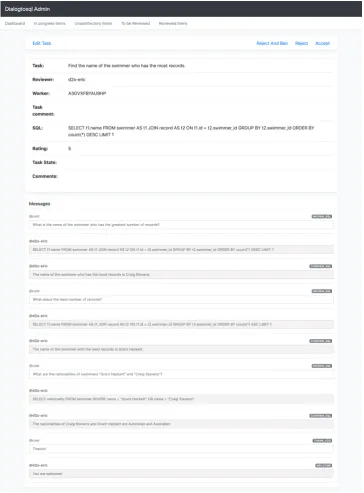
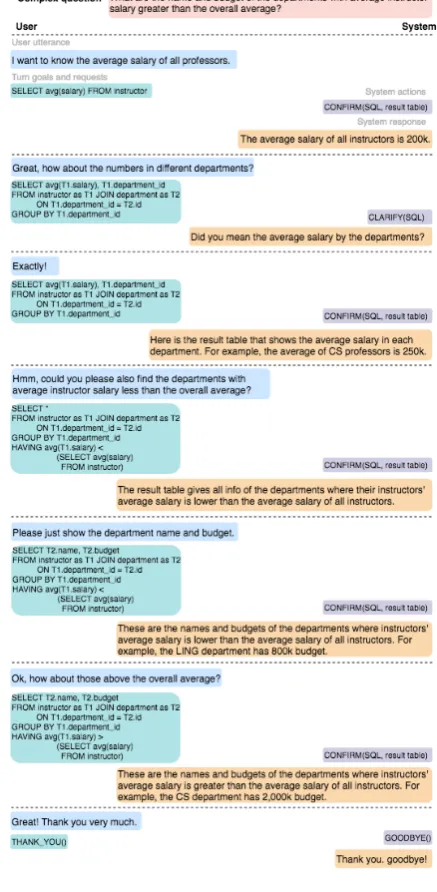
This section provides description of dialog actions in A.1, more details on baseline modifications and hyperparameters in A.2, system response guides in A.3, additional dialog examples in CoSQL dataset in Figure10and11, and the DB user (AMT turk-ers) and the SQL expert (college computer science students) annotation interfaces in Figure 6, 7, 8, and9.
A.1 Description of Dialog Acts
For the DB user, we define the following dialog acts:
INFORM SQL The user informs his/her request
if the users question can be answered by SQL. The system needs to write SQL.
INFER SQL If the users question must be
AMBIGUOUS The users question is ambiguous,
the system needs to double check the user’s intent (e.g. what/did you mean by...?) or ask for which columns to return.
AFFIRM Affirm something said by the system
(user says yes/agree).
NEGATE : Negate something said by the system
(user says no/deny).
NOT RELATED The users question is not related
to the database, the system reminds the user.
CANNOT UNDERSTAND The users question
cannot be understood by the system, the system asks the user to rephrase or paraphrase question.
CANNOT ANSWER The users question cannot be
easily answered by SQL, the system tells the user its limitation.
GREETING Greet the system.
GOOD BYE Say goodbye to the system.
THANK YOU Thank the system.
For the system, we define the following dia-log acts:
CONFIRM SQL The system creates a natural
language response that describes SQL and result table, and asks the user to confirm if the system understood his/her intention.
CLARIFY Ask the user to double check and
clarify his/her intention when the users question is ambiguous.
REJECT Tell the user you did not
under-stand/cannot answer his/her question, or the user question is not related.
REQUEST MORE Ask the user if he/she would
like to ask for more info.
GREETING Greet the user.
SORRY Apologize to the user.
WELCOME Tell the user he/she is welcome.
GOOD BYE Say goodbye to the user.
A.2 Modifications and Hyperparameters for Baselines
CD-Seq2Seq We apply the model with the same settings used in SParC without any changes.
SyntaxSQL-con We apply the model with the same settings used in SParC without any changes.
Template-based We first create a list of SQL query patterns without values, column and ta-ble names that cover the most cases in the train set of CoSQL. And then we manually changed the patterns and their corresponding responses to make sure that table, column, and value slots in the responses have one-to-one map to the slots in the SQL query. Once we have the SQL-response mapping list, during the predic-tion, new SQL statements are compared with every templates to find the best template to use. A score will be computed to represent the similarity between the SQL and each template. The score is computed based on the number of each SQL key components existing in the SQL and each template. Components of the same types are grouped together to allow more flexi-ble matching, like count, max, min are grouped to aggregate. A concrete example of templates is shown: SELECT column0 FROM table0 WHERE
column1 comparison0 value0. column0,1 and
table0 represent column name and table name
respectively. comparison0 represents one of
the comparison operator including >=, <=,
<,>,=,!=, and like. value0represents a value
the user uses to constrain the query result.
Seq2Seq We train a word2vec embedding model on the concatenation of the SQL query and response output of the training data for the embed-ding layer of our Seq2Seq model. We use an em-bedding dimension of 128, hidden dimension of 256, a single-layer bi-directional LSTM encoder and uni-directional LSTM decoder with attention. We use a batch size of 32, clip the norm of the gradient at 2.0, and do early stopping on the vali-dation loss with a patience of 5. We perform de-coding with greedy search.
Pointer-generator We follow the same settings as in the Seq2Seq case with the addition of the copy mechanism during training and testing.
col-umn names related to the sentence. The classi-fier is modified by adding a label(user dialogue act) number predicting module, which predicts the number of the labels(user dialogue acts) of the user utterance. The label number prediction mod-ule is similar to the column number prediction module in SQLNet.
A.3 System Response Guide
System response should be standard and profes-sional. We follow the rules below to write re-sponses for different system dialog action type:
CLARIFY ”Did you mean...?”, ”What did you
mean by...?”, or anything similar.
REJECT ”Sorry, I don’t have the answer to your
question...” or anything similar.
REQUEST MORE ”Do you want anything else?”
or anything similar.
CONFORM SQL We convert SQL written by us
back to natural language. (We should use the col-umn names and values in the SQL). Our response has to describe all information in the SQL inde-pendently instead of referring to any previous con-text or subject.
1. If the returned result can be combined with the SQL description, combine them together to generate the response. For example:
Given SQL:
SELECTAVG(SALARY) FROMINSTRUCTOR
Result Returned: 200k
Your Response:“The average salary of all in-structors is 200k.”
2. If the returned result is too large and cannot be combined with the SQL description, de-scribe them separately. For example:
Given SQL:
SELECT AVG(T1.SALARY),T1.DEPARTMENT ID
FROMINSTRUCTOR AST1 JOINDEPARTMENT AS
T2 ON T1.DEPARTMENT ID = T2.ID GROUP BY
T1.DEPARTMENT ID
Result Returned: a long table
Figure 6: DB User Interface
D1 : Database about soccer containing 3 tables
Q2 :
S2 :
A2 : OU | FSU
R2 :
Q3 :
S3 :
A3 : OU
R3 :
What are their names? INFORM_SQL
The names of the colleges that have enrollment values greater than 18000 are OU and FSU
CONFIRM_SQL SELECT cName FROM College WHERE enr > 18000
Which one has the higher enrollment? INFER_SQL
Among the results, OU has a higher enrollment.
CONFIRM_SQL SELECT cName FROM College WHERE enr > 18000 ORDER BY
enr DESC LIMIT 1
[image:18.595.190.408.79.234.2]... ...
Figure 10: Part of a dialogue example with INFER SQL user dialog label
[image:18.595.185.404.294.741.2]