Extracting Opinion Expressions with
semi-Markov Conditional Random Fields
Bishan Yang
Department of Computer Science Cornell University
Claire Cardie
Department of Computer Science Cornell University
Abstract
Extracting opinion expressions from text is usually formulated as a token-level sequence labeling task tackled using Conditional Ran-dom Fields (CRFs). CRFs, however, do not readily model potentially useful segment-level information like syntactic constituent struc-ture. Thus, we propose a semi-CRF-based ap-proach to the task that can perform sequence labeling at the segment level. We extend the original semi-CRF model (Sarawagi and Co-hen, 2004) to allow the modeling of arbitrar-ily long expressions while accounting for their likely syntactic structure when modeling seg-ment boundaries. We evaluate performance on two opinion extraction tasks, and, in contrast to previous sequence labeling approaches to the task, explore the usefulness of segment-level syntactic parse features. Experimental results demonstrate that our approach outper-forms state-of-the-art methods for both opin-ion expressopin-ion tasks.
1 Introduction
Accurate opinion expression identification is crucial for tasks that benefit from fine-grained opinion anal-ysis (Wiebe et al., 2005): e.g., it is a first step in characterizing the sentiment and intensity of the opinion; it provides a textual anchor for identifying the opinion holder and the target or topic of an opin-ion; and these, in turn, form the basis of opinion-oriented question answering and opinion summa-rization systems. In this paper, we focus on opin-ion expressopin-ions as defined in Wiebe et al. (2005) —
subjective expressions that denote emotions, senti-ment, beliefs, opinions, judgments, or otherprivate states (Quirk et al., 1985) in text. These include
direct subjective expressions(DSEs): explicit men-tions of private states or speech events expressing private states; andexpressive subjective expressions
(ESEs): expressions that indicate sentiment, emo-tion, etc. without explicitly conveying them. Follow-ing are two example sentences labeled with DSEs and ESEs.
(1) The International Committee of the Red Cross, [as usual][ESE], [has refused to make any statements][DSE].
(2) The Chief Minister [said][DSE]that [the demon they have reared will eat up their own vitals][ESE].
As a type of information extraction task, opinion expression extraction has been successfully tackled in the past via sequence tagging methods: Choi et al. (2006) and Breck et al. (2007), for example, ap-ply conditional random fields (CRFs) (Lafferty et al., 2001) using sophisticated token-level features. In token-level sequence labeling, labels are assigned to single tokens, and the label of each token depends on the current token and the label of the previous to-ken (we consider the usual first-order assumption). Segment-based features — features that describe a set of related contiguous tokens, e.g., a phrase or constituent — might provide critical information for identifying opinion expressions; they cannot, how-ever, be readily and naturally represented in the CRF model.
Our goal in this work is to extract opinion ex-pressions at the segment level with semi-Markov conditional random fields (semi-CRFs). Semi-CRFs (Sarawagi and Cohen, 2004) are more powerful than CRFs in that they allow one to construct features to capture characteristics of the subsequences of a sentence. They are defined on semi-Markov chains where labels are attached to segments instead of tokens and label dependencies are modeled at the segment-level. Previous work has shown that semi-CRFs outperform semi-CRFs on named entity recog-nition (NER) tasks (Sarawagi and Cohen, 2004; Okanohara et al., 2006). However, to the best of our knowledge, semi-CRF techniques have not been investigated for opinion expression extraction.
The contribution of this paper is a semi-CRF-based approach for opinion expression extraction that leverages parsing information to provide better modeling of opinion expressions. Specifically, pos-sible segmentations are generated by taking into ac-count likely syntactic structure during learning and inference. As a result, arbitrarily long expressions can be modeled and their boundaries can be influ-enced by probable syntactic structure. We also ex-plore the impact of syntactic features for extracting opinion expressions.
We evaluate our model on two opinion extrac-tion tasks: identifying direct subjective expres-sions (DSEs) and expressive subjective expresexpres-sions (ESEs). Experimental results show that our ap-proach outperforms the state-of-the-art apap-proach for the task by a large margin. We also identify useful syntactic features for the task.
2 Related Work
Previous research to extract direct subjective ex-pressions exists, but is mainly focused on single-word expressions (Wiebe et al., 2005; Wilson et al., 2005; Munson et al., 2005). More recent stud-ies tackle opinion expression extraction at the ex-pression level. Breck et al. (2007) formulate the problem as a token-level sequence labeling prob-lem; their CRF-based approach was shown to sig-nificantly outperform two subjectivity-clue-based baselines. Others extend the token-level approach to jointly identify opinion holders (Choi et al., 2006), and to determine the polarity and
inten-sity of the opinion expressions (Choi and Cardie, 2010). Reranking the output of a simple sequence labeler has been shown to further improve the ex-traction of opinion expressions (Johansson and Mos-chitti, 2010; Johansson and MosMos-chitti, 2011); impor-tantly, their reranking approach relied on features that encoded syntactic structure. All of the above approaches, however, are based on token-level se-quence labeling, which ignores potentially useful phrase-level information.
Semi-CRFs (Sarawagi and Cohen, 2004) are gen-eral CRFs that relax the Markovian assumptions to allow sequence labeling at the segment level. Pre-vious work has shown that semi-CRFs are supe-rior to CRFs for NER and Chinese word segmen-tation (Sarawagi and Cohen, 2004; Okanohara et al., 2006; Andrew, 2006). The task of opinion expres-sion extraction is known to be harder than traditional NER since subjective expressions exhibit substantial lexical variation and their recognition requires more attention to linguistic structure.
Parsing has been leveraged to improve perfor-mance for numerous natural language tasks. In opin-ion mining, numerous studies have shown that syn-tactic parsing features are very helpful for opinion analysis. A lot of work uses syntactic features to identify opinion holders and opinion topics (Bethard et al., 2005; Kim and Hovy, 2006; Kobayashi et al., 2007; Joshi and Carolyn, 2009; Wu et al., 2009; Choi et al., 2005). Jakob et al. (2010) recently employed dependency path features for the extrac-tion of opinion targets. Johansson and Moschitti (2010; Johansson and Moschitti (2011) also success-fully employed syntactic features that indicate de-pendency relations between opinion expressions for the task of opinion expression extraction. However, as their approach is based on the output of a se-quence labeler, these features cannot be encoded to help the learning of the sequence labeler.
3 Approach
can assign labels to segments instead of tokens; hence, features can be defined at the segment level. For example, features likeJX is a verb phraseKcan be easily encoded in the model. In the following subsections, we first introduce standard semi-CRFs and then describe our semi-CRF-based approach for opinion expression extraction.
3.1 Semi-CRFs
In semi-CRFs, each observed sentence x is repre-sented as a sequence of consecutive segments s =
hs1, ..., sni, wheresi is a triplesi = (ti, ui, yi), ti denotes the start position of segmentsi, ui denotes the end position, andyidenotes the label of the seg-ment. Segments are restricted to have positive length less than or equal to a maximum length ofLthat has been seen in the corpus (1≤ui−ti+ 1≤L).
Features in semi-CRFs are defined at the seg-ment level rather than the word level. The fea-ture function g(i, x, s) is a function of x, the cur-rent segment si, and the label yi−1 of the
previ-ous segmentsi−1 (we consider the usual first-order
Markovian assumption). It can also be written as
g(x, ti, ui, yi, yi−1). The conditional probability of
a segmentationsgiven a sequencexis defined as
p(s|x) = 1
Z(x)exp (
X
i X
k
λkgk(i, x, s) )
(1)
where
Z(x) = X
s0∈S
exp (
X
i X
k
λkgk(i, x, s0) )
and the setScontains all possible segmentations ob-tained from segment candidates with length ranging from 1 to the maximum lengthL.
The correct segmentation s of a sentence is defined as a sequence of entity segments (i.e., the entities to be extracted) and non-entity segments. For example, the correct segmentation of sentence (2) in Section 1 is
h(The,NONE),(Chief,NONE),(Minister,NONE), (said,DSE),(that,NONE),(the demon they have reared will eat up their own vitals,ESE),(.,NONE)i. Here, non-entity segments are represented as unit-length segments.
3.2 Semi-CRF-based Approach for Opinion Expression Extraction
In this section, we present an extended version of semi-CRFs in which we can make use of parsing in-formation in learning entity boundaries and labels for opinion expression extraction.
As discussed in Section 3.1, the maximum entity lengthLis fixed during training to generate segment candidates in the standard semi-CRFs. In opinion expression extraction, L is unbounded since opin-ion expressopin-ions may be clauses or whole sentences, which can be arbitrarily long. Thus, fixing an upper bound on segment length based on the observed en-tities may lead to an incorrect removal of segments during inference. Also note that possible segment candidates are generated based on the length con-straint, which means any span of the text consisting of no more than L words would be considered as a possible segment. This would lead to the consid-eration of implausible segments, e.g., “The Chief” in sentence (2) is an incorrect segment within the multi-word expression “The Chief Minister”.
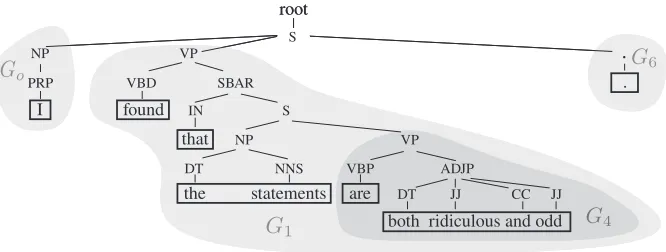
To address these problems, we propose tech-niques to incorporate parsing information into the modeling of segments in semi-CRFs. More specifi-cally, we construct segment units from the parse tree of each sentence1, and then build up possible seg-ment candidates based on those units. In the parse tree, each leaf phrase or leaf word is considered to be a segment unit. Each segment unit performs as the smallest unit in the model (words within a segment unit will be automatically assigned the same label). The segment units are highlighted in rectangles in the parse tree example in Figure 1. As the segment units are not separable, we avoid implausible seg-ments, which truncate multi-word expressions. For example, “both ridiculous and”, would not be con-sidered a possible segment in our model.
To generate segment candidates for the model, we consider meaningful combinations of consecu-tive segment units. Intuiconsecu-tively, a sentence is made up of several parts, and each has its own grammati-cal role or meaning. We define the boundary of these parts based on the parse tree structure. Specifically,
1
We use the Stanford Parserhttp://nlp.stanford.
edu/software/lex-parser.shtml to generate the
NP VP .
VBD SBAR
S
root
that
.
IN S
NP VP
PRP
I found
DT NNS
the statements
VBP ADJP
are DT JJ CC JJ
both riddiculous and odd
Go
G1 G4
G6
NP VP .
VBD SBAR
S
root
that
.
IN S
NP VP
PRP
I found
DT NNS
the statements
VBP ADJP
are DT JJ CC JJ
both ridiculous and odd
Go
G1 G4
[image:4.612.141.474.57.183.2]G6
Figure 1: A parse tree example. There are seven segment units in the sentence. The shaded regions correspond to segment groups, whereGirepresents the segment group starting from segment unitUi.
we consider each segment unit to belong to a mean-ingful group defined by the span of its parent node. Two consecutive segment units are considered to be-long to the same group if the subtrees rooted in their parent nodes have the same rightmost child. For ex-ample, in Figure 1, segment units “are” and “both ridiculous and odd” belong to the same group, while “I” and “found” belong to different groups.
Algorithm 1Construction of segment candidates Input:A training sentencex
Output:A set of segment candidatesS
1: Obtain the segment unitsU = (U1, ..., Um) by preorder traversal of the parse treeT, each Ui corresponds to a node inT
2: fori= 1tomdo 3: j←i−1
4: whilej < m−1and
commonGroup(Ui, ..., Uj+1)do
5: j←j+ 1
6: fork=itojdo 7: fort= 0toj−kdo
8: s←segment(Uk, ..., Uk+t)
9: S←S∪s
10: ReturnS
Following this idea, we generate possible seg-ment candidates by Algorithm 1. Starting from each segment unit Ui, we first find the rightmost segment unit Uj that belongs to the same group as Ui. Function commonGroup(Ui, ..., Uj) re-turns True if Ui, ..., Uj are within the same group (the parent nodes of Ui,...,Uj have the same
right-most child in their subtrees), otherwise it returns
False. Then we enumerate all possible combina-tions of segment units Ui, ..., Uk where i ≤ k ≤
j. segment(Ui, ..., Uj) denotes the segment ob-tained by concatenating words in the consecutive segment units Ui,...,Uj. This way, segment can-didates are generated without constraints on length and are meaningful for learning entity boundaries.
Based on the generated segment candidates, the correct segmentation for each training sentence can be obtained as follows. For opinion expressions that do not match any segment candidate, we break them down into smaller segments using a greedy matching process. Starting from the start position of the expression, we search for the longest candi-date that is contained in the expression, add it to the correct segmentation for the sentence, set the start position to be the next position, and repeat the process. Using this process, the correct segmen-tation of sentence (2) would be s = h(The Chief Minister,NONE),(said,DSE),(that,NONE),(the de-mon they have reared,ESE), (will eat up their own vitals,ESE),(.)i. Note that here non-entities corre-spond to segment units instead of single-word seg-ments in the original semi-CRF model.2
After obtaining the set of possible segment candi-dates and the correct segmentationsfor each train-ing sentence, the semi-CRF model can be trained. The goal of learning is to find the optimal parameter
λby maximizing log-likelihood. We use the
limited-2There are cases where words within a segment unit have
memory BFGS algorithm (Liu and Nocedal, 1989) for optimization in our implementation, where the gradient of the log-likelihood L (corresponding to one instancex) is computed:
∂L ∂λk
=X
i
gk(x, ti, ui, yi, yi−1)
−X
s0∈S
X
y,y0
X
j
gk(x, t0j, u0j, y, y0)p(y, y0|x)
(2)
whereS is all possible segmentations consisting of the generated segment candidates, p(y, y0|x) is the probability of having labelyfor the current segment
s0j (with boundary(t0j, u0j)) and labely0for the pre-vious segments0j−1.
We use a forward-backward algorithm to com-pute the marginal distributionp(y, y0|x)and the nor-malization factorZ(x)efficiently. For inference we seek the best segmentations∗ = arg maxsp(s|x), where p(s|x) is defined by Equation 1. We im-plement efficient inference using an extension of Viterbi algorithm to segments. In particular, define
V(j, y) as the largest unnormalized probability of
p(s1:j|x)with labelyat the ending positionj. Then we have
V(j, y) = max (i,j)∈s:,j
max
y0 φ(x, i, j, y, y
0)V(i−1, y0)
where
φ(x, i, j, y, y0) = exp (
X
k
λkgk(x, i, j, y, y0) )
and s:,j denotes the set of the generated segment candidates ending at position j. The best segmen-tation can be obtained from tracing the path of
maxyV(n, y).
3.3 Features
Here we described the features used in our model. Very generally, we include CRF-style features that are segment-level extensions of the token-level fea-tures. We also include new segment-level features that can be naturally represented in semi-CRFs but not CRFs.
For CRF-style features, we consider the string representation of the current word, its part-of-speech, and a dictionary-derived feature, which is
based on a subjectivity lexicon provided by Wilson et al. (2005). The lexicon consists of a set of words that can act as strong or weak cues to subjectivity. If the current word appears as an entry in the lexi-con, then a featurestrongorweakwill be fired if the entry is of that strength. These features have been successfully employed in previous work (Breck et al., 2007). To employ them in our model, we sim-ply extend the feature definition to the segment level. For example, a token-level featureJxisgreatKwill be extended to a segment-level featureJscontains
greatK.
Previous work on semi-CRFs has explored fea-tures such as the length of the segment, the position of the segment in the current segmentation (at the be-ginning or at the end), indicators for the start word and end word within the segment, and indicators for words before and after the segment. These features have been shown useful for the task of NE recogni-tion (Sarawagi and Cohen, 2004; Okanohara et al., 2006). However, we only found the position of the segment to be helpful for the extraction of opinion expressions, probably due to the lack of patterns in the length distribution and word choices of opinion expressions.
Besides the above features, we design new segment-level syntactic features to capture the syn-tactic patterns of opinion expressions. Synsyn-tactic pat-terns are often used to identify useful information in information extraction tasks. In our task, we found that the majority of opinion expressions involve verb phrases.3 For example, “was encouraged”, “ex-pressed goodwill”, “cannot accept” are all within a VP constituent. To capture such structural prefer-ences, we define several syntax-based parse features for VP-related constituents.4
Let VPROOTdenote a VP constituent whose par-ent node is not VP, and let VPLEAF denote a VP constituent whose children nodes are non-VP. De-note the head of VPLEAF as the predicate, and its next segment unit as the argument. If a segment con-sists of words in the VP nodes visited by the preorder
3
The percentages of opinion expressions involving VP/NP/PP are 64.13%/18.43%/5.92% for DSEs and 43.22%/24.99%/11.77% for ESEs in the data set we used.
4
traversal from a VPROOTto a VPLEAF, then we re-fer to it as a verb-cluster segment. If a segment con-sists of a verb cluster and the argument in VPLEAF, we consider it as a VP segment. The following fea-tures are defined for verb-cluster segments and VP segments.
VPcluster: Indicates whether or not the segment matches the verb-cluster structure.
VPpred: A feature of the syntactic category and the word of the head of VPLEAF. The head of VPLEAF is the predicate of the verb phrase, which may encode some intention of opinions in the verb phrase. For example, if “warned” is the head of VPLEAF rather than “informed”, the chance of the segment being an opinion expression increases.
VParg: A feature of the syntactic category and the head word of the argument in VPLEAF. For ex-ample, the noun phrase “a negative stand” is the ar-gument of the predicate “take” in the verb phrase “take a negative stand”. The argument in the verb phrase (could be a noun phrase, adjectival phrase or prepositional phrase) may convey some relevant in-formation for identifying opinion expressions.
VPsubj: Whether the verb clusters or the argu-ment in the segargu-ment contains an entry from the sub-jectivity lexicon. For example, the word “negative” is in the lexicon, so the segment “take a negative stand” has a featureISVPSUBJ.
4 Experiments
For evaluation, we use the MPQA 1.2 corpus (Wiebe et al., 2005)5, a widely used data set for fine-grained opinion analysis. It contains 535 news articles, a to-tal of 11,114 sentences with subjectivity-related an-notations at the phrase level. We focus on the task of extracting two types of opinion expressions: di-rect subjective expressions (DSEs) and expressive subjective expressions (ESEs). Table 1 shows some statistics of the corpus. As in prior research that uses the corpus, we set aside the standard 135 docu-ments as a development set and use 400 docudocu-ments as the evaluation set. All experiments employ 10-fold cross validation on the evaluation set, and the average over all runs is reported.
5
Available at http://www.cs.pitt.edu/mpqa/.
DSEs ESEs Sentences with opinions(%) 55.89 57.93
TotalNum 9746 11730
MaxLength 15 40
[image:6.612.335.518.57.126.2]Length≥1 (%) 43.38 71.65 Length≥4 (%) 9.44 35.01 Table 1: Statistics of opinion expressions in the MPQA Corpus.
4.1 Evaluation Metrics
We use precision, recall, and F-measure to evalu-ate the quality of the model. Precision is defined as |C|∩PP| | and recall, as |C|C∩P||, where C and P are the sets of correct and predicted expression spans, respectively. F-measure is computed as P2P R+R. Be-cause the boundaries of opinion expressions are hard to define even for human annotators (Wiebe et al., 2005), previous research mainly focused on soft pre-cision and recall measures for performance evalu-ation. Breck et al. (2007) introduced an overlap measure, which considers a predicted expression to be correct if it overlaps with a correct expression. We refer to this metric asBinary Overlap. Johans-son and Moschitti (2010) provides a stricter measure that computes the proportion of overlapping spans: if a correct expression s overlaps with a predicted expressions0, the overlap contributes value |s|∩s0s|0|to
|C ∩P|instead of value 1. We refer to this metric asProportional Overlap. To compare with previous work, we present our results according to both met-rics.
4.2 Baseline Methods
As a baseline, we use the token-level CRF-based ap-proach of Breck et al. (2007) applied to the MPQA dataset. We employ a very similar, but not iden-tical set of features: indicators for specific words at the current location and neighboring words in a
[−4,+4]window, part-of-speech features, and opin-ion lexicon features for tokens that are contained in the subjectivity lexicon (see Section 3.3). We do not include WordNet, Levin’s verb categorization, and FrameNet features.
assump-DSE Extraction ESE Extraction
Method Precision Recall F-measure Precision Recall F-measure
CRF 82.83 49.38 61.87 78.56 43.57 56.05
segment-CRF 82.52 51.48 63.41 78.90 44.46 56.88
syntactic-CRF 82.48 49.09 61.55 78.41 43.39 55.95
semi-CRF 66.67 74.13 70.20 71.21 57.41 63.57
[image:7.612.118.497.57.159.2]new-semi-CRF 67.72∗∗ 74.33 70.87∗ 73.57∗∗∗ 57.63 64.74∗∗ semi-CRF(w/ syn) 64.86 74.10 69.17 70.68 56.61 62.87 new-semi-CRF(w/ syn) 70.12∗∗∗ 74.74∗ 72.36∗∗∗ 73.61∗∗∗ 59.27∗∗∗ 65.67∗∗∗
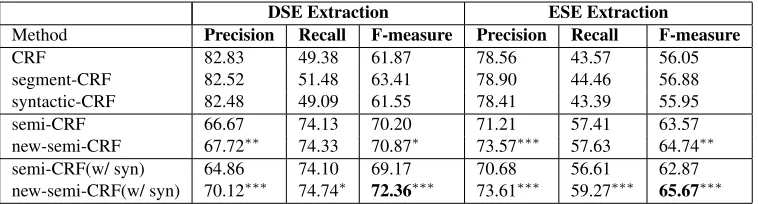
Table 2: Results for extracting opinion expressions with Binary-Overlap metric. (w/ syn) indicates the inclusion of syntactic parse features VPpre, VParg and VPsubj. Results of new-semi-CRF that are statistically significantly greater than semi-CRF according to a two-tailed t-test are indicated with∗(p < 0.1),∗∗(p < 0.05),∗∗∗(p < 0.005). T-test results are also shown for new-semi-CRF(w/ syn) versus semi-CRF(w/ syn).
DSE Extraction ESE Extraction
Method Precision Recall F-measure Precision Recall F-measure
CRF 77.91 46.45 58.20 67.72 37.55 48.31
segment-CRF 77.86 48.58 59.83 68.03 38.34 49.04
syntactic-CRF 77.73 46.27 58.01 67.80 37.60 48.37
semi-CRF 60.38 68.34 64.11 57.30 46.20 51.16
new-semi-CRF 62.50∗∗ 68.59∗ 65.41∗ 61.69∗∗∗ 47.44∗∗ 53.63∗∗∗
semi-CRF(w/ syn) 58.69 67.80 62.92 57.09 45.63 50.72
[image:7.612.112.500.231.334.2]new-semi-CRF(w/ syn) 65.52∗∗∗ 68.91∗∗∗ 67.17∗∗∗ 61.66∗∗∗ 48.77∗∗∗ 54.47∗∗∗
Table 3: Results for extracting opinion expressions with Proportional-Overlap metric. Notation is the same as above.
tion. Segment-CRF treats segment units obtained from the parser as word tokens. For example, in Figure 1, the segment unitsthe statement andboth ridiculous and odd will be treated as word tokens. Syntactic-CRF encodes segment-level syntactic in-formation in a standard token-level CRF as input features. We consider the VP-related segment fea-tures introduced in Section 3.3. VPPREand VPARG are added to the head word of the corresponding verb phrase, and VPSUBJand VPCLUSTERare added to each token within the corresponding segment.
Another baseline method is the original semi-CRF model (Sarawagi and Cohen, 2004). To the best of our knowledge, our work is the first to ex-plore the use of semi-CRFs on the extraction of opinion expressions. They are considered to be more powerful than CRFs since they allow information to be represented at the expression level. The model requires an input of the maximum entity length. We set it to 15 for DSE and 40 for ESE. For segment fea-tures, we used the same features as in our approach (see Section 3.3).
4.3 Results
Table 2 and Table 3 show the results of DSE and ESE extraction using two different metrics. The standard token-based CRF baseline of Breck et al. (2007) is labeledCRF; the original semi-CRF base-line is labeledsemi-CRF; and our extended semi-CRF approach is labelednew-semi-CRF. For semi-CRF and new-semi-semi-CRF, the results were obtained using two different settings of features: the basic feature set includes features described in Section 3.3 excluding the segment-level syntactic features. In the second feature setting (labeled asw/ synin the tables), we further augment the basic features with the syntactic parse features.
DSE Extraction ESE Extraction
Feature set Precision Recall F-measure Precision Recall F-measure
Basic 67.72 74.33 70.87 73.57 57.63 64.74
Basic+VPpre 70.88 71.44 71.16 73.20 58.20 64.85
Basic+VParg 70.12 74.03 72.02 73.05 58.20 64.79
Basic+VPcluster 70.08 72.94 71.48 73.06 58.45 64.94
Basic+VPsubj 70.04 72.34 71.17 73.31 58.53 65.09
Basic+VPpre+VPsubj 70.91 72.54 71.72 73.61 58.29 65.07 Basic+VParg+VPsubj 70.45 73.53 71.96 74.45 57.80 65.07 Basic+VPpre+VParg+VPsubj 70.12 74.74 72.36 73.61 59.27 65.67
[image:8.612.74.542.57.192.2]Basic+VPcluster+VPpre+VParg+VPsubj 70.91 72.54 71.72 72.84 58.45 64.86
Table 4: Effect of syntactic features on extracting opinion expressions with Binary-Overlap metric
syntactic features into standard CRF yields slightly reduced performance. This is not surprising as en-coding segment-level information into the token-level CRF is not natural. These experiments in-dicate that simply encoding segmentation informa-tion into standard CRF cannot result in large per-formance gains. The promising F-measure results obtained by semi-CRF and new-semi-CRF confirm that relaxing the Markovian assumption on segments leads to better modeling of opinion expressions. We can also see that new-semi-CRF consistently outper-forms the original semi-CRF model. This further confirms the benefit of taking into account syntactic parsing information in modeling segments. In Ta-ble 3, we observe the same general results trend as in Table 2. The scores are generally lower since the metricProportional Overlapis stricter thanBinary Overlap.
We also study the impact of syntactic parse fea-tures on the semi-Markov CRF models. Here we consider the combination of VPPRE, VPARG and VPSUBJsince they turned out to be the most help-ful features for our tasks. Interestingly, we found that after incorporating the syntactic parse features, performance decreases on semi-CRF. This indicates that syntactic information does not help if learning and inference take place on segment candidates gen-erated without accounting for parse information. In contrast, our approach incorporates syntactic pars-ing information in modelpars-ing segments and meanpars-ing- meaning-ful segmentations. We can see in Tables 2 and 3 that adding syntactic features successfully boosts the performance of our approach.
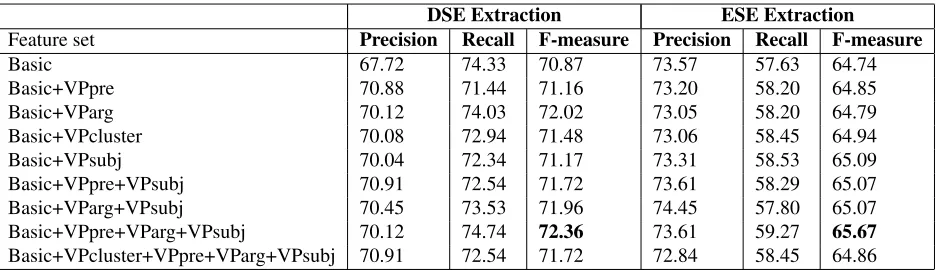
To further explore the effect of the syntactic
fea-tures, we include the results of our model with dif-ferent configurations of syntactic features in Table 4 (here we focus on the Binary Overlap metric as the results with Proportional Overlap demonstrate a similar conclusion). We can see that using the ba-sic features and the combination of VPPRE, VPARG and VPSUBJ yields the best results for both DSE and ESE extraction. For DSE extraction, combin-ing these three features improves the precision no-ticeably from 67.72% to 70.12% while the recall slightly improves. This indicates that VP-related structural information is very helpful for modeling segments as DSEs. However, this trend is not so clear for ESE extraction. This may be due to the fact that DSEs often involve verb phrases while ESEs are represented via a variety of syntactic structures.
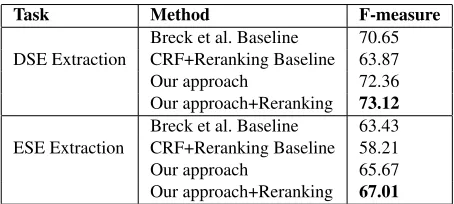
Comparison with previous work. In Table 5, we compare our results to the previous work on opinion expression extraction (here we also focus on the Bi-nary Overlapmetric due to the similar trend demon-strated by theProportional Overlapmetric). Breck et al. (2007) presents the state-of-the-art sequence labeling approach on the tasks of DSE and ESE ex-traction. Their best results are shown as Breck et al. Baseline in the table. Johansson and Mos-chitti (2010) use a reranking technique on the best
parameter settings as in their approach. Our ap-proach+Reranking are results obtained by apply-ing the rerankapply-ing step on the output of our new-semi-CRF approach.
We can see that our approach outperforms the Breck et al. Baseline on both DSE extraction and ESE extraction in spite of the fact that we do not use their WordNet, Levin’s verb categorization, and FrameNet features. The CRF+Reranking Baseline does provide a performance increase over the the baseline CRF results, but overall it cannot beat the other methods since the CRF baseline is very low. As one might expect, reranking also succeeds in boosting the performance of new-semi-CRF, achiev-ing the best performance on F-measure for both DSE and ESE extraction. Note that the interannotator agreement results for these two tasks are 75% for DSE and 72% for ESE using a similar metric to Bi-nary Overlap. Our results are much closer to these interannotator scores than previous systems espe-cially for DSEs.
Task Method F-measure
DSE Extraction
Breck et al. Baseline 70.65 CRF+Reranking Baseline 63.87
Our approach 72.36
Our approach+Reranking 73.12
ESE Extraction
Breck et al. Baseline 63.43 CRF+Reranking Baseline 58.21
Our approach 65.67
[image:9.612.72.299.354.456.2]Our approach+Reranking 67.01
Table 5: Comparison of our work with previous work on opinion expression extraction using the Binary-Overlap metric
4.4 Discussion
We note that our new-semi-CRF approach outper-forms the original semi-CRF w.r.t. both precision and recall, but compared to CRF, our approach yields a clear improvement on recall but not on pre-cision. An error analysis helps explain why. We found that our semi-CRF approach predicted almost the same number of DSEs as the gold standard la-bels while CRF only predicted half of them (for ESE extraction, the trend is similar). With more pre-dicted entities, the precision is sacrificed but recall is boosted substantially, and overall we see an increase in F-measure.
Looking further into the errors, we found sev-eral mistakes that could potentially be fixed to yield better a precision score. Some errors were due to the false prediction of speech events like “said” or “told” as DSEs in cases where they actually just in-troduced statements of fact without expressing any private state. Adding features to distinguish such cases should help improve performance. Other er-rors were due to inadequate modeling of the context surrounding the expressions. For example, “enjoy a relative advantage” was falsely predicted as an ESE. If incorporating information about the subject of this verb phrase which is “products”, this mistake could be avoided since “products” cannot hold or express private state. We also noticed some errors caused by inaccurate parsing and hope to study ways to ac-count for these in our approach as future work.
5 Conclusion
In this paper we propose a semi-CRF-based ap-proach for extracting opinion expressions that takes into account during learning and inference the struc-tural information available from syntactic parsing. Our approach allows opinion expressions to be iden-tified at the segment level and their boundaries to be influenced by their probable syntactic structure. Experimental evaluations show that our model out-performs the best existing approaches on two opin-ion extractopin-ion tasks. In additopin-ion, we identify useful syntactic parse features for these tasks that have not been explored in previous work. Our error analysis indicates that adding additional features that account for subjectivity cues in the local context might fur-ther improve the performance. In future work, we hope to explore better ways of utilizing parsing in-formation with less cost. Also, we will apply our model to additional opinion analysis tasks such as fine-grained opinion summarization and relation ex-traction.
6 Acknowledgement
This work was supported in part by National Science Foundation Grants IIS-1111176 and IIS-0968450, and by a gift from Google. We thank Nikos Karam-patziakis, Igor Labutov, Veselin Stoyanov, Ainur Yessenalina and Jason Yosinski for their helpful comments.
References
Galen Andrew. 2006. A hybrid Markov/semi-Markov conditional random field for sequence segmentation. In Proceedings of EMNLP ’06.
Steven Bethard, Hong Yu, Ashley Thornton, Vasileios Hatzivassiloglou, and Dan Jurafsky. 2005. Extracting opinion propositions and opinion holders using syn-tactic and lexical cues. In Shanahan, James G., Yan Qu, and Janyce Wiebe, editors, Computing Attitude and Affect in Text: Theory and Applications.
Eric Breck, Yejin Choi, and Claire Cardie. 2007. Identi-fying expressions of opinion in context. IJCAI’07.
Yejin Choi, Claire Cardie, Ellen Riloff, and Siddharth Patwardhan. 2005. Identifying sources of opinions with conditional random fields and extraction patterns. In Proceedings of HLT ’05.
Yejin Choi, Eric Breck, and Claire Cardie. 2006. Joint extraction of entities and relations for opinion recog-nition. In Proceedings of EMNLP ’06.
Yejin Choi and Claire Cardie. 2010. Hierarchical se-quential learning for extracting opinions and their at-tributes. In Proceedings of ACL 2010, Short Papers. Richard Johansson and Alessandro Moschitti. 2010.
Syn-tactic and semantic structure for opinion expression detection. In Proceedings of CoNLL ’10.
Niklas Jakob and Iryna Gurevych. Extracting opinion tar-gets in a single- and cross-domain setting with condi-tional random fields. In Proceedings of EMNLP’ 10. Mahesh Joshi and Penstein-Ros’e Carolyn. 2009.
Gen-eralizing dependency features for opinion mining. In Proceedings of ACL/IJCNLP 2009, Short Papers Track.
Dan Klein and Christopher D. Manning. 2003. Accurate unlexicalized parsing. In Proceedings of ACL ’03. Soo-Min Kim and Eduard Hovy. 2006. Extracting
opin-ions, opinion holders, and topics expressed in online news media text. In Proceedings of the ACL Workshop on Sentiment and Subjectivity in Text.
Nozomi Kobayashi, Kentaro Inui, and Yuji Matsumoto. 2007. Extracting aspect-evaluation and aspect-of rela-tions in opinion mining. In Proceedings of EMNLP-CoNLL-2007.
John D. Lafferty, Andrew McCallum, and Fernando C. N. Pereira. 2001. Conditional Random Fields: Proba-bilistic Models for Segmenting and Labeling Sequence Data. In Proceedings of ICML ’01.
Dong C. Liu and Jorge Nocedal. 1989. On the limited memory BFGS method for large scale optimization. Mathematical Programming B 45(3): 503-528. M Arthur Munson, Claire Cardie, and Rich Caruana.
Op-timizing to arbitrary NLP metrics using ensemble se-lection. In HLT-EMNLP05, 2005.
Daisuke Okanohara, Yusuke Miyao, Yoshimasa Tsu-ruoka, and Jun’ichi Tsujii. Improving the scalability of semi-Markov conditional random fields for named entity recognition. In Proceedings of ACL’06. Randolph Quirk, Sidney Greenbaum, Geoffrey Leech,
and Jan Svartvik. A comprehensive grammar of the English language. New York: Longman, 1985. Richard Johansson and Alessandro Moschitti.
Extract-ing Opinion Expressions and Their Polarities - Explo-ration of Pipelines and Joint Models. In Proceedings of ACL ’11, Short Paper.
Ellen Riloff and Janyce M Wiebe. Learning extraction patterns for subjective expressions. In Proceedings of EMNLP 2003.
Charles Sutton and Andrew McCallum. An Introduc-tion to CondiIntroduc-tional Random Fields. FoundaIntroduc-tions and Trends in Machine Learning (FnT ML), 2010. Janyce Wiebe, Theresa Wilson , and Claire Cardie. 2005.
Annotating expressions of opinions and emotions in language. Language Resources and Evaluation, vol-ume 39, issue 2-3, pp. 165-210.
Theresa Wilson, Janyce Wiebe, and Paul Hoffmann. 2005. Recognizing contextual polarity in phrase-level sentiment analysis. In Proceedings of HLT ’05. Theresa Wilson, Paul Hoffmann, Swapna
Somasun-daran, Jason Kessler, Janyce Wiebe, Yejin Choi, Claire Cardie, Ellen Riloff, and Siddharth Patwardhan. Opin-ionFinder: A system for subjectivity analysis. EMNLP 2005. Demo abstract.
Yuanbin Wu, Qi Zhang, Xuanjing Huang, and Lide Wu. Phrase dependency parsing for opinion mining. In Pro-ceedings of EMNLP 2009.