Towards Efficient Named-Entity Rule Induction for Customizability
Ajay Nagesh1,2 1IITB-Monash Research Academy
Ganesh Ramakrishnan 2IIT Bombay
Laura Chiticariu
IBM Research - Almaden
Rajasekar Krishnamurthy
IBM Research - Almaden
Ankush Dharkar
SASTRA University
Pushpak Bhattacharyya
IIT Bombay
Abstract
Generic rule-based systems for Information Extraction (IE) have been shown to work reasonably well out-of-the-box, and achieve state-of-the-art accuracy with further domain customization. However, it is generally rec-ognized that manually building and customiz-ing rules is a complex and labor intensive pro-cess. In this paper, we discuss an approach that facilitates the process of building cus-tomizable rules for Named-Entity Recognition (NER) tasks via rule induction, in the Annota-tion Query Language (AQL). Given a set of basic features and an annotated document col-lection, our goal is to generate an initial set of rules with reasonable accuracy, that are in-terpretable and thus can be easily refined by a human developer. We present an efficient rule induction process, modeled on a four-stage manual rule development process and present initial promising results with our sys-tem. We also propose a simple notion of ex-tractor complexity as a first step to quantify the interpretability of an extractor, and study the effect of induction bias and customization of basic features on the accuracy and complex-ity of induced rules. We demonstrate through experiments that the induced rules have good accuracy and low complexity according to our complexity measure.
1 Introduction
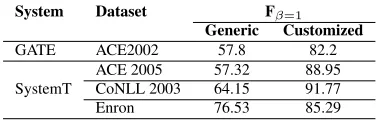
Named-entity recognition (NER) is the task of iden-tifying mentions of rigid designators from text be-longing to named-entity types such as persons, orga-nizations and locations (Nadeau and Sekine, 2007). Generic NER rules have been shown to work reason-ably well-out-of-the-box, and with further domain customization (Chiticariu et al., 2010b), achieve quality surpassing state-of-the-art results. Table 1
System Dataset Fβ=1
Generic Customized
[image:1.612.332.520.198.258.2]GATE ACE2002 57.8 82.2 ACE 2005 57.32 88.95 SystemT CoNLL 2003 64.15 91.77 Enron 76.53 85.29
Table 1:Quality of generic vs. customized rules.
summarizes the quality of NER rules out-of-the-box and after domain customization in the GATE (Cun-ningham et al., 2011) and SystemT (Chiticariu et al., 2010a) systems, as reported in (Maynard et al., 2003) and (Chiticariu et al., 2010b) respectively.
Rule-based systems are widely used in enterprise settings due to theirexplainability. Rules are trans-parent, which leads to better explainability of errors. One can easily identify the cause of a false positive or negative, and refine the rules without affecting other correct results identified by the system. Fur-thermore, rules are typically easier to understand by an IE developer and can be customized for a new domain without requiring additional labeled data.
Typically, a rule-based NER system consists of a combination of four categories of rules (Chiticariu et al., 2010b): (1)Basic Feature (BF)rules to identify components of an entity such as first name and last name. (2)Candidate definition (CD)rules to iden-tify complete occurrences of an entity by combining the output of multiple BF rules, e.g., first name fol-lowed by last name is a person candidate. (3) Candi-date refinement (CR)rules to refine candidates gen-erated by CD rules. E.g., discard candidate persons contained within organizations. (4) Consolidation rules (CO)to resolve overlapping candidates gener-ated by multiple CD and CR rules.
A well-known drawback that influences the adoptability of rule-based NER systems is the
ual effort required to build the rules. A common ap-proach to address this problem is to build a generic NER extractor and then customize it for specific do-mains. While this approach partially alleviates the problem, substantial manual effort (in the order of several person weeks) is still required for the two stages as reported in (Maynard et al., 2003; Chiti-cariu et al., 2010b). In this paper, we present initial work towards facilitating the process of building a generic NER extractor using induction techniques.
Specifically, given as input an annotated docu-ment corpus, a set of BF rules, and a default CO rule for each entity type, our goal is to generate a set of CD and CR rules such that the resulting ex-tractor constitutes a good starting point for further refinement by a developer. Since the generic NER extractor has to be manually customized, a major challenge is to ensure that the generated rules have good accuracy, and, at the same time, that they are
not too complex, and consequentlyinterpretable. The main contributions in this paper are
1. Anefficientsystem for NER rule induction, us-ing a highly expressive rule language (AQL) as the target language. The first phase of rule in-duction uses a combination of clustering and
relative least general generalization (RLGG)
techniques to learn CD rules. The second phase identifies CR rules using a propositional rule learner like JRIP to learn accurate composi-tions of CD rules.
2. Usage of induction biases to enhance the inter-pretability of rules. These biases capture the expertise gleaned from manual rule develop-ment and constrain the search space in our in-duction system.
3. Definition of an initial notion of extractor com-plexity to quantify the interpretability of an ex-tractor and to guide the process of adding in-duction biases to favor learning less complex
extractors. This is to ensure that the rules are easily customizable by the developer.
4. Scalable induction process through usage of SystemT, a state-of-the-art IE system which serves as a highly efficient theorem prover for AQL, and performance optimizations such as clustering of examples and parallelizing vari-ous modules (E.g.: propositional rule learning).
Roadmap We first describe preliminaries on Sys-temT and AQL (Section 3) and define the target lan-guage for our induction algorithm and the notion of rule complexity (Section 4). We then present our approach for inducing CD and CR rules, and dis-cuss induction biases that would favor interpretabil-ity (Section 5), and discuss the results of an empir-ical evaluation (Section 6). We conclude with av-enues for improvement in the future (Section 7).
2 Related Work
Existing approaches to rule induction for IE focus on rule-based systems based on the cascading gram-mar formalism exemplified by the Common Pat-tern Specification Language (CPSL) (Appelt and Onyshkevych, 1998), where rules are specified as a sequence of basic features that describe an en-tity, with limited predicates in the context of an entity mention. Patel et al. (2009) and Soderland (1999) elaborate on top-down techniques for induc-tion of IE rules, whereas (Califf and Mooney, 1997; Califf and Mooney, 1999) discuss a bottom-up IE rule induction system that uses therelative least gen-eral gengen-eralization (RLGG)of examples1. However, in all these systems, the expressivity of the rule-representation language is restricted to that of cap-turing sequence information. As discussed in Sec-tion 3, contextual clues and higher level rule inter-actions such as filteringandjoin are very difficult, if not impossible to express in such representations without resorting to custom code. Learning higher level interactions between rules has received little attention. Our technique for learning higher level in-teractions is similar to the induction ofripple down rules (Gaines and Compton, 1995), which, to the best of our knowledge, has not been previously ap-plied to IE. A framework for refining AQL extractors based on an annotated document corpus described in (Liu et al., 2010). We present complementary techniques for inducing an initial extractor that can be automatically refined in this framework.
3 Preliminaries
SystemT is a declarative IE system based on an al-gebraic framework. In SystemT, developers write rules in AQL. To represent annotations in a
docu-1
Figure 1:ExamplePersonextractor in AQL
ment, AQL uses a simple relational data model with three types: aspanis a region of text within a docu-ment identified by its “begin” and “end” positions; a
tupleis a fixed-size list of spans; arelation, orview, is a multi-set of tuples, where every tuple in the view must be of the same size.
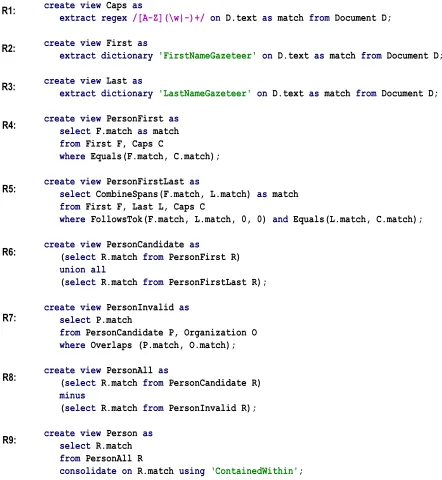
Figure 1 shows a portion of a Person extractor written in AQL. The basic building block of AQL is aview. Aviewis a logical description of a set of tuples in terms of (i) the document text (denoted as a special view calledDocument), and (ii) the contents of other views, as specified in the from clauses of each statement. Figure 1 also illustrates five of the basic constructs that can be used to define a view, and which we explain next. The complete specifica-tion can be found in the AQL manual (IBM, 2012). In the paper, we will use ‘rules’ and ‘views’ inter-changeably.
The extract statement specifies basic character-level extraction primitives such as regular expression and dictionary matching over text, creating a tuple for each match. As an example, ruleR1uses the ex-tractstatement to identify matches (Capsspans) of a
regular expression for capitalized words.
The select statement is similar to the SQL select statement but it contains an additionalconsolidate on clause (explained further), along with an exten-sive collection of text-specific predicates. RuleR5
illustrates a complex example: it selectsFirst spans immediately followed within zero tokens by aLast span, where the latter is also a Caps span. The two conditions are specified using two join predi-cates:FollowsTokandEqualsrespectively. For each triplet ofFirst,LastandCapsspans satisfying the two predicates, the CombineSpans built-in scalar func-tion in the select clause constructs larger PersonFirst-Lastspans that begin at the begin position of theFirst span, and end at the end position of theLast (also Caps) span.
Theunion allstatementmerges the outputs of two or more statements. For example, ruleR6 unions
person candidates identified by rulesR4andR5. The minus statement subtracts the output of one statement from the output of another. For example, ruleR8defines a viewPersonAllby filtering out
Per-sonInvalidtuples from the set ofPersonCandidate tu-ples. Notice that ruleR7used to define the view
Per-sonInvalid illustrates another join predicate of AQL calledOverlaps, which returns true if its two argu-ment spans overlap in the input text. Therefore, at a high level, ruleR8removes person candidates that
overlap with anOrganizationspan. (TheOrganization extractor is not depicted in the figure.)
The consolidate clause of a select statement re-moves selected overlapping spans from the indicated column of the input tuples, according to the spec-ified policy (for instance, ‘ContainedWithin’). For example, ruleR9retainsPersonAllspans that are not
contained in otherPersonAllspans.
Internally, SystemT compiles an AQL extractor into an executable plan in the form of a graph of
ex-press in CPSL systems such as GATE without an escape to custom code (Chiticariu et al., 2010b). In addition, the decoupling between the AQL specifi-cation of “what” to extract from“how” to extract it, allows greater flexibility in choosing an efficient execution strategy among the many possible opera-tor graphs that may exist for the same AQL extrac-tor. Therefore, extractors written in AQL achieve orders of magnitude higher throughput (Chiticariu et al., 2010a).
4 Induction Target Language
Our goal is to automatically generate NER extrac-tors with good quality, and at the same time, man-ageable complexity, so that the extractors can be fur-ther refined and customized by the developer. To this end, we focus on inducing extractors using the sub-set of AQL constructs described in Section 3. We note that we have chosen a small subset of AQL con-structs that are sufficient to implement several com-mon operations required for NER. However, AQL is a much more expressive language, and incorporating additional constructs is subject to our future work.
In this section we describe the building blocks of our target language, and propose a simple definition for measuring the complexity of an extractor.
Target Language. The components of the target language are as follows, and summarized in Table 2.
Basic features (BF):BF viewsare specified using the
extractstatement, such as rulesR1toR3in Figure 1.
In this paper, we assume as input a set ofbasic fea-tures, consisting of dictionaries and regular expres-sions.
Candidate definition (CD):CDviews are expressed using theselectstatement to combine BF views with join predicates (e.g., Equals, FollowsTok or Over-laps), and theCombineSpansscalar function to con-struct larger candidate spans from input spans. Rules
R4 andR5 in Figure 1 are example CD rules. In
general, a CD view is defined as: “Select all spans constructed from view1, view2,. . ., viewn, such that all
join predicates are satisfied”.
Candidate refinement (CR): CR views are used to discard spans output by the CD views that may be incorrect. In general, a CR view is defined as: “From the list of spans of viewvalidsubtract all those spans that belong to viewinvalid”. viewvalid is obtained by join-ing all the positive CD clues on theEqualspredicate
andviewinvalid is obtained by joining all the nega-tive overlapping clues with the Overlaps predicate and subsequently ’union’ing all the negative clues. (e.g., similar in spirit to rulesR6, R7andR8in
Fig-ure 1, except that the subtraction is done from a sin-gle view and not theunionof multiple views).
Consolidation (CO): Finally, aselectstatement with a fixedconsolidateclause is used for each entity type to remove overlapping spans from CR views. An example CO view is defined by ruleR9in Figure 1. Extractor Complexity. Since our goal is to gener-ate extractors with manageable complexity, we must introduce a quantitative measure of extractor com-plexity, in order to (1) judge the complexity of the extractors generated by our system, and (2) reduce the search space considered by the induction system. To this end, we define a simple complexity score that is a function of the number of rules, and the number of input views to each rule of the extrac-tor. In particular, we define the length of rule R, denoted as L(R), as the number of input views in thefromclause(s) of the view. For example, in Fig-ure 1, we have L(R4) = 2andL(R5) = 3, since R4 andR5 have two, and respectively three views
in thefromclause. Furthermore, L(R8) = 2since
each of the two inner statements ofR8has onefrom
clause with a single input view. The complexity of BF rules (e.g.,R1 toR3) and CO rules (e.g.,R9) is
always 1, since these types of rules have a single in-put view. We define thecomplexity of extractorE, denoted asC(E)as the sum of lengths of all rules of
E. For example, the complexity of thePerson extrac-tor from Figure 1 is 15, plus the length of all rules involved in definingOrganization, which are omitted from the figure.
Phase name AQL statements Prescription Rule Type
Basic Features extract Off-the-shelf, Learning using prior work (Riloff, 1993; Li et al., 2008)
Basic Features Definition
Phase 1 (Clustering and RLGG)
select Bottom-up learning (LGG), Top-down
refine-ment
Development of Candidate Rules
Phase 2 (Propositional Rule Learning)
select, union all, minus
RIPPER, Lightweight Rule Induction Candidate Rules Filtering
Consolidation consolidate, union all
Manually identified consolidation rules, based on domain knowledge
[image:5.612.69.550.59.147.2]Consolidation rules
Table 2:Phases in induction, the language constructs invoked in each phase, the prescriptions for inducing rules in the phase and the corresponding type of rule in manual rule development.
simpler and smaller extractors, and therefore consti-tutes a good basis for more comprehensive measures of interpretability in the future.
5 Induction of Rules
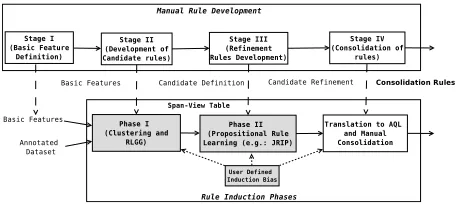
Since the goal is to generate rules that can be cus-tomized by humans, the overall structure of the in-duced rules must be similar in spirit to what a devel-oper following best practices would write. Hence, the induction process is divided into multiple phases. Figure 2 shows the correspondence between the phases of induction and the types of rules. In Ta-ble 2, we summarize the phases of our induction al-gorithm, along with the subset of AQL constructs that comprise the language of the rules learnt in that phase, the possible methods prescribed for inducing the rules and their correspondence with the stages in the manual rule development.
Our induction system generates rules for two of the four categories, namely CD and CR rules as highlighted in Figure 2. We assume that we are given the BFs in the form of dictionaries and reg-ular expressions. Prior work on learning dictionar-ies (Riloff, 1993) and regular expressions (Li et al., 2008) could be leveraged to semi-automate the pro-cess of defining the basic features.
We represent each example, in conjunction with relevant background knowledge in the form first order horn clauses. This background knowledge will serve as input to our induction system. The first phase of induction uses a combination of
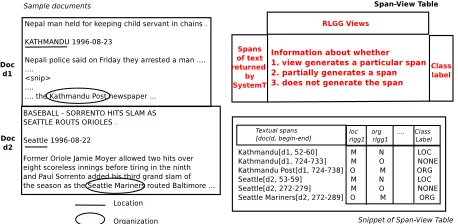
clustering andrelative least general generalization (RLGG)(Nienhuys-Cheng and Wolf, 1997; Muggle-ton and Feng, 1992) techniques. At the end of this phase, we have a number of CD rules. In the sec-ond phase, we begin by forming a structure called the span-view table. Broadly speaking, this is an
attribute-value table formed by all the views induced in the first phase along with the textual spans gener-ated by them. The attribute-value table is used as input to a propositional rule learner such as JRIP
to learn accurate compositions of a useful (as deter-mined by the learning algorithm) subset of the CD rules. This forms the second phase of our system. The rules learnt from this phase are the CR rules. At various phases, several induction biases are intro-duced to enhance the interpretability of rules. These biases capture the expertise gleaned from manual rule development and constrain the search space in our induction system.
The hypothesis language of our induction sys-tem is Annotation Query Language (AQL) and we useSystemT as the theorem prover. SystemT pro-vides a very fast rule execution engine and is cru-cial in our induction system as we test multiple hy-potheses in the search for the more promising ones. AQL provides a very expressive rule representation language that is proven to be capable of encoding all the paradigms that any rule-based representa-tion can encode. The dual advantages ofrich rule-representationandexecution efficiencyare the main motivation behind our choice.
We discuss our induction procedure in detail next.
5.1 Basic Features and Background Knowledge
We assume that we are provided with a set of dictio-naries and regular expressions for defining all our basic create view statements. R1, R2 and R3 in
Figure 2: Correspondence between Manual Rule devel-opment and Rule Induction.
that includes in its body, the basic view-types en-coded as background knowledge predicates. To es-tablish relationships between different background knowledge predicates for each training example, we define some additional “glue predicates” such as
containsandbefore.
5.2 Induction of Candidate Definition Rules
Clustering Module. We obtain non-overlapping clusters of examples within each type, by comput-ing similarities between their representations as def-inite clauses. We present the intuition behind this approach in Figure 3 which illustrates the process of taking two examples and finding their generaliza-tion. It is worthwhile to look at generalizations of instances that are similar. For instance, two token person names such asMark WaughandMark Twain
are part of a single cluster. However, we would not be able to generalize a two-token name (e.g., Mark Waugh) with another name consisting of initials fol-lowed by a token (e.g., M. Waugh). Using a wrap-per around the hierarchical agglomerative cluster-ing implemented in Lcluster-ingPipe2, we cluster examples and look at generalizations only within each cluster. Clustering also helps improve efficiency by reduc-ing the computational overhead, since otherwise, we would have to consider generalizations of all pairs of examples (Muggleton and Feng, 1992).
RLGG computation. We compute our CD
rules as the relative least general generalization (RLGG) (Nienhuys-Cheng and Wolf, 1997; Mug-gleton and Feng, 1992) of examples in each clus-ter. Given a set of clauses in first order logic, their RLGG is the least generalized clause in the
2
http://alias-i.com/lingpipe/demos/tutorial/cluster/read-me.html
Figure 3:Relative Least General Generalization
subsumption lattice of the clauses relative to the background knowledge (Nienhuys-Cheng and Wolf, 1997). RLGG is associative, and we use this fact to compute RLGGs of sets of examples in a clus-ter. The RLGG of two bottom clauses as computed in our system and its translation to an AQL view is illustrated in Figure 3. We filter out noisy RLGGs and convert the selected RLGGs into the equivalent AQL views. Each such AQL view is treated as a CD rule. We next discuss the process of filtering-out noisy RLGGs. We interchangeably refer to the RLGGs and the clusters they represent .
Iterative Clustering and RLGG filtering. Since clustering is sub-optimal, we expected some clusters in a single run of clustering to have poor RLGGs, ei-ther in terms of complexity or precision. We ei- there-fore use an iterative clustering approach, based on the separate-and-conquer (F¨urnkranz, 1999) strat-egy. In each iteration, we pick the clusters with the best RLGGs and remove all examples covered by those RLGGs. The best RLGGs must have preci-sion and number of examples covered above a pre-specified threshold.
5.3 Induction of Candidate Refinement Rules
Span-View Table. The CD views from phase 1 along with the textual spans they generate, yield the
[image:6.612.312.540.58.143.2]Figure 4:Span-View Table
likeJRIPto learn compositions of CD views.
Propositional Rule Learning. Based on our study of different propositional rule learners, we decided to useRIPPER (F¨urnkranz and Widmer, 1994) im-plemented as theJRIPclassifier in weka (Witten et al., 2011). Some considerations that favor JRIP are (i) absence of rule ordering, (ii) ease of conversion to AQL and (iii) amenability to add induction biases in the implementation.
A number of syntactic biases were introduced in JRIP to aid in the interpretability of the induced rules. We observed in our manually developed rules that CR rules for a type involve interaction between CDs for the same type and negations (not-overlaps, not matches) of CDs of the other types. This bias was incorporated by constraining a JRIP rule to con-tain only positive features (CDs) of the same type (say PER) and negative features (CDs) of only other types (ORG and LOC, in this case).
The output of the JRIP algorithm is a set of rules, one set for each of PER, ORG and LOC. Here is an example rule: PER-CR-Rule ⇐ (PerCD
= m) AND (LocCD != o) which is read as : “If a
span matches PerCD and does not overlap with LocCD, then that span denotes a PER named entity”. Here
PerCD is {[FirstName ∧ CapsPerson][LastName
∧ CapsPerson]} 3 and LocCD is {[CapsPlace ∧
CitiesDict]}. This rule filters out wrong person
annotations like“Prince William”inPrince William Sound. (This is the name of a location but has over-lapped with a person named entity.) In AQL, this effect can be achieved most elegantly by theminus
(filter) construct. Such an AQL rule will filter all those occurrences ofPrince Williamfrom the list of
3
Two consecutive spans where the 1st is FirstName and CapsPerson and the 2nd is LastName and CapsPerson.
persons that overlap with a city name.
Steps such as clustering, computation of RLGGs, JRIP, and theorem proving using SystemT were par-allelized. Once the CR views for each type of named entity are learnt, many forms of consolida-tions (COs) are possible, both within and across types. A simple consolidation policy that we have incorporated in the system is as follows: union all the rules of a particular type, then perform a con-tained withinconsolidation, resulting in the final set of consolidated views for each named entity type.
6 Experiments
We evaluate our system on CoNLL03 (Tjong Kim Sang and De Meulder, 2003), a collection of Reuters news stories. We used the CoNLL03 training set for induction and report results on the CoNLL03 test collection.
The basic features (BFs) form the primary input to our induction system. We experimented with three sets of BFs:
Initial set(E1): The goal in this setup is to induce an initial set of rules based on a small set of reason-able BFs. We use a conservative initial set consisting of 15 BFs (5 regular expressions and 10 dictionar-ies).
Enhanced set (E2): Based on the results of E1, we identify a set of additional domain independent BFs4. Five views were added to the existing set in E1 (1 regular expression and 4 dictionaries). The goal is to observe whether our approach yields rea-sonable accuracies compared to generic rules devel-oped manually.
Domain customized set (E3): Based on the knowledge of the domain of the training dataset (CoNLL03), we introduced a set of features specific to this dataset. These included sports-related person, organization and location dictionaries5. These views were added to the existing set in E2. The intended goal is to observe what are the best possible accura-cies that could be achieved with BFs customized to a particular domain.
The set of parameters for iterative clustering on which the accuracies reported are : the precision threshold for the RLGGs of the clusters was 70%
4E.g., the featurepreposition dictionarywas added in E2 to help identify organization names such asBank of England.
Train Test
Type P R F P R F C(E)
E1 (Initial set)
PER 88.5 41.4 56.4 92.5 39.4 55.3 144
ORG 89.1 7.3 13.4 85.9 5.2 9.7 22
LOC 91.6 54.5 68.3 87.3 55.3 67.8 105
Overall 90.2 35.3 50.7 89.2 33.3 48.5 234
E2 (Enhanced set)
PER 84.7 52.9 65.1 87.5 49.9 63.5 233
ORG 88.2 7.8 14.3 85.8 5.9 11.0 99
LOC 92.1 58.6 71.7 88.6 59.1 70.9 257
Overall 88.6 40.7 55.8 88.0 38.2 53.3 457
E3 (Domain customized set)
PER 89.9 57.3 70.0 91.7 56.0 69.5 430
ORG 86.9 50.9 64.2 86.9 47.5 61.4 348
LOC 90.8 67.0 77.1 84.3 67.3 74.8 356
[image:8.612.74.297.55.222.2]Overall 89.4 58.7 70.9 87.3 57.0 68.9 844
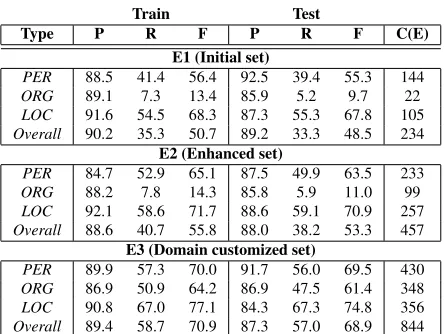
Table 3:Results on CoNLL03 dataset with different basic feature sets
and the number of examples covered by each RLGG was 5. We selected the top 5 clusters from each iter-ation whose RLGGs crossed this threshold. If there were no such clusters then we would lower the preci-sion threshold to 35% (half of the threshold). When no new clusters were formed, we ended the itera-tions.
6.1 Experiments and Results
Effect of Augmenting Basic Features. Table 3 shows the accuracy and complexity of rules induced with the three basic feature sets E1, E2 and E3, respectively 6. The overall F-measure on the test dataset is 48.5% with E1, it increases to around 53.3% with E2 and is highest at 68.9% with E3. As we increase the number of BFs, the accuracies of the induced extractors increases, at the cost of an increase in complexity. In particular, the re-call increases significantly across the board, and is more prominent between E2 and E3, where the ad-ditional domain specific features result in recall in-crease from 5.9% to 47.5% for ORG. The precision increases slightly for PER, but decreases slightly for LOC and ORG with the addition of domain specific features.
Comparison with manually developed rules. We compared the induced extractors with the manually developed extractors of (Chiticariu et al., 2010b), heretofore referred to as manual extractors. (For a detailed analysis, we obtained the extractors from
6
These are the results for the configuration with bias.
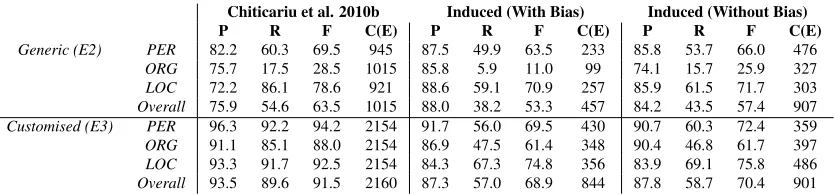
the authors). Table 4 shows the accuracy and com-plexity of the induced rules with E2 and E3 and the manual extractors for the generic domain and, re-spectively, customized for the CoNLL03 domain. (In the table, ignore the column Induced (without bias), which is discussed later). Our technique compares reasonably with the manually constructed generic extractor for two of the three entity types; and on precision for all entity types, especially since our system generated the rules in 1 hour, whereas the development of manual rules took much longer 7. Additional work is required to match the manual customized extractor’s performance, primarily due to shortcomings in our current target language. Re-call that our framework is limited to a small subset of AQL constructs for expressing CD and CR rules, and there is a single consolidation rule. In particu-lar, advanced constructs such as dynamic dictionar-ies are not supported, and the set of predicates to the Filter construct supported in our system is restricted to predicates over other concepts, which is only a subset of those used in (Chiticariu et al., 2010b). The manual extractors also contain a larger number of rules covering many different cases, improving the accuracy, but also leading to a higher complex-ity score. To better analyze the complexcomplex-ity, we also computed the average rule length for each extrac-tor by dividing the complexity score by the number of AQL views of the extractor. The average rule length is 1.78 and 1.87 for the induced extractors with E2 and E3, respectively, and 1.9 and 2.1 for the generic and customized extractors of (Chiticariu et al., 2010b), respectively. The average rule length in-creases from the generic extractor to the customized extractor in both cases. On average, however, an in-dividual induced rule is slightly smaller than a man-ually developed rule.
Effect of Bias. The goal of this experiment is to demonstrate the importance of biases in the induc-tion process. The biases added to the system are broadly of two types: (i) Partition of basic features based on types (ii) Restriction on the type of CD views that can appear in a CR view. 8 Without
7(Chiticariu et al., 2010b) mentions that customization for 3 domains required 8 person weeks. It is reasonable to infer that developing the generic rules took comparable effort.
8
(i) many semantically similar basic features (espe-cially, regular expressions) would match a given to-ken, leading to an increase in the length of a CD a rule. For example, in the CD rule [FirstName-Dict][CapsPerson ∧ CapsOrg]} (“A FirstNameDict span followed by a CapsPerson span that is also a Cap-sOrg span”), CapsPerson and CapsOrg are two very similar regular expressions identifying capitalized phrases that look like person, and respectively, orga-nization names, with small variations (e.g., the for-mer may allow special characters such as ‘-’). In-cluding both BFs in a CD rule leads to a larger rule that is unintuitive for a developer. The former bias excludes such CD rules from consideration.
The latter type of bias prevents CD rules of one type to appear as positive clues for a CR rule of a different type. For instance, without this bias, one of the CR rules obtained was Per ⇐ (OrgCD
= m) AND (LocCD != o)(“If a span matches OrgCD
and does not overlap with LocCD, then that span denotes a PER named entity”. Here OrgCD was
{[CapsOrg][CapsOrg]}andLocCDwas {[CapsLoc
∧ CitiesDict]}. The inclusion of an Organization
CD rule as a positive clue for a Person CR rule is unintuitive for a developer.
Table 4, shows the effect (for E2 and E3) on the test dataset of disabling and enabling bias during the induction of CR rules using JRIP. Adding bias improves the precision of the induced rules. With-out bias, however, the system is less constrained in its search for high recall rules, leading to slightly higher overall F measure. This comes at the cost of an increase in extractor complexity and average rule length. For example, for E2, the average rule length decreases from 2.17 to 1.78 after adding the bias. Overall, our results show that biases lead to less complex extractors with only a very minor ef-fect on accuracy, thus biases are important factors contributing to inducing rules that are understand-able and may be refined by humans.
Comparison with other induction systems. We also experimented with two other induction systems, Aleph9 and ALP10, a package that implements one of the reportedly good information extraction algo-rithms (Ciravegna, 2001). While induction in Aleph
9A system for inductive logic programming. See http://www.cs.ox.ac.uk/activities/machlearn/Aleph/aleph.html
10
http://code.google.com/p/alpie/
was performed with the same target language as in our approach, the target language of ALP is JAPE, which has been shown (Chiticariu et al., 2010b) to lack in some of the constructs (such as minus) that AQL provides and which form a part of our tar-get language (especially the rule refinement phase). However, despite experimenting with all possible parameter configurations for each of these (in each of E1, E2 and E3 settings), the accuracies obtained were substantially (30-50%) worse and the extrac-tor complexity was much (around 60%) higher when compared to our system (with or without bias). Ad-ditionally, Aleph takes close to three days for induc-tion, whereas both ALP and our system require less than an hour.
6.2 Discussion
Weak and Strong CDs reflected in CRs. In our experiments, we found that varying the pre-cision and complexity thresholds while inducing the CDs (c.f Section 5) affected the F1 of the fi-nal extractor only minimally. But reducing the precision threshold generally improved the preci-sion of the final extractor, which seemed counter-intuitive at first. We found that CR rules learned by JRIP consist of a strong CD rule (high preci-sion, typically involving a dictionary) and a weak CD rule (low precision, typically involving only regular expressions). The strong CD rule always corresponded to a positive clue (match) and the weak CD rule corresponded to the negative clue (overlaps or not-matches). This is illustrated in the following CR rule: PER ⇐ (PerCD = m) AND
(OrgCD != o) where (PerCD is {[CapsPersonR]
[CapsPersonR ∧ LastNameDict]} and (OrgCD is
{[CapsOrgR][CapsOrgR][CapsOrgR]}. This is
posited to be the way the CR rule learner operates – it tries to learn conjunctions of weak and strong clues so as to filter one from the other. Therefore, setting a precision threshold too high limited the number of such weak clues and the ability of the CR rule learner to find such rules.
Chiticariu et al. 2010b Induced (With Bias) Induced (Without Bias)
P R F C(E) P R F C(E) P R F C(E)
Generic (E2) PER 82.2 60.3 69.5 945 87.5 49.9 63.5 233 85.8 53.7 66.0 476
ORG 75.7 17.5 28.5 1015 85.8 5.9 11.0 99 74.1 15.7 25.9 327
LOC 72.2 86.1 78.6 921 88.6 59.1 70.9 257 85.9 61.5 71.7 303
Overall 75.9 54.6 63.5 1015 88.0 38.2 53.3 457 84.2 43.5 57.4 907
Customised (E3) PER 96.3 92.2 94.2 2154 91.7 56.0 69.5 430 90.7 60.3 72.4 359
ORG 91.1 85.1 88.0 2154 86.9 47.5 61.4 348 90.4 46.8 61.7 397
LOC 93.3 91.7 92.5 2154 84.3 67.3 74.8 356 83.9 69.1 75.8 486
[image:10.612.98.517.56.154.2]Overall 93.5 89.6 91.5 2160 87.3 57.0 68.9 844 87.8 58.7 70.4 901
Table 4:Comparison of induced rules (with and without bias) and manually developed rules. (CoNLL03 test dataset)
the number of rules, and the size of each rule, but exhibits a number of shortcomings described next. First, it disregards other components of a rule be-sides its from clause, for example, the number of items in the select clause, or the where clause. Sec-ond, rule developers use semantically meaningful view names such as those shown in Figure 1 to help them recall the semantics of a rule at a high-level, an aspect that is not captured by the complexity mea-sure. Automatic generation of meaningful names for induced views is an interesting direction for fu-ture work. Finally, the overall strucfu-ture of an tors is not considered. In simple terms, an extrac-tor consisting of 5 rules of size 1 is indistinguish-able from an extractor consisting of a single rule of size 5, and it is arguable which of these extrac-tors is more interpretable. More generally, the ex-tent of this shortcoming is best explained using an example. When informally examining the rules in-duced by our system, we found that CD rules are similar in spirit to those written by rule develop-ers. On the other hand, the induced CR rules are too fine-grained. In general, rule developers group CD rules with similar semantics, then write refine-ment rules at the higher level of the group, as op-posed to the lower level of individual CD views. For example, one may write multiple CD rules for can-didate person names of the formhFirstihLasti, and multiple CD rules of the formhLasti, hFirsti. One would then union together the candidates from each of the two groups into two different views, e.g., Per-FirstLast and PerLastCommaFirst, and write filter rules at the higher level of these two views, e.g., “Remove PerLastCommaFirst spans that overlap with a PerFirstLast span”. In contrast, our induction algo-rithm considers CR rules consisting of combinations of CD rules directly, leading to many semantically
similar CR rules, each operating over small parts of a larger semantic group (see rule in Section 6.1). This results in repetition, and qualitatively less in-terpretable rules, since humans prefer higher levels of abstraction and generalization. This nuance is not captured by the complexity score which may deem an extractor consisting of many rules, where many of the rules operate at higher levels of groups of can-didates to be more complex than a smaller extrac-tor with many fine-grained rules. Indeed, as shown before, the complexity of the induced extractors is much smaller compared to that of manual extrac-tors, although the latter follow the semantic group-ing principle and are considered more interpretable.
7 Conclusion
References
S. Abiteboul, R. Hull, and V. Vianu. 1995. Foundations of Databases. Addison Wesley Publishing Co.
Douglas E. Appelt and Boyan Onyshkevych. 1998. The common pattern specification language. InTIPSTER workshop.
Mary Elaine Califf and Raymond J. Mooney. 1997. Ap-plying ilp-based techniques to natural language infor-mation extraction: An experiment in relational learn-ing. In IJCAI Workshop on Frontiers of Inductive Logic Programming.
Mary Elaine Califf and Raymond J. Mooney. 1999. Re-lational learning of pattern-match rules for information extraction. InAAAI.
Laura Chiticariu, Rajasekar Krishnamurthy, Yunyao Li, Sriram Raghavan, Frederick R. Reiss, and Shivaku-mar Vaithyanathan. 2010a. Systemt: an algebraic ap-proach to declarative information extraction. InACL.
Laura Chiticariu, Rajasekar Krishnamurthy, Yunyao Li, Frederick Reiss, and Shivakumar Vaithyanathan. 2010b. Domain adaptation of rule-based annotators for named-entity recognition tasks. InEMNLP.
Fabio Ciravegna. 2001. (lp)2, an adaptive algorithm for information extraction from web-related texts. In In Proceedings of the IJCAI-2001 Workshop on Adaptive Text Extraction and Mining.
Hamish Cunningham, Diana Maynard, Kalina Bontcheva, Valentin Tablan, Niraj Aswani, Ian Roberts, Genevieve Gorrell, Adam Funk, An-gus Roberts, Danica Damljanovic, Thomas Heitz, Mark A. Greenwood, Horacio Saggion, Johann Petrak, Yaoyong Li, and Wim Peters. 2011. Text Processing with GATE (Version 6).
J. F¨urnkranz and G. Widmer. 1994. Incremental reduced error pruning. pages 70–77.
Johannes F¨urnkranz. 1999. Separate-and-conquer rule learning.Artif. Intell. Rev., 13(1):3–54, February.
B. R. Gaines and P. Compton. 1995. Induction of ripple-down rules applied to modeling large databases. J. In-tell. Inf. Syst., 5:211–228, November.
IBM, 2012. IBM InfoSphere BigInsights - An-notation Query Language (AQL) reference.
http://publib.boulder.ibm.com/ infocenter/bigins/v1r3/topic/com. ibm.swg.im.infosphere.biginsights. doc/doc/biginsights_aqlref_con_ aql-overview.html.
Yunyao Li, Rajasekar Krishnamurthy, Sriram Raghavan, Shivakumar Vaithyanathan, and H. V. Jagadish. 2008. Regular expression learning for information extrac-tion. InEMNLP.
Bin Liu, Laura Chiticariu, Vivian Chu, H. V. Jagadish, and Frederick R. Reiss. 2010. Automatic rule refine-ment for information extraction. Proc. VLDB Endow., 3:588–597.
Diana Maynard, Kalina Bontcheva, and Hamish Cun-ningham. 2003. Towards a semantic extraction of named entities. InIn Recent Advances in Natural Lan-guage Processing.
Stephen Muggleton and C. Feng. 1992. Efficient induc-tion in logic programs. InILP.
D. Nadeau and S. Sekine. 2007. A survey of named entity recognition and classification. Linguisticae In-vestigationes, 30:3–26.
Shan-Hwei Nienhuys-Cheng and Ronald de Wolf. 1997. Foundations of Inductive Logic Programming. Anup Patel, Ganesh Ramakrishnan, and Pushpak
Bhat-tacharyya. 2009. Incorporating linguistic expertise using ilp for named entity recognition in data hungry indian languages. InILP.
Frederick Reiss, Sriram Raghavan, Rajasekar Krishna-murthy, Huaiyu Zhu, and Shivakumar Vaithyanathan. 2008. An algebraic approach to rule-based informa-tion extracinforma-tion. InICDE.
Ellen Riloff. 1993. Automatically constructing a dictio-nary for information extraction tasks. InAAAI. Stephen Soderland. 1999. Learning information
extrac-tion rules for semi-structured and free text. Mach. Learn., 34:233–272.
Erik F. Tjong Kim Sang and Fien De Meulder. 2003. Introduction to the conll-2003 shared task: language-independent named entity recognition. In HLT-NAACL.