ORIGINAL ARTICLE
Modi
fi
ed-release prednisone for
polymyalgia rheumatica: a multicentre,
randomised, active-controlled,
double-blind, parallel-group study
Maurizio Cutolo,1Michael Hopp,2Stefan Liebscher,2Bhaskar Dasgupta,3 Frank Buttgereit4
To cite:Cutolo M, Hopp M,
Liebscher S,et al. Modified-release prednisone for polymyalgia rheumatica: a multicentre, randomised, active-controlled, double-blind, parallel-group study.RMD Open2017;3: e000426. doi:10.1136/ rmdopen-2016-000426
▸ Prepublication history and additional material are available. To view please visit the journal (http://dx.doi.org/ 10.1136/rmdopen-2016-000426).
BD and FB share senior authorship.
Received 22 December 2016 Revised 22 February 2017 Accepted 24 February 2017
For numbered affiliations see end of article.
Correspondence to Professor Maurizio Cutolo; [email protected]
ABSTRACT
Objective:To assess the efficacy and safety of modified-release (MR) versus immediate-release (IR) prednisone in newly diagnosed glucocorticoid (GC)-naïve patients with polymyalgia rheumatica (PMR). Methods:Patients were randomised to double-blind MR prednisone (taken at approximately 22:00) or IR prednisone (taken in the morning), 15 mg/day for 4 weeks. The primary end point was complete response rate (≥70% reduction in PMR visual analogue scale, duration of morning stiffness and C reactive protein (CRP) (or CRP <2× upper limit of normal (ULN))) at week 4. Non-inferiority was decided if the lower 95% confidence limit (MR vs IR prednisone) was above−15%. 400 patients were planned but only 62 were enrolled due to difficulties in recruiting GC-naïve patients with PMR with CRP≥2×ULN. Results:The percentage of complete responders at week 4 was numerically greater for MR prednisone (53.8%) than for IR prednisone (40.9%). Non-inferiority of MR versus IR prednisone was not proven in the primary analysis on the per protocol population (N=48; treatment difference: 12.22%; 95% CI −15.82% to 40.25%). However, sensitivity analysis on the full analysis population showed an evident trend favouring MR prednisone (N=62; treatment difference: 15.56%; 95% CI−9.16% to 40.28%). Adverse events were generally mild and transient with no unexpected safety observations.
Conclusions:The study showed a clear trend for favourable short-term efficacy of MR prednisone versus IR prednisone in early treatment of PMR. Further studies are warranted.
Trial registration number:EudraCT number 2011-002353-57; Results.
INTRODUCTION
Polymyalgia rheumatica (PMR) is a common inflammatory rheumatic disease of older people1 characterised by new-onset bilat-eral shoulder and/or hip girdle pain with pronounced stiffness and an acute phase
response.2 3 Glucocorticoids (GCs) are the mainstay of treatment and rapidly improve PMR symptoms;4an initialflexible minimum effective GC dose of 12.5–25 mg prednisone (recognising demographics, comorbidities, comedications, GC risk factors and disease severity) is recom-mended by the 2015 European League Against Rheumatism (EULAR) / American College of Rheumatology (ACR) guidelines.5 6
Key messages
What is already known about this subject? ▸ Optimising the timing of glucocorticoid (GC)
administration in relation to endogenous cortisol rhythms and symptom severity using modified-release (MR) formulations can improve thera-peutic potential in inflammatory conditions, as already demonstrated in rheumatoid arthritis. ▸ Preliminary studies suggest that MR prednisone
may also have benefits in polymyalgia rheuma-tica (PMR), but data from randomised controlled trials are lacking.
What does this study add?
▸ This randomised controlled study showed a clear trend for a larger reduction in key PMR symptoms and levels of pro-inflammatory cyto-kine interleukin (IL)-6 with MR prednisone com-pared with immediate-release (IR) prednisone, although only 62 of a planned 400 patients were enrolled due to difficulties in recruiting GC-naïve patients with PMR and the study did not meet its primary objective of showing non-inferiority.
How might this impact on clinical practice? ▸ Results from this study, though limited, suggest
favourable efficacy of MR prednisone over IR pred-nisone in patients with PMR, and further confirm-ation should be sought from larger clinical trials. ▸ Experience from this study demonstrates that
careful consideration of PMR inclusion and response criteria is required.
Cutolo M,et al.RMD Open2017;3:e000426. doi:10.1136/rmdopen-2016-000426 1
on May 7, 2020 by guest. Protected by copyright.
http://rmdopen.bmj.com/
Patients with inflammatory conditions such as PMR typically show circadian variations in clinical symptoms related to altered concentrations of inflammatory cyto-kines, melatonin and cortisol, with key symptoms usually most severe in the early morning.7–10 Modified-release (MR) prednisone has been developed to optimise oral GC treatment strategies with respect to circadian rhythms of inflammation by releasing prednisone
∼4 hours after the administration of the tablet in the late evening. The CAPRA (Circadian Administration of Prednisone in Rheumatoid Arthritis) studies confirmed that optimising the timing of GC administration improves the benefit:risk ratio of long-term, low-dose GC treatment in patients with rheumatoid arthritis (RA).10–12 Preliminary studies in PMR suggest that MR prednisone may also have benefits in this inflammatory condition.13
This randomised, double-blind, active-controlled, parallel-group, non-inferiority phase III clinical study aimed to assess the efficacy and safety of evening MR prednisone compared with morning administration of immediate-release (IR) prednisone in newly diagnosed patients initiating GC treatment for PMR.
METHODS
Setting, patients and treatments
The study (EudraCT number 2011-002353-57) was con-ducted between March 2013 and March 2014 at 41 secondary care centres across nine European countries. Patients aged≥50 years, newly diagnosed with PMR and previously untreated with GCs for PMR, were eligible for inclusion. According to the 2012 EULAR/ACR provi-sional classification criteria for PMR,14 15 the diagnosis had to be confirmed by all of the following at screening: (1) new-onset bilateral shoulder pain with/without hip girdle pain; (2) a PMR visual analogue scale (VAS) score
≥50 (0–100 scale); (3) duration of morning stiffness >45 min and (4) acute phase response shown by ele-vated C reactive protein (CRP;≥2 times the upper limit of normal (ULN)). Patients were randomised in a 1:1 ratio to MR or IR prednisone for 4 weeks, and received 15 mg IR prednisone/placebo between 5:00 and 9:00 and 15 mg MR prednisone/placebo at 22:00±30 min. No rescue medication was used, and other medications for the treatment of PMR, including analgesics and coanal-gesics, were prohibited during the study.
Study assessments
Every morning and evening, patients completed an elec-tronic diary (Log Pad, PHT Corporation), recording how their PMR had affected them (PMR VAS), their overall pain (global pain VAS), pain in their arms and shoulders (shoulder pain VAS), their overall level of fatigue/tiredness (fatigue VAS), duration of morning stiffness and time of medication intake. Interleukin-6 (IL-6), CRP and erythrocyte sedimentation rate (ESR) were measured at baseline, week 1 (CRP/ESR only) and
week 4. Adverse events (AEs) were recorded throughout the study.
Statistical analyses
The primary objective was to demonstrate non-inferiority of MR prednisone administered in the evening versus IR prednisone administered in the morning, with regard to the percentage of complete responders at week 4 ( primary end point). Complete response was defined as
≥70% improvement from baseline in PMR VAS, duration of morning stiffness and CRP (or CRP <2×ULN)).16The primary end point was analysed using logistic regression with treatment as a factor and baseline PMR VAS score, duration of morning stiffness and CRP as covariates. Non-inferiority was concluded if the lower limit of the two-sided 95% CI was above−15%.
The primary analysis was performed using the per protocol population (PPP) with sensitivity analysis per-formed using the full analysis population (FAP; all rando-mised patients who received≥1 dose of study treatment). Assuming a complete response rate of 69%16in the com-parator arm at week 4, an expected treatment difference of 0%, a non-inferiority bound of−15%, 80% power and a two-sidedαof 0.05, a sample size of 300 patients in the PPP (∼400 randomised patients) was required. Further methodology can be found in the online supplementary material.
RESULTS Study patients
The study enrolled, randomised and treated 62 patients (21 male patients, 41 female patients), all Caucasian, with a mean age of 69 years (see online supplementary table S1). All patients were included in the FAP and safety population, while 48 patients (77.4%) were included in the PPP. The study experienced a high screen failure rate (62/124 patients screened), primarily due to an insufficiently high CRP value (77% of screen failures did not have CRP ≥2×ULN). The difficulties in recruiting GC-naïve patients with PMR fulfilling the inclusion criteria, and cessation of production of the comparator Decortin 1 mg tablets, led to the premature termination of the study after 11 months’ recruitment. Participantflow is shown infigure 1.
Primary end point
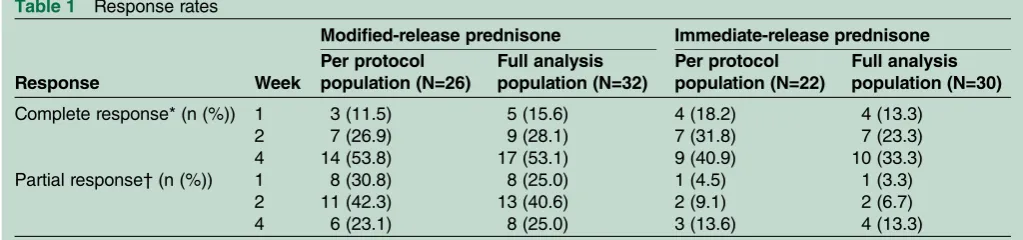
The percentage of complete responders at week 4 was numerically higher for MR prednisone (53.8%) than for IR prednisone (40.9%,table 1), although non-inferiority of MR versus IR prednisone was not proven in the primary PPP analysis (treatment difference: 12.22% in favour of MR prednisone; 95% CI−15.82% to 40.25%). Sensitivity analysis on the FAP showed a trend in favour of MR prednisone (treatment difference: 15.56%; 95% CI −9.16% to 40.28%). The study was relevantly under-powered (N=48 vs planned 300 patients in the PPP) due to recruitment difficulties and early study termination.
on May 7, 2020 by guest. Protected by copyright.
http://rmdopen.bmj.com/
Secondary end points
A clear consistent trend for a larger favourable effect of MR prednisone compared with IR prednisone was observed for all secondary end points (except CRP and ESR) at weeks 1 and 4 (table 2). The percentage of responders ( patients with ≥70% improvement from baseline) was also greater for MR prednisone than for IR prednisone at weeks 1 and 4 for all secondary end points (see online supplementary table S2). Clinically significant mean reductions and treatment differences of more than 10 points in favour of MR prednisone were
observed for PMR VAS, global pain VAS and shoulder pain VAS (table 2). MR prednisone was markedly more effective than IR prednisone in reducing morning stiff-ness duration from as early as week 1 (mean reduction of 326 vs 160 min, table 2), which was supported by the percentage of responders (44% vs 17%, online supplementary table S2).
[image:3.595.219.550.47.394.2]MR prednisone indicated good efficacy in reducing IL-6 levels compared with IR prednisone at week 4 (decrease from baseline of−37.4 vs −29.8 pg/mL, table 2). Notable reductions in CRP and ESR were observed in both
Figure 1 Participant flow.
Table 1 Response rates
Response Week
Modified-release prednisone Immediate-release prednisone Per protocol
population (N=26)
Full analysis population (N=32)
Per protocol population (N=22)
Full analysis population (N=30)
Complete response* (n (%)) 1 3 (11.5) 5 (15.6) 4 (18.2) 4 (13.3)
2 7 (26.9) 9 (28.1) 7 (31.8) 7 (23.3)
4 14 (53.8) 17 (53.1) 9 (40.9) 10 (33.3)
Partial response†(n (%)) 1 8 (30.8) 8 (25.0) 1 (4.5) 1 (3.3)
2 11 (42.3) 13 (40.6) 2 (9.1) 2 (6.7)
4 6 (23.1) 8 (25.0) 3 (13.6) 4 (13.3)
*Complete response was defined as all three of the following: (1)≥70% improvement from baseline in the polymyalgia rheumatica visual analogue scale, (2)≥70% reduction in the duration of morning stiffness and (3)≥70% reduction in the C reactive protein (CRP) value (or CRP <2× upper limit of normal).
†Partial response was defined as two of the above three criteria being met.
Cutolo M,et al.RMD Open2017;3:e000426. doi:10.1136/rmdopen-2016-000426 3
on May 7, 2020 by guest. Protected by copyright.
http://rmdopen.bmj.com/
[image:3.595.41.553.579.699.2]Table 2 Secondary efficacy results (full analysis population)
Parameter Visit
Modified-release prednisone (N=32)
Immediate-release
prednisone (N=30) Estimate
(95% confidence limit)*
p Value for treatment difference
n Mean (SD)† n Mean (SD)†
PMR VAS (0–100 scale) Baseline 32 80.7 (12.88) 30 81.0 (11.70)
Week 1 31 −37.1 (25.70) 30 −28.2 (27.55) −9.3 (−22.97 to 4.30) 0.176
Week 4 27 −70.4 (20.81) 23 −59.8 (24.02) −12.8 (−22.58 to−3.05) 0.011
PMR VAS at awakening (0–100 scale) Baseline 32 81.7 (17.26) 30 85.9 (9.68)
Week 1 32 −36.6 (29.40) 30 −29.4 (29.78) −10.9 (−25.45 to 3.61) 0.138
Week 4 27 −70.7 (18.72) 23 −63.7 (23.25) −11.6 (−21.33 to−1.79) 0.021
Duration of morning stiffness (minutes) Baseline 32 530 (531.0) 30 616 (591.0)
Week 1 31 −326 (435.3) 30 −160 (412.4) 134.5 (18.50 to 250.50)‡ 0.021
Week 4 27 −457 (517.9) 23 −417 (574.7) 46.9 (−110.00 to 203.83)‡ 0.592
Global pain VAS (0–100 scale) Baseline 32 80.0 (13.14) 30 78.2 (13.96)
Week 1 31 −36.2 (26.73) 30 −27.1 (27.96) −7.5 (−21.10 to 6.11) 0.275
Week 4 27 −68.7 (21.73) 23 −55.5 (25.55) −13.6 (−23.23 to−3.26) 0.011
Global pain VAS at awakening (0–100 scale) Baseline 32 80.6 (18.94) 30 83.4 (13.13)
Week 1 32 −35.2 (30.03) 30 −28.5 (32.46) −9.1 (−23.78 to 5.57) 0.219
Week 4 27 −69.3 (20.67) 23 −60.9 (28.28) −12.3 (−23.23 to−1.42) 0.028
Shoulder pain VAS (0–100 scale) Baseline 32 81.0 (13.31) 30 79.9 (13.01)
Week 1 31 −36.9 (26.85) 30 −28.4 (28.67) −7.4 (−21.55 to 6.66) 0.295
Week 4 27 −68.4 (21.46) 23 −57.7 (25.92) −11.1 (−21.30 to−0.91) 0.033
Fatigue VAS (0–100 scale) Baseline 32 72.9 (19.31) 30 75.7 (14.31)
Week 1 31 −29.8 (24.94) 30 −24.6 (27.66) −7.8 (−20.67 to 5.07) 0.230
Week 4 27 −59.4 (27.34) 23 −57.6 (23.16) −6.4 (−16.76 to 4.05) 0.225
C reactive protein (mg/L) Baseline 32 50.6 (32.34) 30 69.6 (49.38)
Week 1 30 −40.8 (27.46) 30 −48.9 (44.27) −6.2 (−13.61 to 1.22) 0.100
Week 4 27 −44.0 (32.24) 23 −52.9 (48.33) −8.0 (−16.37 to 0.37) 0.060
Erythrocyte sedimentation rate (mm/hour) Baseline 32 66.5 (21.62) 30 68.3 (22.84)
Week 1 29 −25.8 (17.03) 35 −23.9 (15.29)
Week 4 31 −38.8 (24.14) 25 −40.1 (23.65) Not estimable§
Interleukin-6 (pg/mL) Screening 28 41.4 (34.97) 30 40.9 (35.18)
Week 4 19 −37.4 (41.27) 22 −29.8 (32.61) −6.5 (−11.84 to−1.23) 0.017
Larger decreases from baseline represent a favourable treatment effect for all secondary efficacy end points.
*Estimates are least square means with confidence limits from a repeated measures analysis of covariance model, if not stated otherwise. †Raw mean at screening/baseline and mean change from baseline at weeks 1 and 4.
‡Estimates and confidence limits stem from the Hodges-Lehmann method. §Convergence criteria not met.
PMR, polymyalgia rheumatica; VAS, visual analogue scale.
Cutolo
M,
et
al
.
RMD
Open
2017;
3
:e000426.
doi:10.1
136/rmdopen
-2016-000
426
O
treatment groups, with a larger decrease for IR prednis-one (although we noted that baseline CRP values were higher in the IR prednisone group, and mean CRP values at week 4 were lower for MR prednisone (8.4 mg/ L) than for IR prednisone (17.9 mg/L)).
Safety
The AEs reported during the study are presented in online supplementary table S3. While more patients experienced AEs in the MR prednisone group (19 (59%); 8 (25%) related) than the IR prednisone group (9 (30%); 3 (10%) related), this was not driven by any specific AEs and the majority of subjects in both treat-ment groups experienced non-related AEs. Two patients experienced serious AEs ( pancytopenia and temporal arteritis), which were not treatment-related. Three patients prematurely discontinued due to AEs: upper abdominal pain in the MR prednisone group and tem-poral arteritis and burning sensation in the IR prednis-one group (figure1).
DISCUSSION
In this study, the complete response rate at week 4 was numerically greater with MR prednisone (53.8%) than with IR prednisone (40.9%). Non-inferiority of MR pred-nisone versus IR predpred-nisone was not proven for the primary end point; however, even with only 48 patients in the PPP (vs the 300 planned), the point estimate was clearly in favour of MR prednisone and the lower 95% confidence limit was only marginally below (−15.82%) the decided non-inferiority threshold of
−15%. Sensitivity analysis on the FAP supported the trend in favour of MR prednisone, and secondary effi -cacy results were encouraging, showing a clear consistent trend for a stronger effect of MR prednisone compared with IR prednisone. Of note, evening MR prednisone was associated with significantly greater reductions in IL-6 levels than morning IR prednisone, suggesting a more effective downregulation of night cytokine synthe-sis.17 These results are similar tofindings in the CAPRA studies in RA.10 12 Consistent with the CAPRA-1 study, we observed no significant difference between MR pred-nisone and IR predpred-nisone on other inflammatory markers (CRP and ESR).
The study experienced a higher than expected screen failure rate (50%), primarily due to patients demonstrat-ing lower CRP values not fulfilling the strict inclusion criteria when referred. It appears that in suspected PMR, primary care practitioners are willing to refer GC-naïve only patients with mild elevation or normal levels of inflammatory markers. However, it is likely that this population may contain predominantly non-inflammatory PMR mimics.18
The CAPRA studies have already confirmed that opti-mising the timing of GC administration improves the benefit:risk ratio of low-dose GC treatment in RA, and the open-label extension of the CAPRA-1 study11 and
other publications19 20 confirmed positive long-term effects. A recent clinical experimental study further sup-ports the use of chronotherapy in PMR.9 Although the formal criteria of non-inferiority were not met, our study showed a clear trend for a favourable clinical effect of MR prednisone over IR prednisone in patients with PMR. Further confirmation should be sought from a large clinical trial in patients with PMR, with careful con-sideration of inclusion and response criteria, based on the present study experience.
Author affiliations
1Research Laboratories and Academic Division of Clinical Rheumatology,
University of Genova, Genova, Italy
2Mundipharma Research GmbH & Co. KG, Limburg, Hessen, Germany 3Department of Rheumatology, Southend University Hospital,
Westcliff-on-Sea, UK
4Department of Rheumatology and Clinical Immunology, Charité University
Medicine, Berlin, Germany
Acknowledgements The authors would like to thank all the study investigators and participants and members of the study team from Mundipharma Research GmbH & Co. KG. Karen Mower (Scientific Editor) provided medical writing assistance that was funded by Mundipharma Research Limited.
Contributors MC, MH, BD and FB were involved in the development of study protocol. MC, BD and FB were involved in patient recruitment and data acquisition. SL was involved in data analysis. MC, MH, SL, BD and FB were involved in manuscript preparation and approved the final version of the manuscript.
Funding The investigation was supported by Mundipharma Research Limited.
Competing interests MC received grant/research support from Horizon Pharma, is a consultant for Mundipharma International and is on the speaker’s bureau for Mundipharma International. MH is an employee of Mundipharma Research GmbH & Co. KG. SL is an employee of Mundipharma Research GmbH & Co. KG. BD received grant/research support from NAPP Pharmaceuticals, and is a consultant for Servier, Roche, Merck, GSK & Mundipharma. FB received grant/research support from Horizon Pharma, is a consultant for Mundipharma International and Horizon Pharma, and is on the speaker’s bureau for Mundipharma International and Horizon Pharma.
Ethics approval The Independent Ethics Committee of each centre reviewed and approved the protocol, and written informed consent was obtained from all patients before enrolment.
Provenance and peer review Not commissioned; externally peer reviewed.
Data sharing statement No additional data are available.
Open Access This is an Open Access article distributed in accordance with the Creative Commons Attribution Non Commercial (CC BY-NC 4.0) license, which permits others to distribute, remix, adapt, build upon this work non-commercially, and license their derivative works on different terms, provided the original work is properly cited and the use is non-commercial. See: http:// creativecommons.org/licenses/by-nc/4.0/
REFERENCES
1. Lawrence RC, Felson DT, Helmick CG,et al. Estimates of the prevalence of arthritis and other rheumatic conditions in the United States, Part II.Arthritis Rheum2008;58:26–35.
2. Salvarani C, Cantini F, Boiardi L,et al. Polymyalgia rheumatica and giant-cell arteritis.N Engl J Med2002;347:261–71.
3. Weyand CM, Goronzy JJ. Giant-cell arteritis and polymyalgia rheumatica.Ann Intern Med2003;139:505–15.
4. Hernández-Rodríguez J, Cid MC, López-Soto A,et al. Treatment of polymyalgia rheumatica: a systematic review.Arch Intern Med 2009;169:1839–50.
Cutolo M,et al.RMD Open2017;3:e000426. doi:10.1136/rmdopen-2016-000426 5
on May 7, 2020 by guest. Protected by copyright.
http://rmdopen.bmj.com/
5. Dejaco C, Singh YP, Perel P,et al. 2015 recommendations for the management of polymyalgia rheumatica: a European League Against Rheumatism/American College of Rheumatology collaborative initiative.Ann Rheum Dis2015;74:1799–807. 6. Dejaco C, Singh YP, Perel P,et al. 2015 recommendations for
the management of polymyalgia rheumatica: a European League Against Rheumatism/American College of Rheumatology collaborative initiative.Arthritis Rheumatol 2015;67:2569–80.
7. Spies CM, Cutolo M, Straub RH,et al. More night than day— circadian rhythms in polymyalgia rheumatica and ankylosing spondylitis.J Rheumatol2010;37:894–9.
8. Buttgereit F. How should impaired morning function in rheumatoid arthritis be treated?Scand J Rheumatol Suppl2011;125:28–39. 9. Galbo H, Kall L. Circadian variations in clinical symptoms and
concentrations of inflammatory cytokines, melatonin, and cortisol in polymyalgia rheumatica before and during prednisolone treatment: a controlled, observational, clinical experimental study.Arthritis Res Ther2016;18:174.
10. Buttgereit F, Doering G, Schaeffler A,et al. Efficacy of
modified-release versus standard prednisone to reduce duration of morning stiffness of the joints in rheumatoid arthritis (CAPRA-1): a double-blind, randomised, controlled trial.Lancet2008;371:205–14. 11. Buttgereit F, Doering G, Schaeffler A,et al. Targeting
pathophysiological rhythms: prednisone chronotherapy shows sustained efficacy in rheumatoid arthritis.Ann Rheum Dis 2010;69:1275–80.
12. Buttgereit F, Mehta D, Kirwan J,et al. Low-dose prednisone chronotherapy for rheumatoid arthritis: a randomised clinical trial (CAPRA-2).Ann Rheum Dis2013;72:204–10.
13. Zakout S, Kirwan JR. Polymyalgia rheumatica has a nocturnal rise in serum interleukin-6 which is almost completely suppressed by nighttime prednisone.Arthritis Rheum2011;63(Suppl 10):79. 14. Dasgupta B, Cimmino MA, Maradit-Kremers H,et al. 2012
provisional classification criteria for polymyalgia rheumatica: a European League Against Rheumatism/American College of Rheumatology collaborative initiative.Ann Rheum Dis 2012;71:484–92.
15. Dasgupta B, Cimmino MA, Maradit Kremers H,et al. 2012 provisional classification criteria for polymyalgia rheumatica: a European League Against Rheumatism/American College of Rheumatology collaborative initiative.Arthritis Rheum 2012;64:943–54.
16. Matteson EL, Maradit-Kremers H, Cimmino MA,et al. Patient-reported outcomes in polymyalgia rheumatica.J Rheumatol 2012;39:795–803.
17. Straub RH, Glück T, Cutolo M,et al. The adrenal steroid status in relation to inflammatory cytokines (interleukin-6 and tumour necrosis factor) in polymyalgia rheumatica.Rheumatology (Oxford)
2000;39:624–31.
18. Dasgupta B, Hutchings A, Matteson EL. Polymyalgia rheumatica: the mess we are now in and what we need to do about it.Arthritis Rheum2006;55:518–20.
19. Pfeiffer BM, Krenzer S, Dockhorn R,et al. Impact of
modified-release prednisone on functional ability in patients with rheumatoid arthritis.Rheumatol Int2013;33:1447–54.
20. Cutolo M, Iaccarino L, Doria A,et al. Efficacy of the switch to modified-release prednisone in rheumatoid arthritis patients treated with standard glucocorticoids.Clin Exp Rheumatol2013;31: 498–505.
on May 7, 2020 by guest. Protected by copyright.
http://rmdopen.bmj.com/