Data-Oriented M e t h o d s for G r a p h e m e - t o - P h o n e m e Conversion
Antal van den Bosch and Walter Daelemans
ITK (Institute for Language Technology and AI)
Tilburg University
P.O. Box 90153, NL-5000 LE Tilburg
Tel: +31 13 663070
Email: antalb~kub.nl, [email protected]
A b s t r a c t
It is traditionally assumed that various sources of linguistic knowledge and their in- teraction should be formalised in order to be able to convert words into their phone- mic representations with reasonable accu- racy. We show that using supervised learn- ing techniques, based on a corpus of tran- scribed words, the same and even better performance can be achieved, without ex- plicit modeling of linguistic knowledge. In this paper we present two instances of this approach. A first model implements a variant of
instance-based learning,
in which a weighed similarity metric and a database of prototypical exemplars are used to pre- dict new mappings. In the second model, grapheme-to-phoneme mappings are looked up in a compressed text-to-speech lexicon(table lookup)
enriched with default map- pings. We compare performance and accu- racy of these approaches to a connectionist (backpropagation) approach and to the lin- guistic knowledge-based approach.1 I n t r o d u c t i o n
Grapheme-to-phoneme conversion is a central task in any text-to-speech (reading aloud) system. Given an alphabet of spelling symbols (graphemes) and an alphabet of phonetic symbols, a mapping should be achieved transliterating strings of graphemes into strings of phonetic symbols. It is well known that this mapping is difficult because in general, not all graphemes are realised in the phonetic transcription, and the same grapheme may correspond to different phonetic symbols, depending on context.
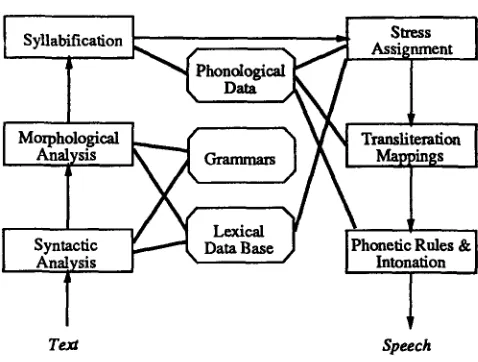
It is traditionally assumed that various sources of linguistic knowledge and their interaction should be formalised in order to be able to convert words into their phonemic representations with reasonable accu- racy. Although different researchers propose differ- ent knowledge structures, consensus seems to be that at least morphological and phonotactic knowledge should be incorporated in order to be able to find morphological and syllable structure. These struc- tures are deemed necessary to define the proper do- mains for phonological and phonetic rules. As a typi- cal architecture for grapheme-to-phoneme conversion in Dutch, consider the modules in [Daelemans, 1988] shown in Figure 1. It contains most of the traditional datastructures and processing components proposed by computational linguists.
A problem with this approach is that the knowl- edge needed is highly language-dependent and re- quires a significant amount of linguistic engineer- ing. We argue that using data-oriented learning tech- niques on a corpus of transcribed words (information. which is readily available in many machine-readable dictionaries), the same and even better performance can be achieved, without explicit modeling of linguis- tic knowledge. The advantages of such an approach are that the technique is reusable for different sets of data (e.g. different languages or sublanguages), and that it is automatic (no explicit linguistic engi- neering is needed to handcraft the rules and knowl- edge structures necessary for implementing the tar- get mapping).
l
_I
s .
I Syllabification ~
,/
~. ~
Assig
~Pho~)~ogieal/~ /
[ M orph ,logical ~
"~1 V ~ Trans~
ve 't Lexic~l If ,~ I
I Syntactic ~
DataBase J
IPhoneti¢Aniysis ] "~ " [ Into~
Text
Stress I Assignment ]
Phonetic Rules & [
lnt°niti°n ]
Speech
Figure 1: Modules in GRAFON, a linguistic knowledge-based grapheme-to-phonerae conversion system.
used to predict new mappings. In a second model, grapheme-to-phoneme mappings are looked up in a compressed text-to-speech lexicon (table lookup) en- riched with default mappings. The most surprising result of our research is that the simplest method (based on tables and defaults) yields the best gener- alisation results, suggesting that previous knowledge- based approaches to the problem were overkill. For the case of Dutch, we make a comparison of perfor- mance and accuracy of these approaches to a connec- tionist (backpropagation) approach and to a state- of-the-art linguistic knowledge-based approach. To prove reusability of the method, we show how our approach can also be used for automatically gener- ating French and English phonemisation modules.
2 D a t a - O r i e n t e d T e x t - t o - s p e e c h C o n v e r s i o n
The algorithms we have applied in our research are
similarity-based and data-oriented. The phonemisa-
tion problem is interpreted as a classification task. Given a target grapheme and its context, the cor- responding phoneme should be predicted. The al- gorithms we used to learn this task are supervised
and data-intensive in the sense that a large num-
ber of examples is provided of input representations with their correct category (in this case a phonetic transcription). Within asupervised, similarity-based approach, the degree in which abstractions are ex- tracted from the examples may be different, as may be the time when abstractions are created: dur- ing training in aggressive abstraction, during perfor- mance in lazy learning. For grapheme-to-phoneme conversion, we claim a data-intensive, lazy learning approach is appropriate to capture the intricate in- teractions between regularities, subregularities, and exceptions that characterise the domain.
2.1 T r a i n i n g a n d T e s t Set E n c o d i n g
Training and test set were randomly selected from a Dutch text-to-speech vocabulary data base. From the 70,000 word dataset, 20,000 were randomly se- lected and randomly divided into 18,500 training words and 1,500 test words. In both sets, each graphemic word is accompanied by its pronuncia- tion in the form of a string of phonemes. In cases where phonemes correspond to grapheme clusters (i.e. there is an alignment problem of grapheme strings with their corresponding phoneme strings), as is the case in, e.g., <schoenen> (shoes)/sXuno/, one grapheme of that cluster is algorithmically mapped to the phoneme, and the remaining graphemes are mapped to phonetic nulls, represented by hyphens. In the example of <schoenen>, this phonetic null in- sertion results in the following alignment:
E
f
To provide a learning system with sufficient informa- tion about the phonemisation task, context informa- tion must be added. In the models described below, this is done by using graphemic windows (compare [Sejnowski and l~senberg, 1987]), i.e. fixed-length parts of words in which one grapheme is mapped to a phoneme; the other graphemes serve as con- text. For example, using a window with one left context grapheme and two right context graphemes (from here on written as '1-1-2'), the application of this window on the word < boek> (book), pronounced a s / b u k / , would result in the four pattern-category pairs of Table 1.
Pattern Left nr. context
1
2
g
3 o
4 e
Focus
positionb
o
e
kRight Target context phoneme
o e b
e k u
k
_
-
_
k
Table 1: Example of the application of the 1-1-~ en-
coding on the word < boek > (book). Underscores
represent spaces, a hyphen represents a phonetic null.
[image:2.596.60.299.68.249.2] [image:2.596.307.540.566.638.2]2.2 I n s t a n c e - B a s e d Learning
As an example of a lazy learning approach, we exper- imented with Instance-Based Learning (IBL, [Aha et
al.,
1991]). IBL is a framework and methodologyfor incremental supervised machine learning. The distinguishing feature of IBL is the fact that no ex- plicit abstractions are constructed on the basis of the training examples during the training phase. A se- lection of the training items themselves is used to classify new inputs. IBL shares with Memory-Based Reasoning (MBR, [Stanfill and Waltz, 1986]) and Case-Based Reasoning (CBR, [Riesbeck and Schank, 1989]) the hypothesis that much of intelligent be- haviour is based on the immediate use of stored episodes of earlier experience rather than on the use of explicitly constructed abstractions extracted from this experience (e.g. in the form of rules or decision trees). In the present context of learning linguis- tic mappings, the hypothesis would be that much of language behaviour is based on this type of memory- based processing rather than on rule-based process- ing. In linguistics, a similar emphasis on analogy to stored examples instead of explicit but inaccessible rules, is present in the work of a.o. [Derwing and Skousen, 1989]. IBL is inspired to some extent on psychological research on exemplar-based categori- sation (as opposed to classical and probabilistic cat- egorisation, [Smith and Medin, 1981]). Finally, as far as algorithms are concerned, IBL finds its inspiration in statistical pattern recognition, especially the rich research tradition on the nearest-neighbour decision rule (see e.g. [Devijver and Kittler, 1982], for an overview).
2.2.1 Basic A l g o r i t h m a n d E x t e n s i o n s The main datastructure in our version of IBL is
the
exemplar,
a memory structure representing abouteach pattern the following information: (i) Its distri- bution over the different categories (training patterns may be ambiguous between different categories, so the memory structure should keep information about how many times each category was assigned to a par- ticular pattern). (ii) Its category. This is simply the category with highest frequency in the distribution of a pattern, or a random selection to break a tie. (iii) Other bookkeeping information (performance data, frequency of pattern in training set, etc.)
Training. For each training pattern, it is checked whether an exemplar for it is already present in mem- ory. If this is the case, the frequency of its category is incremented in the distribution field of the corre- sponding memory structure. If the new training item has not yet been stored in memory, a new memory structure is created. In learning linguistic mappings (a noisy domain), learning in IBL often is helped by forgetting poorly performing or unrepresentative training items. In this research a simple technique was used to prune memory: each new training item
is first classified using the memory structures already present. If it is categorised correctly, it is skipped. We have experimented also with more elaborate stor- age saving techniques (based on prototypicality and performance of training patterns), but the results are preliminary and will not be reported here.
Testing. If the test pattern is present in memory, the category with the highest frequency associated with it is used. If it is not in memory, all memory items are sorted according to the similarity of their pattern to the test pattern. The (most frequent) category of the highest ranking exemplar is then pre- dicted as category of the test pattern. When using a Euclidean distance metric (geometrical distance be- tween two patterns in pattern space), all features are interpreted as being equally important. But this is of course not necessarily the case. We extended the basic IBL algorithm proposed by [Aha
et al.,
1991] with a technique for assigning a different importance to different features. Our approach to the problem of weighing the relative importance of features is based on the concept ofInformation Gain
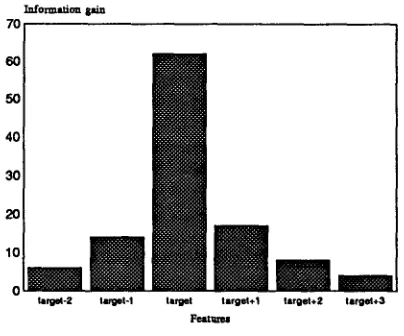
(IG), also used in learning inductive decision trees, [Quinlan, 1986], and first introduced (as far as we know) in IBL in [Daelemans and Van den Bosch, 1992] in the con- text of a syllable segmentation task. The idea is to interpret the training set as an information source capable of generating a number of messages (the dif- ferent categories) with a certain probability. The in- formation entropy of such an information source can be compared in turn for each feature to the average information entropy of the information source when the value of that feature is known. The difference is the IG value for that feature. The (normalised) IG value is used as a weight for that feature during similarity matching. Figure 2 shows the pattern of information-gain values for the different positions in the 2-1-3 grapheme window. Unsurprisingly, the tar- get grapheme is most informative, and context fea- tures become less informative the further they are removed from the target. We also found that right context is more informative than left context (com- pare [Weijters, 1991]).2.3 T a b l e L o o k u p w i t h D e f a u l t s
Our table lookup model can be seen as a link between straightforward lexical lookup and similarity-based reasoning. Lexical lookup of word-pronunciation pairs has various disadvantages, an important one being that this approach only works for the words that are stored in the lexicon and not for new words. Without the possibility of manipulating graphemic strings smaller than whole words, there is no way that lexical lookup can provide generalisations on the basis of which new words can be transliterated.
I
6O
5O
40
30
2O
1 0
[image:4.596.77.279.88.256.2]1111001-2 lalgel-1 Ilroel Illroel+| IIIrOet+2 targot+3 F o a t ~
Figure 2: Information gain value for each position in the 2-1-3 grapheme window.
ciency by compressing it into a text-to-speech lookup
table. The main strategy behind the model is to dy-
namically determine which left and right contexts are minimally sufficient to be able to map a grapheme to the correct phoneme with absolute certainty 1. The context needed to disambiguate a grapheme- to-phoneme mapping can be of very different width. Extreme examples in Dutch are on the one hand the
c-cedille, present in a small number of loan words
(e.g., <re,u:>), always pronounced a s / s / r e g a r d l e s s of left or right context, and on the other hand the < e>, which can map to various phonemes ( e . g . , / o / , / £ / , / e / ) in various contexts. For example, the dis- ambiguation of the pronunciation of the final < e> in words ending with <-ster> (either star or female pro- fession suffix) sometimes involves taking into account large left contexts, as in the examples <venster> (window) and <diensler> (servant), in which the fi- nal < e > is pronounced / 0 / , versus <morgenster> (morning star), in which the final < e> is pronounced /E/. To disambiguate between these three cases, it is necessary to go back five positions in these words to find the first grapheme which the words do not have in common.
T a b l e C o n s t r u c t i o n . The algorithm starts by searching for all unambiguous one-to-one grapheme- phoneme mappings, and storing these mappings (patterns) in the lookup table, more specifically in
the 0-1-0 subtable. The few unambiguous 0-1-0 pat-
terns in our training set include the < f> - / s / c a s e mentioned earlier. The next step of the algorithm is to extend the width of the graphemic window by
1 Here, absolute certMnty of a grapheme-phoneme cor- respondence does only express the fact that that cor- respondence is unambiguous in the training set of the model.
one character. We chose to start by extending the
window on the right (i.e., a 0-1-1 window), because, as also reflected earlier in the Information Gain met- ric used in the IBL model, right context appears to contain slightly more valuable information than the equivalent left context 2 . The algorithm then searches for all certain 0-1-1 patterns to store in the 0-1-1 subtable. Compression is achieved because exten- sions of unambiguous patterns in the 0-1-0 subtable do not have to be stored in the 0-1-1 subtable. This procedure of extending the window and storing all certain patterns that have not been stored earlier is then repeated (extending 0-1-1 to 1-1-1, then to 1- 1-2, etc.), and stops when the whole training corpus is compressed in the lookup table, and all grapheme- phoneme mappings in the corpus are supplied with sufficient left and right contexts. The model eval- uated below is calculated up to the 5-1-5 window. At that point, the lookup table covers 99.5% of all grapheme-phoneme mappings in the training set. As a measure of the amount of compression, in number of bytes, the size of the set of linked tables (including the default table discussed below) is 5.8% of the size of the part of the lexicon used as training set 3.
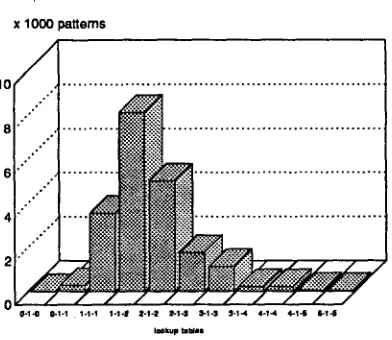
Figure 3 displays the magnitudes of the subtables. It can clearly be seen that most ambiguity is resolved with relatively small contexts. The majority of the ambiguity in the training set is already resolved at the 2-1-2 subtable, after which further extension of window width gradually decreases the number of stored patterns (i.e., resolved ambiguities).
R e t r i e v a l . The pronunciation of a word can be re- trieved by taking each grapheme of that word sepa- rately, and searching in the lookup table for a match- ing graphemic pattern. First, the grapheme is looked up in the 0-1-0 subtable. If it does not match with any graphemic pattern stored in that table, the sin- gle grapheme pattern is extended to a 0-1-1 pattern. This procedure is then repeated until a matching pattern with a minimal context is found, returning a 'certain' grapheme-phoneme mapping. After all graphemes have been processed this way, the phone- mic mappings are concatenated to form the pronun- ciation of the word.
An example of retrieving the pronunciation of a word by table lookup is given in Table 2. As this example illustrates, the contexts needed for disam- biguating between output categories are generally very small.
2The fact that Information Gain reflects this asym-
metry, led us to a new, more generic and domain-
independent, conceptualisation and implementation of
the Table Lookup method, in which context features axe ordered according to their information gain, and patterns axe stored in a single trie instead of in separate tables.
X 1000 patterns
10
8
6
4
2
0
• ...
"'"
!
/" / / / / / / / / / / / 0-1,,fl 0-1-1 1.1-1 1-1-J 2-1-2 IB*14 ~-1,.,1 ~1-14 4-I,,4 4-1-6 $.I,4J
[image:5.596.80.276.88.258.2]tr,=tzup t n t ~ l l
Figure 3: Table magnitudes of lookup subtables.
left context
a a n
b i
e
d i
n
f o c u s
grapheme
right target
context phoneme
a a
nb
b m
i b
ed i
di
i d
ng
g_ rj
Table 2: Example of the correct retrieval of the pro- nunciation of< aanbieding > (offer). Each row con- tains an unambiguous pattern with minimal context found by the lookup algorithm. Underscores repre- sent spaces.
In case of unseen test words that contain grapheme patterns not present in the training set, the lookup algorithm will not be able to retrieve that specific mapping• This problem is handled in our model by adding to the lookup table a second table which con- tains all occurring graphemic patterns in the training set of a fixed window width (1-1-1), coupled with
their most frequently occurring (default) phonemic
mapping. Whenever lookup table retrieval fails and a match can be found between the test pattern and a 1-1-1 default pattern, this default table provides a 'best guess' which in many cases still turns out to be correct• To cover for those particular cases where no matching can be found between the test pattern and the 1-1-1 default patterns, a small third default table is added to the model, containing for each grapheme its most frequently occurring phonemic mapping re- gardless of context (0-1-0), returning a 'final guess'.
It is important to see that generalisation in this approach arises from two different mechanisms: (i) the fact that spellings of different words contain iden- tical grapheme substrings, and (ii) the default tables which reflect probabilities of mappings in the train- ing set. More sophisticated reasoning methods can be used instead of the default table: at present we are investigating the consequences of substituting case- based reasoning such as implemented in IBL for the present default tables.
3 C o m p a r i s o n t o A l t e r n a t i v e A p p r o a c h e s
To get a better insight into the performance of our data-oriented generalisation methods, we compared it to the performance of a 'classical' data-oriented method (backpropagation learning in feed-forward nets), and to the linguistic knowledge-based ap- proach.
3.1 A n A l t e r n a t i v e D a t a - O r i e n t e d A p p r o a c h : C o n n e c t i o n i s m
In IBL, explicit use is made of similarity-based rea- soning. A similarity metric is used to compare items, and the items most similar to a test item are taken as a basis for making a decision about the category of the latter. Backpropagation learning in feedforward connectionist networks (BP), too, uses similarity (or analogy), but more implicitly. Again, an input pat- tern activates an output pattern which is similar to the activation pattern of those items that are sim- ilar to the new item. Complexity is added by the fact that an intermediate hidden layer of units "re- defines" similarity by extracting features from the activation patterns of the input layer. (In our ver- sion of IBL, the information gain metric is used to achieve a similar result).
[image:5.596.75.277.306.443.2]ber of training cycles, connection weight initialisa- tion) which may affect learning and performance of the network considerably, but which cannot be deter- mined by rule. Experimenters can therefore almost never be sure that their results are optimal.
We trained BP networks on grapheme-phoneme conversion using a training set which was restricted, for computational reasons, to all unique 2-1-3 map- pings present in the original training set, removing frequency information, but also removing a large por- tion of redundancy inherent in the original training set. The same test set was used as with IBL and the table lookup model. Graphemes were encoded by assigning each letter a randomly generated 6- bit string; phonemes were encoded locally, i.e., each phoneme was represented by a 46-bit string with only one phoneme-specific bit 'on'. Systematic simula- tions were used to approach optimal hidden layer size (60 units), learning rate (0.05) and momentum (0.4). With these parameter settings, 5 networks were randomly initialised (weights were assigned ran- dom values between -0.5 and 0.5) and trained for 100 epochs 4. The performance result listed below was calculated by averaging the performance scores of these 5 networks on the test set.
3.1.1 R e s u l t s
[image:6.596.320.522.494.553.2]The performance scores on randomly selected, un- seen test words show a surprising best score of the table lookup model. Both IBL and the table perform better than BP. Similar results were obtained for dif- ferent training and test sets, except that for small training sets, table lookup performance dropped be- low that of IBL, but was still higher than that of BP.
Model
'BP 91.3
Generalisation Accuracy on Phonemes
IBL 93.4
TABLE 95.1
3.2 T h e L i n g u i s t i c K n o w l e d g e - B a s e d A p p r o a c h
The traditional linguistic knowledge-based approach of grapheme-phoneme conversion has produced var- ious examples of combined rule-based and lexicon-
based models, e.g. MITALK ([Allen et al., 1987])
for English, GRAFON-D ([Daelemans, 1988]), and MORPA-CUM-MORPHON ([Nunn and Van Heuven, 1993]) for Dutch. The developers of all of these mod- els shared the assumption that the presence of lin- guistic (phonotactic, morphological) knowledge is es- sential for a grapheme-phoneme model to perform at a reasonably high level.
4All c o n n e c t i o n i s t s i m u l a t i o n s w e r e r u n o n P l a N e t 5.6,
a network simulator written by Yoshiro Miyata (Chukyo U., Japan).
In MORPA-CUM-MORPHON ([Nunn and Van Heuven, 1993]), a state-of-the-art system for Dutch, grapheme-phoneme conversion is done in two steps. First, MORPA ([Heemskerk and Van Heuven, 1993]) decomposes a word into a list of morphemes. These morphemes are looked up in a lexicon. Each mor- pheme is associated with its category and a phone- mic transcription. The phonemic transcriptions of the consecutive morphemes are concatenated to form an underlying phonemic representation of the word.
M O R P H O N then applies a number of phonological rules to this underlying representation, deriving the surface pronunciation of the word.
In [Nunn and Van Heuven, 1993], test data is referred to with which they evaluated their sys- tem. We applied the table-lookup method to the same test data in order to make a comparison pos- sible. The test file consists of 1,971 words from var- ious sources: newspaper text, compounds, and low- frequency words. High-frequency words, acronyms, and proper names were removed from the original data set. As we did not try to solve the stress as- signment problem in this experiment, we had to re- comI)ute the error given by [Nunn and Van Heuven, 1993J such that stress assignment or syllable struc- ture errors were not taken into account s .
The table lookup model was reconstructed on the basis of the complete 70,000 word-pronunciation pairs in our Dutch corpus, resulting in a model con- taining 48,000 patterns (including default tables).
3.2.1 R e s u l t s
W h e n comparing the phonemisation accuracy of
the linguistic knowledge-based approach in MORPA- CUM-MORPHON to the results on the same data by the table method, w e see t h a t the table scores signif- icantly higher.
Model
T A B L E M O R P A - C U M - M O R P H O N
Generalisation Accuracy on Words
89.5 85.3
In the knowledge-based approach, errors of mor- phological analysis (spurious ambiguity or no anal- ysis) account for a considerable amount of incorrect phoneme output (even after removal by [Nunn and Van Heuven, 1993] of proper names and other diffi- cult cases from the test set). A new data-oriented version of MORPA ([Heemskerk, 1993]) assigns a pri- ority ordering to the set of morphological decom-
Sin a different set of experiments, we successfully ap- plied the IBL approach and two other data-oriented algo- rithms, analogical modeling and backprop, to the stress
assignment problem (see [Gillis et al., 1992], [Daelemans
e t al., 1993], but we have not yet tried to combine the
positions, based on a probabilistic grammar derived from a corpus of examples of correct decompositions. This new approach raises the overall performance
of MORPA-CUM-MORPHON tO 88.7%, which remains
slightly worse than the table method.
On the basis of an analysis of confusion matri- ces (misclassifications per grapheme), we find that the same types of errors are made by both systems, mainly on vowels (especially on the transcription of grapheme <e>), but less frequently by the table method. E.g. an intended / ~ / was assigned cate- g o r y / ~ / 112 times by MOttPA-CUM-MORPHON, and only 23 times by the table method. Another dif- ference is that while confusions by the table method are symmetric, confusions in MORPA-CUM-MORPHON seem to be directed (e.g. an intended / ~ / i s often misclassified a s / E / , but almost never the other way round).
4 D i s c u s s i o n
4.1 R e l a t e d W o r k
As mentioned earlier, Instance-Based Learning is a form of case-based reasoning: a set of exemplars (cases) and a similarity metric are used to make de- cisions about unseen cases. Earlier work on the ap- plication of Memory-Based Reasoning ([Stanfill and Waltz, 1986; Stanfill, 1987]) (another form of case- based reasoning) to the phonemisation problem using the NetTalk data (MBRTalk), showed a better per- formance than NetTalk itself ([Sejnowski and Rosen- berg, 1987]), however at the cost of an expensive, domain-dependent computational measure of dissim- ilarity that seems to be computationally feasible only when working on a massive parallel computer like the Connection Machine. The Information Gain metric we use in our version of IBL is domain-independent and can be efficiently computed. Another case-based system (or rather a hybrid combination of case-based reasoning and relaxation in a localist interactive ac- tivation network) is P R O ([Lehnert, 1987]). The re- ported performance of this system is not very con- vincing, however, neither is the need for a combina- tion of connectionist and case-based techniques ap- parent. Dietterich and Bakiri ([1991]) systematically compared the performance of ID3 ([Quinlan, 1986]) and BP on the NetTalk data. Their conclusion is that BP consistently outperforms ID3 because the former captures statistical information that the lat- ter does not. However, they demonstrate that ID3 can be extended to capture this statistical informa- tion. Dietterich and Bakiri suggest that there is still substantial room for improvement in learning meth- ods for text-to-speech mapping, and it is indeed the case that our approach significantly outperforms BP.
The application of compression techniques like our
table method to the phonemisation problem has not
yet been reported on as such in the literature. In
[Golding and Rosenbloom, 1991], the interaction of rule-based reasoning and case-based reasoning in the task of pronouncing surnames is studied. It is claimed that a hybrid approach is preferable, in which the output of the rules is used
unless
a com- pelling analogy exist in the case-base. If a compelling analogy is found, it overrides the rule output. In this approach, the (hand-crafted) rules are interpreted asimplementing the defaults, and the cases the
pockets
of exceptions.
Our table-method works along a differ-ent dimension: both default mappings and pockets of exceptions are represented in both the table and the default mapping (which as we suggested earlier, we have replaced in the current version by case-based reasoning). Certain mappings are present in the ta- ble (which can be interpreted as an automatically ac- quired rule set), and uncertain cases are handled by the case-base (or default mapping). Future research should make clearer how these two uses of case-based reasoning are related and whether the strengths of both can be combined.
4.2 Multi-lingual G r a p h e m e - t o - P h o n e m e Conversion
To test the reusability of our algorithms to grapheme-to-phoneme conversion in different lan- guages, we applied the table lookup approach to En- glish and French data. For English, we used the benchmark NetTalk corpus as used in [Sejnowski and Rosenberg, 1987]. For French, we extracted word- pronunciation pairs from Brulex, a lexical data base
for French ([Content et
ai.,
1990]). Roughly similarmodels resulted, proving reusability of technique.
In order to be able to compare these models to the Dutch model described in this paper, we selected for each language a comparable data base containing 20,000 word-pronunciation pairs, and divided these data sets in test sets of 1,500 pairs and training sets of 18,500 pairs. Figure 4 displays the result- ing lookup tables, including the Dutch lookup table displayed earlier in Figure 3.
Given the constant lookup table construction pro- cedure and the similar data sets, two interesting dif- ferences between the three models emerge. Firstly, as can be seen clearly from Figure 4, there are sig- nificant differences between the magnitudes of the models. After expansion to 5-1-5 width, the French model contains 18,000 patterns, the Dutch 27,000
and the English 35,000, reflecting differences in
deep-
ness
of orthography between the three languages.x 1000
paRems19
10
8
i
6 4 2
0 0-14 8-1-1 1-1-1 1-1-| ~ l J / 2-1-t $-1-$ $-1-4 4,14 4-14 $-1-45
BB EnglIsh
I
[] Omch [] French
Figure 4: Table magnitudes of subtables of English, Dutch and French models. For each language, perfor-
mance accuracy up to the 2-1-3 subtable is displayed
on the 2-1-3 subtable bar.
raphy between English on the one hand and Dutch and French on the other hand.
5
C o n c l u s i o n
In computational linguistics, one of the common- sense beliefs is that the performance of a system solv- ing a linguistic problem improves with the amount of linguistic knowledge and sophistication incorpo- rated into it. We have shown that at least for one linguistic task, this is not the case. The linguistically least informed method (compression of a training set into a table, complemented with a rudimentary form of probabilistic reasoning) performed better on un- seen input than a linguistically sophisticated, state- of-the-art knowledge-based system. We have reason to believe that this also applies to other linguistic categorisation problems where superficial input fea- tures and local context solve most ambiguities (we have positive results on stress assignment, [Gillis et
al., 1992; Daehmans et al., 1993], and part of speech
tagging).
The data-oriented algorithms described are sim- ple and domain-independent, and introduce a new kind of reusability into computational linguistics: reusability of the acquisition method (on different data sets) rather than reusability of (hand-coded) knowledge in different applications or formalisms. The former type of reusability seems to be easier to achieve than the latter.
A c k n o w l e d g e m e n t s
Thanks to Henk Kempff (ITK), Alain Content (ULB), and Terrence Sejnowski (UCSD) for mak- ing available for research purposes the Dutch, French
and English data we used. We are also grateful to Josee Heemskerk, Anneke Nunn, Gert Durieux, Steven Gillis, Ton Weijters and participants of the CLIN'92-meeting in Tilburg for comments and ideas.
R e f e r e n c e s
[Aha et al., 1991] D. Aha, D. Kibler and M. Albert. Instance-Based Learning Algorithms. Machine
Learning, 6, 37-66, 1991.
[Allen et al., 1987] J. Allen, S. Hunnicutt, and D. Klatt. From text to speech: the MITaik system.
Cambridge, UK: Cambridge University Press. [Content et al., 1990] A. Content, P. Mousty, and
M. l~deau. Brulex: une base de donn~es lexi- tales informatis6e pour le francais 6crit et purl6.
L'Ann~e Psychologique, 90, 551-566, 1990.
[Daelemans, 1988] W. Daelemans. GRAFON: A Grapheme-to-phoneme Conversion System for Dutch. In Proceedings Twelfth International Con-
ference on Computational Linguistics (COLING-
88), Budapest, 133-138, 1988. [Daelemans and Van den Bosch, 1992]
W. Daelemans and A. van den Bosch. Generaliza- tion performance of backpropagation learning on a syllabification task. In M. Drossaers and A. Nijholt (Eds.), Proceedings of the 3rd Twente Workshop
on Language Technology. Enschede: Universiteit
Twente, 27-37, 1992.
[Daelemans et al., 1993]
W. Daelemans, A. van den Bosch, S. Gillis and
G. Durieux. A data-driven approach to stress ac- quisition. In Proceedings of the ECML workshop
on ML techniques for Te~t Analysis, Vienna, 1993.
[Derwing and Skousen, 1989] B. L. Derwing and It. Skousen. Real time morphology: symbolic rules or analogical networks. Berkeley Linguistic Soci-
ety, 15: 48-62, 1989.
[DevijverandKittler, 1982] P. A. Devijver and J. Kittler. Pattern Recognition. A Statistical Ap-
proach. London: Prentice-Hall, 1982.
[Dietterich and Bakiri, 1991] T. G. Dietterich and
G. Bakiri. Error-correcting output codes: a gen- eral method for improving multiclass inductive learning programs. Proceedings AAAI-91, Menlo Park, CA, 572-577, 1991.
[Gillis et at., 1992] S. Gillis, G. Durieux, W. Daele- roans and A. van den Bosch. Exploring artificial learning algorithms: learning to stress Dutch sim- plex words. Antwerp Papers in Linguistics, 71, 1992.
[Golding and Rosenbloom, 1991] A. R. Golding and P. S. l~osenbloom. Improving rule-based sys- tems through Case-Based Reasoning. Proceedings
[Heemskerk and Van Heuven, 1993]
J. Heemskerk and V. J. van Heuven. MORPA, a lexicon-based MORphological PArser. In V.J. van Heuven and L.C.W. Pols (Eds.),
Analysis and syn-
thesis of speech; strategic research towards high-
quality text-to-speech generation.
Berlin: Moutonde Gruyter, 1993.
[Heemskerk, 1993] J. Heemskerk. A probabilistic context-free grammar for disambiguation in mor- phological parsing. In
Proceedings EACL-93,
Utrecht, 1993.
[Lehnert, 1987] W. Lehnert. Case-based problem solving with a large knowledge base of learned cases. In
Proceedings AAAI-87,
Seattle, WA, 1987. [Nunn and Van Heuven, 1993] A. Nunn and V. J. van Heuven. MORPHON, lexicon- based text-to-phoneme conversion and phonolog- ical rules. In V.J. van Heuven and L.C.W. Pols (Eds.),Analysis and synthesis of speech; strategic
research towards high-quality text-to-speech gener-
ation.
Berlin: Mouton de Gruyter, 1993.[Quinlan, 1986] J. R. Quinlan. Induction of Decision Trees.
Machine Learning,
1, 81-106, 1986.[Riesbeck and Schank, 1989] C. K. Riesbeck and R. S. Schank.
Inside case based reasoning.
Hills- dale, NJ: Lawrence Earlbaum Assoc., 1989. [Sejnowski and Rosenberg, 1987] T. J. Sejnowskiand C. R. Rosenberg. Parallel networks that learn to pronounce English text.
Complex Systems, 1,
145-168, 1987.
[Smith and Media, 1981] E. E. Smith and D. L. Medin
Categories and concepts.
Cambridge, MA: Harvard University Press, 1981.[Stanfill and Waltz, 1986]
C. W. Stanfill and D. Waltz. Toward memory- based reasoning.
Communications of the ACM,
29:12, 1213-1228, 1986.
[Stanfill, 1987] C. W. Stanfill. Memory-based rea- soning applied to English pronunciation.
Proceed-
ings AAAI-87,
Seattle, WA, 577-581, 1987.[Weijters and Hoppenbrouwers, 1990] A. Wei- jters and G. Hoppenbrouwers. NetSpraak: een neuraal netwerk voor grafeem-foneem-omzetting.