Effective Greedy Inference for Graph-based
Non-Projective Dependency Parsing
Ilan Tchernowitz Liron Yedidsion
Faculty of Industrial Engineering and Management, Technion, IIT
{ilantc@campus|lirony@ie|roiri@ie}.technion.ac.il
Roi Reichart
Abstract
Exact inference in high-order graph-based non-projective dependency parsing is in-tractable. Hence, sophisticated approximation techniques based on algorithms such as be-lief propagation and dual decomposition have been employed. In contrast, we propose a sim-ple greedy search approximation for this prob-lem which is very intuitive and easy to im-plement. We implement the algorithm within the second-order TurboParser and experiment with the datasets of the CoNLL 2006 and 2007 shared task on multilingual dependency pars-ing. Our algorithm improves the run time of the parser by a factor of 1.43 while losing 1% in UAS on average across languages. More-over, an ensemble method exploiting the joint power of the parsers, achieves an average UAS 0.27% higher than the TurboParser.
1 Introduction
Dependency parsing is instrumental in NLP appli-cations, with recent examples in information extrac-tion (Wu and Weld, 2010), word embeddings (Levy and Goldberg, 2014), and opinion mining (Almeida et al., 2015). The two main approaches for this task are graph based (McDonald et al., 2005) and transi-tion based (Nivre et al., 2007).
The graph based approach aims to optimize a global objective function. While exact polyno-mial inference algorithms exist for projective pars-ing (Eisner, 1996; McDonald et al., 2005; Carreras, 2007; Koo and Collins, 2010, inter alia), high order non-projective parsing is NP-hard (McDonald and Pereira, 2006). The current remedy for this comes in
the form of advanced optimization techniques such as dual decomposition (Martins et al., 2013), LP re-laxations (Riedel et al., 2012), belief propagation (Smith and Eisner, 2008; Gormley et al., 2015) and sampling (Zhang et al., 2014b; Zhang et al., 2014a). The transition based approach (Zhang and Nivre, 2011; Bohnet and Nivre, 2012; Honnibal et al., 2013; Choi and McCallum, 2013a, inter alia), and the easy first approach (Goldberg and Elhadad, 2010) which extends it by training non-directional parsers that consider structural information from both sides of their decision points, lack a global ob-jective function. Yet, their sequential greedy solvers are fast and accurate in practice.
We propose a greedy search algorithm for high-order, non-projective graph-based dependency pars-ing. Our algorithm is a simple iterative graph-based method that does not rely on advanced optimization techniques. Moreover, we factorize the graph-based objective into a sum of terms and show that our basic greedy algorithm relaxes the global objective by se-quentially optimizing these terms instead of globally optimizing their sum.
Unlike previous greedy approaches to depen-dency parsing, transition based and non-directional, our algorithm does not require a specialized feature set or a training method that specializes in local deci-sions. In contrast, it supports global parameter train-ing based on the comparison between an induced tree and the gold tree. Hence, it can be integrated into any graph-based parser.
We first present a basic greedy algorithm that re-laxes the global graph-based objective (Section 3). However, as this simple algorithm does not provide a
realistic estimation of the impact of an arc selection on uncompleted high-order structures in the partial parse forest, it is not competitive with state of the art approximations. We hence present an advanced version of our algorithm with an improved arc score formulation and show that this simple algorithm pro-vides high quality solutions to the graph-based infer-ence problem (Section 4).
Particularly, we implement the algorithm within the TurboParser (Martins et al., 2013) and exper-iment (Sections 8 and 9) with the datasets of the CoNLL 2006-2007 shared tasks on multilingual de-pendency parsing (Buchholz and Marsi, 2006; Nils-son et al., 2007). On average across languages our parser achieves UAS scores of 87.78% and 89.25% for first and second order parsing respectively, com-pared to respective UAS of 87.98% and 90.26% achieved by the original TurboParser.
We further implement (Section 6) an ensemble method that integrates information from the output tree of the original TurboParser and the arc weights learned by our variant of the parser into our search algorithm to generate a new tree. This yields an im-provement: average UAS of 88.03% and 90.53% for first and second parsing, respectively.
Despite being greedy, the theoretical runtime complexity of our advanced algorithm is not better than the best previously proposed approximations for our problem (O(nk+1), fornword sentences and
korder parsing, Section 5). In experiments, our al-gorithms improve the runtime of the TurboParser by a factor of up to 2.41.
The main contribution of this paper is hence in providing a simple, intuitive and easy to implement solution for a long standing problem that has been addressed in past with advanced optimization tech-niques. Besides the intellectual contribution, we believe this will make high-order graph-based de-pendency parsing accessible to a much broader re-search and engineering community as it substan-tially relaxes the coding and algorithmic proficiency required for the implementation and understanding of parsing algorithms.
2 Problem Formulation
We start with a brief definition of the high order graph-based dependency parsing problem. Given an
nword input sentence, an input graphG = (V, E) is defined. The set of vertices is V = {0, ..., n}, with the{1, . . . , n}vertices representing the words of the sentence, in their order of appearance, and the 0 vertex is a specializedrootvertex. The set of arcs isE ={(u, v) :u ∈ {0, ..., n}, v ∈ {1, ..., n}, u6= v}, that is, the root vertex has no incoming arcs.
We further define a part of orderkto be a subset ofE of size k, and denote the set of all parts with
parts. For the special case of k = 1 a part is an arc. Different works employed differentpartssets (e.g. (Martins et al., 2013; McDonald et al., 2005; Koo and Collins, 2010)). Generally, mostpartssets consist of arcs connecting vertices either vertically (e.g.{(u, v),(v, z)}fork= 2) or horizontally (e.g. {(u, v),(u, z)}, fork = 2). In this paper we focus on the parts employed by (Martins et al., 2013), a state-of-the-art parser, but our algorithms are gener-ally applicable for anypartsset consistent with this general definition.1
In graph-based dependency parsing, each part p is given a score Wp ∈ R. A Dependency Tree
(DT) T is a subset of arcs for which the following conditions hold: (1) Every vertex, except for the root, has an incoming arc: ∀v ∈ V \ {0} : ∃u ∈ V s.t.(u, v) ∈T; (2) No vertex has multiple incom-ing arcs:∀(u, u0, v)∈V,(u, v)∈T →(u0, v)∈/ T; and (3) There are no cycles inT. The score of a DT T is finally defined by:
score(T) = X
part⊆T
Wpart
The inference problem in this model is to find the highest scoring DT in the input weighted graph.
3 Basic Greedy Inference
We start with a basic greedy algorithm (Algorithm 1), analyze the approximation it provides for the graph-based objective and its inherent limitations.
1More generally, a part is defined by two arc subsets,Aand
B, such that a partpbelongs to a treeT if∀e ∈ A : e ∈ T and∀e ∈ B : e /∈ T. In this paper we assumeB = φ. Hence, we cannot experiment with the third order TurboParser as in all its third order partsB 6=φ. Also, when we integrate our algorithms into the second order TurboParser we omit the nextSibling part for whichB6=φ. For the original TurboParser
Algorithm 1 maintains a partial tree data struc-ture, Ti, to which it iteratively adds arcs from the
input graphG, one in each iteration, until a depen-dency treeTnis completed. For this end, in every iteration,i, a value,vi
e, composed oflossieandgainie
terms, is computed for every arce ∈E and the arc with the lowestvie value is added toTi−1 to create the extended partial treeTi.
Due to the aforementioned conditions on the in-duced dependency tree, every arc that is added to Ti−1 yields a set oflostArcsandlostPartsthat
can-not be added to the partial tree in subsequent itera-tions. The loss value is defined to be:
lossie:= X
part∈lostP arts
Wpart
That is, every part that contains one or more arcs that violate the dependency tree conditions for a tree that extends the partial treeTi−1∪ {e}is considered alost partas it will not be included in any tree ex-tendingTi−1∪{e}. The loss value sums the weights
of these parts.
Likewise, the gain value is the sum of the weights of all the parts that are added toTi−1 when we add eto it. Denote this set of parts withPe := {part :
part⊆Ti−1∪ {e}, part /∈Ti−1}, then:
gainie:= X
part∈Pe
Wpart
Finally,vei is given by:
vie=lossie−gainie
After the arc with the minimal valuevei is added to Ti−1, the arcs that violate the structural constraints on dependency trees are removed fromG.
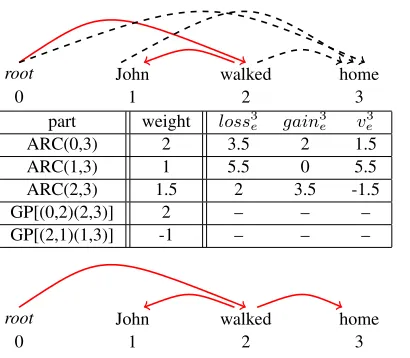
An example of an update iteration of the algo-rithm (lines 3-16) is given in Figure 1. In this ex-ample we consider two types of parts: first-order, arc, parts (ARC) and second-order grandparent parts (GP), consisting of arc pairs, {(g, u),(u, v)}. The upper graph shows the partial treeT2(solid arcs) as well as the rest of the graph G(dashed arcs). The parts included in T2 are ARC(0,2), ARC(2,1) and
GP[(0,2),(2,1)]. The table contains the weights of the parts and the values computed for the arcs dur-ing the third iteration. The arc that is chosen is (2,3), as it has the minimalv3
e value. Thus, in the bottom
root John walked home
0 1 2 3
part weight loss3e gain3e ve3
ARC(0,3) 2 3.5 2 1.5
ARC(1,3) 1 5.5 0 5.5
ARC(2,3) 1.5 2 3.5 -1.5
GP[(0,2)(2,3)] 2 – – –
GP[(2,1)(1,3)] -1 – – –
root John walked home
[image:3.612.314.519.61.240.2]0 1 2 3
Figure 1: An example of an iteration of Algorithm 1 (lines 3-16)). See description in text.
graph that corresponds toT3all other incoming arcs to vertex 3 are removed. (in this instance there are no cycle forming arcs).
Analysis We now turn to an analysis of the relaxation that Algorithm 1 provides for the global graph-based objective. Recall that our objective in iterationiis: veii = min{vei}. For the inferred tree
Tnit holds that:
X
ei∈Tn veii−
X
part⊆G
Wpart=
X
part*Tn
Wpart− X
part⊆Tn
Wpart− X
part⊆G
Wpart=
−2× X
part⊆Tn
Wpart+ X
part*Tn
Wpart− X
part*Tn
Wpart=
−2× X
part⊆Tn Wpart
The first equation holds since Pei∈Tnveii is the
sum of all lost parts (parts that are not inTn) minus all the gained parts (parts inTn). Each of these parts was counted exactly once: when the part was added to the partial tree or when one of its arcs was re-moved fromG. The second equation splits the term ofPpart⊆GWpartto two sums, one over parts inTn
and the other over the rest. Since Ppart⊆GWpart
and 2 are constants, we get:
arg min
Tn (− X
part⊆Tn
Wpart) = arg min Tn
X
ei∈Tn
viei
objective instead of optimizing the sum of terms, and hence the objective, globally.
The main limitation of Algorithm 1 is that it does not take into account high order parts contribution until the part is actually added to T. For exam-ple, in Figure 1, when the arc (2,1)is added, the part GP[(2,1),(1,3)] is getting closer to completion. Yet, this is not taken into account when considering whether(2,1)should be added to the tree or not. In-cluding this information in the gain and loss values of an arc can improve the accuracy of the algorithm, especially in high-order parsing.
Algorithm 1Basic Greedy Inference 1: T0={}
2: fori∈1..n do
3: fore= (u, v)∈Edo
4: Pe := {part ∈ parts : part ⊆ Ti−1 ∪ {e}, part*Ti−1
}
5: gainie:=Ppart∈PeWpart
6: incomingSet:={(u0, v)∈E:u06=u} 7: cycleSet := {(u0, v0) ∈ E : Ti−1
∪ {e} ∪
(u0, v0)contains a cycle}
8: lostArcs= (incomingSet∪cycleSet)
9: lostP arts={part:∃e∈lostArcs∩part} 10: lossi
e:=Ppart∈lostP artsWpart
11: vi
e:=lossie−gainie
12: end for
13: ei= (ui, vi) = arg mine0{vie0}
14: Ti=Ti−1 ∪ {ei
}
15: remove fromGall incoming arcs tovi
16: remove fromGall cycle forming arcs w.r.tTi
17: end for
4 Greedy Inference with Partial Part Predictions
In order for the algorithm to account for information about partial high order parts, we estimate the prob-ability that such parts would be eventually included inTn. Our way to do this (Algorithm 2) is by es-timating these probabilities for arcs and from these derive parts probabilities.
Particularly, for the set of incoming arcs of a ver-texv, Ev = {e = (u, v) : e ∈ E}, a probability
measurepeis computed according to:
pe=(u,v)= expα×W
e P
e0=(u0,v)expα×We0
Where α is a hyper parameter of the model. For α= 0we get a uniform distribution over all possible
Algorithm 2Greedy Inference with Partial Part Pre-dictions
1: T0= {} 2: fori∈1..n do
3: fore= (u, v)∈Edo
4: Pe:={part∈parts:e∈part}
5: gainie:=Ppart∈PeWpart×ppart|(T
i−1 ∪ {e})
6: incomingSet:={(u0, v)∈E:u06=u} 7: cycleSet := {(u0, v0) ∈ E : Ti−1
∪ {e} ∪
(u0, v0)contains a cycle}
8: lostArcs= (incomingSet∪cycleSet)
9: lostP arts={part:∃e∈lostArcs∩part} 10: lossi
e:=Ppart∈lostP artsWpart×ppart|Ti−1
11: vi
e:=β×lossie−(1−β)×gainie
12: end for
13: ei= (ui, vi) = arg mine0{vie0}
14: Ti=Ti−1 ∪ {ei
}
15: remove fromGall incoming arcs tovi
16: remove fromGall cycle forming arcs w.r.tTi
17: end for
heads of a vertexv, and for largeαvalues arcs with larger weights get higher probabilities.
The intuition behind this measure is that arcs mostly compete with other arcs that have the same target vertex and hence their weight should be nor-malized accordingly. Using this measure, we define the arc-factored probability of a part to be:
ppart=
Y
e∈part
pe
And the residual probability of a part given an exist-ing partial treeT:
ppart|T =
ppart
Q
e∈(partTT)pe
These probability measures are used in both the gain and the loss computations (lines 5 and 10 in Algorithm 2) as follows:
gainie:= X
part:e∈part
Wpart×ppart|(Ti−1∪ {e})
lossie:= X
part∈lostP arts
Wpart×ppart|Ti−1
hyper-parameter, β ∈ [0,1], and change the com-putation ofvi
e (line 10 in Algorithm 2) to be: vie :=
β×lossie−(1−β)×gainie.
5 Runtime Complexity Analysis
In this section we provide a sketch of the runtime complexity analysis of the algorithm. Full details are in appendix A. In what follows, we denote the maximal indegree of a vertex withnin.
Algorithm 1 Algorithm 1 consists of two nested loops (lines 2-3) and hence lines 4-11 are repeated O(n× |E|) =O(n×n×nin)times. At each
repe-tition, loss (lines 6-10) and gain (lines 4-5) values are computed. Afterwards the graph’s data struc-tures are updated (lines 13-16). We define data structures (DSs) that keep our computations effi-cient. With these DSs the total runtime of lines 4-11 isO(nin+min{nkin−1, n2in}). The DSs are
initial-ized inO(|parts| ×k) time and their total update time is O(k× |parts|) = O(nkin+1). Thus algo-rithm 1 runs inO(|parts| ×k+n2×nin×(nin+
min{nkin−1, n2in}))time.
Algorithm 2 Algorithm 2 is similar in structure to Algorithm 1. The enhanced loss and gain computa-tions takeO(nin+min{nk−in1, n2in})time. The
ini-tialization of the DSs takesO(|parts| ×k)time and their update time isO(nkin×k2). The total runtime of Algorithm 2 isO(nkin+1×k+n×(n×nin×(nin+
min{n2in, nink−1})+nkin×k2)). For unpruned graphs andk ≥ 2this is equivalent toO(nk+1), the theo-retical runtime of the TurboParser’s dual decompo-sition inference algorithm.
6 Error Propagation
Unlike modern approximation algorithms for our problem, our algorithm is greedy and determinis-tic. That is, in each iteration it selects an arc to be included in its final dependency tree and this de-cision cannot be changed in subsequent iterations. Hence, our algorithm is likely to suffer from error-propagation. We propose two solutions to this prob-lem described within Algorithm 2.
Beam search In each iteration (lines 3-16) the al-gorithm outputs its |B|best solutions to be subse-quently considered in the next iteration. That is, lines 4-10 are performed |B| times for each edge
e ∈ E, one for each of the |B|partial solutions in the beam,bj ∈ B. For each such solution, we
de-note its weight, as calculated by the previous itera-tion of the algorithm withbeamV albj. When
evalu-atingvi
efor an arcewith respect tobj (line 11), we
setvei,j =beamV albj+β×lossie−(1−β)×gainie.
Post-search improvements After Algorithm 2 is executed, we performsiterations of local greedy arc swaps. That is, for every vertexv, s.t. (u, v)∈ Tn, we try to switch the arc(u, v)with the arc(u0, v)as follows. LetTn
v be the sub tree that is rooted atv,
we distinguish between two cases:
(1)Ifu0 ∈/TvnthenTn=Tn\ {(u, v)} ∪ {(u0, v)}. (2)Ifu0 ∈ Tn
v then letwbe the first vertex on the
path from v to u0 (if (v, u0) ∈ T then w = u0): Tn=Tn\ {(u, v),(v, w)} ∪ {(u0, v),(u, w)}.
After inspecting all possible substitutions, we choose the one that yields the best increase in the tree score (if such a substitution exists) and perform the substitution.
7 Parser Combination
In our experiments (see below), we implemented our algorithms within the TurboParser so that each of them, in turn, serves as its inference algorithm. In development data experiments with Algorithm 2 we found that for first order parsing, both our algorithm and the TurboParser predict on average over all lan-guages around 1% of the gold arcs that are not in-cluded in the output of the other algorithm. For sec-ond order parsing, the correspsec-onding numbers are 1.75% (for gold arcs in the output of our algorithm but not of the original TurboParser) and 4.3% (for the other way around). This suggests that an ensem-ble method may improve upon both parsers.
We hence introduce a variation of Algorithm 2 that accepts a dependency treeTo as an input, and
biases its output towards that tree. As different parsers usually generate weights on different scales, we do not directly integrate part weights. Instead, we change the weight of each part part ⊆ To of
order j, to be Wpart = Wpart +γj, where γj is
8 Experimental Setup
We implemented our algorithms within the Tur-boParser (Martins et al., 2013)2. That is, every other
aspect of the parser – feature set, pruning algorithm, cost-augmented MIRA training (Crammer et al., 2006) etc., is kept fixed but our algorithms replace the inference algorithms: Chu-Liu-Edmonds ((Ed-monds, 1967), first order) and dual-decomposition (higher order). We implemented two variants, for algorithm 1 and 2 respectively, and compare their results to those of the original TurboParser.
We experiment with the datasets of the CoNLL 2006 and 2007 shared task on multilingual depen-dency parsing (Buchholz and Marsi, 2006; Nilsson et al., 2007), for a total of 17 languages. When a language is represented in both sets, we used the 2006 version. We followed the standard train/test split of these datasets and, for the 8 languages with a training set of at least 10000 sentences, we ran-domly sampled 1000 sentences from the training set to serve as a development set. For these languages, we first trained the parser on the training set and then used the development set for hyperparameter tuning (|B|,s,α,β, andγ1, . . . , γkforkorder parsing).34
We employ four evaluation measures, where ev-ery measure is computed per language, and we re-port the average across all languages: (1) Unlabeled Attachment Score (UAS); (2) Undirected UAS (U-UAS) - for error analysis purposes; (3) Shared arcs (SARC) - the percentage of arcs shared by the pre-dictions of each of our algorithms and of the origi-nal TurboParser; and (4) Tokens per second (TPS) - for ensemble models this measure includes the TurboParser’s inference time.5 We also report a gold(x,y) = (a,b)measure: whereais the percentage of gold standard arcs included in trees produced by algorithmxbut not byy, andbis the corresponding number foryandx. We consider two setups.
2https://github.com/andre-martins/TurboParser 3
|B| = 3, s = 5, α ∈ [0,2.5], β ∈ [0.2,0.5], γ1 ∈
[0.5,1.5],γ2 ∈ [0.2,0.3]. Our first order part weights are in
[−9,4], and second order part weights in[−3,13].
4The original TurboParser is trained on the training set of
each language and tested on its test set, without any further di-vision of the training data to training and development sets.
5Run times where computed on an Intel(R) Xeon(R) CPU
E5-2697 [email protected] machine with 20GB RAM memory.
Fully Supervised Training In this setup we only consider the 8 languages with a development set. For each language, the parser is trained on the train-ing set and then the hyperparameters are tuned. First we set the beam size (|B|) and number of improve-ment iterations (s) to 0, and tune the other hyperpa-rameters on the language-specific development set. Then, we tune|B|ands, using the optimal parame-ters of the first step, on the English dev. set.
Minimally Supervised Training Here we con-sider all 17 languages. For each language we ran-domly sampled 20 training sets of 500 sentences from the original training set, trained a parser on each set and tested on the original test set. Results for each language were calculated as the average over these 20 folds. The hyper parameters for all languages were tuned once on the English develop-ment set to the values that yielded the best average results across the 20 training samples.
9 Results
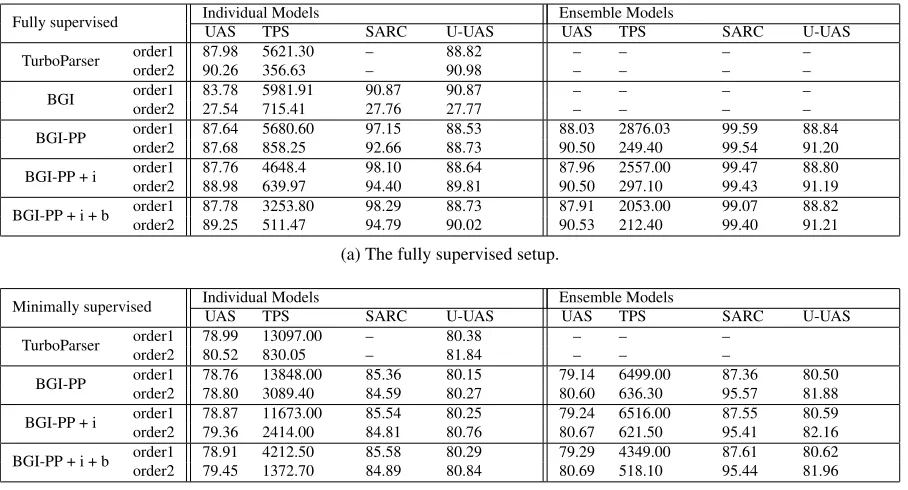
Fully Supervised Training Average results for this setup are presented in table 1 (top). Unsur-prisingly, UAS for second order parsing with basic greedy inference (Algorithm 1, BGI) is very low, as this model does not take information about partial high order parts into account in its edge scores. We hence do not report more results for this algorithm.
The table further reflects the accuracy/runtime tradeoff provided by Algorithm 2 (basic greedy in-ference with partial part predictions, BGI-PP): a UAS degradation of 0.34% and 2.58% for first and second order parsing respectively, with a runtime improvement by factors of 1.01 and 2.4, respec-tively. Employing beam search and post search im-provements (BGI-PP+i+b) to compensate for error propagation improves UAS but harms the runtime gain: for example, the UAS gap in second order parsing is 1.01% while the speedup factor is 1.43.
As discussed in footnote 1 and Section 11, our algorithm does not support the third-order parts of the TurboParser. However, the average UAS of the third-order TurboParser is 90.62% (only 0.36% above second order TurboParser) and its TPS is 72.12 (almost 5 times slower).
Fully supervised Individual ModelsUAS TPS SARC U-UAS Ensemble ModelsUAS TPS SARC U-UAS
TurboParser order1order2 87.9890.26 5621.30356.63 –– 88.8290.98 –– –– –– ––
BGI order1order2 83.7827.54 5981.91715.41 27.7690.87 90.8727.77 –– –– –– ––
BGI-PP order1order2 87.6487.68 5680.60858.25 92.6697.15 88.5388.73 88.0390.50 249.402876.03 99.5499.59 88.8491.20
BGI-PP + i order1order2 87.7688.98 4648.4639.97 94.4098.10 88.6489.81 87.9690.50 297.102557.00 99.4399.47 88.8091.19
BGI-PP + i + b order1order2 87.7889.25 3253.80511.47 94.7998.29 88.7390.02 87.9190.53 212.402053.00 99.4099.07 88.8291.21
(a) The fully supervised setup.
Minimally supervised Individual ModelsUAS TPS SARC U-UAS Ensemble ModelsUAS TPS SARC U-UAS
TurboParser order1order2 78.9980.52 13097.00830.05 –– 80.3881.84 –– –– ––
BGI-PP order1order2 78.7678.80 13848.003089.40 84.5985.36 80.1580.27 79.1480.60 636.306499.00 95.5787.36 80.5081.88
BGI-PP + i order1order2 78.8779.36 11673.002414.00 84.8185.54 80.2580.76 79.2480.67 621.506516.00 95.4187.55 80.5982.16
BGI-PP + i + b order1order2 78.9179.45 4212.501372.70 84.8985.58 80.2980.84 79.2980.69 518.104349.00 95.4487.61 80.6281.96
[image:7.612.81.535.56.301.2](b) The minimally supervised setup.
Table 1:Results for the fully supervised (top table) and minimally supervised (bottom table) setups. The left column section of each table is for individual models while the right column section is for ensemble models (Section 7). BGI-PP is the basic greedy inference algorithm with partial part predictions, +i indicates post-search improvements and +b indicates beam search (Section 6). The Tokens per Second (TPS) measure for the ensemble models reports the additional inference time over the TurboParser inference. All scores are averaged across individual languages.
of differences between the parsers is not arc direc-tionality. The percentage of arcs shared between the parsers increases with model complexity but is still as low as 94.79% for BGI-PP+i+b in second or-der parsing. In this setup, gold(BGI-PP+i+b, Tur-boParser) = (1.6%,2.6%) which supports the devel-opment data pattern reported in Section 6 and further justifies an ensemble approach.
The right column section of the table indeed shows consistent improvements of the ensemble models over the TurboParser for second order pars-ing: the ensemble models achieve UAS of 90.5-90.53% compared to 90.26% of the TurboParser. Naturally, running the TurboParser alone is faster by a factor of 1.67. Like for the individual inference algorithms, the undirected UAS measure indicates that the gain does not come from arc directionality improvements. The ensemble methods share almost all of their arcs with the TurboParser, but in cases of disagreement ensembles tend to be more accurate.
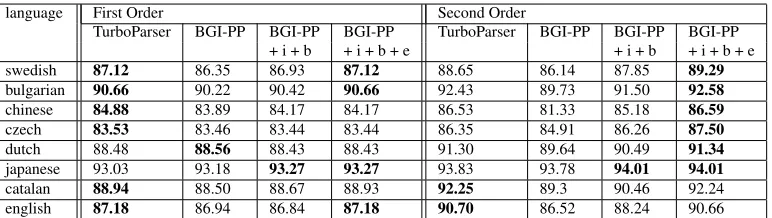
Table 2 complements our results, providing UAS values for each of the 8 languages participat-ing in this setup. The UAS difference between
BGI+PP+i+b and the TurboParser are (+0.24)-(-0.71) in first order parsing and (+0.18)-(-2.46) in second order parsing. In the latter case, combining these two models (BGI+PP+i+b+e) yields improve-ments over the TurboParser in 6 out of 8 languages. Minimally Supervised Training Results for this setup are in table 1 (bottom). While result pat-terns are very similar to the fully supervised case, two observations are worth mentioning. First, the percentage of arcs shared by our algorithms and the original parser is much lower than in the fully supervised case. This is true also for shared gold arcs: gold(BGI-PP+b+i,TurboParser) = (4.86%,5.92%) for second order parsing. This sug-gests that more sophisticated ensemble techniques may be useful in this setup.
language First Order Second Order
[image:8.612.116.502.56.165.2]TurboParser BGI-PP BGI-PP BGI-PP TurboParser BGI-PP BGI-PP BGI-PP + i + b + i + b + e + i + b + i + b + e swedish 87.12 86.35 86.93 87.12 88.65 86.14 87.85 89.29 bulgarian 90.66 90.22 90.42 90.66 92.43 89.73 91.50 92.58 chinese 84.88 83.89 84.17 84.17 86.53 81.33 85.18 86.59 czech 83.53 83.46 83.44 83.44 86.35 84.91 86.26 87.50 dutch 88.48 88.56 88.43 88.43 91.30 89.64 90.49 91.34 japanese 93.03 93.18 93.27 93.27 93.83 93.78 94.01 94.01 catalan 88.94 88.50 88.67 88.93 92.25 89.3 90.46 92.24 english 87.18 86.94 86.84 87.18 90.70 86.52 88.24 90.66
Table 2: Per language UAS for the fully supervised setup. Model names are as in Table 1, ‘e’ stands for ensemble. Best results for each language and parsing model order are highlighted in bold.
(gold(BGI+i+b,TurboParser) = (4.98%,5.5%)), im-proving the ensemble techniques is a promising fu-ture research direction.
10 Related Work
Our work brings together ideas that have been con-sidered in past, although in different forms.
Greedy Inference Goldberg and Elhadad (2010) introduced an easy-first, greedy, approach to depen-dency parsing. Their algorithm adds at each iteration the best candidate arc, in contrast to the left to right ordering of standard transition based parsers. This work is extended at (Tratz and Hovy, 2011; Gold-berg and Nivre, ; GoldGold-berg and Nivre, 2013).
The easy-first parser consists of a feature set and a specialized variant of the structured perceptron training algorithm, both dedicated to greedy infer-ence. In contrast, we show that a variant of the Tur-boParser that employs Algorithm 2 for inference and is trained with its standard global training algorithm, performs very similarly to the same parser that em-ploys dual decomposition inference.
Error Propagation in Deterministic Parsing Since deterministic algorithms are standard in transition-based parsing, the error-propagation prob-lem has been dealt with in that context. Various methods were employed, with beam search being a prominent idea (Sagae and Lavie, 2006; Titov and Henderson, 2007; Zhang and Clark, 2008; Huang et al., 2009; Zhang and Nivre, 2011; Bohnet and Nivre, 2012; Choi and McCallum, 2013b, inter alia).
Post Search Improvements Several previous works employed post-search improvements tech-niques. Like in our case, these techniques improve
the tree induced by an initial, possibly more princi-pled, search technique through local, greedy steps.
McDonald and Pereira (2006) proposed to ap-proximate high-order graph-based non-projective parsing, by arc-swap iterations over a previously in-duced projective tree. Levi et al. (2016) proposed a post-search improvements method, different than ours, to compensate for errors of their graph-based, undirected inference algorithm. Finally, Zhang et al. (2014a) demonstrated that multiple random ini-tialization followed by local improvements with re-spect to a high-order parsing objective result in ex-cellent parsing performance. Their algorithm, how-ever, shouldbhhb employ hundreds of random ini-tializations in order to provide state-of-the-art re-sults.
Ensemble Approaches Finally, several previous works combined dependency parsers. These include Nivre and McDonald (2008) who used the output of one parser to provide features for another, Zhang and Clark (2008) that proposed a beam-search based parser that combines two parsers into a single sys-tem for training and inference, and Martins et al. (2008) that employed stacked learning, in which a second predictor is trained to improve the perfor-mance of the first. Our work complements these works by integrating information from a pre-trained TurboParser in our algorithm at test time only.
11 Discussion
in-cluding information from parts that require a given set of arcs not to be included in the de-pendency tree (footnote 1). For example, the nextSibling((1,2),(1,5)) part of the TurboParser would fire iff the tree includes the arcs (1,2) and (1,5)but not the arcs(1,3)and(1,4).
In order to account for such parts, we should de-cide how to compute their probabilities and, addi-tionally, at which point they are considered part of the tree. We explored several approaches, but failed to improve our results. Hence, we did not experi-ment with the third-order TurboParser as all of its third-order parts contain ”non-included” arcs. This is left for future work.
A Runtime Complexity Analysis
Here we analyze the complexity of our algorithms, denoting the maximal indegree of a vertex withnin.
Algorithm 1 Algorithm 1 consists of two nested loops (lines 2-k3) and hence lines 4-11 are repeated O(n× |E|) =O(n×n×nin)times. At each
repe-tition, loss (lines 6-10) and gain (lines 4-5) values are computed. Afterwards the graph’s data struc-tures are updated (lines 13-16).
For every arc that we examine (line 3), there are O(nin)lostarcs, as there areO(nin)incoming arcs
(set 1) and O(nin) cycles to break (set 2). Since
every lost arc translates to a set of lost parts, we can avoid repeating computations by storing the par-tial loss of every arc in a data structure (DS):e →
P
part:e∈partwpart. Now, instead of summing all
the lost parts, (every edge participates in O(nk−in1) parts,6 thus there are O(nk
in) lost parts per added
arc), we can sum only O(nin) partial loss values.
However, since some lost parts may contain an arc from set 1 and an arc from set 2, we need to sub-tract the values that were summed twice, this can be done inO(min{nkin−1, n2in})time by holding a sec-ond DS:e1×e2→Ppart:e1∈part∧e2∈partwpart.7
In order to efficiently compute the gain values, we hold a mapping from arcs to the sum of weights of parts that can be completed in the current iteration by adding the arc to the tree. With this DS, gain
val-6Assuming that a part is a connected component.
7For first order parsing this is not needed; for second order
parsing it is done inO(nin)time.
ues can be computed in constant time. In total, the runtime of lines 4-11 isO(nin+min{nk−in1, n2in}).
The DSs are initialized in O(|parts| × k) time. Since every part is deleted at most once, and gets updated (its arcs are added to the tree) at most k times, the total DS update time isO(k× |parts|) = O(nkin+1). Thus algorithm 1 runs inO(|parts| ×k+ n2×n
in×(nin+min{nink−1, n2in}))time.
Algorithm 2 Algorithm 2 is similar in structure to Algorithm 1 but the loss and gain computations are more complex. To facilitate efficiency, we hold two DSs: (a) a mapping from arcs to the sum of
lost partsvalues, which are nowwpart×Ppart for
part ∈ parts; and (b) a mapping from arc pairs to the sum of part values for parts that contain both arcs. The loss and gain values can be computed, as above, inO(nin+min{nink−1, n2in})time.
The initialization of the DSs takesO(|parts| ×k) time. In the i-th iteration we add e = (u, v) to Ti, and remove the lostArcsfrom E. Every lost arc participates in O(nkin−1) parts, and we need to updateO(k) entries for each lost part in DS(a) (as the value of the other arcs of that part should no longer account for that part’s weight) andO(k2) en-tries in DS (b). Thus, the total update time of the DSs isO(nkin×k2)and the total runtime of Algo-rithm 2 isO(nkin+1 ×k+n×(n×nin ×(nin+
min{n2
in, nk−in1})+nkin×k2)). For unpruned graphs
andk ≥ 2this is equivalent toO(nk+1), the theo-retical runtime of the TurboParser’s dual decompo-sition inference algorithm.
Acknowledgments
The third author was partly supported by a research grant from the Microsoft/Technion research center for electronic commerce: Context Sensitive Sen-tence Understanding for Natural Language Process-ing.
References
Mariana SC Almeida, Cl´audia Pinto, Helena Figueira, Pedro Mendes, and Andr´e FT Martins. 2015. Align-ing opinions: Cross-lAlign-ingual opinion minAlign-ing with de-pendencies. InACL.
Pro-ceedings of EMNLP-CoNLL. Association for Compu-tational Linguistics.
Sabine Buchholz and Erwin Marsi. 2006. Conll-x shared task on multilingual dependency parsing. InCoNLL. Xavier Carreras. 2007. Experiments with a higher-order
projective dependency parser. InEMNLP-CoNLL. Jinho D Choi and Andrew McCallum. 2013a.
Transition-based dependency parsing with selectional branching. InACL.
Jinho D Choi and Andrew McCallum. 2013b. Transition-based dependency parsing with selectional branching. InACL.
Koby Crammer, Ofer Dekel, Joseph Keshet, Shai Shalev-Shwartz, and Yoram Singer. 2006. Online passive-aggressive algorithms. The Journal of Machine Learn-ing Research, 7:551–585.
J. Edmonds. 1967. Optimum branchings.Journal of Re-search of the National Bureau of Standards, 71B:233– 240.
Jason Eisner. 1996. Efficient normal-form parsing for combinatory categorial grammar. InACL.
Yoav Goldberg and Michael Elhadad. 2010. An effi-cient algorithm for easy-first non-directional depen-dency parsing. InNAACL-HLT.
Yoav Goldberg and Joakim Nivre. A dynamic oracle for arc-eager dependency parsing. InCOLING.
Yoav Goldberg and Joakim Nivre. 2013. Training deterministic parsers with non-deterministic oracles.
Transactions of the Association for Computational Linguistics, 1(Oct):403–414.
Matthew Gormley, Mark Dredze, and Jason Eisner. 2015. Approximation-aware dependency parsing by belief propagation. Transactions of the Association for Com-putational Linguistics, 3:489–501.
Matthew Honnibal, Yoav Goldberg, and Mark Johnson. 2013. A non-monotonic arc-eager transition system for dependency parsing. InCoNLL.
Liang Huang, Wenbin Jiang, and Qun Liu. 2009. Bilingually-constrained (monolingual) shift-reduce parsing. InEMNLP.
Terry Koo and Michael Collins. 2010. Efficient third-order dependency parsers. InACL.
Effi Levi, Roi Reichart, and Ari Rappoport. 2016. Edge-linear first-order dependency parsing with undirected minimum spanning tree inference. InACL.
Omer Levy and Yoav Goldberg. 2014. Neural word em-bedding as implicit matrix factorization. InNIPS. Andr´e FT Martins, Dipanjan Das, Noah A Smith, and
Eric P Xing. 2008. Stacking dependency parsers. In
EMNLP.
A. Martins, M. Almeida, and N. A. Smith. 2013. Turn-ing on the turbo: Fast third-order non-projective turbo parsers. InACL.
Ryan McDonald and Fernando Pereira. 2006. On-line learning of approximate dependency parsing al-gorithms. InEACL.
Ryan McDonald, Fernando Pereira, Kiril Ribarov, and Jan Hajic. 2005. Non-projective dependency parsing using spanning tree algorithms. InHLT-EMNLP. Jens Nilsson, Sebastian Riedel, and Deniz Yuret. 2007.
The conll 2007 shared task on dependency parsing. In Proceedings of the CoNLL shared task session of EMNLP-CoNLL.
Joakim Nivre and Ryan McDonald. 2008. Integrating graph-based and transition-based dependency parsers. InACL-08: HLT, June.
Joakim Nivre, Johan Hall, Jens Nilsson, Atanas Chanev, G¨ulsen Eryigit, Sandra K¨ubler, Svetoslav Marinov, and Erwin Marsi. 2007. Maltparser: A language-independent system for data-driven dependency pars-ing.Natural Language Engineering, 13(02):95–135. Sebastian Riedel, David Smith, and Andrew McCallum.
2012. Parse, price and cut – delayed column and row generation for graph based parsers. In EMNLP-CoNLL.
Kenji Sagae and Alon Lavie. 2006. A best-first prob-abilistic shift-reduce parser. In Proc. of the COL-ING/ACL on Main conference poster sessions. David Smith and Jason Eisner. 2008. Dependency
pars-ing by belief propagation. InEMNLP.
Ivan Titov and James Henderson. 2007. Fast and robust multilingual dependency parsing with a generative la-tent variable model. InEMNLP-CoNLL.
Stephen Tratz and Eduard Hovy. 2011. A fast, accu-rate, non-projective, semantically-enriched parser. In
EMNLP.
Fei Wu and Daniel S Weld. 2010. Open information extraction using wikipedia. InACL.
Yue Zhang and Stephen Clark. 2008. A tale of two parsers: Investigating and combining graph-based and transition-based dependency parsing using beam-search. InEMNLP.
Yue Zhang and Joakim Nivre. 2011. Transition-based dependency parsing with rich non-local features. In
ACL.
Yuan Zhang, Tao Lei, Regina Barzilay, and Tommi Jaakkola. 2014a. Greed is good if randomized: New inference for dependency parsing. InEMNLP. Yuan Zhang, Tao Lei, Regina Barzilay, Tommi Jaakkola,