Variational Neural Discourse Relation Recognizer
Biao Zhang1, Deyi Xiong2∗, Jinsong Su1, Qun Liu3,4, Rongrong Ji1, Hong Duan1, Min Zhang2
Xiamen University, Xiamen, China 3610051
Provincial Key Laboratory for Computer Information Processing Technology Soochow University, Suzhou, China 2150062
ADAPT Centre, School of Computing, Dublin City University3
Key Laboratory of Intelligent Information Processing, Institute of Computing Technology, Chinese Academy of Sciences4
[email protected], {jssu, rrji, hduan}@xmu.edu.cn [email protected], {dyxiong, minzhang}@suda.edu.cn
Abstract
Implicit discourse relation recognition is a crucial component for automatic discourse-level analysis and nature language understand-ing. Previous studies exploit discriminative models that are built on either powerful man-ual features or deep discourse representations. In this paper, instead, we explore generative models and propose a variational neural dis-course relation recognizer. We refer to this model as VarNDRR. VarNDRR establishes a directed probabilistic model with a latent con-tinuous variable that generates both a dis-course and the relation between the two ar-guments of the discourse. In order to per-form efficient inference and learning, we in-troduce neural discourse relation models to approximate the prior and posterior distribu-tions of the latent variable, and employ these approximated distributions to optimize a repa-rameterized variational lower bound. This al-lows VarNDRR to be trained with standard stochastic gradient methods. Experiments on the benchmark data set show that VarNDRR can achieve comparable results against state-of-the-art baselines without using any manual features.
1 Introduction
Discourse relation characterizes the internal struc-ture and logical relation of a coherent text. Automat-ically identifying these relations not only plays an important role in discourse comprehension and gen-eration, but also obtains wide applications in many
∗Corresponding author
other relevant natural language processing tasks, such as text summarization (Yoshida et al., 2014), conversation (Higashinaka et al., 2014), question an-swering (Verberne et al., 2007) and information ex-traction (Cimiano et al., 2005). Generally, discourse relations can be divided into two categories: explicit and implicit, which can be illustrated in the follow-ing example:
The company was disappointed by the rul-ing. because The obligation is totally un-warranted.(adapted from wsj 0294)
With the discourse connective because, these two sentences display an explicit discourse relation CONTINGENCYwhich can be inferred easily. Once this discourse connective is removed, however, the discourse relation becomes implicit and difficult to be recognized. This is because almost no surface in-formation in these two sentences can signal this re-lation. For successful recognition of this relation, in the contrary, we need to understand the deep seman-tic correlation betweendisappointedandobligation
in the two sentences above. Although explicit dis-course relation recognition (DRR) has made great progress (Miltsakaki et al., 2005; Pitler et al., 2008), implicit DRR still remains a serious challenge due to the difficulty in semantic analysis.
Conventional approaches to implicit DRR often treat the relation recognition as a classification prob-lem, where discourse arguments and relations are re-garded as the inputs and outputs respectively. Gen-erally, these methods first generate a representation for a discourse, denoted as x1 (e.g., manual fea-1Unless otherwise specified, all variables in the paper, e.g.,
x,y,z are multivariate. But for notational convenience, we
amssymb amsmath
z
x y
θ φ
N
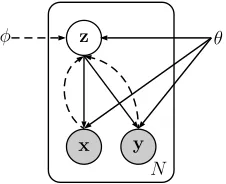
Figure 1: Graphical illustration for VarNDRR. Solid lines denote the generative model pθ(x|z)pθ(y|z), dashed lines denote the variational approximation
qφ(z|x,y)to the posteriorp(z|x,y)andqφ0(z|x)to the priorp(z)for inference. The variational parametersφare
learned jointly with the generative model parametersθ.
tures in SVM-based recognition (Pitler et al., 2009; Lin et al., 2009) or sentence embeddings in neu-ral networks-based recognition (Ji and Eisenstein, 2015; Zhang et al., 2015)), and then directly model the conditional probability of the corresponding dis-course relation y givenx, i.e. p(y|x). In spite of
their success, these discriminative approaches rely heavily on the goodness of discourse representa-tion x. Sophisticated and good representations of a discourse, however, may make models suffer from overfitting as we have no large-scale balanced data.
Instead, we assume that there is a latent continu-ous variablez from an underlying semantic space. It is this latent variable that generates both dis-course arguments and the corresponding relation, i.e. p(x,y|z). The latent variable enables us to jointly model discourse arguments and their rela-tions, rather than conditionally modelyonx. How-ever, the incorporation of the latent variable makes the modeling difficult due to the intractable compu-tation with respect to the posterior distribution.
Inspired by Kingma and Welling (2014) as well as Rezende et al. (2014) who introduce a variational neural inference model to the intractable posterior via optimizing a reparameterized variational lower bound, we propose a variational neural discourse re-lation recognizer (VarNDRR) with a latent contin-uous variable for implicit DRR in this paper. The key idea behind VarNDRR is that although the pos-terior distribution is intractable, we can approximate it via a deep neural network. Figure 1 illustrates the treat them as univariate variables in most cases. Additionally, we use bold symbols to denote variables, and plain symbols to denote values.
graph structure of VarNDRR. Specifically, there are two essential components:
• neural discourse recognizer As a discourse x and its corresponding relation y are indepen-dent with each other given the latent variablez (as shown by the solid lines), we can formulate the generation ofxandyfromz in the equa-tionpθ(x,y|z) = pθ(x|z)pθ(y|z). These two conditional probabilities on the right hand side are modeled via deep neural networks (see sec-tion 3.1).
• neural latent approximatorVarNDRR assumes that the latent variable can be inferred from dis-course argumentsxand relationsy (as shown by the dash lines). In order to infer the la-tent variable, we employ a deep neural net-work to approximate the posterior qφ(z|x,y) as well as the prior qφ0(z|x) (see section 3.2),
which makes the inference procedure efficient. We further employ a reparameterization tech-nique to samplezfromqφ(z|x,y)that not only bridges the gap between the recognizer and the approximator but also allows us to use the stan-dard stochastic gradient ascent techniques for optimization (see section 3.3).
The main contributions of our work lie in two as-pects. 1) We exploit a generative graphic model for implicit DRR. To the best of our knowledge, this has never been investigated before. 2) We develop a neural recognizer and two neural approximators specifically for implicit DRR, which enables both the recognition and inference to be efficient.
We conduct a series of experiments for English implicit DRR on the PDTB-style corpus to evaluate the effectiveness of our proposed VarNDRR model. Experiment results show that our variational model achieves comparable results against several strong baselines in term of F1 score. Extensive analysis on the variational lower bound further reveals that our model can indeed fit the data set with respect to discourse arguments and relations.
2 Background: Variational Autoencoder
[image:2.612.129.242.63.155.2]autoencoder. With a latent random variablez, VAE significantly changes the autoencoder architecture to be able to capture the variations in the observed vari-ablex. The joint distribution of(x,z)is formulated
as follows:
pθ(x,z) =pθ(x|z)pθ(z) (1)
wherepθ(z)is the prior over the latent variable, usu-ally equipped with a simple Gaussian distribution.
pθ(x|z) is the conditional distribution that models the probability ofxgiven the latent variablez. Typi-cally, VAE parameterizespθ(x|z)with a highly non-linear but flexible function approximator such as a neural network.
The objective of VAE is to maximize a variational lower bound as follows:
LV AE(θ, φ;x) =−KL(qφ(z|x)||pθ(z))
+Eqφ(z|x)[logpθ(x|z)]≤logpθ(x) (2)
where KL(Q||P)is Kullback-Leibler divergence
be-tween two distributions Q and P. qφ(z|x) is an approximation of the posterior p(z|x) and usually follows a diagonal GaussianN(µ,diag(σ2))whose
meanµand varianceσ2are parameterized by again,
neural networks, conditioned onx.
To optimize Eq. (2) stochastically with respect to bothθandφ, VAE introduces a reparameterization
trick that parameterizes the latent variablezwith the Gaussian parametersµandσinqφ(z|x):
˜
z=µ+σ (3)
whereis a standard Gaussian variable, and
de-notes an element-wise product. Intuitively, VAE learns the representation of the latent variable not as single points, but as soft ellipsoidal regions in la-tent space, forcing the representation to fill the space rather than memorizing the training data as isolated representations. With this trick, the VAE model can be trained through standard backpropagation tech-nique with stochastic gradient ascent.
3 The VarNDRR Model
This section introduces our proposed VarNDRR model. Formally, in VarNDRR, there are two ob-served variables,xfor a discourse andyfor the cor-responding relation, and one latent variable z. As
z y
x1 x2
pθ(x|z) pθ(y|z)
h′
[image:3.612.331.525.59.164.2]1 h′2
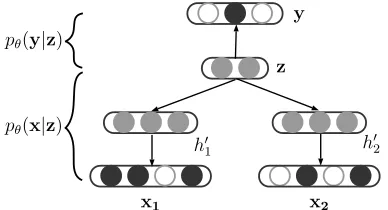
Figure 2: Neural networks for conditional probabilities
pθ(x|z)andpθ(y|z). The gray color denotes real-valued representations while the white and black color 0-1 rep-resentations.
illustrated in Figure 1, the joint distribution of the three variables is formulated as follows:
pθ(x,y,z) =pθ(x,y|z)p(z) (4)
We begin with this distribution to elaborate the ma-jor components of VarNDRR.
3.1 Neural Discourse Recognizer
The conditional distribution p(x,y|z) in Eq. (4)
shows that both discourse arguments and the corre-sponding relation are generated from the latent vari-able. As shown in Figure 1, xis d-separated from y by z. Therefore the discourse x and the corre-sponding relationy is independent given the latent variable z. The joint probability can be therefore formulated as follows:
pθ(x,y,z) =pθ(x|z)pθ(y|z)p(z) (5)
We use a neural modelq0φ(z|x) to approximate the
prior p(z) conditioned on the discourse x (see the following section). With respect to the other two conditional distributions, we parameterize them via neural networks as shown in Figure 2.
Before we describe these neural networks, it is necessary to briefly introduce how discourse rela-tions are annotated in our training data. The PDTB corpus, used as our training data, annotates implicit discourse relations between two neighboring argu-ments, namely Arg1 and Arg2. In VarNDRR, we represent the two arguments with bag-of-word rep-resentations, and denote them asx1andx2.
z∈Rdz onto a hidden layer:
h01 =f(Wh0
1z+bh01)
h02 =f(Wh0
2z+bh01)
(6)
where h01 ∈ Rdh01, h0
2 ∈ R
dh0
2, W∗ is the
transfor-mation matrix, b∗ is the bias term, du denotes the dimensionality of vector representations of u and f(·)is an element-wise activation function, such as
tanh(·), which is used throughout our model.
Upon this hidden layer, we further stack a Sig-moid layer to predict the probabilities of correspond-ing discourse arguments:
x01=Sigmoid(Wx0
1h
0
1+bx0
1)
x02=Sigmoid(Wx0
2h
0
2+bx02)
(7)
here, x01 ∈ Rdx1 and x0
2 ∈ Rdx2 are the
real-valued representations of the reconstructed x1 and
x2 respectively.2 We assume thatpθ(x|z)is a mul-tivariate Bernoulli distribution because of the bag-of-word representation. Therefore the logarithm of
p(x|z) is calculated as the sum of probabilities of
words in discourse arguments as follows:
log p(x|z)
=X
i
x1,ilogx01,i+ (1−x1,i) log(1−x01,i)
+X
j
x2,jlogx02,j+ (1−x2,j) log(1−x02,j) (8)
whereui,j is thejth element inui.
In order to estimatepθ(y|z)(the top part in Fig-ure 2), we stack a softmax layer over the multilayer-perceptron-transformed representation of the latent variablez:
y0 =SoftMax(Wy0MLP(z) +by0) (9)
y0 ∈ Rdy, and d
y denotes the number of discourse relations. MLP projects the representation of latent variablezinto adm-dimensional space through four
internal layers, each of which has dimension dm.
Suppose that the true relation isy ∈ Rdy, the
log-arithm ofp(y|z)is defined as:
log p(y|z) =
dy
X
i=1
yilogy0i (10)
2Notice that the equality ofd
x1 = dx2, dh0
1 = dh02 is not necessary though we assume so in our experiments.
µ
x1
h1
logσ2
h2
x2 y
hy
q′
φ(z|x)
qφ(z|x,y)
Figure 3: Neural networks for Gaussian parametersµ
andlogσin the approximated posterior qφ(z|x,y)and priorq0
φ(z|x).
In order to precisely estimate these conditional probabilities, our model will force the representation
zof the latent variable to encode semantic
informa-tion for both the reconstructed discoursex0(Eq. (8)) and predicted discourse relationy0(Eq. (10)), which
is exactly what we want.
3.2 Neural Latent Approximator
For the joint distribution in Eq. (5), we can define a variational lower bound that is similar to Eq. (2). The difference lies in two aspects: the approximate prior q0φ(z|x) and posteriorqφ(z|x,y). We model both distributions as a multivariate Gaussian distri-bution with a diagonal covariance structure:
N(z;µ, σ2I)
The meanµand s.d. σ of the approximate
distribu-tion are the outputs of the neural network as shown in Figure 3, where the prior and posterior have dif-ferent conditions and independent parameters.
Approximate Posterior qφ(z|x,y) is modeled to condition on both observed variables: the discourse argumentsxand relationsy. Similar to the calcula-tion ofpθ(x|z), we first transform the inputxandy into a hidden representation:
h1 =f(Wh1x1+bh1)
h2 =f(Wh2x2+bh2)
hy =f(Whyy+bhy)
(11)
whereh1 ∈Rdh1, h2∈Rdh2 andhy ∈Rdhy.3
3Notice thatd
[image:4.612.318.551.55.215.2]We then obtain the Gaussian parameters of the posteriorµandlogσ2through linear regression:
µ=Wµ1h1+Wµ2h2+Wµyhy +bµ
logσ2 =Wσ1h1+Wσ2h2+Wσyhy+bσ
(12)
where µ, σ ∈ Rdz. In this way, this posterior
ap-proximator can be efficiently computed.
Approximate Priorqφ0(z|x) is modeled to
condi-tion on discourse argumentsxalone. This is based on the observation that discriminative models are able to obtain promising results using onlyx. There-fore, assuming the discourse arguments encode the prior information for discourse relation recognition is meaningful.
The neural model for priorqφ0(z|x)is the same as
that (i.e. Eq (11) and (12)) for posteriorqφ(z|x,y) (see Figure 3), except for the absence of discourse relationy. For clarity , we useµ0 andσ0 to denote
the mean and s.d. of the approximate prior.
With the parameters of Gaussian distribution, we can access the representationzusing different
sam-pling strategies. However, traditional samsam-pling ap-proaches often breaks off the connection between recognizer and approximator, making the optimiza-tion difficult. Instead, we employ the reparameteri-zation trick (Kingma and Welling, 2014; Rezende et al., 2014) as in Eq. (3). During training, we sam-ple the latent variable usingz˜= µ+σ; during
testing, however, we employ the expectation ofzin the approximate prior distribution, i.e. setz˜=µ0to
avoid uncertainty.
3.3 Parameter Learning
We employ the Monte Carlo method to estimate the expectation over the approximate posterior, that is Eqφ(z|x,y)[logpθ(x,y|z)]. Given a training instance
(x(t), y(t)), the joint training objective is defined:
L(θ, φ)' −KL(qφ(z|x(t), y(t))||qφ0(z|x(t)))
+1
L
L
X
l=1
logpθ(x(t), y(t)|z˜(t,l)) (13)
wherez˜(t,l)=µ(t)+σ(t)(l)and(l)∼ N(0,I)
Lis the number of samples. The first term is the KL
divergence of two Gaussian distributions which can be computed and differentiated without estimation.
Algorithm 1 Parameter Learning Algorithm of VarNDRR.
Inputs:A, the maximum number of iterations;
M, the number of instances in one batch;
L, the number of samples;
θ, φ←Initialize parameters
repeat
D ←getRandomMiniBatch(M)
←getRandomNoiseFromStandardGaussian()
g← ∇θ,φL(θ, φ;D, )
θ, φ←parameterUpdater(θ, φ;g)
until convergence of parameters (θ, φ) or reach the
maximum iterationA
Relation Train Dev Test#Instance Number
COM 1942 197 152
CON 3342 295 279
EXP 7004 671 574
[image:5.612.355.497.223.307.2]TEM 760 64 85
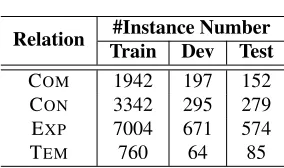
Table 1: Statistics of implicit discourse relations for the training (Train), development (Dev) and test (Test) sets in PDTB.
Maximizing this objective will minimize the differ-ence between the approximate posterior and prior, thus making the settingz˜ = µ0 during testing
rea-sonable. The second term is the approximate ex-pectation ofEqφ(z|x,y)[logpθ(x,y|z)], which is also
differentiable.
As the objective function in Eq. (13) is differen-tiable, we can optimize both the model parametersθ
and variational parametersφjointly using standard
gradient ascent techniques. The training procedure for VarNDRR is summarized in Algorithm 1.
4 Experiments
We conducted experiments on English implicit DRR task to validate the effectiveness of VarNDRR.4
4.1 Dataset
We used the largest hand-annotated discourse cor-pus PDTB 2.05 (Prasad et al., 2008) (PDTB
here-after). This corpus contains discourse annotations over 2,312 Wall Street Journal articles, and is or-ganized in different sections. Following previous work (Pitler et al., 2009; Zhou et al., 2010; Lan et
4Source code is available at
https://github.com/DeepLearnXMU/VarNDRR.
Model Acc P R F1 R&X (2015) - - - 41.00
J&E (2015) 70.27 - - 35.93
SVM 63.10 22.79 64.47 33.68
SCNN 60.42 22.00 67.76 33.22
VarNDRR 63.30 24.00 71.05 35.88
(a) COMvs Other
Model Acc P R F1
(R&X (2015)) - - - 53.80
(J&E (2015)) 76.95 - - 52.78
SVM 62.62 39.14 72.40 50.82
SCNN 63.00 39.80 75.29 52.04
VarNDRR 53.82 35.39 88.53 50.56
(b) CONvs Other
Model Acc P R F1
(R&X (2015)) - - - 69.40
(J&E (2015)) 69.80 - - 80.02
SVM 60.71 65.89 58.89 62.19
SCNN 63.00 56.29 91.11 69.59
VarNDRR 57.36 56.46 97.39 71.48
(c) EXPvs Other
Model Acc P R F1
(R&X (2015)) - - - 33.30
(J&E (2015)) 87.11 - - 27.63
SVM 66.25 15.10 68.24 24.73
SCNN 76.95 20.22 62.35 30.54
VarNDRR 62.14 17.40 97.65 29.54
[image:6.612.86.537.57.260.2](d) TEMvs Other
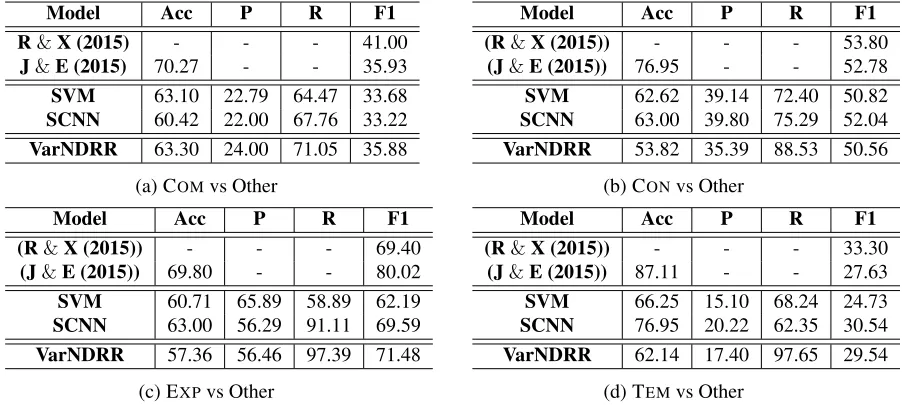
Table 2: Classification results of different models on the implicit DRR task. Acc=Accuracy,P=Precision,R=Recall, andF1=F1 score.
al., 2013; Zhang et al., 2015), we used sections 2-20 as our training set, sections 21-22 as the test set. Sections 0-1 were used as the development set for hyperparameter optimization.
In PDTB, discourse relations are annotated in a predicate-argument view. Each discourse connective is treated as a predicate that takes two text spans as its arguments. The discourse relation tags in PDTB are arranged in a three-level hierarchy, where the top level consists of four major semantic classes: TEMPORAL (TEM), CONTINGENCY (CON), EX -PANSION (EXP) and COMPARISON (COM). Be-cause the top-level relations are general enough to be annotated with a high inter-annotator agreement and are common to most theories of discourse, in our experiments we only use this level of annotations.
We formulated the task as four separate one-against-all binary classification problems: each top level class vs. the other three discourse relation classes. We also balanced the training set by resam-pling training instances in each class until the num-ber of positive and negative instances are equal. In contrast, all instances in the test and development set are kept in nature. The statistics of various data sets is listed in Table 1.
4.2 Setup
We tokenized all datasets using Stanford NLP Toolkit6. For optimization, we employed the Adam
6http://nlp.stanford.edu/software/corenlp.shtml
algorithm (Kingma and Ba, 2014) to update param-eters. With respect to the hyperparametersM, L, A
and the dimensionality of all vector representations, we set them according to previous work (Kingma and Welling, 2014; Rezende et al., 2014) and pre-liminary experiments on the development set. Fi-nally, we set M = 16, A = 1000, L = 1, dz =
20, dx1 =dx2 = 10001, dh1 =dh2 =dh01 =dh02 =
dm =dhy = 400, dy = 2for all experiments.7. All
parameters of VarNDRR are initialized by a Gaus-sian distribution (µ = 0, σ = 0.01). For Adam,
we setβ1 = 0.9, β2 = 0.999with a learning rate 0.001. Additionally, we tied the following
parame-ters in practice:Wh1 andWh2,Wx01 andWx02.
We compared VarNDRR against the following two different baseline methods:
• SVM:a support vector machine (SVM) classi-fier8trained with several manual features.
• SCNN:a shallow convolutional neural network proposed by Zhang et al. (2015).
We also provide results from two state-of-the-art systems:
• Rutherford and Xue (2015) convert explicit discourse relations into implicit instances. • Ji and Eisenstein (2015) augment discourse
representations via entity connections.
7There is one dimension ind
x1anddx2for unknown words.
1 -1270.24 25.3012 2 -207.21 26.04374 3 -210.21 26.64165 4 -182.84 24.70785 5 -182.17 23.63014
6 -178.72 24
7 -177.09 27.61506 8 -174.33 24.70434 9 -170.43 25.9366 10 -166.63 22.83105 11 -163.22 22.94118 12 -159.37 25.1809 13 -155.23 27.72681 14 -150.78 28.74459 15 -146.27 29.29533 16 -141.61 30.70362 17 -136.9 29.55665 18 -132.44 28.82527 19 -128.22 29.78355 20 -124.19 26.22951 21 -120.32 12.41379 22 -117.68 28.42942 23 -113.3 29.53846 24 -110.01 30.33932 25 -106.99 29.63636 26 -104.15 29.67581 27 -101.29 27.86885 28 -98.89 27.32558 29 -96.5 28.09917 30 -94.19 29.26829 31 -92.15 22.90389 32 -90.16 29.36242 33 -88.39 29.14238 34 -86.65 27.86305 35 -84.92 12.12121 36 -83.46 29.7593 37 -81.93 28.66379 38 -80.44 30.66516 39 -79.16 29.19006 40 -77.8 34.93045 41 -76.65 29.93062 42 -75.48 38.41808 43 -74.41 42.2043 44 -73.35 0.980392 45 -72.38 26.60218 46 -71.4 19.58042 47 -70.51 28.50467 48 -69.65 26.22169 49 -68.79 20.12579 50 -68 24.19872 51 -67.18 28.16456 52 -66.44 26.67877 53 -65.76 28.53261
54 -65.04 0
-1400 -1200 -1000 -800 -600 -400 -200 0 0 5 10 15 20 25 30 35 40 45
1 101 201 301 401 501 601 701 801 901
Dev Train
(a) COMvs Other
1 -774.47 31.84422 2 -178.34 29.57938 3 -174.75 36.31436 4 -172.55 31.85629 5 -168.78 30.78704 6 -164.1 23.26241 7 -159.04 39.74267 8 -153.3 42.9342 9 -147.32 19.25926
10 -141.37 0
11 -135.17 34.44109 12 -129.05 19.48529
13 -123.05 0
14 -117.5 0
15 -112.36 9.69697 16 -107.69 30.15682 17 -103.41 18.91892 18 -99.5 21.02908 19 -95.89 18.05556 20 -92.55 32.95638 21 -89.57 25.26767 22 -86.76 38.05668 23 -84.18 7.506053 24 -81.77 49.31774 25 -79.56 29.11051 26 -77.86 28.06122 27 -75.62 14.74926 28 -73.78 32.99145 29 -72.12 24.42589 30 -70.57 40.37685 31 -69.09 27.44722 32 -67.72 26.64418 33 -66.42 25.56391 34 -65.28 37.69231
35 -64.09 0
36 -63.03 42.11687
37 -62.01 0
38 -61.03 34.80278 39 -60.12 35.76642 40 -59.21 39.21085 41 -58.42 39.11439 42 -57.67 32.78195 43 -56.94 34.12463 44 -56.24 42.22821 45 -55.53 42.36902 46 -54.95 28.40909 47 -54.29 41.14173 48 -53.69 42.89044 49 -53.1 40.85189
50 -52.63 40
51 -52.08 40.1122 52 -51.58 41.76049 53 -51.11 43.67301 54 -50.63 44.73976
-900 -800 -700 -600 -500 -400 -300 -200 -100 0 0 10 20 30 40 50 60
1 101 201 301 401 501 601 701 801 901 Dev Train
(b) CONvs Other
1 -475.58 59.25384 2 -167.78 62.2192 3 -158.7 62.41888 4 -150.99 71.32476 5 -143.16 66.0775 6 -135.89 59.29878 7 -129.95 57.02067 8 -124.59 40.04004
9 -119.7 53.457
10 -115.08 55.83204 11 -110.79 57.92779 12 -106.82 56.6428 13 -103.11 53.08848 14 -99.68 51.27753 15 -96.55 45.91368 16 -93.65 47.80083 17 -91.01 46.41509 18 -88.61 54.89567 19 -86.4 53.93443 20 -84.37 49.91364 21 -82.5 48.92857 22 -80.76 44.04389 23 -79.2 49.95491 24 -77.81 56.56109 25 -76.43 50.39648 26 -75.2 49.74271 27 -74.09 57.31615 28 -72.99 53.35438 29 -71.98 50.30251 30 -71.06 56.90054 31 -70.23 58.11966 32 -69.39 50.76401
33 -68.6 52.6763
34 -67.87 53.72895 35 -67.21 53.23855 36 -66.56 53.52987 37 -65.93 56.77711 38 -65.33 55.22502 39 -64.78 52.33034 40 -64.27 54.64313 41 -63.75 54.04556 42 -63.25 54.64481 43 -62.77 51.9544 44 -62.35 55.74273 45 -61.93 57.18541 46 -61.55 55.28701 47 -61.12 54.69824 48 -60.8 55.39623 49 -60.41 55.02392 50 -60.08 54.04972 51 -59.77 54.69126 52 -59.43 52.52033 53 -59.13 55.87549 54 -58.82 56.77711
-500 -450 -400 -350 -300 -250 -200 -150 -100 -50 0 0 10 20 30 40 50 60 70 80
1 101 201 301 401 501 601 701 801 901 Dev Train
(c) EXPvs Other
1 -2621.6 10.06289 2 -197.63 10.51525 3 -193.15 11.11111 4 -198.57 10.77982 5 -315.79 11.53305 6 -244.37 6.984127 7 -264.03 11.23596 8 -301.25 10.97046 9 -188.89 4.181185
10 -186.88 0
11 -187.06 0
12 -184.16 1.892744 13 -182.4 1.369863 14 -180.22 9.924306 15 -178.27 10.08101 16 -176.39 5.235602
17 -174.71 0
18 -173.06 0
19 -171.49 0
20 -169.66 0
21 -167.42 0
22 -164.95 0
23 -162.28 0
24 -159.85 0
25 -157.64 0
26 -155.43 0
27 -153.12 0
28 -150.95 0
29 -148.96 0
30 -146.91 0
31 -145.03 0
32 -143.22 0
33 -141.17 0
34 -139.52 0
35 -137.63 0
36 -135.8 0
37 -134.07 10.5802 38 -132.44 2.158273 39 -130.8 10.9434 40 -129.51 3.883495 41 -127.7 12.16879 42 -126.55 21.57534 43 -124.58 10.90259 44 -123.23 10.65719 45 -121.78 10.84444 46 -120.3 2.234637 47 -118.94 11.38861 48 -117.44 11.51832 49 -116.18 4.472843 50 -114.76 11.71634 51 -113.71 11.55015 52 -112.34 11.6349 53 -111.18 11.63793 54 -109.95 3.951368
-3000 -2500 -2000 -1500 -1000 -500 0 0 5 10 15 20 25
1 101 201 301 401 501 601 701 801 901 Dev Train
[image:7.612.151.473.54.287.2](d) TEMvs Other
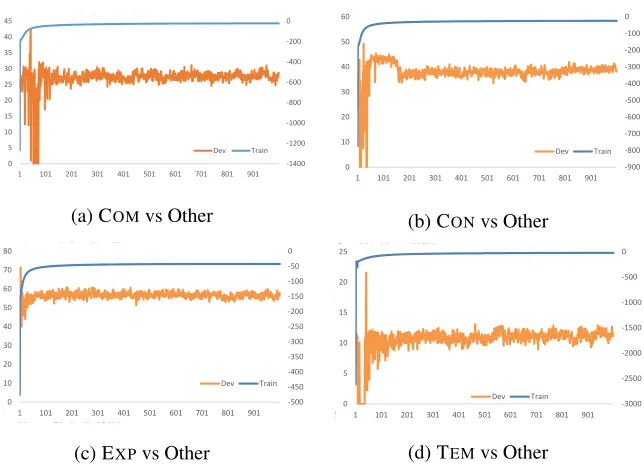
Figure 4: Illustration of the variational lower bound (blue color) on the training set and F-score (brown color) on the development set. Horizontal axis: the epoch numbers; Vertical axis: the F1 score for relation classification (left) and the estimated average variational lower bound per datapoint (right).
Features used in SVM are taken from the state-of-the-art implicit discourse relation recognition model, including Bag of Words, Cross-Argument Word Pairs, Polarity, First-Last, First3,Production Rules, Dependency Rules and Brown cluster pair
(Rutherford and Xue, 2014). In order to collect bag of words, production rules, dependency rules, and cross-argument word pairs, we used a frequency cut-off of 5 to remove rare features, following Lin et al. (2009).
4.3 Classification Results
Because the development and test sets are imbal-anced in terms of the ratio of positive and negative instances, we chose the widely-used F1 score as our major evaluation metric. In addition, we also pro-vide the precision, recall and accuracy for further analysis. Table 2 summarizes the classification re-sults.
From Table 2, we observe that the proposed VarN-DRR outperforms SVM on COM/EXP/TEM and
SCNNon EXP/COM according to their F1 scores. Although it fails on CON, VarNDRR achieves the best result on EXP/COM among these three mod-els. Overall, VarNDRR is competitive in compar-ison with these two baselines. With respect to the accuracy, our model does not yield substantial
im-provements over the two baselines. This may be be-cause that we used the F1 score rather than the accu-racy, as our selection criterion on the development set. With respect to the precision and recall, our model tends to produce relatively lower precisions but higher recalls. This suggests that the improve-ments of VarNDRR in terms of F1 scores mostly benefits from the recall values.
Comparing with the state-of-the-art results of pre-vious work (Ji and Eisenstein, 2015; Rutherford and Xue, 2015), VarNDRR achieves comparable results in term of the F1 scores. Specifically, VarNDRR out-performs Rutherford and Xue (2015) on EXP, and Ji and Eisenstein (2015) on TEM. However, the accu-racy of our model fails to surpass these models. We argue that this is because both baselines use many manual features designed with prior human knowl-edge, but our model is purely neural-based.
Additionally, we find that the performance of our model is proportional to the number of training in-stances. This suggests that collecting more training instances (in spite of the noises) may be beneficial to our model.
4.4 Variational Lower Bound Analysis
for variational methods. Figure 4 shows the training procedure for four tasks in terms of the variational lower bound on the training set. We also provide F1 scores on the development set to investigate the relations between the variational lower bound and recognition performance.
We find that our model converges toward the vari-ational lower bound considerably fast in all exper-iments (within 100 epochs), which resonates with the previous findings (Kingma and Welling, 2014; Rezende et al., 2014). However, the change trend of the F1 score does not follow that of the lower bound which takes more time to converge. Particularly to the four discourse relations, we further observe that the change paths of the F1 score are completely dif-ferent. This may suggest that the four discourse re-lations have different properties and distributions.
In particular, the number of epochs when the best F1 score reaches is also different for the four dis-course relations. This indicates that dividing the im-plicit DRR into four different tasks according to the type of discourse relations is reasonable and better than performing DRR on the mixtures of the four relations.
5 Related Work
There are two lines of research related to our work:
implicit discourse relation recognition and varia-tional neural model, which we describe in succes-sion.
Implicit Discourse Relation Recognition Due to the release of Penn Discourse Treebank (Prasad et al., 2008) corpus, constantly increasing efforts are made for implicit DRR. Upon this corpus, Pilter et al. (2009) exploit several linguistically informed features, such as polarity tags, modality and lexical features. Lin et al. (2009) further incorporate con-text words, word pairs as well as discourse parse information into their classifier. Following this di-rection, several more powerful features have been exploited: entities (Louis et al., 2010), word em-beddings (Braud and Denis, 2015), Brown cluster pairs and co-reference patterns (Rutherford and Xue, 2014). With these features, Park and Cardie (2012) perform feature set optimization for better feature combination.
Different from feature engineering, predicting
discourse connectives can indirectly help the rela-tion classificarela-tion (Zhou et al., 2010; Patterson and Kehler, 2013). In addition, selecting explicit dis-course instances that are similar to the implicit ones can enrich the training corpus for implicit DRR and gains improvement (Wang et al., 2012; Lan et al., 2013; Braud and Denis, 2014; Fisher and Sim-mons, 2015; Rutherford and Xue, 2015). Very re-cently, neural network models have been also used for implicit DRR due to its capability for represen-tation learning (Ji and Eisenstein, 2015; Zhang et al., 2015).
Despite their successes, most of them focus on the discriminative models, leaving the field of genera-tive models for implicit DRR a relagenera-tively uninvesti-gated area. In this respect, the most related work to ours is the latent variable recurrent neural network recently proposed by Ji et al. (2016). However, our work differs from theirs significantly, which can be summarized in the following three aspects: 1) they employ the recurrent neural network to represent the discourse arguments, while we use the simple feed-forward neural network; 2) they treat the discourse relations directly as latent variables, rather than the underlying semantic representation of discourses; 3) their model is optimized in terms of the data likeli-hood, since the discourse relations are observed dur-ing traindur-ing. However, VarNDRR is optimized un-der the variational theory.
complex images.
We follow the spirit of these variational models, but focus on the adaptation and utilization of them onto implicit DRR, which, to the best of our knowl-edge, is the first attempt in this respect.
6 Conclusion and Future Work
In this paper, we have presented a variational neural discourse relation recognizer for implicit DRR. Dif-ferent from conventional discriminative models that directly calculate the conditional probability of the relationy given discourse argumentsx, our model assumes that it is a latent variable from an underly-ing semantic space that generates bothxandy. In order to make the inference and learning efficient, we introduce a neural discourse recognizer and two neural latent approximators as our generative and in-ference model respectively. Using the reparameteri-zation technique, we are able to optimize the whole model via standard stochastic gradient ascent algo-rithm. Experiment results in terms of classification and variational lower bound verify the effectiveness of our model.
In the future, we would like to exploit the utiliza-tion of discourse instances with explicit relautiliza-tions for implicit DRR. For this we can start from two direc-tions: 1) converting explicit instances into pseudo implicit instances and retraining our model; 2) de-veloping a semi-supervised model to leverage se-mantic information inside discourse arguments. Fur-thermore, we are also interested in adapting our model to other similar tasks, such as nature language inference.
Acknowledgments
The authors were supported by National Natural Sci-ence Foundation of China (Grant Nos 61303082, 61672440, 61402388, 61622209 and 61403269), Natural Science Foundation of Fujian Province (Grant No. 2016J05161), Natural Science Founda-tion of Jiangsu Province (Grant No. BK20140355), Research fund of the Provincial Key Laboratory for Computer Information Processing Technology in Soochow University (Grant No. KJS1520), and Re-search fund of the Key Laboratory for Intelligence Information Processing in the Institute of Comput-ing Technology of the Chinese Academy of Sciences
(Grant No. IIP2015-4). We also thank the anony-mous reviewers for their insightful comments.
References
Chlo´e Braud and Pascal Denis. 2014. Combining nat-ural and artificial examples to improve implicit dis-course relation identification. In Proc. of COLING, pages 1694–1705, August.
Chlo´e Braud and Pascal Denis. 2015. Comparing word representations for implicit discourse relation classifi-cation. InProc. of EMNLP, pages 2201–2211. Junyoung Chung, Kyle Kastner, Laurent Dinh, Kratarth
Goel, Aaron C. Courville, and Yoshua Bengio. 2015. A recurrent latent variable model for sequential data. InProc. of NIPS.
Philipp Cimiano, Uwe Reyle, and Jasmin ˇSari´c. 2005. Ontology-driven discourse analysis for information extraction. Data & Knowledge Engineering, 55:59– 83.
Robert Fisher and Reid Simmons. 2015. Spectral semi-supervised discourse relation classification. In Proc. of ACL-IJCNLP, pages 89–93, July.
Karol Gregor, Ivo Danihelka, Alex Graves, and Daan Wierstra. 2015. DRAW: A recurrent neural network for image generation. CoRR, abs/1502.04623. Ryuichiro Higashinaka, Kenji Imamura, Toyomi
Me-guro, Chiaki Miyazaki, Nozomi Kobayashi, Hiroaki Sugiyama, Toru Hirano, Toshiro Makino, and Yoshi-hiro Matsuo. 2014. Towards an open-domain conver-sational system fully based on natural language pro-cessing. InProc. of COLING, pages 928–939. Yangfeng Ji and Jacob Eisenstein. 2015. One vector is
not enough: Entity-augmented distributed semantics for discourse relations.TACL, pages 329–344. Yangfeng Ji, Gholamreza Haffari, and Jacob Eisenstein.
2016. A latent variable recurrent neural network for discourse-driven language models. In Proc. of NAACL, pages 332–342, June.
Diederik P. Kingma and Jimmy Ba. 2014. Adam: A method for stochastic optimization. CoRR, abs/1412.6980.
Diederik P Kingma and Max Welling. 2014. Auto-Encoding Variational Bayes. InProc. of ICLR. Diederik P. Kingma, Shakir Mohamed, Danilo Jimenez
Rezende, and Max Welling. 2014. Semi-supervised learning with deep generative models. In Proc. of NIPS, pages 3581–3589.
Ziheng Lin, Min-Yen Kan, and Hwee Tou Ng. 2009. Recognizing implicit discourse relations in the Penn Discourse Treebank. InProc. of EMNLP, pages 343– 351.
Annie Louis, Aravind Joshi, Rashmi Prasad, and Ani Nenkova. 2010. Using entity features to classify im-plicit discourse relations. InProc. of SIGDIAL, pages 59–62, Tokyo, Japan, September.
Eleni Miltsakaki, Nikhil Dinesh, Rashmi Prasad, Aravind Joshi, and Bonnie Webber. 2005. Experiments on sense annotations and sense disambiguation of dis-course connectives. InProc. of TLT2005.
Joonsuk Park and Claire Cardie. 2012. Improving Im-plicit Discourse Relation Recognition Through Fea-ture Set Optimization. In Proc. of SIGDIAL, pages 108–112, Seoul, South Korea, July.
Gary Patterson and Andrew Kehler. 2013. Predicting the presence of discourse connectives. In Proc. of EMNLP, pages 914–923.
Emily Pitler, Mridhula Raghupathy, Hena Mehta, Ani Nenkova, Alan Lee, and Aravind K Joshi. 2008. Eas-ily identifiable discourse relations. Technical Reports (CIS), page 884.
Emily Pitler, Annie Louis, and Ani Nenkova. 2009. Au-tomatic sense prediction for implicit discourse rela-tions in text. InProc. of ACL-AFNLP, pages 683–691, August.
Rashmi Prasad, Nikhil Dinesh, Alan Lee, Eleni Milt-sakaki, Livio Robaldo, Aravind K Joshi, and Bonnie L Webber. 2008. The penn discourse treebank 2.0. In LREC. Citeseer.
Danilo Jimenez Rezende, Shakir Mohamed, and Daan Wierstra. 2014. Stochastic backpropagation and ap-proximate inference in deep generative models. In Proc. of ICML, pages 1278–1286.
Attapol Rutherford and Nianwen Xue. 2014. Discover-ing implicit discourse relations through brown cluster pair representation and coreference patterns. InProc. of EACL, pages 645–654, April.
Attapol Rutherford and Nianwen Xue. 2015. Improv-ing the inference of implicit discourse relations via classifying explicit discourse connectives. InProc. of NAACL-HLT, pages 799–808, May–June.
Suzan Verberne, Lou Boves, Nelleke Oostdijk, and Peter-Arno Coppen. 2007. Evaluating discourse-based an-swer extraction for why-question anan-swering. InProc. of SIGIR, pages 735–736.
Xun Wang, Sujian Li, Jiwei Li, and Wenjie Li. 2012. Im-plicit discourse relation recognition by selecting typ-ical training examples. In Proc. of COLING, pages 2757–2772.
Yasuhisa Yoshida, Jun Suzuki, Tsutomu Hirao, and Masaaki Nagata. 2014. Dependency-based discourse
parser for single-document summarization. InProc. of EMNLP, pages 1834–1839, October.
Biao Zhang, Jinsong Su, Deyi Xiong, Yaojie Lu, Hong Duan, and Junfeng Yao. 2015. Shallow convolutional neural network for implicit discourse relation recogni-tion. InProc. of EMNLP, September.