86
Interpreting Neural Network Hate Speech Classifiers
Cindy Wang Stanford University Department of Computer Science
Abstract
Deep neural networks have been applied to hate speech detection with apparent success, but they have limited practical applicability without transparency into the predictions they make. In this paper, we perform several ex-periments to visualize and understand a state-of-the-art neural network classifier for hate speech (Zhang et al.,2018). We adapt tech-niques from computer vision to visualize sen-sitive regions of the input stimuli and identify the features learned by individual neurons. We also introduce a method to discover the key-words that are most predictive of hate speech. Our analyses explain the aspects of neural net-works that work well and point out areas for further improvement.
1 Introduction
We define hate speech as “language that is used to express hatred towards a targeted group or is in-tended to be derogatory, to humiliate, or to insult the members of the group” (Davidson et al.,2017). This definition importantly does not include all in-stances of offensive language, reflecting the chal-lenges of automated detection in practice. For instance, in the following examples from Twit-ter (1) clearly expresses homophobic sentiment, while (2) uses the same term self-referentially:
(1) Being gay aint cool ... yall just be confused and hurt ...fagsdont make it to Heaven (2) me showing up in heaven after everyone
told me god hatesfags
As in many other natural language tasks, deep neural networks have become increasingly popu-lar and effective within the realm of hate speech research. However, few attempts have been made to explain the underlying features that contribute to their performance, essentially rendering them black-boxes. Given the significant social, moral, and legal consequences of incorrect predictions,
interpretability is critical for deploying and im-proving these models.
To address this, we contribute three ways of vi-sualizing and understanding neural networks for text classification and conduct a case study on a state-of-the-art model for generalized hate speech. We 1) perform occlusion tests to investigate re-gions of model sensitivity in the inputs,2)identify maximal activations of network units to visualize learned features, and3)identify the unigrams most strongly associated with hate speech. Our analy-ses explore the baanaly-ses of the neural network’s pre-dictions and discuss common classes of errors that remain to be addressed by future work.
2 Related Work
Hate speech classification.Early approaches em-ployed relatively simple classifiers and relied on manually extracted features (e.g. n-grams, part-of-speech tags, lexicons) to represent data ( Di-nakar et al.,2011;Nobata et al., 2016). Schmidt and Wiegand (2017)’s survey of hate speech de-tection describes various types of features used. The classification decisions of such models are interpretable and high-precision: Warner and Hirschberg(2012) found that the trigram“<DET>
jewish <NOUN>” is the most significant
posi-tive feature for anti-semitic hate, while Waseem and Hovy(2016) identified predictive charactern -grams using logistic regression coefficients. How-ever, manually extracted feature spaces are lim-ited in both their semantic and syntactic repre-sentational ability. Lexical features are insuffi-cient when abusive terms take on various dif-ferent meanings (Kwok and Wang,2013; David-son et al., 2017) or are not present at all in the case of implicit hate speech (Dinakar et al.,
capture complex linguistic forms or accurately model context (Waseem and Hovy,2016;Warner and Hirschberg, 2012). Wiegand et al. (2018) used feature-based classification to build a lexi-con of abusive words, which is similar to the terpretability task in this paper of identifying in-dicative unigram features. While their approach is primarily applicable to explicit abuse, they showed that inducing a generic lexicon is important for cross-domain detection of abusive microposts.
Neural network classifiers. The limitations of feature engineering motivate classification meth-ods that can implicitly discover relevant features.
Badjatiya et al. (2017) and Gamb¨ack and Sikdar
(2017) were the first to use recurrent neural net-works (RNNs) and convolution neural netnet-works (CNNs), respectively, for hate speech detection in tweets. A comprehensive comparative study by
Zhang et al. (2018) used a combined CNN and gated recurrent unit (GRU) network to outperform the state-of-the-art on 6 out of 7 publicly avail-able hate speech datasets by 1-13 F1 points. The authors hypothesize that CNN layers capture co-occurring wordn-grams, but they do not perform an analysis of the features that their model actu-ally captures. Deep learning classifiers have also been explored for related tasks such as personal attacks and user comment moderation (Wulczyn et al.,2017;Pavlopoulos et al.,2017).Pavlopoulos et al.(2017) propose an RNN model with a self-attention mechanism, which learns a set of weights to determine the words in a sequence that are most important for classification.
Visualizing neural networks. Existing proaches for visualizing RNNs largely involve ap-plying dimensionality reduction techniques such as t-SNE (van der Maaten and Hinton, 2008) to hidden representations. Hermans and Schrauwen
(2013) andKarpathy et al.(2015) investigated the functionality of internal RNN structures, visual-izing interpretable activations in the context of character-level long short-term memory (LSTM) language models. We are interested in the high-level semantic features identified by network structures and are heavily influenced by the sig-nificant body of work focused on visualizing and interpreting CNNs. Zeiler and Fergus (2013) in-troduced a visualization technique that projects the top activations of CNN layers back into pixel space. They also used partial image occlusion to determine the area of a given image to which
Label # Examples % Examples
Hate 1430 5.8%
Offensive 19190 77.4%
[image:2.595.319.510.62.118.2]Neither 4163 16.8%
Table 1: Distribution of class labels in the dataset.
Figure 1: Illustration of the CNN-GRU architecture.
the network is most sensitive. Girshick et al.
(2013) propose a non-parametric method to visu-alize learned features of individual neurons for ob-ject detection. We adapt these techniques to draw meaningful insights about our problem space.
3 Case Study
Dataset. We use the dataset of 24,802 labeled tweets made available byDavidson et al. (2017). The tweets are labeled as one of three classes: hate speech, offensive but not hate speech, or nei-ther offensive nor hate speech. The distribution of labels in the resulting dataset is shown in Ta-ble1. Out of the seven hate speech datasets pub-licly available at the time of this work,1 it is the only one that is coded for general hate speech, rather than specific hate target characteristics such as race, gender, or religion.
CNN-GRU model. We utilize the CNN-GRU classifier introduced byZhang et al.(2018), which achieves the state-of-the-art on most hate speech datasets includingDavidson et al.(2017), and con-tribute a Tensorflow reimplementation for future study. The inputs to the model are tweets which are mapped to sequences of word embeddings. These are then fed through a 1D convolution and max pooling to generate input to a GRU. The out-put of the GRU is flattened by a global max pool-ing layer, then finally passed to the softmax out-put layer, which predicts a probability distribution over the three classes. The model architecture is shown in Figure1 and described in detail in the original paper.
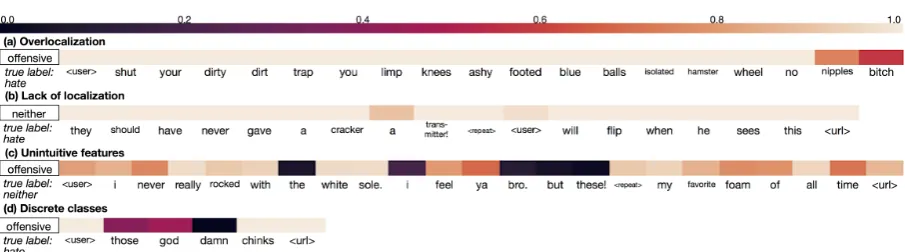
[image:2.595.307.525.150.229.2]Figure 2: Partial occlusion heatmaps of test examples demonstrating four types of errors made by the CNN-GRU network. Heatmaps are plotted for the predicted class (boxed) while the true class is given below. Darker regions denote portions of the input to which the classifier prediction is most sensitive.
4 Visualization Techniques
4.1 Partial Occlusion
Previously applied to image classification net-works, partial occlusion involves iteratively oc-cluding different patches of the input image and monitoring the output of the classifier. We apply a modified version of this technique to our CNN-GRU model by systematically replacing each to-ken of a given input sequence with an<unk> to-ken.2 We then plot a heatmap of the classifier probabilities of the true class (hate, offensive, or
neither) over the tokens in the sequence.
The resulting visualizations reveal a few major types of errors made by the CNN-GRU (Figure
2). We observeoverlocalizationin many long se-quences, particularly those misclassified as offen-sive. This occurs when the classifier decision is sensitive to only a single unigram or bigram rather than the entire context, as in Figure2(a). The net-work loses sequence information during convolu-tion and shows decreased sensitivity to the longer context as a result.
Lack of localizationis the opposite problem in which the model is not sensitive to any region of the input, shown in Figure2(b). It occurs mostly in longer and hate class examples. A possible ex-planation for this type of error is that convolving sequential data diffuses the signal of important to-kens andn-grams.
For correctly classified examples, the sensitive regions intuitively correspond to features like n -grams, part-of-speech templates, and word depen-dencies. However, incorrectly classified examples
2<unk>indicates an out-of-vocabulary word. The word embedding for <unk> is random, whereas in-vocabulary word embeddings encode meaning via unsupervised pre-training.
also demonstrate sensitivity to unintuitive fea-tures that are not helpful for classification. For instance, Figure2(c) shows a sensitive region that crosses a sentence boundary.
Finally, we see a high rate of errors due to the
discretization of thehate andoffensive classes. While hate speech is largely contained within of-fensive language, the sensitive regions for the two classes are disparate. In Figure2(d), the network’s prediction that the example is offensive is highly sensitive to the sequence “those god damn”, but not the racial slur“chinks,”which is both hateful and offensive.
Some of the errors we identify, such as lack of localization and unintuitive features, can be ad-dressed by modifying the model architecture. We can change the way long sequences are convolved, or restrict convolutions within phrase boundaries. More difficult to address are the errors in which our network is sensitive to the correct regions (or a reasonable subset thereof) but makes incorrect predictions. These issues stem from the nature of the data itself, such as the complex linguistic similarity between hate and offensive language. Moreover, many misclassified examples contain implicit characteristics such as sarcasm or irony, which limits the robustness of features learned solely from input text.
4.2 Maximum Activations
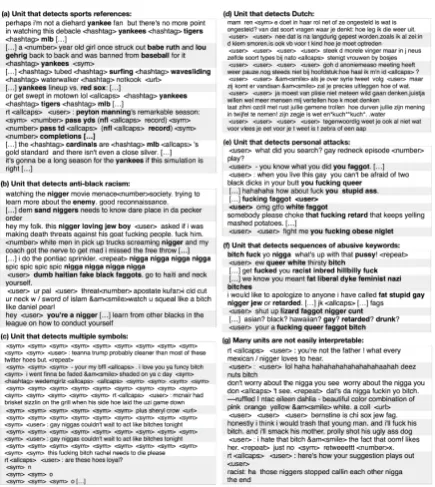
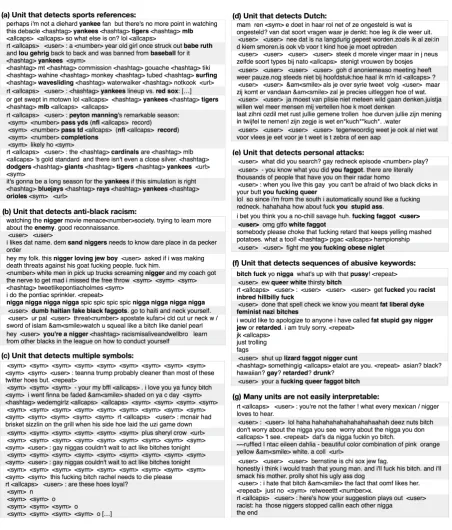
CNN-Figure 3: Examples of interpretable units from the global max pool layer of the CNN-GRU. The inputs with the top eight activations for each neuron are shown, with relevant tokens bolded. In the interest of space, some examples here are abridged and the full version can be found in Appendix Figure4.
GRU, we compute the unit’s activations on the en-tire dataset and retrieve the top-scoring inputs.
Figure3 displays the maximally activating ex-amples for seven of 100 units in the global max pool. We verify that the model does indeed learn relevant features for hate speech classification, some of which are traditional natural language features such as the part-of-speech bigram “you
<NOUN PHRASE>.” Others, like a unit that fires on sports references and a unit that detects Dutch-language tweets (the result of querying for hate keywordsyankeeandhoe,respectively), reflect as-sumptions in data collection. Some units capture features that reflect domain-specific phenomena, such as repeated symbols or sequences of multiple abusive keywords.
Many units are too general or not interpretable at all. For instance, several units detect the hate term bitch,but none of them clearly capture the distinction between when it is used in sex-ist and colloquial contexts. Conversely, exam-ples containing rarer and more ambiguous slurs
like cracker do not appear as top inputs for any
unit. Overall, the CNN-GRU discovers some in-terpretable lexical and syntactical features, but its final layer activations overrepresent common
uni-Category Terms
Hatebase words faggot, nigger, fag, coon, teabag-ger, cripple, spook, muzzie, mook, jiggaboo, mutt, redskin, dink
Hatebase plural faggots, niggers, fags, crackers, coons, rednecks, hos, queers, col-oreds, wetbacks, muzzies, wig-gers, darkies
Pejorative nom-inalization
blacks, jews, commie, lightskins, negroes
Hate-related or offensive
racist, fugly, hag, traitor, chucks, goon, asss, blacc, eff, homopho-bic, racists, nogs, muhammed, fatherless, slurs
Hateful context words
arrested, yelled, smoked, joints, stoned, frat, celibate, catfished, wedlock, sliced, kappa, trap-pin, birthed, allegiance, menace, commander, stamp, cyber Hashtags (see Table4)
Dialect varia-tions
des, boutta, denna, waddup, boof, ont, bestf, playen, sav, erbody, prolli, deze, bougie
Pop culture gram, tweakin, dej, uchiha, mewtwo, bios, fenkell, mikes, beavis, aeropostale
[image:4.595.313.517.58.368.2]Other en, waffle, moe, saltine, squid, pacer, sharpie, skyler, sockfetish, johns, lactose, ov, tater
Table 2: List of keywords discovered via synthetic test examples. Terms within each category appear in order of frequency in the corpus. Descriptions for hashtags are from blogs such aswww.socialseer.comand cross-referenced on Twitter.
grams and fail to detect semantics at a more fine-grained level via surrounding context.
4.3 Synthetic Test Examples
Lastly, we propose a general technique to identify the the most indicative unigram features for a deep model using synthetic test examples and apply it to the CNN-GRU.
For each word in our corpus, we construct a sen-tence of the form “they call you <word>” and feed it as input to the CNN-GRU network. We choose this structure to grammatically accommo-date both nouns and adjectives, and because it is semantically neutral compared to similar formula-tions such as“you are<word>.”We then retrieve the words whose test sentences are classified as hate speech. After filtering out words that do not appear in two or more distinct tweets (retweets are indistinct) and words containing non-alphabetical characters,3 this method returns 101 terms. We manually group the terms into nine categories and
[image:4.595.73.291.59.303.2]summarize them in Table2.
As a quantitative heuristic for the quality of the discovered terms, we evaluate our method’s recall on the hate speech lexicon Hatebase.4We measure the recall of Hatebase words, plural forms of Hate-base words, and tweets containing HateHate-base terms and compare against a random baseline (Table3). The recall of our method is approximately an order of magnitude better than random across all cate-gories. Recall of plural forms is better than that of base forms, which may reflect the training data’s definition of hate speech as language that targets a group. Notably, recall of Hatebase tweets5 is lower than recall of individual terms regardless of form, meaning that the Hatebase terms discovered using our template method are not the ones that occur most commonly in the corpus. This is rea-sonable as several of the most common Hatebase terms such asbitchandniggaare ones that tend to be used colloquially rather than as slurs.
Of the non-Hatebase terms that our method dis-covers, four are pejorative nominalizations. These are neutral adjectives that take on pejorative mean-ing when used as nouns, such as blacks and
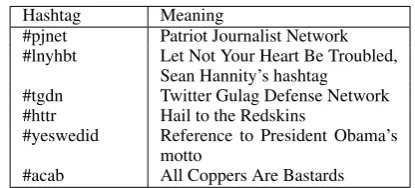
jews (Palmer et al., 2017). We also find six domain-specific hate terms in the form of hash-tags, which tend to be non-word acronyms and primarily used by densely connected, politically conservative Twitter users (see Table 4). The re-sults also include dialect-specific terms and slang spellings, such as des and boutta, which mean
theseandabout torespectively. While these terms
co-occur frequently with hate speech keywords in our corpus, they are semantically neutral, suggest-ing that our model exhibits bias towards certain written vernaculars. While these terms co-occur frequently with hate speech keywords in our cor-pus, they are semantically neutral, suggesting that our model exhibits bias towards certain written vernaculars.
5 Conclusion
We presented a variety of methods to understand the prediction behavior of a neural network text classifier and applied them to hate speech. First,
4Hatebase (https://www.hatebase.org) is an on-line, crowd-sourced hate speech lexicon. Davidson et al. (2017) use Hatebase queries to bootstrap the dataset we use in this paper.
5The number of tweets containing one of the 26 discov-ered terms divided by the number of tweets containing any Hatebase term.
Recall Recall % Recall %
(ours) (ours) (random)
Hb terms 13/182 7.14 1.05
Hb plurals 13/91 14.29 1.06
Both 26/273 9.52 1.04
Hb tweets 1453/ 6.00 1.21
[image:5.595.312.521.61.160.2]24234
Table 3: Comparison between our method and a ran-dom baseline on recall of Hatebase lexicon terms and tweets containing Hatebase terms. The random base-line is averaged over 10,000 trials.
Hashtag Meaning
#pjnet Patriot Journalist Network #lnyhbt Let Not Your Heart Be Troubled,
Sean Hannity’s hashtag #tgdn Twitter Gulag Defense Network #httr Hail to the Redskins
#yeswedid Reference to President Obama’s motto
#acab All Coppers Are Bastards
Table 4: Descriptions of discovered hashtag keywords, given by blogs such aswww.socialseer.comand cross-referenced on Twitter.
we used partial occlusion of the inputs to visual-ize the sensitivity of the network. This revealed that the architecture loses representational capac-ity on long inputs and suffers from lack of class separability. We then analyzed the semantic mean-ing of individual neurons, some of which capture intuitively good features for our domain, though many still appear to be random or uninterpretable. Finally, we presented a way to discover the most indicative hate keywords for our model. Not all discovered terms are inherently hateful, revealing peculiarities and biases of our problem space.
Overall, our experiments give us better insight into the implicit features learned by neural net-works. We lay the groundwork for future efforts towards better modeling and data collection, in-cluding active removal of linguistic discrimina-tion.
Acknowledgments
[image:5.595.310.518.231.325.2]References
Pinkesh Badjatiya, Shashank Gupta, Manish Gupta, and Vasudeva Varma. 2017. Deep learning for hate speech detection in tweets. InWWW 2017 Compan-ion, pages 759–760. International World Wide Web Conference Committee.
Thomas Davidson, Dana Warmsley, Michael Macy, and Ingmar Weber. 2017. Automated hate speech detection and the problem of offensive language. In Proceedings of the Eleventh International AAAI Conference on Web and Social Media, pages 512– 515.
Karthik Dinakar, Roi Reichart, and Henry Lieberman. 2011. Modeling the detection of textual cyberbul-lying. In Fifth International AAAI Conference on Weblogs and Social Media Workshop on the Social Mobile Web, pages 11–17.
Bj¨orn Gamb¨ack and Utpal Kumar Sikdar. 2017. Us-ing convolutional neural networks to classify hate-speech. In Proceedings of the First Workshop on Abusive Language Online, pages 85–90. Association for Computational Linguistics.
Ross B. Girshick, Jeff Donahue, Trevor Darrell, and Ji-tendra Malik. 2013. Rich feature hierarchies for ac-curate object detection and semantic segmentation. CoRR, abs/1311.2524.
Michiel Hermans and Benjamin Schrauwen. 2013. Training and analysing deep recurrent neural net-works. InAdvances in Neural Information Process-ing Systems, pages 190–198.
Andrej Karpathy, Justin Johnson, and Fei-Fei Li. 2015. Visualizing and understanding recurrent networks. CoRR, abs/1506.02078.
Irene Kwok and Yuzhou Wang. 2013. Locate the hate: Detecting tweets against blacks. InProceedings of the Twenty-Seventh AAAI Conference on Artificial Intelligence, pages 1621–1622. Association for the Advancement of Artificial Intelligence.
Laurens van der Maaten and Geoffrey Hinton. 2008. Visualizing data using t-SNE. Journal of Machine Learning Research, 9:2579–2605.
Chikashi Nobata, Joel Tetreault, Achint Thomas, Yashar Mehdad, and Yi Chang. 2016. Abusive lan-guage detection in online user content. In Proceed-ings of the 25th International Conference on World Wide Web, WWW ’16, pages 145–153.
Alexis Palmer, Melissa Robinson, and Kristy Phillips. 2017. Illegal is not a noun: Linguistic form for de-tection of pejorative nominalizations. In Proceed-ings of the First Workshop on Abusive Language On-line, pages 91–100. Association for Computational Linguistics.
John Pavlopoulos, Prodromos Malakasiotis, and Ion Androutsopoulos. 2017. Deep learning for user
comment moderation. InProceedings of the First Workshop on Abusive Language Online, pages 25– 35. Association for Computational Linguistics.
Anna Schmidt and Michael Wiegand. 2017. A survey on hate speech detection using natural language pro-cessing. In Proceedings of the Fifth International Workshop on Natural Language Processing for So-cial Media, pages 1–10.
William Warner and Julia Hirschberg. 2012. Detecting hate speech on the world wide web. In Proceed-ings of the 2012 Workshop on Language in Social Media, pages 19–26. Association for Computational Linguistics.
Zeerak Waseem and Dirk Hovy. 2016. Hateful sym-bols or hateful people? predictive features for hate speech detection on twitter. In Proceedings of the 2016 Conference of the North American Chapter of the Association for Computational Linguistics: Hu-man Language Technologies, pages 88–93. Associ-ation for ComputAssoci-ational Linguistics.
Michael Wiegand, Josef Ruppenhofer, Anna Schmidt, and Clayton Greenberg. 2018. Inducing a lexicon of abusive words–a feature-based approach. In Pro-ceedings of the 2018 Conference of the North Amer-ican Chapter of the Association for Computational Linguistics: Human Language Technologies, vol-ume 1, pages 1046–1056. Association for Compu-tational Linguistics.
Ellery Wulczyn, Nithum Thain, and Lucas Dixon. 2017. Ex machina: Personal attacks seen at scale. InProceedings of the 26th International Conference on World Wide Web, pages 1391–1399. International World Wide Web Conferences Steering Committee.
Matthew D. Zeiler and Rob Fergus. 2013. Visualizing and understanding convolutional networks. CoRR, abs/1311.2901.
Ziqi Zhang, David Robinson, and Jonathan Tepper. 2018. Detecting hate speech on twitter using a convolution-gru based deep neural network. In Eu-ropean Semantic Web Conference 2018, pages 745– 760.
A Appendix
T
rue
labels
Hate 0.31 0.58 0.11
Offensive 0.04 0.94 0.03
Neither 0.02 0.13 0.85
Hate Offensive Neither
[image:6.595.308.523.615.720.2]Predicted labels