4652
Siamese Network-Based Supervised Topic Modeling
Minghui Huang1,∗, Yanghui Rao1,†, Yuwei Liu1, Haoran Xie2, Fu Lee Wang3 1School of Data and Computer Science, Sun Yat-sen University, Guangzhou, China
2Department of Mathematics and Information Technology,
The Education University of Hong Kong, Tai Po, Hong Kong
3School of Science and Technology,
The Open University of Hong Kong, Ho Man Tin, Kowloon, Hong Kong
[email protected], [email protected], [email protected], [email protected],
Abstract
Label-specific topics can be widely used for supporting personality psychology, aspect-level sentiment analysis, and cross-domain sentiment classification. To generate label-specific topics, several supervised topic mod-els which adopt likelihood-driven objective functions have been proposed. However, it is hard for them to get a precise estimation on both topic discovery and supervised learning. In this study, we propose a supervised topic model based on the Siamese network, which can trade off label-specific word distributions with document-specific label distributions in a uniform framework. Experiments on real-world datasets validate that our model per-forms competitive in topic discovery quantita-tively and qualitaquantita-tively. Furthermore, the pro-posed model can effectively predict categor-ical or real-valued labels for new documents by generating word embeddings from a label-specific topical space.
1 Introduction
As one of the most widely used text mining tech-niques, topic modeling can extract meaningful de-scriptions (i.e., topics) from a corpus (Blei,2012). Most previous topic models, such as probabilis-tic Latent Semanprobabilis-tic Analysis (pLSA) (Hofmann,
1999) and Latent Dirichlet Allocation (LDA) (Blei et al., 2001) are unsupervised. In unsupervised topic models, each document is defined as a mix-ture distribution over topics and each topic is represented as a mixture distribution over words. Unsupervised topic models only exploit words in documents and do not incorporate the guid-ance of labels into learning processes. There-fore, these models fail to discover label-specific topics, which are important to support personality
∗
This work was finished when the first author was an undergraduate student of her final year.
†
The corresponding author.
psychology (Weiner and Graham, 1990), aspect-level sentiment analysis (Liu, 2012), and cross-domain sentiment classification (He et al.,2011). For example, label-specific topics generated from sentimental texts can help to find attributions and causes for different sentiments by associating sen-timents with real-world topics/events.
In light of this consideration, several super-vised topic models are proposed to generate label-specific topics. One of the most representative models is the supervised Latent Dirichlet Alloca-tion (sLDA) (Blei and McAuliffe,2007), which re-stricts a document being associated with one real-valued response variable. To deal with categori-cal labels, multi-class sLDA (sLDAc) (Wang et al.,
2009) and Labeled Latent Dirichlet Allocation (L-LDA) (Ramage et al.,2009) are proposed, but they are only applicable to classification. Recently, a supervised Neural Topic Model (sNTM) (Cao et al.,2015) is developed to tackle supervised tasks of both classification and regression. As a hybrid method, sNTM is in essence a neural network by following the document-topic distribution in topic models. Unfortunately, the label information has a little effect on topic generation since sNTM mod-els documents and labmod-els separately.
The above limitation motivates us to develop a supervised topic model which can jointly model documents and labels. Particularly, we propose a Siamese Labeled Topic Model (SLTM) to exploit the information of documents and labels based on the Siamese network (Bromley et al., 1993;
gener-ate more coherent label-specific topics than oth-ers. This is because the supervision of labels is incorporated into topic modeling for SLTM. On the other hand, the mapping of topics to labels is unconstrained for most existing supervised topic models, which renders many coherent topics be-ing generated outside labels. Second, strengths of neural networks are incorporated into SLTM to bootstrap its inference power on label prediction. Third, each word can be mapped to a topical em-bedding space and represented by a word embed-ding after generating label-specific topics.
To validate the effectiveness of the proposed model, we evaluate it on two real-world datasets in text mining. Experimental results indicate that our method is able to discover more coherent and label-specific topics than baseline models. More-over, word embeddings learned by the proposed model can be used to predict labels for new docu-ments effectively.
The remainder of this paper is organized as fol-lows. We summarize related studies on supervised topic modeling in Section2. For convenience of describing our model, we present the neural net-work view of topic models in Section3. Then, we detail the proposed SLTM in Section 4. Experi-mental design and analysis of results are shown in Section5. Finally, we present conclusions and fu-ture work in Section6.
2 Related Work
Topic models, which focus on discovering unob-served class variables named “topics” statistically, have been widely used in text mining. One of the early topic models is pLSA (Hofmann,1999). In pLSA, a document’s word vector was decom-posed into a mixture of topics, and a topic was rep-resented as a probability distribution over words. LDA (Blei et al.,2001) extended pLSA by adding Dirichlet priors for a document’s multinomial tribution over topics and a topic’s multinomial dis-tribution over words, which makes it suitable to generate topics for unseen documents.
The aforementioned models are unsupervised, which may be computationally costly to do some task-specific transformation when there is extra labeling information (Cao et al., 2015). To ad-dress this issue, several supervised topic models have been proposed to introduce the label guid-ance in learning processes. One of the most widely used supervised topic models is sLDA (Blei and
McAuliffe,2007). In sLDA, each document was paired with a response variable which obeys the Gaussian distribution. By extending the sLDA, BP-sLDA (Chen et al.,2015) applied back propa-gation over a deep architecture in conjunction with stochastic gradient/mirror descent for model pa-rameter estimation, leading to scalable and end-to-end discriminative learning characteristics. Based on sLDA, multi-class sLDA (sLDAc) (Wang et al.,
2009) was proposed to model documents with
categorical labels by adding a softmax classifier rather than a linear regression in sLDA to a stan-dard LDA. Another method of tackling corpora with discrete labels is L-LDA (Ramage et al.,
2009), which associated each label with only one
topic. To improve the performance of L-LDA
in the classification task, Dependency-LDA (Dep-LDA) (Rubin et al., 2012) incorporated an extra topic model to capture the dependencies between labels and took the label dependencies into con-sideration when estimating topic distributions. Re-cently, a nonparametric supervised topic model (Li et al.,2018) was proposed to predict the response of interest (e.g., product ratings and sales). The limitation of above models is that they are only applicable to either discrete or continuous data.
In this paper, we propose a Siamese network-based supervised topic model named SLTM. The most relevant work to SLTM is the supervised Neural Topic Model (sNTM) for both classifica-tion and regression tasks (Cao et al.,2015), which constructed two hidden layers to generate the n -gram topic and document-topic representations. However, different from our SLTM using bag-of-words methods, sNTM adopted fixed embed-dings trained on external resources (Mikolov et al.,
2013). Thus, sNTM can not learn data-specific topics. Furthermore, sNTM is hard to follow prob-abilistic characteristics of the topic-word distribu-tion in topic models, because a topic generated by sNTM is composed of an infinite number of n -grams. Finally, sNTM modeled documents and la-bels separately rather than uniformly in our SLTM.
3 Preliminaries
For convenience of describing the proposed model, we use hollow uppercase letters (e.g.,D) to
represent collections, bold uppercase letters (e.g.,
W1) to represent matrices, bold lowercase
let-ters (e.g., yi) to represent vectors, regular
Table 1: Frequently used notations.
Notation Description
M Number of documents
K Number of topics
N Size of the vocabulary
L Size of the label set
D Document collection
di ∈D Thei-th document
V Vocabulary
vj ∈V Thej-th word
Z Topic collection
zk∈Z Thek-th topic
Y Label collection
yi ∈RL Labels for documentdi
p(vj|di) The probability ofvjgivendi
and regular lowercase letters (e.g.,vj) to represent
scalar variables. Based on the above convention, frequently used notations are shown in Table 1. Given a document di with labels yi, our goal is
to discover topics with a neural network frame-work. Therefore, we first describe the neural net-work view of topic models briefly.
Topic modeling is a popular latent variable in-ference method for co-occurrence data which as-sociates unobserved classes with observations di
andvj, wherevj is a word indi. The conditional
probabilityp(vj|di)is defined as:
p(vj|di) = K
X
k=1
p(vj|zk)p(zk|di). (1)
Let φ(vj) = [p(vj|z1), . . . , p(vj|zK)] and
θ(di) = [p(z1|di), . . . , p(zK|di)], then p(vj|di)
in Equation1can be represented as the following vector form:
p(vj|di) =φ(vj)·θ(di). (2)
We represent horizontal stack by commas
and vertical stack by semicolons, thus W1 =
[θ(d1)T, . . . , θ(dM)T] ∈ RK×M and W2 =
[φ(v1);. . .;φ(vN] ∈ RN×K, which are
con-strained by: W1[k, m] ≥ 0, W2[n, k] ≥ 0,
PK
k=1W1[k, m] = 1, and PNj=1W2[j, k] = 1,
wherek ∈ [1, K], m ∈ [1, M], and n ∈ [1, N]. Then, the vector form in Equation 2 can be
ex-𝐲𝑖
𝑝(Z|𝑑𝑖)
𝑑𝑖
𝐖1 𝐖2
𝑝(V|𝑑𝑖)
𝐖3
-𝑝(Z|𝑑𝑖(𝑣𝑗−)
)
𝑑𝑖(𝑣𝑗−)𝐖1 𝐖2𝑝(V|𝑑
𝑖 (𝑣𝑗−)
)
𝐲𝑖 (𝑣𝑗−)
𝐖3
𝑝(𝑣𝑗|𝑑𝑖)
𝑝(𝑣𝑗|𝑑𝒊)
𝑝(𝑣𝑗|𝑑𝑖 (𝑣𝑗−)
) 𝐯𝑗
[image:3.595.309.523.208.338.2]𝐯𝑗
Figure 1: SLTM’s word generation framework.
Document set
Predicted label
Predicted conditional probability Input layer
. . .
Topic distribution
[image:3.595.313.525.432.557.2]Hidden layer Output layer
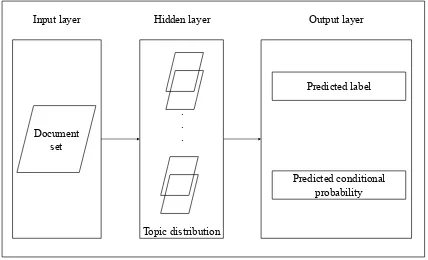
Figure 2: SLTM’s architecture from the perspective of neural networks.
tended to:
p(V|D) =
p(v1|d1) · · · p(v1|dM)
..
. . .. ...
p(vN|d1) · · · p(vN|dM)
=
(φ(v1)·θ(d1)) · · · (φ(v1)·θ(dM))
..
. . .. ...
(φ(vN)·θ(d1)) · · · (φ(vN)·θ(dM))
=W2W1. (3)
With Equation 3, topic models can be viewed as neural networks, whereDandVare input sets, p(V|D)is the output set, andW1 andW2are
pa-rameter matrices of the neural network.
4 Siamese Labeled Topic Model
Similar to generative models such as pLSA, we propose a Siamese Labeled Topic Model (SLTM) based on the aforementioned neural network per-spective of topic models. Figure 1illustrates the framework of generating each word in SLTM, and the process is as follows. For a documentdiinD,
the topic distributionp(Z|di)is estimated by:
wherediis the indicator vector (Yang et al.,2013)
ofdi, which means that thei-th entry ofdiis 1 and
other entries are 0. Labels ofdiareyi, which are
generated from the topic distribution ofdias:yi = W3p(Z|di). The above equation is constrained by W3[l, k] ≥ 0, wherel ∈ [1, L],k ∈ [1, K], and
PL
l=1W3[l, k] = 1ifL >1. A topiczkinZhas
its word distribution p(V|zk), which is computed
by:
p(V|zk) =W2zk, (5)
wherezkis the indicator vector ofzk. Therefore,
words can be generated fromdi as:
p(V|di) =W2W1di. (6)
The architecture of SLTM from the perspec-tive of neural networks is shown in Figure 2. With respect to the model optimization, we adopt the contrastive objective function used in previ-ous works (Socher et al., 2014;Cui et al., 2014;
Cao et al.,2015;He et al., 2017). For document di and every word vj in di, we randomly
sam-ple a document from the document set D which
does not contain vj, as a negative sample
doc-ument. The negative sample document is repre-sented asd(vj−)
i and has labelsy
(vj−)
i . As shown
in Figure 1, the lower sub-network, which takes d(vj−)
i as input, has the same architecture as the
the upper sub-network, which takes di as input.
Because the document-topic distribution and the topic-word distribution of a corpus are fixed,W1,
W2 andW3are shared among two sub-networks
of our model. These two sub-networks are twin networks and thus the proposed model is essen-tially the Siamese network. Our objective is to make word vj be learned by topics in document
di, while not be learned by topics in the
nega-tive sampled documentd(ivj−). Therefore, we only take word vj in V into consideration during the
learning procedure, which can be implemented as dot-multiplyingp(V|di) with the indicator vector
ofvj (i.e., vj) as: pˆ(vj|di) = p(V|di)·vj.
Par-ticularly, the objective is to make the predicted conditional probabilitypˆ(vj|di) approach the
ob-served conditional probability p(vj|di)(i.e., term
frequency of wordvjin documentdi), while make
the conditional probabilitypˆ(vj|d (vj−)
i )approach
zero. Thus, the loss function of predicted condi-tional probabilities and the observed condicondi-tional
Algorithm 1Training Algorithm for SLTM
Input: S={D,Y};
1: repeat
2: for all(di,yi)∈Sdo
3: foreach wordvj in documentdido
4: Sample a document d(vj−)
i which
does not containvj;
5: Calculateloss(SLT M);
6: if loss(SLT M)is reducingthen
7: UpdateW1,W2 andW3;
8: end if
9: end for
10: end for
11: untilconvergence
probability can be defined as:
loss(di, d (vj−) i )
=|p(vj|di)−pˆ(vj|di) + ˆp(vj|d (vj−) i )|. (7)
We use another loss function loss(yi,y (vj−) i )
to capture labels of di and d(vj −)
i , where
loss(yi,y (vj−)
i ) =loss(yi)+loss(y (vj−)
i ). In the
above, equations ofloss(yi)andloss(y (vj−) i )
de-pend on the property of labels. For categorical and real-valued labels, the cross-entropy (Tang et al.,
2014) and the mean absolute error (Willmott and Matsuura,2005) are adopted, respectively.
The maximization of the weighted sum of con-ditional likelihoods is equivalent to minimize the losses of the weighted sum of loss functions, and these two loss functions are weighted by a hyper-parameter α as in (Tang et al., 2014). Thus, the loss function of SLTM is:
loss(SLT M) =α×loss(di, d (vj−) i )
+ (1−α)×loss(yi,y (vj−) i ). (8)
The effect ofαon predicting labels and discov-ering topics will be investigated in Section 5.6. Based on loss(SLT M), three kinds of weights, i.e.,W1,W2, andW3can be updated together by a vanilla back propagation (BP) algorithm with the early stopping criteria (Bengio,2012). The train-ing algorithm is shown in Algorithm1.
the word embedding of vj is generated from the
topic-word distributionW2 as:
e(vj) =W2[j,:]. (9)
The generated word embeddings can be used for specific applications, such as label prediction. Par-ticularly, we firstly represent a new documentdn
by its document embeddingse(dn), wheree(dn)
is the sum of word embeddings of all words indn.
Then, the predicted labelsyˆnof documentdncan
be estimated by:
ˆ
yn=f(W4e(dn)), (10)
where W4 denotes weights of each topic
con-tributing to labels, andf(.)is the activation func-tion which depends on the type of labels. For cat-egorical and normalized real-valued labels, we re-spectively adopt softmax and sigmoid as activa-tion funcactiva-tions. Note that we do not predict labels for new documents based onW3directly, because
topic distributions of these documents can only be learned without the supervision of labels, i.e., new documents’ topic distributions may be incon-sistent toW3. Finally, we updateW4 and word
embeddings by RMSprop (Tieleman and Hinton,
2012) for label prediction.
5 Experiments
In this section, we firstly describe datasets and the setting of experiments. Secondly, we investigate the quality of generated topics by the topic coher-ence score and qualitative analysis. Thirdly, the quality of generated word embeddings is evaluated by label prediction and word similarity. Finally, the effect of the hyper-parameterαis evaluated on coherence of topics and label prediction.
5.1 Datasets and Setting
To evaluate the effectiveness of our method com-prehensively, we conduct experiments on two real-world datasets with categorical and real-valued la-bels, respectively. The first corpus named ISEAR contains a collection of 7,666 sentences and each item is manually tagged with a categorical label over 7 emotions (Scherer and Wallbott,1994). The second dataset YouTube1 is often used for sen-timent strength detection, which contains 3,407 comments on videos and each item is labeled
1http://sentistrength.wlv.ac.uk/
with a real value between 0.1 (i.e., very nega-tive sentiment) and 0.9 (i.e., very posinega-tive senti-ment). These two datasets are selected for their similar word numbers in average. After remov-ing stop words, the mean numbers of words in each document are 8.53 and 8.56 for ISEAR and YouTube. Besides, it is appropriate to evaluate the model performance on predicting emotions and sentiment strengths, because topics play an impor-tant role in understanding sentences or user com-ments (Liu, 2012). Since the proposed SLTM is suitable to both topic discovery and classifi-cation/regression tasks, we employ five kinds of baselines for comparison.
The first kind are the support vector machine (SVM), an efficient deep learning model for clas-sification (i.e., fastText) (Grave et al., 2017), and the following supervised topic models which are confined to categorical labels:
• sLDAc (Wang et al., 2009): it models doc-uments with categorical labels by adding a softmax classifier to a standard LDA.
• L-LDA (Ramage et al.,2009): it is a super-vised model which associates labels with top-ics by one-to-one correspondence. Accord-ingly, the number of topics in L-LDA must equal the size of the label set.
• Dep-LDA (Rubin et al.,2012): it extends L-LDA by introducing a multinomial distribu-tion over labels and capturing the dependen-cies between labels. Then, the label depen-dencies are used to sample topic distributions in supervised learning.
The second kind are the support vector re-gression (SVR), a state-of-the-art deep learn-ing model for sentiment strength detection (i.e., HCNN) (Chen et al., 2017), and the following supervised topic models which are developed for predicting real-valued labels only:
• sLDA (Blei and McAuliffe, 2007): it is a classical supervised topic model, in which, each document is paired with a response vari-able, and the variable is defined as a Gaussian distribution with a mean value that is com-puted by a linear regression of topics.
Table 2: Topic coherence scores on ISEAR using dif-ferent numbers of top wordsT.
5 10 15
pLSA 0.0051 0.0024 -0.0013
LDA 0.0954 0.0492 0.0014
sLDAc 0.0014 0.0031 -0.0035
sNTM -0.9267 -0.9508 -0.9667
[image:6.595.91.274.95.188.2]SLTM 0.1142 0.0680 0.0025
Table 3: Topic coherence scores on YouTube using dif-ferent numbers of top wordsT.
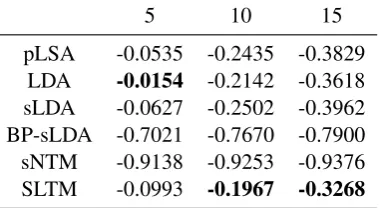
5 10 15
pLSA -0.0535 -0.2435 -0.3829
LDA -0.0154 -0.2142 -0.3618
sLDA -0.0627 -0.2502 -0.3962
BP-sLDA -0.7021 -0.7670 -0.7900
sNTM -0.9138 -0.9253 -0.9376
SLTM -0.0993 -0.1967 -0.3268
parameter estimation of sLDA. The number of hidden layers is set to 3.
The third kind is a supervised n-gram model named sNTM, which is applicable to predict both categorical and real-valued labels for new docu-ments (Cao et al.,2015). In sNTM, eachn-gram is represented by a 300-dimensional embedding vec-tor using the available tool word2vec2. By follow-ing (Cao et al.,2015), a large-scale Google News dataset with around 100 billion words is adopted for training. For topic discovery, two unsuper-vised topic models, pLSA (Hofmann, 1999) and LDA (Blei et al.,2001), are used as the fourth kind of baselines. Finally, we adopt two hybrid meth-ods by combining LDA and supervised learning algorithms as baselines. In particular, a softmax classifier and a liner regression (LR) are used to predict categorical and real-valued labels for doc-uments, respectively. Unless otherwise specified, we setα to 0.5 and adopt the stochastic gradient descent with batch size of 100 for training SLTM.
5.2 Coherence Score of Topics
To investigate the quality of topics discovered by SLTM quantitatively, we use the topic coherence score based on the normalised pointwise mutual information (Lau et al., 2014) as the evaluation metric. Intuitively, a topic coherence score that
2https://code.google.com/p/word2vec/
Table 4: Each label’s top 5 words on ISEAR.
Labels Models Top 5 words of label-specific topics
fear
sLDAc home night carafraid fear
L-LDA/Dep-LDA nightafraidcar homefearfelt SLTM nightafraid fearcar home dark
joy
sLDAc year passed heard exam university L-LDA/Dep-LDA friend got time passed felt
SLTM happy joypassed got university
guilt
sLDAc did didn’t askedguiltysaid L-LDA/Dep-LDA feltguiltyfriend did mother SLTM guiltyfelt mother did friend
disgust
sLDAc saw mandisgusted disgustwoman L-LDA/Dep-LDA disgustedsaw felt people friend
SLTM disgustedsaw people mandisgust
shame
sLDAc knowashamedteacher happened lot L-LDA/Dep-LDA ashamedfelt friend time did
SLTM ashamedfeltshameclass teacher
anger
sLDAc angrycalled newangerexpected L-LDA/Dep-LDA friendangrydid time told
SLTM angryfriendangerbrother told
sadness
sLDAc father close died away years L-LDA/Dep-LDA died friendsadfelt time
SLTM diedsaddeath away friend
is larger indicates that the quality of topics is bet-ter. All unsupervised topic models (i.e., pLSA and LDA) and supervised methods which associate one label with multiple topics (i.e., sLDAc, sLDA, BP-sLDA, and sNTM) are adopted for compari-son. Although L-LDA and Dep-LDA can iden-tify label-specific topics on ISEAR, these models’ one-to-one mapping of labels and topics makes them unsuitable in this evaluation. Particularly, L-LDA and Dep-L-LDA constraint each topic to words in certain documents with the same label, which renders their coherence scores being estimated by a subset of the corpus only. On the other hand, the quality of topics is evaluated on the whole corpus for SLTM and other baseline models.
The average coherence scores of topics gener-ated by different models on ISEAR and YouTube are respectively shown in Table 2 and Table 3, where the number of topics is 20, the number of top words T is set to 5, 10, and 15, and the best scores are highlighted in boldface. The results in-dicate that SLTM can discover more coherent top-ics than both unsupervised topic models and su-pervised methods, except forT = 5on YouTube. It is also interesting to observe that supervised baseline models (i.e., sLDAc, sLDA, BP-sLDA, and sNTM) perform worse than pLSA and LDA for most cases, which validates that it is challeng-ing to trade off label-specific word distributions with document-specific label distributions ( Ram-age et al.,2009).
5.3 Qualitative Analysis on Topics
[image:6.595.88.278.234.338.2]
MR\ IHDU
DQJHU VKDPH
VDGQHVV GLVJXVW
[image:7.595.87.281.66.225.2]JXLOW
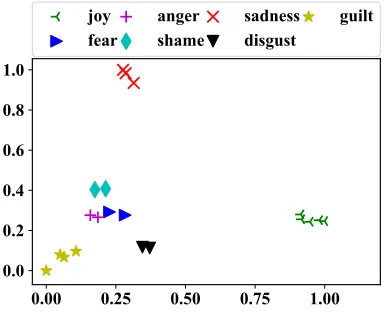
Figure 3: Scatter plot of topics identified by SLTM on ISEAR, where each point indicates a topic.
which contains multiple labels is used for illus-tration, since it is inappropriate to present the re-sults on YouTube with a single real-valued label. For each model that is applicable to ISEAR, we show top 5 words of the generated label-specific topics in Table4. It is worth to note that L-LDA and Dep-LDA achieve the same top words, since their difference only exists in the process of label prediction. The results indicate that although all models can learn meaningful topics, SLTM per-forms better than baseline models in label-specific topic discovery. For example, two words “happy” and “joy” which are strongly related to the label of “joy” are identified by SLTM with large probabil-ities. Similar results can be observed in other la-bels, thus topics discovered by our model are more convenient to be understood than others. Such a kind of performance enhancement is valuable to many real-world applications, e.g., personality ed-ucation and psychotherapy, by producing human interpretable topics/events that evoke users’ par-ticular emotions.
For completeness, we also examine all topics generated by the baseline of sNTM. As mentioned earlier, sNTM is based on n-grams, instead of single words for SLTM and other baseline mod-els. In the practical implementation, only uni-grams and biuni-grams are considered since the em-bedding representation becomes less precise asn increases (Cao et al.,2015). The results indicate that sNTM can generate some topic bigrams such as “smelled disgusting” and “graduation exams”, which are more appropriate to expressing a topic. However, only three topics are manually examined
Table 5: Classification performance on ISEAR.
Accuracy Cohen’s kappa
SVM 0.5063 0.4240
fastText 0.5104 0.4298
LDA+softmax 0.1506 0.0089
sLDAc 0.1875 0.0540
L-LDA 0.4650 0.3758
Dep-LDA 0.4888 0.4036
sNTM 0.2478 0.1212
SLTM 0.5213 0.4415
to be correlated with the seven emotions. This val-idates that sNTM is hard to introduce the guidance of labels in topic generation, because it models documents and labels separately.
To further evaluate the interpretability of topics extracted from SLTM, we firstly get topic embed-dings by: emb(zk) = W1[k,:]. Then, we map
emb(zk) to a two-dimensional space via
Princi-pal Component Analysis (PCA). Figure3presents distributions of topics generated by SLTM over the ISEAR dataset. The scatter plot indicates that top-ics corresponding to the same label are closer than those of different labels. Furthermore, the distance between topics on correlated labels such as “fear” and “anger”, is closer than that of topics on “joy” and other labels.
5.4 Evaluation on Label Prediction
We here evaluate the quality of word embeddings generated by SLTM on predicting categorical and real-valued labels based on ISEAR and YouTube, respectively. Since there are varied parameters for different models, we randomly select 60% of in-stances as the training set, 20% as the validation set, and the remaining 20% as the testing set. The values of parameters (e.g., the number of topics) for each model are all determined by the valida-tion set. In label predicvalida-tion, the main difference between SLTM and other supervised topic mod-els is as follows. On one hand, a label-specific word embedding is introduced for predicting la-bels in SLTM according to Equation10. On the other hand, other supervised topic models for both categorical and real-valued label prediction tasks infer labels for unlabeled documents by topic dis-tributions directly, in which, topic disdis-tributions of unlabeled documents are learned without the su-pervision of labels.
[image:7.595.314.520.84.218.2]Table 6: Regression performance on YouTube.
MAE pR2
SVR 0.1424 -0.0591
HCNN 0.1112 0.3462
LDA+LR 0.1408 -0.0069
sLDA 0.1583 -0.2836
BP-sLDA 0.1394 -0.0208
sNTM 0.1342 0.0807
SLTM 0.1005 0.4112
accuracy and the Cohen’s kappa score (Artstein and Poesio,2008) are used as the evaluation met-rics. Table5shows the classification performance of different models on ISEAR, where the best re-sults are highlighted in boldface. For the predic-tion of real-valued labels on YouTube, we com-pare different models’ regression performance by the mean absolute error (MAE) and the predictive R2(pR2) (Blei and McAuliffe,2007), as shown in Table 6. From the above results we can observe that SLTM achieves substantial performance im-provement over baselines in predicting both cate-gorical and real-valued labels, which indicates that word embeddings generated from labeled docu-ments are more suitable for label prediction tasks than topic distributions generated from unlabeled documents without the guidance of labels.
5.5 Similarity of Word Embeddings
Word embeddings can reflect relations between words, and most methods of generating word em-beddings are based on the local context informa-tion. This is because words with similar contexts may have similar semantics. However, a large-scale corpus is required to learn high quality word embeddings from the local context. Different from the previous word embedding generation meth-ods, SLTM generates word embeddings based on the global label-specific topic information (i.e.,
the topical embedding space). Therefore, we
further compare the quality of word embeddings learned by SLTM and three widely used meth-ods: Word2Vec (W2V) (Mikolov et al., 2013), subword information Word2Vec (siW2V) (Joulin et al., 2017), and SSPMI (Levy and Goldberg,
2014). Among these baseline word embedding
models, W2V and siW2V use the neural network framework, and SSPMI implicitly factorizes the pointwise mutual information (PMI) matrix of the local word co-occurrence patterns.
Table 7: Word similarity results on ISEAR.
MEN SimLex Rare
W2V 0.002 -0.008 -0.119
siW2V 0.002 0.017 0.062
SSPMI 0.023 0.028 -0.004
[image:8.595.331.503.84.162.2]SLTM 0.169 0.037 0.089
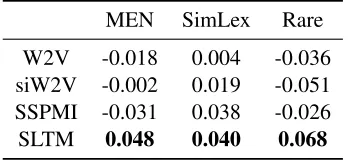
Table 8: Word similarity results on YouTube.
MEN SimLex Rare
W2V -0.018 0.004 -0.036
siW2V -0.002 0.019 -0.051
SSPMI -0.031 0.038 -0.026
SLTM 0.048 0.040 0.068
As our evaluation metric, the word similar-ity is estimated as follows. Firstly, we calcu-late cosine similarity scores for word pairs which occur in both the training set and the testing
set. Secondly, word pairs are ranked
accord-ing to their cosine similarities in the embeddaccord-ing space and human-assigned similarity scores, re-spectively. Finally, rankings of word similarity scores are evaluated by measuring the Spearman’s rank correlation with rankings of human-assigned similarity scores. A higher correlation value in-dicates that it is more consistent to human judge-ments in word similarity. The following standard corpora which contain word pairs associated with human-assigned similarity scores are used for this evaluation: MEN (Bruni et al., 2014), SimLex-999 (SimLex) (Hill et al.,2015), and Rare (Luong et al.,2013).
[image:8.595.330.505.215.295.2]
[image:9.595.71.286.64.209.2]
7 7 7
Figure 4: Topic coherence scores on ISEAR using dif-ferentαvalues.
5.6 Effect of the Hyper-parameter
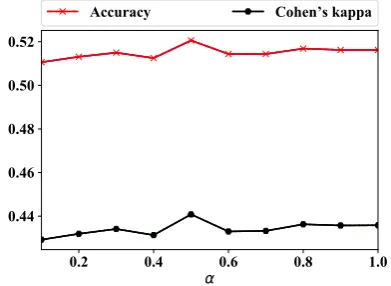
After validating the effectiveness of SLTM on discovering topics and learning word embed-dings, we now investigate the effect of the hyper-parameter in SLTM on these two aspects. Accord-ing to Equation 8, the hyper-parameterα is used to weight two kinds of loss functions. SinceW2
can be updated subject toα > 0, we evaluate the performance of SLTM by varyingαfrom 0.1 to 1 over the ISEAR dataset, as follows.
First, we evaluate the influence of hyper-parameter αon topic discovery by the coherence score of topics. To clearly illustrate the perfor-mance trend with different values of α, we set the number of top wordsT to 5, 10, and 15, and present topic coherence scores in Figure 4. The results indicate that SLTM performs stably un-der theseα values on topic discovery, except for α= 1which ignores the label information totally. This validates the importance of label information in generating coherent topics.
Second, we use the learned word embeddings to predict document labels under different
val-ues of α. As shown in Figure 5, we can
ob-serve that when α = 0.5, i.e., loss(di, d (vj−) i )
andloss(yi,y (vj−)
i )are weighted equally, SLTM
achieves the best performance in label prediction. The results indicate that the co-occurrence of doc-uments and words as well as the label information are both important to generate good word embed-dings. Furthermore, the label prediction perfor-mance of SLTM using any of these α values is better than that of most baselines (ref. Table 5). This validates the robustness of SLTM with differ-ent hyper-parameter values in supervised learning.
[image:9.595.314.510.65.208.2]
$FFXUDF\ &RKHQ VNDSSD
Figure 5: Label prediction performance on ISEAR us-ing differentαvalues.
We also conduct experiments on YouTube using varied α values, which indicates that the hyper-parameter has a similar effect on both datasets.
6 Conclusion
In this paper, we proposed a supervised topic model named SLTM to discover label-specific topics by jointly modeling documents and la-bels. For the SLTM, weight matrices which repre-sent document-topic and topic-word distributions can strictly follow probabilistic characteristics of
topic models. Experiments were conducted on
datasets with both categorical and real-valued la-bels, which validated that SLTM can not only dis-cover more coherent topics, but also boost the per-formance of supervised learning tasks by learning high quality word embeddings. For future work, we plan to speed-up the training process of SLTM by GPUs and distributed algorithms. With the de-velopment of deep learning techniques, we also plan to de-emphasize irrelevant words with an at-tention mechanism.
Acknowledgments
We are grateful to the anonymous reviewers for their valuable comments on this manuscript. The research has been supported by the National Nat-ural Science Foundation of China (61502545, U1711262, U1611264), a grant from the Research Grants Council of the Hong Kong Special Admin-istrative Region, China (UGC/FDS11/E03/16), and the Innovation and Technology Fund (Project
No. GHP/022/17GD) from the Innovation and
References
Ron Artstein and Massimo Poesio. 2008. Inter-coder agreement for computational linguistics. Computa-tional Linguistics, 34(4):555–596.
Yoshua Bengio. 2012. Practical recommendations for gradient-based training of deep architectures. In Neural Networks: Tricks of the Trade - Second Edi-tion, pages 437–478. Springer-Verlag.
David M. Blei. 2012. Probabilistic topic models. Com-munications of the ACM, 55(4):77–84.
David M. Blei and Jon D. McAuliffe. 2007. Super-vised topic models. In Proceedings of the Annual Conference on Neural Information Processing Sys-tems, pages 121–128.
David M. Blei, Andrew Y. Ng, and Michael I. Jordan. 2001. Latent dirichlet allocation. InProceedings of the Annual Conference on Neural Information Pro-cessing Systems, pages 601–608.
Jane Bromley, Isabelle Guyon, Yann LeCun, Eduard S¨ackinger, and Roopak Shah. 1993. Signature veri-fication using a siamese time delay neural network. InProceedings of the Annual Conference on Neural Information Processing Systems, pages 737–744.
Elia Bruni, Nam-Khanh Tran, and Marco Baroni. 2014. Multimodal distributional semantics. Artificial In-telligence Research, 49:1–47.
Ziqiang Cao, Sujian Li, Yang Liu, Wenjie Li, and Heng Ji. 2015. A novel neural topic model and its super-vised extension. In Proceedings of the 29th AAAI Conference on Artificial Intelligence, pages 2210– 2216.
Huijun Chen, Xin Li, Yanghui Rao, Haoran Xie, Fu Lee Wang, and Tak-Lam Wong. 2017. Senti-ment strength prediction using auxiliary features. In Proceedings of the 26th International Conference on World Wide Web Companion, pages 5–14.
Jianshu Chen, Ji He, Yelong Shen, Lin Xiao, Xiaodong He, Jianfeng Gao, Xinying Song, and Li Deng. 2015. End-to-end learning of LDA by mirror-descent back propagation over a deep architecture. InProceedings of the Annual Conference on Neural Information Processing Systems, pages 1765–1773.
Lei Cui, Dongdong Zhang, Shujie Liu, Qiming Chen, Mu Li, Ming Zhou, and Muyun Yang. 2014. Learn-ing topic representation for SMT with neural net-works. In Proceedings of the 52nd Annual Meet-ing of the Association for Computational LMeet-inguis- Linguis-tics, pages 133–143.
Edouard Grave, Tomas Mikolov, Armand Joulin, and Piotr Bojanowski. 2017. Bag of tricks for efficient text classification. InProceedings of the 15th Con-ference of the European Chapter of the Association for Computational Linguistics, pages 427–431.
Ruidan He, Wee Sun Lee, Hwee Tou Ng, and Daniel Dahlmeier. 2017. An unsupervised neural attention model for aspect extraction. InProceedings of the 55th Annual Meeting of the Association for Compu-tational Linguistics, pages 388–397.
Yulan He, Chenghua Lin, and Harith Alani. 2011. Automatically extracting polarity-bearing topics for cross-domain sentiment classification. In Proceed-ings of the 49th Annual Meeting of the Association for Computational Linguistics, pages 123–131.
Felix Hill, Roi Reichart, and Anna Korhonen. 2015. Simlex-999: Evaluating semantic models with (gen-uine) similarity estimation. Computational Linguis-tics, 41(4):665–695.
Thomas Hofmann. 1999. Probabilistic latent seman-tic analysis. InProceedings of the 15th Conference on Uncertainty in Artificial Intelligence, pages 289– 296.
Baotian Hu, Zhengdong Lu, Hang Li, and Qingcai Chen. 2014. Convolutional neural network archi-tectures for matching natural language sentences. In Proceedings of the Annual Conference on Neural In-formation Processing Systems, pages 2042–2050.
Armand Joulin, Edouard Grave, Piotr Bojanowski, and Tomas Mikolov. 2017. Bag of tricks for efficient text classification. InProceedings of the 15th Con-ference of the European Chapter of the Association for Computational Linguistics, pages 427–431.
Siwei Lai, Kang Liu, Shizhu He, and Jun Zhao. 2016. How to generate a good word embedding. IEEE In-telligent Systems, 31(6):5–14.
Jey Han Lau, David Newman, and Timothy Baldwin. 2014. Machine reading tea leaves: Automatically evaluating topic coherence and topic model quality. InProceedings of the 14th Conference of the Euro-pean Chapter of the Association for Computational Linguistics, pages 530–539.
Omer Levy and Yoav Goldberg. 2014. Neural word embedding as implicit matrix factorization. In Pro-ceedings of the Annual Conference on Neural Infor-mation Processing Systems, pages 2177–2185.
Weifeng Li, Junming Yin, and Hsinchun Chen. 2018. Supervised topic modeling using hierarchical dirich-let process-based inverse regression: Experiments on e-commerce applications. IEEE Transactions on Knowledge and Data Engineering, 30(6):1192– 1205.
Bing Liu. 2012. Sentiment Analysis and Opinion Min-ing. Synthesis Lectures on Human Language Tech-nologies. Morgan & Claypool Publishers.
Tomas Mikolov, Ilya Sutskever, Kai Chen, Gregory S. Corrado, and Jeffrey Dean. 2013. Distributed repre-sentations of words and phrases and their composi-tionality. InProceedings of the Annual Conference on Neural Information Processing Systems, pages 3111–3119.
Daniel Ramage, David Leo Wright Hall, Ramesh Nal-lapati, and Christopher D. Manning. 2009. Labeled LDA: A supervised topic model for credit attribu-tion in multi-labeled corpora. InProceedings of the 2009 Conference on Empirical Methods in Natural Language Processing, pages 248–256.
Timothy N. Rubin, America Chambers, Padhraic Smyth, and Mark Steyvers. 2012. Statistical topic models for multi-label document classification. Ma-chine Learning, 88(1-2):157–208.
Klaus R. Scherer and Harald G. Wallbott. 1994. Evi-dence for universality and cultural variation of dif-ferential emotion response patterning. Personality and Social Psychology, 66:310–328.
Richard Socher, Andrej Karpathy, Quoc V. Le, Christo-pher D. Manning, and Andrew Y. Ng. 2014. Grounded compositional semantics for finding and describing images with sentences. Transactions of the Association for Computational Linguistics, 2:207–218.
Duyu Tang, Furu Wei, Nan Yang, Ming Zhou, Ting Liu, and Bing Qin. 2014. Learning sentiment-specific word embedding for twitter sentiment clas-sification. InProceedings of the 52nd Annual Meet-ing of the Association for Computational LMeet-inguis- Linguis-tics, pages 1555–1565.
Tijmen Tieleman and Geoffrey Hinton. 2012. Lecture 6.5-rmsprop: Divide the gradient by a running av-erage of its recent magnitude. COURSERA: Neural Networks for Machine Learning, 4(2):26–31.
Chong Wang, David M. Blei, and Fei-Fei Li. 2009. Si-multaneous image classification and annotation. In Proceedings of the 2009 IEEE Conference on Com-puter Vision and Pattern Recognition, pages 1903– 1910.
Zhongqing Wang and Yue Zhang. 2017. A neural model for joint event detection and summarization. InProceedings of the 26th International Joint Con-ference on Artificial Intelligence, pages 4158–4164.
Bernard Weiner and Sandra Graham. 1990. Attribution in personality psychology. Handbook of personal-ity: Theory and research, pages 465–485.
Cort J Willmott and Kenji Matsuura. 2005. Advantages of the mean absolute error (mae) over the root mean square error (rmse) in assessing average model per-formance. Climate Research, 30(1):79–82.
Chuan Yang, Lihe Zhang, Huchuan Lu, Xiang Ruan, and Ming-Hsuan Yang. 2013. Saliency detection via graph-based manifold ranking. InProceedings