40
Towards Automatic Fake News Detection:
Cross-Level Stance Detection in News Articles
Costanza Conforti [email protected]
Mohammad Taher Pilehvar [email protected]
Language Technology Lab, University of Cambridge
Nigel Collier [email protected]
Abstract
In this paper, we propose to adapt the four-staged pipeline proposed by Zubiaga et al. (2018) for the Rumor Verification task to the problem of Fake News Detection. We show that the recently released FNC-1 corpus covers two of its steps, namely theTracking and the Stance Detection task. We identify asymmetry in length in the input to be a key characteristic of the latter step, when adapted to the framework of Fake News Detection, and propose to handle it as a specific type of Cross-Level Stance Detection. Inspired by theories from the field of Journalism Studies, we im-plement and test two architectures to success-fully model the internal structure of an article and its interactions with a claim.
1 Introduction
The rise of social media platforms, which al-low for real-time posting of news with very lit-tle (or none at all) editorial review at the source, is responsible for an unprecedented growth in the amount of the information available to the pub-lic. While this constitutes an invaluable source of free information, it also facilitates the spread of misinformation. In particular, the literature dis-tinguishes between rumors, i.e., pieces of infor-mation which are unverified at the time of post-ing and therefore can turn out to be true or false, andfake news(orhoaxes), i.e., false stories which are instrumentally made up with the intent to mis-lead the readers and spread disinformation ( Zubi-aga et al.,2018).
Both Rumor Verification (RV) and Fake News Detection (FND) constitute very difficult tasks even for trained professionals. Therefore, ap-proaching them in an end-to-end fashion has gen-erally been avoided. Both tasks, however, can be easily split into a number of sub-steps. For in-stance, Zubiaga et al. (2018) proposed a model
for RV which consists of four stages: a rumor
detectionstage, where potentially rumorous posts are identified, followed by atrackingstage, where posts concerning the identified rumor are col-lected; after determining the orientation expressed in each post with respect to the rumor (stance de-tection), the final truth value of the rumor is ob-tained by aggregating those single stance judg-ments (veracity classification). As shown in Fig-ure 1, this pipeline can be naturally adapted to FND.
In recent years, several efforts have been made by the research community toward the automati-zation of some of these stages, in order to pro-vide effective tools to enhance the performance of human journalists in rumor and fake news de-bunking (Thorne and Vlachos, 2018). Concern-ing FND, Pomerleau and Rao (2017) recently re-leased a dataset for the Stance Detection step in the framework of the Fake News Challenge1(FNC-1). The core of the corpus is constituted by a col-lection of articles discussing 566 claims, 300 of
which come from the EMERGENT dataset (
Fer-reira and Vlachos,2016). Each article is summa-rized in a headline and labeled asagreeing(AGR),
disagreeing(DSG) ordiscussing(DSC) the claim. Additionally, unrelated (UNR) samples were cre-ated by pairing headlines with random articles. The goal of the challenge was to classify the pairs constituted by a headline and an article as AGR,
DSG,DSCorUNR.
Following the pipeline discussed above, it is clear that the FNC-1 actually covers two of the
four steps, namely: (1) Thetrackingstep, consist-ing in filterconsist-ing out the irrelevantUNRsamples; (2) The actualstance detectionstep, consisting in the classification of a related headline/article pair into
AGR,DSCorDSC.
Collection of posts/articles, discussing a given: RV
FND rumor claim Stream of posts/claims,
labeled as: RV FND
Filter out samples discus sing a given topic Identify an emerging topic.
Optional module, to use when topics are not known a priori
1. DETECTION 2. TRACKING STANCE DETECTION3. (ASYMMETRIC) CLASSIFICATION4. VERACITY
Label each filtered sample with the stance expressed toward the topic
Aggregate the stance judge ments into a single veracity judgement
rumor/not rumors potentially fake/not fake
Collection of posts/articles, classified as:
RV
FND
support, deny, query,
comment
agree, disagree, discuss
Veracity judgement of the rumor/claim, as: RV
FND
true, false, unverified true (not fake), false
[image:2.595.78.511.63.187.2](fake), unverified
Figure 1: The rumor verification (RV) pipeline proposed by Zubiaga et al. (2018). The first row describes the corresponding step whereas the second row shows the outputs of each step for both the RV and the fake news detection (FND) tasks. The red rectangle indicates steps covered by the FNC-1 corpus. Figure adapted from Zubiaga et al. (2018).
Note that the amount of semantic understanding needed for the second task is much higher than for the first. In fact, even humans struggle in the re-lated sample classification, as empirically demon-strated by Hanselowski et al. (2018): the inter-annotator agreement of five human judges drops from Fleiss’ κ of .686 to .218, after filtering out theUNRsamples. For this reason, we concentrate on thestance detectionstep, and we make the fol-lowing contributions:
1. We identify asymmetry in length between headlines and articles as a key characteris-tic of the FNC-1 corpus: on average, an ar-ticle contains more than 30 times the num-ber of words contained in its associated head-line. This is peculiar with respect to most of the commonly used datasets for stance de-tection (Mohammad et al.,2017) and require the development of architectures specifically tailored to this considerable asymmetry. Fol-lowing on the terminology introduced by Ju-rgens et al. (2014) for Semantic Similarity, we propose to handle the problem as a Cross-Level Stance Detectiontask. To our knowl-edge, it is the first time that this task is inves-tigated in isolation.
2. Inspired by theoretical principles in the field of Journalism Studies, we propose two sim-ple neural architectures to model the argu-mentative structure of an article, and its com-plex interplay with a headline. We demon-strate that our systems can beat a strong feature-based baseline, based on one of the FNC-1 winning architectures, and that they can successfully model the internal structure of a news article and its relations with a
claim, leveraging only word embeddings as input.
2 Related Work
2.1 Stance Detection
Stance Detection (SD) has been defined as the task of determining the attitude expressed in a short piece of text with respect to a target, usually ex-pressed with one or few words (as Feminism or
Climate Change, Mohammad et al. (2016)). In fact, most of the available corpora for SD consider very short samples, as Tweets. SD became very popular in recent years, resulting in a large num-ber of publications (Mohammad et al.,2017).
To our knowledge, however, no one explicitly considered the problem of stance detection giving as input two items which are considerably asym-metric in length, that is, a long and structured doc-ument and a target expressed in the form of a com-plete sentence and not as a concept. For this rea-son, we propose to call the task introduced in the FNC-1 challenge Cross-Level Stance Detection. This is in line with the definition of Cross-Level Semantic Similarity, which measures the degree to which the meaning of a larger (in terms of length) linguistic item is captured by a smaller item ( Jur-gens et al.,2014).
After reporting on the systems participating to the FNC-1, which released the first SD dataset
col-lecting long documents, we briefly mention some of the most relevant works on SD using Twitter data.
in-LEAD
BODY
TAIL
1. "An astonishing image appears to show a giant crab, nearly 50 feet across, lurking in the har bor at Whitstable, Kent, and while some assert that it is a playful hoax, others believe they have found evidence of a genuine aquatic monster.
2. [...] The giant animal is shaped like an edible crab, a species commonly found in British waters, but which only grows to be ten inches across, on average.
3. People have flocked to the website Weird Whitstable [...] to judge its authenticity for themselves.
4. Quinton Winter, [...] is now convinced that there truly is a strange animal [...]
5. Last year, Winter claims to have spotted the giant crab [...] as he related to The Daily Express.
6. Save yourselves, Crabzilla has arrived in Whitstable http://<URL> pic.twitter.com/<URL>
7. In July of last year, another image emerged, depicting a giant crab [...]
8. Another image, said to be taken in July of last year [...] show[s] a giant, albeit smaller, crab [...]
9. Graphic artist Ashley Austen noted his skepticism of the aerial image [...] to Kent Online [...]
10. The image of the giant crab can be quite easily recreated in Photoshop,” he said. [...]
11. Meet Crabzilla, a giant Japanese spider crab http:/<URL>pic.twitter.com/<URL>
12. Earlier this year, another photograph of an unknown creature emerged from England [...].
13. The largest known species of crustacean is the Japanese Spider Crab. [...]
14. [Images: Quinton Winter via The Daily Express and Weird Whitstablog]"
Claim: Crabzilla! Satellite Picture Reveals Giant Crustacean Lurking Off The Coast Of Whitstable
DSC
(noise)
DSC
AGR
AGR (noise) (noise) (noise)
DSG
DSG
[image:3.595.74.522.75.246.2](noise) (noise) (noise) (noise)
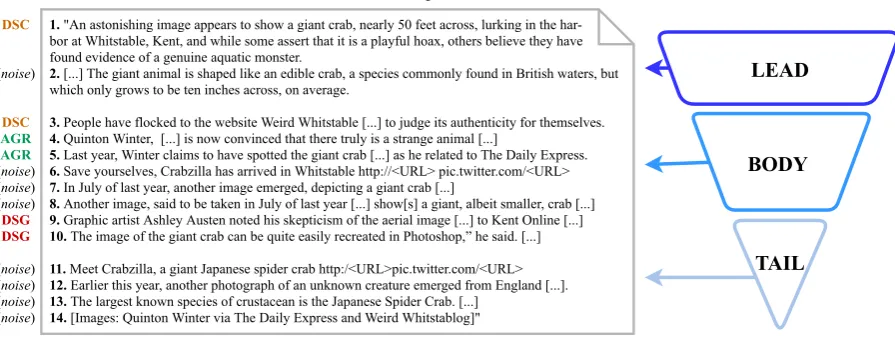
Figure 2: Article from the FNC-1 test set (sample no. 998), analyzed following theinversed pyramid princi-ples (Scanlan,1999). Notice that single sentences may express a different stance with respect to a claim, while others can be irrelevant, as shown in the leftmost column.
dustry. Due to the high number of UNR
sam-ples, which constituted almost three quarters of the training set, most of the groups proposed ar-chitectures which could perform well in this spe-cific class - that is, in the tracking step of the FND pipeline. The second (Hanselowski et al., 2017) and third (Riedel et al., 2017) classified teams proposed multi-layer perceptrons (MLPs)-based systems. The best performing system (Baird et al.,2017) is an ensemble of a convolutional neu-ral network (CNN) and a gradient-boosted deci-sion tree. All models, with the exception of the CNN, take as input a number of hand-engineered features. Recently, Hanselowski et al. (2018) enriched the feature set used in Hanselowski et al. (2017) and added a stacked BiLSTM layer to their model, resulting in a modest gain in perfor-mance.
All models described above performed very well in the UNR classification (with F1 usually above .98 for this class), achieving considerably worse results on the related samples (Hanselowski et al.,2018).
Rumor Stance Detection on Tweets. The most commonly used datasets for rumor stance detec-tion, the RumorEval (Derczynski et al., 2017) and the PHEME (Zubiaga et al., 2016b) corpora, collect Tweets. State-of-the-art results on the PHEME corpus has been obtained by Aker et al. (2017), who used a very rich set of problem-specific features. Their model beat the previous state-of-the-art system by Zubiaga et al. (2016a),
who modeled the tree-structured Twitter conver-sations using a LSTM, taking as input a conversa-tion’s branch at time.
2.2 Journalism Studies: News-writing Prose
Each genre develops its peculiar narrative forms, which allow for the most effective transmission of a message. In modern news-writing prose, espe-cially in the Anglo-Saxon journalism, theinverted pyramidstyle is widely adopted (Scanlan,1999).
Key element of this well standardized template consists in the fact that the most newsworthy facts (the so-called5W), are presented at the very begin-ning of the article - thelead - with the remaining information following, in order of importance, in thebodyof the article: in this section, we can find less essential element as quotes, interviews and background or explanatory information; any addi-tional input, as related stories, images and credits, are put in the very last paragraphs, thetail( Scan-lan,1999). Usually, no more than one or two ideas are expressed in the same paragraph (Sun Techni-cal Publications,2003). Those characteristic ele-ments are clearly visible in Figure2. This style is particularly suited for rapidly evolving break-ing news event, where a journalist can update an article by attaching a new paragraph with the last updates at the beginning of it. Moreover, putting most newsworthy facts at the beginning of an arti-cle allows the impatient readers to quickly decide on their level of interest in the report.
actu-w1 w2 w3 w4
w1 w2 w3
w1 w2 w3 w4 w5
Sentence
n
Sentence 2
Sentence 1
....
ARTICLE
Backward LSTM conditioned on the previous sentence
[image:4.595.77.286.60.290.2]Input features (word embeddings, ...) Forward LSTM conditioned on the previous sentence
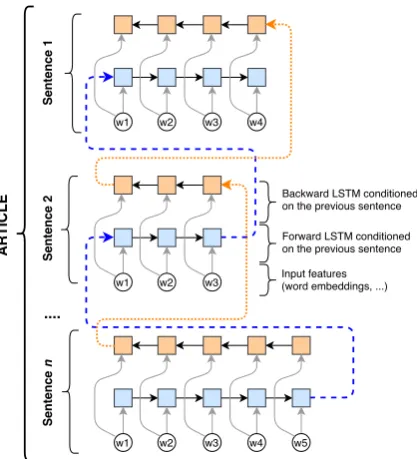
Figure 3: The architecture of our article encoder, which is based on that of Augenstein (2016). Dotted arrows represent conditional encoding and networks with the same color share the weights.
ally written following theinverted pyramid princi-ples.
3 Modeling
3.1 Encoding the article
Based on the elements of Journalism Studies dis-cussed above, we propose a simple architecture based on bidirectional conditional encoding ( Au-genstein et al.,2016) to encode an article split into
nsentences.
Each sentence Si is first converted into its em-bedding representation ESi ∈ Re×si, where eis the embedding size and si is the length of the
ithtokenized sentence. Then, we encode the arti-cle using BiLSTMA, a Bidirectional LSTM which reads the article sentence by sentence in backward order, initializing the first states of its forward and backward components with the last states it has produced after processing the previous sen-tence (Figure3).
Notice that we process the article from the bot-tom to the top, as we assume the most salient infor-mation to be concentrate in thelead. By consider-ing an article as an ensemble of sentences which are separately encoded conditioned to their pre-ceding ones, we can model the relationship of each sentence with respect to the others and, at the same time, reduce the number of parameters.
Sentence 2
Sentence 1
....
HEADLINE
ARTICLE LSTM conditioned onthe headline
LSTM conditioned on the previous sentence
Figure 4: Detail of the forward component of the double-conditional encoding architecture (best seen in color). Dotted arrows represent conditional encoding and networks with the same color share the weights. The system reads an article from the last sentence to the first, processing each sentence twice: first conditioning on the headline, then conditioning on the previous sen-tence. Due to lack of space, only the first two sentences of the article are represented.
3.2 Encoding the relationship between the headline and the article
After having encoded the article, we model its re-lationship with the headline. As shown in Fig-ure2, we expect single sentences to express a po-tentially different stance with respect to the head-line, while some sentences - especially in thebody
and the tail - can be irrelevant. For this reason, we separately evaluate the relationship of each sentence, conditioned on the previous sentence(s), with the headline. In this paper, we consider two approaches:
Double-conditional Encoding. As a first method, we modeled the relationship between the headline and the article using conditional encoding.
First, the headline is encoded using a bidirec-tional LSTM. Then, we separately process each sentence of the article with BiLSTMH, a BiL-STM conditioned on the last states of the BiLBiL-STM which processed the headline. We finally stack
BiLSTMA on top of BiLSTMH. In this way, we
[image:4.595.308.511.71.249.2]Following Wang et al. (2018), we notate this as:
HSi =Bi-LSTMH(ESi) ∀i∈ {1, ..., n} (1)
HSi =Bi-LSTMA(HSi) ∀i∈ {1, ..., n} (2)
This process is shown in Figure4. In this way, we read each sentenceSi, which is encoded in a headline-specific manner, conditioning on the pre-vious sentence(s). Clearly, it could have been pos-sible to obtain a hidden representation for each sentence by first conditioning on the previous sen-tence(s), and then on the headline. Results of pliminary experiments, however, showed worse re-sults for this variant, suggesting that having the conditioning on the previous sentence(s) nearer to the decoder is beneficial for the cross-level stance detection task.
Co-matching Attention. We also explored the use of attention in order to connect the headline
HH ∈Rl×c, encoded using a BiLSTM layer, with the article’s sentences HS1...HSn, embedded as explained in Subsection3.1. Inspired by the archi-tecture proposed by Wang et al. (2018) for multi-choice reading comprehension, we obtain a ma-trixHSi, attentively read with respect to the head-line, for each sentence at positioni ∈ {1, ..., n} as follows: we first obtain an aggregated rep-resentation of the headline and the ith sentence
HSi ∈ Rl×Si (Eq4), obtained by dot product of
HH with the attention weightsAi ∈Rc×si (Eq3); then, we obtain co-matching states of each sen-tence withHHi using Eq5:
Ai =softmax((WhHH +bh))>HSi (3)
HHi =HHAi (4)
HSi =ReLU(Ws
HHi HSi
HHi⊗HSi
+bs) (5)
where Wh ∈ Rl×l, Ws ∈ Rl×2l, bh ∈ Rl and
bs ∈ R2lare the parameters to learn. As in Wang et al. (2018), we use the element-wise subtrac-tion and multiplication⊗to build matching rep-resentations of the headline.
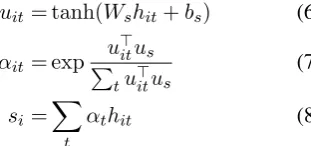
Self-attention. After encoding of the relation-ship between the headline and the article, we em-ploy a similar self-attention mechanism as in Yang et al. (2016) in order to soft-select the most rele-vant elements of the encoded sentence. Given the sequence of vectors{h1, ..., hS}inHSi, obtained with the double-conditional encoding or the co-matching attention approaches described above,
the final vector representation of theith sentence
Siis obtained as follows:
uit= tanh(Wshit+bs) (6)
αit= exp
u>itus P
tu
>
itus
(7)
si = X
t
αthit (8)
where the hidden representation of the word at po-sition t, uit, is obtained though a one-layer MLP (Eq6). The normalized attention matrixαtis then obtained though a softmax operation (Eq 7). Fi-nally,siis computed by a weighted sum of all hid-den stateshtwith the weight matrixαt(Eq8).
3.3 Decoding
Following the inverted pyramid principles, ac-cording to which the most relevant informa-tion is concentrated at the beginning of the arti-cle, we aggregate the sentence vector representa-tions{s1, ..., sn}using a backward LSTM. The fi-nal predictionyˆis finally obtained with a softmax operation over the tagset.
4 Experimental Setup
4.1 Data and Preprocessing
We downloaded the FNC-1 corpus from the chal-lenge website2. As we wanted to concentrate on the cross-level stance detection sub-task, we only consideredrelated(AGR,DSC andDSC) samples, discarding the noisy UNR samples, which would
constitute the output of the tracking step. The distribution of related samples is also very unbal-anced, with theDSCclass constituting more than a
half of the subset and theDSGsamples accounting for only 7.5% of the related samples, as shown in Table1.
samples AGR DSG DSC UNR
all 75,385 7.4% 2.0% 17.7% 72.8% REL 20,491 27.2% 7.5% 65.2%
-Table 1: Label distribution for the FNC-1 dataset, con-sidering all classes, or only the related samples.
As discussed in the Introduction, the cross-level stance detection task is characterized by an asym-metry in length in the input: on average, head-lines are 12.40 tokens long, while articles span from 4 up to 4788 tokens, with an average length
[image:5.595.364.520.101.174.2]headline entire article sentence avg no. tokens 12.40 417.69 30.88
Table 2: Asymmetry in length between headlines and articles in the FNC-1 corpus.
of 417.69 tokens. An article, however, presents a compositional internal structure, as it can be di-vided into smaller elements. We used the NLTK sentence tokenizer3to split articles into sentences, obtaining an average number of 11.97 sentences per article. On average, sentences are 30.88 tokens long, as reported in Table2.
4.2 Baseline
As a baseline, we implemented theAthenamodel proposed by Hanselowski et al. (2017), which
scored second in the FNC-1. We did not use
the first-ranked system, as it is an ensemble model, nor the modification to Athena proposed in Hanselowski et al. (2018), as the new feature set and the BiLSTM layer did not significantly im-prove the performance of the original model. The model consists in a 7-layers deep MLP, with vary-ing number of units, followed by a softmax. Input is presented as a large matrix of concatenated fea-tures, some of which separately encode the head-line or the body:
• Presence ofrefutingandpolaritywords • Tf-idf-weighted BoW unigram features,
con-sidering a vocabulary of 5000 entries.
while others jointly consider the headline/body:
• Word overlap between headline and article. • Count of headline’s token and ngrams which
appear in the article.
• Cosine similarity of the embeddings of nouns and verbs of the headline and the article.
Moreover, they use topic models based on non-negative matrix factorization, latent Dirichlet allo-cation, and latent semantic indexing. This results in a final set of 10 features. In this way, the asym-metry in length between is solved by compressing both the headline and the article into two fixed-sized vectors of the same size.
The same hyperparameters as in Hanselowski et al. (2017) have been used for the implementation
3https://www.nltk.org/_modules/nltk/
tokenize.html
Max headline length (in tokens) 15 Max sentence length (in tokens) 35 Max number of sentences for article 7 Word embedding size 300 BiLSTM cell size 2×128 Embedding dropout 0.1 BiLSTM dropout 0.3 Dense layer dropout 0.2
Epochs 70
Batch size 32
Optimizer Adam
Learning rate 0.001
Experiments using additional input channels
[image:6.595.313.520.62.259.2]Max word length (in characters) 35 Character embedding size 30 Character BiLSTM cell size 2×64 Character BiLSTM dropout 0.2 NE embedding size 30
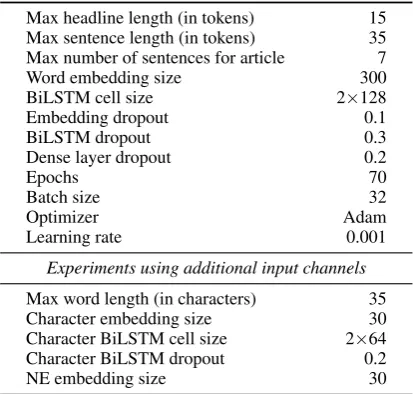
Table 3: Hyperparameters configuration
of the model. For training, we downloaded the fea-ture matrices which had been used inAthenabest submission4, taking only the indices correspond-ing to the related samples.
4.3 (Hyper-)Parameters
The high-level structure of the models has been implemented with Keras, while single layers have been written in Tensorflow. (Hyper-)parameters used for training, useful for experiments replica-tion, are reported in Table 3. Concerning vo-cabulary creation, we included only words oc-curring more than 7 times. The embedding ma-trix has been initialized with word2vec embed-dings5, which performed better than other set of pre-trained embeddings according to some prelim-inary experiments. This can be partially explained asword2vecembeddings are trained on part of the Google News corpus, thus on the same domain as the FNC-1 dataset. OOV words have been zero-initialized. In order to avoid overfitting, we did not update word vectors during training.
4.4 Evaluation Metrics
As we are not considering the UNR samples, the FNC-1 score would not constitute a good met-ric, as it distinguishes between related and unre-lated samples for scoring6. Following Zubiaga et
4
https://drive.google.com/open?id= 0B0-muIdcdTp7UWVyU0duSDRUd3c
5https://code.google.com/archive/p/
word2vec/
6https://github.com/FakeNewsChallenge/
Figure 5: Performance of the co-matching encoder in term of macro-averagedF1score on the test set, considering
the firstnsentences of an article. Blue and red violins represent respectively backward and forward encoding of the considered sentences.
al. (2018) and Hanselowski et al. (2018), we use macro-average precision, recall and F1 measure, which is less affected by the high class unbalance (Table1). We also consider the accuracy with re-spect to the singleAGR,DSGandDSCclasses.
5 Results and Discussion
As shown in Table 4, both encoders described in Section 3outperformed the baseline (line 1), de-spite having a considerably minor number of pa-rameters. In particular, the feature-based model obtained a relatively good performance in clas-sifying the very infrequent DSG labels, probably thanks to its large number of hand-engineered fea-tures. However, it shows some difficulties in dis-criminating betweenAGRandDSC samples. This is probably a consequence of the system flattening the entire article into a fixed-size vector: this in-evitably causes the system to loose the subtle nu-ances in the argumentative structure of the news story, which allows for distinguishing between
AGRandDSCsamples, and to favor the most com-monDSCclass. On the contrary, our architectures approach the asymmetry in length in the input by carefully encoding the articles as a hierarchical se-quence of sentences, and by separately modeling their relative positions with respect to the headline. In this way, they are able to successfully
discrimi-nate betweenAGRandDSCsamples.
In general, the encoder based on co-matching attention performed clearly better than the archi-tecture based on double-conditional encoding (line
2 and 10), reaching a higher performance in all metrics but the classification of theDSCsamples.
5.1 Modeling theInverted Pyramid
In order to test our assumption that the great ma-jority of the FNC-1 corpus were written follow-ing the inverted pyramid style, we took the co-matching attention model, which performed bet-ter than the double-conditionally encoded archi-tecture, and progressively reducing the number of considered sentences. Moreover, we modified the article encoder (Subsection3.1) in order to process the input sequence in forward and not in backward order. For each of these 13 settings7, we run 10 simulations.
As the violin plots in Figure 5 show (blue vi-olins), considering a reduced number sentences does not correlate with an overly big drop in per-formance, until a number of less than four sen-tences is taken. Below this threshold, the ability of the system to correctly classify the stance of the ar-ticle is compromised. This can be explained with the inverted pyramid theory: until we consider a number of sentences sufficient in order to include theleadand part of thebodyof the article, the sys-tem can rely on a sufficient number of elements in order to discriminate its stance. On the contrary, if we consider only the very first sentences, the system can get confused, being exposed to only
7Specifically: 7 backward-encoded co-matching
anonymized accuracy macro-averaged
Model input AGR DSG DSC P R F1
1 Baseline – 26.69 11.76 74.77 39.39 37.74 38.00
2
Double-conditional
Encoding
– no 68.84 09.61 77.42 52.50 51.25 49.81 3 – yes 63.11 09.76 76.03 52.31 49.63 51.77
4 + char no 51.45 23.96 76.32 50.12 50.57 50.32 5 + char yes 59.64 16.93 77.64 53.27 51.40 51.38 6 + ner no 69.57 05.02 76.97 52.14 51.22 48.86 7 + ner yes 75.78 09.33 69.96 54.41 51.31 51.17 8 + char + ner no 62.11 13.20 77.11 52.83 50.80 50.42 9 + char + ner yes 76.77* 12.34 67.47 53.45 49.85 50.56
10
Co-matching attention
– no 69.57 33.0* 74.91 64.14* 58.53* 59.01*
[image:8.595.78.523.64.276.2]11 – yes 64.37 29.27 78.94* 59.64 55.20 57.12 12 + char no 74.46 24.82 71.95 61.77 56.46 58.55 13 + char yes 70.52 15.06 76.39 63.88 55.23 56.01 14 + ner no 66.05 18.79 72.38 58.51 51.48 52.52 15 + ner yes 69.42 31.85 72.38 58.59 54.67 57.32 16 + char + ner no 63.95 20.95 77.76 57.32 53.10 53.90 17 + char + ner yes 67.26 11.05 76.99 57.19 51.84 54.85
Table 4: Results of experiments using double-conditional encoding or co-matching attention. Best results for each encoding type are shown in bold. Best results overall are indicated with an asterisk.
a portion of the (sometimes opposing) opinions expressed in the article. Interestingly, our sys-tem seems to be pretty robust to the noisy sen-tences which could be included when considering a higher number of sentences.
The assumption that most of the articles in the FNC-1 corpus are written following the inverted pyramidprinciples is further confirmed by the fact that, after the threshold of 4 considered sentences, simulations using forward encoding perform al-ways consistently worse than using backwards en-coding (the red violins in Figure5). Reasonably, below this threshold, we do not observe a con-siderable difference in performance between back-ward and forback-ward models.
5.2 Additional Experiments
5.2.1 Using additional Input Channels
To investigate the impact of features other than word embeddings, we consider two further input channels:
• Named Entities (NE) - NEs were obtained using the Stanford NE Recognizer (Finkel et al.,2005), resulting in a tagset of 13 labels. • Characters- Each input word was split into characters. Only characters occurring more than 100 times in the training set were con-sidered, obtaining a final vocabulary of 149 characters. As in Lample et al. (2016), in we concatenate the output of a BiLSTM run over the character sequence.
The output of each input channel is concatenated with the word embedding, and passed to the article encoder described in Section 3.1. Hyperparame-ters used for experiments are reported in Table3.
5.2.2 Anonymizing the input
After manual analysis of the predictions, we sus-pected that some models could have spotted some correlations between certain Named Entities and a specific stance in the training set. Some of those correlations are well known and can be useful in veracity detection (Wang, 2017). In this paper, however, we wanted to train a model for stance detection only based on its language understand-ing, without counting on such possibly accidental correlations.
In order to avoid the systems to rely on chance correlations, which would not generalize on the test set, we modified the input sequences by sub-stituting all input tokens labeled as <PERSON>, <ORGANIZATION> and <LOCATION> by the Stanford Named Entity Recognizer with the cor-responding NE tags.
5.2.3 Results
characters and NE features actually lead to (some-times small) improvements in almost all consid-ered evaluation metrics. Moving to the archi-tecture using co-matching attention, adding char-acters or NE embeddings, even in combination, caused a considerable drop in all evaluation met-rics, apart on some single label classification (as theAGRclass).
As shown in Table 4 (odd lines),
anonymiz-ing the input was always useful for the archi-tecture using double-conditional encoding, result-ing in a consistently higher macro-averaged F1 score. Considering the architecture based on co-matching attention, however, anonymizing the in-put was beneficial only for architectures leverag-ing NE tags (only with word embeddleverag-ings, or in combination with character embeddings), which were also the ones showing the highest drop in performance with respect to the model using only word embeddings.
The best performance according to macro-averaged precision, recall andF1score is obtained using the co-matching attention model leveraging only word embeddings. The high performance of this model is mainly due to its ability to discrimi-nate the very unfrequentDSGclass.
6 Conclusions
We proposed two simple architectures for Cross-Level Stance Detection, which were carefully de-signed to model the internal structure of a news article and its relations with a claim. Results show that our “journalistically”-motivated approach can beat a strong feature-based baseline, without rely-ing on any language-specific resources other than word embeddings. This indicates that an interdis-ciplinary dialogue between Natural Language Pro-cessing and Journalism Studies can be very fruitful for fighting Fake News.
In future work, we aim to put together the dif-ferent stages of the FND pipeline. Following the work of Kochkina et al. (2018) for RV, it could be interesting to compare a sequential approach to separately solve each step of the pipeline in isola-tion, with a joint multi-task system. The generaliz-ability of the models trained on the FND pipeline to other domains could be tested with the recently released ARC corpus (Hanselowski et al., 2018), which has similar statistical characteristics as the
FNC-1 corpus.
Acknowledgments
Special thanks to Chiara Severgnini,
journal-ist at 7 (the weekly magazine supplement of
Corriere della Sera) for her comments on Sec-tion 2.2. The first author (CC) would like to thank the Siemens Machine Intelligence Group (CT RDA BAM MIC-DE, Munich) and the NERC DREAM CDT (grant no. 1945246) for partially funding this work. The third author (NC) is grate-ful for support from the UK EPSRC (grant no. EP/MOO5089/1). We thank the anonymous re-viewers of this paper for their efforts and for the constructive comments and suggestions.
References
Ahmet Aker, Leon Derczynski, and Kalina Bontcheva. 2017. Simple open stance classification for rumour analysis. InProceedings of the International Con-ference Recent Advances in Natural Language Pro-cessing, RANLP 2017, Varna, Bulgaria, September 2 - 8, 2017, pages 31–39.
Isabelle Augenstein, Tim Rockt¨aschel, Andreas Vla-chos, and Kalina Bontcheva. 2016. Stance detec-tion with bidirecdetec-tional condidetec-tional encoding. In Pro-ceedings of the 2016 Conference on Empirical Meth-ods in Natural Language Processing, EMNLP 2016, Austin, Texas, USA, November 1-4, 2016, pages 876–885.
Sean Baird, Doug Sibley, and Yuxi Pan. 2017. Talos targets disinformation with fake news challenge vic-tory. https://blog.talosintelligence.
com/2017/06/.
Leon Derczynski, Kalina Bontcheva, Maria Liakata, Rob Procter, Geraldine Wong Sak Hoi, and Arkaitz Zubiaga. 2017. Semeval-2017 task 8: Rumoureval: Determining rumour veracity and support for ru-mours. In Proceedings of the 11th International Workshop on Semantic Evaluation, SemEval@ACL 2017, Vancouver, Canada, August 3-4, 2017, pages 69–76.
William Ferreira and Andreas Vlachos. 2016. Emer-gent: a novel data-set for stance classification. In Proceedings of the 2016 conference of the North American chapter of the association for computa-tional linguistics: Human language technologies, pages 1163–1168.
Andreas Hanselowski, PVS Avinesh, Benjamin Schiller, and Felix Caspelherr. 2017. Description of the system developed by team athene in the fnc-1. Technical report, Technical report.
Andreas Hanselowski, Avinesh P. V. S., Benjamin Schiller, Felix Caspelherr, Debanjan Chaudhuri, Christian M. Meyer, and Iryna Gurevych. 2018. A retrospective analysis of the fake news challenge stance-detection task. InProceedings of the 27th In-ternational Conference on Computational Linguis-tics, COLING 2018, Santa Fe, New Mexico, USA, August 20-26, 2018, pages 1859–1874.
David Jurgens, Mohammad Taher Pilehvar, and Roberto Navigli. 2014. Semeval-2014 task 3: Cross-level semantic similarity. InProceedings of the 8th international workshop on semantic evalua-tion (SemEval 2014), pages 17–26.
Elena Kochkina, Maria Liakata, and Arkaitz Zubi-aga. 2018. All-in-one: Multi-task learning for ru-mour verification. InProceedings of the 27th Inter-national Conference on Computational Linguistics, COLING 2018, Santa Fe, New Mexico, USA, August 20-26, 2018, pages 3402–3413.
Guillaume Lample, Miguel Ballesteros, Sandeep Sub-ramanian, Kazuya Kawakami, and Chris Dyer. 2016. Neural architectures for named entity recognition. In NAACL HLT 2016, The 2016 Conference of the North American Chapter of the Association for Computational Linguistics: Human Language Tech-nologies, San Diego California, USA, June 12-17, 2016, pages 260–270.
Saif Mohammad, Svetlana Kiritchenko, Parinaz Sob-hani, Xiaodan Zhu, and Colin Cherry. 2016. Semeval-2016 task 6: Detecting stance in tweets. In Proceedings of the 10th International Workshop on Semantic Evaluation (SemEval-2016), pages 31–41.
Saif M Mohammad, Parinaz Sobhani, and Svetlana Kiritchenko. 2017. Stance and sentiment in tweets. ACM Transactions on Internet Technology (TOIT), 17(3):26.
Dean Pomerleau and Delip Rao. 2017. Fake news chal-lenge. http://www.fakenewschallenge. org/.
Benjamin Riedel, Isabelle Augenstein, Georgios P Sp-ithourakis, and Sebastian Riedel. 2017. A sim-ple but tough-to-beat baseline for the fake news challenge stance detection task. arXiv preprint arXiv:1707.03264.
Christopher Scanlan. 1999. Reporting and writing: Basics for the 21st century. Oxford University Press.
Sun Technical Publications. 2003. Read Me First!: A Style Guide for the Computer Industry. Prentice Hall Professional.
James Thorne and Andreas Vlachos. 2018. Automated fact checking: Task formulations, methods and fu-ture directions. In Proceedings of the 27th Inter-national Conference on Computational Linguistics, COLING 2018, Santa Fe, New Mexico, USA, August 20-26, 2018, pages 3346–3359.
Shuohang Wang, Mo Yu, Jing Jiang, and Shiyu Chang. 2018. A co-matching model for multi-choice read-ing comprehension. InProceedings of the 56th An-nual Meeting of the Association for Computational Linguistics, ACL 2018, Melbourne, Australia, July 15-20, 2018, Volume 2: Short Papers, pages 746– 751.
William Yang Wang. 2017. ”liar, liar pants on fire”: A new benchmark dataset for fake news detection. In Proceedings of the 55th Annual Meeting of the As-sociation for Computational Linguistics, ACL 2017, Vancouver, Canada, July 30 - August 4, Volume 2: Short Papers, pages 422–426.
Zichao Yang, Diyi Yang, Chris Dyer, Xiaodong He, Alex Smola, and Eduard Hovy. 2016. Hierarchi-cal attention networks for document classification. InProceedings of the 2016 Conference of the North American Chapter of the Association for Computa-tional Linguistics: Human Language Technologies, pages 1480–1489.
Arkaitz Zubiaga, Ahmet Aker, Kalina Bontcheva, Maria Liakata, and Rob Procter. 2018. Detection and resolution of rumours in social media: A survey. ACM Computing Surveys (CSUR), 51(2):32.
Arkaitz Zubiaga, Elena Kochkina, Maria Liakata, Rob Procter, and Michal Lukasik. 2016a. Stance clas-sification in rumours as a sequential task exploit-ing the tree structure of social media conversations. InCOLING 2016, 26th International Conference on Computational Linguistics, Proceedings of the Con-ference: Technical Papers, December 11-16, 2016, Osaka, Japan, pages 2438–2448.