Using Subcategorization to Resolve Verb Class Ambiguity
Maria Lapata
School o f Cognitive Science Division o f Informatics University o f Edinburgh
2 B u c c l e u c h Place Edinburgh EH8 9LW, U K
m l a p @ c o g s c i . e d . a c . u k
Chris Brew
H C R C L a n g u a g e T e c h n o l o g y G r o u p Division o f Informatics University o f Edinburgh
2 B u c c l e u c h Place Edinburgh EH8 9LW, U K
Abstract
Levin's (1993) taxonomy of verbs and their classes is a widely used resource for lexical semantics. In her framework, some verbs, such as give exhibit no class ambiguity. But other verbs, such as write, can inhabit more than one class. In some of these am- biguous cases the appropriate class for a particular token of a verb is immediately obvious from inspec- tion of the surrounding context. In others it is not, and an application which wants to recover this infor- mation will be forced to rely on some more or less elaborate process of inference. We present a simple statistical model of verb class ambiguity and show how it can be used to carry out such inference.
1 Introduction
The relation between the syntactic realization of a verb's arguments and its meaning has been exten- sively studied in Levin (1993). Levin's work re- lies on the hypothesis that "the behavior of a verb, particularly with respect to the expression and in- terpretation of its arguments, is to a large extent determined by its meaning" (Levin, 1993, p. 1). Verbs which display the same diathesis alterna- tions-alternations in the realization of their argu- ment structure-are assumed to share certain mean- ing components and are organized into a semanti- cally coherent class.
As an example consider sentences (1)-(3) taken from Levin. Example (1) illustrates the causative/inchoative alternation. Verbs undergoing this alternation can be manifested either as transi- tive with a causative reading (cf. (la)) or as intransi- tive with an inchoative reading (cf. (lb)). Examples (2) and (3) illustrate the dative and benefactive al- ternations respectively. Verbs which license the for- mer alternate between the prepositional frame NP- V-NP-PPto (cf. (2a)) and the double object frame V-NP-NP (cf. (2b)), whereas verbs which undergo the latter alternate between the double object frame
(cf. (3a)) and the prepositional frame NP-V-NP-
PPJ~r
(cf. (3b)).(1) a. Janet broke the cup. b. The cup broke. (2) a. Bill sold a car to Tom.
b. Bill sold Tom a car.
(3) a. Martha carved the baby a toy. b. Martha carved a toy for the baby.
Verbs like crack and chip pattern with break in li- censing the causative/inchoative alternation and are associated with the semantic class of BREAK verbs. Verbs make and build behave similar to carve in licensing the benefactive alternation and are mem- bers of the class of BUILD verbs, whereas sell and give undergo the dative alternation and participate in the GIVE class. By grouping together verbs which pattern together with respect to diathesis alterna- tions Levin defines approximately 200 verb classes, which she argues reflect important semantic regu- larities.
2 Motivation
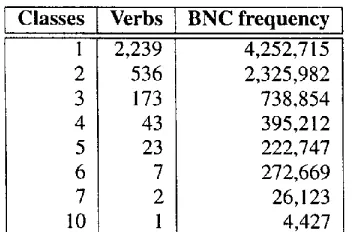
Classes [ Verbs I BNCfrequency
1 2,239 4,252,715
2 536 2,325,982
3 173 738,854
4 43 395,212
5 23 222,747
6 7 272,669
7 2 26,123
10 1 4,427
Table 1: Polysemous verbs according to Levin
I O0
90
80
70
6o
~ so
30 20 I0 0
1 2 ,3 4 5 6 7 8 9 10 11 12 Number of alternations
Classes 1 2 3 4 5 6 7
Figure 1: Relation between number of classes and alternations
Furthermore, as shown in figure 1, the number of alternations licensed by a given verb increases with the number of classes it inhabits. Consider for example verbs participating in one alternation only: of these, 90.4% have one semantic class, 8.6% have two classes, 0.7% have three classes and 0.3% have four classes. In contrast, of the verbs licensing six different alternations, 14% have one class, 17% have two classes, 12.4% have three classes, 53.6% have four classes, 2% have six classes and 1% has seven classes.
Palmer (1999) and Dang et al. (1998) argue that the use of syntactic frames and verb classes can sim- plify the definition of different verb senses. Beyond this, we claim that information about the argument structure of a polysemous verb can often help dis- ambiguating it.
Consider for instance the verb serve which is a member of four classes: GIVE, FIT, MASQUERADE
and FULFILLING. Each of these classes can in turn license four distinct syntactic frames. As shown in the examples I below, in (4a) serve appears ditran- sitively and belongs to the semantic class of GIVE verbs, in (4b) it occurs transitively and is a mem- ber of the class of FIT verbs, in (4c) it takes the predicative complement as minister o f the interior and is a member of MASQUERADE verbs. Finally, in sentence (4d) serve is a FULFILLING verb and takes two complements, a noun phrase (an appren- ticeship) and a prepositional phrase headed by to. In the case of verbs like serve we can guess their semantic class solely on the basis of the frame with which they appear.
(4) a. I'm desperately trying to find a venue for the reception which can serve our guests an authentic Italian meal.
b. The airline serves 164 destinations in over 75 countries.
c. Jean-Antoine Chaptal was a brilliant chemist and technocrat who served Napoleon as minister of the interior from
1800 to 1805.
d. Before her brief exposure to pop stardom, she served an apprenticeship to a still-life photographer.
But sometimes we do not have the syntactic infor- mation that would provide cues for semantic disarn- biguation. Consider sentence (5a). The verb write is a member of three Levin classes, two of which (MESSAGE TRANSFER, PERFORMANCE) take the ditransitive flame NP-V-NP-NP. In this case we have the choice between the "message transfer" reading (cf. (5a)) and the "performance" reading (cf. (Sb)). This is an instance of the common prob- lem of inferring the value of a hidden variable (in this case the "true class" of a particular instance of write). The same situation arises with the verb phone which is listed as a GET verb and an INSTRU- MENT OF COMMUNICATION verb and in both cases can take the frame NP-V-NP-NP. In sentence (5c) the preferred reading is that of "get" instead of "in- strument of communication" (cf. sentence (5d)).
(5) a. A solicitor wrote him a letter at the air- port.
b. I want you to write me a screenplay called "The Trip".
[image:2.612.85.261.56.172.2] [image:2.612.62.287.220.405.2]c. I'll phone you a taxi.
d. As I entered the room I wished I'd thought of phoning a desperate SOS to James.
The objective of this paper is to address the verb class disambiguation problem by developing a probabilistic framework which combines linguis- tic knowledge (i.e., Levin's classification) and frame frequencies acquired from the BNC. Our initial ex- periments focus on the syntactic frames characteris- tic for the dative and benefactive alternations (cf. ex- amples (2) and (3)). These frames are licensed by a fairly large number of classes: 19 classes license the double object frame, 22 license the NP-V-NP-
PPto
frame and 14 classes license the NP-V-NPPPfi~r
frame. The semantic and syntactic properties of these alternations have been extensively studied and are well understood (see Levin (1993) and the references therein). Furthermore, they are fairly pro- ductive and one would expect them to be well rep- resented in a large corpus.In section 3 we describe the statistical model and the estimation of the various model parameters, sec- tion 4 presents some preliminary results and sec- tion 5 contains some discussion and concluding re- marks.
3 The Model
We view the choice of a class for a polysemous verb in a given frame as the joint probability
P(verb,frame, class)
which we rewrite using the chain rule in (6).(6)
P(verb,frame, class) = P(verb)
e (frame lverb) P (class I verb, frame)
We also make the following independence assump- tion:
(7)
P(classlverb,frame) ~ P(class[frame)
The independence assumption reflects Levin's hy- pothesis that the argument structure of a given verb is a direct reflection of its meaning. Accordingly we assume that the semantic class determines the argu- ment structure of its members without making ref- erence to the individual verbs. By applying Bayes Law we write
P(classlframe)
as:(8)
P(class[frame)=
P (frame lclass) P (class)
P (frame )
By substituting (7) and (8) into (6),
P(verb, class,frame)
can be written as:(9)
P(verb,frame, class)
P (verb) P (frame l verb) P (frame lclass) P (class)
P ~rame )
We estimate the probabilities
P(verb),
P(framelverb),
P(framelclass)
andP(class)
as follows:(10)
P(verb)
f(verb)
f (verbi)
i(11)
P(framelverb)
(12)
P(framelclass)
(13)
P(class) .~
f (verb,frame)
f (verb, framei)
if (class,frame)
f (class, framei)
if (class)
Y~. f (classi)
i
(14)
P(frame) ,~
f (frame)
f {framei)
iIt is easy to obtain
f(verb)
from the lemmatized BNC. For the experiments reported here, syntactic frames for the dative and benefactive alternations were automatically extracted from the BNC using Gsearch (Keller et al., 1999), a tool which facilitates search of arbitrary POS-tagged corpora for shallow syntactic patterns based on a user-specified context- free grammar and a syntactic query. The acquisition and filtering process is detailed in Lapata (1999). We rely on Gsearch to provide moderately accu- rate information about verb frames in the same way that Hindle and Rooth (1993) relied on Fidditch to provide moderately accurate information about syn- tactic structure, and Ratnaparkhi (1998) relied on simple heuristics defined over part-of-speech tags to deliver information nearly as useful as that pro- vided by Fidditch. We estimatedf(verb,frame)
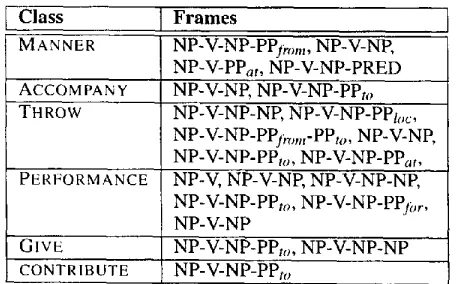
as the number of times a verb co-occurred with a par- ticular frame in the corpus.Class Frames
MAN NER NP-V-NP-PP#om, NP-V-NP, NP-V-PPat, NP-V-NP-PRED ACCOMPANY NP-V-NP, NP-V-NP-PPt,, T H R O W NP-V-NP-NP, NP-V-NP-PPtoc,
NP-V-NP-PP#om-PPto,
NP-V-NP, NP-V-NP-PPto, NP-V-NP-PPar, PERFORMANCE NP-V, NP-V-NP, NP-V-NP-NP, NP-V-NP-PPto, NP-V-NP-PP¢~r, NP-V-NPG I v E NP-V-NP-PPto, NP-V-NP-NP
CONTRIBUTE NP-V-NP-PPto
Table 2: Sample of verb classes and their syntactic frames
we recorded the syntactic frames it licenses (cf. ta- ble 2). Levin's description of the argument struc- ture of various verbs goes beyond the simple list- ing of their subcategofization. Useful information is provided about the thematic roles of verbal argu- ments and their interpretation. Consider the exam- ples in (15): in (15a) the verb present is a member of the FULFILLING class and its theme is expressed by the prepositional phrase
with an award, in (15b) the
PP headed bywith
receives a locative interpretation and the verb load inhabits the SPRAY/LOAD class, whereas in (15c) the prepositional phrase is instru- mental andhit
inhabits the HIT class. None of the information concerning thematic roles was retained. All three classes (FULFILLING, SPRAY/LOAD and HIT) were assigned the frameNP-V-NP-PPwith'.
(15) a. b.
C.
John presented the student with an award. John loaded the truck with bricks. John hit the wall with a hammer.
Because we didn't have corpus counts for the quantity
f(class,frame)
we simply assumed that all frames for a given class are equally likely. This means, for instance, that the estimate forP(NP-V-NP-NPtolGIvE)
is ½ and similarly the es- timate for P(NP-VIPERFORMANCE ) is ~ (cf. ta- ble 2). This is clearly a simplification, since one would expectf(class,frame)
to be different for dif- ferent corpora, and to vary with respect to class size and the frequency of class members.In order to estimate
P(class)
we first estimatef(class)
which we rewrite as follows:(16)
f (class) = E f (verbi, class)
i
Class
size(class) p(class[amb_class) f (verb, class)
THROW 27 0.40 7783.6
SEND 20 0.27 5253.9
GIVE 15 0.20 3891.8
MARRY 10 0.13 2529.6
Table 3: Estimation of
f(verb, class)
for the verbpass
The estimate of
f(verb, class)
for monosemous verbs reduces to the count of the verb in the cor- pus. Once again we cannot estimatef(verb, class)
for polysemous verbs directly. All we have is the overall frequency of a given verb in the BNC and the number of classes it is a member of according to Levin. We rewritef(verb, class)
as:(17)
f (verb, class) = f (verb)p(classlverb)
We approximate
p(classlverb)
by collapsing across all verbs that have the appropriate pattern of ambi- guity:(18)
f (verb, class) ~ f (verb)p(classlamb_class)
Here
amb_class, the ambiguity class of a verb, is
the set of classes that it might inhabit. 2 We collapse verbs into ambiguity classes in order to reduce the number of parameters which must be estimated: we certainly lose information, but the approximation makes it easier to get reliable estimates from limited data. In future work we plan to use the EM algo- rithm (Dempster et al., 1977) to uncover the hiddenclass, but for the present study, we simply approxi-
matep(classlamb_class)
using a heuristic based on class size:size(class)
(19)p(classlamb_class)
size(c)
c ~ a m b ~ ' l a s s
For each class we recorded the number of its mem- bers after discarding verbs whose frequency was less than 1 per 1M in the BNC. This gave us a first approximation of the size of each class. We then computed, for each polysemous verb, the total size of the classes of which it was a member. We calcu- lated
p(classlamb_class)
by dividing the former by the latter (cf. equation (19)). We obtained an esti- mate for the class frequencyf(class)
by multiply- ingp(classlamb_class)
by the observed frequency of the verb in the BNC (cf. equation (18)). [image:4.612.56.284.58.200.2] [image:4.612.297.530.61.123.2]~e.+05 -
4 e + 0 5 -
u~
2e.H)5 -
®
®
®
I !: ...
~: :;No
N
N
"¢ E "
Figure 2: The ten most frequent classes
120
1oo
~
so~ 60
E ~ 4 0
77-
20 ~ ,;.
I t
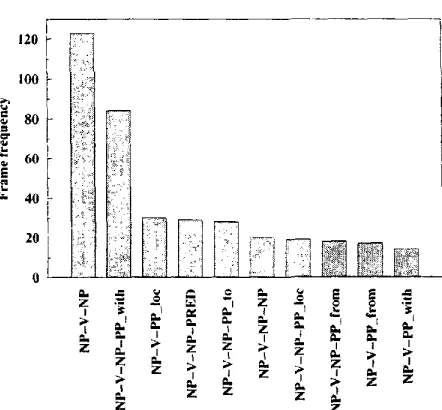
Figure 3:
0 .
Z I
g
Z
m
Ten most frequent frames in Levin
As an example consider the verb pass which has the classes THROW, SEND, GIVE and MARRY. The respective p(classlamb_class) for these classes are 27 20 15 and l0 By multiplying these by the fre-
7 2 ' 7 2 ' 7 2 ~ "
quency of pass in the BNC (19,559) we obtain the estimates for f(verb, class) given in table 3. Note that simply relying on class size, without re- gard to frequency, would give quite different results. For example the class of MANNER OF SPEAKING verbs has 76 members, of which 30 have frequen- cies which are less than 1 per 1M, and is the sev- enth largest class in Levin's classification. Accord- ing to our estimation scheme MANNER OF SPEAK- ING verbs are the 116th largest class. The estimates for the ten most frequent classes are shown in fig- ure 2.
The estimation process described above in- volves at least one gross simplification, since
p(classlamb_class) is calculated without reference to the identity of the verb in question. For any two verbs which fall into the same set of classes
p(classlamb_class) will be the same, even though one or both may be atypical in its distribution across the classes. Furthermore, the estimation tends to favour large classes, again irrespectively of the iden- tity of the verb in question. For example the verb
carry has three classes, CARRY, FIT and COST. In- tuitively speaking, the CARRY class is the most fre- quent (e.g., Smoking can impair the blood which carries oxygen to the brain, I carry sugar lumps around with me). However, since the FIT class
(e.g., Thameslink presently carr/es 20,000 passen-
gers daily) is larger than the CARRY class, it will be given a higher probability (0.45 versus 0.4). This is clearly wrong, but it is an empirical question how much it matters.
Finally, we wanted to estimate the probability of a given frame, P(frame). We could have done this by acquiring Levin compatible subcategoriza- tion frames from the BNC. Techniques for the auto- matic acquisition of subcategofization dictionaries have been developed by Manning (1993), Bfiscoe and Carroll (1997) and Carroll and Rooth (1998). But the present study was less ambitious, and nar- rowly focused on the frames representing the da- tive and the benefactive alternation. In default of the more ambitious study, which we plan for the future, the estimation of P(frame) was carried out on types and not on tokens. The mapping of Levin's linguis- tic specifications into surface syntactic information resulted in 79 different frame types. By counting the number of times a given frame is licensed by several semantic classes we get a distribution of frames, a sample of which is shown in figure 3.
The probabilities P(frmnelclass) and
P(framelverb) will be unreliable when the frequency estimates for f(verb,frame) and
f(class,frame) are small, and ill-defined when the frequency estimates are zero. Following Hindle and Rooth (1993) we smooth the ob- served frequencies in the following way, where
[image:5.612.325.546.53.258.2] [image:5.612.81.311.53.268.2]~ i f (verbi), f (C,frame) : ~ i f (classi,ft~me)
and f ( C ) = ~ i f(classi). We redefine the probability estimates as follows:
(20) P (framel verb)
f(V,Jmme) f (verb,frame) + f(v)
f (verb,framei) + 1 i
(21 ) P (framelclass)
f(C,/~ame) f (class,frame) + f(c)
f (class,framei) + 1 i
When f(verb,frame) is zero, the estimate used is proportional to the average f(V.frame) f(v) across all verbs. Similarly, when f(class,frame) is zero, our estimate is proportional to the average f(c.l'~ame)
f(C) across all classes. We don't claim that this scheme is perfect, but any deficiencies it may have are almost certainly masked by the effects of approximations and simplifications elsewhere in the system.
4 Results
We evaluated the performance of the model on all verbs listed in Levin which are polysemous and take frames characteristic for the dative and benefactive alternations. This resulted in 154 verbs which take the NP-V-NP-NP frame, 135 verbs which take the NP-V-NP-PPw frame and 84 verbs which take the NP-V-NP-PPj~,r frame. The verbs were all polyse- mous and had an average of 3.8 classes. Each class had an average of 3.4 frames. Furthermore, we di- vided these verbs in two categories: verbs which can be disambiguated solely on the basis of their frame (e.g., serve; category A) and verbs which are gen- uinely ambiguous, i.e., they inhabit a single frame and yet can be members of more than one semantic class (e.g., write; category B).
The task was the following: given that we know the frame of a given verb can we predict its se- mantic class? In other words by varying the class in the term P(verb,frame, class) we are trying to see whether the class which maximizes it is the one predicted by the lexical semantics and the argument structure of the verb in question.
For the verbs belonging to category A (306 in total) we used Levin's own classification in eval- uation. The model's performance was considered correct if it agreed with Levin in assigning a verb the appropriate class given a particular frame. For class ambiguous verbs (category B) we compared the model's predictions against manually annotated
data. Given the restriction that these verbs are se- mantically ambiguous in a specific syntactic frame we could not simply sample from the entire BNC, since this would decrease the chances of finding the verb in the frame we are interested in. Instead, for 31 class ambiguous verbs we randomly selected ap- proximately 100 tokens from the data used for the acquisition of frame frequencies for the dative and benefactive alternation. Verbs with frame frequency less than 100 were not used in the evaluation.
The selected tokens were annotated with class in- formation by two judges. The judges were given an- notation guidelines but no prior training. We mea- sured the judges' agreement on the annotation task using the Kappa coefficient (Siegel and Castellan, 1988) which is the ratio of the proportion of times,
P(A), that k raters agree to the proportion of times,
P(E), that we would expect the raters to agree by chance (cf. (22)). If there is a complete agreement among the raters, then K = 1, whereas if there is no agreement among the raters (other than the agree- ment which would be expected to occur by chance), then K = 0.
P(A) - P(E)
(22) K -
1 - P ( E )
We counted the performance of our model as cor- rect if it agreed with the "most preferred", i.e., most frequent verb class as determined in the manually annotated corpus sample by taking the average of the responses of both judges.
We also compared the results for both categories to a naive baseline which relies only on class in- formation and does not take subcategorization into account. For a given polysemous verb, the baseline was computed by defaulting to its most frequent class, where class frequency was determined by the estimation procedure described in the previous sec- tion.
As shown in table 4, in all cases our model out- performs the baseline. It achieves a combined pre- cision of 91.8% for category A verbs. One might expect a precision of 100% since these verbs can be disambiguated solely on the basis of the frame. However, the performance of our model is less, mainly because of the way we estimated the terms
P(class) and P(frame[class): we overemphasize the importance of frequent classes without taking into account how individual verbs distribute across classes.
II Category A Frame [ V e r b s Baseline NP-V-NP-NP 123 61.8% NP-V-NP-PPto 113 67.2%
NP'V-NP-PPfor
70 70% combinedCategory B
Model Verbs Baseline Model
87.8% 14 42.8% 85.7%
92% 15 73.4% 86.6%
98.5% 2 0% 50%
II 306 165.7% 191.8% [31
161.3% 183.9%
Table 4: Model accuracy against baseline
Verb Frame Preferences
save NP-V-NP-NP call NP-V-NP-NP write NP-V-NP-NP make NP-V-NP-NP extend NP-V-NP-PPto present NP-V-NP-PPto take NP-V-NP-PPj~,~ produce NP-V-NP-PPfbr
GET, BILL GET, DUB
MESSAGE TRANSFER, PERFORMANCE DUB, BUILD
FUTURE HAVING, CONTRIBUTE
FULFILLING, REFLEXIVE APPEARANCE STEAL, PERFORMANCE
PERFORMANCE, CREATE
Table 5: Random sample of eight verbs and their semantic preferences as ranked by the model
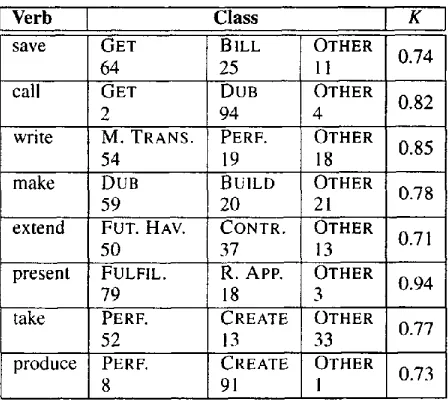
more, our model makes interesting predictions with respect to the semantic preferences of a given verb. In table 5 we show the class preferences the model came up with for eight randomly selected verbs (class preferences are ranked from left to right, with the leftmost class being the most preferred one). Ta- ble 6 summarizes the average class frequencies for the same eight verbs as assigned to corpus tokens by the two judges together with inter-judge agree- ment (K). The category OTHER is reserved for cor- pus tokens which either have the wrong frame or for which the classes in question are not applicable. In general agreement on the class annotation task was good with Kappa values ranging from 0.68 to 1. As shown in table 6, with the exceptions of
call
andproduce
the model's predictions are borne out in corpus data.5 D i s c u s s i o n
Verb save
call
GET 64 GET 2
Class
BILL 25 DUB 94 write M. TRANS. PERF.
54 19
make DUB BUILD
59 20
extend FUT. HAV. CONTR.
50 37
present FULFIL. R. APP.
79 18
take PERF. CREATE
52 13
produce PERF. CREATE
8 91 1
I K
OTHER 0.74 11
OTHER 0.82 4
OTHER 0.85 18
OTHER 0.78 21
OTHER 0.71 13
OTHER 0.94 3
OTHER 0.77 33
OTHER i
0.73i
Table 6: Random sample of eight verbs and their semantic preferences as ranked by two judges
This paper explores the degree to which syntactic frame information can be used to disambiguate verb semantic classes. In doing so, we cast the task of verb class disambiguation in a probabilistic frame- work which exploits Levin's semantic classification and frame frequencies acquired from the BNC. The approach is promising in that it achieves high preci- sion witha simple model and can be easily extended to incorporate other sources of information which
can influence the class selection process (i.e., selec- tional restrictions).
[image:7.612.145.486.53.139.2] [image:7.612.157.477.174.295.2] [image:7.612.326.550.339.540.2]model comes up with an intuitively reasonable rank- ing: we more often write things to people ("message transfer" reading) than for them ("performance" reading). However, faced with a sentence like Max wrote Elisabeth a book pragmatic knowledge forces us to prefer the "performance" reading versus the the "message transfer" reading. In other cases the model comes up with a counterintuitive ranking. For the verb call, for instance, the "get" reading (e.g., I
will call you a cab) is preferred over the more natu- ral "dub" reading (e.g., John called me a fool).
We still rely heavily on the verb class informa- tion provided by Levin. But part of original aim was to infer class information for verbs not listed by Levin. For such a verb, P(class), and hence
P(verb,frame, class) will be zero, which is not what we want. Recent work in computational lin- guistics (e.g., Schfitze (1993)) and cognitive psy- chology (e.g., Landauer and Dumais (1997)) has shown that large corpora implicitly contain seman- tic information, which can be extracted and manipu- lated in the form of co-occurrence vectors. The idea would be to compute the centroid (geometric mean) of the vectors of all members of a semantic class. Given an unknown verb (i.e., a verb not listed in Levin) we can decide its semantic class by compar- ing its semantic vector to the centroids of all seman- tic classes. We could (for example) determine class membership on the basis of the closest distance to the centroid representing a semantic class (cf. Patel et al. (1998) for a proposal similar in spirit). Once we have chosen a class for an unknown verb, we are entitled to assume that it will share the broad syn- tactic and semantic properties of that class.
We also intend to experiment with a full scale subcategorization dictionary acquired from the BNC. We believe this will address issues such as: (a) relations between frames and classes (what are the frames for which the semantic class is predicted most accurately) and (b) relations between verbs and classes (what are the verbs for which the seman- tic class is predicted most accurately). We also plan to experiment with different classification schemes for verb semantics such as WordNet (Miller et al., 1990) and intersective Levin classes (Dang et al., 1998).
References
Ted Briscoe and John Carroll. 1997. Automatic extraction of subcategofization from corpora. In
Proceedings of the 5th ACL Conference on Ap-
plied Natural Language Processing, pages 356- 363, Washinton, DC.
Lou Bumard, 1995. Users Guide for the British Na- tional Corpus. British National Corpus Consor- tium, Oxford University Computing Service. Glenn Carroll and Mats Rooth. 1998. Valence
induction with a head-lexicalized PCFG. In
Proceedings of the 3rd Conference on Empir- ical Methods in Natural Language Processing,
Granada.
Hoa Trang Dang, Karin Kipper, Martha Palmer, and Joseph Rosenzweig. 1998. Investigating regu- lar sense extensions based on intersective Levin classes. In Proceedings of the 17th International Conference on Computational Linguistics and 36th Annual Meeting of the Association for Com- putational Linguistics, pages 293-299, Montrral. A. E Dempster, N. M. Laird, and D. B. Rubin. 1977. Maximum likelihood for incomplete data via the EM algorithm. Journal of the Royal Sta- tistical Socie~, 39(2):1-38.
Donald Hindle and Mats Rooth. 1993. Structural ambiguity and lexical relations. Computational Linguistics, 19(1): 103-120.
Frank Keller, Martin Corley, Steffan Corley, Matthew W. Crocker, and Shaft Trewin. 1999. Gsearch: A tool for syntactic investigation of unparsed corpora. In Proceedings of the EACL Workshop on Linguistically Interpreted Corpora,
Bergen.
Julian Kupiec. 1992. Robust oart-of-speech tag- ging using a hidden Markov model. Computer Speech and Language, 6(3):225-242.
Thomas K. Landauer and Susan T. Dumais. 1997. A solution to Plato's problem: The latent seman- tic analysis theory of acquisition, induction and representation of knowledge. Psychological Re- view, 104(2):211-240.
Mafia Lapata. 1999. Acquiring lexical generaliza- tions from corpora: A case study for diathesis alternations. In Proceedings of the 37th Annual Meeting of the Association for Computational Linguistics, College Park, MA.
Beth Levin. 1993. English Verb Classes and Alter- nations: A Preliminary. Investigation. University of Chicago Press, Chicago.
George A. Miller, Richard Beckwith, Christiane Fellbaum, Derek Gross, and Katherine J. Miller. 1990. Introduction to WordNet: An on-line lexi- cal database. International Journal of Lexicogra- phy, 3(4):235-244.
Martha Palmer. 1999. Consistent criteria for sense distinctions. Computers and the Humanities, to appear.
Malti Patel, John A. Bullinaria, and Joseph E Levy. 1998. Extracting semantic representations from large text corpora. In John A. Bullinaria, D. W. Glasspool, and G. Houghton, editors, In Proceed- ings of the 4th Workshop on Neural Computa- tion and Psychology, pages 199-212. Springer, Berlin.
Adwait Ratnaparkhi. 1998. Unsupervised statisti- cal models for prepositional phrase attachment. In Proceedings of the 7th International Confer- ence on Computational Linguistics, pages 1079-
1085.
Hinrich Schtitze. 1993. Word space. In Stephen. Jos6 Hanson, Jack D. Cowan, and C. Lee Giles, editors, Advances in Neural In- formation Processing Systems, pages 895-902.
Morgan'Kaufmann, San Mateo, CA.
Sidney Siegel and N. John Castellan. 1988. Non Parametric Statistics for the Behavioral Sciences.