Proceedings of NAACL-HLT 2019, pages 2062–2068 2062
Overcoming Catastrophic Forgetting
During Domain Adaptation of Neural Machine Translation
Brian Thompson† Jeremy Gwinnup◦ Huda Khayrallah† Kevin Duh† Philipp Koehn† †Johns Hopkins University,◦Air Force Research Laboratory
{brian.thompson, huda, phi}@jhu.edu, [email protected],
Abstract
Continued training is an effective method for domain adaptation in neural machine transla-tion. However, in-domain gains from adapta-tion come at the expense of general-domain performance. In this work, we interpret the drop in general-domain performance as catas-trophic forgetting of general-domain knowl-edge. To mitigate it, we adapt Elastic Weight Consolidation (EWC)—a machine learning method for learning a new task without for-getting previous tasks. Our method retains the majority of general-domain performance lost in continued training without degrading in-domain performance, outperforming the pre-vious state-of-the-art. We also explore the full range of general-domain performance avail-able when some in-domain degradation is ac-ceptable.
1 Introduction
Neural Machine Translation (NMT) performs poorly without large training corpora (Koehn and Knowles, 2017). Domain adaptation is required when there is sufficient data in the desired lan-guage pair but insufficient data in the desired do-main(the topic, genre, style or level of formality). This work focuses on the supervised domain adap-tation problem where a small in-domain parallel corpus is available for training. Continued train-ing (Luong and Manning, 2015; Sennrich et al.,
2015) (also called fine-tuning), where a model is first trained on general-domain data and then do-main adapted by training on in-dodo-main data, is a popular approach in this setting as it leads to em-pirical improvements in the targeted domain.
One downside of continued training is that the adapted model’s ability to translate general-domain sentences is severely degraded during adaptation (Freitag and Al-Onaizan,2016). We in-terpret this drop in general-domain performance as
catastrophic forgetting (Goodfellow et al., 2013) of general-domain translation knowledge. Degra-dation of general-domain performance may be problematic when the domain adapted NMT sys-tem is used to translate text outside its target do-main, which can happen if there is a mismatch be-tween the data available for domain-specific train-ing and the test data. Poor performance may also concern end users of these MT systems who are expecting good performance on ‘easy’ generic sentences.1
Elastic Weight Consolidation (EWC) ( Kirk-patrick et al.,2017) is a method for training neu-ral networks to learn a new task without for-getting previously learned tasks. We extend EWC to continued training in NMT (see §3): Our first task is to translate general-domain sen-tences, and our second is to translate domain-specific sentences (without forgetting how to translate general-domain sentences). EWC works by adding a per-parameter regularizer, based on the Fisher Information matrix, while training on the second task. At a high level, the regulariza-tion term keeps parameters which are important to general-domain performance close to the ini-tial general-domain model values during contin-ued training, while allowing parameters less im-portant to general-domain performance to adapt more aggressively to the in-domain data.
We show that when adapting general-domain models to the domain of patents, EWC can sub-stantially improve the retention of general-domain performance (up to 18.1 BLEU) without degrad-ing in-domain translation quality. Our proposed method outperforms the previous state-of-the-art method (Dakwale and Monz, 2017) at retaining general-domain performance while adapting to a new domain.
1See Cadwell et al.(2018) andPorro Rodriguez et al.
2 Related Work
A few prior studies address the drop in general-domain NMT performance during continued train-ing. Freitag and Al-Onaizan (2016) found that ensembling general- and in-domain models pro-vides most of the in-domain gain from contin-ued training while retaining most of the general-domain performance. Ensembling doubles mem-ory and computational requirements at translation time, which may be impractical for some appli-cations and does not address our more fundamen-tal goal of building a single model that is robust across domains. Chu et al. (2017) found that mixing general-domain data with the in-domain data used for continued training improved general-domain performance of the resulting models, at the expense of training time.
Dakwale and Monz(2017) share our goal of im-proving the general-domain performance of con-tinued training. They introduce two novel ap-proaches which use the initial, general-domain model to supervise the in-domain model dur-ing continued traindur-ing. The first, multi-objective fine-tuning, which they denote MCL, trains the network with a joint objective of standard log-likelihood loss plus a second term based on knowl-edge distillation (Hinton et al., 2015; Kim and Rush, 2016) of the general-domain model. The second, multiple-output layer fine tuning, adds new parameters to the output layer during con-tinued training that are specific to the new do-main. They found both methods performed sim-ilarly, significantly outperforming ensembling in the more challenging case where domain shift is significant, so we select the simpler MCL as our baseline.
We do not assume that the domain of input sen-tences is known, thus we do not compare to meth-ods such as LHUC (Vilar,2018). Our work applies a regularization term to continued training, similar toMiceli Barone et al.(2017) andKhayrallah et al.
(2018), but for the purpose of retaining general-domain performance as opposed to improving in-domain performance.
3 Method
Compared toKirkpatrick et al.(2017), we present a more general derivation of EWC to address the fact that our tasks are not independent. We also show that the diagonal of the Fisher matrix used in EWC is intractable to compute for
sequence-to-sequence models with large vocabularies. In-stead we propose to approximate it with the diago-nal of theempirical Fisher(Martens,2014), which can be computed efficiently using gradients from back-propagation.
At a high level, our method works as follows:
1. Train on the general-domain data, resulting in parametersθˆG.
2. Compute the diagonal of the empirical Fisher matrixF¯.F¯i,iestimates how important theith
parameterθˆiGis to the general-domain trans-lation task.
3. Initialize parameters to θˆG and train on in-domain data, using an EWC regularization term which incorporates the diagonal ofF¯.
Intuitively, the regularization term during con-tinued training keeps a parameterθi close to
cor-responding general-domain parameter θˆiG if the model’s general-domain performance is sensitive to that parameter (i.e., largeF¯i,i). Parameters to
which general-domain performance is less sensi-tive (i.e., small F¯i,i) are allowed to be updated
more aggressively to fit the in-domain data.
3.1 Bayesian Rationale for EWC
For the following discussions, let X be the set of all well-formed source sentences and Y be the set of all possible sequences of target words. Training data D consists of translations (x, y). We assume x ∈ X is drawn from a true un-derlying distribution of source sentencesQx, and y ∈ Y is drawn from a true conditional distri-bution of correct translations Qy|x. Our model,
parameterized by θ, computes the conditional probability Py|x , P(y|x;θ), which estimates Qy|x. Our dataset D is assumed to have come
from two distinct tasks: general-domain transla-tion with dataDG and in-domain translation with dataDS(domain-specific). Without loss of gener-ality, p(D)=p(DG)p(DS|DG). Applying Bayes
rule tologp(θ|D)and simplifying gives:
logp(θ|D)= logp(DS|DG, θ) + logp(θ|DG)
−logp(DS|DG) (1)
We aim to maximizeEquation 1forθ:
ˆ
θ∗= arg max θ
logp(DS|DG, θ)+ logp(θ|DG)
3.2 Approximatinglogp(θ|DG)
To efficiently compute Equation 2, we first ap-proximate p(θ|DG) as a multivariate Gaussian2 with meanθˆG, obtained by training the network on
DG with standard negative log likelihood (NLL)
loss, and diagonal precision matrix (inverse of the covariance matrix) given by the diagonal of the Fisher Information MatrixF:
F=EPx,y
∇logp(x, y|θ)∇logp(x, y|θ)T
=EQx
h
EPy|x
∇logp(y|x, θ)∇logp(y|x, θ)Ti
This is the expected variance of the likelihood function’s gradient atθ.3The magnitude ofFi,i
in-dicates the model’s sensitivity to parameterθi, on
the general-domain translation task. Note that the first expectation is taken with respect to the true distribution ofxand can be approximated by train-ing samples. The second expectation is taken with respect to the model distributionPy|x, which is
im-practical for a large sequence-to-sequence model as it requires summing over all possible output se-quences.
We approximate the true Fisher with the empir-ical FisherF¯(Martens,2014), whereyis not enu-merated but fixed to be the training labels:
¯ F= 1
|DG|
X
(x,y)∈DG
∇logp(y|x, θ)∇logp(y|x, θ)T
Thus we approximate maximizinglogp(θ|DG)
inEquation 2 by minimizingP
iF¯i,i
h
θi−θˆiG
i2 .
Note that the diagonal of F¯ is easily computed from backpropagation gradients.
3.3 Approximatinglogp(DS|DG, θ)
Tasks are assumed to be independent in the orig-inal EWC work (Kirkpatrick et al.,2017), which is unrealistic in the continued training scenario since both tasks are translation in the same lan-guage.4 Since we assume source sentences inDG
andDSare sampled independently, all dependen-cies can be attributed toQy|x, representing
knowl-edge of translation (i.e.,DG |= DS|Qy|x).Qy|xis
unknown, so we approximate it with our general-domain model (θˆG). Furthermore, we will regular-ize continued training such thatθstays in a region
2
For background, seeMacKay(1992).
3
SeeMartens(2014) for detailed derivation.
4The fact that continued training works is strong
evi-dence that the in-domain translations arenotindependent of the general-domain translations.
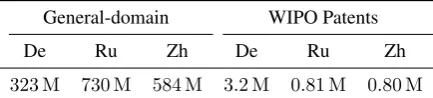
General-domain WIPO Patents
De Ru Zh De Ru Zh
[image:3.595.308.525.63.112.2]323 M 730 M 584 M 3.2 M 0.81 M 0.80 M
Table 1: # English words in the training corpora.
near θˆG. Thus we assume DG |= DS|θ during continued training. This allows us to approximate
logp(DS|DG, θ)inEquation 2withlogp(DS|θ),
which is simply the likelihood function onDS.
3.4 EWC Loss
Combining the approximations above results in the EWC loss used in continued training:
LEW C(θ)=LSN LL(θ)+λ
X
i ¯ Fi,i
h
θi−θˆGi
i2 (3)
WhereLSN LL(θ) is the standard NLL loss onDS
andλis a hyper-parameter which weights the im-portance of the general-domain task. Note that the left-hand side of Equation 3 is still the loss over both the general- and in-domain translation tasks, but the right-hand side is based only on in-domain data. All information from the general-domain data has been collapsed into the second term, which is in the form of a regularizer.
4 Experiments
Our general-domain training data is the concatena-tion of the parallel porconcatena-tions of the WMT17 news translation task (Bojar et al.,2017) and OpenSub-titles18 (Lison et al.,2018) corpora. For De↔En and Ru↔En, we usenewstest2017and the fi-nal2500lines of OpenSubtitles as our test set. We
use newstest2016 and the penultimate 2500
lines of OpenSubtitles as the development set. For Zh↔En, we use the final and penultimate 4000
lines of the UN portion of the WMT data and the final and penultimate2500lines of OpenSubtitles as our test and development sets, respectively.
We use the World Intellectual Property Or-ganization (WIPO) COPPA-V2 corpus ( Junczys-Dowmunt et al., 2016) as our in-domain dataset. The WIPO data consist of parallel sentences from international patent application abstracts. WIPO De↔En data are large enough to train strong in-domain systems (Thompson et al., 2018), so we truncate to 100k lines to simulate a more interest-ing domain adaptation scenario.
tok-25 30 35 40 5
10 15 20 25
En→De
20 25 30 35
10 15 20
En→Ru
10 20 30 40
10 20 30 40
En→Zh
35 40 45 50
10 20 30
De→En
25 30 35 40
10 15 20 25 30
Ru→En
10 20 30 40
10 20 30 40
Zh→En
In-Domain BLEU
General-Domain
BLEU
[image:4.595.104.500.63.352.2]General-Domain Model Continued Training MCL EWC (this work)
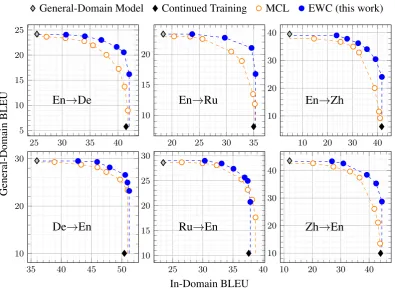
Figure 1: Performance trade-off for MCL and EWC: Convex hull of grid search over learning rate and regulariza-tion amount.x-axis is in-domain BLEU andy-axis is general-domain BLEU, so the desired operating point is the top right corner. Initial general-domain model (GD) and continued training (CT) points are shown for comparison.
enizer (Koehn et al.,2007) and byte-pair encoding (BPE) (Sennrich et al., 2016). We train separate BPE models for the source and target languages, each with a vocabulary size of approximately 30k. BPE is trained on the out-of-domain corpus only and then applied to the training, development, and test data for both out-of-domain and in-domain datasets. Token counts for corpora are shown in Table1.
We implemented5both EWC and MCL in Sock-eye (Hieber et al.,2017). To avoid floating point issues, we normalize the empirical Fisher diago-nal to have a mean value of 1.0instead of divid-ing by the number of sentences. For efficiency, we compute gradients for a batch of sentences prior to squaring and accumulating them. Fisher regular-ization is implemented as weight decay (towards
ˆ
θG) in Adam (Kingma and Ba,2014).
Preliminary experiments in Ru→En found no meaningful difference in general-domain or in-domain performance when computing the diago-nal ofF¯ on varying amounts of data ranging from 500k sentences to the full dataset. We also tried computing the diagonal ofF¯ on held-out data, as
5github.com/thompsonb/sockeye_ewc
there is some evidence that estimating Fisher on held out data reduces overfitting in natural gradi-ent descgradi-ent (Pascanu and Bengio, 2013). How-ever, we again found no meaningful differences. All results presented herein estimate the the diag-onal ofF¯ on 500k training data sentences, which took less than an hour on a GTX 1080 Ti GPU.
We use a two-layer LSTM network with hid-den unit size 512. The general-domain models are trained with a learning rate of 3E-4. We use dropout (0.1) on both RNN inputs and states. We compute lower-casedmulti-bleu.perl. We use label smoothing (0.1) for all experiments ex-cept with MCL, because MCL explicitly regular-izes the output distribution.
MCL uses an interpolation of the cross entropy between the output distribution of the model be-ing trained and the general-domain models output distribution (scaled by α) and the standard train-ing loss (scaled by1−α). For MCL, we do a grid search over learning rates (10−4,10−5,10−6) and
20 25 30 35 10
15 20
In-domain BLEU
General-domain
BLEU
General-Domain Cont. Training MCL LR=10−6 EWC LR=10−6
MCL LR=10−5 EWC LR=10−5
[image:5.595.307.532.59.158.2]MCL LR=10−4 EWC LR=10−4
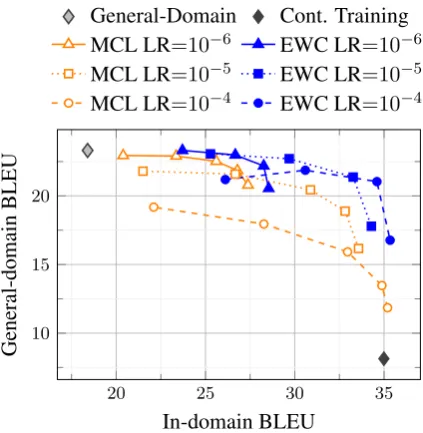
Figure 2: En→Ru results for various learning rates, for both MCL and EWC. Regularization amount increases from left to right for each trace. General-domain and continued training points shown for reference.
5 Results
We present the full in- and general-domain per-formance trade-off6 for both EWC and MCL in
Figure 1. This is computed by taking the con-vex hull of a grid search over learning rate and regularization amount for each method. EWC outperforms MCL at all operating points with the exception of Ru→En, where MCL provides a small in-domain performance improvement at lower general-domain performance; this was also observed inKhayrallah et al.(2018).
Figure 2shows an example result (for En→Ru) of the grid search prior to taking the convex hull. We see similar trends between the three pairs of MCL/EWC curves at corresponding learning rates, but in each case EWC is further up/right, indicating better performance. Note that for both EWC and MCL, both learning rate and regulariza-tion amount have a large impact on final in- and general-domain performance.
General-domain gains fornoin-domain perfor-mance degradation are presented in Table 2. Our method provides large general-domain gains (be-tween 8.0 and 18.1 BLEU), regaining the majority of general-domain performance lost in continued training and substantially outperforming MCL.
6Previous work has compared single runs of competing
methods, making comparison difficult (e.g. one system may be better on in-domain, the other better on general-domain).
Langs GD CT MCL EWC
[image:5.595.75.287.63.280.2]En→De 24.2 5.7 9.0 (+3.2) 16.2(+10.5) De→En 29.6 10.0 23.3 (+13.3) 26.6(+16.5) En→Ru 23.3 8.1 11.8 (+3.7) 16.8 (+8.6) Ru→En 28.6 10.4 21.2 (+10.8) 21.5(+11.1) En→Zh 39.5 6.1 6.1 (+0.0) 24.1(+17.9) Zh→En 43.5 9.9 9.9 (+0.0) 28.7(+18.8)
Table 2: General-domain BLEU for: general-domain model prior to adaptation (GD), standard continued training (CT), and best performing MCL and EWC models withnoin-domain degradation compared to CT (delta from CT). Best improvement over CT bolded.
6 Conclusion
We interpret the general-domain performance drop experienced during continued training as catastrophic forgetting of general-domain knowl-edge and demonstrate that it can be largely miti-gated by applying Elastic Weight Consolidation.
We present the full trade-off for in- and general-domain performance and show that our method outperforms MCL (Dakwale and Monz, 2017) at all operating points in five of six language pairs. Our method is able to regain the majority of the general-domain performance lost during con-tinued training without compromising in-domain performance and without an additional memory or computational burden at translation-time.
Our method retains the advantages of continued training while addressing one of its main short-comings and can be used in practical situations to avoid poor performance when general-domain in-put is encountered, even when in-domain perfor-mance and translation efficiency are both critical.
Acknowledgments
The authors thank Paul McNamee, Matt Post, Zach Wood-Doughty, and the Johns Hopkins 2018 SCALE participants for for helpful discussions and technical assistance.
References
Ondˇrej Bojar, Rajen Chatterjee, Christian Federmann, Yvette Graham, Barry Haddow, Shujian Huang, Matthias Huck, Philipp Koehn, Qun Liu, Varvara Logacheva, Christof Monz, Matteo Negri, Matt Post, Raphael Rubino, Lucia Specia, and Marco Turchi. 2017. Findings of the 2017 conference on machine translation (WMT17). InProceedings of the Second Conference on Machine Translation, Volume 2: Shared Task Papers, pages 169–214, Copenhagen, Denmark. Association for Computa-tional Linguistics.
Patrick Cadwell, Sharon OBrien, and Carlos SC Teix-eira. 2018. Resistance and accommodation: fac-tors for the (non-) adoption of machine transla-tion among professional translators. Perspectives, 26(3):301–321.
Chenhui Chu, Raj Dabre, and Sadao Kurohashi. 2017. An empirical comparison of domain adaptation methods for neural machine translation. In Pro-ceedings of the 55th Annual Meeting of the Associa-tion for ComputaAssocia-tional Linguistics (Volume 2: Short Papers), pages 385–391. Association for Computa-tional Linguistics.
Praveen Dakwale and Christof Monz. 2017. Fine-tuning for neural machine translation with limited degradation across in-and out-of-domain data. Pro-ceedings of the XVI Machine Translation Summit, page 117.
Markus Freitag and Yaser Al-Onaizan. 2016. Fast Do-main Adaptation for Neural Machine Translation. CoRR, abs/1612.06897.
Ian J Goodfellow, Mehdi Mirza, Da Xiao, Aaron Courville, and Yoshua Bengio. 2013. An em-pirical investigation of catastrophic forgetting in gradient-based neural networks. arXiv preprint arXiv:1312.6211.
Felix Hieber, Tobias Domhan, Michael Denkowski, David Vilar, Artem Sokolov, Ann Clifton, and Matt Post. 2017. Sockeye: A toolkit for neural machine translation. arXiv preprint arXiv:1712.05690.
Geoffrey Hinton, Oriol Vinyals, and Jeffrey Dean. 2015. Distilling the knowledge in a neural net-work. InNeurIPS Deep Learning and Representa-tion Learning Workshop.
Marcin Junczys-Dowmunt, Bruno Pouliquen, and Christophe Mazenc. 2016. COPPA V2.0: Corpus of Parallel Patent Applications building large parallel corpora with GNU make. In4th Workshop on Chal-lenges in the Management of Large Corpora Work-shop Programme.
Opinions, interpretations, conclusions and recommdations are those of the authors and are not necessarily en-dorsed by the United States Government. Cleared for public release on 14 Jan 2019. Originator reference number RH-19-119318. Case number 88ABW-2019-0136.
Huda Khayrallah, Brian Thompson, Kevin Duh, and Philipp Koehn. 2018. Regularized training objec-tive for continued training for domain adaptation in neural machine translation. InProceedings of the 2nd Workshop on Neural Machine Translation and Generation, pages 36–44. Association for Computa-tional Linguistics.
Yoon Kim and Alexander M. Rush. 2016. Sequence-level knowledge distillation. InProceedings of the 2016 Conference on Empirical Methods in Natural Language Processing, pages 1317–1327. Associa-tion for ComputaAssocia-tional Linguistics.
Diederik P Kingma and Jimmy Ba. 2014. Adam: A method for stochastic optimization. arXiv preprint arXiv:1412.6980.
James Kirkpatrick, Razvan Pascanu, Neil Rabinowitz, Joel Veness, Guillaume Desjardins, Andrei A Rusu, Kieran Milan, John Quan, Tiago Ramalho, Ag-nieszka Grabska-Barwinska, et al. 2017. Overcom-ing catastrophic forgettOvercom-ing in neural networks. Pro-ceedings of the national academy of sciences, page 201611835.
Philipp Koehn, Hieu Hoang, Alexandra Birch, Chris Callison-Burch, Marcello Federico, Nicola Bertoldi, Brooke Cowan, Wade Shen, Christine Moran, Richard Zens, Chris Dyer, Ondrej Bojar, Alexandra Constantin, and Evan Herbst. 2007. Moses: Open Source Toolkit for Statistical Machine Translation. In Proceedings of the 45th Annual Meeting of the Association for Computational Linguistics Compan-ion Volume Proceedings of the Demo and Poster Sessions, Prague, Czech Republic. Association for Computational Linguistics.
Philipp Koehn and Rebecca Knowles. 2017. Six Chal-lenges for Neural Machine Translation. In Pro-ceedings of the 1st Workshop on Neural Machine Translation (and Generation) at ACL. Association for Computational Linguistics.
Pierre Lison, J¨org Tiedemann, and Milen Kouylekov. 2018. OpenSubtitles2018: Statistical Rescoring of Sentence Alignments in Large, Noisy Parallel Cor-pora. InProceedings of the Eleventh International Conference on Language Resources and Evaluation (LREC 2018), Miyazaki, Japan. European Language Resources Association (ELRA).
Minh-Thang Luong and Christopher D. Manning. 2015. Stanford Neural Machine Translation Sys-tems for Spoken Language Domain. In Interna-tional Workshop on Spoken Language Translation, Da Nang, Vietnam.
David J. C. MacKay. 1992. A practical Bayesian framework for backpropagation networks. Neural Computation, 4(3):448–472.
Antonio Valerio Miceli Barone, Barry Haddow, Ulrich Germann, and Rico Sennrich. 2017. Regularization techniques for fine-tuning in neural machine trans-lation. In Proceedings of the 2017 Conference on Empirical Methods in Natural Language Process-ing, pages 1489–1494, Copenhagen, Denmark. As-sociation for Computational Linguistics.
Razvan Pascanu and Yoshua Bengio. 2013. Revisiting natural gradient for deep networks. arXiv preprint arXiv:1301.3584.
Victoria Porro Rodriguez, Lucia Morado Vazquez, and Pierrette Bouillon. 2017. Study on the use of ma-chine translation and post-editing in swiss-based language service providers.Parall`eles, (29 (2)).
Rico Sennrich, Barry Haddow, and Alexandra Birch. 2015. Improving neural machine translation models with monolingual data. arXiv preprint arXiv:1511.06709.
Rico Sennrich, Barry Haddow, and Alexandra Birch. 2016. Neural Machine Translation of Rare Words with Subword Units. InProceedings of the 54th An-nual Meeting of the Association for Computational Linguistics, Berlin, Germany. Association for Com-putational Linguistics.
Brian Thompson, Huda Khayrallah, Antonios Anasta-sopoulos, Arya D. McCarthy, Kevin Duh, Rebecca Marvin, Paul McNamee, Jeremy Gwinnup, Tim An-derson, and Philipp Koehn. 2018. Freezing subnet-works to analyze domain adaptation in neural ma-chine translation. InProceedings of the Third Con-ference on Machine Translation: Research Papers, pages 124–132, Belgium, Brussels. Association for Computational Linguistics.