Continuous multilinguality with language vectors
Robert Östling
Department of Linguistics∗
Stockholm University [email protected]
Jörg Tiedemann
Department of Modern Languages University of Helsinki
Abstract
Most existing models for multilingual nat-ural language processing (NLP) treat lan-guage as a discrete category, and make predictions for either one language or the other. In contrast, we propose using continuous vector representations of lan-guage. We show that these can be learned efficiently with a character-based neural language model, and used to improve in-ference about language varieties not seen during training. In experiments with 1303 Bible translations into 990 different lan-guages, we empirically explore the ca-pacity of multilingual language models, and also show that the language vectors capture genetic relationships between lan-guages.
1 Introduction
Neural language models (Bengio et al., 2003; Mikolov et al., 2010; Sundermeyer et al., 2012) have become an essential component in several ar-eas of natural language processing (NLP), such as machine translation, speech recognition and im-age captioning. They have also become a common benchmarking application in machine learning re-search on recurrent neural networks (RNN), be-cause producing an accurate probabilistic model of human language is a very challenging task which requires all levels of linguistic analysis, from pragmatics to phonology, to be taken into ac-count.
A typical language model is trained on text in a single language, and if one needs to model mul-tiple languages the standard solution is to train a
∗
Work done while the author was at the University of Helsinki
separate model for each language. This presup-poses large quantities of monolingual data in each of the languages that needs to be covered and each model with its parameters is completely indepen-dent of any of the other models.
We propose instead to use a single model with real-valued vectors to indicate the language used, and to train this model with a large number of languages. We thus get a language model whose predictive distributionp(xt|x1...t−1, l)is a
contin-uous function of the language vectorl, a property that is trivially extended to other neural NLP mod-els. In this paper, we explore the “language space” containing these vectors, and in particular explore what happens when we move beyond the points representing the languages of the training corpus.
The motivation of combining languages into one single model is at least two-fold: First of all, languages are related and share many features and properties, a fact that is ignored when using inde-pendent models. The second motivation is data sparseness, an issue that heavily influences the reliability of data-driven models. Resources are scarce for most languages in the world (and also for most domains in otherwise well-supported lan-guages), which makes it hard to train reasonable parameters. By combining data from many lan-guages, we hope to mitigate this issue.
In contrast to related work, we focus on mas-sively multilingual data sets to cover for the first time a substantial amount of the linguistic diver-sity in the world in a project related to data-driven language modeling. We do not presuppose any prior knowledge about language similarities and evolution and let the model discover relations on its own purely by looking at the data. The only supervision that is giving during training is a lan-guage identifier as a one-hot encoding. From that and the actual training examples, the system learns dense vector representations for each language
cluded in our data set along with the character-level RNN parameters of the language model it-self.
2 Related Work
Multilingual language models is not a new idea (Fugen et al., 2003), the novelty of our work lies primarily in the use of language vectors and the empirical evaluation using nearly a thousand lan-guages.
Concurrent with this work, Johnson et al. (2016) conducted a study using neural machine transla-tion (NMT), where a sub-word decoder is told which language to generate by means of a special language identifier token in the source sentence. This is close to our model, although beyond a sim-ple interpolation experiment (as in our Section 5.3) they did not further explore the language vectors, which would have been challenging to do given the small number of languages used in their study. Ammar et al. (2016) used one-hot language identifiers as input to a multilingual word-based dependency parser, based on multilingual word embeddings. Given that they report this result-ing in higher accuracy than usresult-ing features from a typological database, it is a reasonable guess that their system learned language vectors which were able to encode syntactic properties relevant to the task. Unfortunately, they also did not look closer at the language vector space, which would have been interesting given the relatively large and di-verse sample of languages represented in the Uni-versal Dependencies treebanks.
Our evaluation in Section 5.2 calls to mind pre-vious work on automatic language classification, by Wichmann et al. (2010) among others. How-ever, our purpose is not to detect genealogical re-lationships, even though we use the strong correla-tion between such classificacorrela-tions and our language vectors as evidence that the vector space captures sensible information about languages.
3 Data
We base our experiments on a large collection of Bible translations crawled from the web, coming from various sources and periods of times. Any other multilingual data collection would work as well, but with the selected corpus we have the ad-vantage that we cover the same genre and roughly the same coverage for each language involved. It is also easy to divide the data into training and test
Language
vector
h e l l o
h e l l
<s>
64
64
[image:2.595.307.513.61.206.2]64
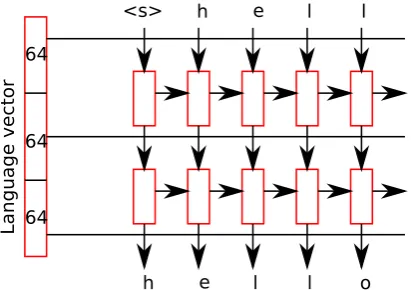
Figure 1: Schematic of our model. The three parts of the language vector are concatenated with the inputs to the two LSTM:s and the final softmax layer.
sets by using Bible verse numbers, which allows us to control for semantic similarity between lan-guages in a way that would have been difficult in a corpus that is not multi-parallel. Altogether we have 1,303 translations in 990 languages that we can use for our purposes. These were chosen so that the model alphabet size is below 1000 sym-bols, which was satisfied by choosing only trans-lations in Latin, Cyrillic or Greek script.
Certainly, there are disadvantages as well, such as the limited size (roughly 500 million tokens in total, with most languages having only one trans-lation of the New Testament each, with roughly 200 thousand tokens), the narrow domain and the high overlap of named entities. The latter can lead to some unexpected effects when using nonsensi-cal language vectors, as the model will then gen-erate a sequence of random names.
4 Methods
Our model is based on a standard stacked character-based LSTM (Hochreiter and Schmid-huber, 1997) with two layers, followed by a hid-den layer and a final output layer with softmax ac-tivations. The only modification made to accom-modate the fact that we train the model with text in nearly a thousand languages, rather than one, is that language embedding vectors are concate-nated to the inputs of the LSTMs at each time step and the hidden layer before the softmax. We used three separate embeddings for these levels, in an attempt to capture different types of information about languages.1 The model structure is
summa-rized in Figure 1.
In our experiments we use 1024-dimensional LSTMs, 128-dimensional character embeddings, and 64-dimensional language embeddings. Layer normalization (Ba et al., 2016) is used, but no dropout or other regularization since the amount of data is very large (about 3 billion characters) and training examples are seen at most twice. For smaller models early stopping is used. We use Adam (Kingma and Ba, 2015) for optimization. Training takes between an hour and a few days on a K40 GPU, depending on the data size.
5 Results
In this section, we present several experiments with the model described. For exploring the lan-guage vector space, we use hierarchical agglomer-ative clustering for visualization. For measuring performance, we use cross-entropy on held out-data. For this, we use a set of the 128 most com-monly translated Bible verses, to ensure that the held-out set is as large and overlapping as possible among languages.
5.1 Model capacity
Our first experiment tries to answer what happens when more and more languages are added to the model. There are two settings: adding languages in a random order, or adding the most closely re-lated languages first. Cross-entropy plots for these settings are shown in Figure 2 and Figure 3.
In both cases, the model degrades gracefully (or even improves) for a number of languages, but then degrades linearly (i.e. exponential growth of 1The embeddings at the different levels are different, but
we did not see any systematic variation. We also found that using the same embedding everywhere gives similar results.
0.8 1 1.2 1.4 1.6 1.8 2 2.2
1 10 100 1000
Test set cross-entropy
[image:3.595.308.525.65.204.2]Number of languages Chayahuita (Cahuapanan, Peru) Konkomba (Gur, Ghana/Togo) Tawala (Oceanic, Papua New Guinea) Benabena (Goroka, Papua New Guinea))
Figure 2: Cross-entropy of the test sets from the first four languages added to our model. At the leftmost point (x = 1), only Chayahuita is used for training the model so no results are available for the other languages.
1 1.2 1.4 1.6 1.8 2 2.2 2.4 2.6
1 10 100 1000
Test set cross-entropy
Number of languages Danish
Norwegian (Nynorsk) Norwegian (Bokmal) Swedish
Figure 3: Cross-entropy of the test sets from Scandinavian languages. The languages added at each step are: Swedish, Norwegian+Danish, Ice-landic+Faroese, remaining Germanic, remaining Indo-European, all remaining languages.
1 1.2 1.4 1.6 1.8 2 2.2 2.4 2.6
1 10 100 1000
Test set cross-entropy (Swedish)
Parameter reduction factor, Number of languages total parameters
LSTM parameters languages
[image:3.595.309.522.300.435.2] [image:3.595.309.521.532.665.2]perplexity) with exponentially increasing number of languages.
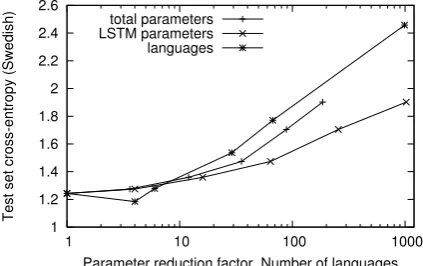
For comparison, Figure 4 compares this to the effect of decreasing the number of parameters in the LSTM by successively halving the hidden state size.2 Here the behavior is similar, but unlike the
Swedish model which got somewhat better when closely related languages were added, the increase in cross-entropy is monotone. It would be inter-esting to investigate how the number of model parameters needs to be scaled up in order to ac-commodate the additional languages, but unfortu-nately the computational resources for such an ex-periment increases with the number of languages and would not be practical to carry out with our current equipment.
5.2 Structure of the language space
We now take a look at the language vectors found during training with the full model of 990 lan-guages. Figure 5 shows a hierarchical clustering of the subset of Germanic languages, which closely matches the established genetic relationships in this language family. While our experiments in-dicate that finding more remote relationships (say, connecting the Germanic languages to the Celtic) is difficult for the model, it is clear that the lan-guage vectors preserves similarity properties be-tween languages.
In additional experiments we found the overall structure of these clusterings to be relatively sta-ble across models, but for very similar languages (such as Danish and the two varieties of Norwe-gian) the hierarchy might differ, and the some holds for languages or groups that are significantly different from the major groups. An example from Figure 5 is English, which is traditionally clas-sified as a West Germanic language with strong influences from North Germanic as well as Ro-mance languages. In the figure English is (weakly) grouped with the West Germanic languages, but in other experiments it is instead weakly grouped with North Germanic.
5.3 Generating Text
Since our language model is conditioned on a lan-guage vector, we can gain some intuitive under-standing of the language space by generating text from different points in it. These points could be 2Note that two curves are given, one countingallmodel
parameters and one counting only the LSTM parameters. The latter dominates the model size for large hidden states.
0.0 0.1 0.2 0.3 0.4 0.5 0.6 0.7 0.8 Faroese
[image:4.595.308.516.72.192.2]IcelandicSwedish NynorskDanish BokmålEnglish M. EnglishFrisian German AfrikaansDutch
Figure 5: Hierarchical clustering of language vec-tors of Germanic languages.
0.0 0.2 0.4 0.6 0.8 1.0 (1-x) English + x German
1.0 1.5 2.0 2.5 3.0 3.5 4.0 4.5
Cross-entropy (King James Version, English)
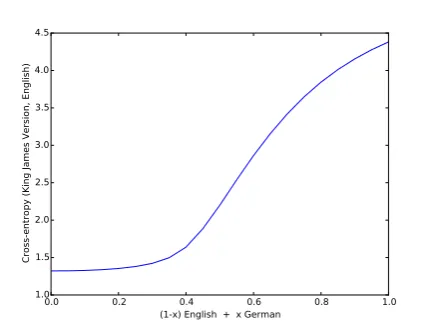
Figure 6: Cross-entropy of interpolated language models for English and German measured on En-glish held-out text.
either one of the vectors learned during training, or some arbitrary other point. Table 1 shows text samples from different points along the line be-tween Modern English [eng] and Middle English [enm]. Consistent with the results of Johnson et al. (2016), it appears that the interesting region lies rather close to 0.5. Compare also to our Figure 6, which shows that up until about a third of the way between English and German, the language model is nearly perfectly tuned to English.
5.4 Mixing and Interpolating Between Languages
By means of cross-entropy, we can also visualize the relation between languages in the multilingual space. Figure 6 plots the interpolation results for two relatively dissimilar languages, English and German. As expected, once the language vector moves too close to the German one, model perfor-mance drops drastically.
[image:4.595.309.526.245.407.2]0.0 0.2 0.4 0.6 0.8 1.0 (1-x) Modern English + x Middle English
1.26 1.28 1.30 1.32 1.34 1.36 1.38 1.40
[image:5.595.81.278.73.223.2]Cross-entropy (King James Version)
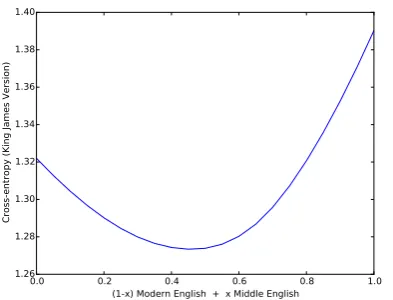
Figure 7: Cross-entropy of interpolated language models for modern and middle English tested on data from the King James Bible.
we interpolate between two language variants and compute cross-entropy of a text that repre-sents an intermediate form. Figure 7 shows the cross-entropy of the King James Version of the Bible (published 1611), when interpolating be-tween Modern English (1500–) and Middle En-glish (1050–1500). The optimal point turns out to be close to the midway point between them.
5.5 Language identification
If we have a sample of an unknown language or language variant, it is possible to estimate its guage vector by backpropagating through the guage model with all parameters except the lan-guage vector fixed.3We found that a very small set
of sentences is enough to give a considerable im-provement in cross-entropy on held-out sentences. In this experiment, we used 32 sentences from the King James Version of the Bible. Using the re-sulting language vector, test set cross-entropy im-proved from 1.39 (using the Modern English lan-guage vector as initial value) to 1.35. This is com-parable to the result obtained in Section 5.4, ex-cept that here we do not restrict the search space to points on a straight line between two language vectors.
6 Conclusions
We have shown thatlanguage vectors, dense vec-tor representations of natural languages, can be 3In practice, using error backpropagation is too
computa-tionally expensive for most applications, and we use it here because it requires only minimal modifications to our model. A more reasonable method could be to train a separate lan-guage vector encoder network.
Table 1: Examples generated by interpolating be-tween Modern English and Middle English.
% Random sample
(temperature parameterτ= 0.5)
30 and thei schulen go in to alle these thingis, and schalt endure bothe in the weie
40 and there was a certaine other person who was called in a dreame that he went into a mountaine. 44 and the second sacrifice, and the father, and the
prophet, shall be given to it.
48 and god sayd, i am the light of the world, and the powers of the enemies of the most high god may find first for many.
50 but if there be some of the seruants, and to all the people, and the angels of god, and the prophets 52 then he came to the gate of the city, and the bread
was to be brought
56 therefore, behold, i will lose the sound of my soul, and i will not fight it into the land of egypt 60 and the man whom the son of man is born of god,
so have i therefore already sent to the good news of christ.
learned efficiently from raw text and possess sev-eral interesting properties. First, they capture lan-guage similarity to the extent that lanlan-guage family trees can be reconstructed by clustering the vec-tors. Second, they allow us to interpolate between languages in a sensible way, and even allow adopt-ing the model usadopt-ing a very small set of text, simply by optimizing the language vector.
References
Waleed Ammar, George Mulcaire, Miguel Ballesteros, Chris Dyer, and Noah Smith. 2016. Many lan-guages, one parser. Transactions of the Association for Computational Linguistics, 4:431–444.
Jimmy Lei Ba, Jamie Ryan Kiros, and Geoffrey E. Hin-ton. 2016. Layer normalization. ArXiv e-prints, July.
Yoshua Bengio, Réjean Ducharme, Pascal Vincent, and Christian Janvin. 2003. A neural probabilistic lan-guage model. Journal of Machine Learning Re-search, 3:1137–1155, March.
Christian Fugen, Sebastian Stuker, Hagen Soltau, Flo-rian Metze, and Tanja Schultz. 2003. Efficient handling of multilingual language models. In2003 IEEE Workshop on Automatic Speech Recognition and Understanding, pages 441–446, Nov.
[image:5.595.311.536.105.337.2]Melvin Johnson, Mike Schuster, Quoc V. Le, Maxim Krikun, Yonghui Wu, Zhifeng Chen, Nikhil Tho-rat, Fernanda B. Viégas, Martin Wattenberg, Greg Corrado, Macduff Hughes, and Jeffrey Dean. 2016. Google’s multilingual neural machine translation system: Enabling zero-shot translation. CoRR, abs/1611.04558.
Diederik P. Kingma and Jimmy Ba. 2015. Adam: A method for stochastic optimization. The Interna-tional Conference on Learning Representations. Tomáš Mikolov, Martin Karafiát, Lukáš Burget, Jan
ˇCernocký, and Sanjeev Khudanpur. 2010. Recur-rent neural network based language model. In IN-TERSPEECH 2010, pages 1045–1048.
Martin Sundermeyer, Ralf Schlüter, and Hermann Ney. 2012. LSTM neural networks for language model-ing. InINTERSPEECH 2012, pages 194–197. Søren Wichmann, Eric W. Holman, Dik Bakker, and