End-to-End Trainable Attentive Decoder for Hierarchical Entity
Classification
Sanjeev Kumar Karn1,2, Ulli Waltinger2and Hinrich Sch¨utze1 1LMU Munich
2Siemens Corporate Technology Munich
2{sanjeev.kumar karn,ulli.waltinger}@siemens.com
Abstract
We address fine-grained entity classifica-tion and propose a novel attenclassifica-tion-based recurrent neural network (RNN) encoder-decoder that generates paths in the type hierarchy and can be trained end-to-end. We show that our model performs better on fine-grained entity classification than prior work that relies on flat or local clas-sifiers that do not directly model hierarchi-cal structure.
1 Introduction
Many tasks in natural language processing involve hierarchical classification, e.g., fine-grained mor-phological and part-of-speech tags form a hierar-chy (Mueller et al., 2013) as do many large topic sets (Lewis et al., 2004). The task definition can either specify that a single path is correct, corre-sponding to a single-label classification problem at the lowest level of the hierarchy, e.g., in fine-grained morphological tagging; or that multiple paths can be correct, corresponding to a multilabel classification problem at the lowest level of the hi-erarchy, e.g., in topic classification.
In this paper, we address fine-grained entity mention classification, another problem with a hierarchical class structure. In this task, each mention can have several fine-grained types, e.g., Obama is both a politician and an author in a con-text in which his election is related to his prior suc-cess as a best-selling author; thus, the problem is multilabel at the lowest level of the hierarchy.
Two standard approaches to hierarchical classi-fication are flat and local classiclassi-fication. In flat clas-sification (e.g., FIGER (Ling and Weld, 2012), At-tentive Encoder (Shimaoka et al., 2016; Shimaoka et al., 2017)), the task is formalized as a flat mul-ticlass multilabel problem. In local classification (Gillick et al., 2014; Yosef et al., 2012; Yogatama
et al., 2015), a separate local classifier is learned for each node of the hierarchy. In both approaches, some form of postprocessing is necessary to make the decisions consistent, e.g., an entity can only be a celebrity if they are also a person.
In this paper, we propose an attentive RNN encoder-decoder for hierarchical classification. The encoder-decoder performs classification by generating paths in the hierarchy from top node to leaf nodes. Thus, we model the structure of the hierarchy more directly than prior work. On each step of the path, part of the input to the encoder-decoder is an attention-weighted sum of the states of a bidirectional Gated Recurrent Unit (GRU) (Cho et al., 2014) run over the context of the men-tion to be classified. Unlike prior work on hierar-chical entity classification, our architecture can be trained end-to-end. We show that our model per-forms better than prior work on the FIGER dataset (Ling and Weld, 2012).
This paper is structured as follows. In Section 2, we provide a detailed description of our model PthDCode. In Section 3, we describe and analyze our experiments. In Section 4, we discuss related work. Section 5 concludes.
2 Model
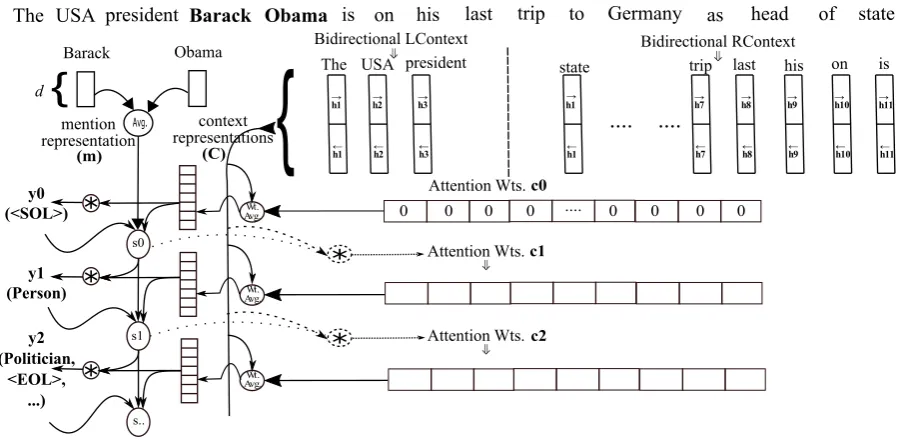
Figure 1 displays our model PthDCode.
We use lowercase italics for variables, upper-case italics for sequences, lowerupper-case bold for vec-tors and uppercase bold for matrices. Sentence
S = hx1, . . . ,x|S|i is a sequence of words,
rep-resented as embeddingsxi, each of dimensiond. The classes of an entity are represented asy, a vec-tor oflbinary indicators, each indicating whether the corresponding class is correct. Hidden states of forward and backward encoders and of the de-coder have dimensionalityp.
PthDCode extracts mention hxb, . . . ,xri, right context Rc = hxr+1, . . . ,xr+wi and left context
Lc = hxb−1, . . . ,xb−wi where w is a parameter.
d
←
h1 ←h2 ←h3 ←h1 h7← ←h8 ←h9 ←h10 ←h11
→
h1 →h2 →h3 h1 →h7 →h8 →h9 →h10 →h11 Bidirectional LContext
⇓ Bidirectional RContext⇓
Attention Wts.
⇓
Attention Wts.
⇓
.... ....
Wt. Avg.
Wt. Avg. Avg.
*
*
*
*
*
Wt. Avg.
y0 (<SOL>)
y1 (Person)
y2 (Politician,
<EOL>, ...)
mention representation
context representations
s0
s1
s..
c1
c2
(m) (C)
0 0 0 0 .... 0 0 0 0
Barack Obama
The USA president state trip last his on is
The USA president Barack Obama is on his last trip to Germany as head of state
Attention Wts.c0
[image:2.595.75.526.60.280.2]→
Figure 1: PthDCode, the attentive encoder-decoder for hierarchical entity classification
The representationmof the mention is computed as the average of itsr−b+ 1vectors. The context is represented byC, a matrix of size2w×2p; each column ofCconsists of two hidden state vectorsh (each of dimension2p), corresponding to forward and backward GRUs run onLcandRc.
The initial states0of PthDCode’s decoder RNN is computed using the mention representation m compressed to p dimensions by an extra hidden layer (not shown in the figure). Initial outputy0 is a dummy symbol SOL (Start Of Label), and ini-tial attention weights c0 are set to zero. At each path generation step i, attention weights αij are computed following Bahdanau et al. (2014):
αij = P2wexp(eij)
j=1exp(eij) (1)
eij =att(si−1,C.j) (2)
where att is a feedforward network with softmax output layer andC.jis thejth column ofC. The final context representation for the decoder is then computed as ci = P2wj=1αijC.j. In Figure 1, dashed objects are used for indicating involvement in calculating attention weights.
The attention-weighted sum ci and the current state si−1 are used to predict the distribution yi over entity classes (non-dashed *-nodes in Fig-ure 1):
yi=g(si−1,ci) (3)
where g is a feedforward network with element-wise sigmoid. Finally, PthDCode uses prediction
yi, weighted averageci and previous statesi−1 to compute the next state:
si =f(si−1,yi,ci) (4)
The loss function at each step or level is binary cross-entropy:
1
l
l X
k=1
−tiklog(yik)−(1−tik) log(1−yik) (5)
whereyi andti are prediction and truth andlthe number of classes. The objective is to minimize the total loss, i.e., the sum of the losses at each level. During inference, we compute the Cartesian product of predicted types at each level and filter out those paths that do not occur in train.
3 Experiments and results
Dataset.We use the Wiki dataset (Ling and Weld, 2012) published by Ren et al. (2016).1 It consists of 2.69 million mentions obtained from 1.5 million sentences sampled from Wikipedia articles. These mentions are tagged with 113 types with a max-imum of two levels of hierarchy. Ling and Weld (2012) also created a test set of 434 sentences that contain 562 gold entity mentions. Similar to prior work (Ling and Weld, 2012; Ren et al., 2016; Yo-gatama et al., 2015; Shimaoka et al., 2017), we randomly sample a training set of 2 million and a disjoint dev set of size 500.
0 0.1 0.2 0.3 0.4 0.5 0.6 0.7 0.8 0.9
0 5 10 15 20 25 30
Pe
rf
or
m
an
ce
s
iterations(x2000)
Test and Development performances along the training iteration
[image:3.595.75.290.68.199.2]Evaluation Metrics dev_strict dev_macro dev_micro test_strict test_macro test_micro
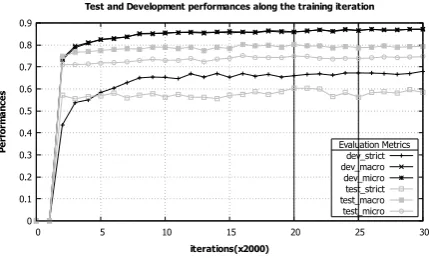
Figure 2: Learning curve
Evaluation. Like prior work, we use three F1 metrics, strict, loose macro and loose micro, that differ in the definition of precision P and recall
R. Letnbe the number of mentions, Ti the true set of tags of mention iandYi the predicted set. Then, we defineP =R = 1/nPi=1n δ(Yi =Ti) for strict; P = 1/nPni=1(|Yi ∩Ti|)/(|Yi|) and
R= 1/nPni=1(|Yi∩Ti|)/(|Ti|)for loose macro; andP = (Pni=1|Yi ∩Ti|)/(Pni=1|Yi|)andR =
(Pni=1|Yi∩Ti|)/(Pni=1|Ti|)) for loose micro. Parameter Settings. We use pre-trained word embeddings of size 300 provided by (Pennington et al., 2014). OOV vectors are randomly initial-ized. Similar to (Shimaoka et al., 2017), all hid-den stateshof the encoder-decoder were set to 100 dimension and mention lengths mto 5. Window size isw= 15. We bracket left and right contexts with special start and end symbols. For short left / right contexts, we bracket with additional different start / end symbols that are masked out for calcula-tion of loss and attencalcula-tion weights. Another special symbol EOL (End Of Label) is appended to short paths, so that all hierarchical paths have the same length. We use ADAM (Kingma and Ba, 2014) with learning rate .001 and batch size 500. Fol-lowing (Srivastava et al., 2014), we regularize our learning by dropout of states used in computing prediction as in Eq. 3 with probability of .5. Simi-larly, we also drop out feedback connections used in computing next states as in Eq. 4 with probabil-ity of .2. We also add Gaussian noise with a proba-bility of .1 to feedforward weights. The weights of feedforward units are initialized with an isotropic Gaussian distribution having mean 0 and standard deviation .02 while weights of recurrent units are initialized with random orthogonal matrix.
Results.As shown in Figure 2, we evaluate our model on dev and test sets after every 2k iterations
and report the performances of the models that are stable in all form of metrics on dev set. The rea-son for evaluating on range of models is nature of collection of dev and test data. We usecv =σ/µ, the coefficient of variation (Brown, 1998), to se-lect and combine models in application. After an initial training stage, we compute cv for each of the three metrics for windows of 10,000 iterations, startpoints have the form 4000 + 6000s. For a given window starting at iteration2000t, we com-putecv of the three metrics based on the six itera-tions2000(t+i),0≤i≤5. We select the range with the lowest average cv; this was the interval
[40000,50000]; cf. Figure 2. Since train and test
data are collected from different sources, the sen-sitive strict measure varies with a larger standard deviation compared to other metrics.
Table 1 shows performance of PthDCode on test, based on the interval [40000,50000]; av-erage and standard deviation are computed for
2000(20 +i),0 ≤ i ≤ 5, as described above.
PthDCode achieves clearly better results than other baseline methods – FIGER (Ling and Weld, 2012), (Yogatama et al., 2015) and (Shimaoka et al., 2017) – when trained on raw (i.e., not de-noised) datasets of a similar size. Attentive en-coder (Shimaoka et al., 2017) is a neural base-line for PthDCode, to which comparison in Ta-ble 1 suggests decoding of path hierarchy rather than flat classification significantly improves the performance. Ren et al. (2016) implementation of FIGER (Ling and Weld, 2012) trained on the de-noised corpus performs better on strict and loose micro metrics, but as the training data are differ-ent, results are not directly comparable. An im-portant observation in Table 1 is that most of the improved systems (Ren et al., 2016; Yogatama et al., 2015) consider entity classification in a hierar-chical setup either through denoising or classifica-tion. One can also observe that our model achieves relatively high increase in terms of loose macro. The reason for this is mostly because of the macro
F1direct dependence on average precision and av-erage recall, which in our case is relatively high because of large improvement in the recall.
strict macroF1 microF1
FIGER, L&W .532 .699 .693
Yogatama et al. – – .723
Shimaoka et al. .545 .748 .716 PthDCode .586±.016.793±.005.742±.005 HYENA, Ren et al. .543 .695 .681 FIGER, Ren et al. .589 .763 .749
Table 1: Entity classification evaluation on origi-nal data (top four rows). For comparison, we also provide results by Ren et al. (2016) on denoised data (bottom two rows).
Level 1 Level 2
P R F1 P R F1
Yogatama et al. .828.704 .761 .682.471 .557 PthDCode .788.830 .808 .534.641 .583
Table 2: Per-level evaluation
trained end-to-end.
Table 3 shows, for some examples, which five words received the highest attention on level 1 (L1) and on level 2 (L2). The words are or-dered from highest to lowest attention. We see that PthDCode attends to “from” for the location “Glasgow”, but not for the organization “Univer-sity of Glasgow”. We also see that some words appear only on one of the two levels, e.g., for the mention “Glasgow”, the context word “Glasgow” only appears on level 2. This indicates the bene-fit of level-wise attention. The last row shows an example of two types, /PEOP, /PEOP/Ethnc, that are correct, but are not part of the gold standard, so we count them as errors.
4 Related work
Named entity recognition (NER) is the joint prob-lem of entity mention segmentation and entity mention classification (Finkel et al., 2005; Mc-Callum and Li, 2003). Most work on NER uses a small set of coarse-grained labels like person
andlocation, e.g., MUC-7 (Chinchor and
Robin-son, 1998). Most work on the fine-grained FIGER (Ling and Weld, 2012) and HYENA (Yosef et al., 2012) taxonomies has cast NER as a two-step pro-cess (Elsner et al., 2009; Ritter et al., 2011; Collins and Singer, 1999) of entity mention segmentation followed by entity mention classification. The rea-son for two-step is the high complexity of joint models for fine-grained entity recognition. A joint model like CRF (Lafferty et al., 2001) has a state space corresponding to segmentation type times semantic types. Introducing a larger class set into
joint models already increases the complexity of learning drastically, furthermore the multilabel na-ture of fine-grained entity mention classification explodes the state space of the exponential model further (Ling and Weld, 2012).
Utilizing fine-grained entity information hances the performance for tasks like named en-tity disambiguation (Yosef et al., 2012), relation extraction (Ling and Weld, 2012) and question answering (Lin et al., 2012; Lee et al., 2006). A major challenge with fine grained entity men-tion classificamen-tion is the scarcity of human anno-tated datasets. Currently, most of the datasets are collected through distant supervision, utilizing Wikipedia texts with anchor links to obtain entity mentions and using knowledge bases like Freebase and YAGO to obtain candidate types for the men-tion. This introduces noise and complexities like unrelated labels, redundant labels and large sizes of candidate label sets. To address these chal-lenges, Ling and Weld (2012) mapped Freebase types to their own tag set with 113 types, Yosef et al. (2012) derived a 505-subtype fine-grained tax-onomy using YAGO knowledge base, Gillick et al. (2014) devised heuristics to filter candidate types and, most recently, Ren et al. (2016) proposed a heterogeneous partial-label embedding framework to denoise candidate types by jointly embedding entity mentions, context features and entity type hierarchy.
We address fine-grained entity mention classi-fication in this paper. A related problem is fine-grained entity typing: the problem of predicting the complete set of types of the entity that a men-tion refers to (Yaghoobzadeh and Sch¨utze, 2017). For the sentences “Obama was elected president” and “Obama graduated from Harvard in 1991”, fine-grained entity mention classification should predict “politician” for the first and “lawyer” for the second. In contrast, given a corpus contain-ing these two sentences, fine-grained entity typcontain-ing should predict the types {“politician”, “lawyer”}
for “Obama”.
mention predict types left context right context L1 attention L2 attention
Lexar /ORG,
/ORG/Comp According to Photogra-phyBlog , SanDisk and have no immediate plansto produce XQD or WiFi SD cards .
to cards Ac-cording San-Disk .
According . SanDisk cards and University
of Glasgow /ORG, /ORG/ED-INST
The study is from the College of Medical , Vet-erinary & Life Sciences ,
, Glasgow , UK . The . Sci-ences Glas-gow ,
The . Veteri-nary Sciences study Glasgow /LOC,
/LOC/city from the College of Med-ical , Veterinary & Life Sciences , University of Glasgow ,
, UK . from .
Uni-versity the UK
from . Glas-gow College Veterinary South
Asian /LOC,/PEOP, /PEOP/Ethnc
“ The student groups and cul-tures are very different than the East Asian stu-dent groups and cultures
cultures “ stu-dent cultures The
cultures “ stu-dent The cul-tures
Table 3: Top 5 Attention per level (L1/L2). ORG = organization, Comp = company ED-INST = educational institution, LOC = Location, PEOP = People, Ethnc = ethnicity
through local classifiers for each label in the hier-archy and enforcing their outputs to follow a sin-gle path in it improved performance. Similarly, Yosef et al. (2012) used a set of support vector ma-chine classifiers corresponding to each node in the hierarchy and then postprocessed them during in-ference through a metaclassifier. Yogatama et al. (2015), using a kernel enhanced WSABIE embed-ding method (Weston et al., 2011), learned an em-bedding for each type in the hierarchy and during inference filtered out predicted types that exceeded a threshold limit and did not fit into a path. Ren et al. (2016) showed that mapping a set of correla-tions, more specifically correlations of the types in the hierarchy, into an embedding space gener-ates embeddings for mentions and types. These embeddings were then used for filtering the noisy candidate types and for denoising the train corpus. Ren et al. (2016) also showed that using the de-noised corpus with baseline methods of (Ling and Weld, 2012; Yosef et al., 2012) enhanced the per-formance of those baseline methods significantly.
Recurrent neural networks (RNN) have been a successful model for sequence modeling tasks. Introduction of RNN based encoder-decoder ar-chitectures (Cho et al., 2014; Sutskever et al., 2014) addressed the end to end sequence to se-quence learning problem that does not highly depend on lengths of sequences. Bahdanau et al. (2014) included attention mechanism to an encoder-decoder architecture and subsequently several other methods used them to improve per-formance on a range of tasks, e.g., machine trans-lation (Bahdanau et al., 2014), image captioning (Xu et al., 2015), question answering (Kumar et al., 2016), morphological reinflection (Kann and
Sch¨utze, 2016). Recently, Shimaoka et al. (2016) and Shimaoka et al. (2017) included attention weighted contextual information into their logistic classification based entity classification model and showed improvement over traditional and non-attention based LSTM models.
In this paper, we describe the first decoder for hierarchical classification. It is trained end-to-end to predict paths from root to leaf nodes and also leverages attention-weighted sums of hidden state vectors of context when predicting classes at each level of the hierarchy.
5 Conclusion
We introduced an entity mention classification model that learns to predict types from an en-tity type hierarchy using an encoder-decoder with a level-wise contextual attention mechanism. A clear improvement in performance is observed at each level as well as in overall type hierarchy prediction compared to models trained in a com-parable setting and performance close to models trained on datasets that have been denoised. We attribute this good performance to the fact that our method is the first neural network model for hier-archical classification that can be trained end-to-end while taking into account the tree structure of the entity classes through direct modeling of paths in the hierarchy.
[image:5.595.74.528.61.215.2]References
Dzmitry Bahdanau, Kyunghyun Cho, and Yoshua Bengio. 2014. Neural machine translation by jointly learning to align and translate. CoRR, abs/1409.0473.
Charles E. Brown. 1998. Coefficient of variation. In
Applied multivariate statistics in geohydrology and related sciences, pages 155–157. Springer.
Nancy Chinchor and Patricia Robinson. 1998. Ap-pendix e: Muc-7 named entity task definition (ver-sion 3.5). InSeventh Message Understanding Con-ference (MUC-7), Fairfax, Virginia. Association for Computational Linguistics.
Kyunghyun Cho, Bart van Merrienboer, Caglar Gul-cehre, Dzmitry Bahdanau, Fethi Bougares, Holger Schwenk, and Yoshua Bengio. 2014. Learning phrase representations using rnn encoder–decoder for statistical machine translation. InProceedings of the 2014 Conference on Empirical Methods in Nat-ural Language Processing (EMNLP), pages 1724– 1734, Doha, Qatar. Association for Computational Linguistics.
Michael Collins and Yoram Singer. 1999. Unsuper-vised models for named entity classification. In
1999 Joint SIGDAT Conference on Empirical Meth-ods in Natural Language Processing and Very Large Corpora, pages 100–110.
Micha Elsner, Eugene Charniak, and Mark Johnson. 2009. Structured generative models for unsuper-vised named-entity clustering. In Proceedings of Human Language Technologies: The 2009 Annual Conference of the North American Chapter of the Association for Computational Linguistics, pages 164–172, Boulder, Colorado. Association for Com-putational Linguistics.
Rose Jenny Finkel, Trond Grenager, and Christopher Manning. 2005. Incorporating non-local informa-tion into informainforma-tion extracinforma-tion systems by gibbs sampling. InProceedings of the 43rd Annual Meet-ing of the Association for Computational LMeet-inguis- Linguis-tics (ACL’05), pages 363–370, Ann Arbor, Michi-gan. Association for Computational Linguistics. Daniel Gillick, Nevena Lazic, Kuzman Ganchev, Jesse
Kirchner, and David Huynh. 2014. Context-dependent fine-grained entity type tagging. CoRR, abs/1412.1820.
Katharina Kann and Hinrich Sch¨utze. 2016. Single-model encoder-decoder with explicit morphological representation for reinflection. InProceedings of the 54th Annual Meeting of the Association for Compu-tational Linguistics (Volume 2: Short Papers), pages 555–560, Berlin, Germany, August. Association for Computational Linguistics.
Diederik P. Kingma and Jimmy Ba. 2014. Adam: A method for stochastic optimization. CoRR, abs/1412.6980.
Ankit Kumar, Ozan Irsoy, Peter Ondruska, Mohit Iyyer, James Bradbury, Ishaan Gulrajani, Victor Zhong, Romain Paulus, and Richard Socher. 2016. Ask me anything: Dynamic memory networks for natural language processing. In Maria-Florina Bal-can and Kilian Q. Weinberger, editors,Proceedings of the 33nd International Conference on Machine Learning, ICML, volume 48 ofJMLR Workshop and Conference Proceedings, pages 1378–1387, New York City, NY, USA, June. JMLR.org.
John D. Lafferty, Andrew McCallum, and Fernando C. N. Pereira. 2001. Conditional random fields: Probabilistic models for segmenting and labeling se-quence data. In Carla E. Brodley and Andrea Po-horeckyj Danyluk, editors,Proceedings of the Eigh-teenth International Conference on Machine Learn-ing (ICML 2001), pages 282–289, Williams College, Williamstown, MA, USA, July. Morgan Kaufmann.
Changki Lee, Yi-Gyu Hwang, Hyo-Jung Oh, Soojong Lim, Jeong Heo, Chung-Hee Lee, Hyeon-Jin Kim, Ji-Hyun Wang, and Myung-Gil Jang. 2006. Fine-grained named entity recognition using conditional random fields for question answering. In Hwee Tou Ng, Mun-Kew Leong, Min-Yen Kan, and Dong-Hong Ji, editors, Information Retrieval Technol-ogy, Third Asia Information Retrieval Symposium, AIRS 2006, volume 4182 ofLecture Notes in Com-puter Science, pages 581–587, Singapore, October. Springer.
David D. Lewis, Yiming Yang, Tony G. Rose, and Fan Li. 2004. RCV1: A new benchmark collection for text categorization research.Journal of Machine Learning Research, 5:361–397.
Thomas Lin, Mausam, and Oren Etzioni. 2012. No noun phrase left behind: Detecting and typing un-linkable entities. In Proceedings of the 2012 Joint Conference on Empirical Methods in Natural guage Processing and Computational Natural Lan-guage Learning, pages 893–903, Jeju Island, Korea, July. Association for Computational Linguistics.
Xiao Ling and Daniel S. Weld. 2012. Fine-grained entity recognition. In J¨org Hoffmann and Bart Sel-man, editors,Proceedings of the Twenty-Sixth AAAI Conference on Artificial Intelligence, pages 94–100, Toronto, Ontario, Canada, July. AAAI Press.
Andrew McCallum and Wei Li. 2003. Early results for named entity recognition with conditional ran-dom fields, feature induction and web-enhanced lex-icons. In Walter Daelemans and Miles Osborne, ed-itors,Proceedings of CoNLL-2003, pages 188–191. Edmonton, Canada.
Jeffrey Pennington, Richard Socher, and Christopher Manning. 2014. Glove: Global vectors for word representation. In Proceedings of the 2014 Con-ference on Empirical Methods in Natural Language Processing (EMNLP), pages 1532–1543, Doha, Qatar. Association for Computational Linguistics. Xiang Ren, Wenqi He, Meng Qu, Clare R. Voss, Heng
Ji, and Jiawei Han. 2016. Label noise reduction in entity typing by heterogeneous partial-label em-bedding. In Balaji Krishnapuram, Mohak Shah, Alexander J. Smola, Charu Aggarwal, Dou Shen, and Rajeev Rastogi, editors,Proceedings of the 22nd ACM SIGKDD International Conference on Knowl-edge Discovery and Data Mining, pages 1825–1834, San Francisco, CA, USA, August. ACM.
Alan Ritter, Sam Clark, Mausam, and Oren Etzioni. 2011. Named entity recognition in tweets: An ex-perimental study. InProceedings of the 2011 Con-ference on Empirical Methods in Natural Language Processing, pages 1524–1534, Edinburgh, Scotland, UK. Association for Computational Linguistics. Sonse Shimaoka, Pontus Stenetorp, Kentaro Inui, and
Sebastian Riedel. 2016. An attentive neural ar-chitecture for fine-grained entity type classification. In Proceedings of the 5th Workshop on Automated Knowledge Base Construction, pages 69–74, San Diego, California, USA, June. Association for Com-putational Linguistics.
Sonse Shimaoka, Pontus Stenetorp, Kentaro Inui, and Sebastian Riedel. 2017. Neural architectures for fine-grained entity type classification. In Proceed-ings of the 15th Conference of the European Chap-ter of the Association for Computational Linguis-tics, Valencia, Spain, April. Association for Com-putational Linguistics. to appear.
Nitish Srivastava, Geoffrey Hinton, Alex Krizhevsky, Ilya Sutskever, and Ruslan Salakhutdinov. 2014. Dropout: A simple way to prevent neural networks from overfitting. Journal of Machine Learning Re-search, 15:1929–1958.
Ilya Sutskever, Oriol Vinyals, and Quoc V. Le. 2014. Sequence to sequence learning with neural net-works. In Zoubin Ghahramani, Max Welling, Corinna Cortes, Neil D. Lawrence, and Kilian Q. Weinberger, editors, Advances in Neural Informa-tion Processing Systems 27: Annual Conference on Neural Information Processing Systems 2014, pages 3104–3112, Montreal, Quebec, Canada, December. Jason Weston, Samy Bengio, and Nicolas Usunier.
2011. WSABIE: scaling up to large vocabulary im-age annotation. In Toby Walsh, editor,IJCAI 2011, Proceedings of the 22nd International Joint Con-ference on Artificial Intelligence, pages 2764–2770, Barcelona, Catalonia, Spain, July. IJCAI/AAAI. Kelvin Xu, Jimmy Ba, Ryan Kiros, Kyunghyun
Cho, Aaron C. Courville, Ruslan Salakhutdinov, Richard S. Zemel, and Yoshua Bengio. 2015.
Show, attend and tell: Neural image caption gen-eration with visual attention. In Francis R. Bach and David M. Blei, editors, Proceedings of the 32nd International Conference on Machine Learn-ing, ICML, volume 37 of JMLR Workshop and Conference Proceedings, pages 2048–2057, Lille, France, July. JMLR.org.
Yadollah Yaghoobzadeh and Hinrich Sch¨utze. 2017. Multi-level representations for fine-grained typing of knowledge base entities. InProceedings of the 15th Conference of the European Chapter of the As-sociation for Computational Linguistics, Valencia, Spain. Association for Computational Linguistics. to appear.
Dani Yogatama, Daniel Gillick, and Nevena Lazic. 2015. Embedding methods for fine grained entity type classification. InProceedings of the 53rd An-nual Meeting of the Association for Computational Linguistics and the 7th International Joint Confer-ence on Natural Language Processing (Volume 2: Short Papers), pages 291–296, Beijing, China. As-sociation for Computational Linguistics.