Autobank: a semi-automatic annotation tool for developing deep
Minimalist Grammar treebanks
John Torr School of Informatics University of Edinburgh 11 Crichton Street, Edinburgh, UK
Abstract
This paper presents Autobank, a pro-totype tool for constructing a wide-coverage Minimalist Grammar (MG) (Sta-bler, 1997), and semi-automatically con-verting the Penn Treebank (PTB) into a deep Minimalist treebank. The front end of the tool is a graphical user interface which facilitates the rapid development of a seed set of MG trees via manual reanno-tation of PTB preterminals with MG lex-ical categories. The system then extracts various dependency mappings between the source and target trees, and uses these in concert with a non-statistical MG parser to automatically reannotate the rest of the corpus. Autobank thus enables deep tree-bank conversions (and subsequent mod-ifications) without the need for complex transduction algorithms accompanied by cascades of ad hoc rules; instead, the locus of human effort falls directly on the task of grammar construction itself.
1 Introduction
Deep parsing techniques, such as CCG parsing, have recently been shown to yield significant ben-efits for certain NLP applications. However, the construction of new treebanks for training and evaluating parsers using different formalisms is extremely expensive and time-consuming. The Penn Treebank (PTB) (Marcus et al., 1993), for in-stance, the most commonly used treebank within NLP, took a team of linguists around three years to develop. Its structures were loosely based on Chomsky’s Extended Standard Theory (EST) from the 1970s and, nearly half a century on, these look very different from contemporary Chom-skyan Minimalist analyses. Considerable
theoret-ical advances have been made during that time, including the discovery of many robust cross-linguistic generalizations. These could prove very useful for NLP applications such as machine trans-lation, particularly with respect to under-resourced languages. Unfortunately, the lack of any Mini-malist treebank to date has meant that there has been very little research into statistical Minimalist parsing (though see Hunter and Dyer (2013)).
Given the labour intensity of constructing new treebanks from scratch, computational linguists have developed techniques for converting existing treebanks into different formalisms (e.g. Hocken-maier and Steedman (2002), Chen et al. (2006)). These approaches generally involve two main sub-tasks: the first is to create a general algorithm to translate the existing trees into the representational format of the target formalism, for example by bi-narizing and lexicalizing the source trees and, in the case of CCGbank (Hockenmaier and Steed-man, 2002), replacing traces of movement with al-ternative operations such as type-raising and com-position; the second task involves coding cascades of ad hoc rules to non-trivially modify and/or en-rich the underlying phrase structures, either cause the target formalism requires this, or be-cause the researcher disagrees with certain theo-retical decisions made by the original treebank’s annotators. CCGbank, for instance, replaces many small clauses in the PTB by a two-complement analysis following Steedman (1996).
Autobank is a new approach to semi-automatic treebank conversion. It was designed to avoid the need for coding complex transduction algo-rithms and cascades of ad hoc rules. Such rules become far less feasible (and difficult for future researchers to modify) when transducing to a very deep formalism such as a Minimalist Grammar (MG) (Stabler, 1997), whose theory of phrase
structure1 differs considerably from that of the
PTB2. Furthermore, given the many competing
analyses for any given construction in the Mini-malist literature, no single MG treebank will be universally accepted. It is therefore hoped that Au-tobank will stimulate wider interest in broad cov-erage statistical Minimalist parsing by providing researchers with a relatively quick and straight-forward way to engineer their own MGs and tree-banks, or to modify existing ones.
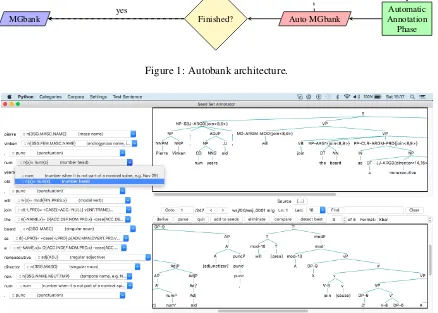
Autobank works as follows: the PTB first un-dergoes an initial preprocessing phase. Next, the researcher builds a seed MG corpus by annotat-ing lexical items on PTB trees with MG categories and then selecting from among a set of candi-date parses which are output using these categories by MGParse, an Extended Directional Minimal-ist Grammar (EDMG) parser (see Torr and Sta-bler (2016)). The system then extracts various de-pendency mappings between the source and target trees. Next, a set of candidate parses is generated for the remaining trees in the PTB, and these are scored using the dependency mappings extracted from the seeds. In this way, the source corpus ef-fectively adopts a disambiguation role in lieu of any statistical model. The basic architecture of the system, which was implemented in Python and its Tkinter module, is given in fig 1.
2 Preprocessing
Autobank includes a module for preprocessing the PTB which corrects certain mistakes and adds some additional annotations carried out by vari-ous researchers since the treebank’s initial release. For example, following Hockenmaier and Steed-man (2002), we have corrected cases where verbs were incorrectly labelled with the past tense tag VBD instead of the past participle tag VBN. We also extend the PTB tag set to include person, number and gender3information on nominals and
pronominals, in order to constrain reflexive bind-ing and agreement phenomena in MGbank.
The semantic role labels of PropBank (Palmer et al., 2005) and Nombank (Meyers et al., 2004)
1MGs are a mildly context sensitive and computational
interpretation of Chomsky’s (1995) Minimalist Program.
2For example, Minimalist trees contain many more null
heads and traces of phrasal movement, along with shell and Xbar phrase structures, cartographic clausal and nominal structures, functional heads, head movements, covert move-ments/Agree operations etc.
3We used the NLTK name database to derive gender on
proper nouns.
have also been added onto PTB non-terminals4,
along with the head word and its span. For in-stance, the AGENT subject NP Jack in the sen-tence, Jack helped her, would be annotated with the tag ARG0{helped<1,2>}. We have also added the additional NP structure from Vadas and Curran (2007), the additional structure for hy-phenated compounds included in the Ontonotes 5 (Weischedel et al., 2012) version of the PTB, and the additional structure and role labels for coor-dination phrases recently released by Ficler and Goldberg (2016). For all structure added, any function tags are redistributed accordingly5.
Finally, PropBank includes additional antecedent-trace co-indexing which we have also imported, and some of this implies the need for additional NP structure beyond what Vadas and Curran have provided. For instance, in the phrase, the unit of New York-based Lowes Corp that *T* makes kent cigarettes, the original anno-tation has the unitandof New York-based Lowes Corp as separate sister NP and PP constituents (with an SBAR node sister to both), both of which are co-indexed with the subject trace (*T*) position in PropBank. In such cases we have added an additional NP node resolving the two constituents into a single antecedent NP.
3 The manual annotation phase
Autobank provides a powerful graphical user in-terface enabling the researcher to construct an (ED)MG by relabelling PTB preterminals with MG categories and selecting the correct MG parse from a set of candidates generated by the parser.
The main annotation environment is shown in fig 2. The PTB tree and its MG candidates are re-spectively displayed on the top and bottom of the screen. Between these are a number of buttons al-lowing for easy navigation through the PTB, in-cluding a regular expression search facility for locating specific construction types by searching both the bracketing and the string. The user can also choose to focus on sentences of a given string length. On the left, the sentence is displayed from top to bottom, each word with a drop-down menu listing all MG categories so far associated with that word’s PTB preterminal category. Like
4Among other things, these crucially distinguish adjuncts
from arguments, raising/ECM from subject/object control, andpromise-type subject control from object control/ECM.
5We use a modified version of Collins’ (1999) head
Penn Treebank Preprocessing AnnotationManual Phase
Seed MGbank
Automatic extraction of source-target dependency
mappings
Automatic Annotation
Phase Auto MGbank
Finished? MGbank
no
[image:3.595.74.532.67.217.2]yes
Figure 1: Autobank architecture.
Figure 2: The main annotation environment.
CCG, EDMG is a strongly lexicalized and deriva-tional formalism, with all subcategorization and linear order information encoded on lexical items. EDMG categories are sequences of features or-dered from left to right which are checked and deleted as the derivation proceeds. For example, the hypothetical category, d= =d v6, could be used
to represent a transitive verb that first looks to its right for an object with d as its first feature (i.e. a DP), before selecting a DP subject on its left and thus yielding a constituent of category v, i.e. a VP. MGParse category features can also include subcategorization and agreement properties and requirements, and allow for percolation of such
6This category (which is actually used for ditransitives by
MGParse) is similar to the CCG category (S\NP)/NP.
features up the tree via a simple unification mech-anism7. In lieu of any statistical model, this
enables the human annotator to tightly constrain the grammar and thus reduce the amount of lo-cal and global ambiguity present during manual and automatic annotation. For example, the cat-egory: v{+TRANS.x}= +case{+ACC.-NULL} =d lv{TRANS.x}, could be used for the null causative light verb (so-calledlittle v) that is stan-dardly assumed in Minimalism to govern a main transitive verb. It specifies that its VP complement must have the property TRANS and that the
ob-7As in CCG, such unification is limited to atomic property
[image:3.595.82.520.172.485.2]ject whose case feature it will check (in this case via covert movement) must have the property ACC but must not have the property NULL, and that following selection of anAGENTDP specifier the resulting vP will have the property TRANS. Fur-thermore, any additional properties carried by the VP complement (such as PRES, 3SG etc.) will be percolated onto the vP (or rather onto its selectee (lv) feature) owing to thexvariable.
Both overt and null (i.e. phonetically silent) MG categories can be added to the system and later modified using the menu system at the top of the screen. Any time the user attempts to modify a category, the system will first reparse any trees in the seed set containing that category to ensure that the same Xbar tree can still be generated for the sentence in question following the modification8.
Once the user has selected an MG category for each word in the sentence, clickingparsecauses MGParse to return all possible parses using these categories. Parsing without annotating some or all of the words in the sentence is also possible: MG-Parse will simply try all available MG categories already associated with a word’s PTB pretermi-nal in the seed set. Once returned, the trees can be viewed in several formats, including multiple MG derivation tree formats, and Xbar tree and MG (bare phrase structure) derived tree formats. Candidate parses can be viewed side-by-side for comparison, and there is the option to perform a diff on the bracketings, and to eliminate incorrect candidates from consideration. Once the user has identified the correct tree, they can clickadd to seeds to save it; seeds can be viewed and re-moved at any point using the native file system.
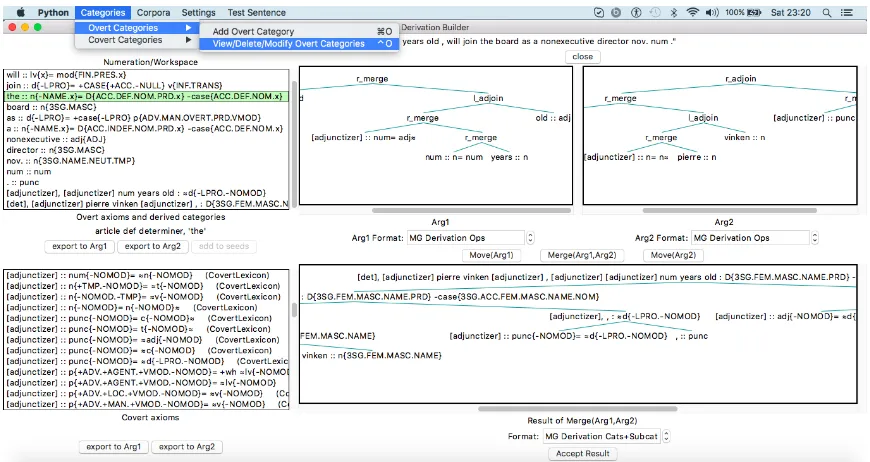
There will inevitably be occasions when the parser fails to return any parses. In these cases it is useful to build up the derivation step-by-step to identify the point where it fails, and Autobank provides an interface for doing just this (see fig 3). Whereas in annotation mode null heads were kept hidden for simplicity, in derivation mode the en-tire null lexicon is available, along with the overt categories the user selected on the main annotation screen. Other features of the system include a test sentence mode, a corpus stats display, a facility for automatically detecting the best candidate MG
8In general, subcategorization properties and
require-ments are the only features on an MG category that can be modified without first removing all seed parses containing that category as they do not affect the Xbar tree’s geometry (though they can license or prevent its generation).
parse (to test the performance of the automatic an-notator, and speed up annotation), a parser settings menu, and an option for backing up all data.
The extreme succinctness of the (strongly) lex-icalized (ED)MG formalism, as discussed in Sta-bler (2013), means that seed set creation can be a relatively rapid process. Like CCGs, MGs have abstract rule schemas which generalize across cat-egories, thus dramatically reducing the size of the grammar. Taking CCGbank’s 1300 categories as an approximate upper bound, a researcher work-ing five days a week on the annotation process and adding 20 MG categories per day to the system should have added enough MG categories to parse all the sentences of the PTB within 3 months.
4 The automatic annotation phase
Once the user has created an initial seed set, they can selectauto generate corpusfrom the corpus menu. This prompts the system to ex-tract a set of dependency mappings and lexical cat-egory mappings holding between each seed MG tree and its PTB source tree. To achieve this, the system traverses the PTB and MG trees and ex-tracts a Collins-style dependency tuple for every non-head child of every non-terminal in each tree. The tuples include the head child and non-head child categories, the parent category, any relevant function tags, the directionality of the dependency, and the head child’s and non-head child’s head words and spans. Where there are multiple tuples in a tree with the same head and non-head word spans, these are grouped together into achain.
For example, for the sentence the doctor ex-amined Jack, the AGENT subject NP in a PTB-style tree would yield the following dependency: [VP, examined, <2,3>, NP, doctor, <1,2>, S, [ARG0, SUBJ], left]. Many Minimalists assume thatAGENTsubjects are base-generated inside the verb phrase (Koopman and Sportiche, 1991) in spec-vP, before moving to the surface subject po-sition in spec-TP. Although in its surface popo-sition the subject is a dependent of the T(ense) head, it is the lexical verb which is the semantic head of the extended projection (i.e. of the CP clause con-taining it), and both syntactic and semantic heads are used here when generating the tuples9. Two
tuples are therefore extracted for the dependency
9This also allows the system to capture certain systematic
Figure 3: The step-by-step derivation builder.
between the verb and the subject and together they form a chain representing the latter’s deep and sur-face positions. The system then establishes map-pings from PTB tuples/chains to MG tuples/chains which share the same head and non-head spans (this includes instances where the relation between the head and dependent has been reversed).
Each mapping is stored in three forms of vary-ing degrees of abstraction. In the first, all word-specific information (i.e. the head and non-head words and their spans) is deleted; in the second the spans and non-head word are deleted, but (a lemmatized version of) the head word is retained, while in the third the spans are deleted but both the (lemmatized) head and non-head words are retained. The fully reified mapping for our sub-ject dependency, for instance, would be: [VP, ex-amine, NP, doctor, S, [ARG0, SUBJ], left] —> [[T’, examine, DP, doctor, TP, left], [v’, exam-ine, DP,doctor, vP, left]]. Including both abstract and reified mappings allows the system to recog-nise not only general phrase structural correspon-dences, but also more idiosyncratic mappings con-ditioned by specific lexical items, as in the case of idioms and light verb constructions, for instance.
The system next parses the remaining sen-tences, selecting a set of potential MG categories for each word in each sentence using the lexi-cal category mappings10. Whenever a dependency
10Note that there will be many MG categories for every
PTB category, which will make parsing quite slow for certain
mapping is discovered which has previously been seen in the seeds, the MG tree containing it is awarded with a point; the candidate with the most points is added to the Auto MGbank. The abstract mapping above, for instance, ensures that for tran-sitive sentences, trees containing the subject trace in spec vP are preferred. The user can choose to specify the number and maximum string length of the trees that are automatically generated (together with a timeout value for the parser) and can then inspect the results and transfer any good trees into the seed corpus, thereby rapidly expanding it.
5 Conclusion
Autobank is a GUI tool currently being used to semi-automatically construct MGbank, a deep Minimalist version of the PTB. Minimalism is a lively theory, however, and in continual flux. Au-tobank was therefore designed with reusability in mind, in the hope that other researchers will use it to create alternative Minimalist treebanks, ei-ther from scratch or by modifying an existing one, and to stimulate greater interest in computational Minimalism and statistical MG parsing. The sys-tem could also potentially be adapted for use with other source and (lexicalised) target formalisms.
Acknowledgements
Many thanks to Ed Stabler for providing the ini-tial inspiration for this project, and for his subse-quent guidance and encouragement last summer. The work described in this paper was funded by Nuance Communications Inc. and the Engineering and Physical Sciences Research Council. I would also like to thank the reviewers for their comments and also my supervisors Mark Steedman and Shay Cohen for their help and guidance during the de-velopment of the Autobank system and the writing of this paper.
References
John Chen, Srinivas Bangalore, and K. Vijay-Shanker. 2006. Automated extraction of tree-adjoining
gram-mars from treebanks. Natural Language
Engineer-ing, 12(3):251–299.
Noam Chomsky. 1995.The Minimalist Program. MIT
Press, Cambridge, Massachusetts.
Michael Collins. 1999. Head-Driven Statistical
Mod-els for Natural Language Parsing. Ph.D. thesis, University of Pennsylvania.
Jessica Ficler and Yoav Goldberg. 2016. Coordina-tion annotaCoordina-tion extension in the penn tree bank. In
Proceedings of the 54th Annual Meeting of the As-sociation for Computational Linguistics, ACL 2016, Berlin, German, Volume 1: Long Papers, pages 834–842.
Julia Hockenmaier and Mark Steedman. 2002.
Acquiring compact lexicalized grammars from a
cleaner treebank. In Proceedings of the Third
In-ternational Conference on Language Resources and Evaluation (LREC), pages 1974–1981.
Tim Hunter and Chris Dyer. 2013. Distributions on
minimalist grammar derivations. InProceedings of
the 13th Meeting on the Mathematics of Language (MoL 13), pages 1–11, Sofia, Bulgaria, August. The Association of Computational Linguistics.
Hilda Koopman and Dominique Sportiche. 1991. The position of subjects. Lingua, 85(2-3):211–258. Mike Lewis and Mark Steedman. 2014. Improved
CCG parsing with semi-supervised supertagging.
Transactions of the Association for Computational Linguistics, 2:327–338.
Mitch Marcus, Beatrice Santorini, and
M. Marcinkiewicz. 1993. Building a large
annotated corpus of English: The Penn Treebank.
Computational Linguistics, 19:313–330.
A. Meyers, R. Reeves, C. Macleod, R. Szekely, V. Zielinska, B. Young, and R. Grishman. 2004.
The NomBank project: An interim report. In
Pro-ceedings of HLT-EACL Workshop: Frontiers in Cor-pus Annotation.
Martha Palmer, Dan Gildea, and Paul Kingsbury. 2005. The proposition bank: An annotated corpus of se-mantic roles. Computational Linguistics, 31(1):71– 106.
Edward Stabler. 1997. Derivational minimalism. In Christian Retor´e, editor, Logical Aspects of Com-putational Linguistics (LACL’96), volume 1328 of
Lecture Notes in Computer Science, pages 68–95, New York. Springer.
Edward Stabler. 2013. Two models of minimalist, incremental syntactic analysis. Topics in Cognitive Science, 5:611–633.
Mark Steedman. 1996. Surface Structure and
Inter-pretation. Linguistic Inquiry Monograph 30. MIT Press, Cambridge, MA.
John Torr and Edward P. Stabler. 2016. Coordination in minimalist grammars: Excorporation and across
the board (head) movement. InProceedings of the
Twelfth International Workshop on Tree Adjoining Grammar and Related Formalisms (TAG+12), pages 1–17.
David Vadas and James Curran. 2007. Adding noun phrase structure to the penn treebank. In Proceed-ings of the 45th Annual Meeting of the Association of Computational Linguistics, pages 240–247, Prague, June. ACL.
Ralph Weischedel, Sameer Pradhan, Lance Ramshaw, Jeff Kaufman, Michelle Franchini, Mohammed El-Bachouti, Nianwen Xue, Martha Palmer, Jena D. Hwang, Claire Bonial, Jinho Choi, Aous Mansouri, Maha Foster, Abdel aati Hawwary, Mitchell Marcus, Ann Taylor, Craig Greenberg, Eduard Hovy, Robert
Belvin, and Ann Houston. 2012. OntoNotes