Extracting the Unextractable: A Case Study on Verb-particles
Timothy Baldwin
∗and Aline Villavicencio
†∗
CSLI, Ventura Hall, Stanford University
Stanford, CA 94305-4115 USA
[email protected]
†
University of Cambridge, Computer Laboratory, William Gates Building
JJ Thomson Avenue, Cambridge CB3 OFD, UK
[email protected]
Abstract
This paper proposes a series of techniques for ex-tracting English verb–particle constructions from raw text corpora. We initially propose three basic methods, based on tagger output, chunker output and a chunk grammar, respectively, with the chunk grammar method optionally combining with an at-tachment resolution module to determine the syn-tactic structure of verb–preposition pairs in ambigu-ous constructs. We then combine the three methods together into a single classifier, and add in a number of extra lexical and frequentistic features, producing a final F-score of 0.865 over the WSJ.
1
Introduction
There is growing awareness of the pervasiveness and idiosyncrasy of multiword expressions(MWEs), and the need for a robust, structured handling thereof (Sag et al., 2002; Calzolari et al., 2002; Copestake et al., 2002). Examples of MWEs are lexically fixed expressions (e.g.ad hoc), idioms (e.g.
see double), light verb constructions (e.g. make a mistake) and institutionalised phrases (e.g. kindle excitement).
MWEs pose a challenge to NLP due to their syn-tactic and semantic idiosyncrasies, which are often unpredictable from their component parts. Large-scale manual annotation of MWEs is infeasible due to their sheer volume (at least equivalent to the num-ber of simplex words (Jackendoff, 1997)), produc-tivity and domain-specificity. Ideally, therefore, we would like to have some means of automatically ex-tracting MWEs from a given domain or corpus, al-lowing us to pre-tune our grammar prior to deploy-ment. It is this task of extraction that we target in this paper. This research represents a component of the LinGO multiword expression project,1
which is targeted at extracting, adequately handling and rep-resenting MWEs of all types. As a research testbed and target resource to expand/domain-tune, we use the LinGO English Resource Grammar (LinGO-ERG), a linguistically-precise HPSG-based gram-mar under development at CSLI (Copestake and Flickinger, 2000; Flickinger, 2000).
The particular MWE type we target for extrac-tion is the English verb-particle construction. Verb-particle constructions (“VPCs”) consist of a
1http://lingo.stanford.edu/mwe
head verb and one or more obligatory particles, in the form of intransitive prepositions (e.g. hand in), adjectives (e.g. cut short) or verbs (e.g. let go) (Villavicencio and Copestake, 2002a; Villavicen-cio and Copestake, 2002b; Huddleston and Pullum, 2002); for the purposes of this paper, we will fo-cus exclusively on prepositional particles—by far the most common and productive of the three types— and further restrict our attention to single-particle VPCs (i.e. we ignore VPCs such as get along to-gether). We define VPCs to optionally select for an NP complement, i.e. to occur both transitively (e.g.
hand in the paper) and intransitively (e.g.battle on). One aspect of VPCs that makes them difficult to extract (cited in, e.g., Smadja (1993)) is that the verb and particle can be non-contiguous, e.g. hand the paper inandbattle right on. This sets them apart from conventional collocations and terminology (see, e.g., Manning and Sch¨utze (1999) and McKeown and Radev (2000)) in that they cannot be captured ef-fectively using N-grams, due to the variability in the number and type of words potentially interceding between the verb and particle.
We are aiming for an extraction technique which is applicable to any raw text corpus, allowing us to tune grammars to novel domains. Any linguistic annotation required during the extraction process, therefore, is produced through automatic means, and it is only for reasons of accessibility and compa-rability with other research that we choose to work over the Wall Street Journal section of the Penn Treebank (Marcus et al., 1993). That is, other than in establishing upper bounds on the performance of the different extraction methods, we use only the raw text component of the treebank.
In this paper, we first outline distinguishing fea-tures of VPCs relevant to the extraction process (§ 2). We then present and evaluate a number of simple methods for extracting VPCs based on, re-spectively, POS tagging (§ 3), the output of a full text chunk parser (§4), and a chunk grammar (§5). Finally, we detail enhancements to the basic meth-ods (§6) and give a brief description of related re-search (§7) before concluding the paper (§8).
2
Distinguishing Features of VPCs
we analyse the actual occurrence of VPCs in the WSJ.
2.1 Linguistic features
Given an arbitrary verb–preposition pair, where the preposition is governed by the verb, a number of analyses are possible. If the preposition is intransi-tive, a VPC (either intransitive or transitive) results. If the preposition is transitive, it must select for an NP, producing either aprepositional verb(e.g. re-fer to) or afree verb–preposition combination
(e.g.put it on the table,climb up the ladder). A number of diagnostics can be used to distinguish VPCs from both prepositional verbs and free verb– preposition combinations (Huddleston and Pullum, 2002):
1. transitive VPCs undergo the particle alterna-tion
2. with transitive VPCs, pronominal objects must be expressed in the “split” configuration 3. manner adverbs cannot occur between the verb
and particle
The first two diagnostics are restricted to transitive VPCs, while the third applies to both intransitive and transitive VPCs.
The first diagnostic is the canonical test for par-ticlehood, and states that transitive VPCs take two word orders: thejoinedconfiguration whereby the verb and particle are adjacent and the NP comple-ment follows the particle (e.g. hand in the paper), and the split configuration whereby the NP com-plement occurs between the verb and particle (e.g.
hand the paper in). Note that prepositional verbs and free verb–preposition combinations can occur only in the joined configuration (e.g.refer to the book
vs. *refer the book to). Therefore, the existence of a verb–preposition pair in the split configuration is sufficient evidence for a VPC analysis. It is impor-tant to realise that compatibility with the particle alternation is a sufficient but not necessary condi-tion on verb–particlehood. That is, a small number of VPCs do not readily occur in the split configu-ration, including carry out (a threat) (cf. ?carry a threat out).
The second diagnostic stipulates that pronominal NPs can occur only in the split configuration (hand it invs.*hand in it). Note also that heavy NPs tend to occur in the joined configuration, and that various other factors interact to determine which configura-tion a given VPC in context will occur in (see, e.g., Gries (2000)).
The third diagnostic states that manner adverbs cannot intercede between the verb and particle (e.g.
*hand quickly the paper in). Note that this con-straint is restricted to manner adverbs, and that there is a small set of adverbs which can pre-modify particles and hence occur between the verb and par-ticle (e.g.well in jump well up).
2.2 Corpus occurrence
In order to get a feel for the relative frequency of VPCs in the corpus targeted for extraction, namely
0 5 10 15 20 25 30 35 40
0 10 20 30 40 50 60 70
VPC types (%)
[image:2.595.327.529.72.208.2]Corpus frequency
Figure 1: Frequency distribution of VPCs in the WSJ
Tagger correct
extracted Prec Rec Fβ=1
Brill 135
135 1.000 0.177 0.301
Penn 667
800 0.834 0.565 0.673
Table 1: POS-based extraction results
the WSJ section of the Penn Treebank, we took a random sample of 200 VPCs from the Alvey Natu-ral Language Tools grammar (Grover et al., 1993) and did a manual corpus search for each. In the case that a VPC was found attested in the WSJ, we made a note of the frequency of occurrence as: (a) an intransitive VPC, (b) a transitive VPC in the joined configuration, and (c) a transitive VPC in the split configuration. Of the 200 VPCs, only 62 were attested in the Wall Street Journal corpus (WSJ), at a mean token frequency of 5.1 and median to-ken frequency of 2 (frequencies totalled over all 3 usages). Figure 1 indicates the relative proportion of the 62 attested VPC types which occur with the indicated frequencies. From this, it is apparent that two-thirds of VPCs occur at most three times in the overall corpus, meaning that any extraction method must be able to handle extremely sparse data.
Of the 62 attested VPCs, 29 have intransitive us-ages and 45 have transitive usus-ages. Of the 45 at-tested transitive VPCs, 12 occur in both the joined and split configurations and can hence be unambigu-ously identified as VPCs based on the first diagnostic from above. For the remaining 33 transitive VPCs, we have only the joined usage, and must find some alternate means of ruling out a prepositional verb or free verb–preposition combination analysis. Note that for the split VPCs, the mean number of words occurring between the verb and particle was 1.6 and the maximum 3.
[image:2.595.329.522.265.309.2]3
Method-1: Simple POS-based
Extraction
One obvious method for extracting VPCs is to run a simple regular expression over the output of a part-of-speech (POS) tagger, based on the observation that the Penn Treebank POS tagset, e.g., contains a dedicated particle tag (RP). Given that all particles
are governed by a verb, extraction consists of simply locating each particle and searching back (to the left of the particle, as particles cannot be passivised or otherwise extraposed) for the head verb of the VPC. Here and for the subsequent methods, we assume that the maximum word length for NP complements in the split configuration for transitive VPCs is 5,2
i.e. that an NP “heavier” than this would occur more naturally in the joined configuration. We thus dis-count all particles which are more than 5 words from their governing verb. Additionally, we extracted a set of 73 canonical particles from the LinGO-ERG, and used this to filter out extraneous particles in the POS data.
In line with our assumption of raw text to extract over, we use the Brill tagger (Brill, 1995) to auto-matically tag the WSJ, rather than making use of the manual POS annotation provided in the Penn Treebank. We further lemmatise the data using morph (Minnen et al., 2001) and extract VPCs based on the Brill tags. This produces a total of 135 VPCs, which we evaluate according to the standard metrics of precision (Prec), recall (Rec) and F-score (Fβ=1).
Note that here and for the remainder of this pa-per, precision is calculated according to the man-ual annotation for the combined total of 4,173 VPC candidate types extracted by the various methods described in this paper, whereas recall is relative to the 62 attested VPCs from the Alvey Tools data as described above.
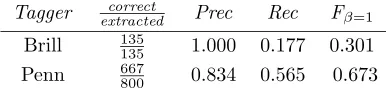
As indicated in the first line of Table 1 (“Brill”), the simple POS-based method results in a precision of 1.000, recall of 0.177 and F-score of 0.301.
In order to determine the upper bound on per-formance for this method, we ran the extraction method over the original tagging from the Penn Treebank. This resulted in an F-score of 0.774 (“Penn” in Table 1). The primary reason for the large disparity between the Brill tagger output and original Penn Treebank annotation is that it is no-toriously difficult to differentiate between particles, prepositions and adverbs (Toutanova and Manning, 2000). Over the WSJ, the Brill tagger achieves a modest tag recall of 0.103 for particles, and tag pre-cision of 0.838. That is, it is highly conservative in allocating particle tags, to the extent that it recog-nises only two particle types for the whole of the WSJ:out anddown.
4
Method-2: Simple Chunk-based
Extraction
To overcome the shortcomings of the Brill tagger in identifying particles, we next look to full chunk
2Note, this is the same as the maximum span length of 5
used by Smadja (1993), and above the maximum attested NP length of 3 from our corpus study (see Section 2.2).
WSJ CoNLL
Prec Rec Fβ=1 Prec Rec Fβ=1
[image:3.595.323.536.70.108.2]0.889 0.911 0.900 0.912 0.925 0.919
Table 2: Chunking performance
parsing. Full chunk parsing involves partitioning up a text into syntactically-cohesive, head-final seg-ments (“chunks”), without attempting to resolve inter-chunk dependencies. In the chunk inventory devised for the CoNLL-2000 test chunking shared task (Tjong Kim Sang and Buchholz, 2000), a ded-icated particle chunk type once again exists. It is therefore possible to adopt an analogous approach to that from Method-1, in identifying particle chunks then working back to locate the verb each particle chunk is associated with.
4.1 Chunk parsing method
In order to chunk parse the WSJ, we first tagged the full WSJ and Brown corpora using the Brill tag-ger, and then converted them into chunks based on the original Penn Treebank parse trees, with the aid of the conversion script used in preparing the CoNLL-2000 shared task data.3
We next lemma-tised the data using morph (Minnen et al., 2000), and chunk parsed the WSJ with TiMBL 4.1 (Daele-mans et al., 2001) using the Brown corpus as train-ing data. TiMBL is a memory-based classification system based on the k-nearest neighbour algorithm,
which takes as training data a set of fixed-length feature vectors pre-classified according to an infor-mation field. For each test instance described over the same feature vector, it then returns the “neigh-bours” at thek-nearest distances to the test instance
and classifies the test instance according to the class distribution over those neighbours. TiMBL provides powerful functionality for determining the relative distance between different values of a given feature in the form of MVDM, and also supports weighted voting between neighbours in classifying inputs, e.g. in the form of inverse distance weighting.
We ran TiMBL based on the feature set described in Veenstra and van den Bosch (2000), that is using the 5 word lemmata and POS tags to the left and 3 word lemmata and POS tags to the right of each focus word, along with the POS tag and lemma for the focus word. We setkto 5, ran MVDM over only
the POS tags4
and used inverse distance weighting, but otherwise ran TiMBL with the default settings. We evaluated the basic TiMBL method over both the full WSJ data, training on the Brown section of the Penn Treebank, and over the original shared task data from CoNLL-2000, the results for which are presented in Table 2. Note that, similarly to the CoNLL-2000 shared task, precision, recall and
3
Note that the gold standard chunk data for the WSJ was used only in evaluation of chunking performance, and to es-tablish upper bounds on the performance of the various ex-traction methods.
4Based on the results of Veenstra and van den Bosch
Chunker correct
extracted Prec Rec Fβ=1
TiMBL 695
854 0.772 0.548 0.641
Penn 651
[image:4.595.85.287.72.117.2]760 0.857 0.694 0.766
Table 3: Chunk tag-based extraction results
F-score are all evaluated at the chunk rather than the word level. The F-score of 0.919 for the CoNLL-2000 data is roughly the median score attained by systems performing in the original task, and slightly higher than the F-score of 0.915 reported by Veen-stra and van den Bosch (2000), due to the use of word lemmata rather than surface forms, and also inverse distance weighting. The reason for the drop-off in performance between the CoNLL data and the full WSJ is due to the CoNLL training and test data coming from a homogeneous data source, namely a subsection of the WSJ, but the Brown corpus being used as the training data in chunking the full extent of the WSJ.
4.2 Extraction method
Having chunk-parsed the WSJ in the manner de-scribed above, we next set about extracting VPCs by identifying each particle chunk, and searching back for the governing verb. As for Method-1, we allow a maximum of 5 words to intercede between a particle and its governing verb, and we apply the additional stipulation that the only chunks that can occur be-tween the verb and the particle are: (a) noun chunks, (b) preposition chunks adjoining noun chunks, and (c) adverb chunks found in our closed set of particle pre-modifiers (see§2.1). Additionally, we used the gold standard set of 73 particles to filter out extra-neous particle chunks, as for Method-1 above.
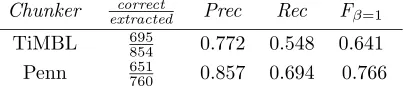
The results for chunk-based extraction are pre-sented in Table 3, evaluated over the chunk parser output (“TiMBL”) and also the gold-standard chunk data for the WSJ (“Penn”). These results are signifi-cantly better than those for Method-1 over the Brill output and Penn data, respectively, both in terms of the raw number of VPCs extracted and F-score. One reason for the relative success of extracting over chunker as compared to tagger output is that our chunker was considerably more successful than the Brill tagger at annotating particles, returning an F-score of 0.737 over particle chunks (precision=0.786, recall=0.693). The stipulations on particle type and what could occur between a verb and particle chunk were crucial in maintaining a high VPC extraction precision, relative to both particle chunk precision and the gold standard extraction precision. As can be seen from the upper bound on recall (i.e. recall over the gold standard chunk data), however, this method has limited applicability.
5
Method-3: Chunk Grammar-based
Extraction
The principle weakness of Method-2 was recall, lead-ing us to implement a rule-based chunk sequencer which searches for particles in prepositional and ad-verbial chunks as well as particle chunks. In essence,
Method correct
extracted Prec Rec Fβ=1
Rule−att 676
1119 0.604 0.694 0.646 Timbl−att 615
823 0.747 0.661 0.702 Penn−att 694
927 0.749 0.823 0.784 Rule+att 951
3126 0.304 0.823 0.444 Timbl+att 739
1049 0.704 0.710 0.707 Penn+att 750
1079 0.695 0.871 0.773
Table 4: Chunk grammar-based extraction results
we take each verb chunk in turn, and search to the right for a single-word particle, prepositional or ad-verbial chunk which is contained in the gold stan-dard set of 73 particles. For each such chunk pair, it then analyses: (a) the chunks which occur be-tween them to ensure that, maximally, an NP and particle pre-modifier adverb chunk are found; (b) the chunks that occur immediately after the parti-cle/preposition/adverb chunk to check for a clause boundary or NP; and (c) the clause context of the verb chunk for possible extraposition of an NP ver-bal complement, through passivisation or relativisa-tion. The objective of this analysis is to both deter-mine the valence of the VPC candidate (intransitive or transitive) and identify evidence either support-ing or rejectsupport-ing a VPC analysis. Evidence for or against a VPC analysis is in the form of congruence with the known linguistic properties of VPCs, as de-scribed in Section 2.1. For example, if a pronominal noun chunk were found to occur immediately after the (possibly) particle chunk (e.g. *see off him), a VPC analysis would not be possible. Alternatively, if a punctuation mark (e.g. a full stop) were found to occur immediately after the “particle” chunk and nothing interceded between the verb and particle chunk, then this would be evidence for an intran-sitive VPC analysis.
The chunk sequencer is not able to furnish posi-tive or negaposi-tive evidence for a VPC analysis in all cases. Indeed, in a high proportion of instances, a noun chunk (=NP) was found to follow the “parti-cle” chunk, leading to ambiguity between analysis as a VPC, prepositional verb or free verb–preposition combination (see Section 2.1), or in the case that an NP occurs between the verb and particle, the “particle” being the head of a PP post-modifying an NP. As a case in point, the VPhand the paper in here could take any of the following structures: (1)
we use an unsupervised attachment disambiguation method, based on the log-likelihood ratio (“LLR”, Dunning (1993)). That is, we use the chunker output to enumerate all the verb–preposition, preposition– noun and verb–noun bigrams in the WSJ data, based on chunk heads rather than strict word bigrams. We then use frequency data to pre-calculate the LLR for each such type. In the case that the verb and “par-ticle” are joined (i.e. no NP occurs between them), we simply compare the LLR of the verb–noun and particle–noun pairs, and assume a VPC analysis in the case that the former is strictly larger than the latter. In the case that the verb and “particle” are split (i.e. we have the chunk sequence VC NC1 PC NC2),5 we calculate three scores: (1) the product
of the LLR for (the heads of) VC-PC and VC-NC2
(analysis as VPC, with NC2 as an NP adjunct of
the verb); (2) the product of the LLR for NC1-PC
and PC-NC2 (transitive verb analysis, with the PP
modifyingNC1); and (3) the product of the LLR for
VC-PCandPC-NC2(analysis as prepositional verb or
free verb–preposition combination). Only in the case that the first of these scores is strictly greater than the other two, do we favour a (transitive) VPC anal-ysis.
Based on the positive and negative grammatical evidence from above, for both intransitive and tran-sitive VPC analyses, we generate four frequency-based features. The optional advent of data derived through attachment resolution, again for both in-transitive and in-transitive VPC analyses, provides an-other two features. These features can be combined in either of two ways: (1) in a rule-based fashion, where a given verb–preposition pair is extracted out as a VPC only in the case that there is positive and no negative evidence for either an intransitive or transitive VPC analysis (“Rule” in Table 4); and
(2) according to a classifier, using TiMBL to train over the auto-chunked Brown data, with the same basic settings as for chunking (with the exception that each feature is numeric and MVDM is not used — results presented as “Timbl” in Table 4). We also
present upper bound results for the classifier-based method using gold standard chunk data, rather than the chunker output (“Penn”). For each of these
three basic methods, we present results with and without the attachment-resolved data (“±att”).
Based on the results in Table 4, the classifier-based method (“Timbl”) is superior to not only the
rule-based method (“Rule”), but also Method-1 and
Method-2. While the rule-based method degrades significantly when the attachment data is factored in, the classifier-based method remains at the same basic F-score value, undergoing a drop in precision but equivalent gain in recall and gaining more than 120 correct VPCs in the process. Rule+attreturns
the highest recall value of all the automatic meth-ods to date at 0.823, at the cost of low precision at 0.304. This points to the attachment disambigua-tion method having high recall but low precision.
Timbl±attandPenn±attare equivalent in terms
5Here,VC= verb chunk,NC= noun chunk andPC=
(in-transitive or (in-transitive) preposition chunk.
Method correct
extracted Prec Rec Fβ=1
Combine 719
953 0.754 0.710 0.731
M∗
2
686
778 0.882 0.677 0.766
M3−att∗ 684788 0.868 0.694 0.771
M3+att∗ 1020871 0.854 0.823 0.838
Combine∗ 1000
1164 0.859 0.871 0.865
Combine∗
P enn
931
1047 0.889 0.903 0.896
Table 5: Consolidated extraction results
of precision, but the Penn data leads to considerably better recall.
6
Improving on the Basic Methods
Comparing the results for the three basic methods, it is apparent that Method-1 and Method-2 offer higher precision while Method-3 offers higher recall. In order to capitalise on the respective strengths of the different methods, in this section, we investigate the possibility of combining the outputs of the four methods into a single consolidated classifier. Sys-tem combination is achieved by taking the union of all VPC outputs from all systems, and having a vec-tor of frequency-based features for each, based on the outputs of the different methods for the VPC in question. For each of Method-1 and Method-2, a single feature is used describing the total number of occurrences of the given VPC detected by that method. For Method-3, we retain the 6 features used as input toTimbl±att, namely the frequency with
which positive and negative evidence was detected and also the frequency of VPCs detected through at-tachment resolution, for both intransitive and tran-sitive VPCs. Training data comes from the output of the different methods over the Brown corpus, and the chunking data for Method-2 and Method-3 was generated using the WSJ gold standard chunk data as training data, analogously to the method used to chunk parse the WSJ.
The result of this simple combination process is presented in the first line of Table 5 (“Combine”). Encouragingly, we achieved the exact same recall as the best of the simple methods (Timbl+att) at
0.710, and significantly higher F-score than any in-dividual method at 0.731.
Steeled by this initial success, we further augment the feature space with features describing the fre-quency of occurrence of: (a) the particle in the cor-pus, and (b) deverbal noun and adjective forms of the VPC in the corpus (e.g. turnaround, dried-up), determined through a simple concatenation opera-tion opopera-tionally inserting a hyphen. The first of these is attempted to reflect the fact that high-frequency particles (e.g. up, over) are more productive (i.e. are found in novel VPCs more readily) than low-frequency particles.6 The deverbal feature is
in-tended to reflect the fact that VPCs have the
po-6We also experimented with a similar feature describing
tential to undergo deverbalisation whereas prepo-sitional verbs and free verb–preposition combina-tions do not.7 We additionally added in features
describing: (a) the number of letters in the verb lemma, (b) the verb lemma, and (c) the particle lemma. The first feature was intended to capture the informal observation that shorter verbs tend to be more productive than longer verbs (which offers one possible explanation for the anomalous
call/ring/phone/*telephone up). The second and third features are intended to capture this same pro-ductivity effect, but on a individual word-level. Note that as TiMBL treats all features as fully indepen-dent, it is not able to directly pick up on the gold standard verb–particle pairs in the training data to select in the test data.
The expanded set of features was used to re-evaluate each of: Method-2 (M∗
2 in Table 5); the
classifier version of Method-3 with and without attachment-resolved data (M3±ATT∗); and the
simple system combination method (Combine∗).
Additionally, we calculated an upper bound for the expanded feature set based on the gold standard data for each of the methods (Combine∗
P enn in
Ta-ble 5). The results for these five consolidated meth-ods are presented in Table 5.
The addition of the 7 new features leads to an appreciable gain in both precision and recall for all methods, with the system combination method once again proving to be the best performer, at an F-score of 0.865. The differential between the system com-bination method when trained over auto-generated POS and chunk data (Combine∗) and that trained
over gold standard data (Combine∗
P enn) is still
tan-gible, but considerably less than for any of the in-dividual methods. Importantly, Combine∗
outper-forms the gold standard results for each of the in-dividual methods. Examples of false positives (i.e. verb–prepositions misclassified as VPCs) returned by this final system configuration arefirm away,base on andvery off.
In Section 1, we made the claim that VPCs are highly productive and domain-specific. We validate this claim by comparing the 1000 VPCs correctly extracted by the Combine∗ method against both
the LinGO-ERG and the relatively broad-coverage Alvey Tools VPC inventory. The 28 March, 2002 version of the LinGO-ERG contains a total of 300 intransitive and transitive VPC types, of which 195 were contained in the 1000 correctly-extracted VPCs. Feeding the remaining 805 VPCs into the grammar (with a lexical type describing their tran-sitivity) would therefore result in an almost four-fold increase in the total number of VPCs, and in-crease the chances of the grammar being able to parse WSJ-style text. The Alvey Tools data con-tains a total of 2254 VPC types. Of the 1000 ex-tracted VPCs, 284 or slightly over 28%, were not contained in the Alvey data, with examples includ-inghead down, blend together andbid up. Combin-ing this result with that for the LinGO-ERG, one can
7Note that only a limited number of VPCs can be
dever-balised in this manner: of the 62 VPCs attested in the WSJ, only 8 had a deverbal usage.
see that we are not simply extracting information al-ready at our fingertips, but are accessing significant numbers of novel VPC types.
7
Related research
There is a moderate amount of research related to the extraction of VPCs, or more generally phrasal verbs, which we briefly describe here.
One of the earliest attempts at extracting “in-terrupted collocations” (i.e. non-contiguous colloca-tions, including VPCs), was that of Smadja (1993). Smadja based his method on bigrams, but unlike conventional collocation work, described bigrams by way of the triple ofhword1,word2,posni, whereposn
is the number of words occurring betweenword1and
word2 (up to 4). For VPCs, we can reasonably
ex-pect from 0 to 4 words to occur between the verb and the particle, leading to 5 distinct variants of the same VPC and no motivated way of selecting between them. Smadja did not attempt to evalu-ate his method other than anecdotally, making any comparison with our research impossible.
The work of Blaheta and Johnson (2001) is closer in its objectives to our research, in that it takes a parsed corpus and extracts out multiword verbs (i.e. VPCs and prepositional verbs) through the use of log-linear models. Once again, direct comparison with our results is difficult, as Blaheta and Johnson output a ranked list of all verb–preposition pairs, and subjectively evaluate the quality of different sec-tions of the list. Additionally, they make no attempt to distinguish VPCs from prepositional verbs.
The method which is perhaps closest to ours is that of Kaalep and Muischnek (2002) in extracting Estonian multiword verbs (which are similar to En-glish VPCs in that the components of the multiword verb can be separated by other words). Kaalep and Muischnek apply the “mutual expectation” test over a range of “positioned bigrams”, similar to those used by Smadja. They test their method over three different corpora, with results ranging from a preci-sion of 0.21 and recall of 0.86 (F-score=0.34) for the smallest corpus, to a precision of 0.03 and recall of 0.85 (F-score=0.06) for the largest corpus. That is, high levels of noise are evident in the system output, and the F-score values are well below those achieved by our method for English VPCs.
8
Conclusion
In conclusion, this paper has been concerned with the extraction of English verb–particle construc-tions from raw text corpora. Three basic meth-ods were proposed, based on tagger output, chunker output and a chunk grammar; the chunk grammar method was optionally combined with attachment resolution to determine the syntactic structure of verb–preposition pairs in ambiguous constructs. We then experimented with combining the output of the three methods together into a single classifier, and further complemented the feature space with a num-ber of lexical and frequentistic features, culminating in an F-score of 0.865 over the WSJ.
types, rather than a binary judgement on verb– particlehood. This would allow the extracted out-put to be fed directly into the LinGO-ERG for use in parsing. We are also interested in extending the method to extract prepositional verbs, many of which appear in the attachment resolution data and are subsequently filtered out by the consolidated classifier.
Acknowledgements
This research was supported in part by NSF grant BCS-0094638 and also the Research Collaboration between NTT Communication Science Laboratories, Nippon Telegraph and Telephone Corporation and CSLI, Stanford University. We would like to thank Francis Bond, Ann Copestake, Dan Flickinger, Di-ana McCarthy and the three anonymous reviewers for their valuable input on this research.
References
Don Blaheta and Mark Johnson. 2001. Unsuper-vised learning of multi-word verbs. In Proc. of the ACL/EACL 2001 Workshop on the Compu-tational Extraction, Analysis and Exploitation of Collocations, pages 54–60.
Eric Brill. 1995. Transformation-based error-driven learning and natural language processing: A case study in part-of-speech tagging. Computational Linguistics, 21:543–65.
Nicoletta Calzolari, Charles J. Fillmore, Ralph Gr-ishman, Nancy Ide, Alessandro Lenci, Catherine MacLeod, and Antonio Zampolli. 2002. Towards best practice for multiword expressions in compu-tational lexicons. InProc. of the 3rd International Conference on Language Resources and Evalua-tion (LREC 2002), pages 1934–40.
Ann Copestake and Dan Flickinger. 2000. Open source grammar development environment and broad-coverage English grammar using HPSG. In
Proc. of the 2nd International Conference on Lan-guage Resources and Evaluation (LREC 2000), pages 591–8.
Ann Copestake, Fabre Lambeau, Aline Villavicen-cio, Francis Bond, Timothy Baldwin, Ivan Sag, and Dan Flickinger. 2002. Multiword expres-sions: linguistic precision and reusability. InProc. of the 3rd International Conference on Language Resources and Evaluation (LREC 2002), pages 1941–7.
Walter Daelemans, Jakub Zavrel, Ko van der Sloot, and Antal van den Bosch. 2001. TiMBL: Tilburg Memory Based Learner, version 4.1, reference guide. ILK technical report 01-04.
Ted Dunning. 1993. Accurate methods for the statistics of surprise and coincidence. Computa-tional Linguistics, 19(1):61–74.
Dan Flickinger. 2000. On building a more efficient grammar by exploiting types. Natural Language Engineering, 6(1):15–28.
Stefan T. Gries. 2000. Towards multifactorial anal-yses of syntactic variation: The case of particle placement. Ph.D. thesis, University of Hamburg. Claire Grover, John Carroll, and Edward Briscoe.
1993. The Alvey Natural Language Tools
gram-mar (4th release). Technical Report 284, Com-puter Laboratory, Cambridge University, UK. Rodney Huddleston and Geoffrey K. Pullum. 2002.
The Cambridge Grammar of the English Lan-guage. Cambridge: Cambridge University Press. Ray Jackendoff. 1997. The Architecture of the
Lan-guage Faculty. Cambridge, MA: MIT Press. Heiki-Jaan Kaalep and Kadri Muischnek. 2002.
Us-ing the text corpus to create a comprehensive list of phrasal verbs. InProc. of the 3rd International Conference on Language Resources and Evalua-tion (LREC 2002), pages 101–5.
Christopher D. Manning and Hinrich Sch¨utze. 1999.
Foundations of Statistical Natural Language Pro-cessing. MIT Press.
Mitchell P. Marcus, Beatrice Santorini, and Mary Ann Marcinkiewicz. 1993. Building a large an-notated corpus of English: the Penn Treebank.
Computational Linguistics, 19(2):313–30.
Kathleen R. McKeown and Dragomir R. Radev. 2000. Collocations. In Robert Dale, Hermann Moisl, and Harold Somers, editors, Handbook of Natural Language Processing, chapter 21. Marcel Dekker.
Guido Minnen, John Carroll, and Darren Pearce. 2000. Robust, applied morphological generation. In Proc. of the First International Natural Lan-guage Generation Conference (INLG), pages 201– 8.
Guido Minnen, John Carroll, and Darren Pearce. 2001. Applied morphological processing of En-glish. 7(3).
Ivan Sag, Timothy Baldwin, Francis Bond, Ann Copestake, and Dan Flickinger. 2002. Multiword expressions: A pain in the neck for NLP. In
Proc. of the 3rd International Conference on In-telligent Text Processing and Computational Lin-guistics (CICLing-2002), pages 1–15.
Frank Smadja. 1993. Retrieving collocations from text: Xtract. Computational Linguistics, 19(1):143–78.
Erik F. Tjong Kim Sang and Sabine Buchholz. 2000. Introduction to the CoNLL-2000 shared task: Chunking. In Proc. of the 4th Confer-ence on Computational Natural Language Learn-ing (CoNLL-2000), pages 127–132.
Kristina Toutanova and Christopher D. Manning. 2000. Enriching the knowledge sources used in a maximum entropy part-of-speech tagger. InProc. of the Joint SIGDAT Conference on Empirical Methods in Natural Language Processing and Very Large Corpora (EMNLP/VLC-2000).
Jorn Veenstra and Antal van den Bosch. 2000. Single-classifier memory-based phrase chunking. InProc. of the 4th Conference on Computational Natural Language Learning (CoNLL-2000), pages 157–9.
Aline Villavicencio and Ann Copestake. 2002a. Phrasal verbs and the LinGO-ERG. LinGO Working Paper No. 2002-01.