Multi-Predicate Semantic Role Labeling
Haitong Yang and Chengqing Zong
National Laboratory of Pattern Recognition
Institute of Automation, Chinese Academy of Sciences, Beijing, 100190, China
{htyang, cqzong}@nlpr.ia.ac.cn
Abstract
The current approaches to Semantic Role Labeling (SRL) usually perform role clas-sification for each predicate separately and the interaction among individual predi-cate’s role labeling is ignored if there is more than one predicate in a sentence. In this paper, we prove that different predi-cates in a sentence could help each other during SRL. In multi-predicate role label-ing, there are mainly two key points: argu-ment identification and role labeling of the arguments shared by multiple predicates. To address these issues, in the stage of argument identification, we propose nov-el predicate-rnov-elated features which hnov-elp re-move many argument identification errors; in the stage of argument classification, we adopt a discriminative reranking approach to perform role classification of the shared arguments, in which a large set of glob-al features are proposed. We conducted experiments on two standard benchmarks: Chinese PropBank and English PropBank. The experimental results show that our approach can significantly improve SRL performance, especially in Chinese Prop-Bank.
1 Introduction
Semantic Role Labeling (SRL) is a kind of shal-low semantic parsing task and its goal is to rec-ognize some related phrases and assign a joint structure (WHO did WHAT to WHOM, WHEN, WHERE, WHY, HOW) to each predicate of a sen-tence (Gildea and Jurafsky, 2002). Because of the ability of encoding semantic information, SR-L has been applied in many tasks of NSR-LP, such as question and answering (Narayanan and Haraba-gir, 2004), information extraction (Surdeanu et
The justices will be forced to reconsider the questions.
[ A1 ] [ Pred ]
[ A0 ] [ Pred ] [ A1 ]
Figure 1: A sentence from English PropBank, with an argument shared by multiple predicates
al., 2003; Christensen et al., 2005), and machine translation (Wu and Fung, 2009; Liu and Gildea, 2010; Xiong et al., 2012; Zhai et al., 2012).
Currently, an SRL system works as follows: first identify argument candidates and then per-form classification for each argument candidate. However, this process only focuses on one inde-pendent predicate without considering the internal relations of multiple predicates in a sentence. Ac-cording to our statistics, more than 80% sentences in Propbank carry multiple predicates. One exam-ple is shown in Figure 1, in which there are two predicates ‘Force’ and ‘Reconsider’. Moreover, the constituent ‘the justices’ is shared by the two predicates and is labeled as A1 for ‘Force’ but as A0 for ‘Reconsider’. We call this phenomenon of the shared argumentsRole Transition. Intuitive-ly, all predicates in a sentence are closely related to each other and the internal relations between them would be helpful for SRL.
This paper has made deep investigation on multi-predicate semantic role labeling. We think there are mainly two key points: argument identi-fication and role labeling of the arguments shared by multiple predicates. We adopt different strate-gies to address these two issues.
During argument identification, there are a large number of identification errors caused by the poor performance of auto syntax trees. However, many of these errors can be removed, if we take other predicates into consideration. To achieve this pur-pose, we propose novel predicates-related features which have been proved to be effective to
nize many identification errors. After these fea-tures added, the precision of argument identifica-tion improves significantly by 1.6 points and 0.9 points in experiments on Chinese PropBank and English PropBank respectively, with a slight loss in recall.
Role labeling of the shared arguments is anoth-er key point. The predicates and their shared argu-ment could be considered as a joint structure, with strong dependencies between the shared argumen-t’s roles. If we consider linguistic basis for joint modeling of the shared argument’s roles, there are at least two types of information to be captured. The first type of information is the compatibility of Role Transition among the shared argument’s roles. A noun phrase may be labeled as A0 for a predicate and at the same time, it can be labeled as A1 for another predicate. However, there are few cases that a noun phrase is labeled as A0 for a predicate and as AM-ADV for another predicate at the same time. Secondly, joint modeling the shared arguments could explore global informa-tion. For example, in ‘The columbia mall is ex-pected to open’, there are two predicates ‘expect’ and ‘open’ and a shared argument ‘the columbi-a mcolumbi-all’. Beccolumbi-ause this shcolumbi-ared columbi-argument is before ‘open’ and the predicate ‘open’ is in active voice, a base classifier often incorrectly label this argu-ment A0 for ‘open’. But if we observe that the ar-gument is also an arar-gument of ‘expect’, it should be labeled as A1 for ‘expect’ and ‘open’.
Motivated by the above observations, we at-tempt to jointly model the shared arguments’ roles. Specifically, we utilize the discriminative rerank-ing approach that has been successfully employed in many NLP tasks. Typically, this method first creates a list ofn-best candidates from a base sys-tem, and then reranks them with arbitrary features (both local and global), which are either not com-putable or are computationally intractable within the base model.
We conducted experiments on Chinese Prop-Bank and English PropProp-Bank. Results show that compared with a state-of-the-art base model, the accuracy of our joint model improves significant-ly by 2.4 points and 1.5 points on Chinese Prop-Bank and English PropProp-Bank respectively, which suggests that there are substantial gains to be made by jointly modeling the shared arguments of mul-tiple predicates.
Our contributions can be summarized as
fol-lows:
• To the best of our knowledge, this is the first work to investigate the mutual effect of mul-tiple predicates’ semantic role labeling.
• We present a rich set of features for argument identification and shared arguments’ classifi-cation that yield promising performance.
• We evaluate our method on two standard benchmarks: Chinese PropBank and English PropBank. Our approach performs well in both, which suggests its good universality.
The remainder of this paper is organized as fol-lows. Section 2 gives an overview of our approach. We discuss the mutual effect of multi-predicate’ argument identification and argument classifica-tion in Secclassifica-tion 3 and Secclassifica-tion 4 respectively. The experiments and results are presented in Section 5. Some discussion and analysis can be found in Section 6. Section 7 discusses the related work-s. Finally, the conclusion and future work are in Section 8.
2 Approach Overview
As illustrated in Figure 2, our approach follows the standard separation of the task of semantic role la-beling into two phases: Argument Identification andArgument Classification. We investigate the effect of multiple predicates in Argument Identi-fication and Argument ClassiIdenti-fication respectively. Specifically, in the stage of Argument Identifica-tion, we introduce new features related to predi-cates which are effective to recognize many argu-ment identification errors. In the stage of Argu-ment Classification, we concentrate on the classi-fication of the arguments shared by multiple pred-icates. We first use a base model to generate n -best candidates for the shared arguments and then construct a joint model to rerank then-best list, in which a rich set of global features are proposed.
3 Argument Identification
Candidates
Phase 1: Argument Identification
Base Features
New Features
Classifier
Refined Argument Candidates
Phase 2: Argument Classification
Joint Model Base Model
N-Best list
[image:3.595.74.290.63.376.2]Final Results Is-Shared
Figure 2: The overview of our approach
achieve good performance. The model is formu-lated as follows:
p(y|x) = Z(1x)exp(X
i
θifi(x, y)) (1)
in whichxis the input sample,y(0 or 1) is the out-put label, f(x, y) are feature functions and Z(x)
is a normalization term as follows:
Z(x) =X
y
exp(X
i
θifi(x, y))
3.1 Base Features
Xue (2008) took a critical look at the features used in SRL and achieved good performance. So, we use the same features in Xue (2008) as the base features:
• Predicate lemma
• Path from node to predicate
• Head word
• Head word’s part-of-speech
• Verb class (Xue, 2008)
• Predicate and Head word combination
• Predicate and Phrase type combination
• Verb class and Head word combination
• Verb class and Phrase type combination
3.2 Additional Features
In the SRL community, it is widely recognized that the overall performance of a system is large-ly determined by the quality of syntactic parsers (Gildea and Palmer, 2002), which is particularly notable in the identification stage. Unfortunate-ly, the state-of-the-art auto parsers fall short of the demands of applications. Moreover, when there are multiple predicates, or even multiple clauses in a sentence, the problem of syntactic ambiguity increases drastically (Kim et al., 2000). For ex-ample, in Figure 3, there is a sentence with two consecutive predicates ‘/’ (is) and ‘ Ñ’ (devel-op). Compared with the gold tree, the auto tree is less preferable, which makes the classifier easily mistake ‘úQ’ (building) as an argument of ‘
Ñ’ (develop) with base features. But this identifi-cation error can be removed if we note that there is another predicate ‘/’ (is) before ‘ Ñ’
(devel-IP
NP VP
VV NP
DNP NP
VC VP
NN DEG
IP
NP VP
VC NP
CP NP
IP DEC
VV NP
建筑
是
开发 浦东 的
经济活动
开发 建筑
是
浦东 的 经济活动
(a) (b)
建筑 是 开发 浦东 的 经济活动
Building is an economic activity of developing Pudong.
Figure 3: An example from Chinese PropBank. Tree (a) is the gold syntax tree and (b) is parsed by a state of-the-art parser Berkeley parser. On tree (b), ‘úQ’ (building) is mistaken as an argument
[image:3.595.310.521.455.680.2]op). Similar examples with the pattern ‘NP +/+
VV’ can be found in PropBank, in which the sub-ject NP of the sentence is usually not an argument of the latter predicate. Thus, ‘/’ (is) is an
effec-tive clue to detect this kind of identification error. It is challenging to obtain a fully correct syntax tree for a complex sentence with multiple predi-cates. Therefore, base features that heavily rely on syntax trees often fail in discriminating argu-ments from candidates as demonstrated in Figure 3. However, by considering the elements of neigh-boring predicates, we could capture useful clues like in the above example and remove many iden-tification errors. Below, we define novel predi-caterelated features to encode these ‘clues’ to re-fine candidates.
There are mainly five kinds of features as fol-lows.
• Is the given predicate the nearest one? This is a binary feature that indicates whether the predicate is the nearest one to the candi-date.
• Local adjunct
This is a binary feature designed for adjective and adverbial phrases. Some adjunct phras-es, such as ‘Å’ (only), have a limited sphere of influence. If the candidate is ‘local’ but the given predicate is not the nearest one, the candidate is often not an argument for the given predicate. To collect local adjuncts, we traverse the whole training set to get the ini-tial lexicon of adjuncts and refine it manually.
• Cut-Clause
This type of feature is a binary feature de-signed to distinguish identification errors of noun phrase candidates. If a noun phrase can-didate is separated from the given predicate by a clause consisting of a NP and VP, the candidate is usually not the argument of the given predicate.
• Different Relative Positions with Conjunc-tions
This is a binary feature that describes whether the candidate and the predicate are located in different positions as separated by conjunc-tions such as ‘F/’ (but). Conjunctions are
often used to concatenate two clauses, but the
first clause commonly describes one proposi-tion and the second clause describes anoth-er one. Thus, if the candidate and the given predicate have different positions relative to the conjunctions, the candidate is usually not the argument of the given predicate.
• Consecutive Predicates Sequence
When multiple predicates appear in a sen-tence consecutively, parse errors frequently occurs due to the problems of syntactic am-biguity as demonstrated in Figure 2. To in-dicate such errors, sequence features of the candidates and consecutive predicates are de-fined specifically. For instance, for the candi-date ‘úQ’ (building) of ‘ Ñ’ (develop), the features are ‘cand-/- Ñ’ and ‘cand-/-VV’, in which we use ‘cand’ to represent
the position of the candidate.
4 Argument Classification
In this section, we investigate multi-predicate’ mu-tual effects in Argument Classification. Argument Classification is to assign a label to each argumen-t candidaargumen-te recognized by argumen-the phase of Argumenargumen-t Identification.
4.1 Base Model
A conventional method in Argument Classifica-tion is to assign a label to each argument candidate by a classifier independently. We call this kind of method Base Model. In the base model, we still adopt ME (1) as our classifier; all base features of Argument Identification are contained (shown in subsection 3.1). In addition, there are some other features:
• Position: the relative position of the candi-date argument compared to the predicate
• Subcat frame: the syntactic rule that expands the parent of the verb
• The first and the last word of the candidate
• Phrase type: the syntactic tag of the candidate argument
4.2 Joint Model
As discussed briefly in Section 1, there are many dependencies between the shared arguments’ la-beling for different predicates, but the base model completely ignores such useful information. To incorporate these dependencies, we employ the discriminative reranking method. Here, we first establish a unified framework for reranking. For an input x, the generic reranker selects the best output y∗ among the set of candidates GEN(x) according to the scoring function:
y∗= argmax
y∈GEN(x)score(y) (2)
In our task, GEN(x) is a set of the n-best can-didates generated from the base model. As usual, we calculate the score of a candidate by the dot product between a high dimensional feature and a weight W:
score(y) =W ·f(y) (3)
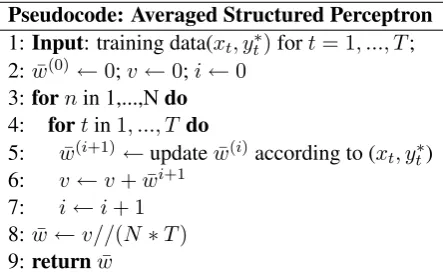
We estimate the weight W using the aver-aged perceptron algorithm (Collins, 2002a) which is well known for its fast speed and good per-formance in similar large-parameter NLP tasks (Huang, 2008). The training algorithm of the generic averaged perceptron is shown in Table 1. In line 5, the algorithm updates W with the differ-ence (if any) between the feature representations of the best scoring candidate and the gold candi-date. We also use a refinement called “averaged parameters” that the final weight vector W is the average of weight vectors over T iterations and N samples. This averaging effect has been shown to reduce overfitting and produces more stable results (Collins, 2002a).
Pseudocode: Averaged Structured Perceptron 1:Input: training data(xt, y∗
t)fort= 1, ..., T; 2:w¯(0)←0;v←0;i←0
3:fornin 1,...,Ndo 4: fortin1, ..., T do
5: w¯(i+1)←updatew¯(i)according to (xt, y∗ t) 6: v←v+ ¯wi+1
7: i←i+ 1
8:w¯←v//(N∗T)
[image:5.595.74.296.590.727.2]9:returnw¯
Table 1: The perceptron training algorithm
4.3 Features for Joint Model
Here, we introduce features used in the joint mod-el. For clear illustration, we describe these fea-tures in the context of the example in Figure 1.
Role Transition (RT): a binary feature to in-dicate whether the transitions among roles of the candidate are reasonable. Because all roles are as-signed to the same candidate, all role transitions should be compatible. For instance, if an argu-ment is labeled as AM-TMP for one predicate, it cannot be labeled as AM-LOC for another pred-icate. This feature is constructed by traversing the training data to ascertain whether transitions between all roles are reasonable. In Table 2, we list some role transitions which are obtained from the training data of experiments on Chinese Prop-Bank.
Roles and Predicates’ Sequence (RPS): a joint feature template that concatenates roles and the given predicates. For the gold candidate ‘Arg1, Arg0’, the feature is ‘Arg1-force, Arg0-reconsider’.
Roles and Predicates’ Sequence with Rela-tive Orders (RPSWR): the template is similar to the above one except that relative orders between roles and predicates are added. If the shared argu-ment is before the given predicate, the feature is described as ‘Role-Predicate’; otherwise, the fea-ture is ‘Predicate-Role’. And, if the predicate’s voice is passive, the order is reversed. Thus, for the gold candidate ‘Arg1, Arg0’, this feature is ‘force-Arg1, Arg0-reconsider’.
Roles and Phrase Type Sequence (RPTS) Roles and Head Word Sequence (RHWS) Roles and Head Word’s POS Sequence (RHWPS)
These three features are utilized to explore the shared argument’s relations with roles.
Role Arg0 Arg1 Arg2 AM-LOC AM-TMP AM-ADV AM-MNR AM-TPC
Arg0 + + + + + + + +
Arg1 + + + + - + + +
Arg2 + + + + - - - +
AM-LOC + + + + - + - +
AM-TMP + - - - + + -
-AM-ADV + - + - + + -
-AM-MNR + + - - - - +
[image:6.595.80.521.61.191.2]-AM-TPC + + + + + + - +
Table 2: Some role transitons from Chinese PropBank. “+” means reasonable role transition and “-” means illegal.
5 Experiments
5.1 Experimental Setting
To evaluate the performance of our approach, we have conducted on two standard benchmarks: Chi-nese PropBank and English PropBank. The exper-imental setting is as follows:
Chinese:
We use Chinese Proposition Bank 1.0. All data are divided into three parts. 648 files (from cht-b 081.fid to chtcht-b 899.fid) are used as the training set. 40 files (from chtb 041.fid to chtb 080.fid) constitutes the development set. The test set con-sists of 72 files (chtb 001.fid to chtb 040.fid and chtb 900.fid to chtb 931.fid). This data setting is the same as in (Xue, 2008; Sun et al., 2009). We adopt Berkeley Parser1 to carry out auto parsing for SRL and the parser is retrained on the training set. We usedn=10 joint assignments for training the joint model and testing.
English:
We choose English Propbank as the evaluation corpus. According to the traditional partition, the training set consists of the annotations in Sections 2 to 21, the development set is Section 24, and the test set is Section 23. This data setting is the same as in (Xue and Palmer, 2004; Toutanova et al., 2005). We adopt Charniak Parser2to carry out auto parsing for SRL and the parser is retrained on the training set. We usedn=10 joint assignments for training the joint model and testing.
5.2 Experiment on Argument Identification We first investigate the performance of our ap-proach in Argument Identification.
For the task of Argument Identification (AI), we 1http://code.google.com/p/berkeleyparser/
2https://github.com/BLLIP/bllip-parser
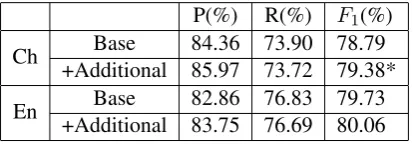
adopt auto parser to produce auto parsing trees for SRL. The results are shown in Table 3. We can see that in the experiment of Chinese, the F1 score reaches to 78.79% with base features. While after additional predicates-related features are added, the precision has improved by 1.6 points with s-light loss in recall, which leads to the improve-ment of 0.6 points in F1. The similar effect oc-curred in the experiment of English. After addi-tional features added in the identification module, the precision is improved by about 0.9 points with a slight loss in recall, leading to an improvement of 0.3 points in F1. However, the improvemen-t in English is slighimprovemen-t smaller improvemen-than in Chinese. We think the main reason is that there are less parse er-rors in English than in Chinese. All results demon-strate that the novel predicted-related features are effective in recognizing many identification errors which are difficult to discriminate with base fea-tures.
P(%) R(%) F1(%) Ch +Additional 85.97 73.72 79.38*Base 84.36 73.90 78.79
En +Additional 83.75 76.69 80.06Base 82.86 76.83 79.73
Table 3: Comparison with Base Features in Ar-gument Identification. Scores marked by “*” are significantly better (p <0.05) than base features.
5.3 Experiment on Argument Classification 5.3.1 Results
[image:6.595.307.514.525.598.2]Num Acc(%) Ch SharedAll 20608462 91.3692.77
[image:7.595.105.258.62.133.2]En SharedAll 140612015 93.8592.30
Table 4: Performance of the Base Model in Argu-ment Classification
Methods Acc(%) Ch BaseJoint 91.3693.74*
[image:7.595.120.242.178.249.2]En BaseJoint 93.8595.33*
Table 5: Comparison with Base Model on shared arguments. Scores marked by “*” are significantly better (p <0.05) than base model.
task is only to assign the correct labels to the con-stituents. The evaluation criterion is Accuracy.
The results of the base model are shown in Ta-ble 4. We first note that in testing set, there are a large number of shared arguments, which weigh-s about one quarter of all argumentweigh-s in Chineweigh-se and 14% in English. Therefore, the fine process-ing of these arguments is essential for argumen-t classificaargumen-tion. However, argumen-the base model cannoargumen-t handle these shared arguments so well in Chinese that the accuracy of the shared arguments is lower by about 1.4 points than the average value of all arguments. Nevertheless, from Table 5 we can see that our joint model’s accuracy on the shared argu-ments reaches 93.74%, 2.4 points higher than the base model in Chinese. Although the base mod-el obtain good performance on shared arguments of English, our joint model’s performance reach-es 95.33%, 1.5 points higher than the base mod-el. This indicates that even though the base model is optimized to utilize a large set of features and achieves the state-of-the-art performance, it is still advantageous to model the joint information of the shared arguments.
Another point to note is that our joint model in resolving English SRL task is not so good as in Chinese SRL. There are mainly two reasons. The first reason is that the shared arguments occur less in English than in Chinese so that training sam-ples are insufficient for our discriminative model. The second reason is the annotation of some in-transitive verbs. In English PropBank, there is a class of intransitive verbs such as “land” (known
as verbs of variable behavior), for which the ar-gument can be tagged as either ARG0 or ARG1. Here, we take examples from the guideline3of En-glish PropBank to explain.
“A bullet (ARG1) landed at his feet” “He (ARG0) landed”
In the above examples, the two arguments and the predicate ‘land’ have the same relative order and voice but the arguments have different label-s for their relabel-spective predicatelabel-s. In fact, accord-ing to the intention of the annotator, ARG0 and ARG1 are both correct. Unfortunately, in English PropBank, there is only one gold label for each ar-gument, which leads to much noise for our joint model. Moreover, such situations are not rare in the corpus.
5.3.2 Feature Performance
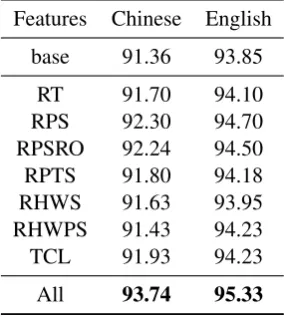
We investigate effects of the features of joint mod-el to the performance and results are shown in Ta-ble 6. Each row shows the improvement over the baseline when that feature is used in the joint mod-el. We can see that features proposed are beneficial to the performance of the joint model. But some features like ‘RPS’ and ‘RPSRO’ play a more im-portant role.
Features Chinese English base 91.36 93.85
RT 91.70 94.10
RPS 92.30 94.70 RPSRO 92.24 94.50 RPTS 91.80 94.18 RHWS 91.63 93.95 RHWPS 91.43 94.23 TCL 91.93 94.23 All 93.74 95.33
Table 6: Features performance in the Joint Model. We use first letter of words to represent features.
5.4 SRL Results
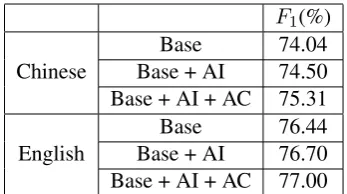
We also conducted the complete experiment on the auto parse trees. The results are shown in Table 7. In experiments on Chinese PropBank, we can see that after novel predicate-related features are added in the stage of Argument Identification, our model outperforms the base model by 0.5 points
[image:7.595.345.488.424.583.2]F1(%)
Chinese Base + AIBase 74.0474.50 Base + AI + AC 75.31
[image:8.595.94.268.61.158.2]English Base + AIBase 76.4476.70 Base + AI + AC 77.00 Table 7: Results on auto parse trees. Base mean-s the bamean-seline mean-symean-stem, +AI meaning predcatemean-s- predcates-related features added in AI, + AC meaning joint module added.
Methods F1(%)
Chinese Sun et al.(2009)Xue(2008) 71.9074.12
Ours 75.31
English Surdeanu and Turmo(2005) 76.46Ours 77.00
Table 8: Comparison with Other Methods
in F1. Furthermore, after incorporating the joint module, the performance goes up to 75.31%, 1.3 points higher than the base model. We obtain sim-ilar observations in experiments on English Prop-Bank, but due to reasons illustrated in Subsection 5.3, the performance of our method is slight better than the base model.
We compare our method with others and the re-sults are shown in Table 8. In Chinese, Xue (2008) and Sun et al. (2009) are pioneer works in Chinese SRL. Our approach outperforms these approaches by about 3.4 and 1.9 F1 points respectively. In English SRL, we compare out method with Sur-deanu and Turmo (2005) which is best result ob-tained with single parse tree as the input in CON-LL 2005 SRL evaluation. Our approach is better than their approach which ignores the relation of multiple predicates’ SRL.
6 Discussion and Analysis
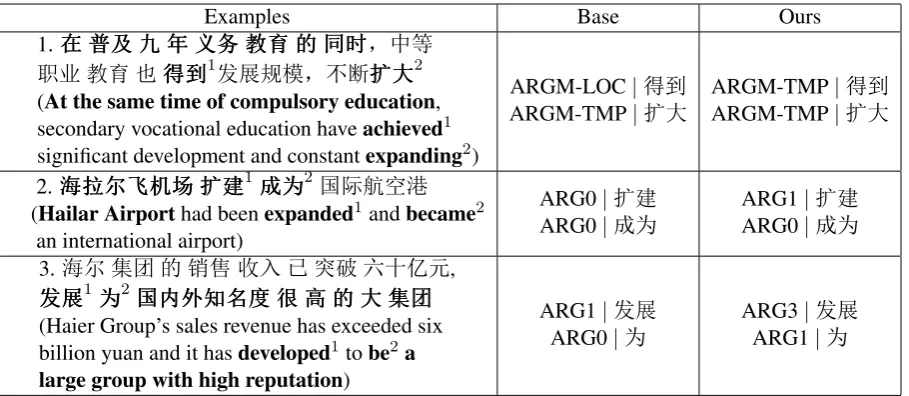
In this section, we discuss some case studies that illustrate the advantages of our model. Some ex-amples from our experiments are shown in Table 9. In example (1), the argument is a preposition-al phrase ‘( nÊ ] t I¡ Y² „ ö’ (at the same time of compulsory education) and shared by two predicates ‘—0’ (witness) and ‘i
'’ (expand). In the corpus, a prepositional phrase is commonly labeled as LOC and ARGM-TMP. Thus, the base model labeled the argument
into these classes but one as ARGM-LOC, another as ARGM-TMP. Unfortunately, ARGM-LOC for ‘—0’ (witness) is wrong while our joint model outputs both correct answers, which benefits from the role transition feature. From Table 1, we can see that the role transition between ARGM-TMP and ARGM-LOC is impossible, which lowers the score of candidates containing both ARGM-LOC and ARGM-TMP in the joint model. Thus, the joint model is more likely to output the gold can-didate.
In example (2), the argument is ‘wÉ Þ: :’ (Hailar Airport) and shared by two predicates ‘iú’ (expand) and ‘ :’ (become). Because of the high similarity of the features in the base mod-el, the argument for both predicates is classified into the same class ARG0, but the label for ‘iú’ (expand) is wrong. Nevertheless, our joint mod-el obtains both correct labmod-els, which benefits from the global features. After searching the training data, we find some similar examples to this one, such as ‘0ÁÐL Ì ò iúó l
Ì’ (The railway operation mileage is expanded to
120 kilometers), in which ‘0Á ÐLÌ ’ (the
railway operation mileage) is labeled as ARG1 for ‘iú’ (expand) but ARG0 for ‘ó’ (to). We think these samples provide evidence for our joint mod-el while these information has not been captured by the base model.
In example (3), the argument is ‘ý… å ¦ˆ Ø „ ' Æâ’ (a large group with high reputation) and shared by predicates ‘ÑU’ (de-velop) and ‘:’ (become). Different from the above cases in which only one label is wrong in the base model, both labels for ‘ÑU’ (develop) and ‘:’ (become) are misclassified by the base model. However, our method still gets correct an-swers for both predicates, which also benefits from the global features.
7 Related work
Our work is related to semantic role labeling and discriminative reranking. In this section, we briefly review these two types of work.
On Semantic Role Labeling
[image:8.595.71.289.229.315.2]Examples Base Ours 1.(((nnnÊÊÊ]]]tttI¡II¡¡YYY²²²„„„ ööö -I
L Y²_———0001ÑUÄ! -iii'''2 (At the same time of compulsory education, secondary vocational education haveachieved1 significant development and constantexpanding2)
ARGM-LOC|—0 ARGM-TMP|i'
ARGM-TMP|—0 ARGM-TMP|i'
2. wwwÉÉÉ ÞÞÞ::::::iiiúúú1 :::2 ýE*z/ (Hailar Airporthad beenexpanded1andbecame2
an international airport)
ARG0|iú ARG0| :
ARG1|iú ARG0| : 3.w Æâ„ .6eò•4mA¿C,
Ñ
ÑÑUUU1:::2ýýý……… ååå ¦¦¦ˆˆˆØØØ„„„'''ÆÆÆâââ (Haier Group’s sales revenue has exceeded six billion yuan and it hasdeveloped1tobe2a large group with high reputation)
ARG1|ÑU ARG0|:
[image:9.595.74.529.61.259.2]ARG3|ÑU ARG1|:
Table 9: Some examples in our experiments
semantic roles for a given predicate. After Gildea and Jurafsky (2002), there have been a large num-ber of works on automatic semantic role label-ing. Based on a basic discriminative model, Pun-yakanok et al. (2004) constructed an integer linear programming architecture, in which the dependen-cy relations among arguments are implied in the constraint conditions. Toutanova et al. (2008) pro-posed a joint model to explore relations of all ar-guments of the same predicate. Unlike them, this paper focus on mining relations of different pred-icates’ semantic roles in one sentence. And, there have been many extensions in machine learning models (Moschitti et al., 2008), feature engineer-ing (Xue and Palmer, 2004), and inference pro-cedures (Toutanova et al., 2005; Punyakanok et al., 2008; Zhuang and Zong, 2010a; Zhuang and Zong, 2010b).
Sun and Jurafsky (2004) did the preliminary work on Chinese SRL without employing any large semantically annotated corpus of Chinese. They just labeled the predicate-argument struc-tures of ten specified verbs to a small collection of Chinese sentences, and utilized Support Vec-tor Machine to identify and classify the arguments. They made the first attempt on Chinese SRL and produced promising results. After the PropBank (Xue and Palmer, 2003) was built, Xue and Palmer (2004) and Xue (2008) took a critical look at fea-tures of argument detection and argument classi-fication. Unlike others’ using syntax trees as the input of SRL, Sun et al. (2009) performed Chi-nese semantic role labeling with shallow parsing. Li et al. (2010) explored joint syntactic and
se-mantic parsing of Chinese to further improve the performance of both syntactic parsing and SRL.
However, to the best of our knowledge, in the literatures, there is no work related to multi-predicate semantic role labeling.
On Discriminative Reranking
Discriminative reranking is a common approach in the NLP community. Its general procedure is that a base system first generates n-best candidates and with the help of global features, we obtain better performance through reranking the n-best candidates. It has been shown to be effective for various natural language processing tasks,such as syntactic parsing (Collins, 2000; Collins, 2002b; Collins and Koo, 2005; Charniak and Johnson, 2005; Huang, 2008), semantic parsing (Lu et al., 2008; Ge and Mooney, 2006), part-of-speech tag-ging (Collins, 2002a), named entity recognition (Collins, 2002c), machine translation (Shen et al., 2004) and surface realization in generation (Kon-stas and Lapata, 2012).
8 Conclusion and Feature Work
that the base model often fails in classifying the shared arguments. To perform the classification of the shared arguments, we propose a joint model and with the help of the global features, our join-t model yields bejoin-tjoin-ter performance join-than join-the base model. To the best of our knowledge, this is the first work of investigating the interaction effect of multi-predicate’s SRL.
In the future, we will explore more effective fea-tures for multi-predicate’s identification and clas-sification. Since we adopt reranking approach in the shared arguments’ classification, the perfor-mance is limited by n-best list. Also, we would like to explore whether there is another method to resolve the problem.
Acknowledgments
We thank the three anonymous reviewers for their helpful comments and suggestions. We would al-so like to thank Nianwen Xue for help in base-line system, and Tao Zhuang, Feifei Zhai, Lu Xi-ang and Junjie Li for insightful discussions. The research work has been partially funded by the Natural Science Foundation of China under Grant No.61333018 and the Hi-Tech Research and De-velopment Program (“863” Program) of China un-der Grant No.2012AA011101, and also the High New Technology Research and Development Pro-gram of Xinjiang Uyghur Autonomous Region un-der Grant No.201312103 as well.
References
Collin F. Baker, Charles j. Fillmore, and John B. Lowe. 1998. The berkeley framenet project. In Proceed-ings of COLING-ACL 1998.
Janara Christensen, Mausam, Stephen Soderland and Oren Etzioni. 2010. Semantic Role Labeling for Open Information Extraction. InProceedings of A-CL 2010.
Eugene Charniak and Mark Johnson. 2005. Coarse tofine n-best parsing and maxent discriminative r-eranking. InProceedings of ACL 1998.
Michael Collins and Terry Koo. 2005. Discriminative reranking for natural language parsing. Computa-tional Linguistics, 31(1):25 69.
Michael Collins. 2000. Discriminative reranking for-natural language parsing. InProceedings of ICML 2000.
Michael Collins. 2002a. Discriminative training meth-ods for hidden Markov models: Theory and
exper-iments with perceptron algorithms. InProceedings of EMNLP 2002.
Michael Collins. 2002b. New ranking algorithms for parsing and tagging: Kernels over discrete struc-tures, and the voted perceptron. In Proceedings of ACL 2002.
Michael Collins. 2002c. Ranking algorithms fornamed-entity extraction: Boosting and the voted perceptron. InProceedings of ACL 2002.
Ruifang Ge and Raymond J. Mooney. 2006. Discrimi-native reranking for semantic parsing. In Proceed-ings of COLING/ACL 2002.
Daniel Gildea and Daniel Jurafsky. 2002. Automatic labeling for semantic roles. InComputational Lin-guistics, 28(3): 245-288.
Daniel Gildea and Martha Palmer. 2002. The necessity of parsing for predicate argument recognition. In
ACL 2002.
Liang Huang. 2008. Forest reranking: Discriminative parsing with non-local features. In Proceedings of ACL 2008.
Sung Dong Kim, Byoung-Tak Zhang and Yung Taek Kim. 2000. Reducing Parsing Complexity by In-traSentence Segmentation based on Maximum En-tropy Model. InProceedings of SIGDAT 2000. Paul Kingsbury and Martha Palmer. 2002. From
Tree-bank to PropBank. InProceedings of LREC 2002. Junhui Li, Guodong Zhou and Hwee Tou Ng. 2010.
Joint Syntactic and Semantic Parsing of Chinese. In
Proceedings of ACL 2010.
Ding Liu and Daniel Gildea. 2010. Semantic role fea-tures for machine translation. In Proceedings of COLING 2010.
Junhui Li, Guodong Zhou and Hwee Tou Ng. 2010. Wei Lu, Hwee Tou Ng, Wee Sun Lee, and Luke S. Zettlemoyer. 2008. A generative model for pars-ing natural language to meanpars-ing representations. In
Proceedings of EMNLP 2008.
Alessandro Moschitti, Daniel Pighin and Roberto Basili. 2008. Tree Kernels for Semantic Role Label-ing. InComputational Linguistics, 34(2): 193-224. Srini Narayanan and Sanda Harabagiu. 2004. Question
Answering based on Semantic Structures. In Pro-ceedings of COLING 2004.
Vasin Punyakanok, Dan Roth, Wen-tau Yih and Dav Zimak. 2004. Semantic Role Labeling via Integer Linear Programming Inference. InProceedings of COLING 2004.
Libin Shen, Anoop Sarkar, and Franz Josef Och. 2004. Discriminative reranking for machine translation. In
Mihai Surdeanu, Sanda Harabagiu, John Williams and Paul Aarseth. 2003. Using Predicate-Argument Structures for Information Extraction. In Proceed-ings of ACL 2003.
Mihai Surdeanu and Jordi Turmo. 2005. Semantic Role Labeling Using Complete Syntactic Analysis. In
Proceedings of CONLL 2005.
Weiwei Sun, Zhifang Sui, Meng Wang and Xin Wang. 2009. Chinese Semantic Role Labeling with Shallow Parsing. InProceedings of ACL 2009.
Ioannis Konstas and Mirella Lapata. 2012. Concept-totext generation via discriminative reranking. In
Proceedings of ACL 2012.
Kristina Toutanova, Aria Haghighi and Christopher D.Manning. 2005. Joint learning improves semantic role labeling. InProceedings of ACL 2005.
Kristina Toutanova, Aria Haghighi and Christopher D.Manning. 2008. A Global Joint Model for Seman-tic Role Labeling. In Computational Linguistics, 34(2): 161-191.
Dekai Wu and Pascale Fung. 2009. Can semantic role labeling improve smt. In Proceedings of EAMT 2009.
Deyi Xiong, Min Zhang and Haizhou Li. 2012. Model-ing the Translation of Predicate-Argument Structure for SMT. InProceedings of ACL 2012.
Nianwen Xue and Martha Palmer. 2003. Annotating the Propositions in the Penn Chinese Treebank. In
Proceedings of the 2nd SIGHAN Workshop on Chi-nese Language Processing..
Nianwen Xue and Martha Palmer. 2004. Calibrating Features for Semantic Role Labeling. In Proceed-ings of EMNLP 2004.
Nianwen Xue. 2008. Labeling Chinese Predicates with Semantic Roles. In Computational Linguistics, 34(2): 225-255.
Feifei Zhai, Jiajun Zhang, Yu Zhou and Chengqing Zong. 2012. Machine Translation by Modeling Predicate-Argument Structure Transformation. In
Proceedings of COLING 2012.
Tao Zhuang and Chengqing Zong. 2010a. A Minimum Error Weighting Combination Strategy for Chinese Semantic Role Labeling. In Proceedings of COL-ING 2010.