Abstractive Summarization of Product Reviews Using Discourse Structure
Shima Gerani‡† ∗ Yashar Mehdad‡ ∗ Giuseppe Carenini‡ Raymond T. Ng‡ Bita Nejat‡
†University of Lugano ‡University of British Columbia
Switzerland Vancouver, BC, Canada
{gerani,mehdad,carenini,rng,nejatb}@cs.ubc.ca
Abstract
We propose a novel abstractive summa-rization system for product reviews by tak-ing advantage of their discourse structure. First, we apply a discourse parser to each review and obtain a discourse tree repre-sentation for every review. We then mod-ify the discourse trees such that every leaf node only contains the aspect words. Sec-ond, we aggregate the aspect discourse trees and generate a graph. We then select a subgraph representing the most impor-tant aspects and the rhetorical relations be-tween them using a PageRank algorithm, and transform the selected subgraph into an aspect tree. Finally, we generate a natural language summary by applying a template-based NLG framework. Quan-titative and qualitative analysis of the re-sults, based on two user studies, show that our approach significantly outperforms ex-tractive and absex-tractive baselines.
1 Introduction
Most existing works on sentiment summarization focus on predicting the overall rating on an en-tity (Pang et al., 2002; Pang and Lee, 2004) or estimating ratings for product features (Lu et al., 2009; Lerman et al., 2009; Snyder and Barzilay, 2007; Titov and McDonald, 2008)). However, the opinion summaries in such systems are extractive, meaning that they generate a summary by concate-nating extracts that are representative of opinion on the entity or its aspects.
Comparing extractive and abstractive sum-maries for evaluative texts has shown that an ab-stractive approach is more appropriate for sum-marizing evaluative text (Carenini et al., 2013;
∗The contribution of the first two authors to this paper
was equal.
Di Fabbrizio et al., 2014). This finding is also supported by a previous study in the context of summarizing news articles (Barzilay et al., 1999). To the best of our knowledge, there are only three previous works on abstractive opinion summariza-tion (Ganesan et al., 2010; Carenini et al., 2013; Di Fabbrizio et al., 2014). The first work (Gane-san et al., 2010) proposes a graph-based method for generating ultra concise opinion summaries that are more suitable for viewing on devices with small screens. This method does not provide a well-formed grammatical abstract and the gener-ated summary only contains words that occur in the original texts. Therefore, this approach is more extractive than abstractive. Another limitation is that the generated summaries do not contain any information about the distribution of opinions.
In the second work, (Carenini et al., 2013) ad-dresses some of the aforementioned problems and generates well-formed grammatical abstracts that describe the distribution of opinion over the en-tity and its features. However, for each product, this approach requires a feature taxonomy hand-crafted by humans as an input, which is not scal-able. To partially address this problem (Mukherjee and Joshi, 2013) has proposed a method for the au-tomatic generation of a product attribute hierarchy that leverages ConceptNet (Liu and Singh, 2004). However, the resulting ontology tree has been used only for sentiment classification and not for clas-sification.
In the third and most recent study, (Di Fabbrizio et al., 2014) proposed Starlet-H as a hybrid ab-stractive/extractive sentiment summarizer. Starlet-H uses extractive summarization techniques to se-lect salient quotes from the input reviews and em-beds them into the abstractive summary to exem-plify, justify or provide evidence for the aggregate positive or negative opinions. However, Starlet-H assumes a limited number of aspects as input and needs a large amount of training data to learn the
ordering of aspects for summary generation. Highlighting the reasons behind opinions in re-views was also previously proposed in (Kim et al., 2013). However, their approach is extractive and similar to (Ganesan et al., 2010) does not cover the distribution of opinions. Furthermore, it aims to explain the opinion on only one aspect, rather than explaining the overall opinion on the product, its aspects and how they affect each other.
To address some of the above mentioned limita-tions , in this paper we propose a novel abstrac-tive summarization framework that generates an aspect-based abstract from multiple reviews of a product. In our framework, anything that is eval-uated in the review is considered an aspect, in-cluding the product itself. We propose a natural language generation (NLG) framework that takes aspects and their structured relation as input and generates an abstractive summary. However, un-like (Carenini et al., 2013), our method assumes no domain knowledge about the entity in terms of a user-defined feature taxonomy. On the other hand, in contrast with Starlet-H, we do not limit the in-put reviews to a small number of aspects and our aspect ordering method takes advantage of rhetor-ical information and does not require any training data. Our method relies on the discourse struc-ture and discourse relations of reviews to infer the
importance of aspects as well as the association
between them (e.g., which aspects relate to each other).
Researchers have recently started using the dis-course structure of text in sentiment analysis and have shown its advantage in improving sentiment classification accuracy (e.g., (Lazaridou et al., 2013; Trivedi and Eisenstein, 2013; Somasun-daran et al., 2009; Asher et al., 2008)). However, to the best of our knowledge, none of the existing works have looked into exploiting discourse struc-ture in abstractive review summarization.
In our work, importance of aspects, derived from the reviews’ discourse structure and rela-tions, is used to rank and select aspects to be in-cluded in the summary. More specifically, we start with the most important (highest ranked) aspects to generate a summary and add more aspects to the system until a summary of desired length is obtained. Aspect associationis considered to bet-ter explain how the opinions on aspects affect each other (e.g., opinion over specific aspects affect the opinion over the more general ones). Consider
the following sentence as an example summary generated by our system for the entity Camera Canon G3: “All reviewers who commented on the camera, thought that it was really good mainly
be-cause of the photo quality.” This summary
encap-sulates all the following key pieces of information:
1)cameraandphoto qualityare the most
impor-tant aspects, 2) People have positive opinion on
camerain general and onphoto qualityas one of
its features, and finally 3)photo qualityis the main reason behind users satisfaction oncamera. Such summary helps users understand the reason behind a rating of a product or its aspects without going through all reviews or reading scattered opinions on different aspects in multiple sentences of an ex-tractive summary.
This paper makes the following contributions:
1.We propose a novel content selection and struc-turing strategy for review summarization, that as-sumes no prior domain knowledge, by taking ad-vantage of the discourse structure of reviews.
2. We propose a novel product-independent template-based NLG framework to generate an ab-stract based on the selected content, without re-lying on deep syntactic knowledge or sophisti-cated NLG methods. Our framework, similarly to (Carenini et al., 2013), can effectively convey the distribution of opinions.
3. We present the first study that investigates the use of discourse structure information in both con-tent selection and abstract generation for multi-document summarization.
Quantitative and qualitative analysis over eval-uation results of two user studies on a set of user reviews on twelve different products show that our system is an effective abstractive system for re-view summarization.
2 Summarization Framework
2006; Kim et al., 2011). In this paper we do not focus on aspect extraction and sentiment predic-tion but rather consider the aspect and their po-larity/strength (P/S) information given as input to the system. P/S scores are integer values in the range [-3, +3], where +3 is the most positive and -3 is the most negative polarity value. We also do not attempt to automatically resolve corefer-ences between aspects. For example, the aspect
“g3”, “canon g3” and “canon” were manually
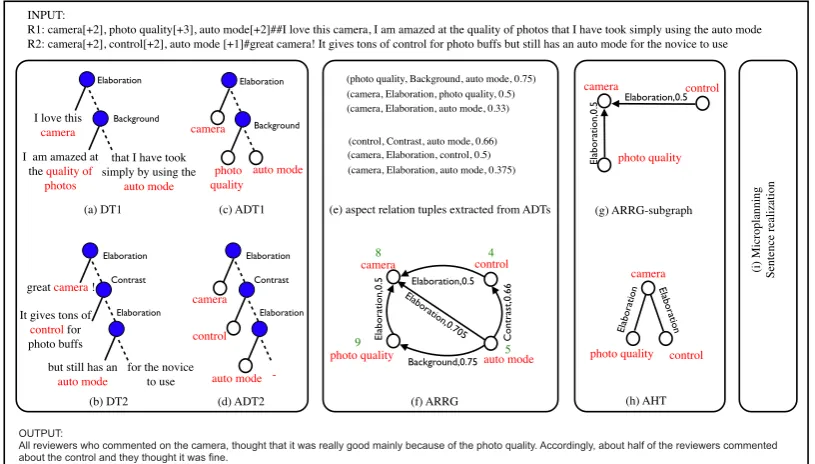
collapsed as into “camera”. This preprocessing step helps to reduce the noise generated by inac-curate aspect labeling in our reviews. Figure 1 shows two sample input reviews where the aspects and their P/S scores are identified. For example, in R1, aspectscamera,photo qualityandauto mode
are mentioned. The P/S values for the three as-pects are [+2], [+3] and [+2] respectively which indicate positive opinion on all aspects.
The first component of our system applies a course parser to each review and obtains a dis-course tree representation for every review (e.g. Figure 1 (a) and (b)). The discourse trees are then modified such that every leaf node only contains the aspect words. The output of the first compo-nent is an aspect-based discourse tree (ADT) for every review (e.g. Figure 1 (c) and (d)). In the second component, we aggregate the ADTs and generate a graph called Aggregated Rhetorical Re-lation Graph (ARRG) (e.g. Figure 1 (f)). The third component of our framework, is responsi-ble for content selection and structuring. It takes ARRG as input, runs Weighted PageRank, and se-lects a subgraph (e.g. Figure 1 (g)) representing the most important aspects. Finally it transforms the selected subgraph into a tree and provides an AHT as output (e.g. Figure 1 (h)). The gener-ated AHT is the input of the last component which generates a natural language summary by apply-ing micro plannapply-ing and sentence realization. We now describe each component of our framework in more detail.
3 Discourse Parsing
Any coherent text is structured so that we can derive and interpret the information. This struc-ture shows how discourse units (text spans such as sentences or clauses) are connected and relate to each other. Discourse analysis aims to reveal this structure. Several theories have been pro-posed in the past to describe the discourse
struc-ture, among which the Rhetorical Structure The-ory (RST) (Mann and Thompson, 1988) is one of the most popular. RST divides a text into min-imal atomic units, called Elementary Discourse Units (EDUs). It then forms a tree representa-tion of a discourse called a Discourse Tree (DT) using rhetorical relations (e.g., Elaboration,
Ex-planation, etc) as edges, and EDUs as leaves.
EDUs linked by a rhetorical relation are also dis-tinguished based on their relative importance in conveying the author’s message: nucleus is the central part, whereas satellite is the peripheral part.
We use a publicly available state-of-the-art dis-course parser (Joty et al., 2013)1 to generate a
DT for each product review. Figure 1 (a) and (b) show DTs for two sample reviews where dotted edges identify the satellite spans. DT1 in Figure 1 (a) shows that review R1 consists of three EDUs with two relations Elaboration and Background
between them. It also shows that the first EDU (i.e. I love camera) is the nucleus (shown by solid line) of the relationElaborationand so the rest of the document (EDUs 2 and 3) is less important and aims at elaborating on what the author meant in the first EDU. Similarly, the structure shows that the third EDU is mentioned as background infor-mation for EDU2 and so is less important for real-izing the core meaning of the document.
After obtaining the DTs, we remove all words from the text spans of each EDU, except the aspect words. Thus, for each review, we have a DT where a leaf node represents the aspects occurring in the corresponding EDU. Note that there may be EDUs containing no aspects in a review. In such cases, we keep the corresponding node and mark it with no aspect. We call the resulting tree an Aspect-based Discourse Tree (ADT) which will be used in the next components. Figure 1 (c) and (d) show ADTs generated from DTs.
4 Aspect Rhetorical Relation Graph (ARRG)
In the second component, we aim at generat-ing an ARRG for a product, based on the ADTs which are the output from the previous compo-nent. There are two motivations behind aggregat-ing the ADTs and buildaggregat-ing the ARRG: i) while each ADT can be rather noisy because of the infor-mal language of the reviews and inaccuracies from
Background Elaboration
I love this camera
I am amazed at the quality of
photos
that I have took simply by using the
auto mode
great camera !
It gives tons of control for photo buffs
but still has an auto mode
for the novice to use INPUT:
R1: camera[+2], photo quality[+3], auto mode[+2]##I love this camera, I am amazed at the quality of photos that I have took simply using the auto mode R2: camera[+2], control[+2], auto mode [+1]#great camera! It gives tons of control for photo buffs but still has an auto mode for the novice to use
camera photo quality auto mode Background Elaboration camera control auto mode camera
-(camera, Elaboration, photo quality, 0.5) (camera, Elaboration, auto mode, 0.33) (photo quality, Background, auto mode, 0.75)
(camera, Elaboration, auto mode, 0.375) (camera, Elaboration, control, 0.5) (control, Contrast, auto mode, 0.66)
Elaboration Contrast Elaboration Elaboration Contrast Elaboration camera
photo quality auto mode control El abo ra tio n, 0. 5 Background,0.75 Elabo ration,0. 705 Elaboration,0.5 Co ntra st, 0. 66 8 4 9 5 camera photo quality control El abo ra tio n, 0. 5 Elaboration,0.5 camera
photo quality control
Elabo ratio
n Elabo ra tion
(d) ADT2 (c) ADT1 (a) DT1
(b) DT2 (f) ARRG (h) AHT
(g) ARRG-subgraph (e) aspect relation tuples extracted from ADTs
OUTPUT:
All reviewers who commented on the camera, thought that it was really good mainly because of the photo quality. Accordingly, about half of the reviewers commented about the control and they thought it was fine.
(i ) M ic ropl anni ng S ent enc e re al iz at ion
[image:4.595.95.503.64.296.2]Wednesday, May 28, 14
Figure 1: A simple example illustrating different components of our summarization framework.
automatic discourse parsing, aggregating all the ADTs can reveal more reliable information; and
ii) the aggregated information highlights the most important aspects overall as well as the strongest connection between the aspects. This information can effectively drive the content selection and ab-stract generation phases.
ARRG is a directed graph in which we allow multiple edges between two vertices. In ARRG, vertices represent aspects. We associate to each aspect/node an importance measure that aggre-gates all the P/S values that the aspect receives in all the reviews. By following (Carenini et al., 2013), letP S(a) be the set of P/S values that an aspect areceives. The direct measure of impor-tance of the aspect is defined as:
dir-moi(a) = X
ps∈P S(a)
ps2 (1)
In ARRG, edges indicate existence of a rhetorical relation between text spans of a re-view in which the aspects occurred. Edges are labeled with the type of the relation as well as a weight indicating our confidence in the presence of the relation between the two aspects. In ARRG, an edge with label r, w from node
u to node v, u −−−→r, w v, indicates the existance of a relation r with confidence w between two aspectsu andv. Also, the direction of the arrow indicates that u and v occurred in the satellite
and nucleus spans respectively. For example,
photo quality−−−−−−−−−−−→elaboration, 0.8 cameraindicates
that there is a high confidence (0.8) that aspect
photo qualitywas used in a text span to elaborate
aspect camera. Moreover, camera is a more important aspect compared tophoto quality.
To build ARRG, we use all the ADTs that are output of the previous component (one for each review). From eachADTj, we extract all tuples of the form(u, r, v, w)in whichuis an aspect oc-curring in a satellite span,vis an aspect occurring in a nucleus span,ris a relation type andwis the weight of the tuple computed as follows:
w= 1−0.5|EDUs between u and v|
|total EDUs inADTj| −0.5
dr
d (2)
where, |.| indicates cardinality of a set. d indi-cates the depth of theADTj anddr indicates the depth of the sub-tree ofADTj rooted at relation
likely that aspects are related through non adjacent EDUs and so are less strongly related. Figure 1 (e) shows tuples extracted from sample ADTs.
Notice that every two aspects u andv may be related by the same relation more than once in an ADT for a review. Thus, we might haveituples with the sameu,r, andv but confidence weights which are not necessarily the same. From every
ADTj, we extract all (u, r, v, wij) and select the one with maximum confidence. We then aggre-gate the selected tuples extracted from different reviews. Putting these two steps together, for ev-ery two aspectsuandv related by relationr, we obtain a single tuple(u, r, v,wˆ)where
ˆ
w=X
j max
i wij (3)
Figure 1 (f) shows an example ARRG built for the sample reviews.
5 Content Selection and Structuring
The content of the summary is selected by extract-ing from ARRG a subgraph containextract-ing the most important aspects. Such content is then structured by transforming the subgraph into an aspect hier-archy.
5.1 Subgraph Extraction
In ARRG aspects/nodes are weighted by how fquently and strongly they are evaluated in the re-views (i.e, dir-moi) and edges are weighted by how frequently and strongly the corresponding as-pects are rhetorically related in the discourse trees (Equation 3). In content selection, we want to extract aspects that not only have high weight, but that are also linked with heavy edges to other heavy aspects. This problem can be effectively addressed by Weighted Page Rank (WPR) (Xing and Ghorbani, 2004). WPR takes the importance of both the in-links and out-links of the aspects into account and distributes rank scores based on the weights of relations between aspects. In this way, the heavier aspect nodes, that are either in the nuclei of many relations or in the satellites of relations with other heavy aspects, are promoted. We then update the weight of nodes (aspects) with the new score from WPR. Finally, we rank nodes based on their updated score moi and select the topNaspects.
moi(a) =αdir-moi(a) + (1−α)W P R(a) (4)
Hereαis a coefficient that can be tuned on a de-velopment set or can be set to0.5without tuning. Figure 1 (g) shows an example subgraph selected from the sample ARRG.
5.2 Aspects Subgraph to Aspects Hierarchy Transformation
In this step, we generate a hierarchical tree struc-ture for aspects. Such a tree strucstruc-ture helps to navigate over aspects and can be easily traversed to find certain aspects and their relation to their parent or children. The hierarchy of aspects also matches the intuition that the root node is the most frequent and general aspect (often the product) and as the depth increases, nodes represent more spe-cific aspects of the product with less frequency and weight.
To obtain a hierarchical tree structure from the extracted subgraph, we first build an undirected graph as follows: we merge the edges connecting two nodes and consider the sum of their weights as the weight of the merged graph. We also ignore the relation direction for the purpose of generat-ing the tree. We then find the Maximum Span-ning Tree of the undirected subgraph and set the highest weighted aspect as the root of the tree. This process results in a useful knowledge struc-ture of aspects with their associated weight and sentiment polarity connected with the rhetorical relations called Aspect Hierarchical Tree (AHT). Figure 1 (h) shows the generated AHT from the sub-graph.
6 Abstract Generation
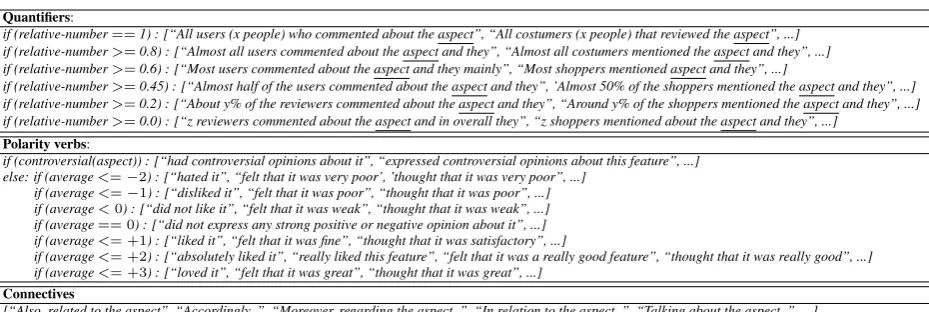
The automatic generation of a natural language summary in our system involves the following tasks (Reiter and Dale, 2000): (i) microplanning, which covers lexical selection; and (ii) sentence realization, which produces english text from the output of the microplanner.
6.1 Microplanning
Quantifiers:
if (relative-number==1) : [“All users (x people) who commented about the aspect”, “All costumers (x people) that reviewed the aspect”, ...] if (relative-number>=0.8) : [“Almost all users commented about the aspect and they”, “Almost all costumers mentioned the aspect and they”, ...] if (relative-number>=0.6) : [“Most users commented about the aspect and they mainly”, “Most shoppers mentioned aspect and they”, ...]
if (relative-number>=0.45) : [“Almost half of the users commented about the aspect and they”, ’Almost 50% of the shoppers mentioned the aspect and they”, ...] if (relative-number>=0.2) : [“About y% of the reviewers commented about the aspect and they”, “Around y% of the shoppers mentioned the aspect and they”, ...] if (relative-number>=0.0) : [“z reviewers commented about the aspect and in overall they”, “z shoppers mentioned about the aspect and they”, ...]
Polarity verbs:
if (controversial(aspect)) : [“had controversial opinions about it”, “expressed controversial opinions about this feature”, ...] else: if (average<=−2) : [“hated it”, “felt that it was very poor’, ’thought that it was very poor”, ...]
if (average<=−1) : [“disliked it”, “felt that it was poor”, “thought that it was poor”, ...] if (average<0) : [“did not like it”, “felt that it was weak”, “thought that it was weak”, ...] if (average== 0) : [“did not express any strong positive or negative opinion about it”, ...] if (average<= +1) : [“liked it”, “felt that it was fine”, “thought that it was satisfactory”, ...]
if (average<= +2) : [“absolutely liked it”, “really liked this feature”, “felt that it was a really good feature”, “thought that it was really good”, ...] if (average<= +3) : [“loved it”, “felt that it was great”, “thought that it was great”, ...]
Connectives
[image:6.595.77.542.58.214.2][“Also, related to the aspect”, “Accordingly, ”, “Moreover, regarding the aspect, ” ,“In relation to the aspect, ”, “Talking about the aspect, ”, ...]
Table 1: Microplanning strategy for lexical choice. The selected lexical items will fill the template in the realization step.
Sentence realization templates: First sentence templates:
if (polarity-agreement(root,highest-weighted-child) & connecting-relation == [elaboration, explain, cause, summary, same-unit, background, evidence, justify]): “quantifier + polarity-verb +‘mainly because of the’ +highest-weighted-child”
else: “quantifier + polarity-verb”
First level children (aspects) sentences templates: “connective + ‘, ’ + quantifier + ’ ’ + polarity-verb” Supporting sentences templates:
if (#children(aspect)==1): “connective + quantifier + verb ”
elseif (#children(aspect)>1 & polarity-agreement(children)): “connective + quantifier + verb + [and, similarly, while, ...] + quantifier + verb” elseif (#children(aspect)>1 &!polarity-agreement(children)): “connective + quantifier + verb + [but, in contrast, on contrary, ...] + quantifier + verb”
Table 2: Sentence realization templates.
Quantifiers: for each aspect, a quantifier is se-lected based on both the absolute and relative number of users whose opinions contributed to the evaluation of the aspect.
Polarity verbs: for each aspect, a polarity verb is selected based on the average sentiment polarity strength for that aspect. Although the average, in most cases, can be a good metric to evaluate the polarity of an aspect, it fails when the distribution of evaluations is centered on zero, for instance, if there are equal numbers of positive and negative evaluations (i.e., controversial). To partially solve this problem, we first check whether the aspect evaluation is controversial by applying the formula proposed by (Carenini and Cheung, 2008). In the case of controversiality, our microplanner selects a lexical item to express the controversiality of the aspect. In other cases, we use the average and se-lect the polarity verb based on that.
Connectives: in order to form more fluent and readable sentences and to increase the language variability, we randomly select our connectives from the list shown in Table 1. Moreover, when a parent aspect (excluding the root in AHT) has two children, they are connected by one of the co-ordinating conjunction “[and, similarly]” if they
agree on polarity, and they will be connected by a choice of “[on the contrary, in contrast]” other-wise (see Supporting sentences templates in Table 2). As an alternative we could have selected con-nectives based on the discourse relations specified in the aspects tree. However, this is left as future work.
6.2 Sentence Realization
The realization of our abstract generation is per-formed by applying a rather simple and compre-hensive template-based strategy. Depending on the specific lexical choice in microplanning step, an appropriate template and corresponding fillers are selected as shown in Table 2. We develop three different templates: i)generates the first abstract sentence;ii)generates the abstract sentence for the aspects with no children; and iii) generates sup-porting sentences for aspects with children.
For illustration, assuming that we apply this strategy to a 5-node variation of the AHT in Figure 1 (h), where the aspect “control” has two children
“auto mode” and “setting”, we obtain “All
thought it was fine. Also, related to the control, 7 users expressed their opinion about the auto mode and they liked it, similarly, 6 shoppers commented about the setting and they thought that it was
sat-isfactory.”
7 Experimental Setup
7.1 Dataset and Baselines
We conduct our experiments using the customer reviews of twelve products obtained from (Hu and Liu, 2004a): 4 digital cameras, 1 DVD player, 1 MP3 player, 2 routers, 2 phones, 1 diaper and 1 antivirus. The reviews were collected from Ama-zon.com and Cnet.com. We use manually anno-tated aspects and their associated sentiment from the same dataset.
We compare the summaries generated by our system with two state-of-the-art extractive base-lines and a simpler version of our abstractive sys-tem, as follows:
1) MEAD-LexRank (LR): we use the LexRank (Erkan and Radev, 2004) implementation inside the MEAD summarization framework (Radev et al., 2004), which outperforms other algorithms implemented in the MEAD framework.
2) MEADStar (MEAD*): a state-of-the-art ex-tractive opinion summarization system (Carenini et al., 2013), which is adapted from the open source summarization framework MEAD. MEAD* orders aspects by the number of tences evaluating that aspect, and selects a sen-tence from each aspect until it reaches the word limit. The sentence that is selected for each aspect is the one with the highest sum of polarity/strength evaluations for any aspect.
3) Simple Abstractive (SA): we sort the aspects of each product based on dir-moi (Equation 1). Then, for each aspect, we generate a sentence based on a simple template “quantifier + polarity-verb” until the summary reaches the word limit.
We limit the length of our summaries to 150 words. In our experiment we use the default pa-rameter in Equation 4 without tuning (i.e. α = 0.5). Our system starts the content selection pro-cess with 10 aspects and generates a summary based on a AHT with 10 aspects. We add one as-pect, reproduce the AHT and regenerate the sum-mary. We repeat this process until the word limit is reached.
7.2 Evaluation Framework
On one hand, the lack of product reviews datasets with human written summaries, and on the other hand, the difficulty of generating human-written summaries for reviews, makes review summary evaluation a very challenging task.
We evaluate the summaries generated by our system by performing two user studies based on pairwise preferences using a popular crowdsourc-ing service.2 The user preference evaluation is an
effective method for opinion summarization (e.g., (Lerman et al., 2009)). The main motivations be-hind pairwise preferences evaluation is two-fold:
i) raters can make a preference decision more ef-ficiently than a scoring judgment; and ii) rater agreement is higher in preference decisions than in scoring judgments (Ariely et al., 2003).
In both user studies, for each product, we run six pairwise comparisons for four summaries. In each rating assignment, two summaries of the same product were placed in random order. Raters were shown the name of each product along with the relevant summaries and were asked to express their preference for one summary over the other using a simple set of criteria. For two summaries
S1andS2 raters should choose one of the
follow-ing three options: 1) PreferS1, 2) PreferS2, 3) No
preference.
Raters were specifically instructed that their rat-ing should express “overall satisfaction with the
information provided by the summary”. Raters
were also asked to provide a brief comment jus-tifying their choice. Over48raters participated in each study, and each comparison was evaluated by at least five raters generating more than 360 judg-ments for each user study. We pre-select the high skilled raters to ensure a higher quality results.
The main difference between the two user stud-ies is that in “user study 1”, we show two sum-maries to the raters and ask them to choose the one they prefer without showing them the original re-views. In contrast, in “user study 2”, we show two summaries with links to the full text of the reviews for the raters to explore. In order to make sure that the raters read the reviews, we ask them to write a short summary of the reviews before rating the automatic summaries. We ran two different user studies because:i) for each product there might be many reviews to be included;ii) there is no guar-anty that raters, in various evaluation settings, read
System I vs System II Agreement No preference Preferred Sys I Preferred Sys II
User Studies 1 2 1 2 1 2 1 2
LR vs MEAD* 0.33 0.75 7% 6% 35% 20% 58% 74%
LR vs SA 0.42 0.83 0% 0% 38% 21% 62% 79%
LR vs Our System 0.50 1.00 0% 3% 26% 13% 74% 84%
MEAD* vs SA 0.58 0.83 0% 0% 38% 20% 62% 80%
MEAD* vs Our System 0.67 0.50 0% 3% 25% 30% 75% 67%
[image:8.595.87.516.62.151.2]SA vs Our System 0.42 0.50 12% 11% 23% 32% 65% 57%
Table 3: Results of pairwise preference user studies. Statistically significant improvements (p < 0.01) over the baselines are demonstrated by bold fonts. Italic fonts indicate statistical significance (p <0.01) of abstractive methods (SA and Our System) over extractive approaches (LR and MEAD*).
Systems LR MEAD* SA Our System
User Studies 1 2 1 2 1 2 1 2
Preference 33% 18% 41% 41% 49% 63% 71% 69%
Table 4: System preference results. Statistically significant improvements (p <0.01) over the baselines are demonstrated by bold fonts.
the reviews (partially or completely); andiii) there is no evidence regarding the depth that each rater would look into the reviews. Therefore, choosing between user study 1 and 2 is not a straightforward decision. In other words, designing the two user studies in this way helps us to answer the ques-tion: “Does the fact that raters can read all the
reviews affect their ratings?”.
8 Results
This section provides a quantitative and qualitative analysis of the evaluation results3.
8.1 Quantitative Analysis
Quantitative results for both user studies are shown in Table 3. The second column indicates the percentage of judgments for which the raters were in agreement. Agreement here is a weak agreement, where four (out of five) raters are de-fined to be in agreement if they all gave the same rating. The next three columns indicate the per-centage of judgments for each preference cate-gory, grouped into two user studies. In addi-tion, we measure the preference for each system in both user studies (Table 4). For each system, the preference is the number of times raters prefer the system, divided by the total number of judg-ments for that system (e.g., if A is preferred over
3The evaluation results and summaries obtained
from CrowdFlower are publicly available and can be downloaded from: https://www.cs.ubc. ca/cs-research/lci/research-groups/ natural-language-processing/reviews/ user_study_results.zip
B 10 out of 30 times, and A is preferred over C 15 out of 20 times, the overall preference of A is (10+15)/(30+20)=50%)
Abstractive vs. Extractive: the results of our sys-tem and SA in Table 3 show statistically signifi-cant improvements in pairwise preference over ex-tractive baselines (LR and MEAD*) in both user studies.4 Moreover, the results of overall
prefer-ence in Table 4 demonstrates that two abstractive systems are preferred over the extractive ones in both studies. This further supports the findings in the previous studies (e.g., (Carenini et al., 2013)) that users prefer abstractive summarization. We can observe that, in both user studies, raters prefer our system over other abstractive and extractive baselines. Also, the highest pairwise preference percentages occur comparing an extractive and an abstractive system (e.g., LR vs Our System).
Abstractive Systems: the raters prefer our system over SA in both user studies (65% and 57%), and our system ranks first in our pairwise preference user studies. Knowing that both systems are ab-stractive and the differences between them comes from using the rhetorical structure in the content selection and abstract generation phases, proves the effectiveness of using rhetorical structure and relations in abstractive summarization of reviews.
Extractive Systems: the result in Table 3 and 4 demonstrate that raters prefer MEAD* over LR. Although both systems are extractive, the MEAD* system has been proposed for extractive opinion
4The statistical significance tests was calculated by
[image:8.595.98.500.215.255.2]Preference Sys 1 to Sys 2 Reasons Examples of preference justification taken from the raters comments Our System to LR and MEAD* Readability, coverage of aspects,
aggregation of opinions better wording, more objective, more depth, I like the stats, more detail aboutpeople opinion, less personal experience, detail comparison from different reviews, a summary in a summary, mentions more features, ...
LR and MEAD* to Our System Descriptiveness, personal point of
views, product capabilities explain how the product is positive, good characteristics about the product,has lot more to tell, more descriptive about features, personal perspective, not only characteristics but also ability, more true to the product itself, ... Our System to SA The relations between the aspects,
[image:9.595.81.517.61.148.2]more language variability provides a bit more information, is very complete, not repetitive, more ele-gant, coherent, ... SA to Our System Simpler structure, more aspects written better, has touched variety of features, ...
Table 5: System preference results. The reasons are classified based on raters justifications preferring the underlined systems.
summarization. In contrast, LR is a generic ex-tractive summarization system which is not opti-mized for opinion summarization. This also fur-ther demonstrates the need for opinion and reviews summarization systems.
User Study 1 vs. User Study 2: the first
in-teresting observation is that, although the over-all ranking of systems in both user studies does not change, there are some changes in the re-sults. This indicates that reading the reviews ef-fects preference decisions. We can observe that in all cases except one (MEAD* vs Our System) the agreement between the raters increases sig-nificantly when they are given the reviews. This can be interpreted as reading the reviews helps the rater to choose a better summary easier and more effectively. Moreover, we calculate the over-all agreement for both user studies.5 Case study 2
reports a higher overall agreement (70%) in com-parison with the user study 1 (65%). This further proves our finding that showing the reviews can help the raters with their preference judgment.
In Table 3, the preference of sys 2 (last col-umn) significantly rises for all cases when com-pared with the LR system. This proves that raters strongly prefer the summaries that cover opinion-ated sentences, specifically when they are exposed to the reviews. The same result is reflected in Ta-ble 4, where the overall preference of LR drops when the raters are given the reviews. We also ob-serve a significant rise in preference of sys 2 when MEAD* is compared with SA (Table 3) and in the overall preference of SA (Table 4) in user study 2. This proves that raters become more confident in preferring an abstractive summary over an ex-tractive one when the reviews are given to them. In contrast, we notice that the preference of sys 2 drops comparing “MEAD* vs Our System” and “SA vs Our System”. Knowing that the drop is
5The agreement is calculated based on 100 randomly
sam-pled units selected from our crowdsourcing job.
not significant and the the overall ranking of sys-tems remains unchanged, this case is less straight forward to interpret.
8.2 Qualitative Analysis
We collect and group the rater justifications in the results we obtain by crowdsourcing our evaluation framework, when preferring a summary over an-other, in Table 5. To make the comparison more clear, Example 1 shows the summaries generated by MEAD* and our system.
Comparing our system with the extractive base-lines, raters’ justifications are classified in three main categories. Although the language of the ex-tractive summaries is less formal, raters often pre-fer our system in terms of presentation and lan-guage. They justify their selections by expressing phrases such as “better grammar” or “fewer er-rors”. They also comment about the coverage of aspects in the summaries generated by our system and they realize that our system was capable of aggregating the opinions for each aspect. In con-trast, when they prefer the extractive summaries, they like the descriptive language of the summary and the technical details of the products that were missing in our system summaries.
We also notice that raters realize the usage of structure (AHT) in our system (both of content se-lection and summary generation) and they appre-ciate it by expressing phrases such as “very
com-plete”, “more elegant” or “related features”. In
Product: Nikon Coolpix 4300
MEAD*: it is very compact but the controls are so well designed that they ’re still easy to use . It ’s easy for beginners to use , but has features that more serious photographers will love , so it ’s an excellent camera to grow into . But overall this is a good camera with a ’ really good ’ picture clarity ; an exceptional close-up shooting capability .The battery life is very good , i got about 90 minutes with the lcd turned on all the time , the first time around , and i have been using it with the lcd off every now and then , and have yet needed to recharge it . Yes , the picture quality and features which are too numerous to mention are unmatched for any camera in this price range.
Our System: All reviewers (34 people), who commented on the cam-era, felt that it was really good mainly because of the picture. Around 26% of the reviewers expressed their opinion about the picture quality and they really liked it. Around 24% of the reviewers noted the use and they thought that it was satisfactory. Talking about the use, around 24% of the reviewers expressed their opinion about the size and they felt that it was fine. Only 6 reviewers commented about the scene mode and in overall they thought that it was satisfactory. Moreover, regarding the scene mode, 4 shoppers mentioned about the manual mode and they thought that it was satisfactory, and similarly only 4 reviewers com-mented about the auto mode and in overall they did not express any strong positive or negative opinion about it. Only 4 costumers men-tioned the software and they felt that it was really good.
Example 1. Summaries generated by our system and MEAD* baseline for the Nikon Coolpix 4300 camera. For brevity we exclude other baselines.
9 Conclusions
We have presented a framework for abstractive summarization of product reviews based on dis-course structure. For content selection, we pro-pose a graph model based on the importance and association relations between aspects, that as-sumes no prior domain knowledge, by taking ad-vantage of the discourse structure of reviews. For abstract generation, we propose a product inde-pendent template-based natural language genera-tion (NLG) framework that takes aspects and their structured relation as input and generates an ab-stractive summary. Quantitative evaluation results, based on two pairwise preference user studies, show substantial improvement over extractive and abstractive baselines, including MEAD*, which is considered a state-of-the-art opinion extractive summarization system, and a simpler version of our abstractive system. In future work, we plan to extend the microplanning phase by taking ad-vantage of the highly weighted rhetorical relations between the aspects and select connective phrases based on the discourse relations specified in the aspects tree. In addition, we plan to develop and evaluate an end-to-end system, in which the aspect extraction and polarity estimation of aspects are automated. In this way, we can achieve an end-to-end automatic summarizaion system for product reviews.
Acknowledgments
This work was supported in part by Swiss Na-tional Science Foundation (PBTIP2-145659) and NSERC Business Intelligence Network. We would like to thank the anonymous reviewers for their valuable comments. We also acknowledge Shafiq Rayhan Joty for his help regarding rhetori-cal parser.
References
Dan Ariely, George Loewenstein, and Drazen Prelec. 2003. “Coherent Arbitrariness”: Stable Demand Curves Without Stable Preferences.Quarterly Jour-nal of Economics, 118:73–105.
Nicholas Asher, Farah Benamara, and Yvette Yannick Mathieu. 2008. Distilling opinion in discourse: A preliminary study. InColing 2008: Companion vol-ume: Posters and Demonstrations, pages 5–8.
Regina Barzilay, Kathleen R. McKeown, and Michael Elhadad. 1999. Information fusion in the context of multi-document summarization. InProceedings of the 37th annual meeting of the Association for Computational Linguistics on Computational Lin-guistics, ACL ’99, pages 550–557, Stroudsburg, PA, USA. Association for Computational Linguistics.
Giuseppe Carenini and Jackie Chi Kit Cheung. 2008. Extractive vs. nlg-based abstractive summarization of evaluative text: the effect of corpus controversial-ity. In INLG ’08: Proceedings of the Fifth Inter-national Natural Language Generation Conference, pages 33–41, Morristown, NJ, USA. Association for Computational Linguistics.
Giuseppe Carenini, Jackie Chi Kit Cheung, and Adam Pauls. 2013. Multi-document summarization of evaluative text. Computational Intelligence, 29(4):545–576.
Giuseppe Di Fabbrizio, Amanda Stent, and Robert Gaizauskas. 2014. A hybrid approach to multi-document summarization of opinions in reviews. In
Proceedings of the 8th International Natural Lan-guage Generation conference, INLG 2014.
G¨unes Erkan and Dragomir R. Radev. 2004. Lexrank: graph-based lexical centrality as salience in text summarization. J. Artif. Int. Res., 22(1):457–479, December.
Kavita Ganesan, ChengXiang Zhai, and Jiawei Han. 2010. Opinosis: a graph-based approach to abstrac-tive summarization of highly redundant opinions. In
Minqing Hu and Bing Liu. 2004a. Mining and sum-marizing customer reviews. InProceedings of ACM SIGKDD Conference on Knowledge Discovery and Data Mining 2004 (KDD 2004), pages 168–177, Seattle, Washington.
Minqing Hu and Bing Liu. 2004b. Mining opinion features in customer reviews. InProceedings of the Nineteenth National Conference on Artificial Intelli-gence (AAAI-2004).
Minqing Hu and Bing Liu. 2006. Opinion feature extraction using class sequential rules. In Pro-ceedings of AAAI 2006 Spring Sympoia on Compu-tational Approaches to Analyzing Weblogs (AAAI-CAAW 2006).
Shafiq Joty, Giuseppe Carenini, Raymond Ng, and Yashar Mehdad. 2013. Combining intra- and multi-sentential rhetorical parsing for document-level dis-course analysis. InProceedings of the 51st Annual Meeting of the Association for Computational Lin-guistics (Volume 1: Long Papers), pages 486–496, Sofia, Bulgaria, August. Association for Computa-tional Linguistics.
Hyun Duk Kim, Kavita Ganesan, Parikshit Sondhi, and ChengXiang Zhai. 2011. Comprehensive review of opinion summarization.
Hyun Duk Kim, Malu Castellanos, Meichun Hsu, ChengXiang Zhai, Umeshwar Dayal, and Riddhi-man Ghosh. 2013. Compact explanatory opinion summarization. In Proceedings of the 22Nd ACM International Conference on Conference on Infor-mation & Knowledge Management, CIKM ’13, pages 1697–1702, New York, NY, USA. ACM.
Angeliki Lazaridou, Ivan Titov, and Caroline Sporleder. 2013. A bayesian model for joint unsupervised induction of sentiment, aspect and discourse representations. In Proceedings of the 51st Annual Meeting of the Association for Compu-tational Linguistics (Volume 1: Long Papers), pages 1630–1639, Sofia, Bulgaria, August. Association for Computational Linguistics.
Kevin Lerman, Sasha Blair-Goldensohn, and Ryan Mc-Donald. 2009. Sentiment summarization: Evaluat-ing and learnEvaluat-ing user preferences. InProceedings of the 12th Conference of the European Chapter of the Association for Computational Linguistics, EACL ’09, pages 514–522, Stroudsburg, PA, USA. Asso-ciation for Computational Linguistics.
Hugo Liu and Push Singh. 2004. Conceptnet: A prac-tical commonsense reasoning toolkit. BT Technol-ogy Journal, 22(4):211–226.
Yue Lu, ChengXiang Zhai, and Neel Sundaresan. 2009. Rated aspect summarization of short com-ments. In Proceedings of the 18th International Conference on World Wide Web, WWW ’09, pages 131–140, New York, NY, USA. ACM.
William C. Mann and Sandra A. Thompson. 1988. Rhetorical structure theory: Toward a functional the-ory of text organization. Text, 8(3):243–281. Subhabrata Mukherjee and Sachindra Joshi. 2013.
Sentiment aggregation using conceptnet ontology. In Proceedings of the 6th International Joint Con-ference on Natural Language Processing, IJCNLP 2013.
Bo Pang and Lillian Lee. 2004. A sentimental educa-tion: Sentiment analysis using subjectivity summa-rization based on minimum cuts. InProceedings of the 42Nd Annual Meeting on Association for Com-putational Linguistics, ACL ’04, Stroudsburg, PA, USA. Association for Computational Linguistics. Bo Pang, Lillian Lee, and Shivakumar Vaithyanathan.
2002. Thumbs up?: Sentiment classification using machine learning techniques. InProceedings of the ACL-02 Conference on Empirical Methods in Natu-ral Language Processing - Volume 10, EMNLP ’02, pages 79–86, Stroudsburg, PA, USA. Association for Computational Linguistics.
Dragomir Radev, Timothy Allison, Sasha Blair-Goldensohn, John Blitzer, Arda C¸elebi, Stanko Dimitrov, Elliott Drabek, Ali Hakim, Wai Lam, Danyu Liu, Jahna Otterbacher, Hong Qi, Horacio Saggion, Simone Teufel, Michael Topper, Adam Winkel, and Zhu Zhang. 2004. MEAD — A plat-form for multidocument multilingual text summa-rization. InConference on Language Resources and Evaluation (LREC), Lisbon, Portugal.
Ehud Reiter and Robert Dale. 2000. Building Natural Language Generation Systems. Cambridge Univer-sity Press, New York, NY, USA.
Benjamin Snyder and Regina Barzilay. 2007. Multiple aspect ranking using the good grief algorithm. In
HLT-NAACL, pages 300–307.
Swapna Somasundaran, Galileo Namata, Janyce Wiebe, and Lise Getoor. 2009. Supervised and unsupervised methods in employing discourse rela-tions for improving opinion polarity classification. InProceedings of the 2009 Conference on Empirical Methods in Natural Language Processing: Volume 1 - Volume 1, EMNLP ’09, pages 170–179, Strouds-burg, PA, USA. Association for Computational Lin-guistics.
Ivan Titov and Ryan T. McDonald. 2008. A joint model of text and aspect ratings for sentiment sum-marization. In Proceedings of the 46th Annual Meeting of the Association for Computational Lin-guistics, June 15-20, 2008, Columbus, Ohio, USA, ACL 2008, pages 308–316. Association for Compu-tational Linguistics.
Wenpu Xing and Ali Ghorbani. 2004. Weighted pager-ank algorithm. InProceedings of the Second Annual Conference on Communication Networks and Ser-vices Research, CNSR ’04, pages 305–314. IEEE Computer Society.