An Experimental Comparison of Active Learning Strategies for
Partially Labeled Sequences
Diego Marcheggiani
Istituto di Scienza e Tecnologie dell’Informazione
Consiglio Nazionale delle Ricerche
Pisa, Italy
[email protected]
Thierry Arti`eres
LIP6
Pierre et Marie Curie University
Paris, France
[email protected]
Abstract
Active learning(AL) consists of asking human annotators to annotate automatically selected data that are assumed to bring the most bene-fit in the creation of a classifier. AL allows to learn accurate systems with much less anno-tated data than what is required by pure super-vised learning algorithms, hence limiting the tedious effort of annotating a large collection of data.
We experimentally investigate the behav-ior of several AL strategies for sequence labeling tasks (in a partially-labeled sce-nario) tailored on Partially-Labeled Condi-tional Random Fields, on four sequence la-beling tasks: phrase chunking, part-of-speech tagging, named-entity recognition, and bio-entity recognition.
1 Introduction
Today, the state-of-the-art methods in most natural lan-guage processing tasks are supervised machine learn-ing approaches. Their main problem lies in their need of large human-annotated training corpus, which re-quires a tedious and expensive work from domain ex-perts. The process ofactive learning(AL) employs one or more human annotators by asking them to label new samples which are supposed to be the most informa-tive in the creation of a new classifier. A classifier is incrementally retrained with all the data labeled by the annotator. AL has been demonstrated to work well and to produce accurate classifiers while saving much hu-man annotation effort. One critical issue is to define a measure of the informativeness which should reflect how much new information a new example would give in the learning of a new classifier once annotated.
A lot of work has been done on the AL field in the past years (see (Settles, 2012) for an exhaustive overview). In particular, AL proved its usefulness in se-quence labeling tasks (Settles and Craven, 2008). Yet, researchers have always adopted as annotation unit an entire sequence (i.e., the annotator is asked to anno-tate the whole sequence) while it looks like it could be much more relevant to ask for labeling only small parts of it (e.g., the ones with highest ambiguity). A few
works have investigated this idea. For instance, Wan-varie et al. (2011) proposed to use Partially-Labeled Conditional Random Fields (PL-CRFs) (Tsuboi et al., 2008), a semi-supervised variation of Conditional Ran-dom Fields (CRFs) (Lafferty et al., 2001) able to deal with partially-labeled sequences, thus enabling to adopt as annotation unit single tokens and still learning from full sequences. AL with partially labeled sequences has proven to be effective in substantially reducing the amount of annotated data with respect to common AL approaches (see (Wanvarie et al., 2011)).
In this work we focus on AL strategies for partially labeled sequences adopting the single token as annota-tion unit and PL-CRFs as learning algorithm given its nature in dealing with partially labeled sequences. We propose several AL strategies based on measures of un-certaintyadapted for the AL with partially labeled se-quences scenario and tailored on PL-CRFs. We further propose two strategies that exploit the finer granularity given by the partially-labeled scenario. We also show that the choice of single-token annotation can bring to unpredictable results on sequence labeling tasks in which the structure of the sequences is not regular, e.g., named-entity recognition. We propose a first solution to the problem of unpredictability. The aim of this work is thoroughly compare the effectiveness and the behavior of all the proposed AL strategies on four stan-dard sequence labeling tasks, phrase chunking, part-of-speech tagging, named-entity recognition and bio-entity recognition.
The remainder of this paper is as follows. In tion 2 we summarize the related work in AL, in Sec-tion 3 we describe PL-CRFs, the semi-supervised al-gorithm we adopt in this work. Section 4 describes in details the AL framework and the AL strategies we propose. Section 5 provides a description of the experi-mental setting, the datasets, and discusses the empirical results. Section 6 summarizes our findings.
2 Related Work
Our work belongs to the pool-based AL framework. It considers the case in which a large amount (pool) of unlabeled examples is available, from which samples to be labeled must be chosen. This framework fits all the sequence labeling problems we consider here. For a more exhaustive survey on other AL frameworks see
(Settles, 2012).
Most of the AL works on sequence labeling adopted the entire sequence as annotation unit (Settles and Craven, 2008) which was demonstrated by Wanvarie et al. (2011) to be less effective than using the single token as annotation unit. The main AL works in this latter line of work are (Shen et al., 2004), (Tomanek and Hahn, 2009) and (Wanvarie et al., 2011). Shen et al. (2004) adopted SVMs as learning algorithm and proposed two strategies that combine three criteria, in-formativeness, representativeness and diversity. SVMs allowed them to use as annotation unit a subset of the tokens in a sequence, without annotating, in any way, the rest of the tokens in the sequence. In (Tomanek and Hahn, 2009), the most uncertain tokens of the sequence are singularly annotated, but the rest of the labels in the sequence are then chosen by the classifier in a semi-supervised fashion. Wanvarie et al. (2011) is the clos-est work to ours, they adopt a minimum confidence se-lection strategy with re-estimation using the PL-CRFs. Differently from our work, Wanvarie et al. (2011) show that adopting the AL with partially labeled sequences using re-estimation, the annotation cost can be dramat-ically reduced (by annotating from 8% to 10% of the tokens of the entire training set), obtaining the same level of performance of the classifier trained on the en-tire, fully-labeled, training set. We started our work from this conclusion and we focused on AL with par-tially labeled sequences using re-estimation by compar-ing several AL strategies in order to find the strategy that allows to create the best classifier with the mini-mum annotation effort.
3 Partially-Labeled
Conditional Random Fields
Nowadays, CRFs are thede-factostandard for the so-lution of sequence labeling tasks (Sarawagi, 2008). In traditional CRFs (Lafferty et al., 2001) the conditional probability of a sequence of labelsygiven a sequence of observed feature vectorsxis given by:
p(y|x) =Z(1x)YT
t=1
Ψt(y,x) (1)
where a standard choice for sequence labeling tasks are the so called Linear-chain CRFs:
p(y|x) = Z(1x)
T
Y
t=1
Ψt(yt, yt−1,xt) (2)
with:
Ψt(yt, yt−1,xt) = Ψu(yt, xt)Ψb(yt, yt−1) (3)
where Ψu(yt, xt) models the co-occurrence between
features xt, and label yt at time t, and Ψb(yt, yt−1)
models the co-occurrence between two adjacent labels
ytandyt−1.
PL-CRFs introduced by Tsuboi et al. (2008) allow to learn a CRF model using partially-labeled sequences, marginalizing on those tokens that do not have an as-signed label. In PL-CRFs,Ldenotes a partially labeled information about a sequence. It consists of a sequence of setsLtin whichLt =Y (whereY is the set of all
the possible labels) if there is no label information for token at timet. Ltis a singleton containingytif the
label of the token at timetis known, andYLis the set
of label sequences that fits the partial label information L. Then the probability of a partial labeling may be computed as:
p(YL|x) =
X
y∈YL
p(y|x) (4)
In order to perform inference and parameter learning on PL-CRFs, some modifications on traditional CRFs inference algorithms are required.
3.1 Forward-Backward Algorithm
Differently from traditional CRFs, the forward and backward scores (respectivelyαandβ), are calculated as follows:
αt,L(j) =
0 ifj6∈Lt
Ψ1(j, y0, x1) else ift= 1
andj∈Lt
SA(j) otherwise
(5)
βt,L(i) =
0 ifj6∈Lt
1 else ift=T
andj∈Lt
SB(j) otherwise
(6)
where
SA(j) = X
i∈Lt−1
αt−1,L(i)Ψt(j, i, xt) (7)
SB(j) = X
j∈Lt+1
βt+1,L(j)Ψt+1(j, i, xt+1) (8)
andy0is a special label that encodes the beginning of
a sequence.
3.2 Marginal Probability
The marginal probabilityp(yt = j|x,L)is calculated
as:
p(yt=j|x,L) =αt,L(j)ZL(·xβt,)L(j) (9)
with:
∀t, ZL(x) =
X
j∈Lt
αt,L(j)·βt,L(j) (10)
3.3 Viterbi Algorithm
The most probable sequence assignment may be de-rived with a Viterbi algorithm by recursively comput-ing the followcomput-ing quantities:
δt,L(j) =
0 ifj 6∈Lt
Ψ1(j, y0, x1) else ift= 1
andj∈Lt
M(j) otherwise
(11)
where
M(j) = max
i∈Lt−1δt−1,L(i)Ψt(j, i, xt) (12)
The most probable assignment is then calculated as: y∗=argmax
yp(y|x,L) 3.4 Log-Likelihood
PL-CRFs’s parametersθare learnt through maximum likelihood estimation, that is to maximize the log-likelihood functionLL(θ):
LL(θ) =XN
i=1
logp(YL(i)|x(i))
=
N
X
i=1
logZYL(i)(x(i))−logZY(x(i))
(13)
The parameters θ that maximize Equation (13) are computed via the LBFGS optimization method (Byrd et al., 1994).
4 Active Learning Strategies
Pool-based AL (see (Lewis and Catlett, 1994)) is prob-ably the most common scenario in AL, where one has a large amount (pool) of unlabeled examplesU1and a
small amount of labeled examplesT1. In this scenario,
the process of AL consists in a series ofn iterations where a classifierΦi is trained with labeled examples
Ti, and then is used to classify the unlabeled examples
Ui. At this point an AL strategySwill select a number
of examplesBthat once labeled will hopefully improve the performance of the next classifierΦi+1.
Algorithm 1 shows the pool-based AL framework for partially annotated sequences as introduced in (Wanvarie et al., 2011). Differently from AL for fully labeled sequences (Esuli et al., 2010), thanks to the finer granularity of the partially labeled model, we use the token as basic annotation unit, instead of the entire sequence.
The point of using the partial labeling is in saving the request for human annotations on tokens whose labels are already known (inferred) by the classifier and con-centrate on those tokens that the classifier finds hard to label. Using the semi-supervised approach of the PL-CRFs we can take advantage of single-labeled tokens instead of an entire labeled sequence.
The entire pool-based AL process with partially la-beled sequences is summarized in Algorithm 1. The
Algorithm 1Pool-based active learning framework Require: T1, the initial training set
U1, the initial unlabeled set
S, the selected AL strategy
n, the number of iterations
B, the dimension of the update batch
1: fori←1tondo 2: Φi←train(Ti)
3: Li←Φi(Ui)
4: forb←1toBdo
5: x(∗b)←arg minxt∈x,x∈LiS(t,x)
6: Li← Li−x(b)∪Φi(x(b), y∗)
7: Ui← Ui−x∗(b)∪(x(∗b), y∗)
8: Ti← Ti−x∗(b)∪(x(∗b), y∗)
9: Ui+1← Ui
10: Ti+1← Ti
functionS(t,x)is what, hereafter, we call an AL strat-egy. S(t,x)takes as input an automatically annotated sequencexand an elementtof this sequence, from the set of sequencesLi annotated by the PL-CRF
classi-fierΦi, and returns a measure of informativeness as a
function of the classifier decision.
For each iteration through the update batchB, the most informative element x(∗b), according to the AL strategy, is chosen. The subscript∗, in this case, repre-sents the most informative token, while the superscript
(b)represents the sequence in which the token appears. After the choice of the most informative token the sets
Li, Ui andTi are updated. Li is updated by
remov-ing the annotated sequence x(b) and all the
informa-tion given by the classifier, and by adding the same se-quence with the new manually labeled token (y∗) and all the re-estimated annotation given by the classifier
Φi(x(b), y∗). In the unlabeled setUi and the training
setTi the most informative tokenx(∗b)is updated with its manually labeled version (x(∗b), y∗)1. AfterBtoken annotations, the unlabeled set and the training set for the next iteration, respectivelyUi+1 andTi+1, are
up-dated.
The inference methods of Section 3 allow not only to train a CRF model with partially labeled sequences, but give the possibility of classifying partially labeled sequences, using the known labels as support for the prediction of the other ones. Thus, in this AL scenario, each time a token is chosen it is immediately labeled, and this new information, as we can see from line 6 of Algorithm 1, is promptly used to re-estimate the infor-mativeness of the other tokens in the sequence in which the chosen token appears.
One may argue that, for a human annotator,
anno-1In order to have a light notation we omit the fact that
tating only one or few tokens, instead of the entire se-quence, is a difficult task. This would be correct in the scenario in which the text is presented to the hu-man annotator without any visual clue about the an-notations. However, in (Culotta and McCallum, 2005) it is shown that presenting to the human annotator the highlighted sequence to be annotated along with the as-sociated sequence of labels obtained by the classifier requires much less effort from the annotator than per-forming the annotation without any visual and contex-tual clue.
4.1 Greedy Strategies
In this section we present three AL strategies that select the most informative tokens, regardless of the assign-ment performed by the Viterbi algorithm. The ratio-nale behind these strategies is that, even though we are looking for the most probable sequence assignment, we also want to annotate the most informative tokens sin-gularly.
TheMinimum Token Probability (MTP)strategy employs as measure of informativeness the probability of the most probable assignment at timet. This strategy greedily samples the tokens whose highest probability among the labels is lowest.
SMT P(t,x) = max
j∈Y p(yt=j|x,L) (14) TheMaximum Token Entropy (MTE)strategy relies on the entropy measure to evaluate the ambiguity about the label of a token. The rationale of it is that, if more than one label have the same assigned marginal proba-bility, the entropy will be high, that is,
SMT E(t,x) =
X
j∈Y
p(yt=j|x,L)·logp(yt=j|x,L) (15)
In order to directly plug theSMT Estrategy into the AL
framework of Algorithm 1, we removed the minus sign at the beginning of the entropy formula. This allow us to use themin operator with a maximum entropy approach.
The Minimum Token Margin (MTM)strategy is a variant of the margin sampling strategy introduced in (Scheffer et al., 2001). It calculates the informative-ness by considering the two most probable assignments and by subtracting the highest probability by the low-est. Withmax0 that calculates the second maximum value, MTM is defined as:
SMT M(t,x) =
max
j∈Y p(yt=j|x,L)−maxj∈Y 0p(y
t=j|x,L) (16)
4.2 Viterbi Strategies
The following AL strategies take into consideration the most probable sequence assignments obtained from the Viterbi algorithm computed on already known labels in the sequence.
The rationale is that, with these strategies, the mea-sure of uncertainty is chosen according to the informa-tion obtained from the outcome of the Viterbi algorithm (i.e., the most probable sequence assignment).
The Minimum Viterbi Probability (MVP) is the base strategy adopted in (Wanvarie et al., 2011). It takes as measure of informativeness the probability of the label chosen by the Viterbi algorithm.
SMV P(t,x) =p(y∗
t|x,L) (17)
wherey∗
t is the label assignment chosen by the Viterbi
algorithm. In general, the token assignments that max-imize the probability of the sequence assignment y∗
t
are different from the token assignments that maxi-mize the probability of the individual token assign-mentsargmaxj∈Yp(yt=j).
TheMaximum Viterbi Pseudo-Entropy (MVPE) strategy calculates for each token the “pseudo” entropy of the most probable sequences at the variation of the label at positiont. The prefix pseudo is used because even though it is calculated as an entropy, the summa-tion is over all the possible labels that can be associated to a token, and not all the possible sequence assign-ments.
SMV P E(t,x) =
X
j∈Y
p(y∗
yt=j|x,L)·logp(y∗yt=j|x,L) (18)
wherey∗
yt=j represents the most probable assignment
with the label at timetconstrained to the valuej. As in the MTE strategy the minus sign is removed in order to plug the functions directly into the AL framework of Algorithm 1.
The Minimum Viterbi Margin (MVM) strategy calculates the difference of the sequence probabili-ties of the two most probable sequence assignments at the variation of the label at timet. When the dif-ference at timet is low, the Viterbi algorithm, in that time, chooses between two almost equally probable, se-quence assignments. Formally:
SMV M(t,x) =p(y∗
y∗
t|x,L)−p(y
0∗
y0∗
t |x,L) (19)
wherey0∗is the second most probable assignment. PL-CRFs allow us to inspect one token at time in or-der to decide if it is worth to annotate. This fact give us the possibility of exploit two quantities in order to estimate the informativeness of a token, the sequence probability, usually adopted in the traditional AL for sequence labeling, and the marginal probabilities of the single tokens as in Section 4.1. TheMinimum Expec-tation (ME)strategy combines the marginal probabili-ties,p(yt=j|x,L)andp(yy∗t=j|x,L).
SME(t,x) =X j∈Y
p(yt=j|x,L)·p(y∗yt=j|x,L)
Here the maximum sequence probability is seen as a function, and what we calculate is the expected value of this very function. The rationale of this strategy is pick-ing those tokens in which both, the sequence probabil-ity returned by the Viterbi algorithm, and the marginal probability of the considered labels are low.
Given that the ME strategy gives a high weight to the sequence probability, one might expect that tokens that belongs to longer sequences are selected more fre-quently, given that, the sequence probability of longer sequences is usually lower than shorter ones. One way to normalize this difference is subtracting the current maximum sequence probability, that is, the maximum sequence probability calculated without any new label estimation, to the expected value obtained from the es-timation of the label assignment of the token. This is the Minimum Expectation Difference (MED) strat-egy.
SMED(t,x) =SME(t,x)−p(y∗|x,L) (21)
The rationale of this strategy is that when the expected value is far from the maximum value, that is the value returned by the Viterbi algorithm, it means that we have uncertainty on the token taken into consideration.
TheRandom (RAND)strategy samples random to-kens without any external information. It is used as
baselineto compare the real effectiveness of the pro-posed strategy.
At the best of our knowledge the strategies presented in this section (with the exception of the MVP strategy) have never been applied in the context of AL with par-tially labeled sequences scenario.
5 Experiments
5.1 Datasets
We have experimented and evaluated the AL strate-gies of Section 4 on four sequence labeling tasks, part-of-speech tagging, phrase chunking, named-entity recognition and bio-entity recognition. We used the CoNLL2000 dataset (Tjong Kim Sang and Buchholz, 2000) for the phrase chunking task, the CoNLL2003 dataset (Tjong Kim Sang and De Meulder, 2003), for the named-entity recognition task, the NLPBA2004 dataset (Kim et al., 2004), for the biomedical entity recognition task and the CoNLL2000POS dataset2for
the part-of-speech labeling task. All the datasets are publicly available and are standard benchmarks in se-quence labeling tasks. Table 1 shows some statistics of the datasets in terms of dimensions, number of labels, distribution of the labels, etc. The data heterogeneity of the different datasets allowed us to test the AL strate-gies on different “experimental settings”, thus to have a more robust empirical evaluation.
2This is the CoNLL2000 dataset annotated with
part-of-speech labels instead of chunking labels.
5.2 Experimental Setting
We tested the AL strategies described in Section 4 on test sets composed by 2012 sequences and 47377 tokens for the CoNLL2000 and CoNLL2000POS datasets, by 3452 sequences and 46394 tokens for the CoNLL2003 dataset and by 3856 sequences and 101039 tokens for the NLPBA2004 dataset. We chose an initial training set T1 of ∼5 sequences on
CoNLL2000 and CoNLL2000POS datasets, ∼7 se-quences on CoNLL2003 dataset and∼4 sequences on NLPBA2004 dataset, for a total of∼100 labeled tokens for each dataset. The dimension of the batch updateB
has been chosen as a trade-off between an ideal case in which the system is retrained after every single anno-tation (i.e.,B = 1) and a practical case with higherB
to limit the algorithmic complexity (since the PL-CRF classifier must be retrained every iteration). We used in our experimentsB = 50. We fixed the number of AL iterationsnat 40 because what matters here is how the strategies behave in the beginning of AL process when the annotation effort remains low. For each strategy and for each dataset, we report averaged results of three runs with a different randomly sampled initial training setT1.
For each dataset we adopted a standard set of fea-tures. For the CoNLL2000 dataset we adopted the same standard features used in (Wanvarie et al., 2011) for the same dataset, for the CoNLL2003 and the NLPBA2004 dataset we adopted the features used in (Wanvarie et al., 2011) for the CoNLL2003 dataset, while for the CoNLL2000POS dataset we used the features pre-sented in (Ratnaparkhi, 1996). As evaluation measure we adopted the token variant of theF1measure,
intro-duced by Esuli and Sebastiani (2010). This variant, in-stead of the entire annotation (chunk/entity), calculates
T Ps, F Ps, and F Ns, singularly for each token that compose the annotation, bringing to a finer evaluation.
5.3 Results
Table 1: Training Data Statistics. #Sis the number of total sequences in the dataset,#Tis the number of tokens in the dataset,#Lis the number of positive labels (labels different from the negative labelO),AALis the average length, in tokens, of annotations (sequence of tokens that refer to the same instance of a label),APTis the average number of token in a sequence annotated with a positive label,ASLis the average length of a sequence,AAis the average number of annotations in a sequence,%ACis the percentage of sequences with more than one positive annotation,%DACis the percentage of sequences that have two or more annotations with different labels.
Dataset #S #T #L AAL APT ASL AA %AC %DAC
CoNLL2000 8936 211727 11 1.6 20.6 24 12.0 98% 98% CoNLL2000POS 8936 211727 35 1.0 20.8 24 20.8 100% 99% CoNLL2003 17290 254979 4 1.4 2.5 15 2.2 45% 32% NLPBA2004 18546 492551 5 2.5 5.9 27 3.1 72% 47%
0 500 1000 1500 2000
number annotated tokens 0.75
0.80 0.85 0.90 0.95
F1 MTP
MTE MTM MVP MVPE MVM ME MED RAND
0 500 1000 1500 2000
number annotated tokens 0.5
0.6 0.7 0.8 0.9
F1 MTP
MTE MTM MVP MVPE MVM ME MED RAND
Figure 1: F1 results on CoNLL2000 dataset (left) and CoNLL2000POS dataset (right). For both datasets the
maximum number of annotated tokens used (2100) represents∼1% of the entire training set.
datasets. The MVPE strategy performs particularly bad in the CoNLL2003 dataset but it performs better than the RAND strategy in the other datasets. The perfor-mance of the ME strategy is always above the aver-age, in particular it is the best performing strategy in the NLPBA2004 dataset. However, in the CoNLL2003 dataset its performance is similar to the RAND’s per-formance. Looking at the data, as expected, ME tends to choose tokens belonging to the longest sequences, regardless if the sequence is already partially anno-tated, that is, it tends to choose tokens from the same sequences. This behavior is not particularly relevant on the CoNLL2003 dataset given that the average num-ber of positive tokens per sentence is not high (2.5, see Table 1). For the other datasets, the average num-ber of positive tokens per sentence is high, and so the ME strategy is particularly effective. The MED strategy has the most heterogeneous behavior among the datasets. It shows average performances in the CoNLL2000 dataset and NLPBA2004 dataset, but is slower than the RAND strategy in the CoNLL2003 and CoNLL2000POS datasets.
In Figure 2 (left) we can notice that there are some strategies that are consistently worse than the RAND strategy. The difference between the strategies below
the RAND strategy and the RAND strategy itself might be due to the fact that those strategies ask to label to-kens that are “outliers” (if we imagine toto-kens as points of the features space) that rarely appear in the training and test set, and on which the classifier is very uncer-tain. Given that we are in a semi-supervised setting, with very few training examples, these “outliers” can introduce a lot of noise in the created models and so yielding poor results. This phenomenon does not hap-pen in the RAND strategy given that it samples uni-formly from the unlabeled set and given that the “out-liers” (special cases) are not many, the probability of randomly selecting an “outlier” is low.
5.3.1 Performance Drop
0 500 1000 1500 2000 number annotated tokens
0.2 0.3 0.4 0.5 0.6 0.7
F1
MTP MTE MTM
MVP MVPE MVM
ME MED RAND
0 500 1000 1500 2000
number annotated tokens 0.1
0.2 0.3 0.4 0.5 0.6
F1
[image:7.595.78.522.60.227.2]MTP MTE MTM MVP MVPE MVM ME MED RAND
Figure 2: F1results on CoNLL2003 dataset (left) and NLPBA2004 dataset (right). 2100 annotated tokens
repre-sent the∼0.8% and∼0.4% respectively of the CoNLL2003 training set and the NLPBA2004 training set.
for the remaining of the (unlabeled) tokens in the se-quence.
0 500 1000 1500 2000
number annotated tokens 0.3
0.4 0.5 0.6 0.7
F1 MTP
MTE MTM MVP MVPE MVM ME MED RAND
Figure 3: F1results on CoNLL2003 dataset, three
to-kens annotation. 6100 annotated toto-kens represent the
∼2.4% of the CoNLL2003 training set.
A similar phenomenon, called missed class effect
(Tomanek et al., 2009), happens in AL when the strate-gies inspect regions of the example space around the decision boundaries, bringing to a slow AL process. In (Tomanek et al., 2009) the missed class effect prob-lem is solved by helping the AL strategies to inspect regions far from the decision boundaries, that is, by choosing an entire sequence instead of a single to-ken. This solution is not suitable in this context given that we will loose all the advantages we have in the partially-labeled scenario, thus, we decided to anno-tate for each chosen token the previous token and the next token. The learning curves of the AL strategies adopting this method (Figure 3) show a monotonically increasing performance in function of the number of annotated tokens.
By annotating three tokens at time, the tokens that were considered “outliers” in the scenario with a single
token annotation are now supported by other tokens of the sequence. This fact helps to decrease the noise in-troduced in the semi-supervised model yielding better results.
[image:7.595.74.292.330.494.2]5.3.2 Statistical Analysis
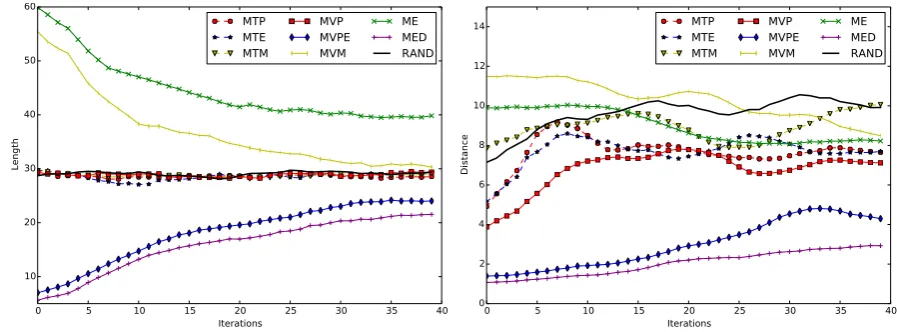
Figure 4 reports a few statistics that highlight the be-havior of the methods on one of the datasets. One may see for instance that the MVM and ME strategies are very different from the other methods in that they se-lect tokens that belong to significantly longer sentences on average. Also it may be seen that MVM in partic-ular selects tokens that are far from already annotated tokens in the sentence. This strategy probably yields a particular behavior with respect to exploration and ex-ploitation that seems to suit the two tasks well. The other strategies do exhibit different behaviors that intu-itively should not work well. For instance the MED and the MVPE strategies select tokens from new fully unla-beled sentences (not shown statistics), preferably short, so that the distance from selected tokens to already la-beled tokens in the sentence (when any) is low. These curves look like relevant indicators of the behavior of the methods, and it would probably be worth monitor-ing these all along the AL process to make sure the learning exhibit a suitable behavior. This will be a fu-ture study that is out of the scope of this work.
6 Conclusion
0 5 10 15 20 25 30 35 40 Iterations
10 20 30 40 50 60
Length
MTP MTE MTM
MVP MVPE MVM
ME MED RAND
0 5 10 15 20 25 30 35 40
Iterations 0
2 4 6 8 10 12 14
Distance
MTP MTE MTM
MVP MVPE MVM
[image:8.595.72.521.61.227.2]ME MED RAND
Figure 4: Behavior of the methods on CoNLL2000 dataset as a function of the number of the iterations (x-axis, from 1 to 40). Average length of the sentence the tokens that are selected by the AL strategy belong to (left) and average distance from a token that is selected to the closest already labeled token in the sentence, if any (right).
AL process highly unpredictable shows up. This phe-nomenon consists in random drops of accuracy of the classifiers learnt during the AL process. We have pro-posed a first solution for this problem that does not have a relevant impact on the human annotation effort.
Acknowledgments
We kindly thank Fabrizio Sebastiani and Andrea Esuli for their help and valuable comments, and Dittaya Wanvarie for providing us her implementation of partially-labeled CRFs.
References
Richard H. Byrd, Jorge Nocedal, and Robert B. Schn-abel. 1994. Representations of quasi-Newton matri-ces and their use in limited memory methods. Math-emathical Programming, 63:129–156.
Aron Culotta and Andrew McCallum. 2005. Reduc-ing labelReduc-ing effort for structured prediction tasks. In
Proceedings of the Twentieth National Conference on Artificial Intelligence and the Seventeenth Inno-vative Applications of Artificial Intelligence Confer-ence, (AAAI 2005), pages 746–751, Pittsburgh, US. Andrea Esuli and Fabrizio Sebastiani. 2010.
Evalu-ating information extraction. InProceedings of the Conference on Multilingual and Multimodal Infor-mation Access Evaluation (CLEF 2010), pages 100– 111, Padova, IT.
Andrea Esuli, Diego Marcheggiani, and Fabrizio Se-bastiani. 2010. Sentence-based active learning strategies for information extraction. InProceedings of the First Italian Information Retrieval Workshop (IIR 2010), pages 41–45, Padua, Italy.
Jin-Dong Kim, Tomoko Ohta, Yoshimasa Tsuruoka, Yuka Tateisi, and Nigel Collier. 2004. Introduc-tion to the bio-entity recogniIntroduc-tion task at JNLPBA. In
Proceedings of the International Joint Workshop on Natural Language Processing in Biomedicine and its Applications, pages 70–75, Geneva, CH.
John Lafferty, Andrew McCallum, and Fernando Pereira. 2001. Conditional random fields: Proba-bilistic models for segmenting and labeling sequence data. InProceedings of the 18th International Con-ference on Machine Learning (ICML 2001), pages 282–289, Williamstown, US.
David D. Lewis and Jason Catlett. 1994. Hetero-geneous uncertainty sampling for supervised learn-ing. InProceedings of 11th International Confer-ence on Machine Learning (ICML 1994), pages 148– 156, New Brunswick, US.
Adwait Ratnaparkhi. 1996. A maximum entropy model for part-of-speech tagging. InProceedings of the conference on empirical methods in natural lan-guage processing, volume 1, pages 133–142. Sunita Sarawagi. 2008. Information extraction.
Foun-dations and Trends in Databases, 1(3):261—377. Tobias Scheffer, Christian Decomain, and Stefan
Wro-bel. 2001. Active hidden Markov models for infor-mation extraction. InProceedings of the 4th Inter-national Conference on Advances in Intelligent Data Analysis (IDA 2001), pages 309–318, Cascais, PT. Burr Settles and Mark Craven. 2008. An
analy-sis of active learning strategies for sequence label-ing tasks. In Proceedings of the Conference on Empirical Methods in Natural Language Processing (EMNLP 2008), pages 1070–1079, Honolulu, US. Burr Settles. 2012. Active learning. Synthesis
Lec-tures on Artificial Intelligence and Machine Learn-ing. Morgan & Claypool Publishers.
learning for named entity recognition. In Proceed-ings of the 42nd Meeting of the Association for Com-putational Linguistics (ACL 2004), pages 589–596, Barcelona, ES.
Erik F. Tjong Kim Sang and Sabine Buchholz. 2000. Introduction to the CoNLL-2000 shared task: Chunking. In Proceedings of the 2nd Workshop on Learning Language in Logic and 4th Confer-ence on Computational Natural Language Learning (LLL/CoNLL 2000), pages 127–132. Lisbon, PT. Erik F. Tjong Kim Sang and Fien De Meulder.
2003. Introduction to the CoNLL-2003 shared task: Language-independent named entity recognition. In
Proceedings of the 7th Conference on Natural Lan-guage Learning (CONLL 2003), pages 142–147, Ed-monton, CA.
Katrin Tomanek and Udo Hahn. 2009. Semi-supervised active learning for sequence labeling. In
Proceedings of the 47th Annual Meeting of the As-sociation for Computational Linguistics and the 4th International Joint Conference on Natural Language Processing of the AFNLP (ACL-IJCNLP 2009), pages 1039–1047, Singapore.
Katrin Tomanek, Florian Laws, Udo Hahn, and Hin-rich Sch¨utze. 2009. On proper unit selection in active learning: co-selection effects for named en-tity recognition. InProceedings of the NAACL HLT 2009 Workshop on Active Learning for Natural Lan-guage Processing, pages 9–17, Boulder, US. Yuta Tsuboi, Hisashi Kashima, Hiroki Oda, Shinsuke
Mori, and Yuji Matsumoto. 2008. Training condi-tional random fields using incomplete annotations. In Proceedings of the 22nd International Confer-ence on Computational Linguistics (COLING 2008), pages 897–904, Manchester, UK.