Review Article
Efficacy and safety of cervical cage used in patients
with cervical discectomy: a meta-analysis
of randomized clinical trials
Dong Chen, Xin Jiang, Zhongshi Li, Dongping Shi, Jingxin Zhao
Department of Spine Surgery, China-Japan Friendship Hospital, Beijing 100029, China
Received August 12, 2017; Accepted February 22, 2018; Epub August 15, 2018; Published August 30, 2018
Abstract:Background and purpose: The efficacy and safety of cervical cage in patients with cervical discectomy and fusion was controversial in recent years. This meta-analysis was in order to evaluate the efficacy and safety
of cervical cage alone. Methods: PubMed, Cochrane Library, EMBASE and the Clinical Trials.gov databases were searched and randomized controlled trials were included. The primary endpoint was fusion rate and the incidence of adverse events. Good to excellent rate, operation time, hospital time and blood loss were regard as secondary endpoints. Results: Totally, 530 patients were included from 9 RCTs. There was no difference between cervical cage and autologous bone grafts in fusion rate (RR = 0.98; 95% CI = 0.90-1.06; P = 0.60; I2 = 0), good to excellent rate
(RR = 1.04; 95% CI = 0.94-1.45; P = 0.47; I2 = 8%) and operation time (SMD = -0.38; 95% CI = 1.70-0.94; P = 0.04;
I2 = 70%). There were significantly difference in the rate of adverse events (RR = 0.43; 95% CI = 0.21-0.90; P = 0.03;
I2 = 0), blood loss (SMD = -0.39; 95% CI = -0.74-0.05; P = 0.03; I2 = 0) and hospital time (SMD = -0.32; 95% CI =
-0.58-0.05; P = 0.02; I2 = 0) when cervical cage compare with autologous bone grafts. Conclusion: No differences
were demonstrated between cervical cage and autologous bone gifts respect to the fusion rate, good to excellent rate and operation time. But the cervical cage associated with lower rate of adverse events, blood loss and shorter hospital time compare with autologous bone grafts.
Keywords: Efficacy, cervical cage, cervical discectomy, meta-analysis, randomized clinical trials
Introduction
Anterior cervical discectomy with fusion is a traditional surgical technique for reduction or elimination of pain and neurological deficits caused by degenerative discs [1, 2]. A number of substrates are currently used for cervical fusion, such as cervical cage and autologous bone grafts. Cervical cages are rigid structures which are made of polymer materials or titani-um that can be filled with local bone and asso -ciated with little complications [3]. The fusion rate of autologous bone grafts was 83% to 97% with common complication of bone removal such as infection, hematoma and long standing pain [4]. There are some clinical studies dem-onstrated that cervical cages are safe and effective in the treatment of cervical disorders and yield good long term clinical performance for patients with degenerative discs [5-8]. Despite widespread use of cervical cages, only
few clinical studies with little of sample size comparing safety and efficacy of cervical cages and autologous bone grafts in the cervical decompression and fusion procedure have been published.
Our meta-analysis was aimed to evaluate the safety and efficacy of cervical cages in order to provide evidence-based information for clinic.
Methods
In order to conduct a high-quality meta-analy-sis, our meta-analysis followed the Preferred Reporting Items for Systematic Reviews and Meta-analyses (PRISMA) [9] statement.
Data sources and searches
set from January 1990 through June 2017. The following keywords were used in search strategies: “cervical cage”; “spinal diseases”; “cage fusion”, “autologous bone grafts” and “spondylosis”.
Study selection
Studies from the literature independently searched were screened by two investigators and a third investigator was consulted when disagreements arose. We included studies which met the inclusion criteria that: (1) RCTs conducted in humans; (2) Patients with spinal diseases; (3) Full-text articles of controlled tri-als about cervical cage used compare with autologous bone grafts published in English; and (4) The fusion rate, complication rate, inci-dence of healed, good to excellent rate, opera-tion time, hospital time and blood loss were reported. Reviews, meta-analyses, editorials, observational studies, and studies in which it was not possible to assess the outcomes. Data extraction and quality assessment
Clinical data were independently extracted by two different authors and a standardized extraction form was used. A third investigator
Differences in dichotomous outcomes were reported associated with the risk ratio (RR) and 95% confidence interval (CI) and continuous outcomes were reported to be associated with standard mean differences (SMDs) and 95% CI. Cochran Q test and I2 statistic was used to
assess the heterogeneity. When Cochran’s P<0.10 and an I2>50, significant heterogeneity
were considered to be indicative. A fixed effect model was used for pooled analyses, whereas a random effect model was used when signifi -cant heterogeneity existed. Data analyses were performed by Review Manager (RevMan) soft-ware (version 5.1; The Cochrane Collaboration, Copenhagen, Denmark). The symmetry of the funnel plot was conducted by Begger test using STATA software (version 11.1; Stata Corp LP, College Station, TX, USA). Also, sensitivity anal-ysis was conducted by excluding each individu-al study through the STATA software.
Results
Search result
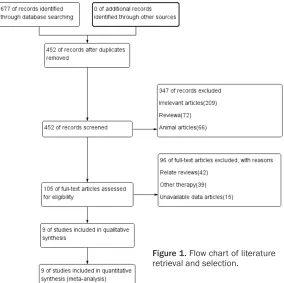
[image:2.612.92.376.71.354.2]A total of 677 potentially publications were identified and 9 studies [10-18] were included after 87 full publications were reviewed, as shown in Figure 1. The baseline characteristics
Figure 1. Flow chart of literature retrieval and selection.
was consulted to resolve con- flicting opinions. The follow-ing information was extracted from the included investiga-tions: authors’ names; year of publication; characteristics of the participants; total number of participants and mean age. The fusion rate, complication rate, incidence of healed, good to excellent rate, opera-tion time, hospital time and blood loss were extracted. In addition, information regard-ing random sequence genera-tion, allocation concealment, blinding of participants and outcome assessment, incom-plete outcome data, selective reporting, and other biases were also collected to evalu-ate the quality of the included investigations.
including authors’ names; year of publication and characteristics of the participants of the 9 included studies were shown in Table 1. We included 530 participants in our meta-analysis (282 for cervical and 248 for autologous bone grafts). The quality assessment was detailed in
Appendix Table 1 and Appendix Figures 1 and
2.
Clinical results
The fusion rate was the primary efficacy end -point and the incidence of adverse events was the primary safety endpoint. Good to excellent rate, operation time, hospital time and blood loss were regard as secondary endpoints. Fusion rate
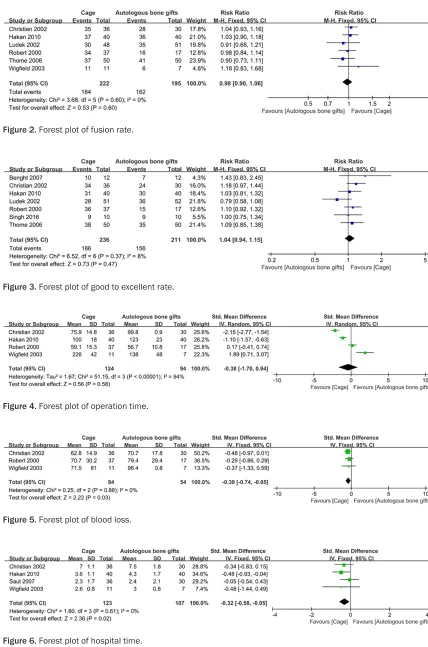
Six RCTs involving 417 patients reported the fusion rate, with 222 patients randomized to the cervical cage arm and 195 randomized to the autologous bone grafts arm. No differences existed in the fusion rate between cervical cage and autologous bone grafts (RR = 0.98; 95% CI = 0.90-1.06; P = 0.60; I2 = 0; Figure 2).
Good to excellent rate
There were 7 RCTs involving 447 patients that reported the good to excellent rate of cage fusion, with 236 patients randomized to the
cervical cage arm and 211 randomized to the autologous bone grafts arm. Cervical cage had similar results compared with autologous bone grafts with respect to good to excellent rate (RR = 1.04; 95% CI = 0.94-1.45; P = 0.47; I2 = 8%; Figure 3).
Operation time
Four RCTs involving 411 patients reported the operation time of fusion rate. 124 patients were randomized to the cervical cage arm and 138 patients were randomized to the autolo-gous bone grafts arm. The operation time of cervical cage and autologous bone grafts was similar (SMD = -0.38; 95% CI = 1.70-0.94; P = 0.04; I2 = 70%; Figure 4).
Blood loss
There were 3 RCTs involving 138 patients that reported the blood loss of cervical fusion that 84 patients were randomized to the cervical cage arm and 54 were randomized to the autol-ogous bone grafts arm. Cervical cage was associated with lower blood loss to autologous bone grafts (SMD = -0.39; 95% CI = -0.74-0.05; P = 0.03; I2 = 0; Figure 5).
Hospital time
[image:3.612.92.525.85.240.2]There were 4 RCTs involving 230 patients that reported the hospital time. There were 123 patients were randomized to the cervical cage arm and 107 were randomized to the autolo-gous bone grafts arm. Cervical cage was asso-ciated with a significant shorter hospital time with autologous bone grafts (SMD = -0.32; 95% CI = -0.58-0.05; P = 0.02; I2 = 0; Figure 6). Table 1. Baseline characteristics of included studies
Sample size Mean Age Male Current smoker
Cage/autologous
bone grafts Cage/autologous bone grafts Cage/autologous bone grafts Cage/autologous bone grafts
Singh 2016 10/10 52.3 (39-62)/49.8 (37-59) 6/7
-Thome 2006 50/50 49±10/46±9 18/24 29/29
Hakan 2010 40/40 48 (38-59)/49 (27-70) 24/26 16/10
Benght 2007 12/12 42 (29-58)/41 (28-56) 5/6 5/5
Wigfield 2003 11/7 47.0±12.4/62.7±14.9 6/7
-Christian 2002 36/30 50.5±13.4/47.3±11.5 27/28 11/11
Robert 2000 37/17 44.1±7.2/44.2±8.8 16/7 14/8
Saut 2007 35/30 - 24/26
[image:3.612.91.288.276.331.2]-Ludek 2002 52/51 48/47 20/25 23/20
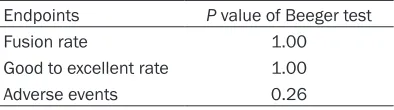
Table 2. Results of Begger test
Endpoints P value of Beeger test
Fusion rate 1.00
Good to excellent rate 1.00
Figure 2. Forest plot of fusion rate.
Figure 3. Forest plot of good to excellent rate.
Figure 4. Forest plot of operation time.
[image:4.612.87.515.63.710.2]Figure 5. Forest plot of blood loss.
Adverse events
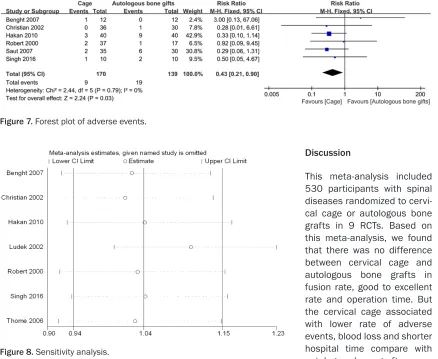
[image:5.612.90.528.73.432.2] [image:5.612.92.519.74.179.2]The common adverse events associated with cervical cage used included infections, subsid-ence, displacement and bleeding. There were 309 patients included in the 6 RCTs with reported adverse events. The cervical cage associated with much lower adverse events compared with autologous bone grafts (RR = 0.43; 95% CI = 0.21-0.90; P = 0.03; I2 = 0; Figure 7).
Sensitivity and publication bias analysis
Sensitivity analysis was conducted by excluding each individual study. There was no study will influence the meta-analysis results which dem -onstrate that our result was stable such as shown in Figure 8. No significant evidence of publication bias was obtained using the Begger test in the study endpoints, as shown in Table
2.
In recent years, although non-fusion techniques such as cervical disc replacement in the treat-ment of cervical degeneration and neuropathy caused widespread concern, but this method to improve the clinical efficacy side and the lack of sufficient evidence. Autologous bone is the only material that can combine bone-induced, bone conduction and bone regeneration, so it is recognized as the gold standard for spinal fusion material. But there still a big controversy exist in the chosen of cervical cage or autolo-gous bone gifts. Many RCTs and retrospective analyzes found that there is no significant dif -ference in the efficacy of the two fusion modali -ties in the treatment of cervical spondylosis such as pain relief and fusion rate [12, 19]. This is the newest meta-analysis about cervical cage compared with autologous bone gifts. In a meta-analysis published in 2016, which includ-ed both randomizinclud-ed clinical trials and retro-spective studies. Compared with this
[image:5.612.94.418.180.415.2]met-anal-Figure 7. Forest plot of adverse events.
Figure 8. Sensitivity analysis.
Discussion
ysis, our study only included the RCT which can enhance the reliability and evidence level, at the same, we analysis difference endpoints such as good to excellent rate and hospital time. From our meta-analysis, we found that the cervical cage associated lower blood loss compare with autologous bone grafts. This result is same as the study of Jacobs [4]. Autologous bone gifts patients with more blood loss and longer hospital time that may be the result of the large bleeding of autologous bone procedure. Addition, the quality of included studies were evaluated according to the Cochrane Handbook. In additional, detailed sensitivity and bias analysis were conducted in our study which never have been done in other publications.
There were also some limitations in our study. First, the power of our analysis was restricted because of the limit number of clinical investi-gations and sample sizes. Second, the differ-ences in patient clinical management, such as the type or material of cervical cage may have affected our outcome. Finally, the quality of some evidence was discounted due to various limitations. So large RCTs associated with cer-vical cage are needed to further explore the efficacy and safety profile of cervical in clinical practice. Detailed subgroup analysis can be conducted when enough clinical trials pub-lished by professors in the future.
No differences were demonstrated between cervical cage and autologous bone gifts respect to the fusion rate, good to excellent rate and operation time. But the cervical cage is associ-ated with lower rate of adverse events, blood loss and shorter hospital time as compared with autologous bone grafts.
Disclosure of conflict of interest
None.
Address correspondence to: Xin Jiang, Department of Spine Surgery, China-Japan Friendship Hospital, No.2 Yinghuadongjie Street, Chaoyang District, Beijing 100029, China. Tel: 0086-010-84205485; E-mail: [email protected]
References
[1] Eleraky MA, Llanos C and Sonntag VK. Cervical corpectomy: report of 185 cases and review of the literature. J Neurosurg 1999; 90: 35-41.
[2] Hauerberg J, Kosteljanetz M, Boge-Rasmussen T, Dons K, Gideon P, Springborg JB and Wagner A. Anterior cervical discectomy with or without fusion with ray titanium cage: a prospective randomized clinical study. Spine (Phila Pa 1976) 2008; 33: 458-464.
[3] Chong E, Pelletier MH, Mobbs RJ and Walsh WR. The design evolution of interbody cages in anterior cervical discectomy and fusion: a sys-tematic review. BMC Musculoskelet Disord 2015; 16: 99.
[4] Jacobs W, Willems PC, Kruyt M, van Limbeek J, Anderson PG, Pavlov P, Bartels R and Oner C. Systematic review of anterior interbody fusion techniques for single- and double-level cervical degenerative disc disease. Spine (Phila Pa 1976) 2011; 36: E950-960.
[5] Marbacher S, Hidalgo-Staub T, Kienzler J, Wuergler-Hauri C, Landolt H and Fandino J. Long-term outcome after adjacent two-level anterior cervical discectomy and fusion using stand-alone plasmaphore-covered titanium cages. J Neurol Surg A Cent Eur Neurosurg 2015; 76: 199-204.
[6] Moreland DB, Asch HL, Clabeaux DE, Castiglia GJ, Czajka GA, Lewis PJ, Egnatchik JG, Cappuccino A and Huynh L. Anterior cervical discectomy and fusion with implantable titani-um cage: initial impressions, patient outcomes and comparison to fusion with allograft. Spine J 2004; 4: 184-191; discussion 191.
[7] Caroli E, Orlando ER, D’Andrea G and Ferrante L. Anterior cervical fusion with interbody titani-um cage containing surgical bone site graft: our institution’s experience in 103 consecutive cases of degenerative spondylosis. J Spinal Disord Tech 2007; 20: 216-220.
[8] Jang JW, Lee JK, Lee JH, Hur H, Kim TW and Kim SH. Effect of posterior subsidence on cer-vical alignment after anterior cercer-vical corpec-tomy and reconstruction using titanium mesh cages in degenerative cervical disease. J Clin Neurosci 2014; 21: 1779-1785.
[9] Moher D, Liberati A, Tetzlaff J and Altman DG. Preferred reporting items for systematic re-views and meta-analyses: the PRISMA state-ment. J Clin Epidemiol 2009; 62: 1006-1012. [10] Singh P, Kumar A and Shekhawat V. Com-
parative analysis of interbody cages versus
tri-cortical graft with anterior plate fixation for an -terior cervical discectomy and fusion in degen-erative cervical disc disease. J Clin Diagn Res 2016; 10: RC05-08.
[12] Lofgren H, Engquist M, Hoffmann P, Sigstedt B and Vavruch L. Clinical and radiological evalua-tion of trabecular metal and the Smith-Robinson technique in anterior cervical fusion for degenerative disease: a prospective, ran-domized, controlled study with 2-year follow-up. Eur Spine J 2010; 19: 464-473.
[13] Lind BI, Zoega B and Rosen H. Autograft
ver-sus interbody fusion cage without plate fixation
in the cervical spine: a randomized clinical study using radiostereometry. Eur Spine J 2007; 16: 1251-1256.
[14] Wigfield C, Robertson J, Gill S and Nelson R.
Clinical experience with porous tantalum cervi-cal interbody implants in a prospective ran-domized controlled trial. Br J Neurosurg 2003; 17: 418-425.
[15] Barlocher CB, Barth A, Krauss JK, Binggeli R and Seiler RW. Comparative evaluation of mi-crodiscectomy only, autograft fusion, poly-methylmethacrylate interposition, and thread-ed titanium cage fusion for treatment of single-level cervical disc disease: a prospective ran-domized study in 125 patients. Neurosurg Focus 2002; 12: E4.
[16] Hacker RJ. A randomized prospective study of an anterior cervical interbody fusion device with a minimum of 2 years of follow-up results. J Neurosurg 2000; 93: 222-226.
[17] Celik SE, Kara A and Celik S. A comparison of changes over time in cervical foraminal height after tricortical iliac graft or polyetheretherke-tone cage placement following anterior discec-tomy. J Neurosurg Spine 2007; 6: 10-16. [18] Vavruch L, Hedlund R, Javid D, Leszniewski W
and Shalabi A. A prospective randomized com-parison between the cloward procedure and a
carbon fiber cage in the cervical spine: a clini -cal and radiologic study. Spine (Phila Pa 1976) 2002; 27: 1694-1701.
Appendix Table 1. Quality assessment of included studies
Study Random sequence generation concealmentAllocation
Blinding Incomplete
outcome data
Selective reporting Other bias Participants
and personnel assessmentOutcome
Singh 2016 Computer generated randomisation Unclear Unclear Blinded 0 No No
Thome 2006 Computer generated randomisation Concealed list Blinded Blinded 0 No No
Hakan 2010 Randomized Unclear Unclear Unclear 0 No No
Benght 2007 Randomized Sealed envelopes Blinded Blinded 2 withdrew No No
Wigfield 2003 Centralized randomization schedule
of the statistical analysis system Sealed envelope Blinded Blinded 0 No No
Christian 2002 Randomized Unclear Unclear Unclear 0 No No
Robert 2000 Randomized Unclear Unclear Unclear 0 No No
Saut 2007 Randomized Unclear Unclear Unclear 0 No No
Ludek 2002 Randomized Unclear Unclear Unclear 0 No No