Refining Word Segmentation Using a Manually Aligned Corpus
for Statistical Machine Translation
Xiaolin Wang Masao Utiyama Andrew Finch Eiichiro Sumita National Institute of Information and Communications Technology
{xiaolin.wang,mutiyama,andrew.finch,eiichiro.sumita}@nict.go.jp
Abstract
Languages that have no explicit word de-limiters often have to be segmented for sta-tistical machine translation (SMT). This is commonly performed by automated seg-menters trained on manually annotated corpora. However, the word segmentation (WS) schemes of these annotated corpora are handcrafted for general usage, and may not be suitable for SMT. An analysis was performed to test this hypothesis us-ing a manually annotated word alignment (WA) corpus for Chinese-English SMT. An analysis revealed that 74.60% of the sentences in the WA corpus if segmented using an automated segmenter trained on the Penn Chinese Treebank (CTB) will contain conflicts with the gold WA an-notations. We formulated an approach based on word splitting with reference to the annotated WA to alleviate these con-flicts. Experimental results show that the refined WS reduced word alignment error rate by 6.82% and achieved the highest BLEU improvement (0.63 on average) on the Chinese-English open machine trans-lation (OpenMT) corpora compared to re-lated work.
1 Introduction
Word segmentation is a prerequisite for many natural language processing (NLP) applications on those languages that have no explicit space between words, such as Arabic, Chinese and Japanese. As the first processing step, WS affects all successive steps, thus it has a large potential impact on the final performance. For SMT, the unsupervised WA, building translation models and reordering models, and decoding are all based on segmented words.
Automated word segmenters built through supervised-learning methods, after decades of in-tensive research, have emerged as effective so-lutions to WS tasks and become widely used in many NLP applications. For example, the Stan-ford word segmenter (Xue et al., 2002)1 which is based on conditional random field (CRF) is em-ployed to prepare the official corpus for NTCIR-9 Chinese-English patent translation task (Goto et al., 2011).
However, one problem with applying these supervised-learning word segmenters to SMT is that the WS scheme of annotating the training cor-pus may not be optimal for SMT. (Chang et al., 2008) noticed that the words in CTB are often too long for SMT. For example, a full Chinese per-sonal name which consists of a family name and a given name is always taken as a single word, but its counterpart in English is usually two words.
Manually WA corpora are precious resources for SMT research, but they used to be only avail-able in small volumes due to the production cost. For example, (Och and Ney, 2000) initially an-notated 447 English-French sentence pairs, which later became the test data set in ACL 2003 shared task on word alignment (Mihalcea and Pedersen, 2003), and was used frequently thereafter (Liang et al., 2006; DeNero and Klein, 2007; Haghighi et al., 2009)
For Chinese and English, the shortage of man-ually WA corpora has recently been relieved by the linguistic data consortium (LDC) 2 GALE Chinese-English word alignment and tag-ging training corpus (the GALE WA corpus)3. The corpus is considerably large, containing 4,735 documents, 18,507 sentence pairs, 620,189 Chi-nese tokens, 518,137 English words, and 421,763
1http://nlp.stanford.edu/software/
segmenter.shtml
2
http://catalog.ldc.upenn.edu
3Catalog numbers: LDC2012T16, LDC2012T20,
LDC2012T24 and LDC2013T05.
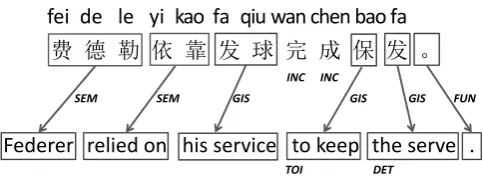
alignment annotations. The corpus carries no Chi-nese WS annotation, and the WA annotation was performed between Chinese characters and En-glish words. The alignment identifies minimum translation units and relations4, referred as atomic blocks and atomic edges, respectively, in this pa-per. Figure 1 shows an example that contains six atomic edges.
Visual inspection of the segmentation of an au-tomatic segmenter with reference to a WA cor-pus revealed a number of inconsistencies. For ex-ample, consider the word “bao fa” in Figure 1. Empirically we observed that this word is mented as a single token by an automatic seg-menter trained on the CTB, however, this segmen-tation differs with the alignment in the WA cor-pus, since its two components are aligned to two different English words. Our hypothesis was that the removal of these inconsistencies would benefit machine translation performance (this is explained further in Section 2.3), and we explored this idea in this work.
This paper focuses on optimizing Chinese WS for Chinese-English SMT, but both the research method and the proposed solution are language-independent. They can be applied to other lan-guage pairs.
The major contributions of this paper include,
• analyze the CTB WS scheme for Chinese-English SMT;
• propose a lexical word splitter to refine the WS;
• achieve a BLEU improvement over a baseline Stanford word segmenter, and a state-of-the-art extension, on Chinese-English OpenMT corpora.
The rest of this paper is organized as follows: first, Section 2 analyzes WS using a WA corpus; next, Section 3 proposes a lexical word splitter to refine WS; then, Section 4 evaluates the pro-posed method on end-to-end SMT as well as word segmentation and alignment; after that, Section 5 compares this work to related work; finally, Sec-tion 6 concludes this paper.
4Guidelines for Chinese-English Word
Align-ment(Version 4.0)
2 Analysis of a General-purpose Automatic Word Segmenter
This section first briefly describes the GALE WA corpus, then presents an analysis of the WS arising from a CTB-standard word segmenter with refer-ence to the segmentation of the atomic blocks in the GALE WA corpus, finally the impact of the findings on SMT is discussed.
2.1 GALE WA corpus
The GALE WA corpus was developed by the LDC, and was used as training data in the DARPA GALE global autonomous language exploitation program 5. The corpus incorporates linguistic knowledge into word aligned text to help improve automatic WA and translation quality. It em-ploys two annotation schemes: alignment and tag-ging (Li et al., 2010). Alignment identifies min-imum translation units and translation relations; tagging adds contextual, syntactic and language-specific features to the alignment annotation. For example, the sample shown in Figure 1 carries tags on both alignment edges and tokens.
The GALE WA corpus contains 18,057 man-ually word aligned Chinese and English parallel sentences which are extracted from newswire and web blogs. Table 1 presents the statistics on the corpus. One third of the sentences are approxi-mately newswire text, and the remainder consists of web blogs.
2.2 Analysis of WS
In order to produce a Chinese word segmenta-tion consistent with the CTB standard we used the Stanford Chinese word segmenter with a model trained on the CTB corpus. We will refer to this as the ‘CTB segmenter’ in the rest of this paper.
The Chinese sentences in the GALE WA cor-pus were first segmented by the CTB segmenter, and the predicted words were compared against the atomic blocks with respect to the granularity of segmentation. The analysis falls into the following three categories, two of which may be potentially harmful to SMT:
• Fully consistent: the word locates within the block of one atomic alignment edge. For ex-ample, in Figure 2(a), the Chinese text has
5https://catalog.ldc.upenn.edu/
[image:3.595.178.420.59.148.2]
Figure 1: Example from the GALE WA corpus. Each line arrow represents an atomic edge, and each box represents an atomic block. SEM (semantic), GIS (grammatically inferred semantic) and FUN (function) are tags of edges. INC (not translated), TOI (to-infinitive) and DET (determiner) are tags of tokens.
Genre # Files # Sentences† # CN tokens # EN tokens # Alignment edges
Newswire 2,175 6,218 246,371 205,281 164,033
Web blog 2,560 11,839 373,818 312,856 257,730
Total 4,735 18,057 620,189 518,137 421,763
Table 1: GALE WA corpus.†Sentences rejected by the annotators are excluded.
four atomic blocks; the CTB segmenter pro-duces five words which all locate within the blocks, so they are all small enough.
• Alignment inconsistent: the word aligns to more than one atomic block, but the target expression is contiguous, allowing for cor-rect phrase pair extraction (Zens et al., 2002). For example, in Figure 2(b), the characters in the word “shuang fang”, which is produced by the CTB segmenter, contains two atomic blocks, but the span of the target “to both side” is continuous, therefore the phrase pair “shuang fang ||| to both sides” can be ex-tracted.
• Alignment inconsistent and extraction hin-dered: the word aligned to more than one atomic block, and the target expression is not contiguous, which hinders correct phrase pair extractions. For example, in Figure 2(c), the word “zeng chan” has to be split in order to match the target language.
Table 2 shows the statistics of the three cat-egories of CTB WS on the GALE WA corpus. 90.74% of the words are fully consistent, while the remaining 9.26% of the words have inconsistent alignments. 74.60% of the sentences contain this problem. The category with inconsistent align-ment and extraction hindered only accounts for 0.46% of the words, affecting 9.06% of the sen-tences.
2.3 Impact of WS on SMT
The word alignment has a direct impact on the na-ture of both the translation model, and lexical re-ordering model in a phrase-base SMT system. The words in last two categories are all longer than an atomic block, which might lead to problems in the word alignment in two ways:
• First, longer words tend to be more sparse in the training corpus, thus the estimated distri-bution of their target phrases are less accu-rate.
• Second, the alignment from them to target sides are one-to-many, which is much more complicated and requires fertilized alignment models such as IBM model 4 – 6 (Och and Ney, 2000).
The words in the category of “fully consistent” can be aligned using simple models, because the alignment from them to the target side are one-to-one or many-to-one-to-one, and simple alignment models such as IBM model 1, IBM model 2 and HMM model are sufficient (Och and Ney, 2000).
3 Refining the Word Segmentation
(a)
(b)
[image:4.595.82.503.61.269.2]
(c)
Figure 2: Examples of automated WS on manually WA corpus: (a) Fully consistent; (b) Alignment inconsistent; (c) Alignment inconsistent and extraction hindered. The Chinese words separated by white space are the output of the CTB segmenter. Arrows represent the alignment of atomic blocks. Note that “shuang fang” and “zeng chan” are words produced by the CTB segmenter, but consist of two atomic blocks.
Category Count Word Ratio Sentence Ratio
Fully consistent 355,702 90.74% 25.40%†
Alignment inconsistent 34,464 8.81% 65.54%
Alignment inconsistent & extraction hindered 1,830 0.46% 9.06%
Sum of conflict‡ 36,294 9.26% 74.60%
Table 2: CTB WS on GALE WA corpus: †All words are fully consistent;‡Alignment inconsistent plus alignment inconsistent & extraction hindered
strategy, based on a supervised learning approach, to re-segment the corpus. This subsection first for-malizes the task, and then presents the approach.
3.1 Word splitting task
The word splitting task is formalized as a sequence labeling task as follows: each word (represented by a sequence of charactersx = x1. . . xT where
T is the length of sample) produced by the CTB segmenter is a sample, and a corresponding se-quence of binary boundary labels y = y1. . . yT is the learning target,
yt=
1 if there is a split point betweenctandct−1;
0 otherwise.
(1)
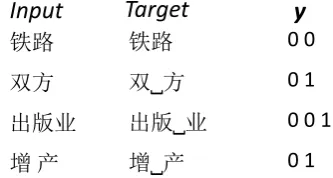
The sequence of boundary labels is derived from the gold WA annotation as follows: for a sequence of two atomic blocks, where the first character of the second block is xt, then the
Figure 3: Samples of word splitting task
belyt = 1. Figure 3 presents several samples ex-tracted from the examples in Figure 2.
[image:4.595.331.498.484.573.2]Set # Sentences # Samples # Split points # Split points per sample
Train. 16,057 348,086 32,337 0.0929
Test 2,000 43,910 3,929 0.0895
Table 3: Data set for learning the word splitting
3.2 CRF approach
This paper employs a condition random field (CRF) to solve this sequence labeling task (Laf-ferty et al., 2001). A linear-chain CRF defines the conditional probability ofygivenxas,
PΛ(y|x) = Z1 x(
T
X
t=1
X
k
λkfk(yt−1, yt,x, t)),
(2) whereΛ ={λ1, . . .}are parameters,Zxis a per-input normalization that makes the probability of all state sequences sum to one;fk(yt−1, yt,x, t)is a feature function which is often a binary-valued sparse feature. The training of CRF model is to maximize the likelihood of training data together with a regularization penalty to avoid over-fitting as (Peng et al., 2004; Peng and McCallum, 2006),
Λ∗=argmax Λ (
X
i
logPΛ(yi|xi)−
X
k
λ2
k
2δ2
k),
(3) where (x,y) are training samples; the hyperparam-eter δk can be understood as the variance of the prior distribution ofλk. When predicting the la-bels of test samples, the CRF decoder searches for the optimal label sequencey∗ that maximizes the conditional probability,
y∗=argmax
y PΛ(y|x). (4)
In (Chang et al., 2008) a method is proposed to select an appropriate level of segmentation gran-ularity (in practical terms, to encourage smaller segments). We call their method “length tuner”. The following artificial feature is introduced into the learned CRF model:
f0(x, yt−1, yt,1) =
½
1 ifyt= +1
0 otherwise (5)
The weightλ0 of this feature is set by hand to bias the output of CRF model. By way of expla-nation, a very large positive λ0 will cause every character to be segmented, or conversely a very large negativeλ0will inhibit the output of segmen-tation boundaries. In their experiments, λ0 = 2
was used to force a CRF segmenter to adopt an in-termediate granularity between character and the CTB WS scheme. Compared to the length tuner, our proposed method exploits lexical knowledge about word splitting, and we will therefore refer to it as the “lexical word splitter” or “lexical splitter” for short.
3.3 Feature Set
The featuresfk(yt−1, yt,x, t)we used include the WS features from the Chinese Stanford word seg-menter and a set of extended features described below. The WS features are included because the target split points may share some common char-acteristics with the boundaries in the CTB WS scheme.
The extended features consists of four types – named entities, word frequency, word length and character-level unsupervised WA. For each type of the feature, the value and value concatenated with previous or current character are taken as sparse features (see Table 4 for details). The real val-ues of word frequency, word length and character-level unsupervised WA are converted into sparse features due to the routine of CRF model.
The character-level unsupervised alignment feature is inspired by the related works of unsu-pervised bilingual WS (Xu et al., 2008; Chung and Gildea, 2009; Nguyen et al., 2010; Michael et al., 2011). The idea is that the character-level WA can approximately capture the counterpart English ex-pression of each Chinese token, and source tokens aligned to different target expressions should be split into different words (see Figure 4 for an illus-tration).
cal-Feature Definition Example
NE NE tag of current word Geography:NE
NE-C−1 NE concatenated with previous character Geo.-ding:NE-C−1
NE-C0 NE concatenated with current character Geo.-mei:NE-C0
Frequency Nearest integer of negative logarithm of word frequency 5†:Freq
Freq.-C−1 Frequency concatenated with previous character 5-ding:Freq-C−1 Freq.-C0 Frequency concatenated with current character 5-mei:Freq-C0 Length Length of current word (1,2,3,4,5,6,7 or>7) 4:Len
Len.-Position Length concatenated with the position 4-2:Len-Pos
Len.-C−1 Length concatenated with previous character 4-ding:Len-C−1
Len.-C0 Length concatenated with current character 4-mei:Len-C0
Char. Align. Five-level relative frequency of being split 0.4‡:CA
C.A.-C−1 C.A. concatenated with previous character 0.4-ding:CA-C−1
[image:6.595.85.516.62.254.2]C.A.-C0 C.A. concatenated with current character 0.4-mei:CA-C0
Table 4: Extended features used in the CRF model for word splitting. The example shows the features used in the decision whether to split the Chinese word “la ding mei zhou” (Latin America, the first four Chinese characters in Figure 4) after the second Chinese character. † Round(-log10(0.00019)); ‡ Round(0.43×5 ) / 5
Figure 4: Illustration of character-level unsuper-vised alignment features. The dotted lines are word boundaries suggested by the alignment.
culated as,
fCA(w, i) = nni
w (6)
wherew is a word,iis a splitting position (from 1 to the length ofwminus 1);niis the number of times the words as split at positioniaccording to the character-level alignment, that is, the character before and afteriare aligned to different English expressions;nw is occurrence count of wordwin the training corpus.
4 Experiments
In the last section we found that 9.26% of words produced by the CTB segmenter have the poten-tial to cause problems for SMT, and propose a lexical word splitter to address this issue through segmentation refinement. This section contains experiments designed to empirically evaluate the proposed lexical word splitter in three aspects: first, whether the WS accuracy is improved;
sec-ond, whether the accuracy of the unsupervised WA during training SMT systems is improved; third, whether the end-to-end translation quality is im-proved.
This section first describes the experimental methodology, then presents the experimental re-sults, and finally illustrates the operation of our proposed method using a real example.
4.1 Experimental Methodology
4.1.1 Experimental Corpora
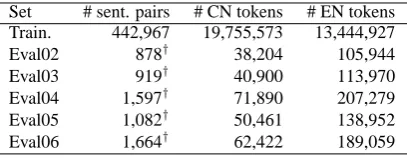
The GALE manual WA corpus and the Chinese to English corpus from the shared task of the NIST open machine translation (OpenMT) 2006 evalua-tion 6 were employed as the experimental corpus (Table 5).
The experimental corpus for WS was con-structed by first segmenting 2000 held out sen-tences from the GALE manual WA corpus with the Stanford segmenter, and then refining the seg-mentation with the gold alignment annotation. For example, the gold segmentation for the examples in Figure 2 is presented in Figure 5. Note that this test corpus is intended to represent an oracle segmentation for our proposed method, and serves primarily to gauge the improvement of our method over the baseline Stanford segmenter, relative to an upper bound.
6http://www.itl.nist.gov/iad/mig/
[image:6.595.93.269.338.420.2]
[image:7.595.91.273.60.138.2]
!
Figure 5: Examples of gold WS for evaluation
Set # sent. pairs # CN tokens # EN tokens Train. 442,967 19,755,573 13,444,927 Eval02 878† 38,204 105,944 Eval03 919† 40,900 113,970 Eval04 1,597† 71,890 207,279 Eval05 1,082† 50,461 138,952 Eval06 1,664† 62,422 189,059
Table 5: NIST Open machine translation 2006 Corpora. † Number of sentence samples which contain one Chinese sentence and four English ref-erence sentences.
The experimental corpus for unsupervised WA was the union set of the NIST OpenMT training set and the 2000 test sentence pairs from GALE WA corpus. We removed the United Nations cor-pus from the NIST OpenMT constraint training re-sources because it is out of domain.
The main result of this paper is the evaluation of the end-to-end performance of an SMT sys-tem. The experimental corpus for this task was the NIST OpenMT corpus. The data set of the NIST evaluation 2002 was used as a development set for MERT tuning (Och, 2003), and the remain-ing data sets of the NIST evaluation from 2003 to 2006 were used as test sets. The English sentences were tokenized by Stanford toolkit7and converted to lowercase.
4.1.2 Evaluation
The performance of WS was measured by pre-cision, recall and F1 of gold words (Sproat and Emerson, 2003),
The performance of unsupervised WA in the SMT training procedure was measured through alignment error rate (AER)(Och and Ney, 2000; Liang et al., 2006). Sure alignment edges and possible alignment edges were not distinguished in this paper as no such tags are found in GALE manual WA corpus.
The performance of SMT was measured using BLEU (Papineni et al., 2002).
7http://nlp.stanford.edu/software/
corenlp.shtml
4.1.3 Baseline Methods
Two Chinese WS methods were taken as the base-line methods in this paper. One method was the CTB segmenter, that is, Stanford Chinese word segmenter with the model trained on CTB corpus. The other method was the length tuner in (Chang et al., 2008), which added a constant into the con-fidence scores of a trained CRF word segmenter to encourage it to output more word boundaries (see Section 3.2 for details).
4.1.4 Implementation and Parameter settings
The proposed lexical word splitter was imple-mented on the CRF model toolkit released with the Stanford segmenter (Tseng et al., 2005). The regularity parametersδkare set to be 3, the same as the Stanford segmenter, because no significant performance improvements were observed by tun-ing that parameter.
To extract features for the word splitter, the Stanford named entity recognizer (Finkel et al., 2005)8was employed to obtain the tags of named entities. Word frequencies were caculated from the source side of SMT training corpus. The character-level unsupervised alignment was con-ducted using GIZA++ (Och and Ney, 2003)9.
The length tuner reused the CRF model of CTB segmenter. The parameter λ0 was tuned through the grid search in (Chang et al., 2008), that is, ob-serving the BLEU score on the SMT development set varing from λ0 = 0 to λ0 = 32. The grid search showed thatλ0 = 2was optimal, agreeing with the value in (Chang et al., 2008).
Moses (Koehn et al., 2007)10, a state-of-the-art phrase-based SMT system, was employed to per-form end-to-end SMT experiments. GIZA++ was employed to perform unsupervised WA.
4.2 Experimental Results
4.2.1 Word Segmentation
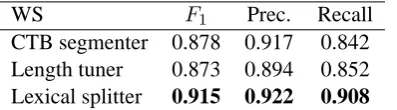
The WS performance of CTB segmenter, length tuner and the proposed lexical splitter are pre-sented in Table 6. The proposed method achieves the highest scores on all the criterion ofF1, preci-sion and recall. The length tuner outperforms the CTB segmenter in terms of recall, but with lower precision.
8http://nlp.stanford.edu/software/
CRF-NER.shtml
9
http://www.statmt.org/moses/giza/ GIZA++.html
[image:7.595.80.284.173.252.2]WS F1 Prec. Recall CTB segmenter 0.878 0.917 0.842
Length tuner 0.873 0.894 0.852
[image:8.595.85.284.62.117.2]Lexical splitter 0.915 0.922 0.908
Table 6: Performance of WS
WS AER Prec. Recall
CTB segmenter 0.425 0.622 0.534
Length tuner 0.417 0.642 0.535
[image:8.595.83.283.62.215.2]Lexical splitter 0.396 0.674 0.547
Table 7: Performance of unsupervised WA using different WS strategies
4.2.2 Word Alignment
The WA performance of the CTB segmenter, length tuner and the proposed lexical spliter is pre-sented in Table 7. Both lexical splitter and length tuner outperform the CTB segmenter, indicating the splitting words into smaller pieces can improve the accuracy of unsupervised WA. This result sup-ports the finding in (Chang et al., 2008) that the segment size from CTB WS is too large for SMT. In addition, the proposed lexical splitter signifi-cantly outperforms the length tuner.
4.2.3 Machine Translation
The end-to-end SMT performance of CTB seg-menter, length tuner and the proposed lexical spliter are presented in Table 8. Each experiment was performed three times, and the average BLEU and standard derivation were calculated, because there is randomness in the results from MERT. The proposed lexical splitter outperformed the two baselines on all the test sets, and achieves an average improvement of 0.63 BLEU percentage points, indicating that the proposed method can effectively improve the translation quality. The length tuner also outperforms the CTB segmenter, but the average improvement is 0.15 BLEU per-centage points, much less than the proposed meth-ods.
4.3 Analysis
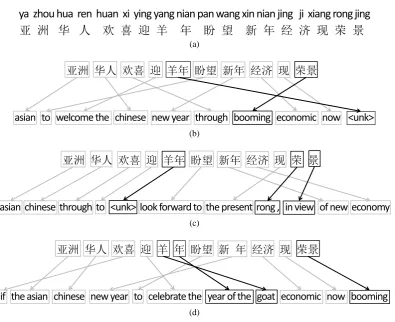
Figure 6 presents an example from the test cor-pus, which demonstrates how the proposed lexical splitter splits words more accurately than the base-line length tuner method. Two words in the seg-mentation result of the CTB segmenter are wor-thy of attention. The first one is “yang nian”(the year of goat), the lexical splitter split this word and
got the right translation, while the length tuner did not split it. The second is “rong jing”(booming or prosperity), the length tuner split this word, which resulted in wrong translations, while the lexical splitter avoided this mistake.
5 Comparison to Related Work
The most similar work in the literature to the posed method is the the length tuner method pro-posed by (Chang et al., 2008). This method also encourages the generation of more words during segmentation by using a single parameter that can be use to control segment length. Our method dif-fers from theirs in that it is able to acquire vocabu-lary knowledge from word alignments that can be used to more accurately split words into segments suitable for machine translation.
There is large volume of research using bilin-gual unsupervised and semi-supervised WS to ad-dress the problem of optimizing WS for SMT (Xu et al., 2008; Chung and Gildea, 2009; Nguyen et al., 2010; Michael et al., 2011). The main differ-ence with our approach is that they use automatic WA results, most often obtained using the same tools as are used in training SMT systems. One of the main problems of using unsupervised WA is that it is noisy, and therefore, employing iterative optimization methods to refine the results of unsu-pervised WA is a key issue in their research, for example boosting (Ma and Way, 2009; Michael et al., 2011), expectation maximization (Chung and Gildea, 2009), Bayesian sampling (Xu et al., 2008; Nguyen et al., 2010), or heuristic search (Zhao et al., 2013). Nevertheless, noisy WA makes both analyzing WS and improving SMT quality quite hard. In contrast, by using manual WA, we can clearly analyze the segmentation problems (Sec-tion 2), and train supervised models to solve the problem (Section 3).
WS eval03 eval04 eval05 eval06 improve CTB segmenter 31.89±0.09 32.73±0.19 31.03±0.16 31.38±0.23
[image:9.595.87.514.62.118.2]Length tuner 32.06±0.07 32.74±0.10 31.34±0.11 31.50±0.11 0.15±0.12 Lexical splitter 32.55±0.18 32.94±0.11 31.87±0.15 32.17±0.35 0.63±0.29
Table 8: Performance (BLEU) of SMT
(a)
(b)
(c)
(d)
Figure 6: Example of SMT from test sets. (a) source; (b) CTB segmenter; (c) length tuner; (d) lexical splitter. The four gold references are: “ethnic chinese in asia celebrate year of goat and hope for economic prosperity in new year”, “ asian chinese celebrate the arrival of the year of sheep and wish a prosperous new year”, “ asian chinese happily welcome the year of goat , expecting economic prosperity in new year”,“asian chinese happily welcomed year of the goat , praying for prosperity in the new year”
6 Conclusion
This paper is concerned with the role of word segmentation in Chinese-to-English SMT. We ex-plored the use of a manually annotated word align-ment corpus to refine word segalign-mentation for ma-chine translation. Based on an initial finding that 74.60% of running sentences in the WA corpus have segmentation inconsistent with a gold WA annotation, we proposed a supervised lexical re-segmentation model to modify the WS in order to relieve these issues.
Our main experimental results show that the proposed approach is capable of improving both alignment quality and end-to-end translation
qual-ity. The proposed method achieved the highest BLEU score relative to a number of respectable baseline systems that included the Stanford word segmenter, and an improved Stanford word seg-menter that could be tuned for segment length. No language-specific techniques other than a manu-ally aligned corpus were employed in this paper, thus the approach can applied to other SMT lan-guage pairs that require WS.
[image:9.595.104.500.146.468.2]oper-ation on SMT is non-trivial. On one hand, it can reduce the ambiguity in the source side. On the other hand, it may cause sparseness problems.
Acknowledgements
We thank the three reviewers for their valuable comments. We also thank the Stanford natural lan-guage processing group for releasing the source codes of their word segmenter.
References
Pi-Chuan Chang, Michel Galley, and Christopher D Manning. 2008. Optimizing Chinese word segmen-tation for machine translation performance. In
Pro-ceedings of the 3rd Workshop on Statistical Machine Translation, pages 224–232. Association for
Com-putational Linguistics.
Tagyoung Chung and Daniel Gildea. 2009. Unsu-pervised tokenization for machine translation. In
Proceedings of the 2009 Conference on Empirical Methods in Natural Language Processing: Volume 2-Volume 2, pages 718–726. Association for
Com-putational Linguistics.
John DeNero and Dan Klein. 2007. Tailoring word alignments to syntactic machine translation. In ACL, volume 45, page 17.
Jenny Rose Finkel, Trond Grenager, and Christopher Manning. 2005. Incorporating non-local informa-tion into informainforma-tion extracinforma-tion systems by gibbs sampling. In Proceedings of the 43rd Annual
Meet-ing on Association for Computational LMeet-inguistics,
pages 363–370. Association for Computational Lin-guistics.
Isao Goto, Bin Lu, Ka Po Chow, Eiichiro Sumita, and Benjamin K Tsou. 2011. Overview of the patent machine translation task at the NTCIR-9 workshop. In Proceedings of NTCIR, volume 9, pages 559–578.
Aria Haghighi, John Blitzer, John DeNero, and Dan Klein. 2009. Better word alignments with su-pervised itg models. In Proceedings of the Joint
Conference of the 47th Annual Meeting of the ACL and the 4th International Joint Conference on Natu-ral Language Processing of the AFNLP: Volume 2-Volume 2, pages 923–931. Association for
Compu-tational Linguistics.
Philipp Koehn, Hieu Hoang, Alexandra Birch, Chris Callison-Burch, Marcello Federico, Nicola Bertoldi, Brooke Cowan, Wade Shen, Christine Moran, Richard Zens, et al. 2007. Moses: open source toolkit for statistical machine translation. In
Pro-ceedings of the 45th Annual Meeting of the ACL on Interactive Poster and Demonstration Sessions,
pages 177–180. Association for Computational Lin-guistics.
John Lafferty, Andrew McCallum, and Fernando CN Pereira. 2001. Conditional random fields: Prob-abilistic models for segmenting and labeling se-quence data. In Proceedings of the 18th
Interna-tional Conference on Machine Learning, pages 282–
289. Association for Computing Machinery.
Xuansong Li, Niyu Ge, Stephen Grimes, Stephanie Strassel, and Kazuaki Maeda. 2010. Enriching word alignment with linguistic tags. In LREC, pages 2189–2195.
Percy Liang, Ben Taskar, and Dan Klein. 2006. Align-ment by agreeAlign-ment. In Proceedings of the main
conference on Human Language Technology Con-ference of the North American Chapter of the As-sociation of Computational Linguistics, pages 104–
111. Association for Computational Linguistics.
Yanjun Ma and Andy Way. 2009. Bilingually moti-vated domain-adapted word segmentation for statis-tical machine translation. In Proceedings of the 12th
Conference of the European Chapter of the Associa-tion for ComputaAssocia-tional Linguistics, pages 549–557.
Association for Computational Linguistics.
Paul Michael, Andrew Finch, and Eiichiro Sumita. 2011. Integration of multiple bilingually-trained segmentation schemes into statistical machine trans-lation. IEICE transactions on information and
sys-tems, 94(3):690–697.
Rada Mihalcea and Ted Pedersen. 2003. An evaluation exercise for word alignment. In Rada Mihalcea and Ted Pedersen, editors, HLT-NAACL 2003 Workshop:
Building and Using Parallel Texts: Data Driven Ma-chine Translation and Beyond, pages 1–10,
Edmon-ton, Alberta, Canada, May 31. Association for Com-putational Linguistics.
ThuyLinh Nguyen, Stephan Vogel, and Noah A Smith. 2010. Nonparametric word segmentation for ma-chine translation. In Proceedings of the 23rd
Inter-national Conference on Computational Linguistics,
pages 815–823. Association for Computational Lin-guistics.
Franz Josef Och and Hermann Ney. 2000. A com-parison of alignment models for statistical machine translation. In Proceedings of the 18th
confer-ence on Computational linguistics-Volume 2, pages
1086–1090. Association for Computational Linguis-tics.
Franz Josef Och and Hermann Ney. 2003. A System-atic Comparison of Various Statistical Alignment Models. Computational Linguistics, 29(1):19–51.
Franz Josef Och. 2003. Minimum error rate training in statistical machine translation. In Proceedings of
the 41st Annual Meeting on Association for Compu-tational Linguistics-Volume 1, pages 160–167.
Kishore Papineni, Salim Roukos, Todd Ward, and Wei-Jing Zhu. 2002. BLEU: a method for automatic evaluation of machine translation. In Proceedings
of the 40th Annual Meeting on Association for Com-putational Linguistics, pages 311–318. Association
for Computational Linguistics.
Fuchun Peng and Andrew McCallum. 2006. Infor-mation extraction from research papers using con-ditional random fields. Information Processing &
Management, 42(4):963–979.
Fuchun Peng, Fangfang Feng, and Andrew McCallum. 2004. Chinese segmentation and new word detec-tion using condidetec-tional random fields. Computer
Sci-ence Department Faculty Publication Series.
Richard Sproat and Thomas Emerson. 2003. The first international chinese word segmentation bake-off. In Proceedings of the second SIGHAN
work-shop on Chinese language processing-Volume 17,
pages 133–143. Association for Computational Lin-guistics.
Huihsin Tseng, Pichuan Chang, Galen Andrew, Daniel Jurafsky, and Christopher Manning. 2005. A con-ditional random field word segmenter for SIGHAN Bakeoff 2005. In Proceedings of the 4th SIGHAN
Workshop on Chinese Language Processing, volume
171. Jeju Island, Korea.
Jia Xu, Jianfeng Gao, Kristina Toutanova, and
Her-mann Ney. 2008. Bayesian semi-supervised
Chinese word segmentation for statistical machine translation. In Proceedings of the 22nd
Interna-tional Conference on ComputaInterna-tional Linguistics-Volume 1, pages 1017–1024. Association for
Com-putational Linguistics.
Nianwen Xue, Fu-Dong Chiou, and Martha Palmer. 2002. Building a large-scale annotated chinese cor-pus. In Proceedings of the 19th international
confer-ence on Computational linguistics-Volume 1, pages
1–8. Association for Computational Linguistics.
Richard Zens, Franz Josef Och, and Hermann Ney. 2002. Phrase-based statistical machine translation. In Advances in Artificial Intelligence, pages 18–32. Springer.
Hai Zhao, Masao Utiyama, Eiichro Sumita, and Bao-Liang Lu. 2013. An empirical study on word seg-mentation for chinese machine translation. A.
Gel-bukh (Ed.): CICLing 2013, Part II, LNCS 7817,