Improving Statistical Machine Translation using
Word Sense Disambiguation
Marine CARPUAT Dekai WU∗
[email protected] [email protected]
Human Language Technology Center HKUST
Department of Computer Science and Engineering
University of Science and Technology, Clear Water Bay, Hong Kong
Abstract
We show for the first time that incorporating the predictions of a word sense disambigua-tion system within a typical phrase-based statistical machine translation (SMT) model consistently improves translation quality across all three different IWSLT Chinese-English test sets, as well as producing sta-tistically significant improvements on the larger NIST Chinese-English MT task— and moreover never hurts performance on any test set, according not only to BLEU but to all eight most commonly used au-tomatic evaluation metrics. Recent work has challenged the assumption that word sense disambiguation (WSD) systems are useful for SMT. Yet SMT translation qual-ity still obviously suffers from inaccurate lexical choice. In this paper, we address this problem by investigating a new strat-egy for integrating WSD into an SMT sys-tem, that performsfully phrasal multi-word disambiguation. Instead of directly incor-porating a Senseval-style WSD system, we redefine the WSD task to match the ex-act same phrasal translation disambiguation task faced by phrase-based SMT systems. Our results provide the first known empir-ical evidence that lexempir-ical semantics are in-deed useful for SMT, despite claims to the contrary.
∗
This material is based upon work supported in part by the Defense Advanced Research Projects Agency (DARPA) under GALE Contract No. HR0011-06-C-0023, and by the Hong Kong Research Grants Council (RGC) research grants
1 Introduction
Common assumptions about the role and useful-ness of word sense disambiguation (WSD) models in full-scale statistical machine translation (SMT) systems have recently been challenged.
On the one hand, in previous work (Carpuat and Wu, 2005b) we obtained disappointing results when using the predictions of a Senseval WSD system in conjunction with a standard word-based SMT sys-tem: we reported slightly lower BLEU scores de-spite trying to incorporate WSD using a number of apparently sensible methods. These results cast doubt on the assumption that sophisticated dedicated WSD systems that were developed independently from any particular NLP application can easily be integrated into a SMT system so as to improve trans-lation quality through stronger models of context and rich linguistic information. Rather, it has been argued, SMT systems have managed to achieve sig-nificant improvements in translation quality without directly addressing translation disambiguation as a WSD task. Instead, translation disambiguation deci-sions are made indirectly, typically using only word surface forms and very local contextual information, forgoing the much richer linguistic information that WSD systems typically take advantage of.
On the other hand, error analysis reveals that the performance of SMT systems still suffers from inac-curate lexical choice. In subsequent empirical stud-ies, we have shown that SMT systems perform much worse than dedicated WSD models, both supervised
RGC6083/99E, RGC6256/00E, and DAG03/04.EG09. Any opinions, findings and conclusions or recommendations ex-pressed in this material are those of the author(s) and do not necessarily reflect the views of the Defense Advanced Research Projects Agency.
and unsupervised, on a Senseval WSD task (Carpuat and Wu, 2005a), and therefore suggest that WSD should have a role to play in state-of-the-art SMT systems. In addition to the Senseval shared tasks, which have provided standard sense inventories and data sets, WSD research has also turned increasingly to designing specific models for a particular applica-tion. For instance, Vickreyet al.(2005) and Specia (2006) proposed WSD systems designed for French to English, and Portuguese to English translation re-spectively, and present a more optimistic outlook for the use of WSD in MT, although these WSD sys-tems have not yet been integrated nor evaluated in full-scale machine translation systems.
Taken together, these seemingly contradictory re-sults suggest that improving SMT lexical choice ac-curacy remains a key challenge to improve current SMT quality, and that it is still unclear what is the most appropriate integration framework for the WSD models in SMT.
In this paper, we present first results with a new architecture that integrates a state-of-the-art WSD model into phrase-based SMT so as to per-form multi-word phrasal lexical disambiguation, and show that this new WSD approach not only produces gains acrossallavailable Chinese-English IWSLT06 test sets for all eight commonly used au-tomated MT evaluation metrics, but also produces statistically significant gains on the much larger NIST Chinese-English task. The main difference between this approach and several of our earlier ap-proaches as described in Carpuat and Wu (2005b) and subsequently Carpuat et al. (2006) lies in the fact that we focus on repurposing the WSD system for multi-word phrase-based SMT. Rather than us-ing a generic Senseval WSD model as we did in Carpuat and Wu (2005b), here both the WSD train-ing and the WSD predictions are integrated into the phrase-based SMT framework. Furthermore, rather than using a single word based WSD approach to augment a phrase-based SMT model as we did in Carpuat et al. (2006) to improve BLEU and NIST scores, here the WSD training and predictions oper-ate on full multi-word phrasal units, resulting in sig-nificantly more reliable and consistent gains as eva-luted by many other translation accuracy metrics as well. Specifically:
• Instead of using a Senseval system, we redefine the WSD task to be exactly the same as lexi-cal choice task faced by the multi-word phrasal translation disambiguation task faced by the phrase-based SMT system.
• Instead of using predefined senses drawn from manually constructed sense inventories such as HowNet (Dong, 1998), our WSD for SMT sys-tem directly disambiguates between all phrasal translation candidates seen during SMT train-ing.
• Instead of learning from manually annotated training data, our WSD system is trained on the same corpora as the SMT system.
However, despite these adaptations to the SMT task, the core sense disambiguation task remains pure WSD:
• The rich context features are typical of WSD and almost never used in SMT.
• The dynamic integration of context-sensitive translation probabilities is not typical of SMT.
• Although it is embedded in a real SMT sys-tem, the WSD task is exactly the same as in recent and coming Senseval Multilingual Lexi-cal Sample tasks (e.g., Chklovskiet al.(2004)), where sense inventories represent the semantic distinctions made by another language.
2 Problems in context-sensitive lexical choice for SMT
To the best of our knowledge, there has been no pre-vious attempt at integrating a state-of-the-art WSD system for fully phrasal multi-word lexical choice into phrase-based SMT, with evaluation of the re-sulting system on a translation task. While there are many evaluations of WSD quality, in particular the Senseval series of shared tasks (Kilgarriff and Rosenzweig (1999), Kilgarriff (2001), Mihalceaet al.(2004)), very little work has been done to address the actual integration of WSD in realistic SMT ap-plications.
To fully integrate WSD into phrase-based SMT, it is necessary to perform lexical disambiguation on multi-word phrasal lexical units; in contrast, the model reported in Cabezas and Resnik (2005) can only perform lexical disambiguation on sin-gle words. Like the model proposed in this paper, Cabezas and Resnik attempted to integrate phrase-based WSD models into decoding. However, al-though they reported that incorporating these predic-tions via the Pharaoh XML markup scheme yielded a small improvement in BLEU score over a Pharaoh baseline on a single Spanish-English translation data set, we have determined empirically that applying their single-word based model to several Chinese-English datasets doesnotyield systematic improve-ments on most MT evaluation metrics (Carpuat and Wu, 2007). The single-word model has the disad-vantage of forcing the decoder to choose between the baseline phrasal translation probabilities versus the WSD model predictions for single words. In ad-dition, the single-word model does not generalize to WSD for phrasal lexical choice, as overlapping spans cannot be specified with the XML markup scheme. Providing WSD predictions for phrases would require committing to a phrase segmenta-tion of the input sentence before decoding, which is likely to hurt translation quality.
It is also necessary to focus directly on translation accuracy rather than other measures such as align-ment error rate, which may not actually lead to im-proved translation quality; in contrast, for example, Garcia-Varea et al. (2001) and Garcia-Varea et al. (2002) show improved alignment error rate with a maximum entropy based context-dependent lexical
choice model, but not improved translation accu-racy. In contrast, our evaluation in this paper is con-ducted on the actual decoding task, rather than in-termediate tasks such as word alignment. Moreover, in the present work, all commonly available auto-mated MT evaluation metrics are used, rather than only BLEU score, so as to maintain a more balanced perspective.
Another problem in the context-sensitive lexical choice in SMT models of Garcia Vareaet al. is that their feature set is insufficiently rich to make much better predictions than the SMT model itself. In contrast, our WSD-based lexical choice models are designed to directly model the lexical choice in the actual translation direction, and take full advantage of not residing strictly within the Bayesian source-channel model in order to benefit from the much richer Senseval-style feature set this facilitates.
Garcia Vareaet al. found that the best results are obtained when the training of the context-dependent translation model is fully incorporated with the EM training of the SMT system. As described below, the training of our new WSD model, though not in-corporated within the EM training, is also far more closely tied to the SMT model than is the case with traditional standalone WSD models.
In contrast with Brown et al. (1991), our ap-proach incorporates the predictions of state-of-the-art WSD models that use rich contextual features for any phrase in the input vocabulary. In Brownet al.’s early study of WSD impact on SMT performance, the authors reported improved translation quality on a French to English task, by choosing an English translation for a French word based on the single contextual feature which is reliably discriminative. However, this was a pilot study, which is limited to words with exactly two translation candidates, and it is not clear that the conclusions would generalize to more recent SMT architectures.
3 Problems in translation-oriented WSD
Diab (2004). In contrast, this paper focuses on the converse goal of using WSD models to improve ac-tual translation quality.
Recently, several researchers have focused on de-signing WSD systems for the specific purpose of translation. Vickreyet al.(2005) train a logistic re-gression WSD model on data extracted from auto-matically word aligned parallel corpora, but evaluate on a blank filling task, which is essentially an eval-uation of WSD accuracy. Specia (2006) describes an inductive logic programming-based WSD sys-tem, which was specifically designed for the purpose of Portuguese to English translation, but this system was also only evaluated on WSD accuracy, and not integrated in a full-scale machine translation system. Ng et al. (2003) show that it is possible to use automatically word aligned parallel corpora to train accurate supervised WSD models. The purpose of the study was to lower the annotation cost for su-pervised WSD, as suggested earlier by Resnik and Yarowsky (1999). However this result is also en-couraging for the integration of WSD in SMT, since it suggests that accurate WSD can be achieved using training data of the kind needed for SMT.
4 Building WSD models for phrase-based SMT
4.1 WSD models for every phrase in the input vocabulary
Just like for the baseline phrase translation model, WSD models are defined for every phrase in the in-put vocabulary. Lexical choice in SMT is naturally framed as a WSD problem, so the first step of inte-gration consists of defining a WSD model for every phrase in the SMT input vocabulary.
This differs from traditional WSD tasks, where the WSD target is a single content word. Sense-val for instance has either lexical sample or all word tasks. The target words for both categories of Sen-seval WSD tasks are typically only content words— primarily nouns, verbs, and adjectives—while in the context of SMT, we need to translate entire sen-tences, and therefore have a WSD model not only for every word in the input sentences, regardless of their POS tag, but for every phrase, including tokens such as articles, prepositions and even punctuation. Further empirical studies have suggested that
includ-ing WSD predictions for those longer phrases is a key factor to help the decoder produce better trans-lations (Carpuat and Wu, 2007).
4.2 WSD uses the same sense definitions as the SMT system
Instead of using pre-defined sense inventories, the WSD models disambiguate between the SMT trans-lation candidates. In order to closely integrate WSD predictions into the SMT system, we need to formu-late WSD models so that they produce features that can directly be used in translation decisions taken by the SMT system. It is therefore necessary for the WSD and SMT systems to consider exactly the same translation candidates for a given word in the input language.
Assuming a standard phrase-based SMT system (e.g., Koehnet al.(2003)), WSD senses are thus ei-ther words or phrases, as learned in the SMT phrasal translation lexicon. Those “sense” candidates are very different from those typically used even in ded-icated WSD tasks, even in the multilingual Senseval tasks. Each candidate is a phrase that is not neces-sarily a syntactic noun or verb phrase as in manually compiled dictionaries. It is quite possible that dis-tinct “senses” in our WSD for SMT system could be considered synonyms in a traditional WSD frame-work, especially in monolingual WSD.
In addition to the consistency requirements for in-tegration, this requirement is also motivated by em-pirical studies, which show that predefined trans-lations derived from sense distinctions defined in monolingual ontologies do not match translation distinction made by human translators (Speciaet al., 2006).
4.3 WSD uses the same training data as the SMT system
WSD training does not require any other resources than SMT training, nor any manual sense annota-tion. We employ supervised WSD systems, since Senseval results have amply demonstrated that su-pervised models significantly outperform unsuper-vised approaches (see for instance the English lexi-cal sample tasks results described by Mihalceaet al. (2004)).
in-put language phrase is sense-tagged with its aligned output language phrase in the parallel corpus. The phrase alignment method used to extract the WSD training data therefore depends on the one used by the SMT system. This presents the advantage of training WSD and SMT models on exactly the same data, thus eliminating domain mismatches between Senseval data and parallel corpora. But most impor-tantly, this allows WSD training data to be gener-ated entirely automatically, since the parallel corpus is automatically phrase-aligned in order to learn the SMT phrase bilexicon.
4.4 The WSD system
The word sense disambiguation subsystem is mod-eled after the best performing WSD system in the Chinese lexical sample task at Senseval-3 (Carpuat et al., 2004).
The features employed are typical of WSD and are therefore far richer than those used in most SMT systems. The feature set consists of position-sensitive, syntactic, and local collocational fea-tures, since these features yielded the best results when combined in a na¨ıve Bayes model on several Senseval-2 lexical sample tasks (Yarowsky and Flo-rian, 2002). These features scale easily to the bigger vocabulary and sense candidates to be considered in a SMT task.
The Senseval system consists of an ensemble of four combined WSD models:
The first model is a na¨ıve Bayes model, since Yarowsky and Florian (2002) found this model to be the most accurate classifier in a comparative study on a subset of Senseval-2 English lexical sample data.
The second model is a maximum entropy model (Jaynes, 1978), since Klein and Manning (Klein and Manning, 2002) found that this model yielded higher accuracy than na¨ıve Bayes in a subsequent comparison of WSD performance.
The third model is a boosting model (Freund and Schapire, 1997), since boosting has consistently turned in very competitive scores on related tasks such as named entity classification. We also use the Adaboost.MH algorithm.
The fourth model is a Kernel PCA-based model (Wu et al., 2004). Kernel Principal Component Analysis or KPCA is a nonlinear kernel method for
extracting nonlinear principal components from vec-tor sets where, conceptually, then-dimensional in-put vectors are nonlinearly mapped from their origi-nal spaceRnto a high-dimensional feature spaceF where linear PCA is performed, yielding a transform by which the input vectors can be mapped nonlin-early to a new set of vectors (Sch¨olkopfet al., 1998). WSD can be performed by a Nearest Neighbor Clas-sifier in the high-dimensional KPCA feature space.
All these classifiers have the ability to handle large numbers of sparse features, many of which may be irrelevant. Moreover, the maximum entropy and boosting models are known to be well suited to handling features that are highly interdependent.
4.5 Integrating WSD predictions in phrase-based SMT architectures
It is non-trivial to incorporate WSD into an existing phrase-based architecture such as Pharaoh (Koehn, 2004), since the decoder is not set up to easily ac-cept multiple translation probabilities that are dy-namically computed in context-sensitive fashion.
For everyphrasein a given SMT input sentence, the WSD probabilities can be used as additional fea-ture in a loglinear translation model, in combina-tion with typical context-independent SMT bilexi-con probabilities.
We overcome this obstacle by devising a calling architecture that reinitializes the decoder with dy-namically generated lexicons on a per-sentence ba-sis.
Unlike a n-best reranking approach, which is lim-ited by the lexical choices made by the decoder us-ing only the baseline context-independent transla-tion probabilities, our method allows the system to make full use of WSD information for all competing phrases at all decoding stages.
5 Experimental setup
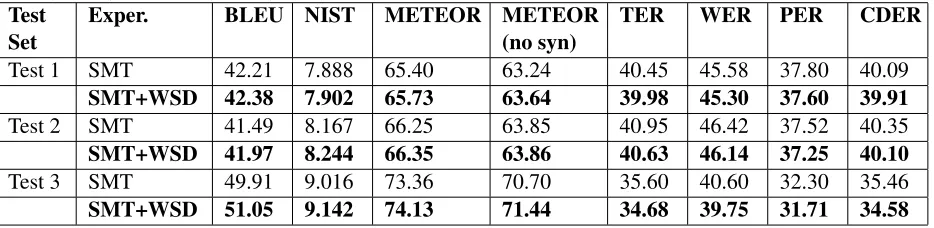
Table 1: Evaluation results on the IWSLT06 dataset: integrating the WSD translation predictions improves BLEU, NIST, METEOR, WER, PER, CDER and TER across all 3 different available test sets.
Test Set
Exper. BLEU NIST METEOR METEOR (no syn)
TER WER PER CDER
Test 1 SMT 42.21 7.888 65.40 63.24 40.45 45.58 37.80 40.09 SMT+WSD 42.38 7.902 65.73 63.64 39.98 45.30 37.60 39.91 Test 2 SMT 41.49 8.167 66.25 63.85 40.95 46.42 37.52 40.35 SMT+WSD 41.97 8.244 66.35 63.86 40.63 46.14 37.25 40.10 Test 3 SMT 49.91 9.016 73.36 70.70 35.60 40.60 32.30 35.46 SMT+WSD 51.05 9.142 74.13 71.44 34.68 39.75 31.71 34.58
Table 2: Evaluation results on the NIST test set: integrating the WSD translation predictions improves BLEU, NIST, METEOR, WER, PER, CDER and TER
Exper. BLEU NIST METEOR METEOR (no syn)
TER WER PER CDER
SMT 20.41 7.155 60.21 56.15 76.76 88.26 61.71 70.32 SMT+WSD 20.92 7.468 60.30 56.79 71.34 83.87 57.29 67.38
5.1 Data set
Preliminary experiments are conducted using train-ing and evaluation data drawn from the multilin-gual BTEC corpus, which contains sentences used in conversations in the travel domain, and their transla-tions in several languages. A subset of this data was made available for the IWSLT06 evaluation cam-paign (Paul, 2006); the training set consists of 40000 sentence pairs, and each test set contains around 500 sentences. We used only the pure text data, and not the speech transcriptions, so that speech-specific is-sues would not interfere with our primary goal of un-derstanding the effect of integrating WSD in a full-scale phrase-based model.
A larger scale evaluation is conducted on the stan-dard NIST Chinese-English test set (MT-04), which contains 1788 sentences drawn from newswire cor-pora, and therefore of a much wider domain than the IWSLT data set. The training set consists of about 1 million sentence pairs in the news domain.
Basic preprocessing was applied to the corpus. The English side was simply tokenized and case-normalized. The Chinese side was word segmented using the LDC segmenter.
5.2 Baseline SMT system
Since our focus is not on a specific SMT architec-ture, we use the off-the-shelf phrase-based decoder
Pharaoh (Koehn, 2004) trained on the IWSLT train-ing set. Pharaoh implements a beam search decoder for phrase-based statistical models, and presents the advantages of being freely available and widely used.
The phrase bilexicon is derived from the inter-section of bidirectional IBM Model 4 alignments, obtained with GIZA++ (Och and Ney, 2003), aug-mented to improve recall using the grow-diag-final heuristic. The language model is trained on the Eng-lish side of the corpus using the SRI language mod-eling toolkit (Stolcke, 2002).
The loglinear model weights are learned using Chiang’s implementation of the maximum BLEU training algorithm (Och, 2003), both for the base-line, and the WSD-augmented system. Due to time constraints, this optimization was only con-ducted on the IWSLT task. The weights used in the WSD-augmented NIST model are based on the best IWSLT model. Given that the two tasks are quite different, we expect further improvements on the WSD-augmented system after running maximum BLEU optimization for the NIST task.
6 Results and discussion
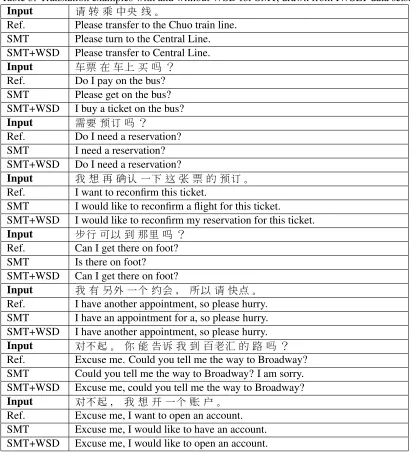
Table 3: Translation examples with and without WSD for SMT, drawn from IWSLT data sets. Input ÷lX -. ¿
Ref. Please transfer to the Chuo train line. SMT Please turn to the Central Line. SMT+WSD Please transfer to Central Line. Input fh(f p
Ref. Do I pay on the bus? SMT Please get on the bus? SMT+WSD I buy a ticket on the bus? Input •„¢
Ref. Do I need a reservation? SMT I need a reservation? SMT+WSD Do I need a reservation?
Input ó•n¤ Ù h„„¢ Ref. I want to reconfirm this ticket.
SMT I would like to reconfirm a flight for this ticket.
SMT+WSD I would like to reconfirm my reservation for this ticket. Input eLïå0£Ì
Ref. Can I get there on foot? SMT Is there on foot? SMT+WSD Can I get there on foot?
Input æ *¦ @å÷ë¹ Ref. I have another appointment, so please hurry. SMT I have an appointment for a, so please hurry. SMT+WSD I have another appointment, so please hurry. Input ù w `ýJÉ 0~ G„ï
Ref. Excuse me. Could you tell me the way to Broadway? SMT Could you tell me the way to Broadway? I am sorry. SMT+WSD Excuse me, could you tell me the way to Broadway? Input ù w ó *&7
Ref. Excuse me, I want to open an account. SMT Excuse me, I would like to have an account. SMT+WSD Excuse me, I would like to open an account.
The results are shown in Table 1 for IWSLT and Ta-ble 2 for the NIST task. Paired bootstrap resampling shows that the improvements on the NIST test set are statistically significant at the 95% level.
Remarkably, integrating WSD predictions helps all the very different metrics. In addition to the widely used BLEU (Papineniet al., 2002) and NIST (Doddington, 2002) scores, we also evaluate trans-lation quality with the recently proposed Meteor (Banerjee and Lavie, 2005) and four edit-distance style metrics, Word Error Rate (WER), Position-independent word Error Rate (PER) (Tillmann et
al., 1997), CDER, which allows block reordering (Leusch et al., 2006), and Translation Edit Rate (TER) (Snover et al., 2006). Note that we report Meteor scores computed both with and without us-ing WordNet synonyms to match translation candi-dates and references, showing that the improvement is not due to context-independent synonym matches at evaluation time.
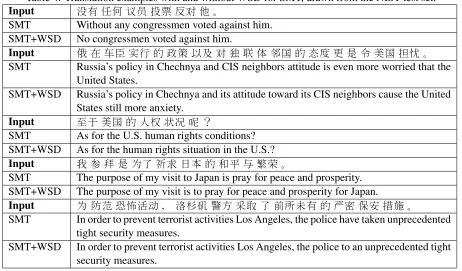
Table 4: Translation examples with and without WSD for SMT, drawn from the NIST test set. Input ¡ ûU®X•hÍùÖ
SMT Without any congressmen voted against him. SMT+WSD No congressmen voted against him.
Input Ä(fãžL„?VåÊùìTS»ý„ ¦ô /äŽýÅç SMT Russia’s policy in Chechnya and CIS neighbors attitude is even more worried that the
United States.
SMT+WSD Russia’s policy in Chechnya and its attitude toward its CIS neighbors cause the United States still more anxiety.
Input óŽŽý„ºC¶µb
SMT As for the U.S. human rights conditions? SMT+WSD As for the human rights situation in the U.S.? Input ÂÜ/:†HBå,„Œs Ac
SMT The purpose of my visit to Japan is pray for peace and prosperity. SMT+WSD The purpose of my visit is to pray for peace and prosperity for Japan. Input : 2 P ;¨ Iöf¹ÇÖ†M@* „%Æ݉ª½
SMT In order to prevent terrorist activities Los Angeles, the police have taken unprecedented tight security measures.
SMT+WSD In order to prevent terrorist activities Los Angeles, the police to an unprecedented tight security measures.
2 and 3, and 95.74% of the NIST test set.
Tables 3 and 4 show examples of translations drawn from the IWSLT and NIST test sets respec-tively.
A more detailed analysis reveals WSD predic-tions give better rankings and are more discrimi-native than baseline translation probabilities, which helps the final translation in three different ways.
• The rich context features help rank the correct translation first with WSD while it is ranked lower according to baseline translation proba-bility scores .
• Even when WSD and baseline translation prob-abilities agree on the top translation candidate, the stronger WSD scores help override wrong language model predictions.
• The strong WSD scores for phrases help the decoder pick longer phrase translations, while using baseline translation probabilities often translate those phrases in smaller chunks that include a frequent (and incorrect) translation candidate.
For instance, the top 4 Chinese sentences in
Ta-ble 4, are better translated by the WSD-augmented system because the WSD scores help the decoder to choose longer phrases. In the first example, the phrase “¡ ûU” is correctly translated as a whole as “No” by the WSD-augmented system, while the baseline translates each word separately yielding an incorrect translation. In the following three examples, the WSD system encourages the de-coder to translate the long phrases “ô /äŽý Åç”, “Žý „ ºC ¶µ”, and “HB å, „ Œs Ac” as single units, while the baseline in-troduces errors by breaking them down into shorter phrases.
The last sentence in the table shows an example where the WSD predictions do not help the base-line system. The translation quality is actually much worse, since the verb “ÇÖ” is incorrectly trans-lated as “to”, despite the fact that the top candidate predicted by the WSD system alone is the much bet-ter translation “has taken”, but with a relatively low probability of 0.509.
7 Conclusion
SMT consistently helps on all commonly available automated translation quality evaluation metrics on all three different test sets from the Chinese-English IWSLT06 text translation task, and yields statisti-cally significant gains on the larger NIST Chinese-English task. It is important to note that the WSD models never hurt translation quality, and always yield individual gains of a level that makes their in-tegration always worthwile.
We have proposed to consistently integrate WSD models both during training, where sense definitions and sense-annotated data are automatically extracted from the word-aligned parallel corpora from SMT training, and during testing, where the phrasal WSD probabilities are used by the SMT system just like all the other lexical choice features.
Context features are derived from state-of-the-art WSD models, and the evaluation is conducted on the actual translation task, rather than intermediate tasks such as word alignment.
It is to be emphasized that this approach does not merely consist of adding a source sentence feature in the log linear model for translation. On the con-trary, it remains a real WSD task, defined just as in the Senseval Multilingual Lexical Sample tasks (e.g., Chklovskiet al.(2004)). Our model makes use of typical WSD features that are almost never used in SMT systems, and requires a dynamically created translation lexicon on a per-sentence basis.
To our knowledge this constitues the first attempt at fully integrating state-of-the-art WSD with con-ventional phrase-based SMT. Unlike previous ap-proaches, the WSD targets are not only single words, but multi-word phrases, just as in the SMT sys-tem. This means that WSD senses are unusually predicted not only for a limited set of single words or very short phrases, but for all phrases of arbitrar-ily length that are in the SMT translation lexicon. The single word approach, as we reported in Carpuat et al. (2006), improved BLEU and NIST scores for phrase-based SMT, but subsequent detailed em-pirical studies we have performed since then sug-gest that single word WSD approaches are less suc-cessful when evaluated under all other MT metrics (Carpuat and Wu, 2007). Thus, fully phrasal WSD predictions for longer phrases, as reported in this pa-per, are particularly important to improve translation quality.
The results reported in this paper cast new light on the WSD vs. SMT debate, suggesting that a close integration of WSD and SMT decisions should be incorporated in a SMT model that successfully uses WSD predictions. Our objective here is to demon-strate that this technique works for the widest pos-sible class of models, so we have chosen as the baseline the most widely used phrase-based SMT model. Our positive results suggest that our ex-periments could be tried on other current statistical MT models, especially the growing family of tree-structured SMT models employing stochastic trans-duction grammars of various sorts (Wu and Chiang, 2007). For instance, incorporating WSD predictions into an MT decoder based on inversion transduction grammars (Wu, 1997)—such as the Bracketing ITG based models of Wu (1996), Zenset al. (2004), or Cherry and Lin (2007)—would present an intriguing comparison with the present work. It would also be interesting to assess whether a more grammatically structured statistical MT model that is less reliant on an n-gram language model, such as the syntactic ITG based “grammatical channel” translation model of (Wu and Wong, 1998), could make more effective use of WSD predictions.
References
Satanjeev Banerjee and Alon Lavie. METEOR: An automatic metric for MT evaluation with im-proved correlation with human judgement. In Proceedings of Workshop on Intrinsic and Extrin-sic Evaluation Measures for MT and/or Summa-rization at the 43th Annual Meeting of the Associ-ation of ComputAssoci-ational Linguistics (ACL-2005), Ann Arbor, Michigan, June 2005.
Peter Brown, Stephen Della Pietra, Vincent Della Pietra, and Robert Mercer. Word-sense disam-biguation using statistical methods. In Proceed-ings of 29th meeting of the Association for Com-putational Linguistics, pages 264–270, Berkeley, California, 1991.
Clara Cabezas and Philip Resnik. Using WSD tech-niques for lexical selection in statistical machine translation. Technical report, Institute for Ad-vanced Computer Studies, University of Mary-land, 2005.
sense disambiguation performance of statistical machine translation. InProceedings of the Second International Joint Conference on Natural Lan-guage Processing (IJCNLP), pages 122–127, Jeju Island, Republic of Korea, 2005.
Marine Carpuat and Dekai Wu. Word sense disam-biguation vs. statistical machine translation. In Proceedings of the annual meeting of the associa-tion for computaassocia-tional linguistics (ACL-05), Ann Arbor, Michigan, 2005.
Marine Carpuat and Dekai Wu. How phrase sense disambiguation outperforms word sense disambiguation for statistical machine translation. Forthcoming, 2007.
Marine Carpuat, Weifeng Su, and Dekai Wu. Aug-menting ensemble classification for word sense disambiguation with a Kernel PCA model. In Pro-ceedings of Senseval-3, Third International Work-shop on Evaluating Word Sense Disambiguation Systems, Barcelona, July 2004. SIGLEX, Associ-ation for ComputAssoci-ational Linguistics.
Marine Carpuat, Yihai Shen, Xiaofeng Yu, and Dekai Wu. Toward integrating word sense and en-tity disambiguation into statistical machine trans-lation. In Third International Workshop on Spo-ken Language Translation (IWSLT 2006), Kyoto, November 2006.
Colin Cherry and Dekang Lin. Inversion Transduc-tion Grammar for joint phrasal translaTransduc-tion mod-eling. In Dekai Wu and David Chiang, editors, NAACL-HLT 2007 / AMTA Workshop on Syntax and Structure in Statistical Translation (SSST), pages 17–24, Rochester, NY, April 2007.
Timothy Chklovski, Rada Mihalcea, Ted Pedersen, and Amruta Purandare. The Senseval-3 multilin-gual English-Hindi lexical sample task. In Pro-ceedings of Senseval-3, Third International Work-shop on Evaluating Word Sense Disambiguation Systems, pages 5–8, Barcelona, Spain, July 2004. SIGLEX, Association for Computational Linguis-tics.
Ido Dagan and Alon Itai. Word sense disambigua-tion using a second language monolingual corpus. Computational Linguistics, 20(4):563–596, 1994.
Mona Diab. Relieving the data acquisition bottle-neck in word sense disambiguation. In
Proceed-ings of the 42nd Annual Meeting of the Associa-tion for ComputaAssocia-tional Linguistics, 2004.
George Doddington. Automatic evaluation of machine translation quality using n-gram co-occurrence statistics. In Proceedings of the Human Language Technology conference (HLT-2002), San Diego, CA, 2002.
Zhendong Dong. Knowledge description: what, how and who? In Proceedings of Inter-national Symposium on Electronic Dictionary, Tokyo, Japan, 1998.
Yoram Freund and Robert E. Schapire. A decision-theoretic generalization of on-line learning and an application to boosting. In Journal of Com-puter and System Sciences, 55(1), pages 119–139, 1997.
Ismael Garcia-Varea, Franz Och, Hermann Ney, and Francisco Casacuberta. Refined lexicon models for statistical machine translation using a maxi-mum entropy approach. In Proceedings of the 39th annual meeting of the association for compu-tational linguistics (ACL-01), Toulouse, France, 2001.
Ismael Garcia-Varea, Franz Och, Hermann Ney, and Francisco Casacuberta. Efficient integration of maximum entropy lexicon models within the training of statistical alignment models. In Pro-ceedings of AMTA-2002, pages 54–63, Tiburon, California, October 2002.
E.T. Jaynes. Where do we Stand on Maximum En-tropy? MIT Press, Cambridge MA, 1978.
Adam Kilgarriff and Joseph Rosenzweig. Frame-work and results for English Senseval.Computers and the Humanities, 34(1):15–48, 1999. Special issue on SENSEVAL.
Adam Kilgarriff. English lexical sample task de-scription. In Proceedings of Senseval-2, Sec-ond International Workshop on Evaluating Word Sense Disambiguation Systems, pages 17–20, Toulouse, France, July 2001. SIGLEX, Associa-tion for ComputaAssocia-tional Linguistics.
Processing, pages 9–16, Philadelphia, July 2002. SIGDAT, Association for Computational Linguis-tics.
Philipp Koehn, Franz Och, and Daniel Marcu. Sta-tistical phrase-based translation. In Proceedings of HLT/NAACL-2003, Edmonton, Canada, May 2003.
Philipp Koehn. Pharaoh: a beam search decoder for phrase-based statistical machine translation mod-els. In6th Conference of the Association for Ma-chine Translation in the Americas (AMTA), Wash-ington, DC, September 2004.
Gregor Leusch, Nicola Ueffing, and Hermann Ney. Efficient MT evaluation using block movements. In Proceedings of EACL-2006 (11th Confer-ence of the European Chapter of the Association for Computational Linguistics), pages 241–248, Trento, Italy, April 2006.
Cong Li and Hang Li. Word translation disambigua-tion using bilingual bootstrapping. In Proceed-ings of the 40th Annual Meeting of the Associ-ation for ComputAssoci-ational Linguistics, pages 343– 351, 2002.
Rada Mihalcea, Timothy Chklovski, and Adam Kill-gariff. The Senseval-3 English lexical sample task. InProceedings of Senseval-3, Third Interna-tional Workshop on Evaluating Word Sense Dis-ambiguation Systems, pages 25–28, Barcelona, Spain, July 2004. SIGLEX, Association for Com-putational Linguistics.
Hwee Tou Ng, Bin Wang, and Yee Seng Chan. Ex-ploiting parallel texts for word sense disambigua-tion: An empirical study. InProceedings of ACL-03, Sapporo, Japan, pages 455–462, 2003.
Franz Josef Och and Hermann Ney. A system-atic comparison of various statistical alignment models. Computational Linguistics, 29(1):19–52, 2003.
Franz Josef Och. Minimum error rate training in sta-tistical machine translation. InProceedings of the 41st Annual Meeting of the Association for Com-putational Linguistics, pages 160–167, 2003.
Kishore Papineni, Salim Roukos, Todd Ward, and Wei-Jing Zhu. BLEU: a method for automatic evaluation of machine translation. InProceedings
of the 40th Annual Meeting of the Association for Computational Linguistics, 2002.
Michael Paul. Overview of the IWSLT06 evalua-tion campaign. In Third International Workshop on Spoken Language Translation (IWSLT 2006), Kyoto, November 2006.
Philip Resnik and David Yarowsky. Distinguising systems and distinguishing senses: New evalua-tion methods for word sense disambiguaevalua-tion. Nat-ural Language Engineering, 5(2):113–133, 1999.
Bernhard Sch¨olkopf, Alexander Smola, and Klaus-Rober M¨uller. Nonlinear component analysis as a kernel eigenvalue problem. Neural Computation, 10(5), 1998.
Matthew Snover, Bonnie Dorr, Richard Schwartz, Linnea Micciulla, and John Makhoul. A study of translation edit rate with targeted human an-notation. In Proceedings of AMTA, pages 223– 231, Boston, MA, 2006. Association for Machine Translation in the Americas.
Lucia Specia, Maria das Gra¨cas Volpe Nunes, Gabriela Castelo Branco Ribeiro, and Mark Stevenson. Multilingual versus monolingual WSD. In EACL-2006 Workshop on Making Sense of Sense: Bringing Psycholinguistics and Computational Linguistics Together, pages 33– 40, Trento, Italy, April 2006.
Lucia Specia. A hybrid relational approach for WSD—first results. InProceedings of the COL-ING/ACL 06 Student Research Workshop, pages 55–60, Sydney, July 2006. ACL.
Andreas Stolcke. SRILM—an extensible language modeling toolkit. InInternational Conference on Spoken Language Processing, Denver, Colorado, September 2002.
Christoph Tillmann, Stefan Vogel, Hermann Ney, A. Zubiaga, and H. Sawaf. Accelerated DP-based search for statistical translation. In Pro-ceedings of Eurospeech’97, pages 2667–2670, Rhodes, Greece, 1997.
Dekai Wu and David Chiang, editors. NAACL-HLT 2007 / AMTA Workshop on Syntax and Structure in Statistical Translation (SSST). Association for Computational Linguistics, Rochester, NY, USA, April 2007.
Dekai Wu and Hongsing Wong. Machine translation with a stochastic grammatical channel. In Pro-ceedings of COLING-ACL’98, Montreal,Canada, August 1998.
Dekai Wu, Weifeng Su, and Marine Carpuat. A Kernel PCA method for superior word sense dis-ambiguation. In Proceedings of the 42nd An-nual Meeting of the Association for Computa-tional Linguistics, Barcelona, Spain, July 2004.
Dekai Wu. A polynomial-time algorithm for statis-tical machine translation. InProceedings of 34th Annual Meeting of the Association for Computa-tional Linguistics, Santa Cruz, California, June 1996.
Dekai Wu. Stochastic inversion transduction gram-mars and bilingual parsing of parallel corpora. Computational Linguistics, 23(3):377–404, 1997.
David Yarowsky and Radu Florian. Evaluating sense disambiguation across diverse parameter spaces. Natural Language Engineering, 8(4):293–310, 2002.