Learning Noun Phrase Query Segmentation
Shane Bergsma and Qin Iris Wang Department of Computing Science
University of Alberta
Edmonton, Alberta, Canada, T6G 2E8
{bergsma,wqin}@cs.ualberta.ca
Abstract
Query segmentation is the process of tak-ing a user’s search-engine query and di-viding the tokens into individual phrases or semantic units. Identification of these query segments can potentially improve both document-retrieval precision, by first returning pages which contain the exact query segments, and document-retrieval re-call, by allowing query expansion or substi-tution via the segmented units. We train and evaluate a machine-learned query segmenta-tion system that achieves 86% segmentasegmenta-tion- segmentation-decision accuracy on a gold standard set of segmented noun phrase queries, well above recently published approaches. Key en-ablers of this high performance are features derived from previous natural language pro-cessing work in noun compound bracketing. For example, token association features be-yond simple N-gram counts provide power-ful indicators of segmentation.
1 Introduction
Billions of times every day, people around the world communicate with Internet search engines via a small text box on a web page. The user provides a sequence of words to the search engine, and the search engine interprets the query and tries to return web pages that not only contain the query tokens,
but that are also somehow about the topic or idea
that the query terms describe.
Recent years have seen a widespread recognition that the user is indeed providing natural language
text to the search engine; query tokens are not inde-pendent, unordered symbols to be matched on a web document but rather ordered words and phrases with syntactic relationships. For example, Zhai (1997) pointed out that indexing on single-word symbols is not able to distinguish a search for “bank terminol-ogy” from one for “terminology bank.” The reader can submit these queries to a current search engine to confirm that modern indexing does recognize the effect of token order on query meaning in some way. Accurately interpreting query semantics also de-pends on establishing relationships between the query tokens. For example, consider the query “two man power saw.” There are a number of possible interpretations of this query, and these can be ex-pressed through a number of different segmentations or bracketings of the query terms:
1. [two man power saw] 2. [two man] [power saw] 3. [two] [man] [power saw] 4. [two] [man power] [saw], etc.
One simple way to make use of these interpretations in search would be to put quotation marks around the phrasal segments to require the search engine to only find pages with exact phrase matches. If, as seems likely, the searcher is seeking pages about the large, mechanically-powered two-man saws used by lum-berjacks and sawyers to cut big trees, then the first segmentation is correct. Indeed, a phrasal search for “two man power saw” on Google does find the device of interest. So does the second interpreta-tion, but along with other, less-relevant pages dis-cussing competitions involving “two-manhandsaw,
two-woman handsaw, power sawlog bucking, etc.”
The top document returned for the third interpreta-tion, meanwhile, describes amanon a rampage at a
subway station withtwocordlesspower saws, while
the fourth interpretation finds pages about topics ranging from hockey’s thrillingtwo-man powerplay
advantage to the man power situation during the
Second World War. Clearly, choosing the right seg-mentation means finding the right documents faster. Query segmentation can also help if insufficient pages are returned for the original query. A tech-nique such as query substitution or expansion (Jones et al., 2006) can be employed using the segmented units. For example, we could replace the sexist “two man” modifier with the politically-correct “two per-son” phrase in order to find additional relevant doc-uments. Without segmentation, expanding via the individual words “two,” “man,” “power,” or “saw” could produce less sensible results.
In this paper, we propose a data-driven, machine-learned approach to query segmentation. Similar to previous segmentation approaches described in Sec-tion 2, we make a decision to segment or not to seg-ment between each pair of tokens in the query. Un-like previous work, we view this as a classification task where the decision parameters are learned dis-criminatively from gold standard data. In Section 3, we describe our approach and the features we use. Section 4 describes our labelled data, as well as the specific tools used for our experiments. Section 5 provides the results of our evaluation, and shows the strong gains in performance possible using a wide set of features within a discriminative framework.
2 Related Work
Query segmentation has previously been ap-proached in an unsupervised manner. Risvik et al. (2003) combine the frequency count of a seg-ment and the mutual information (MI) between pairs of words in the segment in a heuristic scoring func-tion. The system chooses the segmentation with the highest score as the output segmentation. Jones et al. (2006) use MI between pairs of tokens as the sole factor in deciding on segmentation breaks. If the MI is above a threshold (optimized on a small training set), the pair of tokens is joined in a segment. Oth-erwise, a segmentation break is made.
Query segmentation is related to the task of noun compound (NC) bracketing. NC bracketing deter-mines the syntactic structure of an NC as expressed by a binary tree, or, equivalently, a binary bracket-ing (Nakov and Hearst, 2005a). Zhai (1997) first identified the importance of syntactic query/corpus parsing for information retrieval, but did not con-sider query segmentation itself. In principle, as
N increases, the number of binary trees for an N
-token compound is much greater than the2N−1 pos-sible segmentations. In practice, empirical NC re-search has focused on three-word compounds. The computational problem is thus deciding whether the three-word NC has a left or right-bracketing struc-ture (Lauer, 1995). For the segmentation task, analysing a three-word NC requires deciding be-tween four different segmentations. For example, there are two bracketings for “used car parts,” the left-bracketing “[[used car] parts]” and the right-bracketing “[used [car parts]],” while there are four segmentations, including the case where there is only one segment, “[used car parts]” and the base case where each token forms its own segment, “[used] [car] [parts].” Query segmentation thus nat-urally handles the case where the query consists of multiple, separate noun phrases that should not be analysed with a single binary tree.
Despite the differences between the tasks, it is worth investigating whether the information that helps disambiguate left and right-bracketings can also be useful for segmentation. In particular, we explored many of the sources of information used by Nakov and Hearst (2005a), as well as several novel features that aid segmentation performance and should also prove useful for NC analysis re-searchers. Unlike all previous approaches that we are aware of, we apply our features in a flexible discriminative framework rather than a classification based on a vote or average of features.
NC analysis has benefited from the recent trend of using web-derived features rather than corpus-based counts (Keller and Lapata, 2003). Lapata and Keller (2004) first used web-based co-occurrence counts for the bracketing of NCs. Recent inno-vations have been to use statistics “beyond the N-gram,” such as counting the number of web pages where a pair of wordsw,xparticipate in a genitive
phrase (“wx”) (Nakov and Hearst, 2005a) or have
a definite article as a left-boundary marker (“the
w x”) (Nicholson and Baldwin, 2006). We show
strong performance gains when such features are employed for query segmentation.
NC bracketing is part of a larger field of research on multiword expressions including general NC in-terpretation. NC interpretation explores not just the syntactic dependencies among compound con-stituents, but the semantics of the nominal relation-ships (Girju et al., 2005). Web-based statistics have also had an impact on these wider analysis tasks, in-cluding work on interpretation of verb nominalisa-tions (Nicholson and Baldwin, 2006) and NC coor-dination (Nakov and Hearst, 2005b).
3 Methodology
3.1 Segmentation Classification
Consider a query x = {x1, x2, ..., xN} consisting
of N query tokens. Segmentation is a mappingS :
x → y ∈YN, whereyis a segmentation from the setYN. Since we can either have or not have a
seg-mentation break at each of theN−1spaces between
the N tokens, |YN| = 2N−1. Supervised machine
learning can be applied to derive the mappingS
au-tomatically, given a set of training examples con-sisting of pairs of queries and their segmentations
T ={(xi,yi)}. Typically this would be done via a
set of featuresΨ(x,y)for the structured examples. A set of weightswcan be learned discriminatively such that each training example(xi,yi)has a higher
score, Scorew(x,y) =w·Ψ(x,y), than alterna-tive query-segmentation pairs,(xi,zi), zi 6=yi.1 At
test time, the classifier chooses the segmentation for xthat has the highest score according to the learned parameterization: yˆ = argmaxyScorew(x,y). Unlike many problems in NLP such as parsing or part-of-speech tagging, the small cardinality of YN
makes enumerating all the alternative query segmen-tations computationally feasible.
In our preliminary experiments, we used a Sup-port Vector Machine (SVM) ranker (Joachims, 2002) to learn the structured classifier.2 We also
in-1See e.g. Collins (2002) for a popular training algorithm. 2A ranking approach was also used previously by Daum´e III and Marcu (2004) for the CoNLL-99 nested noun phrase iden-tification task.
vestigated a Hidden Markov Model SVM (Altun et al., 2003) to label the segmentation breaks using in-formation from past segmentation decisions. Ulti-mately, the mappings produced by these approaches were not as accurate as a simple formulation that creates a full query segmentation y as the combi-nation of independent classification decisions made between each pair of tokens in the query.3
In the classification framework, the input is a query,x, a position in the query,i, where 0<i<N, and the output is a segmentation decision yes/no.
The training set of segmented queries is converted into examples of decisions between tokens and learning is performed on this set. At test time,N−1
segmentation decisions are made for the N-length
query and an output segmentation y is produced. Here, features depend only on the input queryxand the position in the queryi. For a decision at position i, we use features from tokens up to three positions
to the left and to the right of the decision location. That is, for a decision betweenxL0andxR0, we ex-tract features from a window of six tokens in the query: {..., xL2, xL1, xL0, xR0, xR1, xR2, ...}. We now detail the features derived from this window.
3.2 Features
There are a number of possible indicators of whether a segmentation break occurs between a pair of to-kens. Some of these features fire separately for each tokenxin our feature window, while others are
de-fined over pairs or sets of tokens in the window. We first describe the features that are defined for the to-kens around the decision boundary, xL0 and xR0, before describing how these same features are ex-tended to longer phrases and other token pairs.
3.2.1 Decision-boundary features
Table 1 lists the binary features that fire if partic-ular aspects of a token or pair of tokens are present. For example, one of thePOS-tags features will fire
if the pair’s part-of-speech tags areDT JJ, another
feature will fire if the position of the pair in the
Table 1: Indicator features. Name Description
is-the tokenx= “the”
is-free tokenx= “free”
POS-tags Part-of-speech tags of pairxL0xR0 fwd-pos position from beginning,i
rev-pos position from endN −i
ken is 2, etc. The two lexical features (for when the token is “the” and when the token is “free”) fire sep-arately for the left and right tokens around the deci-sion boundary. They are designed to add discrimi-nation for these common query words, motivated by examples in our training set. For example, in the training set, “free” often occurs in its own segment when it’s on the left-hand-side of a decision bound-ary (e.g. “free” “online” ...), but may join into a larger segment when it’s on the right-hand-side of a collocation (e.g. “sulfite free” or “sugar free”). The classifier can use the feature weights to encourage or discourage segmentation in these specific situations. For statistical features, previous work (Section 2) suggests that the mutual information between the de-cision tokensxL0 andxR0 may be appropriate. The log of the pointwise mutual information (Church and Hanks, 1989) between the decision-boundary tokens
xL0, xR0is:
MI(xL0, xR0) = log
Pr(xL0xR0) Pr(xL0)Pr(xR0)
This is equivalent to the sum: logC(xL0xR0) +
logK−logC(xL0)−logC(xR0). For web-based features, the countsC(.)can be taken as a search
en-gine’s count of the number of pages containing the term. The normalizerK is thus the total number of
pages on the Internet.
Represented as a summation, we can see that pro-viding MI as the feature effectively ties the weights on the logarithmic countsC(xL0xR0),C(xL0), and
[image:4.612.320.533.84.209.2]C(xR0). Another approach would be to provide these logarithmic counts as separate features to our learning algorithm, which can then set the weights optimally for segmentation. We call this set of counts the “Basic” features. In Section 5, we con-firm results on our development set that showed us-ing the basic features untied increased segmentation
Table 2: Statistical features. Name Description
web-count count of “x” on the web
pair-count web count “w x”
definite web count “thew x”
collapsed web count “wx” (one word)
and-count web count “wandx”
genitive web count “w’sx”
Qcount-1 Counts of “x” in query database
Qcounts-2 Counts of “w x” in database
performance by up to 4% over using MI – an impor-tant observation for all researchers using association models as features in their discriminative classifiers. Furthermore, with this technique, we do not need to normalize the counts for the other pairwise statis-tical features given in Table 2. We can simply rely on our learning algorithm to increase or decrease the weights on the logarithm of the counts as needed.
To illustrate how the statistical features work, consider a query from our development set: “star wars weapons guns.” The phrase “star wars” can easily be interpreted as a phrase; there is a high co-occurrence count (pair-count), and many pages where they occur as a single phrase (collapsed), e.g. “starwars.com.” “Weapons” and “guns,” on the other hand, should not be joined together. Although they may have a high co-occurrence count, the coor-dination feature (and-count) is high (“weapons and guns”) showing these to be related concepts but not phrasal constituents. Including this novel feature re-sulted in noticeable gains on the development set.
Since this is a query-based segmentation, features that consider whether sets of tokens occurred else-where in the query database may provide domain-specific discrimination. For each of the Qcount fea-tures, we look for two quantities: the number of times the phrase occurs as a query on its own and the number of times the phrase occurs within another query.4 Including both of these counts also resulted
in performance gains on the development set. We also extensively investigated other corpus-based features, such as the number of times the phrase occurred hyphenated or capitalized, and the
corpus-based distributional similarity (Lin, 1998) between a pair of tokens. These features are not available from search-engine statistics because search engines disregard punctuation and capitaliza-tion, and collecting page-count-based distributional similarity statistics is computationally infeasible.
Unfortunately, none of the corpus-based features improved performance on the development set and are thus excluded from further consideration. This is perhaps not surprising. For such a task that in-volves real user queries, with arbitrary spellings and sometimes exotic vocabulary, gathering counts from web search engines is the only way to procure reli-able and broad-coverage statistics.
3.2.2 Context Features
Although the tokens at the decision boundary are of paramount importance, information from the neighbouring tokens is also critical for segmentation decision discrimination. We thus include features that take into consideration the preceding and fol-lowing tokens,xL1andxR1, as context information. We gather all the token indicator features for each of these tokens, as well as all pairwise features between
xL1 and xL0, and thenxR0 and xR1. If context to-kens are not available at this position in the query, a feature fires to indicate this. Also, if the context features are available, we include trigram web and query-database counts of “xL1 xL0 xR0” and “xL0
xR0 xR1”, and a fourgram spanning both contexts. Furthermore, if tokensxL2andxR2are available, we collect relevant token-level, pairwise, trigram, and fourgram counts including these tokens as well.
In Section 5, we show that context features are very important. They allow our system to implic-itly leverage surrounding segmentation decisions, which cannot be accessed directly in an independent segmentation-decision classifier. For example, con-sider the query “bank loan amoritization schedule.” Although “loan amoritization” has a strong connec-tion, we may nevertheless insert a break between them because “bank loan” and “amoritization sched-ule” each have even stronger association.
3.2.3 Dependency Features
Motivated by work in noun phrase parsing, it might be beneficial to check if, for example, token
xL0 is more likely to modify a later token, such as
xR1. For example, in “female bus driver”, we might not wish to segment “female bus” because “female” has a much stronger association with “driver” than with “bus”. Thus, as features, we include the pair-wise counts betweenxL0andxR1, and thenxL1and
xR0. Features from longer range dependencies did not improve performance on the development set.
4 Experimental Setup
4.1 Data
Our dataset was taken from the AOL search query database (Pass et al., 2006), a collection of 35 million queries submitted to the AOL search en-gine. Most punctuation has been removed from the queries.5 Along with the query, each entry in the
database contains an anonymous user ID and the do-main of the URL the user clicked on, if they selected one of the returned pages. For our data, we used only those queries with a click-URL. This subset has a higher proportion of correctly-spelled queries, and facilitates annotation (described below).
We then tagged the search queries using a max-imum entropy part-of-speech tagger (Ratnaparkhi, 1996). As our approach was designed particularly for noun phrase queries, we selected for our final ex-periments those AOL queries containing only deter-miners, adjectives, and nouns. We also only consid-ered phrases of length four or greater, since queries of these lengths are most likely to benefit from a seg-mentation, but our approach works for queries of any length. Future experiments will investigate applying the current approach to phrasal verbs, prepositional idioms and segments with other parts of speech.
We randomly selected 500 queries for training, 500 for development, and 500 for final testing. These were all manually segmented by our annota-tors. Manual segmentation was done with improv-ing search precision in mind. Annotators were asked to analyze each query and form an idea of what the user was searching for, taking into consideration the click-URL or performing their own online searches, if needed. The annotators were then asked to seg-ment the query to improve search retrieval, by forc-ing a search engine to find pages with the segments
occurring as unbroken units.
One annotator segmented all three data sets, and these were used for all the experiments. Two ad-ditional annotators also segmented the final test set to allow inter-annotator agreement calculation. The pairwise agreement on segmentation decisions (be-tween each pair of tokens) was be(be-tween 84.0% and 84.6%. The agreement on entire queries was be-tween 57.6% and 60.8%. All three agreed com-pletely on 219 of the 500 queries, and we use this “intersected” set for a separate evaluation in our ex-periments.6 If we take the proportion of
segmenta-tion decisions the annotators would be expected to agree on by chance to be 50%, the Kappa
statis-tic (Jurafsky and Martin, 2000, page 315) is around .69, below the .8 considered to be good reliability.
This observed agreement was lower than we an-ticipated, and reflects both differences in query in-terpretation and in the perceived value of differ-ent segmdiffer-entations for retrieval performance. An-notators agreed that terms like “real estate,” “work force,” “west palm beach,” and “private investiga-tor” should be separate segments. These are colloca-tions in the linguistics sense (Manning and Sch¨utze, 1999, pages 183-187); we cannot substitute related words for terms in these expressions nor apply syn-tactic transformations or paraphrases (e.g. we don’t say “investigator of privates”). However, for a query such as “bank manager,” should we exclude web pages that discuss “manager of the bank” or “branch manager for XYZ bank”? If a user is searching for a particular webpage, excluding such results could be harmful. However, for query substitution or expan-sion, identifying that “bank manager” is a single unit may be useful. We can resolve the conflicting objec-tives of our two motivating applications by moving to a multi-layer query bracketing scheme, first seg-menting unbreakable collocations and then building them into semantic units with a query segmentation grammar. This will be the subject of future research.
4.2 Experiments
All of our statistical feature information was col-lected using the Google SOAP Search API.7 For
training and classifying our data, we use the popular
6All queries and statistical feature information is available at http://www.cs.ualberta.ca/˜bergsma/QuerySegmentation/
7http://code.google.com/apis/soapsearch/
Support Vector Machine (SVM) learning package SVMlight (Joachims, 1999). SVMs are
maximum-margin classifiers that achieve good performance on a range of tasks. In each case, we learn a linear ker-nel on the training set segmentation decisions and tune the parameter that trades-off training error and margin on the development set.
We use the following two evaluation criteria: 1. Seg-Acc:Segmentation decision accuracy: the
proportion of times our classifier’s decision to insert a segment break or not between a pair of tokens agrees with the gold standard decision. 2. Qry-Acc: Query segmentation accuracy: the
proportion of queries for which the complete segmentation derived from our classifications agrees with the gold standard segmentation.
5 Results
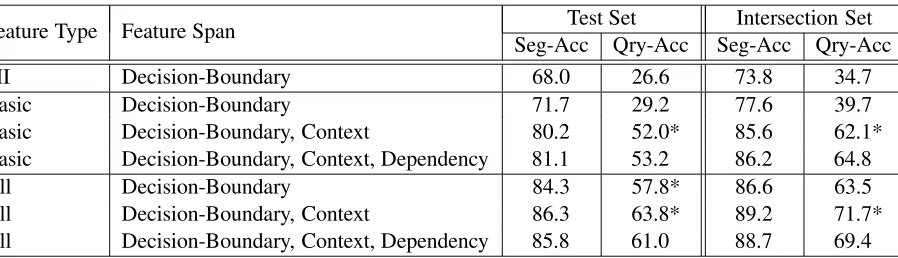
Table 3 provides our results for various configu-rations of features and token-combinations as de-scribed in Section 3.8 For comparison, a baseline
that always chooses a segmentation break achieves 44.8% Seg-Acc and 4.2% Qry-Acc, while a system that inserts no breaks achieves 55.2% Seg-Acc and 4.0% Qry-Acc. Our comparison system is the MI approach used by Jones et al. (2006), which achieves 68% Seg-Acc and 26.6% Qry-Acc (Table 3). We let the SVM set the threshold for MI on the training set. Note that the Basic, Decision-Boundary system
(Section 3.2.1), which uses exactly the same co-occurrence information as the MI system (in the form of the Basic features) but allows the SVM to
discriminatively weight the logarithmic counts, im-mediately increases Seg-Acc performance by 3.7%. Even more strikingly, adding theBasic count
infor-mation for theContexttokens (Section 3.2.2) boosts
performance by another 8.5%, increasing Qry-Acc by over 22%. Smaller, further gains arise by adding
Dependencytoken information (Section 3.2.3).
Also, notice that moving fromBasic features for
theDecision-Boundary tokens to all of our
indica-tor (Table 1) and statistical (Table 2) features (re-ferred to asAllfeatures) increases performance from
71.7% to 84.3%. These gains convincingly justify
Table 3: Segmentation Performance (%)
Feature Type Feature Span Seg-Acc Qry-Acc Seg-Acc Qry-AccTest Set Intersection Set
MI Decision-Boundary 68.0 26.6 73.8 34.7
Basic Decision-Boundary 71.7 29.2 77.6 39.7
Basic Decision-Boundary, Context 80.2 52.0* 85.6 62.1*
Basic Decision-Boundary, Context, Dependency 81.1 53.2 86.2 64.8
All Decision-Boundary 84.3 57.8* 86.6 63.5
All Decision-Boundary, Context 86.3 63.8* 89.2 71.7*
All Decision-Boundary, Context, Dependency 85.8 61.0 88.7 69.4
our use of an expanded feature set for this task. Including Context with the expanded features adds
another 2%, while adding Dependencyinformation
actually seems to hinder performance slightly, al-though gains were seen when adding Dependency
information on the development set.
Note, however, that these results must also be considered in light of the low inter-annotator agree-ment (Section 4.1). Indeed, results are lower if we evaluate using the test-set labels from another an-notator (necessarily training on the original anno-tator’s labels). On the intersected set of the three annotators, however, results are better still: 88.7% Seg-Acc and 69.4% Qry-Acc on the intersected queries for the full-featured system (Table 3). Since high performance is dependent on consistent train-ing and test labelltrain-ings, it seems likely that develop-ing more-explicit annotation instructions may allow further improvements in performance as within-set and between-set annotation agreement increases.
It would also be theoretically interesting, and of significant practical importance, to develop a learn-ing approach that embraces the agreement of the annotations as part of the learning algorithm. Our initial ranking formulation (Section 3.1), for exam-ple, could learn a model that prefers segmentations with higher agreement, but still prefers any anno-tated segmentation to alternative, unobserved struc-tures. As there is growing interest in making max-imal use of annotation resources within discrimina-tive learning techniques (Zaidan et al., 2007), devel-oping a general empirical approach to learning from ambiguously-labelled examples would be both an important contribution to this trend and a potentially helpful technique in a number of NLP domains.
6 Conclusion
We have developed a novel approach to search query segmentation and evaluated this approach on actual user queries, reducing error by 56% over a recent comparison approach. Gains in performance were made possible by both leveraging recent progress in feature engineering for noun compound bracketing, as well as using a flexible, discriminative incorpora-tion of associaincorpora-tion informaincorpora-tion, beyond the decision-boundary tokens. We have created and made avail-able a set of manually-segmented user queries, and thus provided a new testing platform for other re-searchers in this area. Our initial formulation of query segmentation as a structured learning prob-lem, and our leveraging of association statistics be-yond the decision boundary, also provides power-ful tools for noun compound bracketing researchers to both move beyond three-word compounds and to adopt discriminative feature weighting techniques.
The next step in this research is to directly inves-tigate how query segmentation affects search perfor-mance. For such an evaluation, we would need to know, for each possible segmentation (including no segmentation), the document retrieval performance. This could be the proportion of returned documents that are deemed to be relevant to the original query. Exactly such an evaluation was recently used by Ku-maran and Allan (2007) for the related task of query contraction. Of course, a dataset with queries and retrieval scores may serve for more than evaluation; it may provide the examples used by the learning module. That is, the parameters of the contraction or segmentation scoring function could be discrim-inatively set to optimize the retrieval of the training set queries. A unified framework for query contrac-tion, segmentacontrac-tion, and expansion, all based on dis-criminatively optimizing retrieval performance, is a very appealing future research direction. In this framework, the size of the training sets would not be limited by human annotation resources, but by the number of queries for which retrieved-document relevance judgments are available. Generating more training examples would allow the use of more pow-erful, finer-grained lexical features for classification.
Acknowledgments
We gratefully acknowledge support from the Natu-ral Sciences and Engineering Research Council of Canada, the Alberta Ingenuity Fund, the Alberta In-genuity Center for Machine Learning, and the Al-berta Informatics Circle of Research Excellence.
References
Yasemin Altun, Ioannis Tsochantaridis, and Thomas Hofmann. 2003. Hidden markov support vector machines. InICML. Kenneth Ward Church and Patrick Hanks. 1989. Word
associ-ation norms, mutual informassoci-ation, and lexicography. InACL, pages 76–83.
Michael Collins. 2002. Discriminative training methods for hidden markov models: Theory and experiments with per-ceptron algorithms. InEMNLP, pages 1–8.
Roxana Girju, Dan Moldovan, Marta Tatu, and Daniel Antohe. 2005. On the semantics of noun compounds. Computer Speech and Language, 19(4):479–496.
Hal Daum´e III and Daniel Marcu. 2004. NP bracketing by maximum entropy tagging and SVM reranking. InEMNLP, pages 254–261.
Thorsten Joachims. 1999. Making large-scale Support Vector Machine learning practical. In B. Sch¨olkopf and C. Burges, editors,Advances in Kernel Methods: Support Vector Ma-chines, pages 169–184. MIT-Press.
Thorsten Joachims. 2002. Optimizing search engines using clickthrough data. InACM Conference on Knowledge Dis-covery and Data Mining, pages 133–142.
Rosie Jones, Benjamin Rey, Omid Madani, and Wiley Greiner. 2006. Generating query substitutions. InWWW, pages 387– 396.
Daniel Jurafsky and James H. Martin. 2000. Speech and lan-guage processing. Prentice Hall.
Frank Keller and Mirella Lapata. 2003. Using the web to obtain frequencies for unseen bigrams.Computational Linguistics, 29(3):459–484.
Giridhar Kumaran and James Allan. 2007. A case for shorter queries, and helping users create them. In NAACL-HLT, pages 220–227.
Mirella Lapata and Frank Keller. 2004. The web as a base-line: Evaluating the performance of unsupervised web-based models for a range of NLP tasks. In HLT-NAACL, pages 121–128.
Mark Lauer. 1995. Corpus statistics meet the noun compound: Some empirical results. InACL, pages 47–54.
Dekang Lin. 1998. Automatic retrieval and clustering of simi-lar words. InCOLING/ACL, pages 768–773.
Christopher D. Manning and Hinrich Sch¨utze. 1999. Foun-dations of Statistical Natural Language Processing. MIT Press.
Preslav Nakov and Marti Hearst. 2005a. Search engine statis-tics beyond the n-gram: Application to noun compound bracketing. InCoNLL, pages 17–24.
Preslav Nakov and Marti Hearst. 2005b. Using the web as an implicit training set: application to structural ambiguity resolution. InHLT/EMNLP, pages 835–842.
Jeremy Nicholson and Timothy Baldwin. 2006. Interpretation of compound nominalisations using corpus and web statis-tics. InACL Workshop on Multiword Expressions, pages 54–61.
Greg Pass, Abdur Chowdhury, and Cayley Torgeson. 2006. A picture of search. InThe First International Conference on Scalable Information Systems.
Adwait Ratnaparkhi. 1996. A maximum entropy model for part-of-speech tagging. InEMNLP, pages 133–142. Knut Magne Risvik, Tomasz Mikolajewski, and Peter Boros.
2003. Query segmentation for web search. InWWW (Poster Session).
Omar Zaidan, Jason Eisner, and Christine Piatko. 2007. Using “annotator rationales” to improve machine learning for text categorization. InNAACL-HLT, pages 260–267.