Improving Dependency Parsing with Subtrees from Auto-Parsed Data
Wenliang Chen, Jun’ichi Kazama, Kiyotaka Uchimoto, and Kentaro Torisawa
Language Infrastructure Group, MASTAR Project
National Institute of Information and Communications Technology 3-5 Hikari-dai, Seika-cho, Soraku-gun, Kyoto, Japan, 619-0289 {chenwl, kazama, uchimoto, torisawa}@nict.go.jp
Abstract
This paper presents a simple and effective approach to improve dependency parsing by using subtrees from auto-parsed data. First, we use a baseline parser to parse large-scale unannotated data. Then we ex-tract subtrees from dependency parse trees in the auto-parsed data. Finally, we con-struct new subtree-based features for pars-ing algorithms. To demonstrate the ef-fectiveness of our proposed approach, we present the experimental results on the En-glish Penn Treebank and the Chinese Penn Treebank. These results show that our ap-proach significantly outperforms baseline systems. And, it achieves the best accu-racy for the Chinese data and an accuaccu-racy which is competitive with the best known systems for the English data.
1 Introduction
Dependency parsing, which attempts to build de-pendency links between words in a sentence, has experienced a surge of interest in recent times, owing to its usefulness in such applications as machine translation (Nakazawa et al., 2006) and question answering (Cui et al., 2005). To ob-tain dependency parsers with high accuracy, super-vised techniques require a large amount of hand-annotated data. While hand-hand-annotated data are very expensive, large-scale unannotated data can be obtained easily. Therefore, the use of large-scale unannotated data in training is an attractive idea to improve dependency parsing performance. In this paper, we present an approach that ex-tracts subtrees from dependency trees in auto-parsed data to improve dependency parsing. The
auto-parsed data are generated from large-scale unannotated data by using a baseline parser. Then, from dependency trees in the data, we extract dif-ferent types of subtrees. Finally, we represent subtree-based features on training data to train de-pendency parsers.
The use of auto-parsed data is not new. How-ever, unlike most of the previous studies (Sagae and Tsujii, 2007; Steedman et al., 2003) that im-proved the performance by using entire trees from auto-parsed data, we exploit partial information (i.e., subtrees) in auto-parsed data. In their ap-proaches, they used entire auto-parsed trees as newly labeled data to train the parsing models, while we use subtree-based features and employ the original gold-standard data to train the mod-els. The use of subtrees instead of complete trees can be justified by the fact that the accuracy of par-tial dependencies is much higher than that of en-tire dependency trees. Previous studies (McDon-ald and Pereira, 2006; Yamada and Matsumoto, 2003; Zhang and Clark, 2008) show that the accu-racies of complete trees are about 40% for English and about 35% for Chinese, while the accuracies of relations between two words are much higher: about 90% for English and about 85% for Chinese. From these observations, we may conjecture that it is possible to conduct a more effective selection by using subtrees as the unit of information.
En-glish and Chinese data. We show that this sim-ple approach greatly improves the accuracy and that the use of richer structures (i.e, word triples) indeed gives additional improvement. We also demonstrate that our approach and other improve-ment techniques (Koo et al., 2008; Nivre and Mc-Donald, 2008) are complementary and that we can achieve very high accuracies when we combine our method with other improvement techniques. Specifically, we achieve the best accuracy for the Chinese data.
The rest of this paper is as follows: Section 2 introduces the background of dependency parsing. Section 3 proposes an approach for extracting sub-trees and represents the subtree-based features for dependency parsers. Section 4 explains the ex-perimental results and Section 5 discusses related work. Finally, in section 6 we draw conclusions. 2 Dependency parsing
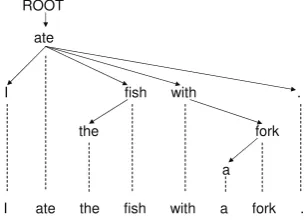
Dependency parsing assigns head-dependent rela-tions between the words in a sentence. A sim-ple examsim-ple is shown in Figure 1, where an arc between two words indicates a dependency rela-tion between them. For example, the arc between “ate” and “fish” indicates that “ate” is the head of “fish” and “fish” is the dependent. The arc be-tween “ROOT” and “ate” indicates that “ate” is the ROOT of the sentence.
[image:2.595.93.272.466.510.2]ROOT I ate the fish with a fork .
Figure 1: Example for dependency structure
2.1 Parsing approach
For dependency parsing, there are two main types of parsing models (Nivre and McDonald, 2008): graph-based model and transition-based model, which achieved state-of-the-art accuracy for a wide range of languages as shown in recent CoNLL shared tasks (Buchholz et al., 2006; Nivre et al., 2007). Our subtree-based features can be applied in both of the two parsing models.
In this paper, as the base parsing system, we employ the graph-based MST parsing model pro-posed by McDonald et al. (2005) and McDonald and Pereira (2006), which uses the idea of Max-imum Spanning Trees of a graph and large mar-gin structured learning algorithms. The details
of parsing model were presented in McDonald et al. (2005) and McDonald and Pereira (2006).
2.2 Baseline Parser
In the MST parsing model, there are two well-used modes: the first-order and the second-order. The first-order model uses first-order features that are defined over single graph edges and the second-order model adds second-second-order features that are defined on adjacent edges.
For the parsing of unannotated data, we use the first-order MST parsing model, because we need to parse a large number of sentences and the parser must be fast. We call this parser the Baseline Parser.
3 Our approach
In this section, we describe our approach of ex-tracting subtrees from unannotated data. First, we preprocess unannotated data using the Baseline Parser and obtain auto-parsed data. Subsequently, we extract the subtrees from dependency trees in the auto-parsed data. Finally, we generate subtree-based features for the parsing models.
3.1 Subtrees extraction
[image:2.595.338.492.480.590.2]To ease explanation, we transform the dependency structure into a more tree-like structure as shown in Figure 2, the sentence is the same as the one in Figure 1.
ate
I fish with .
the fork ROOT
a
I ate the fish with a fork .
Figure 2: Example for dependency structure in tree-format
Our task is to extract subtrees from dependency trees. If a subtree contains two nodes, we call it a bigram-subtree. If a subtree contains three nodes, we call it a trigram-subtree.
3.2 List of subtrees
We extract subtrees from dependency trees and
store them in list Lst. First, we extract
a dependency relation in a tree, we add these two
words as a subtree into listLst. Similarly, we can
extract trigram-subtrees. Note that the dependency direction and the order of the words in the original sentence are important in the extraction. To enable this, the subtrees are encoded in the string format
that is expressed as st = w : wid : hid(−w :
wid : hid)+1, where w refers to a word in the
subtree, wid refers to the ID (starting from 1) of
a word in the subtree (words are ordered
accord-ing to the positions of the original sentence)2, and
hidrefers to an ID of the head of the word (hid=0
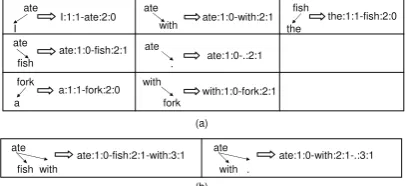
means that this word is the root of a subtree). For example, “ate” and “fish” have a right dependency arc in the sentence shown in Figure 2. So the subtree is encoded as “ate:1:0-fish:2:1”. Figure 3 shows all the subtrees extracted from the sentence in Figure 2, where the subtrees in (a) are bigram-subtrees and the ones in (b) are trigram-bigram-subtrees.
ate I
I:1:1-ate:2:0
ate fish
ate:1:0-fish:2:1
ate
fish with
ate:1:0-fish:2:1-with:3:1 ate
with ate:1:0-with:2:1
ate
. ate:1:0-.:2:1 fish the
the:1:1-fish:2:0
with
fork
with:1:0-fork:2:1 fork
a
a:1:1-fork:2:0
ate
with .
ate:1:0-with:2:1-.:3:1
[image:3.595.80.284.332.425.2](b) (a)
Figure 3: Examples of subtrees
Note that we only used the trigram-subtrees
containing a head, its dependent d1, and d1’s
leftmost right sibling3. We could not consider
the case where two children are on different
sides4 of the head (for instance, “I” and “fish”
for “ate” in Figure 2). We also do not use the child-parent-grandparent type (grandparent-type in short) trigram-subtrees. These are due to the limitations of the parsing algorithm of (McDonald and Pereira, 2006), which does not allow the fea-tures defined on those types of trigram-subtrees.
We extract the subtrees from the auto-parsed data, then merge the same subtrees into one en-try, and count their frequency. We eliminate all subtrees that occur only once in the data.
1+refers to matching the preceding element one or more
times and is the same as a regular expression in Perl.
2So,widis in fact redundant but we include it for ease of
understanding.
3Note that the order of the siblings is based on the order
of the words in the original sentence.
4Here, “side” means the position of a word relative to the
head in the original sentence.
3.3 Subtree-based features
We represent new features based on the extracted subtrees and call them subtree-based features. The features based on bigram-subtrees correspond to the first-order features in the MST parsing model and those based on trigram-subtrees features cor-respond to the second-order features.
We first group the extracted subtrees into dif-ferent sets based on their frequencies. After ex-periments with many different threshold settings on development data sets, we chose the follow-ing way. We group the subtrees into three sets corresponding to three levels of frequency: “high-frequency (HF)”, “middle-“high-frequency (MF)”, and “low-frequency (LF)”. HF, MF, and LF are used as set IDs for the three sets. The following are the settings: if a subtree is one of the TOP-10% most frequent subtrees, it is in set HF; else if a subtree is one of the TOP-20% subtrees, it is in set MF; else it is in set LF. Note that we compute these levels within a set of subtrees with the same number of nodes. We store the set ID for every subtree in
Lst. For example, if subtree “ate:1:0-with:2:1” is
among the TOP-10%, its set ID is HF.
3.3.1 First-order subtree-based features
The first-order features are based on bigram-subtrees that are related to word pairs. We
gener-ate new features for a headhand a dependentdin
the parsing process. Figure 4-(a)5shows the words
and their surrounding words, where h−1 refers to
the word to the left of the head in the sentence,
h+1refers to the word to the right of the head,d−1
refers to the word to the left of the dependent, and
d+1 refers to the word to the right of the
depen-dent. Temporary bigram-subtrees are formed by word pairs that are linked by dashed-lines in the
figure. Then we retrieve these subtrees inLstto
get their set IDs (if a subtree is not included in
Lst, its set ID is ZERO. That is, we have four sets:
HF, MF, LF, and ZERO.).
Then we generate first-order subtree-based fea-tures, consisting of indicator functions for set IDs of the retrieved bigram-subtrees. When generating subtree-based features, each dashed line in Figure 4-(a) triggers a different feature.
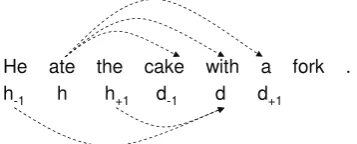
To demonstrate how to generate first-order subtree-based features, we use an example that is as follows. Suppose that we are going to parse the sentence “He ate the cake with a fork.” as shown
… h-1 h h+1 … d-1 d d+1 …
(a)
(b)
[image:4.595.107.259.59.181.2]… h … d1 … d2 …
Figure 4: Word pairs and triple for feature repre-sentation
in Figure 5, where h is “ate” and d is “with”.
We can generate the features for the pairs linked
by dashed-lines, such as h−d, h−d+1 and so
on. Then we have the temporary bigram-subtrees
“ate:1:0-with:2:1” for h −d and “ate:1:0-a:2:1”
for h −d+1, and so on. If we can find subtree
“ate:1:0-with:2:1” forh−dfromLstwith set ID
HF, we generate the feature “H-D:HF”, and if we
find subtree “ate:1:0-a:2:1” forh−d+1with set ID
ZERO, we generate the feature “H-D+1:ZERO”. The other three features are also generated simi-larly.
He ate the cake with a fork .
h-1 h h+1 d-1 d d+1
Figure 5: First-order subtree-based features
3.3.2 Second-order subtree-based features
The second-order features are based on trigram-subtrees that are related to triples of words. We
generate features for a triple of a head h, its
de-pendent d1, and d1’s right-leftmost sibling d2.
The triple is shown in Figure 4-(b). A temporary
trigram-subtree is formed by the word forms ofh,
d1, andd2. Then we retrieve the subtree inLstto
get its set ID. In addition, we consider the triples
of “h-NULL”6, d1, andd2, which means that we
only check the words of sibling nodes without checking the head word.
Then, we generate second-order subtree-based features, consisting of indicator functions for set IDs of the retrieved trigram-subtrees.
6h-NULL is a dummy token
We also generate combined features involving the set IDs and part-of-speech tags of heads, and the set IDs and word forms of heads. Specifically, for any feature related to word form, we remove this feature if the word is not one of the Top-N most frequent words in the training data. We used N=1000 for the experiments in this paper. This method can reduce the size of the feature sets.
In this paper, we only used bigram-subtrees and the limited form of trigram-subtrees, though in theory we can use k-gram-subtrees, which are lim-ited in the same way as our trigram subtrees, in (k-1)th-order MST parsing models mentioned in McDonald and Pereira (2006) or use grandparent-type trigram-subtrees in parsing models of Car-reras (2007). Although the higher-order MST parsing models will be slow with exact inference,
requiring O(nk) time (McDonald and Pereira,
2006), it might be possible to use higher-order k-gram subtrees with approximated parsing model in the future. Of course, our method can also be easily extended to the labeled dependency case.
4 Experiments
In order to evaluate the effectiveness of the subtree-based features, we conducted experiments on English data and Chinese Data.
For English, we used the Penn Treebank (Mar-cus et al., 1993) in our experiments and the tool
“Penn2Malt”7to convert the data into dependency
structures using a standard set of head rules (Ya-mada and Matsumoto, 2003). To match previ-ous work (McDonald et al., 2005; McDonald and Pereira, 2006; Koo et al., 2008), we split the data into a training set (sections 2-21), a development set (Section 22), and a test set (section 23). Fol-lowing the work of Koo et al. (2008), we used the MXPOST (Ratnaparkhi, 1996) tagger trained on training data to provide part-of-speech tags for the development and the test set, and we used 10-way jackknifing to generate tags for the training set. For the unannotated data, we used the BLLIP corpus (Charniak et al., 2000) that contains about
43 million words of WSJ text.8 We used the
MX-POST tagger trained on training data to assign part-of-speech tags and used the Basic Parser to process the sentences of the BLLIP corpus.
For Chinese, we used the Chinese Treebank
[image:4.595.93.272.416.488.2](CTB) version 4.09 in the experiments. We also
used the “Penn2Malt” tool to convert the data and created a data split: files 1-270 and files 400-931 for training, files 271-300 for testing, and files 301-325 for development. We used gold standard segmentation and part-of-speech tags in the CTB. The data partition and part-of-speech settings were chosen to match previous work (Chen et al., 2008; Yu et al., 2008). For the unannotated data, we
used the PFR corpus10, which has approximately
15 million words whose segmentation and POS tags are given. We used its original segmentation though there are differences in segmentation pol-icy between CTB and this corpus. As for POS tags, we discarded the original POS tags and as-signed CTB style POS tags using a TNT-based tagger (Brants, 2000) trained on the training data. We used the Basic Parser to process all the sen-tences of the PFR corpus.
We measured the parser quality by the unla-beled attachment score (UAS), i.e., the percentage of tokens (excluding all punctuation tokens) with the correct HEAD. And we also evaluated on com-plete dependency analysis.
4.1 Experimental Results
In our experiments, we used MSTParser, a
freely available implementation11 of the first- and
second-order MST parsing models. For baseline systems, we used the first- and second-order basic features, which were the same as the features used by McDonald and Pereira (2006), and we used the default settings of MSTParser throughout the paper: iters=10; training-k=1; decode-type=proj. We implemented our systems based on the MST-Parser by incorporating the subtree-based features.
4.1.1 Main results of English data
English
UAS Complete
Ord1 90.95 37.45
Ord1s 91.76(+0.81) 40.68
Ord2 91.71 42.88
Ord2s 92.51(+0.80) 46.19 Ord2b 92.28(+0.57) 45.44
[image:5.595.99.264.586.696.2]Ord2t 92.06(+0.35) 42.96
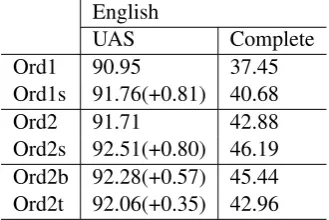
Table 1: Dependency parsing results for English
9http://www.cis.upenn.edu/˜chinese/. 10http://www.icl.pku.edu.
11http://mstparser.sourceforge.net
The results are shown in Table 1, where Ord1/Ord2 refers to a first-/second-order MSTParser with basic features, Ord1s/Ord2s refers to a first-/second-order MSTParser with basic+subtree-based features, and the improve-ments by the subtree-based features over the basic features are shown in parentheses. Note that we use both the bigram- and trigram- subtrees in Ord2s. The parsers using the subtree-based features consistently outperformed those using the basic features. For the first-order parser, we found that there is an absolute improvement of 0.81 points (UAS) by adding subtree-based features. For the second-order parser, we got an absolute improvement of 0.8 points (UAS) by including subtree-based features. The improve-ments of parsing with subtree-based features were
significant in McNemar’s Test (p <10−6).
We also checked the sole effect of bigram- and trigram-subtrees. The results are also shown in Table 1, where Ord2b/Ord2t refers to a second-order MSTParser with bigram-/trigram-subtrees only. The results showed that trigram-subtrees can provide further improvement, although the effect of the bigram-subtrees seemed larger.
4.1.2 Comparative results of English data
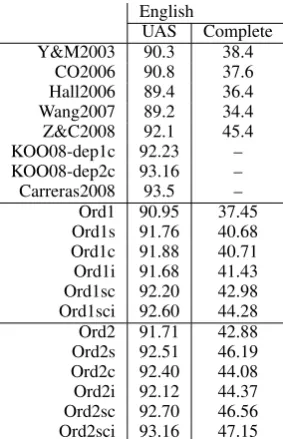
Table 2 shows the performance of the systems that were compared, where Y&M2003 refers to the parser of Yamada and Matsumoto (2003), CO2006 refers to the parser of Corston-Oliver et al. (2006), Hall2006 refers to the parser of Hall et al. (2006), Wang2007 refers to the parser of Wang et al. (2007), Z&C 2008 refers to the combi-nation graph-based and transition-based system of Zhang and Clark (2008), KOO08-dep1c/KOO08-dep2c refers to a graph-based system with first-/second-order cluster-based features by Koo et al. (2008), and Carreras2008 refers to the paper of Carreras et al. (2008). The results showed that Ord2s performed better than the first five systems. The second-order system of Koo et al. (2008) per-formed better than our systems. The reason may be that the MSTParser only uses sibling interac-tions for second-order, while Koo et al. (2008) uses both sibling and grandparent interactions, and uses cluster-based features. Carreras et al. (2008) reported a very high accuracy using information of constituent structure of the TAG grammar formal-ism. In our systems, we did not use such knowl-edge.
with the techniques presented in other work, such as the cluster-based features in Koo et al. (2008), the integrating methods of Zhang and Clark (2008), and Nivre and McDonald (2008), and the parsing methods of Carreras et al. (2008).
English
UAS Complete Y&M2003 90.3 38.4
[image:6.595.110.252.135.355.2]CO2006 90.8 37.6 Hall2006 89.4 36.4 Wang2007 89.2 34.4 Z&C2008 92.1 45.4 KOO08-dep1c 92.23 – KOO08-dep2c 93.16 – Carreras2008 93.5 – Ord1 90.95 37.45 Ord1s 91.76 40.68 Ord1c 91.88 40.71 Ord1i 91.68 41.43 Ord1sc 92.20 42.98 Ord1sci 92.60 44.28 Ord2 91.71 42.88 Ord2s 92.51 46.19 Ord2c 92.40 44.08 Ord2i 92.12 44.37 Ord2sc 92.70 46.56 Ord2sci 93.16 47.15
Table 2: Dependency parsing results for English, for our parsers and previous work
To demonstrate that our approach and other work are complementary, we thus implemented a system using all the techniques we had at hand that used subtree- and cluster-based features and applied the integrating method of Nivre and McDonald (2008). We used the word clustering
tool12, which was used by Koo et al. (2008), to
produce word clusters on the BLLIP corpus. The cluster-based features were the same as the fea-tures used by Koo et al. (2008). For the integrating method, we used the transition MaxEnt-based parser of Zhao and Kit (2008) because it was faster than the MaltParser. The results are shown in the bottom part of Table 2, where Ord1c/Ord2c refers to a first-/second-order MSTParser with cluster-based features, Ord1i/Ordli refers to a first-/second-order MSTParser with integrating-based features, Ord1sc/Ord2sc refers to a first-/second-order MSTParser with subtree-based+cluster-based features, and Ord1sci/Ord2sci refers to a first-/second-order MSTParser with subtree-based+cluster-based+integrating-based features. Ord1c/Ord2c was worse than KOO08-dep1c/-dep2c, but Ord1sci outperformed KOO08-dep1c
12 http://www.cs.berkeley.edu/˜pliang/software/brown-cluster-1.2.zip
and Ord2sci performed similarly to KOO08-dep2c by using all of the techniques we had. These results indicated that subtree-based features can provide different information and work well with other techniques.
4.1.3 Main results of Chinese data
The results are shown in Table 3 where abbrevia-tions are the same as in Table 1. As in the English experiments, parsers with the subtree-based fea-tures outperformed parsers with the basic feafea-tures, and second-order parsers outperformed first-order parsers. For the first-order parser, the subtree-based features provided 1.3 absolute points
im-provement. For the second-order parser, the
subtree-based features achieved an absolute im-provement of 1.25 points. The imim-provements of parsing with subtree-based features were
signifi-cant in McNemar’s Test (p <10−5).
Chinese
UAS Complete
Ord1 86.38 40.80
Ord1s 87.68(+1.30) 42.24
Ord2 88.18 47.12
[image:6.595.332.499.325.436.2]Ord2s 89.43(+1.25) 47.53 Ord2b 89.16(+0.98) 47.12 Ord2t 88.55(+0.37) 47.12
Table 3: Dependency parsing results for Chinese.
4.1.4 Comparative results of Chinese data
Table 4 shows the comparative results, where Wang2007 refers to the parser of Wang et al. (2007), Chen2008 refers to the parser of Chen et al. (2008), and Yu2008 refers to the parser of Yu et al. (2008) that is the best reported results for this data set. And “all words” refers to all the
sentences in test set and “≤40 words”13 refers to
the sentences with the length up to 40. The table shows that our parsers outperformed previous sys-tems.
We also implemented integrating systems for Chinese data as well. When we applied the cluster-based features, the performance dropped a little. The reason may be that we are using
gold-POS tags for Chinese data14. Thus we did not
13Wang et al. (2007) and Chen et al. (2008) reported the scores on these sentences.
use cluster-based features for the integrating sys-tems. The results are shown in Table 4, where Ord1si/Ord2si refers to the first-order/second-order system with subtree-based+intergrating-based features. We found that the integrating sys-tems provided better results. Overall, we have achieved a high accuracy, which is the best known result for this dataset.
Zhang and Clark (2008) and Duan et al. (2007) reported results on a different data split of Penn Chinese Treebank. We also ran our systems (Ord2s) on their data and provided UAS 86.70 (for non-root words)/77.39 (for root words), better than their results: 86.21/76.26 in Zhang and Clark (2008) and 84.36/73.70 in Duan et al. (2007).
Chinese
all words ≤40words UAS Complete UAS Complete
Wang2007 – – 86.6 28.4
Chen2008 86.52 – 88.4 –
Yu2008 87.26 – – –
[image:7.595.338.492.57.168.2]Ord1s 87.68 42.24 91.11 54.40 Ord1si 88.24 43.96 91.32 55.93 Ord2s 89.43 47.53 91.67 59.77 Ord2si 89.91 48.56 92.34 62.83
Table 4: Dependency parsing results for Chinese, for our parsers and for previous work
4.1.5 Effect of different sizes of unannotated data
Here, we consider the improvement relative to the sizes of the unannotated data. Figure 6 shows the results of first-order parsers with different num-bers of words in the unannotated data. Please note that the size of full English unannotated data is 43M and the size of full Chinese unannotated data is 15M. From the figure, we found that the parser obtained more benefits as we added more unanno-tated data.
86 87 88 89 90 91 92
43 32 16 8 4 2 0
UAS
Size of unannotated data(M) English Chinese
Figure 6: Results with different sizes of large-scale unannotated data.
0 0.1 0.2 0.3 0.4 0.5 0.6 0.7 0.8 0.9
0 1 2 3 4 5 6
Percentage (smoothed)
Number of unknown words Better NoChange Worse
Figure 7: Improvement relative to unknown words for English
0 0.1 0.2 0.3 0.4 0.5 0.6 0.7 0.8 0.9
0 1 2 3 4 5 6
Percentage (smoothed)
[image:7.595.339.494.219.331.2]Number of unknown words Better NoChange Worse
Figure 8: Improvement relative to unknown words for Chinese
4.2 Additional Analysis
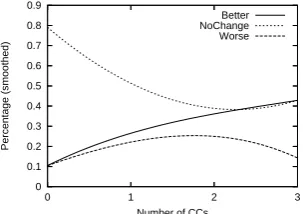
In this section, we investigated the results on sentence level from different views. For Fig-ures 7-12, we classified each sentence into one of three classes: “Better” for those where the pro-posed parsers provided better results relative to the parsers with basic features, “Worse” for those where the proposed parsers provided worse results relative to the basic parsers, and “NoChange” for those where the accuracies remained the same.
4.2.1 Unknown words
Here, we consider the unknown word15 problem,
which is an important issue for parsing. We cal-culated the number of unknown words in one sen-tence, and listed the changes of the sentences with unknown words. Here, we compared the Ord1 system and the Ord1s system.
Figures 7 and 8 show the results, where the x
axis refers to the number of unknown words in one
sentence and the y axis shows the percentages of
the three classes. For example, for the sentences having three unknown words in the Chinese data, 31.58% improved, 23.68% worsened, and 44.74% were unchanged. We did not show the results of
15An unknown word is a word that is not included in the
[image:7.595.77.287.275.375.2]0 0.1 0.2 0.3 0.4 0.5 0.6 0.7 0.8 0.9
4 3 2 1 0
Percentage (smoothed)
[image:8.595.337.489.61.168.2]Number of CCs Better NoChange Worse
Figure 9: Improvement relative to number of conjunctions for English
0 0.1 0.2 0.3 0.4 0.5 0.6 0.7 0.8 0.9
3 2
1 0
Percentage (smoothed)
[image:8.595.110.261.61.169.2]Number of CCs Better NoChange Worse
Figure 10: Improvement relative to number of conjunctions for Chinese
the sentences with more than six unknown words because their numbers were very small. The Bet-ter and Worse curves showed that our approach al-ways provided better results. The results indicated that the improvements apparently became larger when the sentences had more unknown words for the Chinese data. And for the English data, the graph also showed the similar trend, although the improvements for the sentences have three and four unknown words were slightly less than the others.
4.2.2 Coordinating conjunctions
We analyzed our new parsers’ behavior for coordi-nating conjunction structures, which is a very dif-ficult problem for parsing (Kawahara and Kuro-hashi, 2008). Here, we compared the Ord2 system with the Ord2s system.
Figures 9 and 10 show how the subtree-based features affect accuracy as a function of the
num-ber of conjunctions, where thexaxis refers to the
number of conjunctions in one sentence and the
y axis shows the percentages of the three classes.
The figures indicated that the subtree-based fea-tures improved the coordinating conjunction prob-lem. In the trigram-subtree list, many subtrees are related to coordinating conjunctions, such as “utilities:1:3 and:2:3 businesses:3:0” and “pull:1:0 and:2:1 protect:3:1”. These subtrees can provide additional information for parsing models.
4.2.3 PP attachment
We analyzed our new parsers’ behavior for preposition-phrase attachment, which is also a dif-ficult task for parsing (Ratnaparkhi et al., 1994). We compared the Ord2 system with the Ord2s sys-tem. Figures 11 and 12 show how the subtree-based features affect accuracy as a function of the
number of prepositions, where thexaxis refers to
the number of prepositions in one sentence and the
yaxis shows the percentages of the three classes.
The figures indicated that the subtree-based fea-tures improved preposition-phrase attachment.
5 Related work
Our approach is to incorporate unannotated data into parsing models for dependency parsing. Sev-eral previous studies relevant to our approach have been conducted.
Chen et al. (2008) previously proposed an ap-proach that used the information on short de-pendency relations for Chinese dede-pendency pars-ing. They only used the word pairs within two word distances for a transition-based parsing al-gorithm. The approach in this paper differs in that we use richer information on trigram-subtrees besides bigram-subtrees that contain word pairs. And our work is focused on graph-based parsing models as opposed to transition-based models. Yu et al. (2008) constructed case structures from auto-parsed data and utilized them in parsing. Com-pared with their method, our method is much sim-pler but has great effects.
Koo et al. (2008) used the Brown algorithm to produce word clusters on large-scale unannotated data and represented new features based on the clusters for parsing models. The cluster-based fea-tures provided very impressive results. In addition, they used the parsing model by Carreras (2007) that applied second-order features on both sibling and grandparent interactions. Note that our ap-proach and their apap-proach are complementary in that we can use both subtree- and cluster-based features for parsing models. The experimental re-sults showed that we achieved better accuracy for first-order models when we used both of these two types of features.
0 0.1 0.2 0.3 0.4 0.5 0.6 0.7 0.8 0.9
0 1 2 3 4 5 6 7
Percentage (smoothed)
[image:9.595.337.489.61.168.2]Number of prepositions Better NoChange Worse
Figure 11: Improvement relative to number of prepositions for English
0 0.1 0.2 0.3 0.4 0.5 0.6 0.7 0.8 0.9
3 2
1 0
Percentage (smoothed)
Number of prepositions Better NoChange Worse
Figure 12: Improvement relative to number of prepositions for Chinese
tation. They used two parsers to parse the sen-tences in unannotated data and selected only iden-tical results produced by the two parsers. Then, they retrained a parser on newly parsed sentences and the original labeled data. Our approach repre-sents subtree-based features on the original gold-standard data to retrain parsers. McClosky et al. (2006) presented a self-training approach for phrase structure parsing and the approach was
shown to be effective in practice. However,
their approach depends on a high-quality reranker, while we simply augment the features of an ex-isting parser. Moreover, we could use the output of our systems for co-training/self-training tech-niques.
6 Conclusions
We present a simple and effective approach to improve dependency parsing using subtrees from auto-parsed data. In our method, first we use a baseline parser to parse large-scale unannotated data, and then we extract subtrees from depen-dency parsing trees in the auto-parsed data. Fi-nally, we construct new subtree-based features for parsing models. The results show that our ap-proach significantly outperforms baseline systems. We also show that our approach and other tech-niques are complementary, and then achieve the best reported accuracy for the Chinese data and an accuracy that is competitive with the best known systems for the English data.
References
T. Brants. 2000. TnT–a statistical part-of-speech tag-ger.Proceedings of ANLP, pages 224–231.
S. Buchholz, E. Marsi, A. Dubey, and Y. Krymolowski. 2006. CoNLL-X shared task on multilingual depen-dency parsing.Proceedings of CoNLL-X.
Xavier Carreras, Michael Collins, and Terry Koo. 2008. Tag, dynamic programming, and the percep-tron for efficient, feature-rich parsing. In Proceed-ings of CoNLL 2008, pages 9–16, Manchester, Eng-land, August. Coling 2008 Organizing Committee. X. Carreras. 2007. Experiments with a higher-order
projective dependency parser. In Proceedings of the CoNLL Shared Task Session of EMNLP-CoNLL 2007, pages 957–961.
E. Charniak, D. Blaheta, N. Ge, K. Hall, J. Hale, and M. Johnson. 2000. BLLIP 1987-89 WSJ Corpus Release 1, LDC2000T43. Linguistic Data Consor-tium.
WL. Chen, D. Kawahara, K. Uchimoto, YJ. Zhang, and H. Isahara. 2008. Dependency parsing with short dependency relations in unlabeled data. In Proceed-ings of IJCNLP 2008.
S. Corston-Oliver, A. Aue, Kevin. Duh, and Eric Ring-ger. 2006. Multilingual dependency parsing using bayes point machines. InHLT-NAACL2006. H. Cui, RX. Sun, KY. Li, MY. Kan, and TS. Chua.
2005. Question answering passage retrieval us-ing dependency relations. InProceedings of SIGIR 2005, pages 400–407, New York, NY, USA. ACM. Xiangyu Duan, Jun Zhao, and Bo Xu. 2007.
Proba-bilistic models for action-based chinese dependency parsing. InProceedings of ECML/ECPPKDD, War-saw, Poland.
Johan Hall, Joakim Nivre, and Jens Nilsson. 2006. Discriminative classifiers for deterministic depen-dency parsing. InIn Proceedings of CoLING-ACL. D. Kawahara and S. Kurohashi. 2008. Coordination
disambiguation without any similarities. In Pro-ceedings of Coling 2008, pages 425–432, Manch-ester, UK, August.
T. Koo, X. Carreras, and M. Collins. 2008. Simple semi-supervised dependency parsing. In Proceed-ings of ACL-08: HLT, Columbus, Ohio, June. M. Marcus, B. Santorini, and M. Marcinkiewicz.
[image:9.595.110.260.61.169.2]D. McClosky, E. Charniak, and M. Johnson. 2006. Reranking and self-training for parser adaptation. In
Proceedings of Coling-ACL, pages 337–344.
R. McDonald and F. Pereira. 2006. Online learning of approximate dependency parsing algorithms. In
Proc. of EACL2006.
R. McDonald, K. Crammer, and F. Pereira. 2005. On-line large-margin training of dependency parsers. In
Proc. of ACL 2005.
T. Nakazawa, K. Yu, D. Kawahara, and S. Kurohashi. 2006. Example-based machine translation based on deeper nlp. In Proceedings of IWSLT 2006, pages 64–70, Kyoto, Japan.
J. Nivre and R. McDonald. 2008. Integrating graph-based and transition-graph-based dependency parsers. In
Proceedings of ACL-08: HLT, Columbus, Ohio, June.
J. Nivre, J. Hall, S. K¨ubler, R. McDonald, J. Nilsson, S. Riedel, and D. Yuret. 2007. The CoNLL 2007 shared task on dependency parsing. In Proceed-ings of the CoNLL Shared Task Session of EMNLP-CoNLL 2007, pages 915–932.
A. Ratnaparkhi, J. Reynar, and S. Roukos. 1994. A maximum entropy model for prepositional phrase at-tachment. InProceedings of HLT, pages 250–255.
A. Ratnaparkhi. 1996. A maximum entropy model for part-of-speech tagging. InProceedings of EMNLP, pages 133–142.
K. Sagae and J. Tsujii. 2007. Dependency parsing and domain adaptation with LR models and parser en-sembles. InProceedings of the CoNLL Shared Task Session of EMNLP-CoNLL 2007, pages 1044–1050.
M. Steedman, M. Osborne, A. Sarkar, S. Clark, R. Hwa, J. Hockenmaier, P. Ruhlen, S. Baker, and J. Crim. 2003. Bootstrapping statistical parsers from small datasets. InProceedings of EACL 2003, pages 331–338.
Gertjan van Noord. 2007. Using self-trained bilexical preferences to improve disambiguation accuracy. In
Proceedings of IWPT-07, June.
Qin Iris Wang, Dekang Lin, and Dale Schuurmans. 2007. Simple training of dependency parsers via structured boosting. InProceedings of IJCAI2007.
H. Yamada and Y. Matsumoto. 2003. Statistical de-pendency analysis with support vector machines. In
Proceedings of IWPT2003, pages 195–206.
K. Yu, D. Kawahara, and S. Kurohashi. 2008. Chi-nese dependency parsing with large scale automat-ically constructed case structures. In Proceedings of Coling 2008, pages 1049–1056, Manchester, UK, August.
Y. Zhang and S. Clark. 2008. A tale of two parsers: Investigating and combining graph-based and transition-based dependency parsing. In Pro-ceedings of EMNLP 2008, pages 562–571, Hon-olulu, Hawaii, October.