Proceedings of the 2011 Conference on Empirical Methods in Natural Language Processing, pages 1202–1212,
Computing Logical Form on Regulatory Texts
∗Nikhil Dinesh
Artificial Intelligence Center SRI International Menlo Park, CA - 94025 [email protected]
Aravind Joshi and Insup Lee Department of Computer Science
University of Pennsylvania Philadelphia, PA - 19104 {joshi,lee}@seas.upenn.edu
Abstract
The computation of logical form has been pro-posed as an intermediate step in the translation of sentences to logic. Logical form encodes the resolution of scope ambiguities. In this paper, we describe experiments on a modest-sized corpus of regulation annotated with a novel variant of logical form, called abstract syntax trees (ASTs). The main step in com-puting ASTs is to order scope-taking opera-tors. A learning model for ranking is adapted for this ordering. We design features by study-ing the problem of comparstudy-ing the scope of one operator to another. The scope comparisons are used to compute ASTs, with an F-score of
90.6%on the set of ordering decisons.
1 Introduction
May (1985) argued for a level of logical form as a prelude to translating sentences to logic. Just as a parse tree determines the constituent structure of a sentence, a logical form of a sentence represents one way of resolving scope ambiguities. The level of logical form is an appealing layer of modularity; it allows us to take a step beyond parsing in studying scope phenomenon, and yet, avoid the open problem of fully translating sentences to logic.
Data-driven analyses of scope have been of in-terest in psycholinguistics (Kurtzman and MacDon-ald, 1993) and more recently in NLP (Srinivasan and Yates, 2009). The focus has typically been
∗This research was supported in part by ONR MURI
N00014-07-1-0907, NSF CNS-1035715, NSF IIS 07-05671, and SRI International.
on predicting the preferred scopal ordering of sen-tences with two quantifying determiners, for exam-ple, in the sentence “every kid climbed a tree”. In the related problem of translating database queries to logic, Zettlemoyer and Collins (2009) and Wong and Mooney (2007) consider the scope of adjectives in addition to determiners, for example the scope of “cheapest” in the noun phrase “the cheapest flights from Boston to New York”. To our knowledge, em-pirical studies of scope have been restricted to phe-nomenon between and within noun phrases.
In this paper, we describe experiments on a novel annotation of scope phenomenon in regulatory texts – Section 610 of the Food and Drug Administra-tion’s Code of Federal Regulations1 (FDA CFR). Determiners, modals, negation, and verb phrase modifiers are the main scope-taking operators. We have annotated195sentences with a variant of log-ical form, called abstract syntax trees (ASTs). Our focus is on the problem of computing the AST, given a (variant of a) parse tree of a sentence.
The long term goal of this work is to assist in the translation of regulation to logic, for the application of conformance checking. The problem is to for-mally determine whether an organization conforms to regulation, by checking the organization’s records using the logical translation of regulation. Confor-mance checking has been of interest in a variety of regulatory contexts, and examples include privacy policy (Barth et al., 2006; Jones and Sergot, 1992; Anderson, 1996) and business contracts (Governa-tori et al., 2006; Grosof et al., 1999).
We now discuss some problems that arise in
defin-1
http://www.gpoaccess.gov/cfr/index.html
ing logical form and the assumptions that we make to circumvent these problems.
1.1 Problems and Assumptions
A key assumption of logical form is that the trans-lation from language to logic is syntax-based. As a result, the logic needs to be expressive enough to accomodate a syntactic translation. There is no con-sensus logic for constructs, such as, plurals, purpose clauses, and certain modals. This leads to the fol-lowing problem in defining logical form.
How do we define the logical form of a sentence, without defining the logic? We adopt a specific for-malism that accomodates a subset of the constructs found in regulation. We generalize from the formal-ized constructs to other constructs. Some of these generalizations may need revision in the future.
We assume that sentences in regulation are trans-lated to statements in logic of the form:
(id)ϕ(x1, ..., xn)7→ψ(x1, ..., xn)
where, “id” is an identifier, ϕ is the precondition, ψ is the postcondition, andx1, ..., xn are free
vari-ables. The distinction between pre and postcondi-tions has been adopted by most logics for regula-tion, to accomodate exceptions to laws (Sergot et al., 1986; Makinson and van der Torre, 2000; Governa-tori et al., 2006). The pre and postconditions are expressed in a modal logic that we designed in prior work (Dinesh et al., 2011). In describing the logi-cal form, we will sketch how the logilogi-cal form can be mapped to logic. But, we do not assume that the reader has a detailed understanding of the logic.
Given the assumptions about the logic, our goal is to transform a regulatory sentence into a structure that lets us determine: (I) the constituents of a sen-tence that contribute to the pre/postcondition, and (II) the scope of operators in the pre/postcondition. The structures that we use are called abstract syn-tax trees (ASTs), which can be understood as a re-stricted kind of logical form for regulatory texts.
1.2 Contributions and Outline
In this paper, we focus on the problem of computing the AST given a (kind of) parse tree for a sentence. The main step is is to order or rank scope-taking operators. A learning model for ranking is adapted
for this ordering. We design features by studying the problem of comparing the scope of one operator to another. The pairwise scope comparisons are then used to compute ASTs, with an F-score of90.6%on the set of ordering decisons.
The rest of this paper is organized as follows. We define ASTs using an example in Section 2, and setup the learning problem in Section 3. We then de-scribe the corpus using statistics about operators in Section 4. In Section 5, we describe experiments on comparing the scope of an operator to another. We use the pairwise scope comparisons, in Section 6 to comput the AST. We discuss related work in Sec-tion 7 and conclude in SecSec-tion 8.
2 Abstract Syntax Trees
We describe abstract syntax trees (ASTs) using an example from CFR Section 610.11:
(1) A general safety testfor the detection of extra-neous toxic contaminantsshall be performed on biological productsintended for administration to humans.
We discuss the translation in logic and the AST for the fragment of (1) that appears in black. In or-der to keep figures to a manageable size, we restrict attention to fragments of sentences, by graying out portions. The term AST is borrowed from compil-ers (Aho et al., 1986), where it is used as an interme-diate step in the semantic interpretation of programs.
Translation in Logic: The sentence (1) is formally
expressed as:
(1) bio prod(x)7→ Om(x)(∃y : test(y)∧ψ(x, y))
where,ψ(x, y) = gensaf(y)∧ag(y, m(x))∧ob(y, x)
The predicates and function symbols are read as follows. bio prod(x)- “xis a biological product”. m(x)denotes the manufacturer ofx. The modal op-erator O stands for “obligation”. test(y)- “y is a test (event)”.gensaf(y)- “yis a general safety pro-cedure”. ag(y, m(x))- “the agent ofyism(x)”, and
ob(y, x)- “the object of the eventyisx”. The for-malized version of the law is read as follows: “Ifx is a biological product, then the manufacturerm(x)
The distinction between pre and postconditions is a non-trivial assumption. As with all logic-programming formalisms, only free variables are “shared” between pre and postconditons. This im-plies that all existential quantification, modals, and negation appear within the pre or postcondition. In the example above, the existential quantifier (∃y) and the modal (O) appear within the postcondition.
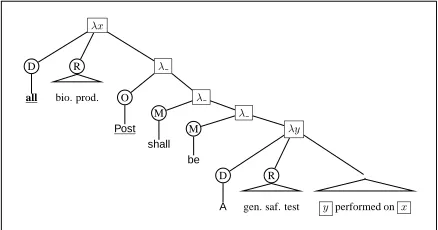
Abstract Syntax Tree: The AST for (1) is shown in
Figure 1. The main nodes of interest are the inter-nal nodes labeled λ. An internal node withn+ 1
children corresponds to an n-ary operator. The first child of the internal node is the operator. Opera-tors are labeled with a part-of-speech tag, for exam-ple, “D” for determiner, “M” for modal, and “O” for other. The remaining nchildren are its arguments. We use the term nuclear scope to refer to the last (nth) argument of the operator, and the term restric-tor to refer to any other argument. We borrow these terms from the literature on quantifier scope for de-terminers (Heim and Kratzer, 1998, Chapter 7).
For example, the phrase “general safety test” is in the restrictor of the operatorA, and the variable y is in its nuclear scope. The modalshallis a unary operator, and doesn’t have a restrictor. Non-unary operators bind the variable displayed on the internal node. The variable y is bound by the operatorA.
Implicit operators are inserted when there is no overt word or phrase. In Figure 1, the implicit oper-ators areunderlined. The generic noun phrase “bi-ological products” is associated with the implicit de-terminerall. Similarly, we use the implicit operator Postto mark the position of the postcondition.
λx
D
all
R
bio. prod.
λ
O
Post
λ
M
shall
λ
M
be
λy
D
A
R gen. saf. test
.
[image:3.612.325.528.466.576.2]yperformed onx
Figure 1: Example of an abstract syntax tree (AST).
We conclude this section with some notation for describing ASTs. Given an AST for a sentences, we
say that an operatoroi scopes overoj, denotedoi≫
oj, if oj appears in the nuclear scope ofoi. For
ex-ample, in Figure 1, we haveall≫Post,all≫shall,
all≫A,Post≫A, andshall≫A. In addition, we
say that the restrictor ofoi scopes over oj, denoted
R(oi)≫oj, ifoj appears in the restrictor ofoi. Such
configurations occur with PP-modification of NPs, and we discuss examples in later sections.
3 Computing ASTs – Overview
In this section, we give an overview of our approach to computing ASTs. We will assume as given a Pro-cessed Parse Tree (PPT) of a sentence, with the op-erators and their restrictors identified. An example is discussed in Section 3.1. Given such a PPT, the AST is computed in two steps: (1) finding the preter-minal at which an operator takes scope, and (2) or-dering the operators associated with a preterminal. We describe the second step in Section 3.2, and then briefly outline the first step in Section 3.3. The steps are described in reverse order, because in most cases, the operators associated with a preterminal are deter-mined directly by syntactic attachment.
3.1 Processed Parse Trees
We compute ASTs from processed parse trees (PPTs) of sentences. Figure 2 gives the PPT cor-responding to the AST in Figure 1.
.
λ
P
Post
λy
D
A R
gen. saf. test
λ
M
shall
λ
M
be .
performed on
λx
D
IMP R
bio. prod.
Figure 2: Processed parse tree (PPT) for (1).
[image:3.612.76.295.537.652.2]postcon-dition marker, annotator-specified implicit operators are not given in the PPT.
There are two main types of nodes in the PPT – operators and preterminals. The nodes labeled with the symbolλ, e.g., λ and λx, correspond to op-erators. The root of the PPT and the restrictors of the operators, are the preterminals. Based on this example, it may seem that a sentence just has a list of operators. While this is true of example (1), em-bedded operators arise, for example, in the context of PP-modification of NPs and relative clauses. We will discuss an example in Section 3.3.
In this work, the PPTs are obtained by removing all scope decisions from the AST. To a first approxi-mation, we start by removing all operators from the AST, and then, replace the corresponding variables by the operators. Implicit unary operators (such as the postcondition marker) are placed at the start of the preterminal.
It is worthwhile to consider whether it is rea-sonable to assume PPTs as given. We believe that this assumption is (slightly) stronger than assuming perfect parse trees. Although the PPT leaves cer-tain chunks of the sentence unprocessed, in most cases, the unprocessed chunks correspond to base NPs. The main additional piece of information is the existence of a postcondition marker for each main clause of a sentence. We believe that computation of PPTs is better seen as a problem of syntax rather than scope, and we set it aside to future work. Our focus here is on converting a PPT to an AST.
3.2 Ordering Operators
The problem of learning to order a set of items is not new. Cohen et al. (1998) give a learning theo-retic perspective, and Liu (2009) surveys informa-tion retrieval applicainforma-tions. The approach that we use can be seen as a probabilistic version of the boosting approach developed by Cohen et al. (1998). We ex-plain the step of ordering operators, by revisiting the example of the general safety test, from Section 2.
Given the PPT in Figure 2, we compute the AST in Figure 1 by ordering or ranking the operators. For example, we need to determine that the implicit de-terminer associated with biological products is uni-versal, and hence, we haveIMP≫Post. However, the determiner “A” associated with general safety test is existential, and hence, we havePost≫A.
We now develop some notation to describe the scopal ordering of operators. A PPT τ is viewed as a set of preterminal nodes, and we will write – (a) p ∈ τ to denote that p occurs in τ, and (b)
|τ| to denote the number of preterminals in τ. A preterminal p is viewed as an ordered set of oper-atorsp = (o1, ...,o|p|). For example, in Figure 2, the root preterminalphas|p|= 5, and the operators o1 =Post,o2=A,o3 =shall, and so on.
An AST α contains a ranking of operators asso-ciated with each preterminal, denoted rα(p). The
ranks of operators are denoted by subscripts. Let p = (o1, ...,o5)be the root preterminal of the PPT in Figure 2. The ranking associated with the AST in Figure 1 is given byrα(p) = (o12,o25,o33,o44,o51). For example,o2
5=Adenotes that the determiner “A” ap-pears second in the surface order (Figure 2) and fifth or lowest in the scope order (Figure 1). Similarly, o5
1 =IMP denotes that the implicit determiner ap-pears fifth or last in the surface order (Figure 2) and first or highest in the scope order (Figure 1). Note that the subscript suffices to identify the position of an operator in the AST.
Model: We now describe the learning model for
or-dering operators. Given a PPTτ, letA(τ)be the set of all possible ASTs. Our goal is to find the AST which has the highest probability given the PPT:
α∗ = arg max
α∈A(τ)P(α|τ)
The conditional probability of an AST is defined as:
P(α|τ) =Y p∈τ
P(rα(p)|τ)
P(rα(p)|τ) =
|pY|−1
i=1
|p| Y
j=i+1
P(oi≫oj|τ)
. λ P Post λx3 D IMP R samp. of λx1 D any R . lot of λx2 D a R lic. prod. λ M may λ M be . ...
Figure 3: PPT for (2)
λx1 D any R λx2 D a R lic. prod. .
lot ofx2
λ P Post λ M may λ M be λx3 D some R
samp. ofx1 .
...
Figure 4: AST for (2)
3.3 Finding the Scope Preterminal
In the example that we discussed in the previous sec-tion, there were no embedded operators, i.e., an op-erator or its variable located in the restrictor of an-other. An embedded operator can either – (a) take scope within the restrictor of the embedding oper-ator, or (b) outscope the embedding operator. To account for the second case, we need to determine whether it is appropriate to lift an embedded opera-tor to a higher preterminal than the one to which it is associated syntactically.
We discuss an example of inverse linking (Larson, 1985) to illustrate the problem. Consider the follow-ing sentence:
(2) Samples of any lot of a licensed product,except for radioactive biological products, together with the protocols showing results of applicable tests,
may at any time be required to be sent to the Di-rector, Center for Biologics Evaluation and Re-search.
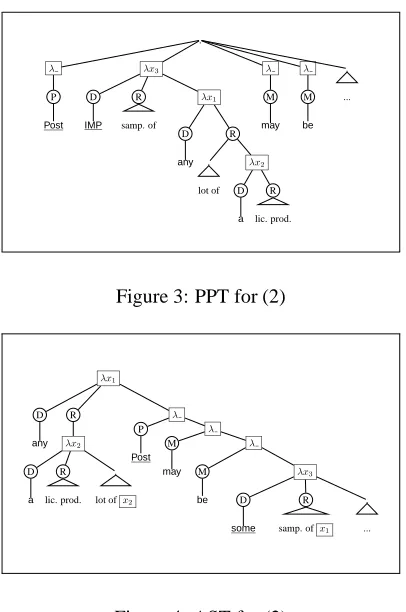
The PPT and AST for (2) are shown in Figures 3 and 4 respectively. Consider the noun phrase “IMP samples of any lot of a licensed product” in the
. λ P Post λx1 D any R . lot of λx2 D a R lic. prod. λx3 D IMP R
samp. ofx1
λ M may λ M be . ...
Figure 5: Second PPT for (2), obtained from the PPT in Figure 3, by raisinganyto the root preterminal.
PPT. The implicit determinerIMPin the PPT is in-terpreted as the existential determinersome in the AST. The three operators are related as follows in the AST:any≫some and R(any)≫ a, i.e., any outscopes the implicit determiner, andaappears in the restrictor ofany. Observe that the variables x1 and x2 , which are associated withanyand a, ap-pear in the restrictors ofsomeandanyrespectively. As a result, in the PPT, in Figure 3,anyandaappear in the restrictor ofIMPandany. The PPT provides a standard parse of PP-modification of NPs.
The important feature of this example is that the determiner “any” is syntactically embedded in the restrictor of IMP in the PPT (Figure 4), but it outscopes the implicit determiner in the AST (Fig-ure 3). As a result, the PPT in Fig(Fig-ure 3 cannot be converted to the AST in Figure 4 simply by ranking sibling operators (as we did in the previous section). To handle such cases, we convert the PPT in Fig-ure 3 to a second PPT (shown in FigFig-ure 5). The only allowed operation during this conversion is to raise an embedded operator to a higher preterminal. The PPT in Figure 5 is obtained by raising any to the root preterminal, making it a sibling of the implicit determinerIMPin the PPT in Figure 5. This second PPT can be converted to the AST by reordering sib-ling operators. The learning model used for this step is similar to the one used to order operators, and in the interests of space, we omit the details.
4 Brief Overview of the Corpus
[image:5.612.322.528.70.192.2]every, a, at least), modal auxiliaries (e.g., must, be), VP modifiers (e.g.,if,for,after), negation and coordinating conjunctions (e.g., and,but,or). The majority of the corpus was annotated by a single an-notator. However, to estimate inter-annotator agree-ment, a set of 32 sentences was annotated by a second annotator. In this section, we restrict our-selves to presenting statistics that highlight part of the guidelines and motivate the features that we use to order operators. An example-based justification of guidelines, and a discussion of inter-annotator agreement can be found in (Dinesh, 2010).
De Re vs De Dicto: We narrow our focus to one part
of the annotation, the de re vs de dicto distinction. Informally, operators with de re scope occur in the precondition of the logical translation of a sentence, while those with de dicto scope occur in the post-condition. This distinction is of key importance in the application of conformance checking, as it helps determine the facts that need to be provided by an organization (de re), and the actions that an organi-zation is required to take (de dicto).
For simplicity, we further restrict attention to op-erators that are siblings of the postcondition in the AST, and ignore the operators embedded in preposi-tional phrases and clauses, for example. A (main clause) operator o is said to have de re scope iff it outscopes the postcondition marker (o ≫ Post). Otherwise, the operator is said to have de dicto scope (Post≫o). In the example of the general safety test from Section 2, the implicit determiner associated with “biological products” has de re scope, while all other operators in the sentence have de dicto scope.
Operator Number of De Re Scope Type Instances Percentage Determiner 277 59.9% Modal Aux 268 0% VP Modifier 132 68.2%
CC 36 22.2%
Neg 33 0%
[image:6.612.341.511.152.236.2]Other 74 17.6%
Table 1: De Re scope distribution. An operator has de re scope iff it outscopes the postcondition marker.
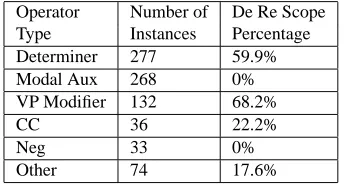
Table 1 shows the percentage of each type of op-erator that has de re scope. Modal auxiliaries and negation are umambigous to this distinction, and al-ways have de dicto scope. Note that a type of
opera-tor with50%occuring de re is ambiguous, while0%
or100%are unambiguous. Thus, from Table 1, we can conclude that determiners, and VP modifiers are the most ambiguous types. And, more features are needed to disambiguate them.
Determiner Number of De Re Scope Type Instances Percentage Universal 74 100% Existential 12 0% Ambiguous 50 28% Deictic 127 53.5%
[image:6.612.100.272.529.621.2]Other 14 35.7%
Table 2: De Re scope distribution for determiners.
Determiners: We divide the determiners into the following subtypes: universal/generic (e.g., every, all), existential (some), ambiguous (e.g.,a,an), de-ictic (e.g.,the,those), and other (e.g., at least,at most). The guidelines for annotation were as fol-lows – (a) universal determiners have de re scope, (b) existential determiners have de dicto scope, and (c) for other determiners, the annotator needs to de-cide whether a particular use is interpreted existen-tially or universally. Table 2 shows de re scope dis-tribution for each of these subtypes. As expected, universal and existential determiners are unambigu-ous, while ambiguous and deictic determiners show more variety. For example, the deictic determiner thecan refer to a specific entity (“theFDA”) or have a universal interpretation (“theproducts”).
Thus, to disambiguate between de re and de dicto interpretations for determiners, we need two types of features – (1) Features to predict whether ambiguous and deictic determiners are universal or not, and (2) Features to determine the type of implicit determin-ers. In Table 2, we assume that the type of implicit determiners are given. This assumption is unreal-istic. Rather, we need to predict the type of such determiners, during the computation of the AST.
VP Modifier Number of De Re Scope Type Instances Percentage Temporal and Conditional 73 100%
Purpose 8 0%
References to Laws 33 0.9%
Other 29 65.5%
[image:6.612.315.536.626.696.2]VP Modifiers: We divide the VP modifiers into the
following subtypes: temporal and conditional (e.g.,
after, if), purpose (for), references to laws (which
are a special type of modifier in the legal domain, e.g., “asspecified in paragraph (c)”), and other (e.g.,
regardless,notwithstanding). Table 3 shows the
percentage of each subtype of modifier that has de re scope. Following the guidelines for annotation, the temporal and conditional modifiers are always de re, the purpose modifiers and modifiers conveying references to laws are always de dicto.
5 Comparing the Scope of Operators
We now consider a subproblem in computing the AST – comparing the scope of pairs of operators. In Section 6, we will use the classifiers that perform comparisons, to compute the AST. All experiments in this section use the MAXENT implentation from the MALLET toolkit (McCallum, 2002). We begin
by revisiting de re-de dicto distinction from Sec-tion 4. Then, we generalize to other comparisons.
De Re vs De Dicto: The (binary) classification
problem is as follows. Our observations are triples x = (o,o′, τ) are such that there is a preterminal p ∈τ,{o,o′} ⊆ p, and o′ =Post. In other words, we are considering operators (o) that are siblings of the postcondition marker (o′). An observation has the label1ifo ≫ o′ (de re scope), and a label of0
otherwise (de dicto scope).
Features: We use the following (classes of) fea-tures for an observationx= (o,o′, τ):
• TYPE - The type and subtype of the operator. We use the subtypes from Section 4 only for explicit operators.
• PRE-VERB - Tracks whether o and o′ appear before or after the main verb of the sentence.
• PRE-VERB+ PERF- Conjunction of the previ-ous feature with whether the main verb is per-form. The verb perform is frequent in the CFR, and its subject is typically given de dicto scope, as it is the main predicate of the sentence.
• POS- The part-of-speech of the head word. For example, for the noun phrase biological prod-ucts, the head word is prodprod-ucts, and the POSis
NNS (plural common noun). And, this POStag may indicate a generic/universal interpretation.
Count MAJORITY TYPE ALL
All 823 66.2% 84.1% 89.2%
No MD 522 53.2% 74.9% 83.7%
DT 277 59.9% 62.9% 81.2%
[image:7.612.324.531.119.178.2]Imp. DT 100 69% 76%
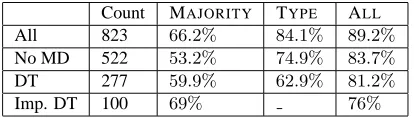
Table 4: De Re vs De Dicto classification. Average accu-racies over 10-fold cross-validation. The rows describe the subset of observations considered, and the columns describe the subset of features used.
Experiments: We evaluate the features by
perform-ing 10-fold cross-validation. The results are summa-rized in Table 4. The rows describe the subset of ob-servations used. “All” includes all obob-servations, “No MD” excludes the modal auxiliaries, “DT” includes only the determiners, and “Imp. DT” includes only implicit determiners. The columns describe the fea-tures used. MAJORITYis the majority baseline, i.e., the accuracy obtained by predicting the most fre-quent class or the majority class. The majority class is de dicto when all operators are considered (the first row), and de re in all other rows. The TYPE
column gives the accuracy when only the type and subtypes are used as features. This column does not apply to implicit determiners, as the subtype infor-mation is unavailable. And, finally, the ALLcolumn gives the accuracy when all features are used.
From Table 4, we can conclude that the TYPE fea-ture is useful in making the de re-de dicto distinc-tion, and further gains are obtained by using ALL
features. The most dramatic improvement is for de-terminers, and indeed, our features were designed for this case. However, the performance gains are not very high for implicit determiners, and further investigation is needed.
Count MAJORITY TYPE ALL
Siblings 2793 76.1% 83.3% 87.5%
Embedded 5081 95% 95.3% 96.4%
Table 5: Ordering siblings and embedded operators. Average accuracies over 10-fold cross-validation. The columns describe the subset of features used.
6 From Operator Comparisons to ASTs
We now consider the problem of computing the AST given the classifiers for comparing operators. Section 6.1 describes the algorithms used. In Sec-tion 6.2, we develop metrics to evaluate the com-putation of ASTs. We conclude, in Section 6.3, by evaluating different algorithms using the metrics.
6.1 Algorithms
We begin by discussing the intractability of the prob-lem of ranking or ordering operators. Then, we sketch the search heuristics used.
Intractability: The decision version of the rank-ing problem is NP-complete. A similar result is es-tablished by Cohen et al. (1998) in the context of a boosting approach to ranking.
Theorem 1. The following problem is NP-complete: Input: A PPTτ, a preterminalp∈τ, probabilities P(oi ≫oj|τ), andc∈[0,1]
Output: Yes, if there is an ordering r such that P(r(p)|τ)≥c
The proof is by reduction from ACYCLIC SUB -GRAPH (Karp, 1972) – finding a subgraph which is acyclic and has at leastkedges.
Heuristics: To order operators, we use a beam search procedure. Each search state consists preter-minal, in which the firstiranks have been assigned to operators. We then search over next states by as-signing the ranki+ 1to one of the remaining opera-tors. We used a beam size of104in our experiments. In most cases, the number of operators per preter-minal is less than 7. As a result, the total number of possible orderings is typically less than7!, and a beam size of104is sufficient to compute an exact or-dering. In other words, due to the size restrictions, in most cases, beam search is equivalent to exact (ex-haustive) search.
To handle embedded operators, we use a simple greedy heuristic. We enumerate the operators in the
initial PPT, corresponding to an in-order traversal. For each operator, we attach it to the most likely an-cestor, given the attachment decisions for the previ-ous operators. This heuristic is optimal for the case where the depth of embedding is at most1, which is the common case.
6.2 Metrics
In this section, we describe metrics used to evaluate the computation of ASTs. Letτ be the initial PPT, α the correct AST, and α∗ the computed AST. We define accuracy at various levels.
The simplest metric is to define accuracy at the level of ASTs, i.e., by computing the fraction of cases for whichα = α∗. However, this metric is harsh, in the sense that it does not give algorithms partial credit for getting a portion of the AST correct.
The next possible metric is to define accuracy at the level of preterminals. Let p be a preterminal. Note thatτ, αand α∗ share the same set of preter-minals, but may associate different operators with them. We say thatp is correct inα∗, if it is asso-ciated with the same set of operators as in α, and for all {o,o′} ⊆ p, we have o ≫ o′ w.r.t. α∗ iff o ≫ o′ w.r.t. α. In other words, the preterminals are identical, both in terms of the set of operators and the ordering between pairs of operators. While preterminal-level accuracy gives partial credit, it is still a little harsh, in the sense that an algorithm which makes one ordering mistake at a preterminal is penalized the same as an algorithm which makes multiple mistakes.
Finally, we consider metrics to define accuracy at the level of pairs of operators. Let p be a preter-minal. The setPairs(p, α) consists of pairs of op-erators (o,o′) such that o and o′ are both associ-ated with p inα, ando = o′ oro ≫ o′. The set
Pairs(p, α∗)is defined similarly usingα∗instead of α. Given the setsPairs(p, α)andPairs(p, α∗), pre-cision, recall, and f-score are defined in the usual way. We leave the details to the reader.
6.3 Results
We evaluate the following algorithms:
[image:8.612.77.293.72.108.2](a) SURFACE – No reordering is performed, i.e., the order of operators in the AST re-spects the surface order
(b) TYPE – Using only type and subtype in-formation for the operators
(c) ALL– Using all the features described in Section 5
2. ALL+ – The initial PPT is transformed into a second PPT before reordering (as described in Section 3.3). All features are used.
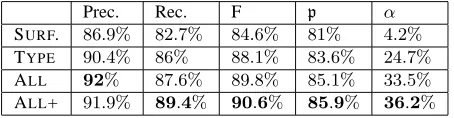
Prec. Rec. F p α
SURF. 86.9% 82.7% 84.6% 81% 4.2%
TYPE 90.4% 86% 88.1% 83.6% 24.7%
ALL 92% 87.6% 89.8% 85.1% 33.5%
[image:9.612.73.300.250.309.2]ALL+ 91.9% 89.4% 90.6% 85.9% 36.2%
Table 6: Performance of the algorithms in computing the ASTs. Averaged over 10-fold cross-validation.195ASTs in total, an average of8.6preterminals per AST, and1.8
operators per preterminal.
Table 6 summarizes the performance of the al-gorithms, under the various metrics. The accura-cies are averaged over 10-fold cross-validation. A total of 195 ASTs are used. The average number of preterminals per AST is8.6, with an average of
1.8operators per preterminal. The best number un-der each metric is shown in bold-face. By adding features, we improve the precision from 86.9% to
90.4%to 92%in moving from SURFACE to TYPE
to ALL. By handling embedded operators, we im-prove the recall from 87.6% to 89.4% in moving from ALLto ALL+. As we saw in Section 5, in95%
of the cases, the embedded operators respects syn-tactic scope, and as a result, we obtain only modest gains from handling embedded operators.
The reader may feel that the F-score of 90.6%is quite high given the size of our training data. This score is inflated by inclusion of reflexive pairs, of the form (o,o). Such pairs are included for the following (technical) reasons. The algorithm that handles embedded operators (ALL+) usually raises them from a single operator node (as in Figure 3) to a multi-operator node (as in Figure 5). If it makes an incorrect decision to raise an operator it takes a precision hit, at the multi-operator node (because
it has some false positives). By contrast, an algo-rithm loses precision for failing to correctly raise, only when we encounter the single operator node.
For these reasons, it is better to consider the rela-tive improvement in F-score over the baseline. The relative improvement of ALL+ over SURFACE in
terms of F-score is 36.6%. We believe that the preterminal-level accuracy is more indicative in an absolute sense. Furthermore, when we restrict atten-tion to those preterminals with two or more opera-tors in the PPT, the accuracy of ALL+ is69.4%.
7 Related Work
ASTs can be seen as a middle ground between two lines of research in translating sentences to logic.
At one end of the spectrum, we have methods that achieve good accuracy on restricted texts. The two main corpora that have been considered are the GEOQUERY corpus (Thompson et al., 1997) and the ATIS-3 corpus (Dahl et al., 1994). The GEO -QUERYcorpus consists of queries to a geographical
database. The queries were collected from students participating in a study and the average sentence length is 8 words. The ATIS corpus is collected from subjects’ interaction with a database of flight information, using spoken natural language. The ut-terances have be transcribed, and the average sen-tence length is10words (Berant et al., 2007). Algo-rithms, which achieve good accuracy, have been de-veloped to compute the logical translation for these queries (Zettlemoyer and Collins, 2005; Wong and Mooney, 2007; Zettlemoyer and Collins, 2009). The annotated sentences in the FDA CFR Section 610.40 are longer (about30words on average), and contain modalities which are not present in these corpora.
At the other end of the spectrum, Bos et al. (Bos et al., 2004) have developed a broad-coverage parser to translate sentences to a logic based on discourse rep-resentation theory. Here, there is no direct method to evaluate the correctness of the translation. However, indirect evaluations are possible, for example, by studying improvement in textual entailment tasks.
regula-tory texts which are less restricted than the database queries in the GEOQUERYand ATIS corpora, but do not exhibit anaphoric phenomenon found in genres, such as, newspaper text. In (Dinesh et al., 2007), we discuss lexical statistics that show significant differ-ences in the distribution of anaphoric items in the CFR and Wall Street Journal (WSJ) corpora. For ex-ample, the frequency of pronouns and anaphoric dis-course connectives is significantly lower in the CFR than in the WSJ. Instead, the CFR has an idiosyn-cratic mechanism for referring to sentences, using phrases such as “except as specified in paragraph (c) and (d)”. A question of interest is whether the GEOQUERY and ATIS corpora show similar
pecu-liarities in terms of anaphora. The second difference between our approach and others is that we do not attempt to translate all the way to logic. The level of logical form lets us obtain a direct evaluation, while leaving open the design of parts of the logic.
8 Conclusions
We described experiments on a modest-sized cor-pus of regulatory sentences, annotated with a novel variant of logical form, called abstract syntax trees (ASTs). An example from the corpus was presented in Section 2 and some statistics, describing the cor-pus, were discussed in Section 4. In Sections 3, 5, and 6, we developed and tested algorithms to con-vert a processed parse tree (PPT) to an AST. The main step in this conversion was to rank or order the operators at a preterminal. We presented a proba-bilistic model for ranking, investigated the design of features, and developed search heuristics. The best algorithm, which uses all features and handles em-bedded operators, achieves an F-score of90.6%.
An important direction for further inquiry is in the design of better features. Various types of features have been proposed for the scopal ordering of deter-miners. Examples include syntactic features (Ioup, 1975; Reinhart, 1983), such as position and voice, semantic features (Grimshaw, 1990; Jackendoff, 1972), such as thematic roles. More recently, Srini-vasan and Yates (2009) showed how pragmatic in-formation, for example “there are more people than cities”, can be leveraged for scope disambiguation. We experimented with lexico-syntactic features in this work, and leave an investigation of semantic and
pragmatic features to future work.
Acknowledgements
We thank Claire Cardie, Steve Kimbrough, Annie Louis, Fernando Pereira, Emily Pitler, Oleg Sokol-sky, and the anonymous reviewers for helpful com-ments on earlier versions of this paper.
References
A. Aho, R. Sethi, and J. Ullman. 1986. Compilers: Prin-ciples, Techniques, and Tools. Addison-Wessley. R. J. Anderson. 1996. A security policy model for
clin-cial information systems. In Proceedings of the IEEE Symposium on Security and Privacy.
A. Barth, A. Dutta, J. C. Mitchell, and H. Nissenbaum. 2006. Privacy and contextual integrity: Framework and applications. In Proceedings IEEE Symposium on Security and Privacy.
J. Berant, Y. Gross, M. Mussel, B. Sandbank, E. Ruppin, and S. Edelman. 2007. Boosting unsupervised gram-mar induction by splitting complex sentences on func-tion words. In Proceedings of the Boston University Conference on Language Development.
J. Bos, S. Clark, M. Steedman, J. R. Curran, and J. Hock-enmaier. 2004. Wide-coverage semantic representa-tions from a CCG parser. In Proceedings of COLING. W. W. Cohen, R. E. Schapire, and Y. Singer. 1998. Learning to order things. Journal of Artificial Intel-ligence Research, 10:243–270.
D. Dahl, M. Bates, M. Brown, W. Fisher, K. Hunicke-Smith, D. Pallett, C. Pao, A. Rudnicky, and E. Shriberg. 1994. Expanding the scope of the ATIS task: the ATIS-3 corpus. In Proceedings of the ARPA HLT Workshop.
N. Dinesh, A. Joshi, I. Lee, and O. Sokolsky. 2007. Logic-based regulatory conformance checking. In Proceedings of the 14th Monterey Workshop.
N. Dinesh, A. Joshi, I. Lee, and O. Sokolsky. 2011. Per-mission to speak: A logic for access control and con-formance. Journal of Logic and Algebraic Program-ming, 80(1):50–74.
N. Dinesh. 2010. Regulatory Conformance Checking: Logic and Logical Form. Ph.D. thesis, University of Pennsylvania.
B. Grosof, Y. Labrou, and H. Y. Chan. 1999. A declar-ative approache to business rules in contracts: Cour-teous logic programs in xml. In ACM Conference on Electronic Commerce.
Irene Heim and Angelika Kratzer. 1998. Semantics in Generative Grammar. Blackwell.
G. Ioup. 1975. Some universals for quantifier scope. Syntax and Semantics, 4:37–58.
R. Jackendoff. 1972. Semantic Interpretation in Genera-tive Grammar. MIT Press.
A. J. I. Jones and M. J. Sergot. 1992. Formal spec-ification of security requirements using the theory of normative positions. In European Symposium on Reasearch in Computer Security (ESORICS).
R. M. Karp. 1972. Reducibility among combinatorial problems. In R. E. Miller and J. W. Thatcher, editors, Complexity of Computer Computations, pages 85–103. Plenum Press.
H. S. Kurtzman and M. C. MacDonald. 1993. Resolution of quantifier scope ambiguities. Cognition, 48:243– 279.
R. K. Larson. 1985. Quantifying to np. Manuscript, MIT.
T. Liu. 2009. Learning to rank for information retrieval. Foundations and Trends in Information Retrieval, 3(3).
D. Makinson and L. van der Torre. 2000. Input/output logics. Journal of Philosophical Logic, 29:383–408. R. May. 1985. Logical Form: Its structure and
deriva-tion. MIT Press.
A. McCallum. 2002. MALLET: A machine learning for language toolkit. http://mallet.cs.umass.edu.
T. Reinhart. 1983. Anaphora and Semantic Interpreta-tion. Croom Helm.
M.J. Sergot, F.Sadri, R.A. Kowalski, F.Kriwaczek, P.Hammond, and H.T. Cory. 1986. The british na-tionality act as a logic program. Communications of the ACM, 29(5):370–86.
P. Srinivasan and A. Yates. 2009. Quantifier scope disambiguation using extracted pragmatic knowledge: Preliminary results. In Proceedings of the Conference on Empirical Methods in Natural Language Process-ing (EMNLP).
C. A. Thompson, R. J. Mooney, and L. R. Tang. 1997. Learning to parse natural language database queries into logical form. In Proceedings of the Workshop on Automata Induction, Grammatical Inference and Lan-guage Acquisition.
Y. W. Wong and R. J. Mooney. 2007. Learning syn-chronous grammars for semantic parsing with lambda calculus. In Proceedings of the Annual Meeting of the Association for Computational Linguistics (ACL).
L. S. Zettlemoyer and M. Collins. 2005. Learning to map sentences to logical form: Structured classifica-tion with probabilistic categorial grammars. In Pro-ceedings of UAI.