User-Friendly Text Prediction for Translators
George Foster and Philippe Langlais and Guy Lapalme RALI, Universit´e de Montr´eal
{foster,felipe,lapalme}@iro.umontreal.ca
Abstract
Text prediction is a form of interactive machine translation that is well suited to skilled translators. In principle it can as-sist in the production of a target text with minimal disruption to a translator’s nor-mal routine. However, recent evaluations of a prototype prediction system showed that it significantly decreased the produc-tivity of most translators who used it. In this paper, we analyze the reasons for this and propose a solution which consists in seeking predictions that maximize the ex-pected benefit to the translator, rather than just trying to anticipate some amount of upcoming text. Using a model of a “typ-ical translator” constructed from data col-lected in the evaluations of the prediction prototype, we show that this approach has the potential to turn text prediction into a help rather than a hindrance to a translator.
1 Introduction
The idea of using text prediction as a tool for trans-lators was first introduced by Church and Hovy as one of many possible applications for “crummy” machine translation technology (Church and Hovy, 1993). Text prediction can be seen as a form of in-teractive MT that is well suited to skilled transla-tors. Compared to the traditional form of IMT based on Kay’s original work (Kay, 1973)—in which the user’s role is to help disambiguate the source text— prediction is less obtrusive and more natural, allow-ing the translator to focus on and directly control the
contents of the target text. Predictions can benefit a translator in several ways: by accelerating typing, by suggesting translations, and by serving as an im-plicit check against errors.
The first implementation of a predictive tool for translators was described in (Foster et al., 1997), in the form of a simple word-completion system based on statistical models. Various enhancements to this were carried out as part of the TransType project (Langlais et al., 2000), including the addition of a re-alistic user interface, better models, and the capabil-ity of predicting multi-word lexical units. In the fi-nal TransType prototype for English to French trans-lation, the translator is presented with a short pop-up menu of predictions after each character typed. These may be incorporated into the text with a spe-cial command or rejected by continuing to type nor-mally.
Although TransType is capable of correctly antic-ipating over 70% of the characters in a freely-typed translation (within the domain of its training cor-pus), this does not mean that users can translate in 70% less time when using the tool. In fact, in a trial with skilled translators, the users’ rate of text pro-duction declined by an average of 17% as a result of using TransType (Langlais et al., 2002). There are two main reasons for this. First, it takes time to read the system’s proposals, so that in cases where they are wrong or too short, the net effect will be to slow the translator down. Second, translators do not always act “rationally” when confronted with a posal; that is, they do not always accept correct pro-posals and they occasionally accept incorrect ones. Many of the former cases correspond to translators simply ignoring proposals altogether, which is un-derstandable behaviour given the first point.
This paper describes a new approach to text pre-diction intended to address these problems. The main idea is to make predictions that maximize the expected benefit to the user in each context, rather than systematically proposing a fixed amount of text after each character typed. The expected benefit is estimated from two components: a statistical trans-lation model that gives the probability that a can-didate prediction will be correct or incorrect, and a user model that determines the benefit to the trans-lator in either case. The user model takes into ac-count the cost of reading a proposal, as well as the random nature of the decision to accept it or not. This approach can be characterized as making fewer but better predictions: in general, predictions will be longer in contexts where the translation model is confident, shorter where it is less so, and absent in contexts where it is very uncertain.
Other novel aspects of the work we describe here are the use of a more accurate statistical translation model than has previously been employed for text prediction, and the use of a decoder to generate pre-dictions of arbitrary length, rather than just single words or lexicalized units as in the TransType pro-totype. The translation model is based on the max-imum entropy principle and is designed specifically for this application.
To evaluate our approach to prediction, we simu-lated the actions of a translator over a large corpus of previously-translated text. The result is an increase of over 10% in translator productivity when using the predictive tool. This is a considerable improve-ment over the -17% observed in the TransType trials.
2 The Text Prediction Task
In the basic prediction task, the input to the predictor is a source sentencesand a prefixhof its translation (ie, the target text before the current cursor position); the output is a proposed extensionxtoh. Figure 1 gives an example. Unlike the TransType prototype, which proposes a set of single-word (or single-unit) suggestions, we assume that each prediction consists of only a single proposal, but one that may span an arbitrary number of words.
As described above, the goal of the predictor is to find the predictionˆxthat maximizes the expected
s: Let us return to serious matters.
t:
h
z }| { On va r
x∗
z }| {
evenir aux choses s´erieuses.
[image:2.612.336.517.73.141.2]x: evenir `a
Figure 1: Example of a prediction for English to French translation.sis the source sentence,his the part of its translation that has already been typed, x∗is what the translator wants to type, andxis the prediction.
benefit to the user:
ˆ
x= argmax x
B(x,h,s), (1)
whereB(x,h,s)measures typing time saved. This obviously depends on how much ofxis correct, and how long it would take to edit it into the desired text. A major simplifying assumption we make is that the user edits only by erasing wrong characters from the end of a proposal. Given a TransType-style interface where acceptance places the cursor at the end of a proposal, this is the most common editing method, and it gives a conservative estimate of the cost at-tainable by other methods. With this assumption, the key determinant of edit cost is the length of the correct prefix of x, so the expected benefit can be written as:
B(x,h,s) =
l X
k=0
p(k|x,h,s)B(x,h,s, k), (2)
wherep(k|x,h,s) is the probability that exactly k characters from the beginning of xwill be correct, lis the length ofx, andB(x,h,s, k)is the benefit to the user given that the firstkcharacters ofxare correct.
Equations (1) and (2) define three main problems: estimating the prefix probabilitiesp(k|x,h,s), esti-mating the user benefit functionB(x,h,s, k), and searching for ˆx. The following three sections de-scribe our solutions to these.
3 Translation Model
model. The first step in the derivation is to con-vert these into a form that deals explicitly with char-acter strings. This is accomplished by noting that p(k|x,h,s)is the probability that the firstk charac-ters of xare correct and that thek+ 1th character (if there is one) is incorrect. Fork < l:
p(k|x,h,s) =p(xk1|h,s)−p(xk+11 |h,s)
where xk1 = x1. . . xk. If k = l, p(k|x,h,s) = p(x|h,s). Also,p(x01)≡1.
The next step is to convert string probabilities into word probabilities. To do this, we assume that strings map one-to-one into token sequences, so that:
p(xk1|h,s)≈p(v1, w2, . . . , wm−1, um|h,s),
wherev1is a possibly-empty word suffix, eachwiis a complete word, andum is a possibly empty word prefix. For example, ifxin figure 1 were evenir aux
choses, thenx141 would map tov1 = evenir,w2 =
aux, andu3 = cho. The one-to-one assumption is reasonable given that entries in our lexicon contain neither whitespace nor internal punctuation.
To model word-sequence probabilities, we apply the chain rule:
p(v1, w2, . . . , wm−1, um|h,s) =
p(v1|h,s) m−1
Y
i=2
p(wi|h, v1, wi2−1,s)×
p(um|h, v1, w2m−1,s). (3)
The probabilities ofv1 andum can be expressed in terms of word probabilities as follows. Letting u1 be the prefix of the word that ends in v1 (eg, r in figure 1),w1=u1v1, andh=h0u1:
p(v1|h,s) =p(w1|h0,s)/ X
w:w=u1v
p(w|h0,s),
where the sum is over all words that start with u1. Similarly:
p(um|h0, w1m−1,s) = X
w:w=umv
p(w|h0, w1m−1,s). (4)
Thus all factors in (3) can be calculated from probabilities of the form p(w|h,s) which give the
likelihood that a wordwwill follow a previous se-quence of wordsh in the translation of s.1 This is the family of distributions we have concentrated on modeling.
Our model forp(w|h,s)is a log-linear combina-tion of a trigram language model forp(w|h) and a maximum-entropy translation model forp(w|s), de-scribed in (Foster, 2000a; Foster, 2000b). The trans-lation component is an analog of the IBM model 2 (Brown et al., 1993), with parameters that are op-timized for use with the trigram. The combined model is shown in (Foster, 2000a) to have signif-icantly lower test corpus perplexity than the linear combination of a trigram and IBM 2 used in the TransType experiments (Langlais et al., 2002). Both models supportO(mJ V3)Viterbi-style searches for the most likely sequence ofmwords that followsh, whereJ is the number of tokens ins andV is the size of the target-language vocabulary.
Compared to an equivalent noisy-channel combi-nation of the form p(t)p(s|t), where t is the tar-get sentence, our model is faster but less accurate. It is faster because the search problem for noisy-channel models is NP-complete (Knight, 1999), and even the fastest dynamic-programming heuristics used in statistical MT (Niessen et al., 1998; Till-mann and Ney, 2000), are polynomial inJ—for in-stanceO(mJ4V3) in (Tillmann and Ney, 2000). It is less accurate because it ignores the alignment rela-tion betweensandh, which is captured by even the simplest noisy-channel models. Our model is there-fore suitable for making predictions in real time, but not for establishing complete translations unassisted by a human.
3.1 Implementation
The most expensive part of the calculation in equa-tion (3) is the sum in (4) over all words in the vo-cabulary, which according to (2) must be carried out for every character positionkin a given prediction x. We reduce the cost of this by performing sums only at the end of each sequence of complete tokens inx(eg, after revenir and revenir aux in the above example). At these points, probabilities for all pos-sible prefixes of the next word are calculated in a
1
single recursive pass over the vocabulary and stored in a trie for later access.
In addition to the exact calculation, we also ex-perimented with establishing exact probabilities via p(w|h,s)only at the end of each token inx, and as-suming that the probabilities of the intervening char-acters vary linearly between these points. As a re-sult of this assumption,p(k|x,h,s) =p(xk1|h,s)−
p(xk+11 |h,s)is constant for allkbetween the end of one word and the next, and therefore can be factored out of the sum in equation (2) between these points.
4 User Model
The purpose of the user model is to determine the expected benefitB(x,h,s, k) to the translator of a predictionxwhose firstkcharacters match the text that the translator wishes to type. This will depend on whether the translator decides to accept or reject the prediction, so the first step in our model is the following expansion:
B(x,h,s, k) = X
a∈{0,1}
p(a|x,h,s, k)B(x,h,s, k, a),
wherep(a|x,h,s, k)is the probability that the trans-lator accepts or rejectsx,B(x,h,s, k, a)is the ben-efit they derive from doing so, and a is a random variable that takes on the values 1 for acceptance and 0 for rejection. The first two quantities are the main elements in the user model, and are described in fol-lowing sections. The parameters of both were esti-mated from data collected during the TransType trial described in (Langlais et al., 2002), which involved nine accomplished translators using a prototype pre-diction tool for approximately half an hour each. In all cases, estimates were made by pooling the data for all nine translators.
4.1 Acceptance Probability
Ideally, a model for p(a|x,h,s, k) would take into account whether the user actually reads the proposal before accepting or rejecting it, eg:
p(a|x,h,s, k) =X
r∈{0,1}
p(a|r,x,h,s, k)p(r|x,h,s, k)
wherer is a boolean “read” variable. However, this information is hard to extract reliably from the avail-able data; and even if were obtainavail-able, many of the
−60 −50 −40 −30 −20 −100 0 10 20 30 40 50 60 0.1
0.2 0.3 0.4 0.5 0.6 0.7 0.8 0.9 1
probability of accepting
gain (length of correct prefix − length of incorrect suffix) raw
[image:4.612.316.537.74.264.2]smoothed model
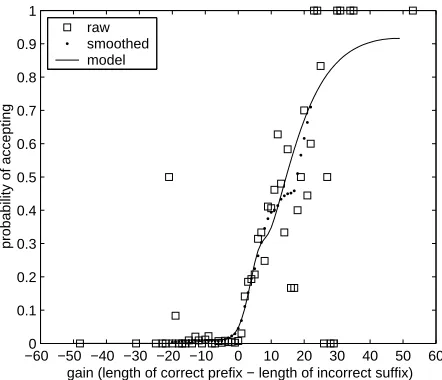
Figure 2: Probability that a prediction will be ac-cepted versus its gain.
factors which influence whether a user is likely to read a proposal—such as a record of how many pre-vious predictions have been accepted—are not avail-able to the predictor in our formulation. We thus modelp(a|x,h,s, k)directly.
Our model is based on the assumption that the probability of acceptingxdepends only on what the user stands to gain from it, defined according to the editing scenario given in section 2 as the amount by which the length of the correct prefix ofxexceeds the length of the incorrect suffix:
p(a|x,h,s, k)≈p(a|2k−l),
wherek−(l−k) = 2k−lis called the gain. For in-stance, the gain for the prediction in figure 1 would be2×7−8 = 6. The strongest part of this assump-tion is dropping the dependence onh, because there is some evidence from the data that users are more likely to accept at the beginnings of words. How-ever, this does not appear to have a severe effect on the quality of the model.
abstrac-0 10 20 30 40 50 60 0
500 1000 1500 2000 2500 3000 3500 4000
average time to accept (msecs)
length of proposal (chars) raw
least−squares fit
0 10 20 30 40 50 60
0 500 1000 1500 2000 2500 3000 3500 4000
average time to reject (msecs)
length of proposal (chars) raw
[image:5.612.74.527.75.260.2]least−squares fit
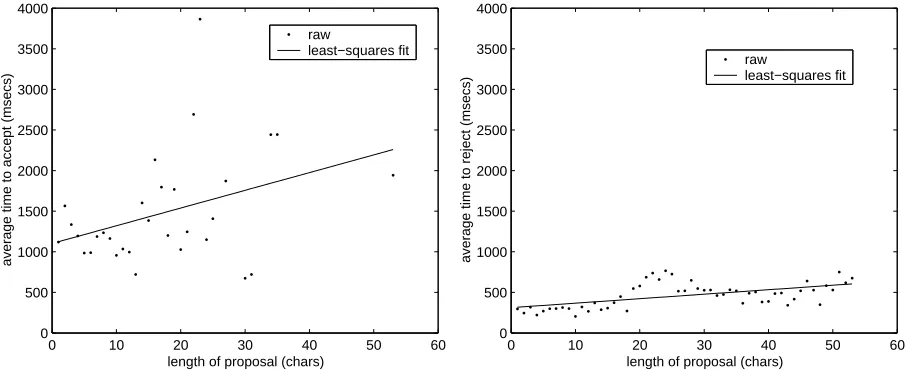
Figure 3: Time to read and accept or reject proposals versus their length
tion, because the empirical probability of acceptance is very low when it is less than zero and rises rapidly as it increases. This relatively clean separation sup-ports the basic assumption in section 2 that benefit depends onk.
The points labelled smoothed in figure 2 were obtained using a sliding-average smoother, and the
model curve was obtained using two-component
Gaussian mixtures to fit the smoothed empirical likelihoodsp(gain|a = 0)andp(gain|a = 1). The model probabilities are taken from the curve at in-tegral values. As an example, the probability of ac-cepting the prediction in figure 1 is about .25.
4.2 Benefit
The benefitB(x,h,s, k, a) is defined as the typing time the translator saves by accepting or rejecting a prediction xwhose first kcharacters are correct. To determine this, we assume that the translator first readsx, then, if he or she decides to accept, uses a special command to place the cursor at the end ofx and erases its lastl−kcharacters. Assuming inde-pendence fromh,sas before, our model is:
B(x, k, a) =
−R1(x) +T(x, k)−E(x, k), a= 1
−R0(x), a= 0
where Ra(x) is the cost of reading x when it ul-timately gets accepted (a= 1) or rejected (a= 0), T(x, k) is the cost of manually typing xk1, and E(x, k)is the edit cost of acceptingx and erasing to the end of its firstkcharacters.
A natural unit for B(x, k, a) is the number of keystrokes saved, so all elements of the above equa-tion are converted to this measure. This is straight-forward in the case ofT(x, k) andE(x, k), which are estimated askandl−k+ 1 respectively—for E(x, k), this corresponds to one keystroke for the command to accept a prediction, and one to erase each wrong character. This is likely to slightly un-derestimate the true benefit, because it is usually harder to typencharacters than to erase them.
As in the previous section, read costs are inter-preted as expected values with respect to the proba-bility that the user actually does readx, eg, assuming 0 cost for not reading, R0(x) = p(r= 1|x)R00(x), where R00(x) is the unknown true cost of reading and rejectingx. To determineRa(x), we measured the average elapsed time in the TransType data from the point at which a proposal was displayed to the point at which the next user action occurred—either an acceptance or some other command signalling a rejection. Times greater than 5 seconds were treated as indicating that the translator was distracted and were filtered out. As shown in figure 3, read times are much higher for predictions that get accepted, re-flecting both a more careful perusal by the translator and the fact the rejected predictions are often simply ignored.2 In both cases there is a weak linear
rela-2
tionship between the number of characters read and the time taken to read them, so we used the least-squares lines shown as our models. Both plots are noisy and would benefit from a more sophisticated psycholinguistic analysis, but they are plausible and empirically-grounded first approximations.
To convert reading times to keystrokes for the benefit function we calculated an average time per keystroke (304 milliseconds) based on sections of the trial where translators were rapidly typing and when predictions were not displayed. This gives an upper bound for the per-keystroke cost of reading— compare to, for instance, simply dividing the total time required to produce a text by the number of characters in it—and therefore results in a conser-vative estimate of benefit.
To illustrate the complete user model, in the fig-ure 1 example the benefit of accepting would be
7−2−4.2 =.8keystrokes and the benefit of reject-ing would be−.2keystrokes. Combining these with the acceptance probability of .25 gives an overall ex-pected benefitB(x,h,s, k= 7)for this proposal of 0.05 keystrokes.
5 Search
Searching directly through all character strings x in order to findxˆ according to equation (1) would be very expensive. The fact thatB(x,h,s)is non-monotonic in the length ofxmakes it difficult to or-ganize efficient dynamic-programming search tech-niques or use heuristics to prune partial hypotheses. Because of this, we adopted a fairly radical search strategy that involves first finding the most likely se-quence of words of each length, then calculating the benefit of each of these sequences to determine the best proposal. The algorithm is:
1. For each length m = 1. . . M, find the best word sequence:
ˆ
wm= argmax
w1:(w1=u1v), wm2
p(w1m|h0,s),
whereu1andh0are as defined in section 3.
2. Convert eachwmˆ to a corresponding character stringˆxm.
3. Output ˆx = argmaxm B(ˆxm,h,s), or the empty string if all B(xˆm,h,s) are non-positive.
M average time maximum time
1 0.0012 0.01
2 0.0038 0.23
3 0.0097 0.51
4 0.0184 0.55
[image:6.612.341.512.71.154.2]5 0.0285 0.57
Table 1: Approximate times in seconds to generate predictions of maximum word sequence lengthM, on a 1.2GHz processor, for the MEMD model.
In all experiments reported below, M was set to a maximum of 5 to allow for convenient testing. Step 1 is carried out using a Viterbi beam search. To speed this up, the search is limited to an active
vo-cabulary of target words likely to appear in
transla-tions ofs, defined as the set of all words connected by some word-pair feature in our translation model to some word ins. Step 2 is a trivial deterministic procedure that mainly involves deciding whether or not to introduce blanks between adjacent words (eg yes in the case of la +vie, no in the case of l’ + an). This also removes the prefixu1 from the pro-posal. Step 3 involves a straightforward evaluation ofmstrings according to equation (2).
Table 1 shows empirical search timings for vari-ous values of M, for the MEMD model described in the next section. Times for the linear model are similar. Although the maximum times shown would cause perceptible delays for M > 1, these occur very rarely, and in practice typing is usually not no-ticeably impeded when using the TransType inter-face, even atM = 5.
6 Evaluation
We evaluated the predictor for English to French translation on a section of the Canadian Hansard corpus, after training the model on a chronologi-cally earlier section. The test corpus consisted of 5,020 sentence pairs and approximately 100k words in each language; details of the training corpus are given in (Foster, 2000b).
config M
1 2 3 4 5
fixed -8.5 -0.4 -3.60 -11.6 -20.8
linear 6.1 9.40 8.8 8.1 7.8
exact 5.3 10.10 10.7 10.0 9.7 corr 5.8 10.7 12.0 12.5 12.6
best 7.9 17.90 24.5 27.7 29.2 fixed -11.5 -9.3 -15.1 -22.0 -28.2
exact 3.0 4.3 5.0 5.2 5.2
[image:7.612.78.294.70.213.2]best 6.2 12.1 15.4 16.7 17.3
Table 2: Results for different predictor configura-tions. Numbers give % reductions in keystrokes.
user M
1 2 3 4 5
superman 48.6 53.5 51.8 51.1 50.9 rational 11.7 17.8 17.2 16.4 16.1 real 5.3 10.10 10.7 10.0 9.7
Table 3: Results for different user simulations. Numbers give % reductions in keystrokes.
acceptance, 1 otherwise. Here k was obtained by comparingxto the knownx∗ from the test corpus. It may seem artificial to measure performance ac-cording to the objective function for the predictor, but this is biased only to the extent that it misrepre-sents an actual user’s characteristics. There are two cases: either the user is a better candidate—types more slowly, reacts more quickly and rationally— than assumed by the model, or a worse one. The predictor will not be optimized in either case, but the simulation will only overestimate the benefit in the second case. By being conservative in estimating the parameters of the user model, we feel we have minimized the number of translators who would fall into this category, and thus can hope to obtain real-istic lower bounds for the average benefit across all translators.
Table 2 contains results for two different trans-lation models. The top portion corresponds to the MEMD2B maximum entropy model described in (Foster, 2000a); the bottom portion corresponds to the linear combination of a trigram and IBM 2 used in the TransType experiments (Langlais et al., 2002). Columns give the maximum permitted number of words in predictions. Rows show different
predic-tor configurations: fixed ignores the user model and makes fixedM-word predictions; linear uses the lin-ear character-probability estimates described in sec-tion 3.1; exact uses the exact character-probability calculation; corr is described below; and best gives an upper bound on performance by choosingm in step 3 of the search algorithm so as to maximize B(x,h,s, k)using the true value ofk.
Table 3 illustrates the effects of different compo-nents of the user model by showing results for sim-ulated users who read infinitely fast and accept only predictions having positive benefit (superman); who read normally but accept like superman (rational); and who match the standard user model (real). For each simulation, the predictor optimized benefits for the corresponding user model.
Several conclusions can be drawn from these re-sults. First, it is clear that estimating expected bene-fit is a much better strategy than making fixed-word-length proposals, since the latter causes an increase in time for all values ofM. In general, making “ex-act” estimates of string prefix probabilities works better than a linear approximation, but the difference is fairly small.
Second, the MEMD2B model significantly out-performs the trigram+IBM2 combination, produc-ing better results for every predictor configuration tested. The figure of -11.5% in bold corresponds to the TransType configuration, and corroborates the validity of the simulation.3
Third, there are large drops in benefit due to read-ing times and probabilistic acceptance. The biggest cost is due to reading, which lowers the best possi-ble keystroke reduction by almost 50% forM = 5. Probabilistic acceptance causes a further drop of about 15% forM = 5.
The main disappointment in these results is that performance peaks at M = 3 rather than continu-ing to improve as the predictor is allowed to con-sider longer word sequences. Since the predictor knows B(x,h,s, k), the most likely cause for this is that the estimates forp(wˆm|h,s) become worse with increasingm. Significantly, performance
lev-3
[image:7.612.75.295.259.330.2]els off at three words, just as the search loses di-rect contact withh through the trigram. To correct for this, we used modified probabilities of the form λmp(wˆm|h,s), whereλm is a length-specific cor-rection factor, tuned so as to optimize benefit on a cross-validation corpus. The results are shown in the
corr row of table 2, for exact character-probability
estimates. In this case, performance improves with M, reaching a maximum keystroke reduction of
12.6%atM = 5.
7 Conclusion and Future Work
We have described an approach to text prediction for translators that is based on maximizing the benefit to the translator according to an explicit user model whose parameters were set from data collected in user evaluations of an existing text prediction proto-type. Using this approach, we demonstrate in sim-ulated results that our current predictor can reduce the time required for an average user to type a text in the domain of our training corpus by over 10%. We look forward to corroborating this result in tests with real translators.
There are many ways to build on the work de-scribed here. The statistical models which are the backbone of the predictor could be improved by making them adaptive—taking advantage of the user’s input—and by adding features to capture the alignment relation betweenhandsin such a way as to preserve the efficient search properties. The user model could also be made adaptive, and it could be enriched in many other ways, for instance so as to capture the propensity of translators to accept at the beginnings of words.
We feel that the idea of creating explicit user mod-els to guide the behaviour of interactive systems is likely to have applications in areas of NLP apart from translators’ tools. For one thing, most of the approach described here carries over more or less directly to monolingual text prediction, which is an important tool for the handicapped (Carlberger et al., 1997). Other possibilities include virtually any ap-plication where a human and a machine communi-cate through a language-rich interface.
References
Peter F. Brown, Stephen A. Della Pietra, Vincent Della J. Pietra, and Robert L. Mercer. 1993. The mathematics of Machine Translation: Parameter estimation.
Com-putational Linguistics, 19(2):263–312, June.
Alice Carlberger, Johan Carlberger, Tina Magnuson, Sira E. Palazuelos-Cagigas, M. Sharon Hunnicutt, and Santiago Aguilera Navarro. 1997. Profet, a new gen-eration of word prediction: an evaluation study. In
Proceedings of the 2nd Workshop on NLP for Commu-nication Aids, Madrid, Spain, July.
Kenneth W. Church and Eduard H. Hovy. 1993. Good applications for crummy machine translation. Ma-chine Translation, 8:239–258.
George Foster, Pierre Isabelle, and Pierre Plamondon. 1997. Target-text Mediated Interactive Machine Translation. Machine Translation, 12:175–194.
George Foster. 2000a. Incorporating position infor-mation into a Maximum Entropy / Minimum Di-vergence translation model. In Proceedings of the
4th Computational Natural Language Learning Work-shop (CoNLL), Lisbon, Portugal, September. ACL
SigNLL.
George Foster. 2000b. A Maximum Entropy / Minimum Divergence translation model. In Proceedings of the
38th Annual Meeting of the Association for Computa-tional Linguistics (ACL), Hong Kong, October.
Martin Kay. 1973. The MIND system. In R. Rustin, editor, Natural Language Processing, pages 155–188. Algorithmics Press, New York.
Kevin Knight. 1999. Decoding complexity in word-replacement translation models. Computational
Lin-guistics, Squibs and Discussion, 25(4).
Philippe Langlais, George Foster, and Guy Lapalme. 2000. Unit completion for a computer-aided transla-tion typing system. Machine Translatransla-tion, 15(4):267– 294, December.
Philippe Langlais, Guy Lapalme, and Marie Loranger. 2002. TransType: From an idea to a system. Machine
Translation. To Appear.
S. Niessen, S. Vogel, H. Ney, and C. Tillmann. 1998. A DP based search algorithm for statistical machine translation. In Proceedings of the 36th Annual
Meet-ing of the ACL and 17th COLING 1998, pages 960–
967, Montr´eal, Canada, August.
C. Tillmann and H. Ney. 2000. Word re-ordering and DP-based search in statistical machine translation. In
Proceedings of the International Conference on Com-putational Linguistics (COLING) 2000, Saarbrucken,