Original Article
Evaluation of early surgical
outcomes, acute inflammatory
response and oncological outcomes in patients
undergo totally laparoscopic distal gastrectomy: a
prospective comparision with open distal gastrectomy
Qilong Chen*, Ke Chen*, Yu Pan, Xueyong Zheng, Jiafei Yan
Department of Gastrointestinal Surgery, Sir Run Run Shaw Hospital, School of Medicine, Zhejiang University, Hangzhou, China. *Equal contributors.
Received October 26, 2017; Accepted July 2, 2018; Epub November 15, 2018; Published November 30, 2018
Abstract:Background and aim: Totally laparoscopic distal gastrectomy (TLDG) is gradually prevailing in recent years. Improved clinical outcomes have been reported in previous studies. However, the advantages and disadvantages of TLDG in acute inflammatory response, pulmonary function and long-term oncological outcomes remain unclear. This study was conducted to clarify these issues. Methods: From March 2010 to September 2011, a total of 74 patients with gastric cancer were perspectively assigned to either TLDG or open distal gastrectomy (ODG). Clinico-pathologic features, operative details, perioperative inflammatory factors, postoperative recovery, and oncological outcomes were compared between the two groups. Results: There were 35 patients (25 males and 10 females) received TLDG and 39 patients (29 males and 10 females) received ODG. The two groups were comparable in the clinicopathological characteristics. TLDG had similar operative time, less blood loss, shorter length of hospital stay and equivalent postoperative morbidity as compared to ODG. The reduction of body temperature in TLDG group was larger than ODG group. No significant difference was found between TLDG and ODG in the changes of blood pH value, PaCO2 and WBC count. Elevation of CRP was lower in TLDG than ODG at postoperative 6 h and 24 h. Levels of IL-6 and IL-10 were higher in ODG at postoperative 0 h, 2 h, 6 h and 24 h. During a median follow-up period of 68 months, the overall survival rates and disease-free survival rates had no difference between TLDG and ODG. Conclusions: This study demonstrated that TLDG can be safely applied for gastric cancer as well as ODG. TLDG has minimal surgical trauma, milder acute inflammatory response and quicker function recovery. Pneumoperitoneum doesn’t adversely affect pulmonary function and oncological outcomes.
Keywords: Laparoscopic gastrectomy, stomach neoplasms, inflammatory response, overall survival rate
Introduction
Gastric cancer (GC) remains one of the most commonly diagnosed malignancies worldwide and the third major cause of cancer-related death globally [1]. Surgery is regarded as a potential option to cure early-stage GC and sig-nificantly enhance prognosis in more advanced stage patients [2]. Open gastrectomy (OG) has traditionally been widely used and laparoscopic gastrectomy (LG) has been increasingly per-formed as a promising approach, showing advantages in many areas such as quicker recovery, less pain, shorter hospitalization,
inci-sion and no contact with the tumor; it is considered incisionless, with the exception of the trocar wounds.
The minimally invasive advantages of LG appear to be sufficiently demonstrated when analyzing from clinical index alone. Apart fr- om the rapid postoperative recovery, however, postoperative pain, inflammatory stress res- ponse and long-term survival status are also critical factors to comprehensively judge the degree of injury caused by a surgical proce-dure. Therefore, this research has conducted a prospective cohort study comparing TLDG and open distal gastrectomy (ODG) performed in our center during the same period. Indexes such as postoperative pain, inflammatory fac-tor levels and long-term tumor relapse and sur-vival rate between the two groups were com-pared and analyzed, so as to understand whether TLDG possesses superiority to ODG in terms of the above aspects. Furthermore, TLDG may result in prolonged duration of oper-ation and anesthesia; meanwhile, the long-term intraoperative CO2 pneumoperitoneum may also exert adverse effect on the internal environment and pulmonary function. Conse- quently, continuous dynamic monitoring on the intraoperative and postoperative blood gas analysis was also performed on both groups in this research to evaluate such risk.
Materials and methods
Patients
This research was approved by the Zhejiang University’s Ethics Committee. A total of 478 consecutive patients underwent radical resec-tion for gastric cancer between March 2010 and September 2011 in our department of Sir Run Run Shaw Hospital. Only patients who agreed to this trial were included in this study and the surgical methods of TLDG or ODG were decided by patients and their families. Written consent was obtained from every patient prior to enrollment. Patients with any of the follow- ing conditions were excluded from this pros- pective non-randomized controlled trial: 1) over 80 years old; 2) palliative resection; 3) subtotal and total gastrectomy; 4) distant metastasis (e.g. peritoneal metastasis or peritoneal lavage cytology positive for carcinoma cells, hepatic metastasis); 5) tumors invading adjacent struc-tures; 6) received neoadjuvant chemotherapy
preoperatively; 7) with the history of gastroin-testinal surgery; 8) the score of American Society of Anesthesiologists was 3 or more; and 9) patients with acute inflammation, fever, immune system disorders, and a long history of drugs use with hormones, immunosuppres-sants, and other effects on the immune sys-tem. Thus 35 patients were enrolled in TLDG group and 39 in ODG group. All TLDG proce-dures were performed by the same surgical team, whereas ODG cases were performed by other two attending surgeons who were profi-cient in the conventional open surgery.
Outcome measures
The following data were collected: 1) intraoper-ative effects: operintraoper-ative time, estimated blood loss, number of retrieved lymph nodes (RLNs), proximal and distal margin distance, body tem-perature; 2) postoperative recovery: pain sco- re, analgesic dosage, time to ambulation, first flatus, restart oral intake, length of postopera-tive hospital stay (LOS), morbidity and mortali-ty; 3) laboratory examination: pH value, arte- rial pressure of carbon dioxide (PaCO2), white blood cell (WBC) count, neutrophils percentage (NE%), C reactive protein (CRP), interleukin-6 (IL-6), and IL-10; and 4) oncologic outcomes: recurrence, and survival.
Laboratory examination
The sample of pH and PaCO2 were taken at the end of operation (0 h), PO 2 h, 6 h and 24 h. The sample of WBC, neutrophils and CRP were taken one day preoperatively (pre), PO 24 h, 72 h and 120 h. The sample of IL-6 and IL-10 were taken one day preoperatively (pre), PO 0 h, 2 h, 6 h, 24 h, 72 h and 120 h. WBC, and neutro-phils were determined with an automated cell counter (Beckman Coulter Inc. Counter LH 750, USA). pH, and PaCO2 were determined with automation (GEM Premier 3000, USA).The lev-els of CRP, IL-6, and IL-10 in plasma were measured using ELISA kits (MultiSciences Inc, Shanghai, China), according to the manufac- turer’s instructions. Samples were collected in ethylene diamine tetraacetic acid (EDTA) anti-coagulative tube and were centrifuged within one hour after sampling, the serum separated and then stored at -80°C until analysis of serum cytokines. The serum was centrifuged at 3500 rpm for 10 min.
Biochemical measurements
Double antibody sandwich method was used in our research. Firstly, the anti-human coating antibody was adsorbed onto micro-wells. The antibodies of CRP, IL-6, and IL-10 were adsorb- ed separately. Then the plasma samples were added so the human CRP/IL-6/IL-10 presented in the sample can bind to antibodies adsorbed to the micro-wells previously. Then biotin-conju-gated anti-human CRP/IL-6/IL-10 antibody was added and bound to human CRP/IL-6/IL-10 captured by the first antibody. Horseradish per-oxidase (HRP) was added and bound to the biotin-conjugated anti-human VEGF-C antibody. Then substrate solution reactive with HRP was added to the wells and a blue product was formed in proportion to the amount of human CRP/IL-6/IL-10 presented in the sample or standard. The reaction was terminated by addi-tion of acid and the color turned yellow. The optical density (OD) of each cytokines in the samples was determined at 450 nm on a micro-plate reader (Thermo Fisher Multiskan, USA). Samples were tested in triplicates, and stan-dard curve with human recombinant cytokine was made in each plate.
Surgical procedure
With the patient in the supine position, mobili-zation of the stomach and en bloc systematic
lymph node dissection were performed via five trocars under a pneumoperitoneum. D2 lymph-adenectomy was undertaken according to the rules of the Gastric Cancer Treatment Guide- lines 2011 by the Japanese Gastric Cancer Association [9], which included number 7, 8, 9, 10, 11p, 11d, and 12a in addition to the D1 dis-section. Billroth II gastrojejunostomy was per-formed after resection of the stomach speci-men. The details of the surgery are described in our previously published articles [10, 11]. Postoperative management
Patients were supported by total parenteral nutrition (TPN) until they could consume a liq-uid diet. After the patients could tolerate the liquid diet, they were transferred gradually to a semiliquid diet. To be discharged from the hos-pital, patients had to be able to tolerate a semi-liquid diet and have a normal blood work panel and temperature, with no obvious discom- fort. Adjuvant chemotherapy with 5-fluorouracil (5-FU)-based regimens (mostly 5-FU with cispl-atin) was recommended to all eligible patients, except those with stage I cancer.
Long-term follow-up
Follow-up data were collected for at least 3 years, including alternating semiannual abdo- minopelvic CT scans or ultrasound examina-tions. An endoscopic surveillance was per-formed annually or earlier if the patient had symptoms or there was any suspicion of recur-rence. Recurrence patterns included peritone-al, locoregionperitone-al, lymph node and hematoge-nous. Peritoneal recurrences included peri- toneal seedlings or Krukenberg’s tumors. Lo- coregional recurrences included tumors in adjacent organs, remnant stomach or anasto-moses. Hematogenous recurrences included tumors in other distant sites, such as liver, lung, bone and brain.
Statistical analysis
DFS was defined as the time from surgery to the time of recurrence of the original gastric cancer or development of a second malignan-cy. OS was defined as the time from surgery to date of death from any cause. P<0.05 was con-sidered statistically significant.
Results
Clinicopathological characteristics
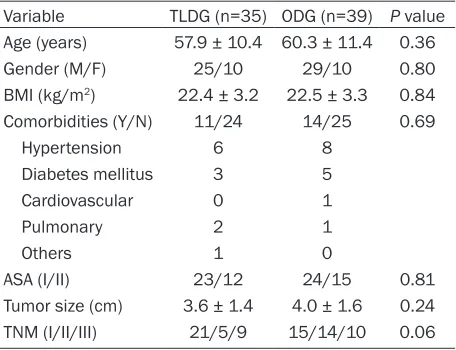
There was no significant difference between TLDG and ODG regarding age, sex, BMI, ASA, tumor size, and TNM stage. There were 35 cases (25 males and 10 females) included in the TLDG group with a mean age of 57.9 years,
Postoperative recovery
The time to ambulation, first flatus, restart oral intake, and LOS were significantly shorter in TLDG group than that in ODG group (P<0.01, Table 2). VSA scores were significantly lower in TLDG group than that in ODG group (P<0.05), in which only PO 24 h without reaching statistical significance (P=0.07). Meanwhile, the dosage of IPCAP was significantly lesser in TLDG group than that in ODG group at PO 24, 48 and 72 h. The postoperative VSA scores and dosage of painkiller were listed in Table 3.
[image:4.612.91.319.96.271.2]The rate of postoperative morbidity in TLDG group was 17.1% (6/35 patients), and there Table 1. Comparison of the clinicopathological
char-acteristics
Variable TLDG (n=35) ODG (n=39) P value Age (years) 57.9 ± 10.4 60.3 ± 11.4 0.36
Gender (M/F) 25/10 29/10 0.80
BMI (kg/m2) 22.4 ± 3.2 22.5 ± 3.3 0.84
Comorbidities (Y/N) 11/24 14/25 0.69
Hypertension 6 8
Diabetes mellitus 3 5
Cardiovascular 0 1
Pulmonary 2 1
Others 1 0
ASA (I/II) 23/12 24/15 0.81
Tumor size (cm) 3.6 ± 1.4 4.0 ± 1.6 0.24
TNM (I/II/III) 21/5/9 15/14/10 0.06
[image:4.612.91.319.351.507.2]M: male, F: female, Y: yes, N: no, BMI, body mass index, ASA: the American Society of Anesthesiologists, TNM: tumor-node-metastasis.
Table 2. Comparison of intraoperative effects and postoperative recovery
Variable TLDG (n=35) ODG (n=39) valueP Operation time (min) 206.5 ± 33.2 217.1 ± 33.7 0.18 Blood loss (mL) 110.3 ± 57.8 237.4 ± 74.9 <0.01
RLN 27.7 ± 8.1 30.6 ± 9.1 0.15
Proximal margin (cm) 5.8 ± 1.0 5.9 ± 1.3 0.74 Distal margin (cm) 5.4 ± 0.8 5.0 ± 1.8 0.23 Ambulation (days) 1.9 ± 0.7 2.4 ± 1.0 0.03 Flatus (days) 3.1 ± 0.8 3.9 ± 0.9 <0.01 Oral intake (days) 4.3 ± 0.9 5.4 ± 1.6 <0.01 LOS (days) 9.0 ± 2.5 10.8 ± 2.7 <0.01
Morbidity (yes/no) 6/29 6/33 0.84
RLN: retrieved lymph node, LOS: length of postoperative hospital stay.
whereas 39 cases (29 males and 10 fe- males) included in the ODG group with a mean age of 60.3 years. In the TLDG group, pathologic examination revealed 21 (60.0%) patients with stage I, 5 (14.3%) with stage II, and 9 (25.7%) patients with stage III tumors. In the ODG group, the numbers of patients with stage I, II, and III were 15 (38.5%), 14 (35.9%), and 10 (25.6%) respec-tively. Although the percentage of advanced cases was higher in ODG group, the differ-ence did not reach statistical significance (P=0.06). The clinicopathological character-istics of TLDG and ODG were summarized in Table 1.
Intraoperative effects
Compared with ODG, TLDG had compara-tive operacompara-tive time (206.5 ± 33.2 vs. 217.1 ± 33.7 min, P=0.18). The intraoperative blood loss was significantly less in TLDG group (110.3 ± 57.8 vs. 237.4 ± 74.9 ml, P<0.01). The difference in the mean num-ber of RLNs between TLDG and ODG was not significant (27.7 ± 8.1 vs. 30.6 ± 9.1, P=0.15), as were the length of proximal and distal resection margin. The outcomes of intraoperative effects were summarized in Table 2.
was no perioperative mortality. Incidences of morbidity included one case of anastomotic leakage at the gastrojejunostomy site (requir-ing an operative correction) and one case of hemorrhage from gastroduodenal artery (re- quiring an operation to stop the bleeding). Other complications included abdominal ab- scess (n=2), pulmonary infection (n=1), and hypoproteinemia (n=1). In ODG group, one case of delayed hemorrhage from hepatic artery required an emergency operation. Unfortu- nately, the patient died of disseminated intra-vascular coagulation (DIC) on PO 35 days. There was also a case of anastomotic leakage requiring an operative correction. Other compli-cations in ODG group included pulmonary infe- ction (n=3), wound infection (n=1), and delayed gastric emptying (n=1). The postoperative
mor-bidity was not statistic different between two groups (14.5% vs. 15.4%, P=0.84).
Blood gas analysis
The blood gas analysis after surgery comple-tion (0 h, 2 h, 6 h, 24 h) in the TLDG and ODG groups were listed in Table 4. The results showed that pH value and PaCO2 were all within the normal level, and there were no significant different in every points between two groups. Inflammatory responses
The change trends of WBC between the two groups were similar. WBC level was significantly increased, reaching the peak at PO 6 h, and then decreased gradually. The total WBC count was lower in the TLDG group than in the ODG group. As to every points, however, there were no statistically different except that the TLDG group in PO 6 h was significant lower than ODG group (P<0.05) (Figure 2A).
The change trend of NE% was similar to that of WBC. However, even though the NE% level of PO 0 h in the TLDG group was lower than that of in the ODG group, the difference was not statis-tically significant (P=0.06, Figure 2B).
[image:5.612.92.285.71.212.2]The increase of CRP was significant after sur-gery in both groups. The time of reaching the peak was PO 72 h and PO 24 h in the TLDG and ODG group, respectively. The difference was statistically significant in the TLDG group com-pared with that in the ODG group at PO 6 h and PO 24 h (P<0.05, Figure 2C).
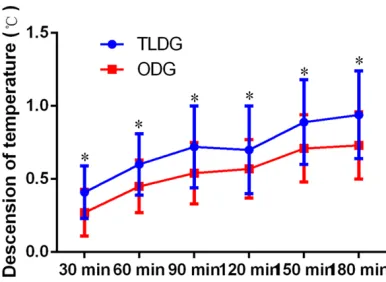
[image:5.612.323.521.95.244.2]Figure 1. Evaluation of the intraoperative changes in the body temperature. *P<0.05.
Table 3. Comparison of the postoperative VSA
scores and dosage of painkiller
Variable (n=35) TLDG ODG (n=39) P value VSA score
PO 24 h 2.7 ± 0.7 3.1 ± 1.1 0.07 PO 48 h 2.3 ± 0.5 2.6 ± 0.7 0.03 PO 72 h 2.1 ± 0.5 2.4 ± 0.8 <0.01 PO 96 h 1.8 ± 0.6 2.2 ± 0.5 <0.01 PO 120 h 1.6 ± 0.7 2.1 ± 0.5 <0.01 IPCAP usage (mL)
PO 24 h 34.1 ± 23.0 62.5 ± 39.8 <0.01 PO 48 h 24.0 ± 16.0 47.1 ± 31.4 <0.01 PO 72 h 9.5 ± 8.2 26.4 ± 28.2 <0.01
[image:5.612.90.302.288.444.2]PO: postoperative, VAS: visual analogue scale, IPCAP: intrave-nous patient-controlled analgesia pump.
Table 4. Comparison of blood gas analysis out-comes within postoperative 24 hours
Variable TLDG (n=35) ODG (n=39) P value pH
PO 0 h 7.37 ± 0.05 7.36 ± 0.04 0.86 PO 2 h 7.35 ± 0.03 7.35 ± 0.03 0.79 PO 6 h 7.36 ± 0.02 7.36 ± 0.03 0.84 PO 24 h 7.36 ± 0.04 7.36 ± 0.04 0.97 PaCO2 (mmHg)
PO 0 h 38.0 ± 5.5 37.9 ± 6.0 0.92 PO 2 h 39.9 ± 4.4 40.1 ± 4.4 0.80 PO 6 h 38.2 ± 3.5 37.9 ± 3.2 0.65 PO 24 h 38.5 ± 4.5 38.4 ± 4.2 0.97
The level in the two groups increased signifi-cantly after surgery, and peaked at PO 2 h and then decreased gradually. The level of increase was significantly lower in the TLDG group with ODG group. The difference of increased IL-6 was statistically significant in the TLDG group compared with ODG group at PO 0 h, 2 h, 6 h, and 24 h (P<0.05) (Figure 2D).
The level also peaked at PO 2 h in both group. Levels was significantly lower in the TLDG group comparing with ODG group at PO 0 h, 2 h, 6 h, and 24 h (P<0.05) (Figure 2E).
Recurrence and survival
The median follow-up period for the TLDG group was 68 (range, 13-83) months and 68 (range, 7-92) months for the ODG group. Two cases in TLDG group and three cases in ODG group we- re lost to follow-up assessment. Nine patients developed tumor recurrence in TLDG group, 3
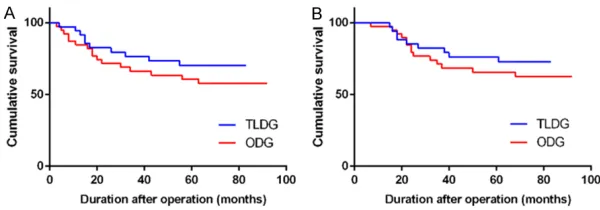
es other than gastric cancer. There were 16 cases of recurrence and 14 deaths in ODG group. The sites of recurrence were 5 (31.3%) peritoneal recurrence, 5 (31.3%) distant or hematogenous recurrence, 3 (18.8%) lymphat-ic recurrence and 3 (18.8%) locoregional recur-rence. The 3-y and 5-y DFS rate was 76.5% and 70.1% in TLDG, 66.3% and 60.5% in ODG (Figure 3A). The 3-y and 5-y OS rate was 82.2% and 76.2% in TLDG, 71.2% and 65.6% in ODG (Figure 3B). The differences of survival rates were not statistically significant between gr- oups (DFS, P=0.28; OS, P=0.39).
Discussion
[image:6.612.91.519.71.263.2]Totally laparoscopic distal gastrectomy (TLDG), which is characterized by an intracorporeal anastomosis without auxiliary incision and no contact with the tumor, is considered incision-less, with the exception of the trocar wounds. The available clinical evidences implied that
Figure 2. Evaluation of the postoperative inflammatory response changes: (A) WBC; (B) NE; (C) CRP; (D) 6; (E) IL-10. *P<0.05, **P<0.01.
Figure 3. Kaplan-Meier survival curves: (A) Cumulative DFS; (B) Cumulative OS.
[image:6.612.90.390.312.417.2]TLDG could be a feasible alternative to LADG for gastric cancer performed in experienced hands, especially favored in patients with a high body mass index [12-16]. Therefore, the present study was a prospective cohort study with long-term follow-up to provide a relatively objective evaluation of TLDG.
The intraoperative hypothermia exerts numer-ous adverse effects on recovery like inducing cardiovascular diseases, increasing the risk of wound infection and prolonging postoperative length of stay [17, 18]. ODG is a major abdomi-nal surgery with long-term exposure of organs in the air and consequently loss of heat. Meanwhile, some concerns of hypothermia also arise from laparoscopic surgery. First of all, prolonged duration of anesthesia is associ-ated with the severity of hypothermia [19]. Identical relationship was observed in both ODG and TLDG in our study. Laparoscopic sur-gery consumes longer operative time in set of most abdominal surgeries [20]. But in this study, TLDG could perform in a comparative time to ODG do. Pneumoperitoneum also re- sults in transitory retention of CO2, compensa-tive hyperventilation and heat loss. More impor-tantly, the gas would spill and take away heat during introduction and withdraw of laparo-scopic instruments and aspiration. As showed in research, the application of dry-cold CO2 was the primary cause, which was responsible for a great amount of heat loss [21]. Consequently, application of heated and humidified CO2 could effectively prevent the problem of body tem-perature decrease in laparoscopic surgery [22, 23]. Our study showed that in same operative time, patients underwent TLDG had higher reduction of temperature. The trend could be seen even only 30 min after the initiation of surgery, which had lasted until the completion of surgery. Therefore, we believed that TLDG was more likely to induce intraoperative hypo-thermia in the absence of insulation measure. Studies suggested that laparoscopic surgery would not lead to more severe hypothermia [24-26]. However in these studies, researchers mostly drew their conclusions based on simple surgeries like laparoscopic cholecystotomy (LC) or using intraoperative application of insulation measure in their study [24-26]. In later clinical practice, we take some insulation measure, including application of cutaneous warming sy- stems, avoidance of unnecessary aspiration.
Furthermore, continuous CO2 pneumoperitone-um might cause additional burden on pulmo-nary function. According to our experience, the intraoperative end-tidal CO2 (ETCO2) could be maintained within a normal range. Blood-gas was dynamically monitored in both groups within 24 h after surgery, and the results indi-cated that the differences in postoperative pH and PaCO2 between groups were not statisti-cally significant. Thus, it could be seen that a reasonable setting of ventilator contributed to completely eliminating the adverse effects of long-term CO2 pneumoperitoneum on pulmo-nary function. Chang et al. reported the chan- ges in ETCO2 and PaCO2 during LG were sig- nificant in patients comorbid with chronic ob- structive pulmonary disease (COPD) [27]. How- ever, in our study, there was no significant dif-ference in incidence of postoperative pulmo-nary complications between the laparoscopic or open surgery.
As to intraoperative effects and postoperative recovery, the present study demonstrated that blood loss, ambulation, time to flatus and oral intake in TLDG group were significantly supe- rior than that in ODG group, whereas operative time, morbidity and mortality, resection of lymph nodes and proximal resection margin were comparable between two groups. These findings met the majority studies of laparoscop-ic gastrlaparoscop-ic surgery [28-31]. Besides, in our opin-ion, the operative time of TLDG in experienced hands could be similar to ODG owing to the application of automatic staples in TLDG. In terms of postoperative pain, results indicated that pain control in TLDG group was superior even in the presence of reduced postoperative dosage of painkiller. It sufficiently suggested that TLDG possessed huge advantage in reliev-ing postoperative pain, which mainly benefited from its smaller surgical incision.
On the contrary, the differences between two groups were not significant postoperative 72 h. Cui et al. found no statistical differences be- tween laparoscopy-assisted gastrectomy (LAG) and OG for gastric cancer patients with respect to the levels of perioperative cytokines, such as IL-4, IL-6. However, cytokines in the LAG group had trends to return to preoperative levels fast-er than OG group [32]. Thfast-erefore, we believe that laparoscopic surgery could contribute to alleviating the inflammatory stress response in early time after surgery, but such advantage gradually disappeared with time passing due to the homeostasis system. In this study, postop-erative WBC count and NE% in both groups were also compared. The results revealed that WBC count and NE% in TLDG group were dis-tinctly lower than those in ODG immediately after surgery (PO 0 h), but no significant differ-ences could be seen between two groups at the remaining points. Okholm et al. in their review found that IL-6 and CRP were significant-ly reduced in laparoscopic patients compared to laparotomy for gastric cancer [33]. However, although most included studies reported low levels of WBC in laparoscopic patients, this result did not reach statistical significance. These studies suggested that when evaluating inflammatory stress level in patients, WBC and NE% can’t reflect the delicate difference as IL-6, IL-10 and CRP. In addition, Lee et al. report-ed that postoperative WBC and CRP level in the TLDG group were significantly lower than those in the LADG group for gastric cancer [34], which was different from our previous retrospective study [13]. Therefore, whether TLDG could fur-ther reduce inflammation compared to LADG need future research with more cytokines to confirm.
Cancer recurrence and long-term survival are two critical outcomes for evaluating surgical interventions in oncological therapy. The extent of lymph nodes dissection and the number of harvested lymph nodes are the main index to judge the curative effect. Researches including this study revealed that the laparoscopic approach was able to achieve the same out-comes both in early and advanced gastric can-cer [7, 8, 35, 36]. There was a concan-cern that pneumoperitoneum was a risk for recurrence of gastric cancer [37], especially in patients with serosa-invasived tumors [38]. On the other hand, Son et al. argued LG can safely applied in patients even with serosa-positive tumors [39].
Mo et al. conducted a meta-analysis of 20 ran-domized control studies (RCTs) and demon-strated pneumoperitoneum does not enhance wound metastases following various laparo-scopic abdominal surgeries [40]. In our study, we also found TLDG had a similar incisional recurrence risk as ODG. In addtion, it was reported that the immune function played an important role in the recovery, and prevent metastasis and recurrence [41]. Li et al. [42] reported laparoscopic surgery was associated with low IL-6, IL-8 secretion and less circulating tumor cells (CTCs), suggesting the advantag- es in restricting CTCs release and preserving immune response for hepatocellular carcino- ma (HCC) patients. Lee et al. [8] performed a retrospective study of 2410 patients compar-ing LADG with ODG for gastric cancer by pro-pensity-score matching analysis finding that 5-year OS rates were not significantly different. In our study, the median follow-up duration was as long as 68 months. We found that TLDG was not inferior to ODG without statistical signifi-cant in DFS or OS between the two groups. Our study shows that TLDG is associated with the advantages of minimal surgical trau-ma, milder acute inflammatory response and quicker function recovery. Pneumoperitoneum doesn’t have an adverse effect in patients’ pul-monary function and oncological outcomes. However, regarding the inherent limitation of our study, well designed large scale random-ized study is needed to further confirm the ad- vantages of TLDG.
Acknowledgements
This research was supported by Medical and health technology project of Zhejiang Province (grant No. 2014KYB138).
Disclosure of conflict of interest
None.
Abbreviations
reac-tive protein; IL, Interleukin; TNM, Tumor-node-metastasis; IPCAP, Intravenous patient-contro- lled analgesia pump; PO, Postoperative; VAS, Visual analogue scale; h, hour; pre, Preoperative; EDTA, Ethylene diamine tetraacetic acid; OD, Optical density; HRP, Horseradish peroxidase; TPN, total parenteral nutrition; 5-FU, 5-fluorou- racil; SD, Standard deviation; DFS, Disease-free survival; OS, Overall survival; LC, Laparo- scopic cholecystotomy; ETCO2, End-tidal CO2; COPD, Chronic obstructive pulmonary disease; LAG, Laparoscopy-assisted gastrectomy; RCT, Randomized control study; CTC, Circulating tu- mor cell; HCC, hepatocellular carcinoma.
Address correspondence to: Jiafei Yan, Department of Gastrointestinal Surgery, Sir Run Run Shaw Hospital, School of Medicine, Zhejiang University, 3 East Qingchun Road, Hangzhou 310016, China. Tel: +86-15088687865; E-mail: [email protected]
References
[1] Torre LA, Bray F, Siegel RL, Ferlay J, Lortet-Tieu-lent J and Jemal A. Global cancer statistics, 2012. CA Cancer J Clin 2015; 65: 87-108. [2] Songun I, Putter H, Kranenbarg EM, Sasako M
and van de Velde CJ. Surgical treatment of gas-tric cancer: 15-year follow-up results of the randomised nationwide Dutch D1D2 trial. Lan-cet Oncol 2010; 11: 439-449.
[3] Chen K, Xu XW, Mou YP, Pan Y, Zhou YC, Zhang RC and Wu D. Systematic review and meta-analysis of laparoscopic and open gastrectomy for advanced gastric cancer. World J Surg On-col 2013; 11: 182.
[4] Best LM, Mughal M and Gurusamy KS. Laparo-scopic versus open gastrectomy for gastric cancer. Cochrane Database Syst Rev 2016; 3: CD011389.
[5] Chen K, Pan Y, Zhai ST, Yu WH, Pan JH, Zhu YP, Chen QL and Wang XF. Totally laparoscopic ver-sus open total gastrectomy for gastric cancer: a case-matched study about short-term out-comes. Medicine 2017; 96: 0000000000- 008061.
[6] Kim YW, Yoon HM, Yun YH, Nam BH, Eom BW, Baik YH, Lee SE, Lee Y, Kim YA, Park JY and Ryu KW. Long-term outcomes of laparoscopy-assisted distal gastrectomy for early gastric cancer: result of a randomized controlled trial (COACT 0301). Surg Endosc 2013; 27: 4267-4276.
[7] Wang W, Chen K, Xu XW, Pan Y and Mou YP. Case-matched comparison of laparoscopy-as-sisted and open distal gastrectomy for gastric cancer. World J Gastroenterol 2013; 19: 3672-3677.
[8] Lee JH, Nam BH, Ryu KW, Ryu SY, Kim YW, Park YK and Kim S. Comparison of the long-term results of patients who underwent lapa-roscopy versus open distal gastrectomy. Surg Endosc 2016; 30: 430-436.
[9] Japanese Gastric Cancer Association. Japa-nese gastric cancer treatment guidelines 2010 (ver. 3). Gastric Cancer 2011; 14: 113-123. [10] Chen K, Xu X, Mou Y, Pan Y, Zhang R, Zhou Y,
Wu D and Huang C. Totally laparoscopic distal gastrectomy with D2 lymphadenectomy and Billroth II gastrojejunostomy for gastric cancer: short- and medium-term results of 139 con-secutive cases from a single institution. Int J Med Sci 2013; 10: 1462-1470.
[11] Chen K, Wu D, Pan Y, Cai JQ, Yan JF, Chen DW, Maher H and Mou YP. Totally laparoscopic gas-trectomy using intracorporeally stapler or hand-sewn anastomosis for gastric cancer: a single-center experience of 478 consecutive cases and outcomes. World J Surg Oncol 2016; 14: 016-0868.
[12] Kim MG, Kawada H, Kim BS, Kim TH, Kim KC and Yook JH. A totally laparoscopic distal gas -trectomy with gastroduodenostomy (TLDG) for improvement of the early surgical outcomes in high BMI patients. Surg Endosc 2011; 25: 1076-1082.
[13] Chen K, Mou YP, Xu XW, Pan Y, Zhou YC, Cai JQ and Huang CJ. Comparison of short-term surgi-cal outcomes between totally laparoscopic and laparoscopic-assisted distal gastrectomy for gastric cancer: a 10-y single-center experience with meta-analysis. J Surg Res 2015; 194: 367-374.
[14] Chen K, He Y, Cai JQ, Pan Y, Wu D, Chen DW, Yan JF, Maher H and Mou YP. Comparing the short-term outcomes of intracorporeal esoph-agojejunostomy with extracorporeal esophago-jejunostomy after laparoscopic total gastrecto-my for gastric cancer. BMC Surg 2016; 16: 13. [15] Chen K, Pan Y, Zhai ST, Cai JQ, Chen QL, Chen
DW, Zhu YP, Zhang Y, Zhang YP, Maher H and Wang XF. Laparoscopic gastrectomy in obese gastric cancer patients: a comparative study with non-obese patients and evaluation of dif-ference in laparoscopic methods. BMC Gastro-enterol 2017; 17: 78.
[16] Chen K, Pan Y, Yu WH, Zheng XY, Zhu LH and Wang XF. Application of laparoscopic gastrec-tomy in obese patients (BMI≥30 kg/m2) with gastric cancer: a comparison with open gas-trectomy regarding short-term outcomes. Surg Laparosc Endosc Percutan Tech 2018; 28: e18-e23.
[18] Billeter AT, Hohmann SF, Druen D, Cannon R and Polk HC Jr. Unintentional perioperative hy -pothermia is associated with severe complica-tions and high mortality in elective operacomplica-tions. Surgery 2014; 156: 1245-1252.
[19] Yang L, Huang CY, Zhou ZB, Wen ZS, Zhang GR, Liu KX and Huang WQ. Risk factors for hypo -thermia in patients under general anesthesia: Is there a drawback of laminar airflow operat -ing rooms? A prospective cohort study. Int J Surg 2015; 21: 14-17.
[20] Chen K, Pan Y, Liu XL, Jiang GY, Wu D, Maher H and Cai XJ. Minimally invasive pancreaticoduo-denectomy for periampullary disease: a com-prehensive review of literature and meta-anal-ysis of outcomes compared with open surgery. BMC Gastroenterol 2017; 17: 017-0691. [21] Bashirov E, Cetiner S, Emre M, Seydaliyeva T,
Alic V, Daglioglu K, Ozalevli M, San M and Top-cuoglu MS. A randomized controlled study evaluating the effects of the temperature of insufflated CO2 on core body temperature and blood gases (an experimental study). Surg En-dosc 2007; 21: 1820-1825.
[22] Sajid MS, Mallick AS, Rimpel J, Bokari SA, Cheek E and Baig MK. Effect of heated and hu -midified carbon dioxide on patients after lapa -roscopic procedures: a meta-analysis. Surg Laparosc Endosc Percutan Tech 2008; 18: 539-546.
[23] Peng Y, Zheng M, Ye Q, Chen X, Yu B and Liu B. Heated and humidified CO2 prevents hypo -thermia, peritoneal injury, and intra-abdominal adhesions during prolonged laparoscopic in-sufflations. J Surg Res 2009; 151: 40-47. [24] Stewart BT, Stitz RW, Tuch MM and Lumley JW.
Hypothermia in open and laparoscopic colorec-tal surgery. Dis Colon Rectum 1999; 42: 1292-1295.
[25] Berber E, String A, Garland A, Engle KL, Kim KM, Ituarte P and Siperstein AE. Intraoperative thermal regulation in patients undergoing lap-aroscopic vs open surgical procedures. Surg Endosc 2001; 15: 281-285.
[26] Nguyen NT, Fleming NW, Singh A, Lee SJ, Gold-man CD and Wolfe BM. Evaluation of core tem-perature during laparoscopic and open gastric bypass. Obes Surg 2001; 11: 570-575. [27] Chang HM, Lee SW, Nomura E and Tanigawa
N. Laparoscopic versus open gastrectomy for gastric cancer patients with COPD. J Surg On-col 2009; 100: 456-458.
[28] Lee JH, Park DJ, Kim HH, Lee HJ and Yang HK. Comparison of complications after laparosco-py-assisted distal gastrectomy and open distal gastrectomy for gastric cancer using the Cla-vien-Dindo classification. Surg Endosc 2012; 26: 1287-1295.
[29] Yasunaga H, Horiguchi H, Kuwabara K, Matsu-da S, Fushimi K, Hashimoto H and Ayanian JZ. Outcomes after laparoscopic or open distal gastrectomy for early-stage gastric cancer: a propensity-matched analysis. Ann Surg 2013; 257: 640-646.
[30] Oh SY, Kwon S, Lee KG, Suh YS, Choe HN, Kong SH, Lee HJ, Kim WH and Yang HK. Outcomes of minimally invasive surgery for early gastric cancer are comparable with those for open surgery: analysis of 1,013 minimally invasive surgeries at a single institution. Surg Endosc 2014; 28: 789-795.
[31] Kim W, Kim HH, Han SU, Kim MC, Hyung WJ, Ryu SW, Cho GS, Kim CY, Yang HK, Park DJ, Song KY, Lee SI, Ryu SY, Lee JH and Lee HJ. Decreased morbidity of laparoscopic distal gastrectomy compared with open distal gas-trectomy for stage I gastric cancer: short-term outcomes from a multicenter randomized con-trolled trial (KLASS-01). Ann Surg 2016; 263: 28-35.
[32] Cui M, Gong C, Jiang B, Yao Z, Chen L, Di J, Xing J, Yang H, Zhang C, Zhang N, Liu M, Tan F, Wang Z and Su X. Evaluation of immune re-sponses of gastric cancer patients treated by laparoscopic and open gastrectomy. Med On-col 2015; 32: 253.
[33] Okholm C, Goetze JP, Svendsen LB and Achiam MP. Inflammatory response in laparoscopic vs. open surgery for gastric cancer. Scand J Gas-troenterol 2014; 49: 1027-1034.
[34] Lee SH, Kim IH, Kwak SG and Chae HD. Com -parison of short-term outcomes and acute in-flammatory response between laparoscopy-assisted and totally laparoscopic distal gas- trectomy for early gastric cancer. Ann Surg Treat Res 2015; 89: 176-182.
[35] Park YK, Yoon HM, Kim YW, Park JY, Ryu KW, Lee YJ, Jeong O, Yoon KY, Lee JH, Lee SE, Yu W, Jeong SH, Kim T, Kim S, Nam BH; COACT group. Laparoscopy-assisted versus open D2 distal gastrectomy for advanced gastric cancer: re-sults from a randomized phase II multicenter clinical trial (COACT 1001). Ann Surg 2018; 267: 638-645.
[36] Kawase H, Ebihara Y, Shichinohe T, Nakamura F, Murakawa K, Morita T, Okushiba S and Hira -no S. Long-term outcome after laparoscopic gastrectomy: a multicenter retrospective study. Langenbecks Arch Surg 2017; 402: 41-47. [37] Lee J and Kim W. Long-term outcomes after
laparoscopy-assisted gastrectomy for advanc- ed gastric cancer: analysis of consecutive 106 experiences. J Surg Oncol 2009; 100: 693-698.
change in pathologic subserosa-limited gastric cancer. World J Surg 2012; 36: 355-361. [39] Son T, Hyung WJ, Lee JH, Kim YM and Noh SH.
Minimally invasive surgery for serosa-positive gastric cancer (pT4a) in patients with preoper-ative diagnosis of cancer without serosal inva-sion. Surg Endosc 2014; 28: 866-874. [40] Mo X, Yang Y, Lai H, Xiao J, He K, Chen J and Lin
Y. Does carbon dioxide pneumoperitoneum en-hance wound metastases following laparo-scopic abdominal tumor surgery? A meta-anal-ysis of 20 randomized control studies. Tumour Biol 2014; 35: 7351-7359.
[41] Sylla P, Kirman I and Whelan RL. Immunologi-cal advantages of advanced laparoscopy. Surg Clin North Am 2005; 85: 1-18, vii.