Paradigmatic Modifiability Statistics for the Extraction
of Complex Multi-Word Terms
Joachim Wermter Jena University
Language & Information Engineering JULIELab
Friedrich-Schiller-Universit¨at Jena F¨urstengraben 30
D-07743 Jena, Germany [email protected]
Udo Hahn Jena University
Language & Information Engineering JULIELab
Friedrich-Schiller-Universit¨at Jena F¨urstengraben 30
D-07743 Jena, Germany [email protected]
Abstract
We here propose a new method which sets apart domain-specific terminology from common non-specific noun phrases. It is based on the observation that termino-logical multi-word groups reveal a con-siderably lesser degree of distributional variation than non-specific noun phrases. We define a measure for the observable amount of paradigmatic modifiability of terms and, subsequently, test it on bigram, trigram and quadgram noun phrases ex-tracted from a 104-million-word biomedi-cal text corpus. Using a community-wide curated biomedical terminology system as an evaluation gold standard, we show that our algorithm significantly outperforms a variety of standard term identification measures. We also provide empirical ev-idence that our methodolgy is essentially domain- and corpus-size-independent.
1 Introduction
As we witness the ever-increasing proliferation of volumes of medical and biological documents, the available dictionaries and terminological systems cannot keep up with this pace of growth and, hence, become more and more incomplete. What’s worse, the constant stream of new terms is increasingly get-ting unmanageable because human curators are in the loop. The costly, often error-prone and time-consuming nature of manually identifying new ter-minology from the most recent literature calls for
advanced procedures which can automatically assist database curators in the task of assembling, updat-ing and maintainupdat-ing domain-specific controlled vo-cabularies. Whereas the recognition of single-word terms usually does not pose any particular chal-lenges, the vast majority of biomedical or any other domain-specific terms typically consists of multi-word units.1 Unfortunately these are much more
difficult to recognize and extract than their singleton counterparts. Moreover, although the need to assem-ble and extend technical and scientific terminologies is currently most pressing in the biomedical domain, virtually any (sub-)field of human research/expertise in which we deal with terminologically structured knowledge calls for high-performance terminology identification and extraction methods. We want to target exactly this challenge.
2 Related Work
The automatic extraction of complex multi-word terms from domain-specific corpora is already an active field of research (cf., e.g., for the biomedi-cal domain Rindflesch et al. (1999), Collier et al. (2002), Bodenreider et al. (2002), or Nenadi´c et al. (2003)). Typically, in all of these approaches term candidates are collected from texts by vari-ous forms of linguistic filtering (part-of-speech tag-ging, phrase chunking, etc.), through which candi-dates obeying various linguistic patterns are iden-tified (e.g., noun-noun, adjective-noun-noun com-binations). These candidates are then submitted to frequency- or statistically-based evidence measures
1Nakagawa and Mori (2002) claim that more than 85% of domain-specific terms are multi-word units.
(such as the C-value (Frantzi et al., 2000)), which compute scores indicating to what degree a candi-date qualifies as a term. Term mining, as a whole, is a complex process involving several other com-ponents (orthographic and morphological normal-ization, acronym detection, conflation of term vari-ants, term context, term clustering; cf. Nenadi´c et al. (2003)). Still, the measure which assigns atermhood value to a term candidate is the essential building block of any term identification system.
For multi-word automatic term recognition (ATR), the C-value approach (Frantzi et al., 2000; Nenadi´c et al., 2004), which aims at improving the extraction of nested terms, has been one of the most widely used techniques in recent years. Other po-tential association measures are mutual information (Damerau, 1993) and the whole battery of statisti-cal and information-theoretic measures (t-test, log-likelihood, entropy) which are typically employed for the extraction of general-language collocations (Manning and Sch¨utze, 1999; Evert and Krenn, 2001). While these measures have their statistical merits in terminology identification, it is interesting to note that they only make little use of linguistic properties inherent to complex terms.2
More linguistically oriented work on ATR by Daille (1996) or on term variation by Jacquemin (1999) builds on the deep syntactic analysis of term candidates. This includes morphological and head-modifier dependency analysis and thus presupposes accurate, high-quality parsing which, for sublan-guages at least, can only be achieved by a highly domain-dependent type of grammar. As sublan-guages from different domains usually reveal a high degree of syntactic variability among each other (e.g., in terms of POS distribution, syntactic pat-terns), this property makes it difficult to port gram-matical specifications to different domains.
Therefore, one may wonder whether there are cross-domain linguistic properties which might be beneficial to ATR and still could be accounted for by only shallow syntactic analysis. In this paper, we propose thelimited paradigmatic modifiabilityof terms as a criterion which meets these requirements and will elaborate on it in detail in Subsection 3.3.
2A notable exception is the C-value method which incorpo-rates a term’s likelihood of being nested in other multi-word units.
3 Methods and Experiments
3.1 Text Corpus
We collected a biomedical training corpus of ap-proximately 513,000 MEDLINE abstracts using the following query composed of MESH terms from the biomedical domain: transcription factors,blood cells and human.3 We then annotated the
result-ing 104-million-word corpus with the GENIA part-of-speech tagger4and identified noun phrases (NPs)
with the YAMCHAchunker (Kudo and Matsumoto, 2001). We restrict our study to NP recognition (i.e., determining the extension of a noun phrase but refraining from assigning any internal constituent structure to that phrase), because the vast majority of technical or scientific terms surface as noun phrases (Justeson and Katz, 1995). We filtered out a num-ber of stop words (determiners, pronouns, measure symbols, etc.) and also ignored noun phrases with coordination markers (“and”,“or”, etc.).5
n-gram cut-off NP term candidates
length tokens types
no cut-off 5,920,018 1,055,820
bigrams c≥10 4,185,427 67,308
no cut-off 3,110,786 1,655,440
trigrams c≥8 1,053,651 31,017
no cut-off 1,686,745 1,356,547
[image:2.612.325.526.334.426.2]quadgrams c≥6 222,255 10,838
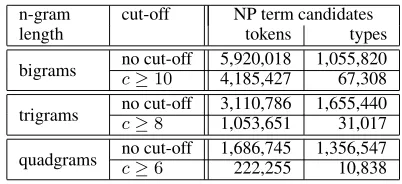
Table 1: Frequency distribution for noun phrase term candi-date tokens and types for the MEDLINEtext corpus
In order to obtain the term candidate sets (see Ta-ble 1), we counted the frequency of occurrence of noun phrases in our training corpus and categorized them according to their length. For this study, we re-stricted ourselves to noun phrases of length 2 (word bigrams), length 3 (word trigrams) and length 4 (word quadgrams). Morphological normalization of term candidates has shown to be beneficial for ATR (Nenadi´c et al., 2004). We thus normalized the
nom-3MEDLINE(http://www.ncbi.nlm.nih.gov) is the largest biomedical bibliographic database. For information re-trieval purposes, all of its abstracts are indexed with a controlled indexing vocabulary, theMedical Subject Headings (MESH, 2004).
4http://www-tsujii.is.s.u-tokyo.ac.jp/
GENIA/postagger/
inal head of each noun phrase (typically the right-most noun in English) via the full-form UMLSSPE -CIALISTLEXICON(UMLS, 2004), a large repository of both general-language and domain-specific (med-ical) vocabulary. To eliminate noisy low-frequency data (cf. also Evert and Krenn (2001)), we defined different frequency cut-off thresholds, c, for the bi-gram, trigram and quadgram candidate sets and only considered candidates above these thresholds.
3.2 Evaluating Term Extraction Quality
Typically, terminology extraction studies evaluate the goodness of their algorithms by having their ranked output examined by domain experts who identify the true positives among the ranked can-didates. There are several problems with such an approach. First, very often only one such expert is consulted and, hence, inter-annotator agreement cannot be determined (as, e.g., in the studies of Frantzi et al. (2000) or Collier et al. (2002)). Fur-thermore, what constitutes a relevant term for a par-ticular domain may be rather difficult to decide – even for domain experts – when judges are just ex-posed to a list of candidates without any further con-text information. Thus, rather than relying on ad hochuman judgment in identifying true positives in a candidate set, as an alternative we may take al-ready existing terminolgical resources into account. They have evolved over many years and usually re-flect community-wide consensus achieved by expert committees. With these considerations in mind, the biomedical domain is an ideal test bed for evaluat-ing the goodness of ATR algorithms because it hosts one of the most extensive and most carefully curated terminological resources, viz. the UMLSMETATHE -SAURUS (UMLS, 2004). We will then take the mere existence of a term in the UMLSas the decision cri-terion whether or not a candidate term is also recog-nized as a biomedical term.
Accordingly, for the purpose of evaluating the quality of different measures in recognizing multi-word terms from the biomedical literature, we as-sign every word bigram, trigram, and quadgram in our candidate sets (see Table 1) the status of being a term (i.e., a true positive), if it is found in the 2004 edition of the UMLS METATHESAURUS.6 For
6We exclude UMLSvocabularies not relevant for molecular biology, such as nursing and health care billing codes.
example, the word trigram “long terminal repeat”
is listed as a term in one of the UMLS vocabular-ies, viz. MESH (2004), whereas “t cell response” is not. Thus, among the 67,308 word bigram candi-date types, 14,650 (21.8%) were identified as true terms; among the 31,017 word trigram candidate types, their number amounts to 3,590 (11.6%), while among the 10,838 word quadgram types, 873 (8.1%) were identified as true terms.7
3.3 Paradigmatic Modifiability of Terms
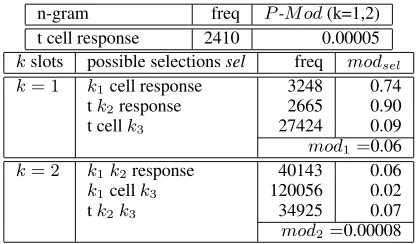
For most standard association measures utilized for terminology extraction, the frequency of occurrence of the term candidates either plays a major role (e.g., C-value), or has at least a significant impact on the assignment of the degree of termhood (e.g., t-test). However, frequency of occurrence in a train-ing corpus may be misleadtrain-ing regardtrain-ing the deci-sion whether or not a multi-word expresdeci-sion is a term. For example, taking the two trigram multi-word expressions from the previous subsection, the non-term “t cell response” appears 2410 times in our 104-million-word MEDLINE corpus, whereas the term “long terminal repeat” (long repeating se-quences of DNA) only appears 434 times (see also Tables 2 and 3 below).
The linguistic property around which we built our measure of termhood is the limited paradigmatic modifiabilityof multi-word terminological units. A multi-word expression such as “long terminal re-peat” contains three token slots in which slot 1 is filled by “long”, slot 2 by “terminal” and slot 3 by “repeat”. Thelimited paradigmatic modifiability of such a trigram is now defined by the probability with which one or more such slots cannot be filled by other tokens. We estimate the likelihood of preclud-ing the appearance of alternative tokens in particular slot positions by employing the standard combina-tory formula without repetitions. For an n-gram (of sizen) to select kslots (i.e., in an unordered selec-tion) we thus define:
C(n, k) = n!
k!(n−k)! (1)
For example, forn= 3(word trigram) andk= 1
and k = 2 slots, there are three possible selections
for eachkfor “long terminal repeat” and for “t cell
response” (see Tables 2 and 3).kis actually a place-holder for any possible token (and its frequency) which fills this position in the training corpus.
n-gram freq P-M od(k=1,2)
long terminal repeat 434 0.03 kslots possible selectionssel freq modsel
k= 1 k1terminal repeat 460 0.940
longk2repeat 448 0.970
long terminalk3 436 0.995 mod1=0.91
k= 2 k1k2repeat 1831 0.23
k1terminalk3 1062 0.41
longk2k3 1371 0.32
[image:4.612.83.289.155.276.2]mod2=0.03
Table 2: P-M odandk-modifiabilities fork = 1andk = 2 for the trigram term“long terminal repeat”
n-gram freq P-M od(k=1,2)
t cell response 2410 0.00005
kslots possible selectionssel freq modsel
k= 1 k1cell response 3248 0.74
tk2response 2665 0.90
t cellk3 27424 0.09
mod1=0.06
k= 2 k1k2response 40143 0.06
k1cellk3 120056 0.02
tk2k3 34925 0.07
mod2=0.00008
Table 3: P-M odandk-modifiabilities fork = 1andk = 2 for the trigram non-term“t cell response”
Now, for a particulark(1≤k ≤n;n= length of n-gram), the frequency of each possible selection, sel, is determined. The paradigmatic modifiability for a particular selection sel is then defined by the n-gram’s frequency scaled against the frequency of sel. As can be seen in Tables 2 and 3, alower fre-quency induces amore limitedparadigmatic modifi-ability for a particular sel (which is, of course, ex-pressed as a higher probability value; see the column labeledmodsel in both tables). Thus, with sbeing
the number of distinct possible selections for a par-ticular k, the k-modifiability, modk, of an n-gram
can be defined as follows (f stands for frequency):
modk(n-gram) := s
Y
i=1
f(n-gram)
f(seli, n-gram) (2)
Theparadigmatic modifiability,P-M od, of an n-gram is the product of all its k-modifiabilities:8
P-M od(n-gram) := n
Y
k=1
modk(n-gram) (3)
Comparing the trigram P-M od values for k = 1,2 in Tables 2 and 3, it can be seen that the term
“long terminal repeat” gets a much higher weight than the non-term “t cell response”, although their mere frequency values suggest the opposite. This is also reflected in the respective list rank (see Subsec-tion 4.1 for details) assigned to both trigrams by the t-test and by ourP-M odmeasure. While “t cell
re-sponse” has rank 24 on the t-test output list (which directly reflects its high frequency),P-M odassigns rank 1249 to it. Conversely, “long terminal repeat” is ranked on position 242 by the t-test, whereas it occupies rank 24 forP-M od. In fact, even lower-frequency multi-word units gain a prominent rank-ing, if they exhibit limited paradigmatic modifiabil-ity. For example, the trigram term “porphyria cu-tanea tarda” is ranked on position 28 by P-M od, although its frequency is only 48 (which results in rank 3291 on the t-test output list). Despite its lower frequency, this term is judged as being relevant for the molecular biology domain.9 It should be noted
that the termhood values (and the corresponding list ranks) computed byP-M odalso includek = 3and,
hence, take into account a reasonable amount of fre-quency load. As can be seen from the previous rank-ing examples, still this factor does not override the paradigmatic modifiability factors of the lowerks.
On the other hand,P-M odwill also demote true terms in their ranking, if their paradigmatic modifi-ability is less limited. This is particularly the case if one or more of the tokens of a particular term often occur in the same slot of other equal-length n-grams. For example, the trigram term“bone marrow cell”
occurs 1757 times in our corpus and is thus ranked quite high (position 31) by the t-test.P-M od, how-ever, ranks this term on position 550 because the
to-8Setting the upper limit ofkton(e.g.,n= 3for trigrams) actually has the pleasant side effect of including frequency in our modifiability measure. In this case, the only possible selec-tionk1k2k3as the denominator of Formula (2) is equivalent to summing up the frequencies of all trigram term candidates.
[image:4.612.81.291.324.446.2]ken “cell” also occurs in many other trigrams and thus leads to a less limited paradigmatic modifiabil-ity. Still, the underlying assumption of our approach is that such a case is more an exception than the rule and that terms are linguistically more ‘frozen’ than non-terms, which is exactly the intuition behind our measure of limited paradigmatic modifiability.
3.4 Methods of Evaluation
As already described in Subsection 3.2, standard procedures for evaluating the quality of termhood measures usually involve identifying the true posi-tives among a (usually) arbitrarily set number of the mhighest ranked candidates returned by a particu-lar measure, a procedure usually carried out by a do-main expert. Because this is labor-intensive (besides being unreliable), mis usually small, ranging from 50 to several hundreds.10 By contrast, we choose
a large and already consensual terminology to iden-tify the true terms in our candidate sets. Thus, we are able to dynamically examine various m-highest ranked samples, which, in turn, allows for the plot-ting of standard precision and recall graphs for the entire candidate set. We thus provide a more reli-able evaluation setting for ATR measures than what is common practice in the literature.
We compare our P-M od algorithm against the t-test measure,11 which, of all standard measures,
yields the best results in general-language collo-cation extraction studies (Evert and Krenn, 2001), and also against the widely used C-value, which aims at enhancing the common frequency of occur-rence measure by making it sensitive to nested terms (Frantzi et al., 2000). Our baseline is defined by the proportion of true positives (i.e., the proportion of terms) in our bi-, tri- and quadgram candidate sets. This is equivalent to the likelihood of finding a true positive by blindly picking from one of the different sets (see Subsection 3.2).
10Studies on collocation extraction (e.g., by Evert and Krenn (2001)) also point out the inadequacy of such evaluation meth-ods. In essence, they usually lead to very superficial judgments about the measures under scrutiny.
11Manning and Sch¨utze (1999) describe how this measure can be used for the extraction of multi-word expressions.
4 Results and Discussion
4.1 Precision/Recall for Terminology Extraction
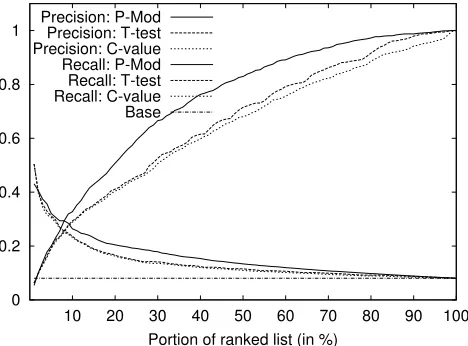
For each of the different candidate sets, we incre-mentally examined portions of the ranked output lists returned by each of the three measures we con-sidered. The precision values for the various por-tions were computed such that for each percent point of the list, the number of true positives found (i.e., the number of terms) was scaled against the overall number of candidate items returned. This yields the (descending) precision curves in Figures 1, 2 and 3 and some associated values in Table 4.
Portion of Precisionscores of measures ranked list
considered P-M od t-test C-value
1% 0.82 0.62 0.62
Bigrams 10% 0.53 0.42 0.41
20% 0.42 0.35 0.34
30% 0.37 0.32 0.31
baseline 0.22 0.22 0.22
1% 0.62 0.55 0.54
Trigrams 10% 0.37 0.29 0.28
20% 0.29 0.23 0.23
30% 0.24 0.20 0.19
baseline 0.12 0.12 0.12
1% 0.43 0.50 0.50
Quadgrams 10% 0.26 0.24 0.23
20% 0.20 0.16 0.16
30% 0.18 0.14 0.14
[image:5.612.313.540.236.423.2]baseline 0.08 0.08 0.08
Table 4: Precision scores for biomedical term extraction at selected portions of the ranked list
0 0.2 0.4 0.6 0.8 1
100 90 80 70 60 50 40 30 20 10
Portion of ranked list (in %) Precision: P-Mod
[image:6.612.74.305.51.226.2]Precision: T-test Precision: C-value Recall: P-Mod Recall: T-test Recall: C-value Base
Figure 1:Precision/Recall for bigram biomedical term extrac-tion
0 0.2 0.4 0.6 0.8 1
100 90 80 70 60 50 40 30 20 10
Portion of ranked list (in %) Precision: P-Mod
[image:6.612.318.534.197.387.2]Precision: T-test Precision: C-value Recall: P-Mod Recall: T-test Recall: C-value Base
Figure 2: Precision/Recall for trigram biomedical term ex-traction
0 0.2 0.4 0.6 0.8 1
100 90 80 70 60 50 40 30 20 10
Portion of ranked list (in %) Precision: P-Mod
Precision: T-test Precision: C-value Recall: P-Mod Recall: T-test Recall: C-value Base
Figure 3:Precision/Recall for quadgram biomedical term ex-traction
The (ascending) recall curves in Figures 1, 2 and 3 and their corresponding values in Table 5 indicate whichproportion of all true positives (i.e., the pro-portion of all terms in a candidate set) is identified by a particular measure at a certain point of the ranked list. For term extraction, recall is an even better indi-cator of a particular measure’s performance because finding a bigger proportion of the true terms at an early stage is simply more economical.
Recall Portion of Ranked List scores of
measures P-M od t-test C-value
0.5 29% 35% 37%
0.6 39% 45% 47%
Bigrams 0.7 51% 56% 59%
0.8 65% 69% 72%
0.9 82% 83% 85%
0.5 19% 28% 30%
Trigrams 0.6 27% 38% 40%
0.7 36% 50% 53%
0.8 50% 63% 66%
0.9 68% 77% 84%
0.5 20% 28% 30%
0.6 26% 38% 40%
Quadgrams 0.7 34% 49% 53%
0.8 45% 62% 65%
0.9 61% 79% 82%
Table 5: Portions of the ranked list to consider for selected recall scores for biomedical term extraction
[image:6.612.72.304.276.451.2] [image:6.612.73.307.500.673.2](P-M od) to 63% (t-test), and at recall point 0.9, 68% (P-M od) to 77% (t-test). For quadgram term identification, the results forP-M odare equally su-perior to those for the other measures, and at recall points 0.8 and 0.9 even more pronounced than for trigram terms.
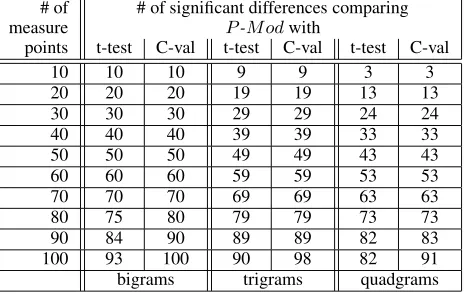
We also tested the significance of differences for these results, both comparing P-M odvs.t-test and P-M odvs.C-value. Because in all cases the ranked lists were taken from the same set of candidates (viz.
the set of bigram, trigram, and quadgram candidate types), and hence constitute dependent samples, we applied the McNemar test (Sachs, 1984) for statis-tical testing. We selected 100 measure points in the ranked lists, one after each increment of one percent, and then used the two-tailed test for a confidence in-terval of 95%. Table 6 lists the number of significant differences for these measure points at intervals of 10 for the , tri-, and quadgram results. For the bi-gram differences between P-M odand C-value, all of them are significant, and between P-M od and t-test, all are significantly different up to measure point 70.12 Looking at the tri- and quadgrams,
al-though the number of significant differences is less than for bigrams, the vast majority of measure points is still significantly different and thus underlines the superior performance of theP-M odmeasure.
# of # of significant differences comparing
measure P-M odwith
points t-test C-val t-test C-val t-test C-val
10 10 10 9 9 3 3
20 20 20 19 19 13 13
30 30 30 29 29 24 24
40 40 40 39 39 33 33
50 50 50 49 49 43 43
60 60 60 59 59 53 53
70 70 70 69 69 63 63
80 75 80 79 79 73 73
90 84 90 89 89 82 83
100 93 100 90 98 82 91
[image:7.612.316.546.257.433.2]bigrams trigrams quadgrams
Table 6: Significance testing of differences for bi-, tri- and quadgrams using the two-tailed McNemar test at 95% confi-dence interval
12As can be seen in Figures 1, 2 and 3, the curves start to merge at the higher measure points and, thus, the number of significant differences decreases.
4.2 Domain Independence and Corpus Size
One might suspect that the results reported above could be attributed to the corpus size. Indeed, the text collection we employed in this study is rather large (104 million words). Other text genres and do-mains (e.g., clinical narratives, various engineering domains) or even more specialized biological sub-domains (e.g., plant biology) do not offer such a plethora of free-text material as the molecular biol-ogy domain. To test the effect a drastically shrunken corpus size might have, we assessed the terminology extraction methods for trigrams on a much smaller-sized subset of our original corpus,viz.on 10 million words. These results are depicted in Figure 4.
0 0.2 0.4 0.6 0.8 1
100 90 80 70 60 50 40 30 20 10
Portion of ranked list (in %) Precision: P-Mod
[image:7.612.68.300.448.595.2]Precision: T-test Precision: C-value Recall: P-Mod Recall: T-test Recall: C-value Base
Figure 4: Precision/Recall for trigram biomedical term ex-traction on the 10-million-word corpus (cutoff c ≥ 4, with 6,760 term candidate types)
The P-M odextraction criterion still clearly out-performs the other ones on that 10-million-word cor-pus, both in terms of precision and recall. We also examined whether the differences were statistically significant and applied the two-tailed McNemar test on 100 selected measure points. ComparingP-M od with t-test, most significant differences could be ob-served between measure points 20 and 80, with al-most 80% to 90% of the points being significantly different. These significant differences were even more pronounced when comparing the results be-tweenP-M odand C-value.
5 Conclusions
two of the standard approaches in distinguishing terms from non-terms in the biomedical literature. While mining scientific literature for new termino-logical units and assembling those in controlled vo-cabularies is a task involving several components, one essential building block is to measure the de-gree of termhoodof a candidate. In this respect, our study has shown that a criterion which incorporates a vital linguistic property of terms, viz. their lim-ited paradigmatic modifiability, is much more pow-erful than linguistically more uninformed measures. This is in line with our previous work on general-language collocation extraction (Wermter and Hahn, 2004), in which we showed that a linguistically mo-tivated criterion based on the limited syntagmatic
modifiability of collocations outperforms alternative standard association measures as well.
We also collected evidence that the superiority of theP-M odmethod relative to other term extraction approaches holds independent of the underlying cor-pus size (given a reasonable offset). This is a crucial finding because other domains might lack large vol-umes of free-text material but still provide sufficient corpus sizes for valid term extraction. Finally, since we only require shallow syntactic analysis (in terms of NP chunking), our approach might be well suited to be easily portable to other domains. Hence, we may conclude that, although our methodology has been tested on the biomedical domain only, there are essentially no inherent domain-specific restrictions. Acknowledgements. This work was partly supported by the European Network of Excellence ”Semantic Mining in Biomedicine” (NoE 507505).
References
Olivier Bodenreider, Thomas C. Rindflesch, and Anita Burgun. 2002. Unsupervised, corpus-based method for extending a biomedical terminology. In Stephen Johnson, editor, Pro-ceedings of the ACL/NAACL 2002 Workshop on ‘Natural Language Processing in the Biomedical Domain’, pages 53– 60. Philadelphia, PA, USA, July 11, 2002.
Nigel Collier, Chikashi Nobata, and Jun’ichi Tsujii. 2002. Au-tomatic acquisition and classification of terminology using a tagged corpus in the molecular biology domain. Terminol-ogy, 7(2):239–257.
B´eatrice Daille. 1996. Study and implementation of com-bined techniques for automatic extraction of terminology. In Judith L. Klavans and Philip Resnik, editors, The Balanc-ing Act: CombinBalanc-ing Statistical and Symbolic Approaches to Language, pages 49–66. Cambridge, MA: MIT Press.
Fred J. Damerau. 1993. Generating and evaluating domain-oriented multi-word terms from text. Information Process-ing & Management, 29(4):433–447.
Stefan Evert and Brigitte Krenn. 2001. Methods for the qualitative evaluation of lexical association measures. In
ACL’01/EACL’01 – Proceedings of the 39th Annual Meet-ing of the Association for Computational LMeet-inguistics and the 10th Conference of the European Chapter of the ACL, pages 188–195. Toulouse, France, July 9-11, 2001.
Katerina T. Frantzi, Sophia Ananiadou, and Hideki Mima. 2000. Automatic recognition of multi-word terms: The C-value/NC-value method. International Journal on Digital Libraries, 3(2):115–130.
Christian Jacquemin. 1999. Syntagmatic and paradigmatic rep-resentations of term variation. InProceedings of the 37rd Annual Meeting of the Association for Computational Lin-guistics, pages 341–348. College Park, MD, USA, 20-26 June 1999.
John S. Justeson and Slava M. Katz. 1995. Technical terminol-ogy: Some linguistic properties and an algorithm for identi-fication in text.Natural Language Engineering, 1(1):9–27. Taku Kudo and Yuji Matsumoto. 2001. Chunking with support
vector machines. In NAACL’01, Language Technologies 2001 – Proceedings of the 2nd Meeting of the North Amer-ican Chapter of the Association for Computational Linguis-tics, pages 192–199. Pittsburgh, PA, USA, June 2-7, 2001. Christopher D. Manning and Hinrich Sch¨utze. 1999.
Foun-dations of Statistical Natural Language Processing. Cam-bridge, MA; London, U.K.: Bradford Book & MIT Press. Hiroshi Nakagawa and Tatsunori Mori. 2002. A simple but
powerful automatic term extraction method. In COMPU -TERM2002 – Proceedings of the 2nd International Work-shop on Computational Terminology, pages 29–35. Taipei, Taiwan, August 31, 2002.
Goran Nenadi´c, Irena Spasi´c, and Sophia Ananiadou. 2003. Terminology-driven mining of biomedical literature. Bioin-formatics, 19(8):938–943.
Goran Nenadi´c, Sophia Ananiadou, and John McNaught. 2004. Enhancing automatic term recognition through recognition of variation. InCOLING 2004 – Proceedings of the 20th In-ternational Conference on Computational Linguistics, pages 604–610. Geneva, Switzerland, August 23-27, 2004. Thomas C. Rindflesch, Lawrence Hunter, and Alan R. Aronson.
1999. Mining molecular binding terminology from biomed-ical text. InAMIA’99 – Proceedings of the Annual Sym-posium of the American Medical Informatics Association, pages 127–131. Washington, D.C., November 6-10, 1999. Lothar Sachs. 1984. Applied Statistics: A Handbook of
Tech-niques. New York: Springer, 2nd edition.
MESH. 2004. Medical Subject Headings. Bethesda, MD: Na-tional Library of Medicine.
UMLS. 2004. Unified Medical Language System. Bethesda,
MD: National Library of Medicine.