93
Pingan Smart Health and SJTU at COIN - Shared Task: utilizing
Pre-trained Language Models and Common-sense Knowledge in Machine
Reading Tasks
Xiepeng Li1∗ Zhexi Zhang2∗ Wei Zhu1∗† Zheng Li1 Yuan Ni1 Peng Gao1 Junchi Yan2 Guotong Xie1
1 Pingan Health Tech, Shanghai, China
2Shanghai Jiaotong University, Shanghai, China
Abstract
To solve the shared tasks of COIN: COmmon-sense INference in Natural Language Process-ing) Workshop in EMNLP-IJCNLP 2019, we need explore the impact of knowledge repre-sentation in modeling commonsense knowl-edge to boost performance of machine reading comprehension beyond simple text matching. There are two approaches to represent knowl-edge in the low-dimensional space. The first is to leverage large-scale unsupervised text cor-pus to train fixed or contextual language repre-sentations. The second approach is to explic-itly express knowledge into a knowledge graph (KG), and then fit a model to represent the facts in the KG. We have experimented both (a) improving the fine-tuning of pre-trained language models on a task with a small dataset size, by leveraging datasets of similar tasks; and (b) incorporating the distributional repre-sentations of a KG onto the reprerepre-sentations of pre-trained language models, via simply con-catenation or multi-head attention. We find out that: (a) for task 1, first fine-tuning on larger datasets like RACE (Lai et al., 2017) and SWAG (Zellers et al.,2018), and then fine-tuning on the target task improve the perfor-mance significantly; (b) for task 2, we find out the incorporating a KG of commonsense knowledge, WordNet (Miller, 1995) into the Bert model (Devlin et al., 2018) is helpful, however, it will hurts the performace of XL-NET (Yang et al.,2019), a more powerful pre-trained model. Our approaches achieve the state-of-the-art results on both shared task’s official test data, outperforming all the other submissions.
1 Introduction
Machine reading comprehension (MRC) tasks have always been the most studied tasks in the
∗
Equal contribution.
†
Corresponding email: [email protected]; [email protected].
field of natural language understanding. Common forms of reading comprehension tasks involve question answer (QA) , cloze-style and multiple-choice questions. Many models have achieved excellent results on MRC datasets such as ( Ra-jpurkar et al.,2016;Nguyen et al.,2016;Lai et al.,
2017;Zhang et al.,2018a). However,Kaushik and
Lipton(2018) demonstrate that most questions in
previous MRC tasks can be answered by simply matching the patterns in the textual level even with passage or question only, but existing models per-form badly on questions that require incorporating knowledge in more sophisticated ways. In con-trast, human beings can easily reason with knowl-edge from contexts or commonsense knowlknowl-edge when doing MRC task. Thus, it is of significance for models to be able to reason with knowledge, especially commonsense knowledge.
Various deep learning models have been pro-posed and shown pretty good performance on MRC tasks (Parikh et al.,2019;Zhu et al.,2018;
Sun et al., 2018; Xu et al., 2017). Majority of these approaches utilize sequence relevant neu-ral networks such as GRU (Cho et al., 2014), LSTM (Hochreiter and Schmidhuber, 1997) and Attention mechanism (Vaswani et al., 2017) to model the implicit relation among passages, ques-tions and answers.
As pre-trained language models have shown miraculous performance on several NLP tasks, a large number of methods utilize this pre-trained language model to extract textual level features in MRC tasks. (Zhang et al., 2019; Ran et al.,
2019) compute the contextual representation of passages, questions and options separately with BERT and match the representation in down-stream networks. They achieved the best results on RACE dataset at their submission time.
everyday scenarios, which is an extended ver-sion of SemEval 2018 Task 11 (Ostermann
et al., 2018). Shared task 2 uses the ReCoRD
dataset (Zhang et al., 2018a), a machine reading comprehension dataset in news articles. It anno-tates named entities in the news articles and ad-ditionally provides some brief bullet points that summarize the news. It then asks for cloze-style answers, filling in a blank in a sentence related to the news article. Accomplishing these tasks re-quires both the capability of reading comprehen-sion and commonsense knowledge inference.
Our system is based on XLNet (Yang et al.,
2019), a generalized auto-regressive pretraining method which achieves state-of-the-art results on many NLP tasks. For task 1, We first pre-train the model on multiple-choice question dataset RACE (Lai et al., 2017) to gain certain reading comprehension abilities. Afterwards, we mine commonsense knowledge by fine-tuning grounded commonsense inference dataset SWAG (Zellers
et al., 2018) on XLNet instead of
introduc-ing knowledge graph of general knowledge such as ConceptNet (Speer et al., 2017) or Word-Net (Miller,1995). For task 2, other than utiliz-ing XLNet’s representation power, we also exper-iment on enhancing the representation and regu-larizing predicted prior of named entities, by con-catenating the pre-trained embedding of WordNet of contextual word embedding. We finally im-plement a series of post-processing strategies to improve the model prediction results. Our sys-tem achieves state-of-the-art performance on the both shared tasks’ official test data, even though we only train on the train sets and only submit sin-gle models.
2 Model settings
In this section, we present the system designs we experimented for the two shared tasks.
2.1 Pretrained language model Fine-tuning
As shown inDevlin et al. (2018) andYang et al.
(2019), the usual way to employ pre-trained lan-guage models in representing multiple text input is concatenation of text inputs in certain orders. For this section, the denotations mainly follow Yang
et al. (2019) since we mainly use XLNet as the
text encoder. Since the notations for Bert will be quite similar, which will not be included in this work.
For task 1, the inputs are a context passage (de-noted asP), two queries (denoted asQi,i= 1,2),
and two answer options for each query,Ai,j, for
j = 1,2. FollowingYang et al. (2019)’s solution on the RACE dataset, we concatenate the inputs as follows:
Concat2i=1[P,[SEP], QAi,[SEP],[CLS]],
(1) where QAi is the concatenation of the
query-answer pairs:
QAi =Concat2j=1[Qi, Ai,j]. (2)
As for Task 2, the inputs are a context passage (de-noted asP), which in this case is a piece of a news-paper article, and a assertive sentence (denoted as S) part of which is masked out, thus they are con-catenated as follows:
Concat[P,[SEP], S,[SEP],[CLS]]. (3)
After the text inputs are concatenated accord-ingly, they will go through XLNet to get a contex-tual representation. The output layer for the two tasks are different. For task 1, a fully-connected layer is put on the [CLS]token’s representation two give out the likelihood of which answer op-tion is the answer. For task 2, the answer is se-lected from the context passage, thus we have to predict the start position and end position. Thus two fully-connected layers are needed, where the first is to estimate the likelihood of being the start position for each token, and the second combines the encoded representation and the output of the first fully-connected layer and predicts the end po-sition.
2.2 Multi-funetuning
Finetuning a pre-trained language model on a small target task dataset has shown significant per-formance gains, as is shown inDevlin et al.(2018)
and Yang et al. (2019). However, directly
fine-tuning is proven not to be the most effective way, since although pre-trained LMs are known to gen-eralize well, overfitting problem is still inevitable. Thus, related corpus or similar datasets are often used, such asWang et al. (2019) andPhang et al.
Dataset Options Sentence A Sentence B RACE 4 passage query+option
SWAG 4 query option
[image:3.595.73.302.63.121.2]Task 1 2 passage query+option
Table 1: Structure of inputs for the two supplementary tasks and the target task dataset
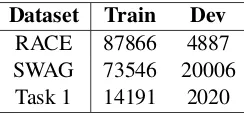
[image:3.595.315.517.63.236.2]Dataset Train Dev RACE 87866 4887 SWAG 73546 20006 Task 1 14191 2020
Table 2: Basic statistics for the three datasets involved in solving task 1
that (a) to let the pre-trained LMs to adopt to the similar contextual environment, (b) and make the model more suitable for this specific task forma-tion.
Due to the fact that task 1 dataset is small and during fine-tuning the original XLNet model over-fits very quickly, we experimented on a multi-stage fine-tuning strategy. The first additional dataset we choose is RACE, which is relatively larger. Then we choose to fune-tune on SWAG, whose queries are similar to our target task and requires commonsense reasoning. Then we fine-tune till convergence on the task 1 train set.
Table 1presents the structure of the inputs for the three datasets, where k is the number of op-tions for each query. After each stage before the final fine-tuning, we disregard the final fully-connected output layer and use the updated XLNet layers to fine-tune on the next dataset.
2.3 Knowledge fusing
Besides the original basic fine-tuning architecture adopted by the XLNet, we also experiment on in-volving commonsense knowledge for context en-coding, as is depicted in Figure1.
The commonsense knowledge graph we use is the WordNet (Miller,1995). The KG embedding is trained using DistMult (Yang et al., 2014a). First, we will match the phrases in the passage to entities in the WordNet, using Aho-Corasick algo-rithm (Arudchutha et al., 2014).1 Then each to-ken in the entity will be given the same
[image:3.595.120.242.170.227.2]embed-1If a phrase is matched to multiple entities in the KG, we will take the average of all entity embeddings as the entity embedding for the phrase.
Figure 1: The architecture of our KG infusing model with XLNet as text encoder
ding vector, which is the embedding of the en-tity in WordNet. Tokens not in any enen-tity will be given a zero vector as embedding. The KG coded text input will be incorporated with the en-coded output of XLNet using a multi-head atten-tion layer (Vaswani et al.,2017), where the XLNet encoded output acts as the query and the KG en-coded output acts the key and value. Then the out-put layer is the same with answer span prediction layers described in the previous subsection.
2.4 Answer Verification
To improve the prediction results of a model, we implement a series of answer verification strate-gies, which are the following:
• as there are additional entity information pro-vided with the dataset, at the span predict stage, we filter invalid predicted spans ac-cording to whether it match a named entity
• if we can not find any entities in all predic-tions, we randomly select one from the enti-ties provided to us
• some entity is a part of the ‘-‘ concatenation span, then we match the answer by its left or right concatenated contexts
3 Experiment
3.1 Dataset
the leader-board is calculated on official test data, which will not be published. Only training and de-velopment data for the task are available to us.
Task 2, which is the ReCoRD dataset (Zhang et al.,2018b) has 65, 000 queries on the train set and 10, 000 queries on the dev set. The answer for the ReCoRD dataset is not unique, since an entity is likely to be mentioned multiple times in a news article. Thus, we take each passage-query-answer-span as one sample during training, which can also be seen as a kind of data augmentation.
For both tasks, we only submit the models trained on the train sets of the target tasks.
3.2 Experimental setting
We use XLNet (large, cased) as the pre-trained language model. For task 1 dataset, we truncate the query-answer pair to a maximum length of 128, and set the maximum length of the passage-query-answer pair to 384. So the max length of the whole text inputs of one sample is 768. With a Tesla V100-PCIE-16GB GPU card, the batch size can only be set to be 2 on each card, thus we em-ploy 8 GPUs for training. Firstly we fine-tune the original XLNet on RACE for 100,000 steps with the sequence length of 192, query-answer length of 96 and Adam optimizer leaning rate of 1e-6. Afterwards, we fine-tune the model on SWAG for 12,500 steps with the same parameters as RACE’s. Eventually, the model is fine-tuned on the task 1 dataset till convergence, where the learning rate is set as 8e-6.
For task 2, the maximum length of the passage-querypair is set to be 384, in which the maximum length for the query is 64. During training the learning rate is 5e-6 and batch size is 4 on each GPU card.
When we try to infuse the KG into the XL-Net, we use the OpenKE library (Han et al.,2018) to train the KG representions of WordNet. We choose DistMult (Yang et al., 2014b) as the em-bedding model, set the emem-bedding size as 100, epoches as 10, batch size as 32 and the learning rate as 1e-4. The multi-head attention betwen the XLNet encoded output and the entity encoded out-put has the same number of attention head as the XLNet large model. During training, we will keep the KG embedding trainable. Besides multi-head attention, we also experiment using a whole trans-former block, i.e., a multi-head attention layer fol-lowed by a position-wise feed-forward network,
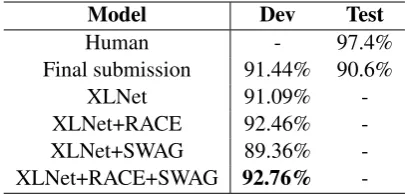
Model Dev Test
Human - 97.4%
Final submission 91.44% 90.6%
XLNet 91.09%
-XLNet+RACE 92.46% -XLNet+SWAG 89.36% -XLNet+RACE+SWAG 92.76%
-Table 3: Main results on the task 1.
and combining the entity encoding by simply con-catenating it onto the XLNet encoded output. For comparison, we switch XLNet with Bert (large model), and repeat the above experiments.
3.3 Results
The main experimental accuracy results for task 1 are shown in Table 3, in which human perfor-mance is provided by task organizers. Our sys-tem consists of fine-tuning XLNet on RACE and SWAG. We also conduct an ablation experiment to investigate the effects of the two external dataset. As a result, Table3illustrates that pre-training on RACE plays a significant role in the system. Ori-gin XLNet achieves an accuracy of 91.09%, indi-cating its powerful text representation ability, es-pecially in the reading comprehension task. Pre-training on SWAG without RACE does not im-prove the accuracy perhaps because SWAG mis-leads the model to better adjust its task forma-tion, thus making it worse on the machine reading comprehension. Meanwhile, combining SWAG together with RACE makes sense, indicating the model can improve its commonsense inference ability.
We achieved the best performance on the offi-cial dev dataset with the training steps described in section3.2while our submission result on the offi-cial leader-board was obtained with fewer training steps due to queue submission time impact on Co-dalab. Despite being not fully trained, our system still achieve the best result with the accuracy of 90.6%, outperforming other participating teams.
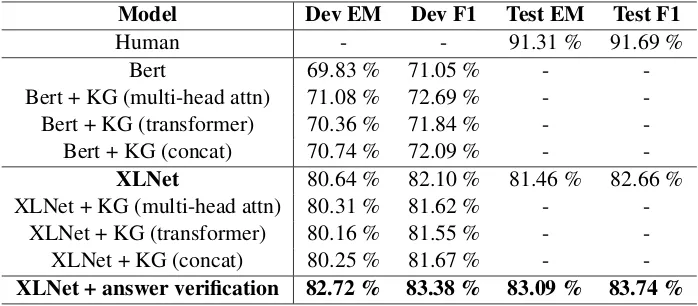
[image:4.595.314.518.62.159.2]Model Dev EM Dev F1 Test EM Test F1
Human - - 91.31 % 91.69 %
Bert 69.83 % 71.05 % -
-Bert + KG (multi-head attn) 71.08 % 72.69 % - -Bert + KG (transformer) 70.36 % 71.84 % - -Bert + KG (concat) 70.74 % 72.09 % -
-XLNet 80.64 % 82.10 % 81.46 % 82.66 % XLNet + KG (multi-head attn) 80.31 % 81.62 % -
[image:5.595.124.473.62.215.2]-XLNet + KG (transformer) 80.16 % 81.55 % - -XLNet + KG (concat) 80.25 % 81.67 % - -XLNet + answer verification 82.72 % 83.38 % 83.09 % 83.74 %
Table 4: The main results on task 2.
Bert, it does not help improving XLNet models. For the models with KG, regardless of what the underlying pre-trained langugae model is, multi-head attention works best on infusing the knowl-edge, and simple concatenation works better than adding a whole transformer block.
For task 2, implementing the answer verifica-tion process after we obtain the predicverifica-tions of XLNet model boost the performance significantly, both on the dev set and the test set. Since we did not see significant improvements by adding KG into the model, we did not submit results from KG infused models.
Conclusions
To conclude, we have shown that XLNet, a re-cently proposed pre-trained language model, is powerful in text representation for machine read-ing tasks. Simply fine-tunread-ing XLNet on the shared tasks already outperforms the other models which use Bert as text encoder. However, we demon-strate on task 1 that multi-stage fine-tuning on sim-ilar tasks can help providing more stable conver-gence and improve the final results significantly. For task 2, we also show that the model predic-tions can be improved by adding human designed post-processing strategies. We also experiments on incorporating commonsense KG into the archi-tecture of XLNet, however, due to our limited ex-periments, we haven’t obtain significant improve-ments by adding KG into the model, especially models based on XLNet. However, it is a direc-tion worth further research.
References
S. Arudchutha, T. Nishanthy, and R. G. Ragel. 2014. String matching with multicore cpus: Performing better with the aho-corasick algorithm. InIEEE In-ternational Conference on Industrial Information Systems.
Kyunghyun Cho, Bart Van Merri¨enboer, Caglar Gul-cehre, Dzmitry Bahdanau, Fethi Bougares, Holger Schwenk, and Yoshua Bengio. 2014. Learning phrase representations using rnn encoder-decoder for statistical machine translation. arXiv preprint arXiv:1406.1078.
Jacob Devlin, Ming-Wei Chang, Kenton Lee, and Kristina Toutanova. 2018. Bert: Pre-training of deep bidirectional transformers for language understand-ing.arXiv preprint arXiv:1810.04805.
Xu Han, Shulin Cao, Xin Lv, Yankai Lin, Zhiyuan Liu, Maosong Sun, and Juanzi Li. 2018. Openke: An open toolkit for knowledge embedding. In Proceed-ings of EMNLP, pages 139–144.
Sepp Hochreiter and J¨urgen Schmidhuber. 1997. Long short-term memory. Neural computation, 9(8):1735–1780.
Divyansh Kaushik and Zachary C Lipton. 2018. How much reading does reading comprehension require? a critical investigation of popular benchmarks. arXiv preprint arXiv:1808.04926.
Guokun Lai, Qizhe Xie, Hanxiao Liu, Yiming Yang, and Eduard Hovy. 2017. Race: Large-scale reading comprehension dataset from examinations. arXiv preprint arXiv:1704.04683.
George A Miller. 1995. Wordnet: a lexical database for english. Communications of the ACM, 38(11):39– 41.
Simon Ostermann, Michael Roth, Ashutosh Modi, Ste-fan Thater, and Manfred Pinkal. 2018. Semeval-2018 task 11: Machine comprehension using com-monsense knowledge. InProceedings of The 12th International Workshop on Semantic Evaluation, pages 747–757.
Soham Parikh, Ananya B Sai, Preksha Nema, and Mitesh M Khapra. 2019. Eliminet: A model for eliminating options for reading comprehension with multiple choice questions. arXiv preprint arXiv:1904.02651.
Jason Phang, Thibault Fvry, and Samuel R. Bowman. 2018. Sentence encoders on stilts: Supplementary training on intermediate labeled-data tasks.
Pranav Rajpurkar, Jian Zhang, Konstantin Lopyrev, and Percy Liang. 2016. Squad: 100,000+ questions for machine comprehension of text. arXiv preprint arXiv:1606.05250.
Qiu Ran, Peng Li, Weiwei Hu, and Jie Zhou. 2019. Option comparison network for multiple-choice reading comprehension. arXiv preprint arXiv:1903.03033.
Robert Speer, Joshua Chin, and Catherine Havasi. 2017. Conceptnet 5.5: An open multilingual graph of general knowledge. InThirty-First AAAI Confer-ence on Artificial IntelligConfer-ence.
Kai Sun, Dian Yu, Dong Yu, and Claire Cardie. 2018. Improving machine reading comprehension with general reading strategies. arXiv preprint arXiv:1810.13441.
Ashish Vaswani, Noam Shazeer, Niki Parmar, Jakob Uszkoreit, Llion Jones, Aidan N Gomez, Łukasz Kaiser, and Illia Polosukhin. 2017. Attention is all you need. InAdvances in neural information pro-cessing systems, pages 5998–6008.
Alex Wang, Yada Pruksachatkun, Nikita Nangia, Amanpreet Singh, Julian Michael, Felix Hill, Omer Levy, and Samuel R. Bowman. 2019. Superglue: A stickier benchmark for general-purpose language understanding systems.
Yichong Xu, Jingjing Liu, Jianfeng Gao, Yelong Shen, and Xiaodong Liu. 2017. Dynamic fusion networks for machine reading comprehension. arXiv preprint arXiv:1711.04964.
Bishan Yang, Wen-tau Yih, Xiaodong He, Jianfeng Gao, and Li Deng. 2014a. Embedding Entities and Relations for Learning and Inference in Knowledge Bases.arXiv e-prints, page arXiv:1412.6575.
Bishan Yang, Wen-tau Yih, Xiaodong He, Jianfeng Gao, and Li Deng. 2014b. Embedding Entities and Relations for Learning and Inference in Knowledge Bases.arXiv e-prints, page arXiv:1412.6575.
Zhilin Yang, Zihang Dai, Yiming Yang, Jaime Car-bonell, Ruslan Salakhutdinov, and Quoc V Le. 2019. Xlnet: Generalized autoregressive pretrain-ing for language understandpretrain-ing. arXiv preprint arXiv:1906.08237.
Rowan Zellers, Yonatan Bisk, Roy Schwartz, and Yejin Choi. 2018. Swag: A large-scale adversarial dataset for grounded commonsense inference. arXiv preprint arXiv:1808.05326.
Sheng Zhang, Xiaodong Liu, Jingjing Liu, Jianfeng Gao, Kevin Duh, and Benjamin Van Durme. 2018a.
Record: Bridging the gap between human and ma-chine commonsense reading comprehension.CoRR, abs/1810.12885.
Sheng Zhang, Xiaodong Liu, Jingjing Liu, Jianfeng Gao, and Benjamin Van Durme. 2018b. Record: Bridging the gap between human and machine com-monsense reading comprehension.
Shuailiang Zhang, Hai Zhao, Yuwei Wu, Zhuosheng Zhang, Xi Zhou, and Xiang Zhou. 2019. Dual co-matching network for multi-choice reading compre-hension. arXiv preprint arXiv:1901.09381.