Proceedings of the 2nd Workshop on Deep Learning Approaches for Low-Resource NLP (DeepLo), pages 163–174 Hong Kong, China, November 3, 2019. c2019 Association for Computational Linguistics
163
Cross-lingual Parsing with Polyglot Training and Multi-treebank
Learning: A Faroese Case Study
James Barry and Joachim Wagner and Jennifer Foster
ADAPT Centre
School of Computing, Dublin City University, Ireland
Abstract
Cross-lingual dependency parsing involves transferring syntactic knowledge from one lan-guage to another. It is a crucial component for inducing dependency parsers in low-resource scenarios where no training data for a guage exists. Using Faroese as the target lguage, we compare two approaches using an-notation projection: first, projecting from mul-tiplemonolingualsource models; second, pro-jecting from a singlepolyglotmodel which is trained on the combination of all source lan-guages. Furthermore, we reproduce multi-source projection (Tyers et al.,2018), in which dependency trees of multiple sources are com-bined. Finally, we apply multi-treebank mod-elling to the projected treebanks, in addition to or alternatively to polyglot modelling on the source side. We find that polyglot training on the source languages produces an overall trend of better results on the target language but the single best result for the target lan-guage is obtained by projecting from monolin-gual source parsing models and then training multi-treebank POS tagging and parsing mod-els on the target side.
1 Introduction
Cross-lingual transfer methods, i. e. methods that transfer knowledge from one or more source lan-guages to a target language, have led to substan-tial improvements for low-resource dependency parsing (Rosa and Mareˇcek, 2018; Agi´c et al.,
2016; Guo et al., 2015; Lynn et al., 2014; Mc-Donald et al.,2011;Hwa et al.,2005) and part-of-speech (POS) tagging (Plank and Agi´c,2018). In low-resource scenarios, there may be not enough data for data-driven models to learn how to parse. In cases where no annotated data is available, knowledge is often transferred from annotated data in other languages and when there is only a small amount of annotated data, additional
knowl-edge can be induced from external corpora such as by learning distributed word representations (Mikolov et al.,2013;Al-Rfou’ et al.,2013) and more recent contextualized variants (Peters et al.,
2018;Devlin et al.,2019).
This work focuses on dependency parsing for low-resource languages by means of annotation projection (Yarowsky et al., 2001) and synthetic treebank creation (Tiedemann and Agi´c, 2016). We build on recent work by Tyers et al. (2018) who show that in the absence of annotated training data for the target language, a lexicalized treebank can be created by translating a target language cor-pus into a number of related source languages and parsing the translations using models trained on the source language treebanks.1 These annotations are then projected to the target language using sep-arate word alignments for each source language, combined into a single graph for each sentence and decoded (Sagae and Lavie,2006), resulting in a treebank for the target language, Faroese in the case ofTyers et al.’s and our experiments.
Inspired by recent literature involving multilin-gual learning (Mulcaire et al., 2019;Smith et al.,
2018;Vilares et al.,2016), we investigate whether additional improvements can be made by:
1. using a single polyglot2parsing model which is trained on the combination of all source languages to create synthetic source tree-banks (which are subsequently projected to the target language)
1In this paper,
source languageandtarget language al-ways refer to the projection, not the direction of translation.
2
We adopt the same terminology used inMulcaire et al.
2. training a multi-treebank model on the indi-vidually projected treebanks and the treebank produced with multi-source projections.
The former differs from the approach ofTyers et al. (2018), who use multiple discrete, mono-lingual models to parse the translated sentences, whereas in this work we use a single model trained on multiple source treebanks. The latter differs from training on the target treebank produced by multi-source projection in that the information of the individual projections is still available and training data is not reduced to cases where all source languages provide a projection.
In other words, we aim to investigate whether the current state-of-the-art approach for Faroese, which relies on cross-lingual transfer, can be im-proved upon by adopting an approach based on source-side polyglot learning and/or target-side multi-treebank learning. We hypothesize that a polyglot model can exploit similarities in mor-phology and syntax across the included source lan-guages, which will result in a better model to pro-vide annotations for projection. On the target side, we expect that combining different sources of in-formation will result in a more robust target model. We evaluated our various models on the Faroese test set and experienced considerable gains for three of the four source languages (Danish, Nor-wegian Bokm˚al and Swedish) by adopting a poly-glot model. However, for Norwegian Nynorsk, a stronger monolingual model was able to out-perform the polyglot approach. When we ex-tended multi-treebank learning to the target side, we experienced additional gains for all cases. Our best result of 71.5 – an absolute improvement of 7.2 points over the result reported byTyers et al.
(2018) – was achieved with multi-treebank target learning over the monolingual projections.
2 Background
Tyers et al. (2018) describe a method for creat-ing synthetic treebanks for Faroese based on pre-vious work which uses machine translation and word alignments to transfer trees from source lan-guage(s) to the target language. Sentences from Faroese are translated into the four source lan-guages Danish, Swedish, Norwegian Nynorsk and Norwegian Bokm˚al. The translated sentences are then tokenized, POS tagged and parsed using the relevant source language model trained on the source language treebank. The resulting trees
are projected back to the Faroese sentences using word alignments. The four trees for each sentence are combined into a graph with edge scores one to four (the number of trees that support them), from which a single tree per sentence is produced using the Chu-Liu-Edmonds algorithm (Chu and Liu, 1965;Edmonds, 1967). The resulting trees make up a synthetic treebank for Faroese which is then used to train a Faroese parsing model. The parser output is evaluated using the gold-standard Faroese test treebank developed by Tyers et al.
(2018). The approach is compared to a delexi-calized baseline, which it outperforms by a large margin. It is also shown that, for Faroese, a combi-nation of the four source languages (multi-source projection) is superior to individual language pro-jection.
The idea of annotation projection using word-alignments originates from (Yarowsky et al.,2001) who used word alignments to transfer information such as POS tags from source to target languages. This method was later used in dependency parsing byHwa et al.(2005), who project dependencies to a target language and use a set of heuristics to form dependency trees in the target language. A parser is then trained on the projected treebank and eval-uated against gold-standard treebanks.Zeman and Resnik(2008) introduced the idea of delexicalized dependency parsing whereby a parser is trained using only POS information and is then applied to a target language.
McDonald et al. (2011) perform delexicalized dependency parsing using direct transfer and show that this approach outperforms unsupervised ap-proaches for grammar induction. Importantly, this approach can be extended to the multi-source case by training on multiple source languages and pre-dicting a target language. In an additional ex-periment, they combine annotation projection and multi-source transfer.
Tiedemann and Agi´c(2016) present a thorough comparison of pre-neural cross-lingual parsing. Various forms of projected annotation methods are compared to delexicalized baselines, and the use of machine translation instead of parallel cor-pora to produce synthetic treebanks in the target language is explored. In contrast to Tyers et al.
Agi´c et al. (2016) leverage massively multi-lingual parallel corpora such as translations of the Bible and web-scraped data from the Watch-tower Online Library website3 for low-resource POS tagging and dependency parsing using anno-tation projection. They project weight matrices (as opposed to decoded dependency arcs) from mul-tiple source languages and average the matrices weighted by word alignment confidences. They then decode the weight matrices into dependency trees on the target side, which are then used to train a parser. This approach utilizes dense informa-tion from multiple source languages, which helps reduce noise from source side predictions but to the best of our knowledge, the source-side pars-ing models learn information between source lan-guages independently and the cross-lingual inter-action only occurs when projecting the edge scores into multi-source weight matrices.
The idea of projecting dense information in the form of a weighted graph has been further ex-tended bySchlichtkrull and Søgaard (2017) who bypass the need to train the target parser on de-coded trees and develop a parser which can be trained directly on weighted graphs.
Plank and Agi´c (2018) use annotation projec-tion for POS tagging. They find that choosing high quality training instances results in superior accu-racy than randomly sampling a larger training set. To this end, they rank the target sentences by the percentage of words covered by word alignments across all source languages and choose the topk
covered sentences for training.
Meechan-Maddon and Nivre (2019) carry out an evaluation on cross-lingual parsing for three low-resource languages which are supported by related languages. They include three experi-ments: first, training a monolingual model on a small number of sentences in the target language; second, training across-lingualmodel on related source languages which is then applied to the tar-get data and lastly, training a multilingualmodel which includes target data as well as data from the related support languages. They found that train-ing a monoltrain-ingual model on the target data was always superior to training a cross-lingual model. Interestingly, they found that the best results were achieved by training a model on the various sup-port languages as well as the target data, i. e. their multilingual model. While we do not combine
3https://wol.jw.org/
the synthetic target treebanks with the source tree-banks in our experiments, the results of Meechan-Maddon and Nivre(2019) motivate us to carry out this experiment in the future.
3 Method
We outline the process used for creating a syn-thetic treebank for cross-lingual dependency pars-ing. We use the following resources: raw Faroese sentences taken from Wikipedia, a machine trans-lation system to translate these sentences into all source languages (Danish, Swedish, Norwegian Nynorsk and Norwegian Bokm˚al), a word-aligner to provide word alignments between the words in the target and source sentences, treebanks for the four source languages on which to train parsing models, POS tagging and parsing tools, and, lastly a target language test set. We use the same raw corpus, alignments and tokenized and segmented versions of the source translations4asTyers et al.
(2018) who release all of their data.5 In this way, the experimental pipeline is the same as theirs but we predict POS tags and dependency annotations using our own models.
Target Language Corpus We use the tar-get corpus built by Tyers et al. (2018) which comprises 28,862 sentences which were ex-tracted from Faroese Wikipedia dumps6using the WikiExtractor script7and further pre-processed to remove any non-Faroese texts and other forms of unsuitable sentences.
Machine Translation As noted byTyers et al.
(2018), popular repositories for developing ma-chine translation systems such as OPUS ( Tiede-mann,2016) contain an inadequate amount of sen-tences to train a data-driven machine translation system for Faroese. For instance, there are fewer than 7,000 sentence pairs between Faroese and Danish, Faroese and English, Faroese and Norwe-gian and Faroese and Swedish. Consequently, to create parallel source sentences,Tyers et al.(2018) use a rule-based machine translation system avail-able in Apertium8 to translate from Faroese to
4The original authors tokenize and segment the source
translations with UDPipe.
5https://github.com/ftyers/
cross-lingual-parsing 6
https://dumps.wikimedia.org/ 7
https://github.com/attardi/ wikiextractor
Faroese Wikipedia Sentences
Norwegian Bokm˚al Translations
Norwegian Nynorsk Translations Swedish
Translations
Danish Translations Translation
Pivot Translation
[image:4.595.78.284.67.201.2]Pivot Translation Pivot Translation
Figure 1: Overview of the machine translation process. The Faroese sentences are first translated into Norwe-gian Bokm˚al and then from NorweNorwe-gian Bokm˚al into the other source languages (pivot translation).
Norwegian Bokm˚al. There also exists translation systems from Norwegian Bokm˚al to Norwegian Nynorsk, Swedish and Danish in Apertium. As a result, the authors usepivot translationfrom Nor-wegian Bokm˚al into the other source languages. The process is illustrated in Fig. 1. For a more thorough description of the machine translation process and for resource creation in general, see the work ofTyers et al.(2018).
Word Alignments We use word alignments be-tween the Faroese text and the source translations generated by Tyers et al. (2018) using fast align (Dyer et al., 2013), a word alignment tool based on IBM Model 2.9
Source Treebanks We use the Universal Depen-dencies v2.2 treebanks (Nivre et al.,2018) to train our source parsing models. This is the version used for the 2018 CoNLL shared task on Parsing Universal Dependencies (Zeman et al.,2018).
Source Tagging and Parsing Models In or-der for our parsers to work well with predicted POS tags, we follow the same steps as used in the 2018 CoNLL shared task for creating train-ing and development treebanks with automatically predicted POS tags (henceforth referred to as sil-ver POS). Since we are required to parse translated text which only has lexical features available, we
9
Note that previous related work (Agi´c et al.,2016) report better results using IBM Model 1 with a more diverse lan-guage setup. They claim that IBM Model 2 introduces a bias towards more closely related languages. As we are working with related languages and translations and alignments are largely word-for-word, we expect that this will have less of an impact on our experiments although IBM Model 1 should also be tried in future work.
disregard lemmas, language-specific POS (XPOS) and morphological features and only use the word form and universal POS (UPOS) tag as input fea-tures to our parsers. We develop our POS tagging and parsing models using the AllenNLP library (Gardner et al.,2018).
We use jackknife resampling to predict the UPOS tags for the training treebanks. We split the training treebank into ten parts, train models on nine parts and predict UPOS for the excluded part. The process is repeated until all ten parts are predicted and they are then combined to recreate the treebank with silver POS tags. Only token fea-tures are used to predict the UPOS tag.10 Finally, we train a model per source language on the full training data to check performance on the respec-tive development set and to POS tag the source language translations before parsing.
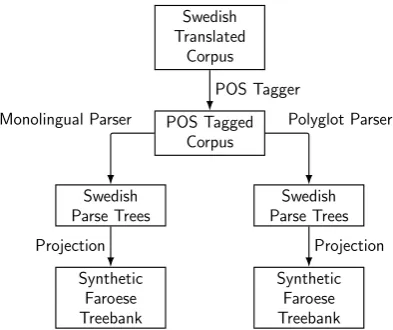
We train two variants of parsing models. The first is a monolingual biaffine dependency parser (Dozat and Manning, 2017) trained on the indi-vidual source treebanks. The second is a poly-glot model trained on all source treebanks using the multilingual parser of Schuster et al. (2019), which is the same graph-based biaffine depen-dency parser, extended to enable parsing with mul-tiple treebanks. We additionally include a tree-bank embedding (Ammar et al., 2016; Stymne et al., 2018) to the input of the polyglot parser to help the parser differentiate between the source languages. We optimize the model for average de-velopment set LAS across the included languages. The process is illustrated in Fig.2.
To ensure that our parser is realistic, we add a pre-trained monolingual word embedding to each monolingual parser, giving a considerable im-provement in accuracy on the development sets of the source languages. We use the precomputed Word2Vec embeddings11 released as part of the 2017 CoNLL shared task on UD parsing (Zeman et al.,2017) which were trained on CommonCrawl and Wikipedia.
In order to use pre-trained word embeddings for the polyglot setting, we need to consider that a polyglot model uses a shared vocabulary across all input languages. In our experiments, we simply
10We observe slightly lower POS tagging scores on fully
annotated test sets than UDPipe, which uses gold lemmas, XPOS and morphological features to predict the UPOS label and therefore cannot be applied to the translated text without also building predictors for these features.
11https://lindat.mff.cuni.cz/
use the union of the word embeddings and average the word vector for words that occur in more than one language. Future work should explore cross-lingual word embeddings with limited amount of parallel data or use aligned contextual embeddings as in (Schuster et al.,2019).
Swedish Translated
Corpus
POS Tagged Corpus
Swedish Parse Trees
Swedish Parse Trees
Synthetic Faroese Treebank
Synthetic Faroese Treebank POS Tagger
Monolingual Parser Polyglot Parser
[image:5.595.83.280.172.337.2]Projection Projection
Figure 2: Overview of themonolingualandpolyglot
parse experiments using Swedish translations as an ex-ample. This process is repeated for all source lan-guages.
Synthetic Source Treebanks Source transla-tions are tokenized with UDPipe (Straka and Strakov´a,2017) by Tyers et al.(2018). For each source language, the POS model trained on the full training data (see previous section) is used to tag the tokenized translations. Once the text is tagged, we predict dependency arcs and labels with the parsing models of the previous section, and use annotation projection (described below) to provide syntactic annotations for the target sentences.
Annotation Projection Once the synthetic source treebanks are compiled, i. e. the transla-tions are parsed, the annotatransla-tions are then projected from the source translations to the target language using the word alignments and Tyers et al.’s projection tool, resulting in a Faroese treebank. In some cases, not all tokens are aligned andTyers et al. (2018) work around this by falling back to a 1:1 mapping between the target index and the source index. There are also cases where there is a mismatch in length between the source and target sentences and some dependency structures cannot be projected to the target language. Tyers et al.’s projection setup removes unsuitable projected trees containing e. g. more than one root token, a
token that is its own head or a token with a head outside the range of the sentence.
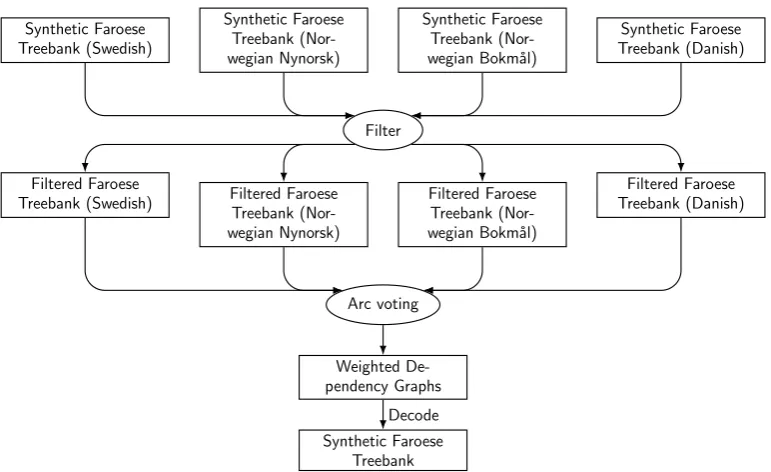
Multi-source Projection For multi-source pro-jection, the four source-language dependency trees for a Faroese sentence are projected into a single graph, scoring edges according to the num-ber of trees that contain them (Sagae and Lavie,
2006;Nivre et al.,2007). The dependency struc-ture is first built by voting over the directed edges. Afterward, dependency labels and POS tags are decided using the same voting procedure. The pro-cess is illustrated in Fig.3.
Target Tagging and Parsing Models At this stage we have Faroese treebanks to train our POS tagging and parsing models. The Faroese tree-banks come in two variants: the result of pro-jection from source trees produced by either 1) a monolingual, or 2) the polyglot model. For each case, we train our POS tagging and parsing mod-els directly on these synthetic treebanks and do not make use of word embeddings as we do not have them for Faroese.
Multi-treebank Target Parsing Since we have several synthetic Faroese treebanks, we have the option of training on a single treebank or using a multi-treebank approach where we train on all tar-get treebanks in the same way as we did for induc-ing the polyglot source model. The process is il-lustrated in Fig.4. When training a multi-treebank target model, for each target treebank, we add a treebank embedding denoting the source model used to project annotations to the target treebank. At predict time, we must include one of these tree-bank embeddings as input to the model. As we do not have real Faroese data in our target train-ing treebanks, we must choose the treebank em-bedding of one of the synthetic target treebanks.
Stymne et al. (2018) introduce the term “proxy treebank” to refer to cases where the test treebank is not in the training set and a treebank embedding from the training set must be used instead.
4 Experiments
In this section, we describe our experiments, which include a replication of the main findings ofTyers et al. (2018), using AllenNLP (Gardner et al.,2018) for POS tagging and parsing instead of UDPipe (Straka and Strakov´a,2017).12
12All of the code and scripts to reproduce the experiments
Synthetic Faroese Treebank (Swedish)
Synthetic Faroese Treebank (Nor-wegian Nynorsk)
Synthetic Faroese Treebank (Nor-wegian Bokm˚al)
Synthetic Faroese Treebank (Danish)
Filter
Filtered Faroese
Treebank (Swedish) Filtered FaroeseTreebank
(Nor-wegian Nynorsk)
Filtered Faroese Treebank (Nor-wegian Bokm˚al)
Filtered Faroese Treebank (Danish)
Arc voting
Weighted De-pendency Graphs
Synthetic Faroese Treebank
[image:6.595.107.493.66.302.2]Decode
Figure 3: Multi-source projection. The source language is listed in brackets.
4.1 Details
The hyper-parameters of our POS tagging and parsing models are given in Table1. For POS tag-ging, we adopt a standard architecture with a word and character-level Bi-LSTM (Plank et al.,2016;
Graves and Schmidhuber,2005) to learn context-sensitive representations of our words. These rep-resentations are passed to a multilayer perceptron (MLP) classifier followed by a softmax function to choose a tag with the highest probability. For both the POS tagging and parsing models, we use a word embedding dimension of size 100 and a character embedding dimension of size 64. POS tag embeddings of dimension 50 are included in the parser. We train our Faroese models for fifty epochs. We do not split the synthetic Faroese tree-banks into training/development portions though we suspect doing so will help the models to not overfit on the training data. For all experiments we report labelled attachment scores produced by the official CoNLL 2018 evaluation script.13
4.2 Results
The development results of our monolingual and polyglot models on the source language treebanks are shown in Table2. The results for the polyglot
multilingual-parsing
13https://github.com/ufal/conll2018/
blob/master/evaluation_script/conll18_ ud_eval.py
model are better for three out of four source lan-guages, whereas for no nynorsk, the monolingual model marginally outperforms the polyglot one. These results suggest that the polyglot model will contribute better syntactic annotations for Faroese treebanks.
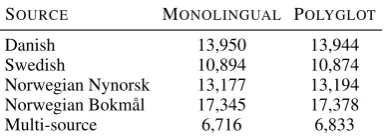
The statistics of the filtered Faroese treebanks obtained via projection with our source parsing models are given in Table3. The treebank sizes are fairly similar regardless of whether source annota-tions are provided by a monolingual or a polyglot model which is expected because the word align-ments are the major factor in determining whether a projection is successful. There is a proportion-ally lower number of sentences for multi-source projection. This is because this method only uses the intersection of sentences which are present across all synthetic treebanks after filtering. The treebank originating from Norwegian Bokm˚al has the highest number of valid sentences, suggesting that it could be a good candidate for projection to Faroese. It also has the highest source language parsing accuracy (Table2).
Synthetic Faroese Treebank (Swedish)
Synthetic Faroese Treebank (Norwegian
Nynorsk)
Synthetic Faroese Treebank (Norwegian
Bokm˚al)
Synthetic Faroese Treebank (Danish)
Synthetic Faroese Treebank (Multi-source
Projection)
Faroese Model (Swedish)
Faroese Model (Norwegian
Nynorsk)
Faroese Model (Norwegian
Bokm˚al)
Faroese Model (Danish)
Faroese Model (Multi-source
Projection)
Train Train Train Train Train
Train
Faroese Multi-treebank Model with Treebank
[image:7.595.98.500.65.265.2]Embeddings: swe, non, nob, dan, msp
Figure 4: Single versus multi-treebank training. The source language is listed in brackets.
POS Tagger Architecture
Parameter Value
Char-BiLSTM layers 2 BiLSTM layers 2 BiLSTM size 400 Dropout LSTMs 0.33 Dropout MLP 0.33 Dropout embeddings 0.33 Nonlinear act. (MLP) ELU
Parser Architecture
Parameter Value
Char-BiLSTM layers 2 BiLSTM layers 3 BiLSTM size 400 Arc MLP size 500 Label MLP size 100 Dropout LSTMs 0.33 Dropout MLP 0.33 Dropout embeddings 0.33 Nonlinear act. (MLP) ELU
Embeddings
Parameter Size
Word embedding (both) 100 Char embedding (both) 64 POS embedding (parser) 50 Treebank embedding (both) 12
Training
Parameter Value
Optimizer Adam
Learning rate 0.001 Adam epsilon 1e-08 beta1 (both) 0.9 beta2 (parser) 0.9 beta2 (tagger) 0.999
Table 1: Chosen hyperparameters for our POS tagging and parsing models.bothmeans the feature is common to both the POS tagger and parser.
significant).14 The polyglot model was
outper-14Statistical significance is tested with udapi-python
TREEBANK MONOLINGUAL POLYGLOT
da ddt 81.10 82.75
sv talbanken 80.61 83.85
no nynorsk 88.54 88.29 no bokmaal 89.29 90.29
[image:7.595.108.255.312.664.2]average 84.88 86.30
Table 2: Source model LAS scores on the development treebanks using silver POS tags.
SOURCE MONOLINGUAL POLYGLOT
Danish 13,950 13,944
Swedish 10,894 10,874
Norwegian Nynorsk 13,177 13,194 Norwegian Bokm˚al 17,345 17,378 Multi-source 6,716 6,833
Table 3: The number of valid sentences in the Faroese synthetic treebank for each source language after anno-tation projection and sentence filtering.
formed by the monolingual model using Norwe-gian Nynorsk for projection though the difference is not statistically significant. On the source side, the monolingual Norwegian Nynorsk model also performed slightly better than the polyglot model (Table2). This observation supports the intuition that the quality of the projected annotations can be improved by contributing better source anno-tations, i. e. improving the source model(s) is one way to improve performance of the target model. This is supported by the fact that the source
[image:7.595.325.509.314.392.2] [image:7.595.321.514.444.514.2]SOURCELANGUAGE SOURCE TARGETMODEL
MODEL SINGLE MULTI
Danish Monolingual 61.24 63.40 Polyglot 65.29† 65.53†
Swedish Monolingual 65.93 66.15 Polyglot 68.60† 69.69†
Norwegian Nynorsk Monolingual 70.27 71.51 Polyglot 69.80 71.13
Norwegian Bokm˚al Monolingual 67.46 67.94 Polyglot 70.51† 70.58†
Multi-source Monolingual 68.00 69.80 Polyglot 68.55 70.07
[image:8.595.321.511.62.156.2]Average Monolingual 66.58 67.76 Polyglot 68.55 69.40
Table 4: LAS on the target Faroese test treebank.
Single refers to using a single synthetic Faroese tree-bank to train a Faroese model,Multiuses both a multi-treebank POS tagger and a multi-multi-treebank parser with all synthetic Faroese treebanks. The multi-treebank model is tested with each of the five training treebanks (four projected from individual source languages and one using multi-source projection) as proxy treebank. Statistically significant differences between the mono-lingual and polyglot setting are indicated by†for each result pair, excluding averages.
SOURCELANGUAGE MONOLINGUAL POLYGLOT
Danish 61.13 64.43
Swedish 63.19 67.46
Norwegian Nynorsk 68.72 69.28
Norwegian Bokm˚al 66.13 68.77
Multi-source 68.00 68.55
[image:8.595.74.298.63.254.2]Average 65.43 67.70
Table 5: LAS scores between target models trained on the subset of sentences eligible for multi-source projec-tion (with annotaprojec-tions from the stated source).
guage with the highest LAS (Norwegian Bokm˚al) is also the best choice for projection (in this single target model setting).
The multi-source approach was not that effec-tive in our case and some individual better sources were able to surpass this combination approach. One could argue that this may be due to the lower amount of training data when using the multi-source treebank. We test this hypothesis by only including those sentences which contributed to multi-source projection in the single-source syn-thetic treebanks. The results are given in Ta-ble 5. Comparing the results in Tables 4 and 5, we see that LAS scores tend to be slightly lower than on the version which included all target
sen-WORK RESULT
Rosa and Mareˇcek(2018) 49.4
Tyers et al.(2018) 64.4
Our implementation 68.0
ofTyers et al.(2018)
[image:8.595.73.292.408.496.2]Our Best Model 71.5
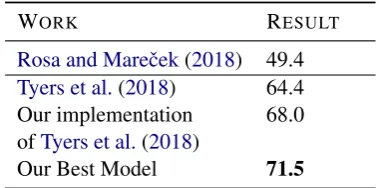
Table 6: Comparison to previous work. LAS on Faroese test set. Note that the first results uses pre-dicted segmentation and tokenization whereas the rest used gold.
tences, indicating that we did lose some infor-mation by filtering out a large number of sen-tences. However, Norwegian Nynorsk still out-performs the multi-source model for the monolin-gual setting and both Norwegian models perform better than the multi-source model in the poly-glot setting, suggesting that size alone does not explain the under-performance of the multi-source model. It is also worth noting that polyglot train-ing is superior to all monoltrain-ingual models which hints that for no nynorsk (the previously better performing model), the monolingual model was not able to achieve its full potential with the re-duced data while the polyglot model was able to provide richer annotations.
Another reason why the multi-source model does not work as well in our experiments as it does in those of Tyers et al. (2018) might be that we use pre-trained embeddings whereas Tyers et al.
(2018) do not. In this way, our monolingual mod-els are stronger and likely do not benefit as much from voting.
The second result column (MULTI) of Table4
shows the effect of training a multi-treebank POS tagger and parser on the Faroese treebanks created by each of the four source languages as well as the treebank which is produced by multi-source projection. This experiment is orthogonal to the experiment using a polyglot model on the source side and so we also test a combination of poly-glot source side parsing and multi-treebank target side parsing. We see improvements over the single treebank setting for all cases.15
15
Table6places our systems in the context of pre-vious results on the same Faroese test set. The highest scoring system in the 2018 CoNLL shared task was that of Rosa and Mareˇcek (2018) who achieved a LAS score of 49.4 on the Faroese test set. Note that they use predicted tokenization and segmentation whereas our experiments and Ty-ers et al.’s use gold tokenization and segmenta-tion, which provides a small artificial boost.Tyers et al.(2018) report an LAS of 64.43 with a mono-lingual multi-source approach. Our implementa-tion which uses a different parser (AllenNLP ver-sus UDPipe) and pre-trained word embeddings achieves an LAS of 68. Our highest score of 71.51 is achieved through the combination of projecting from strong monolingual source models and then training multi-treebank POS tagging and parsing models on the outputs.
5 Conclusion
We have presented parsing results on Faroese, a low-resource language, using annotation projec-tion from multiple monolingual sources versus a single polyglot model. We also extended the idea of multi-treebank learning to the target treebanks. The results of our experiments show that the use of a polyglot source model helps in four out of five cases using single treebank target models. The two source languages that have lowest LAS when using monolingual parsers, namely Danish and Swedish, see significant improvements when switching to a polyglot model. Our best perform-ing sperform-ingle target model is trained on Faroese trees projected from Norwegian Bokm˚al trees produced by a polyglot model. However, the strongest lan-guage with monolingual modelling, Norwegian Nynorsk, does not benefit from switching to a polyglot model. When we filtered the target tree-bank to the subset of sentences selected by multi-source projection, the polyglot model is superior to all five monolingual models, even outperform-ing the Norwegian Nynorsk model. One explana-tion of the improvements seen with polyglot mod-elling is that it introduces a new interaction point for cross-lingual features via the feature extractor of the polyglot parser. With monolingual source models, cross-lingual features only interact indi-rectly in the graph-decoding stage of multi-source projection.
but found that it always helps to also perform multi-treebank training for the POS tagger.
We also applied the multi-treebank approach to the target-side POS tagger and parser and see improvements for all settings. The overall best result is with the setting that uses monolingual source models to create the source trees that are projected to Faroese and combined in a treebank model. The proxy treebank for the multi-treebank model is the multi-treebank that also gave best results with single treebank target models, pro-jected from Norwegian Nynorsk.
We presented a simple solution to deal with us-ing multiple pre-trained embeddus-ings in a model with a shared vocabulary. It was a rather na¨ıve so-lution and we want to explore the use of available cross-lingual word embedding tools. Additionally, the use of contextual embeddings such as ELMo (Peters et al.,2018) or multilingual BERT (Devlin et al.,2019) would likely provide better represen-tations, with the effect of contributing better an-notations for the target language. Indeed, recent work has already shown promising work in this area (Schuster et al.,2019;Kondratyuk,2019).
In the multi-source projection experiments, our criteria for filtering is based on whether the sen-tence was present across all target treebanks and more sophisticated approaches could be used to select better training instances as in Plank and Agi´c(2018).
More generally, we would like to investigate how our findings might change when the num-ber of source languages or treebanks is changed and how the observations carry over to other lan-guages than Faroese. It would also be interesting to use multiple sources of arc weights in a dense graph as in (Agi´c et al.,2016) but with models in-duced from training on multiple source languages together. To work with language pairs with more deviating word orders and/or translations that are not word-for-word, the choice of word alignment algorithm and the projection algorithm may have to be revised.
Acknowledgments
References ˇ
Zeljko Agi´c, Anders Johannsen, Barbara Plank, H´ector Mart´ınez Alonso, Natalie Schluter, and Anders Søgaard. 2016. Multilingual projection for parsing truly low-resource languages. Transactions of the Association for Computational Linguistics, 4:301– 312.
Rami Al-Rfou’, Bryan Perozzi, and Steven Skiena. 2013. Polyglot: Distributed word representations for multilingual NLP. InProceedings of the Seven-teenth Conference on Computational Natural Lan-guage Learning, pages 183–192, Sofia, Bulgaria. Association for Computational Linguistics.
Waleed Ammar, George Mulcaire, Miguel Ballesteros, Chris Dyer, and Noah A. Smith. 2016. Many lan-guages, one parser. Transactions of the Association for Computational Linguistics, 4:431–444.
Yoeng-Jin Chu and Tseng-Hong Liu. 1965. On the shortest arborescence of a directed graph. Scientia Sinica, 14:1396–1400.
Jacob Devlin, Ming-Wei Chang, Kenton Lee, and Kristina Toutanova. 2019. BERT: Pre-training of deep bidirectional transformers for language under-standing. In Proceedings of the 2019 Conference of the North American Chapter of the Association for Computational Linguistics: Human Language Technologies, Volume 1 (Long and Short Papers), pages 4171–4186, Minneapolis, Minnesota. Associ-ation for ComputAssoci-ational Linguistics.
Timothy Dozat and Christopher D. Manning. 2017.
Deep biaffine attention for neural dependency pars-ing. InProceedings of the 5th International Confer-ence on Learning Representations (ICLR 2017).
Chris Dyer, Victor Chahuneau, and Noah A. Smith. 2013. A simple, fast, and effective reparameter-ization of IBM model 2. In Proceedings of the 2013 Conference of the North American Chapter of the Association for Computational Linguistics: Hu-man Language Technologies, pages 644–648, At-lanta, Georgia. Association for Computational Lin-guistics.
Jack Edmonds. 1967. Optimum branchings. Journal of Research of the national Bureau of Standards B, 71(4):233–240.
Matt Gardner, Joel Grus, Mark Neumann, Oyvind Tafjord, Pradeep Dasigi, Nelson F. Liu, Matthew Pe-ters, Michael Schmitz, and Luke Zettlemoyer. 2018.
AllenNLP: A deep semantic natural language pro-cessing platform. InProceedings of Workshop for NLP Open Source Software (NLP-OSS), pages 1– 6, Melbourne, Australia. Association for Computa-tional Linguistics.
Alex Graves and J¨urgen Schmidhuber. 2005. Frame-wise phoneme classification with bidirectional lstm and other neural network architectures. Neural net-works, 18(5-6):602–610.
Jiang Guo, Wanxiang Che, David Yarowsky, Haifeng Wang, and Ting Liu. 2015. Cross-lingual depen-dency parsing based on distributed representations. In Proceedings of the 53rd Annual Meeting of the Association for Computational Linguistics and the 7th International Joint Conference on Natural Lan-guage Processing (Volume 1: Long Papers), pages 1234–1244, Beijing, China. Association for Com-putational Linguistics.
Rebecca Hwa, Philip Resnik, Amy Weinberg, Clara Cabezas, and Okan Kolak. 2005. Bootstrapping parsers via syntactic projection across parallel texts.
Natural language engineering, 11(3):311–325.
Daniel Kondratyuk. 2019. 75 languages, 1 model: Parsing universal dependencies universally. CoRR, abs/1904.02099.
Teresa Lynn, Jennifer Foster, Mark Dras, and Lamia Tounsi. 2014. Cross-lingual transfer parsing for low-resourced languages: An Irish case study. In
Proceedings of the First Celtic Language Technol-ogy Workshop, pages 41–49, Dublin, Ireland. As-sociation for Computational Linguistics and Dublin City University.
Ryan McDonald, Slav Petrov, and Keith Hall. 2011.
Multi-source transfer of delexicalized dependency parsers. InProceedings of the 2011 Conference on Empirical Methods in Natural Language Process-ing, pages 62–72, Edinburgh, Scotland, UK. Asso-ciation for Computational Linguistics.
Ailsa Meechan-Maddon and Joakim Nivre. 2019. How to parse low-resource languages: Cross-lingual pars-ing, target language annotation, or both? In Pro-ceedings of DepLing.
Tomas Mikolov, Ilya Sutskever, Kai Chen, Greg S Cor-rado, and Jeff Dean. 2013. Distributed representa-tions of words and phrases and their compositional-ity. InAdvances in neural information processing systems, pages 3111–3119.
Phoebe Mulcaire, Jungo Kasai, and Noah A. Smith. 2019. Polyglot contextual representations improve crosslingual transfer. In Proceedings of the 2019 Conference of the North American Chapter of the Association for Computational Linguistics: Hu-man Language Technologies, Volume 1 (Long and Short Papers), pages 3912–3918, Minneapolis, Min-nesota. Association for Computational Linguistics.
Candito, Bernard Caron, Gauthier Caron, G¨uls¸en Cebiro˘glu Eryi˘git, Giuseppe G. A. Celano, Savas Cetin, Fabricio Chalub, Jinho Choi, Yongseok Cho, Jayeol Chun, Silvie Cinkov´a, Aur´elie Collomb, C¸ a˘grı C¸ ¨oltekin, Miriam Connor, Marine Courtin, Elizabeth Davidson, Marie-Catherine de Marneffe, Valeria de Paiva, Arantza Diaz de Ilarraza, Carly Dickerson, Peter Dirix, Kaja Dobrovoljc, Tim-othy Dozat, Kira Droganova, Puneet Dwivedi, Marhaba Eli, Ali Elkahky, Binyam Ephrem, Tomaˇz Erjavec, Aline Etienne, Rich´ard Farkas, Hector Fernandez Alcalde, Jennifer Foster, Cl´audia Fre-itas, Katar´ına Gajdoˇsov´a, Daniel Galbraith, Mar-cos Garcia, Moa G¨ardenfors, Kim Gerdes, Filip Ginter, Iakes Goenaga, Koldo Gojenola, Memduh G¨okırmak, Yoav Goldberg, Xavier G´omez Guino-vart, Berta Gonz´ales Saavedra, Matias Grioni, Nor-munds Gr¯uz¯ıtis, Bruno Guillaume, C´eline Guillot-Barbance, Nizar Habash, Jan Hajiˇc, Jan Hajiˇc jr., Linh H`a M˜y, Na-Rae Han, Kim Harris, Dag Haug, Barbora Hladk´a, Jaroslava Hlav´aˇcov´a, Florinel Hociung, Petter Hohle, Jena Hwang, Radu Ion, Elena Irimia, Tom´aˇs Jel´ınek, Anders Johannsen, Fredrik Jørgensen, H¨uner Kas¸ıkara, Sylvain Ka-hane, Hiroshi Kanayama, Jenna Kanerva, Tolga Kayadelen, V´aclava Kettnerov´a, Jesse Kirchner, Natalia Kotsyba, Simon Krek, Sookyoung Kwak, Veronika Laippala, Lorenzo Lambertino, Tatiana Lando, Septina Dian Larasati, Alexei Lavrentiev, John Lee, Phng Lˆe H`ˆong, Alessandro Lenci, Saran Lertpradit, Herman Leung, Cheuk Ying Li, Josie Li, Keying Li, KyungTae Lim, Nikola Ljubeˇsi´c, Olga Loginova, Olga Lyashevskaya, Teresa Lynn, Vivien Macketanz, Aibek Makazhanov, Michael Mandl, Christopher Manning, Ruli Manurung, C˘at˘alina M˘ar˘anduc, David Mareˇcek, Katrin Marhei-necke, H´ector Mart´ınez Alonso, Andr´e Martins, Jan Maˇsek, Yuji Matsumoto, Ryan McDonald, Gustavo Mendonc¸a, Niko Miekka, Anna Missil¨a, C˘at˘alin Mititelu, Yusuke Miyao, Simonetta Montemagni, Amir More, Laura Moreno Romero, Shinsuke Mori, Bjartur Mortensen, Bohdan Moskalevskyi, Kadri Muischnek, Yugo Murawaki, Kaili M¨u¨urisep, Pinkey Nainwani, Juan Ignacio Navarro Hor˜niacek, Anna Nedoluzhko, Gunta Neˇspore-B¯erzkalne, Lng Nguy˜ˆen Thi., Huy`ˆen Nguy˜ˆen Thi. Minh, Vi-taly Nikolaev, Rattima Nitisaroj, Hanna Nurmi, Stina Ojala, Ad´edayo. Ol´u`okun, Mai Omura, Petya Osenova, Robert Ostling, Lilja Øvrelid, Niko¨ Partanen, Elena Pascual, Marco Passarotti, Ag-nieszka Patejuk, Siyao Peng, Cenel-Augusto Perez, Guy Perrier, Slav Petrov, Jussi Piitulainen, Emily Pitler, Barbara Plank, Thierry Poibeau, Mar-tin Popel, Lauma Pretkalnin¸a, Sophie Pr´evost, Prokopis Prokopidis, Adam Przepi´orkowski, Ti-ina Puolakainen, Sampo Pyysalo, Andriela R¨a¨abis, Alexandre Rademaker, Loganathan Ramasamy, Taraka Rama, Carlos Ramisch, Vinit Ravishankar, Livy Real, Siva Reddy, Georg Rehm, Michael Rießler, Larissa Rinaldi, Laura Rituma, Luisa Rocha, Mykhailo Romanenko, Rudolf Rosa, Da-vide Rovati, Valentin Roca, Olga Rudina, Shoval Sadde, Shadi Saleh, Tanja Samardˇzi´c, Stephanie
Samson, Manuela Sanguinetti, Baiba Saul¯ıte, Yanin Sawanakunanon, Nathan Schneider, Sebas-tian Schuster, Djam´e Seddah, Wolfgang Seeker, Mojgan Seraji, Mo Shen, Atsuko Shimada, Muh Shohibussirri, Dmitry Sichinava, Natalia Silveira, Maria Simi, Radu Simionescu, Katalin Simk´o, M´aria ˇSimkov´a, Kiril Simov, Aaron Smith, Is-abela Soares-Bastos, Antonio Stella, Milan Straka, Jana Strnadov´a, Alane Suhr, Umut Sulubacak, Zsolt Sz´ant´o, Dima Taji, Yuta Takahashi, Takaaki Tanaka, Isabelle Tellier, Trond Trosterud, Anna Trukhina, Reut Tsarfaty, Francis Tyers, Sumire Ue-matsu, Zdeˇnka Ureˇsov´a, Larraitz Uria, Hans Uszko-reit, Sowmya Vajjala, Daniel van Niekerk, Gertjan van Noord, Viktor Varga, Veronika Vincze, Lars Wallin, Jonathan North Washington, Seyi Williams, Mats Wir´en, Tsegay Woldemariam, Tak-sum Wong, Chunxiao Yan, Marat M. Yavrumyan, Zhuoran Yu, Zdenˇek ˇZabokrtsk´y, Amir Zeldes, Daniel Zeman, Manying Zhang, and Hanzhi Zhu. 2018. Univer-sal dependencies 2.2. LINDAT/CLARIN digital li-brary at the Institute of Formal and Applied Linguis-tics ( ´UFAL), Faculty of Mathematics and Physics, Charles University.
Joakim Nivre, Johan Hall, Sandra K¨ubler, Ryan Mc-Donald, Jens Nilsson, Sebastian Riedel, and Deniz Yuret. 2007. The CoNLL 2007 shared task on de-pendency parsing. In Proceedings of the CoNLL Shared Task Session of EMNLP-CoNLL 2007, pages 915–932, Prague, Czech Republic. Association for Computational Linguistics.
Matthew Peters, Mark Neumann, Mohit Iyyer, Matt Gardner, Christopher Clark, Kenton Lee, and Luke Zettlemoyer. 2018. Deep contextualized word rep-resentations. In Proceedings of the 2018 Confer-ence of the North American Chapter of the Associ-ation for ComputAssoci-ational Linguistics: Human Lan-guage Technologies, Volume 1 (Long Papers), pages 2227–2237, New Orleans, Louisiana. Association for Computational Linguistics.
Barbara Plank and ˇZeljko Agi´c. 2018. Distant super-vision from disparate sources for low-resource part-of-speech tagging. InProceedings of the 2018 Con-ference on Empirical Methods in Natural Language Processing, pages 614–620, Brussels, Belgium. As-sociation for Computational Linguistics.
Barbara Plank, Anders Søgaard, and Yoav Goldberg. 2016. Multilingual part-of-speech tagging with bidirectional long short-term memory models and auxiliary loss. In Proceedings of the 54th An-nual Meeting of the Association for Computational Linguistics (Volume 2: Short Papers), pages 412– 418, Berlin, Germany. Association for Computa-tional Linguistics.
to Universal Dependencies, pages 187–196, Brus-sels, Belgium. Association for Computational Lin-guistics.
Kenji Sagae and Alon Lavie. 2006.Parser combination by reparsing. InProceedings of the Human Lan-guage Technology Conference of the NAACL, Com-panion Volume: Short Papers, pages 129–132, New York City, USA. Association for Computational Lin-guistics.
Michael Schlichtkrull and Anders Søgaard. 2017.
Cross-lingual dependency parsing with late decod-ing for truly low-resource languages. In Proceed-ings of the 15th Conference of the European Chap-ter of the Association for Computational Linguistics: Volume 1, Long Papers, pages 220–229, Valencia, Spain. Association for Computational Linguistics.
Tal Schuster, Ori Ram, Regina Barzilay, and Amir Globerson. 2019. Cross-lingual alignment of con-textual word embeddings, with applications to zero-shot dependency parsing. In Proceedings of the 2019 Conference of the North American Chapter of the Association for Computational Linguistics: Hu-man Language Technologies, Volume 1 (Long and Short Papers), pages 1599–1613, Minneapolis, Min-nesota. Association for Computational Linguistics.
Aaron Smith, Bernd Bohnet, Miryam de Lhoneux, Joakim Nivre, Yan Shao, and Sara Stymne. 2018.82 treebanks, 34 models: Universal dependency pars-ing with multi-treebank models. InProceedings of the CoNLL 2018 Shared Task: Multilingual Pars-ing from Raw Text to Universal Dependencies, pages 113–123, Brussels, Belgium. Association for Com-putational Linguistics.
Milan Straka and Jana Strakov´a. 2017. Tokenizing, POS tagging, lemmatizing and parsing UD 2.0 with UDPipe. InProceedings of the CoNLL 2017 Shared Task: Multilingual Parsing from Raw Text to Univer-sal Dependencies, pages 88–99, Vancouver, Canada. Association for Computational Linguistics.
Sara Stymne, Miryam de Lhoneux, Aaron Smith, and Joakim Nivre. 2018. Parser training with heteroge-neous treebanks. InProceedings of the 56th Annual Meeting of the Association for Computational Lin-guistics (Volume 2: Short Papers), pages 619–625. Association for Computational Linguistics.
J¨org Tiedemann. 2016. Opus–parallel corpora for ev-eryone. Baltic Journal of Modern Computing, page 384.
Jrg Tiedemann and ˇZeljko Agi´c. 2016. Synthetic tree-banking for cross-lingual dependency parsing. Jour-nal of Artificial Intelligence Research, 5.
Francis Tyers, Mariya Sheyanova, Aleksandra Mar-tynova, Pavel Stepachev, and Konstantin Vinogorod-skiy. 2018.Multi-source synthetic treebank creation for improved cross-lingual dependency parsing. In
Proceedings of the Second Workshop on Universal
Dependencies (UDW 2018), pages 144–150, Brus-sels, Belgium. Association for Computational Lin-guistics.
David Vilares, Carlos G´omez-Rodr´ıguez, and Miguel A. Alonso. 2016. One model, two lan-guages: training bilingual parsers with harmonized treebanks. In Proceedings of the 54th Annual Meeting of the Association for Computational Lin-guistics (Volume 2: Short Papers), pages 425–431, Berlin, Germany. Association for Computational Linguistics.
David Yarowsky, Grace Ngai, and Richard Wicen-towski. 2001. Inducing multilingual text analysis tools via robust projection across aligned corpora. InProceedings of the first international conference on Human language technology research, pages 1– 8. Association for Computational Linguistics.
Daniel Zeman, Jan Hajiˇc, Martin Popel, Martin Pot-thast, Milan Straka, Filip Ginter, Joakim Nivre, and Slav Petrov. 2018. CoNLL 2018 shared task: Mul-tilingual parsing from raw text to universal depen-dencies. InProceedings of the CoNLL 2018 Shared Task: Multilingual Parsing from Raw Text to Univer-sal Dependencies, pages 1–21, Brussels, Belgium. Association for Computational Linguistics.
Daniel Zeman, Martin Popel, Milan Straka, Jan Ha-jic, Joakim Nivre, Filip Ginter, Juhani Luotolahti, Sampo Pyysalo, Slav Petrov, Martin Potthast, Fran-cis Tyers, Elena Badmaeva, Memduh Gokirmak, Anna Nedoluzhko, Silvie Cinkova, Jan Hajic jr., Jaroslava Hlavacova, V´aclava Kettnerov´a, Zdenka Uresova, Jenna Kanerva, Stina Ojala, Anna Mis-sil¨a, Christopher D. Manning, Sebastian Schuster, Siva Reddy, Dima Taji, Nizar Habash, Herman Le-ung, Marie-Catherine de Marneffe, Manuela San-guinetti, Maria Simi, Hiroshi Kanayama, Valeria de-Paiva, Kira Droganova, H´ector Mart´ınez Alonso, C¸ a˘gr C¸ ¨oltekin, Umut Sulubacak, Hans Uszkor-eit, Vivien Macketanz, Aljoscha Burchardt, Kim Harris, Katrin Marheinecke, Georg Rehm, Tolga Kayadelen, Mohammed Attia, Ali Elkahky, Zhuoran Yu, Emily Pitler, Saran Lertpradit, Michael Mandl, Jesse Kirchner, Hector Fernandez Alcalde, Jana Str-nadov´a, Esha Banerjee, Ruli Manurung, Antonio Stella, Atsuko Shimada, Sookyoung Kwak, Gustavo Mendonca, Tatiana Lando, Rattima Nitisaroj, and Josie Li. 2017. Conll 2017 shared task: Multilingual parsing from raw text to universal dependencies. In
Proceedings of the CoNLL 2017 Shared Task: Multi-lingual Parsing from Raw Text to Universal Depen-dencies, pages 1–19, Vancouver, Canada. Associa-tion for ComputaAssocia-tional Linguistics.