Proceedings of the 5th Workshop on BioNLP Open Shared Tasks, pages 196–205 196
Coreference Resolution in Full Text Articles with BERT and Syntax-based
Mention Filtering
Hai-Long Trieu1, Khoa N. A. Duong1, Nhung T. H. Nguyen2, Makoto Miwa1,3, Hiroya Takamura1,Sophia Ananiadou2
1Artificial Intelligence Research Center (AIRC),
National Institute of Advanced Industrial Science and Technology (AIST), Japan 2National Centre for Text Mining, University of Manchester, United Kingdom
3Toyota Technological Institute, Japan
{long.trieu, khoa.duong, takamura.hiroya}@aist.go.jp, [email protected],
{nhung.nguyen, Sophia.Ananiadou}@manchester.ac.uk
Abstract
This paper describes our system developed for the coreference resolution task of the CRAFT Shared Tasks 2019. The CRAFT corpus is more challenging than other existing corpora because it contains full text articles. We have employed an existing span-based state-of-the-art neural coreference resolution system as a baseline system. We enhance the system with two different techniques to capture long-distance coreferent pairs. Firstly, we filter noisy mentions based on parse trees with in-creasing the number of antecedent candidates. Secondly, instead of relying on the LSTMs, we integrate the highly expressive language model–BERT into our model. Experimental results show that our proposed systems sig-nificantly outperform the baseline. The best performing system obtained F-scores of 44%, 48%, 39%, 49%, 40%, and 57% on the test set with B3, BLANC, CEAFE, CEAFM, LEA, and MUC metrics, respectively. Additionally, the proposed model is able to detect coreferent pairs in long distances, even with a distance of more than 200 sentences.
1 Introduction
Coreference resolution is important not only in general domains but also in the biomedical do-main. The Colorado Richly Annotated Full Text (CRAFT) corpus (Cohen et al., 2017) was con-structed with an aim of boosting the performance of the task in the biomedical literature. Un-like other corpora, CRAFT is comprised of full text articles or full papers, its coreferent chains are arbitrarily long; the mean length of corefer-ent chains is 4 while the longest chain is 186, which makes the resolution even more difficult than usual. The corpus has been fully released in the CRAFT Shared Task 2019. In this paper, we
present our approach to address the coreference resolution task in this challenging corpus.
We employ the state-of-the-art end-to-end coreference system (Lee et al.,2017) as our base-line. The system generates all continuous se-quences of words (or spans) in each sentence as mention candidates, which means the number of candidates increases linearly to the number of sen-tences. Such candidates may contain a large num-ber of noisy spans, which are spans in a sentence that do not fit any noun phrases according to the corresponding parse tree. Such noisy spans are of-ten wasteful when being included in the list of can-didates for the coreference resolution step. Espe-cially for the CRAFT corpus, of which the average number of sentences is more than 300, the num-ber of noisy spans would be many and needs to be reduced. Also, our observations on the CRAFT corpus show that in many cases, a mention and its antecedent are far away, e.g., a mention can occur in the result section of a paper while its antecedent is in the abstract section.
To address these problems, we enhance the baseline system in two ways; we propose to filter noisy spans by using syntactic information and in-crease the number of antecedent candidates to cap-ture such long-distance coreferent pairs. We fur-ther boost the system by replacing the underlying Long Short-Term Memory (LSTM) (Hochreiter and Schmidhuber, 1997) layer with the Bidirec-tional Encoder Representations from Transformer (BERT) model (Devlin et al.,2019)—a contextu-alized language model that can efficiently capture context in a wide range of NLP tasks.
num-ber of antecedents and filtering noisy ones, we could boost the recall of mention detection, hence improving the performance of coreference resolu-tion. When incorporating BERT into the system, we could attain better scores in both mention de-tection and coreference resolution at every met-rics.
Our contributions are as follows.
• We proposed a new method to filter noisy spans, which is a weakness of the base-line system (Lee et al., 2017). Our filter-ing method based on syntactic trees reduced up to 90% noisy spans but still kept 93% of correct mentions on the development set. The method helps our model more computa-tionally efficient than the baseline one, hence allowing us to increase the number of an-tecedent candidates to capture long-distance coreferent pairs.
• We successfully integrated the BERT model to replace the LSTM layers for coreference resolution task and obtained significant im-provement.
• Although we only experimented our model with the CRAFT corpus, our proposed method is general enough to be applied to other corpora with long documents.
2 Methods
2.1 LSTM-based Baseline Model
Our model is based on the span-based end-to-end model (Lee et al., 2017). The model employs an exhaustive method to create any continuous se-quences of words (spans) in each sentence. The representation of a span from thek-th word to the
l-th word in a sentence is calculated by concate-nating the information of the first word, last word, head word, and the span width feature as follows:
mk,l= [hk, hl,wk..l, φˆ (k, l)], (1)
where hk and hl are embeddings of the first and
last words calculated by a bidirectional LSTM;
ˆ
wk..lis the weighted sum of the word vectors; and
φ(k, l)encodes the size of this span.
Mention scores are calculated using a feed-forward neural network given the span represen-tation.
sm(k, l) =wm·FFNNm(mk,l), (2)
wherewmis a learnable weight vector; and FFNN
denotes a feed-forward neural network.
Since the span-based model generates a large number of spans, a simple technique is used to rank and filter spans based on aλratio multiplied by the document size and choose thekbest candi-dates.
To find an antecedent for each mention, we cal-culate the antecedent score as follows:
sa(mk,l,mu,v) =wa·FFNNa([mk,l,mu,v,
mk,l◦mu,v, φ((k, l),(u, v))]),
(3)
where wa is a learnable weight vector; ◦ denotes an element-wise multiplication and
φ((k, l),(u, v)) represents the feature vector between the two mentions.
2.2 Coreference Resolution with BERT
Recently, BERT (Devlin et al., 2019) shows sig-nificant improvement on various tasks in compar-ison with other deep learning models including LSTMs. This highly expressive language model is able to capture contextual information effectively. We, therefore, aim at investigating whether this ar-chitecture can work effectively on coreference res-olution in comparison with the previous LSTM-based models.
In the BERT model, contextual representations are assigned to sub-words in each word. We use the representation of the last subword in a word as the representation of the word and calculated the span representation using Equation 1. Since the pre-trained BERT model just supports sentences up to 512 sub-words, we utilize a sliding window technique with a window size of 512 and stride of 256 for longer sentences and then retrieve word embeddings from windows so that each sub-word has maximum left and right context. We adapted the mention score and antecedent score functions as Equations2and3.
2.3 Learning Parse Trees to Filter Mentions
A weakness of the span-based baseline model is that the greedy method generates a large number of noisy, mostly meaningless, spans. Although
S
NP VP .
JJS VBN NNS
Most tested strains
VBP NP PP
exhibit DT JJ NN
a diurnal rhythm
IN S
with NP VP
NN
IOP
VBG ADJP PP
being DT JJS
the highest
IN NP
during NP PP
DT JJ NN
the dark period
IN NP
of DT NN
the day
[image:3.595.83.517.71.354.2].
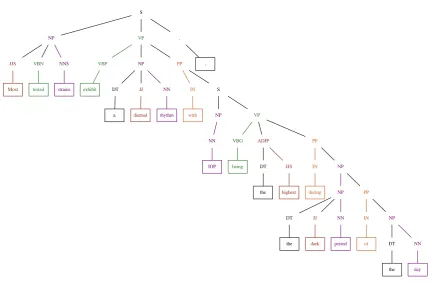
Figure 1: Three patterns corresponding to three gold mentions are extracted from the parse tree: “a diurnal rhythm with IOP” (pattern:(NP,IN,NP)), “the dark period of the day” (pattern:(NP)), “the day” (pattern:(NP))
In order to overcome this issue, we propose to filter noisy spans based on their syntactic infor-mation. We observe that in the task like corefer-ence resolution, mentions usually follow syntac-tic structures such as noun phrases. We therefore learn a syntactic parsing model to parse sentences and then extract patterns of gold mentions based on the resulting parse trees.
The end-to-end parsing model is trained jointly by the two following steps.
• Part-of-speech (POS) classifier: given raw sentences from the training set, words are split into sub-words with corresponding vec-tors from BERT embeddings. The last sub-word embedding of each sub-word is used as the word embedding and passed through a linear layer to predict POS tags. The gold label POS tags are obtained from the CRAFT training set. Predicted POS tags and the raw texts will be used as the input for the parsing model.
• Parser: our model is based on the con-stituency parsing model (Kitaev and Klein,
2018), in which parse trees were built based on a self-attentive encoder and achieved state-of-the-art performance on the Penn
Treebank. Unlike their model, we replaced the self-attentive encoder by BERT.
Figure 1presents an example of using a parse tree to extract patterns of gold mentions. In this example, three patterns corresponding to three gold mentions are extracted: (NP, IN, NP), (NP), and (NP).
In the coreference resolution model, generated spans that match with the learned patterns are fed into the span representation layer to create span embeddings, while unmatched spans are ignored.
3 Experimental Settings
3.1 Dataset
The organizer provided two subsets of the CRAFT corpus (Cohen et al.,2017): one for training and one for testing systems. To estimate our model be-fore submitting testing results, we further divided the original training set into two subsets, namely training and development sets. Table1shows the statistics numbers of these three subsets.
3.2 Compared Models
Train Dev Test
No. documents 60 7 30
No. sentences 19,575 2,156 9,099
Avg. sentences/doc 326.25 308.0 303.3
No. mentions 69,413 8,342 33,749
No. discon. men. 4,041 444 1,845
[image:4.595.310.521.62.172.2]No. coreference. 14,679 1,623 7,185
Table 1: Characteristics of the CRAFT corpus. (discon. men.: discontinuous mentions)
• LSTM: this is the baseline model (Lee et al.,
2017) based on LSTM. This model obtained the state-of-the-art performance on general domain. In this setting, all generated spans are used for calculating mention scores. The number of antecedent candidates was 250 and theλ= 0.25.
• LSTM filter: this is the same as the LSTM baseline model, but we applied the filtering method and increased the antecedent number to 600 instead of 250.
• BERT: we employed the pre-trained SciB-ERT model (Beltagy et al., 2019) instead of using the LSTM as the baseline model. The number of antecedent candidates was 600.
• BERT filter: we used the same settings as BERT but we combined it with the filtering method.
• E2E MetaMap (Trieu et al., 2018): this model is based on the baseline model (Lee et al., 2017) but it particularly incorpo-rated semantic type features extracted from the MetaMapLite (Demner-Fushman et al.,
2017) to address biomedical documents. The maximum antecedent was 250.
The E2E MetaMap implementation is based on the Tensorflow repository.1 Meanwhile, the LSTM, LSTM filter, and BERT filter are based on the PyTorch repository.2
For the BERT model, we employed the Py-Torch Pretrained BERT repository.3 We trained
1
https://github.com/kentonl/e2e-coref/ tree/1f37582e68
2https://github.com/allenai/allennlp/
tree/master/allennlp/models/coreference_ resolution
3https://github.com/huggingface/
pytorch-pretrained-BERT/tree/34cf67fd6c
Syntactic Patterns Frequency Ratio (%)
NP 40,639 58.55
NN 10,746 15.48
NML 3,462 4.99
PRP$ 1,012 1.46
NN, NN 1,012 1.46
NP, NN 678 0.98
[image:4.595.73.293.62.158.2]LS 647 0.93
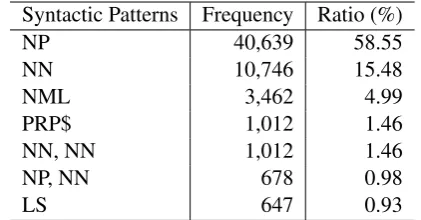
Table 2: The most frequent patterns of mentions in the training set. Please check AppendixAfor the definition of relevant Penn Treebank labels.
the model with the Adam optimizer (Kingma and Ba, 2015). We included gradient clipping and dropout.
4 Results and Discussion
We firstly present the results of extracting patterns to filter mentions. We then report and discuss the performance of our models on the official test set. In order to deeply investigate the effect of the pro-posed method, we describe the intensive results of ablation tests on the development set. We finally conduct analysis to see how each model works on each group of sentence-level distance between mentions and antecedents.
4.1 Patterns of Gold Mentions
Table 2 reports some patterns4 with the highest frequencies in the training set. In total, we ex-tracted 1,561 unique patterns. To avoid low qual-ity filtering, we kept patterns with a minimum fre-quency threshold of 5. The threshold was chosen from our experiments so that we could filter a large number of noisy spans but still kept a high recall on the development set. Specifically, this filtering method helps to reduce up to 90% noisy spans but still kept 93% of correct mentions on the develop-ment set.
4.2 Evaluation on the Test Set
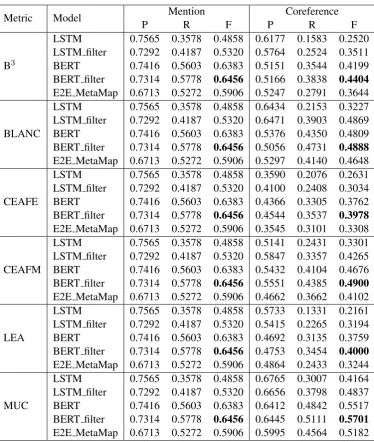
The results on the official test set are presented in Table3. In summary, our BERT filter obtained the best performance on both mention and coreference detection in all metrics.
Mention detection For mention detection, most models obtained approximately the same preci-sion of more than 70%. However, the recall
4The tag set in our patterns follows Penn Treebank POS
Metric Model Mention Coreference
P R F P R F
B3
LSTM 0.7565 0.3578 0.4858 0.6177 0.1583 0.2520
LSTM filter 0.7292 0.4187 0.5320 0.5764 0.2524 0.3511
BERT 0.7416 0.5603 0.6383 0.5151 0.3544 0.4199
BERT filter 0.7314 0.5778 0.6456 0.5166 0.3838 0.4404
E2E MetaMap 0.6713 0.5272 0.5906 0.5247 0.2791 0.3644
BLANC
LSTM 0.7565 0.3578 0.4858 0.6434 0.2153 0.3227
LSTM filter 0.7292 0.4187 0.5320 0.6471 0.3903 0.4869
BERT 0.7416 0.5603 0.6383 0.5376 0.4350 0.4809
BERT filter 0.7314 0.5778 0.6456 0.5056 0.4731 0.4888
E2E MetaMap 0.6713 0.5272 0.5906 0.5297 0.4140 0.4648
CEAFE
LSTM 0.7565 0.3578 0.4858 0.3590 0.2076 0.2631
LSTM filter 0.7292 0.4187 0.5320 0.4100 0.2408 0.3034
BERT 0.7416 0.5603 0.6383 0.4366 0.3305 0.3762
BERT filter 0.7314 0.5778 0.6456 0.4544 0.3537 0.3978
E2E MetaMap 0.6713 0.5272 0.5906 0.3545 0.3101 0.3308
CEAFM
LSTM 0.7565 0.3578 0.4858 0.5141 0.2431 0.3301
LSTM filter 0.7292 0.4187 0.5320 0.5847 0.3357 0.4265
BERT 0.7416 0.5603 0.6383 0.5432 0.4104 0.4676
BERT filter 0.7314 0.5778 0.6456 0.5551 0.4385 0.4900
E2E MetaMap 0.6713 0.5272 0.5906 0.4662 0.3662 0.4102
LEA
LSTM 0.7565 0.3578 0.4858 0.5733 0.1331 0.2161
LSTM filter 0.7292 0.4187 0.5320 0.5415 0.2265 0.3194
BERT 0.7416 0.5603 0.6383 0.4692 0.3135 0.3759
BERT filter 0.7314 0.5778 0.6456 0.4753 0.3454 0.4000
E2E MetaMap 0.6713 0.5272 0.5906 0.4864 0.2433 0.3244
MUC
LSTM 0.7565 0.3578 0.4858 0.6765 0.3007 0.4164
LSTM filter 0.7292 0.4187 0.5320 0.6656 0.3798 0.4837
BERT 0.7416 0.5603 0.6383 0.6412 0.4842 0.5517
BERT filter 0.7314 0.5778 0.6456 0.6445 0.5111 0.5701
[image:5.595.112.487.58.501.2]E2E MetaMap 0.6713 0.5272 0.5906 0.5995 0.4564 0.5182
Table 3: Results on the test set. The three official submissions of our team were BERT, BERT filter and E2E MetaMap. The non-coreference scores of BLANC are reported in AppendixB.
of the BERT filter is much higher than those of the LSTM and LSTM filter (57% vs. 35% and 41%, respectively). Consequently, the F-score of the BERT filter is 16% and 11% points higher than the LSTM and LSTM filter, respectively. The E2E MetaMap is 5% points lower than the BERT filter in F-score.
Coreference detection By obtaining the high-est recall in mention detection, the BERT filter could achieve the highest scores in coreference detection in all metrics. Using the mention fil-tering improved the baseline LSTM from 4-16% points in F-score varied by metrics. When replac-ing LSTM by BERT and combinreplac-ing with mention filtering, we obtained significant improvements:
+19% points of B3 and LEA; +16% points of MUC, BLANC and CEAFM; and +13% points of CEAFE in F-score.
Metric Model Mention Coreference
P R F P R F
B3
LSTM 0.7716 0.3782 0.5076 0.6387 0.1763 0.2764
LSTM filter 0.7193 0.4396 0.5457 0.5725 0.2572 0.3550
BERT 250 0.7288 0.5675 0.6381 0.5258 0.32 0.3979
BERT 0.7094 0.5742 0.6347 0.4807 0.3596 0.4115
BERT filter 0.7066 0.6014 0.6498 0.5021 0.3855 0.4361
BLANC
LSTM 0.7716 0.3782 0.5076 0.5665 0.1487 0.2356
LSTM filter 0.7193 0.4396 0.5457 0.5503 0.2235 0.3179
BERT 250 0.7288 0.5675 0.6381 0.5129 0.3256 0.3983
BERT 0.7094 0.5742 0.6347 0.4691 0.3168 0.3782
BERT filter 0.7066 0.6014 0.6498 0.5141 0.3757 0.4341
CEAFE
LSTM 0.7716 0.3782 0.5076 0.3659 0.2536 0.2996
LSTM filter 0.7193 0.4396 0.5457 0.4123 0.3252 0.3636
BERT 250 0.7288 0.5675 0.6381 0.3888 0.3672 0.3777
BERT 0.7094 0.5742 0.6347 0.4115 0.3674 0.3882
BERT filter 0.7066 0.6014 0.6498 0.4176 0.3993 0.4083
CEAFM
LSTM 0.7716 0.3782 0.5076 0.5285 0.2591 0.3477
LSTM filter 0.7193 0.4396 0.5457 0.5757 0.3518 0.4368
BERT 250 0.7288 0.5675 0.6381 0.5073 0.3952 0.4443
BERT 0.7094 0.5742 0.6347 0.5143 0.4163 0.4602
BERT filter 0.7066 0.6014 0.6498 0.5308 0.4518 0.4881
LEA
LSTM 0.7716 0.3782 0.5076 0.5974 0.1507 0.2407
LSTM filter 0.7193 0.4396 0.5457 0.5370 0.2276 0.3197
BERT 250 0.7288 0.5675 0.6381 0.4811 0.2805 0.3544
BERT 0.7094 0.5742 0.6347 0.4383 0.3196 0.3696
BERT filter 0.7066 0.6014 0.6498 0.4619 0.3464 0.3959
MUC
LSTM 0.7716 0.3782 0.5076 0.7065 0.3117 0.4325
LSTM filter 0.7193 0.4396 0.5457 0.6658 0.3783 0.4825
BERT 250 0.7288 0.5675 0.6381 0.6418 0.4743 0.5455
BERT 0.7094 0.5742 0.6347 0.6144 0.4850 0.5421
[image:6.595.116.484.62.504.2]BERT filter 0.7066 0.6014 0.6498 0.6271 0.5179 0.5673
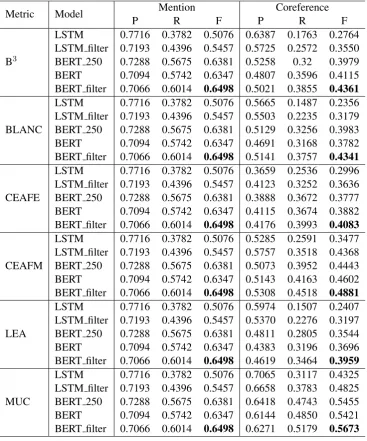
Table 4: Results on the development set.
4.3 Ablation Tests
We conducted experiments on the development set to show the effect of using mention filtering and BERT. In order to directly compare between BERT and LSTM, we also conducted an exper-iment with BERT and set a value of 250 to the number of antecedent candidates. We named it as BERT 250. Meanwhile, LSTM, LSTM filter, BERT, BERT filter have the same settings as de-scribed in Section 3.2. All of the results are re-ported in Table4.
Mention Filtering When we used mention fil-tering, the mention detection precision dropped 6% points in the case of LSTM, but in the case of BERT it was almost the same. However, the
filter-ing helped to improve recall in both cases, which is important to the coreference detection step. As a result, in the coreference resolution step, men-tion filtering improved 2-8% points of F-score in all metrics.
Using BERT Using BERT could significantly boost the performance of the baselines in both mention detection and coreference resolution. For mention detection, BERT produced almost the same precision with the LSTM but much higher recall (+17% points), which led to an increase of 10% points in F-score. For coreference de-tection, BERT-based models outperformed the LSTM-based ones from 4-14% points of F-scores in all metrics.
<= 10 11-50 51-100 101-200 > 200
Mention-antecedent pair distance
0 2500 5000 7500 10000 12500 15000 17500 20000
Counts
[image:7.595.80.523.65.279.2]LSTM LSTM_filter BERT_250 BERT BERT_filter Gold
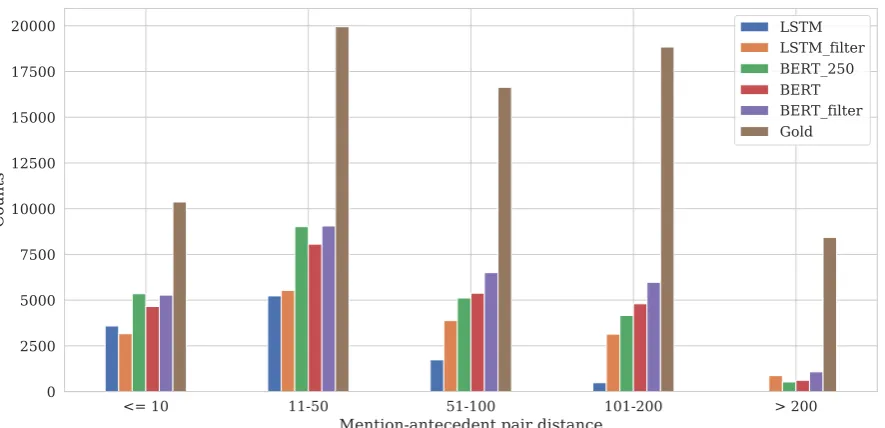
Figure 2: Numbers of correct predictions (true positives) grouped by sentence-level distance between a mention and its antecedent in the development set. The detail results are reported in AppendixC.
(BERT filter vs. LSTM), we could make a signif-icant increase of more than 14% points in F-score for mention detection and from 11% to 20% points in F-score in all metrics for coreference resolution on the development set.
4.4 Analysis
To investigate the effect of distance between a mention and its antecedent(s) on each model, we calculated the number of true positive coreference predictions in the development set and grouped them by sentence-level distance. Specifically, we divided the number of true positive predictions into five groups: ≤10, 11-50, 51-100, 101-200, and>200. The first two groups can be considered as short-distance coreference, e.g., abstract papers like the BioNLP dataset (Nguyen et al.,2011) with an average of nine sentences per document. Mean-while, the other three groups can be considered as long-distance coreference like full papers in the CRAFT corpus.
Distribution of coreferent pairs in gold data
As illustrated in Figure 2, only about 40.85% of the gold pairs are in the groups of short distance while the other 59.15% of them are in the groups of long distance. This means that if a model cannot deal with long distance coreference, pairs of men-tions and antecedents in this region cannot be dis-covered. Among those long distance pairs, 47.8% are in between 51-200 sentences while the number of pairs whose distance is more than 200 is about 11.35%.
The effect of mention filtering The results in Figure2revealed that by using the filtering meth-ods, we could effectively address long-distance coreferent pairs. It can be seen from the figure that the baseline model was good enough when working on short distance pairs, and the filtering may slightly harm the performance. However, for longer distances, the filtering contributed to in-creases of 5.46%, 55.26%, 84.60% and 100% for the groups of 11-50, 51-100, 101-200, and>200, respectively, in comparison with the baseline.
The effect of BERT Without using the filtering method, BERT itself could capture a fairly large number of long-distance pairs, which was even better than the LSTM filter model.
Recall problem It is necessary to note that al-though our model improved the baseline LSTM and obtained promising results, the recall is still low in all groups of distance. For instance, the best performing model, i.e., BERT filter could cover only 50.90%, 45.38%, 39.08%, 31.71%, and 12.82% of the gold pairs in the groups of<=10, 11-50, 51-100, 101-200,>200, respectively. This is an open issue that we will address in the future.
5 Conclusion
In this paper, we particularly address the chal-lenge of coreference resolution in full text articles in the CRAFT Shared Task 2019. Specifically, we employ the span-based end-to-end model (Lee et al.,2017) and enhance the model by utilizing a syntax-based mention filtering method and BERT. To filter noisy mentions, we jointly train a parsing model with a POS classifier to obtain parse trees of sentences. We then generate syntactic patterns of gold mentions based on the resulting parse trees. Any mentions that satisfy the generated patterns will be fed into the coreference resolution model. We finally incorporate BERT into our model. Ex-perimental results on the CRAFT corpus indicate that the proposed method is effective in capturing long-distance coreferences in long documents.
Acknowledgments
This paper is based on results obtained from a project commissioned by the New Energy and Industrial Technology Development Organization (NEDO). This work is also supported by PRISM (Public/Private R&D Investment Strategic Expan-sion PrograM).
References
Iz Beltagy, Arman Cohan, and Kyle Lo. 2019.Scibert: Pretrained contextualized embeddings for scientific text.CoRR, abs/1903.10676.
K. Bretonnel Cohen, Arrick Lanfranchi, Miji Joo-young Choi, Michael Bada, William A. Baumgart-ner Jr., Natalya Panteleyeva, Karin Verspoor, Martha Palmer, and Lawrence E. Hunter. 2017. Corefer-ence annotation and resolution in the colorado richly annotated full text (CRAFT) corpus of biomedical journal articles. BMC Bioinformatics, 18(1):372:1– 372:14.
Dina Demner-Fushman, Willie J Rogers, and Alan R Aronson. 2017. MetaMap Lite: an evaluation of a new Java implementation of MetaMap. Journal
of the American Medical Informatics Association, 24(4):841–844.
Jacob Devlin, Ming-Wei Chang, Kenton Lee, and Kristina Toutanova. 2019. BERT: Pre-training of deep bidirectional transformers for language under-standing. InProceedings of the 2019 Conference of the North American Chapter of the Association for Computational Linguistics: Human Language Technologies, Volume 1 (Long and Short Papers), pages 4171–4186, Minneapolis, Minnesota. Associ-ation for ComputAssoci-ational Linguistics.
Sepp Hochreiter and J¨urgen Schmidhuber. 1997. Long short-term memory. Neural computation, 9(8):1735–1780.
Diederik P Kingma and Jimmy Lei Ba. 2015. Adam: A method for stochastic optimization. In Proceed-ings of the 3rd International Conference on Learn-ing Representations (ICLR2015).
Nikita Kitaev and Dan Klein. 2018. Constituency parsing with a self-attentive encoder. In Proceed-ings of the 56th Annual Meeting of the Association for Computational Linguistics (Volume 1: Long Pa-pers), pages 2676–2686, Melbourne, Australia. As-sociation for Computational Linguistics.
Kenton Lee, Luheng He, Mike Lewis, and Luke Zettle-moyer. 2017. End-to-end neural coreference reso-lution. InProceedings of the 2017 Conference on Empirical Methods in Natural Language Process-ing, pages 188–197, Copenhagen, Denmark. Asso-ciation for Computational Linguistics.
Ngan Nguyen, Jin-Dong Kim, and Jun’ichi Tsujii. 2011. Overview of BioNLP 2011 protein corefer-ence shared task. InProceedings of BioNLP Shared Task 2011 Workshop, pages 74–82, Portland, Ore-gon, USA. Association for Computational Linguis-tics.
H-L. Trieu, N. T. H. Nguyen, M. Miwa, and S. Anani-adou. 2018. Investigating domain-specific informa-tion for neural coreference resoluinforma-tion on biomedical texts. InProceedings of the BioNLP 2018 workshop, pages 183–188.
A Penn Treebank Labels
For the Penn Treebank labels in our syntactic pat-terns, we follow the BioMedical Treebank tagset definition (Warner et al.,2004). Please refer to Ta-ble5for the detail description.
B Non-Coreference Results
Unlike other metrics, the BLANC metric also con-tains non-coreference results. We report the re-sults of the test set in Table6.
C Results on (Mention-Antecedent) Pair Distance
Tag Description
NP noun phrase
[image:10.595.213.384.90.171.2]NN noun, singular or mass NML sub-NP nominal substrings PRP$ possessive pronoun LS list item marker
Table 5: The definition of relevant Penn Treebank labels.
Metric Model Mention Non-Coreference
P R F P R F BLANC-F
BLANC
LSTM 0.7565 0.3578 0.4858 0.5725 0.1314 0.2137 0.2682
LSTM filter 0.7292 0.4187 0.5320 0.5432 0.1796 0.2699 0.3784
BERT 0.7416 0.5603 0.6383 0.5537 0.3172 0.4033 0.4421
BERT filter 0.7314 0.5778 0.6456 0.5383 0.3356 0.4135 0.4512
[image:10.595.81.517.256.354.2]E2E MetaMap 0.6713 0.5272 0.5906 0.4488 0.2812 0.3457 0.4053
Table 6: Non-coreference results for the BLANC metric on the testing set.
Model <=10 11-50 51-100
TP G.R O.R TP G.R O.R TP G.R O.R
(%) (%) (%) (%) (%) (%)
LSTM 3,588 34.61 4.83 5,230 26.22 7.05 1,735 10.43 2.34
LSTM filter 3,164 30.52 4.26 5,532 27.73 7.45 3,878 23.31 5.23
BERT 250 5,347 51.58 7.20 9,015 45.19 12.15 5,115 30.75 6.89
BERT 4,651 44.87 6.27 8,062 40.41 10.86 5,381 32.35 7.25
BERT filter 5,276 50.90 7.11 9,053 45.38 12.20 6,502 39.08 8.76
Group Gold 10,366 100 13.97 19,949 100 26.88 16,636 100 22.41
Model 101-200 >200
TP G.R O.R TP G.R O.R
(%) (%) (%) (%)
LSTM 484 2.57 0.65 0 0.00 0.00
LSTM filter 3,143 16.69 4.23 874 10.37 1.18
BERT 250 4,163 22.10 5.61 527 6.25 0.71
BERT 4,798 25.47 6.46 620 7.35 0.84
BERT filter 5,974 31.71 8.05 1,081 12.82 1.46
Group Gold 18,837 100 25.38 8,431 100 11.36
Total Gold 74,219
[image:10.595.99.502.435.704.2]