Proceedings of the 2019 Conference on Empirical Methods in Natural Language Processing and the 9th International Joint Conference on Natural Language Processing, pages 5668–5678,
5668
The Role of Pragmatic and Discourse Context
in Determining Argument Impact
Esin Durmus Cornell University [email protected]
Faisal Ladhak Amazon
Claire Cardie Cornell University [email protected]
Abstract
Research in the social sciences and psy-chology has shown that the persuasiveness of an argument depends not only the lan-guage employed, but also on attributes of the source/communicator, the audience, and the appropriateness and strength of the argument’s claims given the pragmatic and discourse con-text of the argument. Among these charac-teristics of persuasive arguments, prior work in NLP does not explicitly investigate the ef-fect of the pragmatic and discourse context when determining argument quality. This pa-per presents a new dataset to initiate the study of this aspect of argumentation: it consists of a diverse collection of arguments covering 741 controversial topics and comprising over 47,000 claims. We further propose predic-tive models that incorporate the pragmatic and discourse context of argumentative claims and show that they outperform models that rely only on claim-specific linguistic features for predicting the perceived impact of individual claims within a particular line of argument.
1 Introduction
Previous work in the social sciences and psychol-ogy has shown that the impact and persuasive power of an argument depends not only on the lan-guage employed, but also on the credibility and character of the communicator (i.e. ethos) (Miller et al., 1976;Chaiken,1979,1980); the traits and prior beliefs of the audience (G. Lord et al.,1979;
Davies,1998;Correll et al.,2004;Hullett,2005); and the pragmatic context in which the argument is presented (i.e. kairos) (Haugtvedt and Wegener,
1994;Joyce and Harwood,2014).
Research in Natural Language Processing (NLP) has only partially corroborated these find-ings. One very influential line of work, for ex-ample, develops computational methods to auto-matically determine the linguistic characteristics
of persuasive arguments (Habernal and Gurevych,
2016;Tan et al., 2016;Zhang et al.,2016), but it does so without controlling for the audience, the communicator or the pragmatic context.
Very recent work, on the other hand, shows that attributes of both the audience and the communi-cator constitute important cues for determining ar-gument strength (Lukin et al., 2017;Durmus and Cardie, 2018). They further show that audience and communicator attributes can influence the rel-ative importance of linguistic features for predict-ing the persuasiveness of an argument. These re-sults confirm previous findings in the social sci-ences that show a person’s perception of an argu-ment can be influenced by his background and per-sonality traits.
To the best of our knowledge, however, no NLP studies explicitly investigate the role ofkairos— a component of pragmatic context that refers to the context-dependent “timeliness” and “appropriate-ness” of an argument and its claims within an ar-gumentative discourse — in argument quality pre-diction. Among the many social science studies of attitude change, the order in which argumentative claims are shared with the audience has been stud-ied extensively: Haugtvedt and Wegener (1994), for example, summarize studies showing that the argument-related claims a person is exposed to be-forehand can affect his perception of an alternative argument in complex ways. Joyce and Harwood
(2014) similarly find that changes in an argument’s context can have a big impact on the audience’s perception of the argument.
Some recent studies in NLP have investigated the effect of interactions on the overall persuasive power of posts in social media (Tan et al., 2016;
other factors such as interactions between the in-dividuals (Durmus and Cardie,2019). Therefore, it is difficult to measure the effect of argumenta-tive pragmatic context alone in argument quality prediction without the effect of these confound-ing factors usconfound-ing the datasets and models currently available in this line of research.
In this paper, we study the role of kairos on ar-gument quality prediction by examining the indi-vidual claims of an argument for their timeliness and appropriateness in the context of a particular line of argument.We define kairos as the sequence ofargumentativetext (e.g. claims) along a partic-ular line of argumentative reasoning.
To start, we present a dataset extracted from kialo.com of over 47,000 claims that are part of a diverse collection of arguments on 741 contro-versial topics. The structure of the website dic-tates that each argument must present a supporting or opposing claim for its parent claim, and stay within the topic of the main thesis. Rather than being posts on a social media platform, these are community-curated claims. Furthermore, for each presented claim, the audience votes on its impact within the given line of reasoning. Critically then, the dataset includes the argument context for each claim, allowing us to investigate the characteristics associated with impactful arguments.
With the dataset in hand, we propose the task of studying the characteristics of impactful claims by (1) taking the argument context into account, (2) studying the extent to which this context is im-portant, and (3) determining the representation of context that is more effective. To the best of our knowledge, ours is the first dataset that includes claims with both impact votes and the correspond-ing context of the argument.
2 Related Work
Recent studies in computational argumentation have mainly focused on the tasks of identify-ing the structure of the arguments such as argu-ment structure parsing (Peldszus and Stede,2015;
Park and Cardie, 2014), and argument compo-nent classification (Habernal and Gurevych,2017;
Mochales and Moens,2011). More recently, there is an increased research interest to develop com-putational methods that can automatically evalu-ate qualitative characteristic of arguments, such as their impact and persuasive power (Habernal and Gurevych,2016;Tan et al.,2016;Kelman,1961;
Burgoon et al., 1975; Chaiken, 1987; Tykocin-skl et al.,1994;Dillard and Pfau,2002;Cialdini,
2007;Durik et al., 2008;Marquart and Naderer,
2016). Consistent with findings in the social sci-ences and psychology, some of the work in NLP has shown that the impact and persuasive power of the arguments are not simply related to the lin-guistic characteristics of the language, but also on characteristics the source (ethos) (Durmus and Cardie,2019) and the audience (Lukin et al.,2017;
Durmus and Cardie, 2018). These studies sug-gest that perception of the arguments can be in-fluenced by the credibility of the source, and the background of the audience.
It has also been shown, in social science studies, that kairos, which refers to the “timeliness” and “appropropriateness” of arguments and claims, is important to consider in studies of argument im-pact and persuasiveness (Haugtvedt and Wegener,
1994; Joyce and Harwood, 2014). One recent study in NLP has investigated the role of argu-ment sequencing in arguargu-ment persuasion look-ing at (Hidey and McKeown, 2018) Change My View1, which is a social media platform where users post their views, and challenge other users to present arguments in an attempt to change their them. However, as stated in (Rakshit et al.,2017) many posts on social media platforms either do not express an argument, or diverge from the main topic of conversation. Therefore, it is difficult to measure the effect of pragmatic context in argu-ment impact and persuasion, without confounding factors from using noisy social media data. In con-trast, we provide a dataset of claims along with their structured argument path, which only con-sists of claims and corresponds to a particular line of reasoning for the given controversial topic. This structure enables us to study the characteristics of impactful claims, accounting for the effect of the pragmatic context.
Consistent with previous findings in the social sciences, we find that incorporating pragmatic and discourse context is important in computational studies of persuasion, as predictive models that with the context representation outperform models that only incorporate claim-specific linguistic fea-tures, in predicting the impact of a claim. Such a system that can predict the impact of a claim given an argumentative discourse, for example, could potentially be employed by argument retrieval and
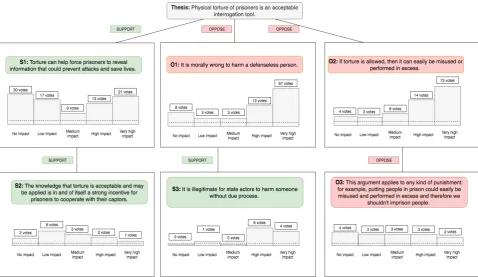
Figure 1: Example partial argument tree with claims and corresponding impact votes for the thesis “PHYSICAL TORTURE OF PRISONERS IS AN ACCEPTABLE INTERROGATION TOOL.”.
generation models which aims to pick or generate the most appropriate possible claim given the dis-course.
3 Dataset
Claims and impact votes. We collected 47,219 claims fromkialo.com23for 741 controversial top-ics and their corresponding impact votes. Impact votes are provided by the users of the platform to evaluate how impactful a particular claim is. Users can pick one of 5 possible impact labels for a particular claim: NO IMPACT,LOW IMPACT,
MEDIUM IMPACT,HIGH IMPACTandVERY HIGH
IMPACT. While evaluating the impact of a claim, users have access to the full argument context and therefore, they can assess how impactful a claim is in the given context of an argument. An inter-esting observation is that, in this dataset, the same claim can have different impact labels depending on the context in which it is presented.
Figure 1 shows a partial argument tree for the argument thesis “PHYSICAL TORTURE OF
2The data is collected from this website in accordance with the terms and conditions.
3There is prior work byDurmus et al.(2019) which cre-ated a dataset of argument trees fromkialo.com. That dataset, however, does not include any impact labels.
PRISONERS IS AN ACCEPTABLE INTERROGA
-TION TOOL.”. Each node in the argument tree cor-responds to a claim, and these argument trees are constructed and edited collaboratively by the users of the platform.
Except the thesis, every claim in the argument tree either opposes or supports its parent claim. Each path from the root to leaf nodes corresponds to anargument pathwhich represents a particular line of reasoning on the given controversial topic.
Moreover, each claim has impact votes as-signed by the users of the platform. The impact votes evaluate how impactful a claim is within its context, which consists of its predecessor claims from the thesis of the tree. For example, claimO1
“IT IS MORALLY WRONG TO HARM A DEFENSE
-LESS PERSON” is an opposing claim for the thesis and it is an IMPACTFUL CLAIM since most of its
impact votes belong to the category ofVERY HIGH IMPACT. However, claim S3 “IT IS ILLEGITI
-MATE FOR STATE ACTORS TO HARM SOMEONE WITHOUT THE PROCESS” is a supporting claim for its parentO1 and it is a less impactful claim since most of the impact votes belong to the NO IMPACTandLOW IMPACTcategories.
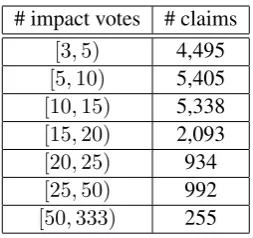
im-# impact votes # claims
[3,5) 4,495
[5,10) 5,405
[10,15) 5,338
[15,20) 2,093
[20,25) 934
[25,50) 992
[image:4.595.118.245.60.179.2][50,333) 255
Table 1: Number of claims for the given range of num-ber of votes. There are 19,512 claims in the dataset with3or more votes. Out of the claims with3or more votes, majority of them have5or more votes.
pact votes are shown in Table1. There are 19,512 claims in total with 3 or more votes. Out of the claims with3or more votes, majority of them have
5or more votes. We limit our study to the claims with at least5votes to have a more reliable assign-ment for the accumulated impact label for each claim.
Impact label statistics. Table3shows the dis-tribution of the number of votes for each of the impact categories. The claims have241,884total votes. The majority of the impact votes belong to
MEDIUM IMPACTcategory. We observe that users assign more HIGH IMPACT and VERY HIGH IM
-PACT votes than LOW IMPACT and NO IMPACT
votes respectively. When we restrict the claims to the ones with at least5 impact votes, we have
213,277votes in total4.
Agreement for the impact votes. To determine the agreement in assigning the impact label for a particular claim, for each claim, we compute the percentage of the votes that are the same as the majority impact vote for that claim. Letci denote the count of the claims with the class labels C=[NO
IMPACT, LOW IMPACT, MEDIUM IMPACT, HIGH
IMPACT,VERY HIGH IMPACT] for the impact label lat indexi.
Agreement= 100∗ maxP04≤i≤4ci i=0ci
% (1)
For example, for claim S1 in Figure 1, the agreement score is 100∗ 30
90% = 33.33% since
the majority class (NO IMPACT) has30 votes and there are90 impact votes in total for this partic-ular claim. We compute the agreement score for
426,998 of them
NO IMPACT, 33,789 of themLOW IM
-PACT, 55,616 of them MEDIUM IMPACT, 47,494 of them
HIGH IMPACTand 49,380 of themVERY HIGH IMPACT.
the cases where (1) we treat each impact label separately (5-class case) and (2) we combine the classes HIGH IMPACT and VERY HIGH IMPACT
into a one class: IMPACTFULandNO IMPACTand
LOW IMPACT into a one class: NOT IMPACTFUL
(3-class case).
Table 2 shows the number of claims with the given agreement score thresholds when we include the claims with at least 5 votes. We see that when we combine the low impact and high impact classes, there are more claims with high agreement score. This may imply that distinguishing between no impact-low impact and high impact-very high impact classes is difficult. To decrease the sparsity issue, in our experiments, we use 3-class repre-sentation for the impact labels. Moreover, to have a more reliable assignment of impact labels, we consider only the claims with have more than 60% agreement.
Context. In an argument tree, the claims from the thesis node (root) to each leaf node, form an ar-gument path. This arar-gument path represents a par-ticular line of reasoning for the given thesis. Sim-ilarly, for each claim, all the claims along the path from the thesis to the claim, represent thecontext
for the claim. For example, in Figure1, the con-text forO1consists of only the thesis, whereas the context forS3 consists of both the thesis andO1
sinceS3is provided to support the claimO1which is an opposing claim for the thesis.
The claims are not constructed independently from their context since they are written in consid-eration with the line of reasoning so far. In most cases, each claim elaborates on the point made by its parent and presents cases to support or oppose the parent claim’s points. Similarly, when users evaluate the impact of a claim, they consider if the claim is timely and appropriate given its con-text. There are cases in the dataset where the same claim has different impact labels, when presented within a different context. Therefore, we claim that it is not sufficient to only study the linguistic characteristic of a claim to determine its impact, but it is also necessary to consider its context in determining the impact.
Context length (Cl) for a particular claimC is defined by number of claims included in the argu-ment path starting from the thesis until the claim C. For example, in Figure1, the context length for
con-3-class case 5-class case Agreement score Number of claims Number of claims
>50% 10,848 7,304
>60% 7,386 4,329
>70% 4,412 2,195
[image:5.595.165.434.61.149.2]>80% 2,068 840
Table 2: Number of claims, with at least 5 votes, above the given threshold of agreement percentage for 3-class and 5-class cases. When we combine the low impact and high impact classes, there are more claims with high agreement score.
Impact label # votes- all claims
No impact 32,681
Low impact 37,457
Medium impact 60,136
High impact 52,764
Very high impact 58,846
[image:5.595.91.273.214.314.2]Total # votes 241,884
Table 3: Number of votes for the given impact label. There are241,884total votes and majority of them be-longs to the categoryMEDIUM IMPACT.
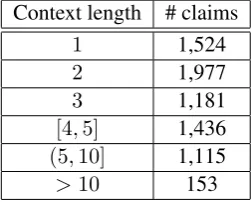
Context length # claims
1 1,524
2 1,977
3 1,181
[4,5] 1,436
(5,10] 1,115
>10 153
Table 4: Number of claims for the given range of con-text length, for claims with more than5votes and an agreement score greater than60%.
text length for the claims with more than5votes and60%agreement score. We observe that more than half of these claims have3or higher context length.
4 Methodology
4.1 Hypothesis and Task Description
Similar to prior work, our aim is to understand the characteristics of impactful claims in argumenta-tion. However, wehypothesizethat the qualitative characteristics of arguments is not independent of the context in which they are presented. To under-stand the relationship between argument context and the impact of a claim, we aim to incorporate the context along with the claim itself in our pre-dictive models.
Prediction task.Given a claim, we want to pre-dict the impact label that is assigned to it by the users:NOT IMPACTFUL,MEDIUM IMPACT, orIM
-PACTFUL.
Preprocessing. We restrict our study to claims with at least5or more votes and greater than60%
agreement, to have a reliable impact label assign-ment. We have7,386claims in the dataset satis-fying these constraints5. We see that the impact classIMPACFULis the majority class since around
58%of the claims belong to this category.
For our experiments, we split our data to train (70%), validation (15%) and test (15%) sets.
4.2 Baseline Models
4.2.1 Majority
The majority baseline assigns the most common label of the training examples (HIGH IMPACT) to
every test example.
4.2.2 SVM with RBF kernel
Similar to (Habernal and Gurevych,2016), we ex-periment with SVM with RBF kernel, with fea-tures that represent (1) the simple characteristics of the argument tree and (2) the linguistic charac-teristics of the claim.
The features that represent the simple character-istics of the claim’s argument tree include the dis-tance and similarity of the claim to the thesis, the similarity of a claim with its parent, and the im-pact votes of the claim’s parent claim. We encode the similarity of a claim to its parent and the thesis claim with the cosine similarity of their tf-idf vec-tors. The distance and similarity metrics aim to model whether claims which are more similar (i.e. potentially more topically relevant) to their parent claim or the thesis claim, are more impactful.
5We have 1,633
NOT IMPACTFUL, 1,445 MEDIUM IM
[image:5.595.118.244.373.474.2]We encode the quality of the parent claim as the number of votes for each impact class, and incor-porate it as a feature to understand if it is more likely for a claim to impactful given an impactful parent claim.
Linguistic features. To represent each claim, we extracted the linguistic features proposed by (Habernal and Gurevych, 2016) such as tf-idf scores for unigrams and bigrams, ratio of quo-tation marks, exclamation marks, modal verbs, stop words, type-token ratio, hedging (Hyland,
1998), named entity types, POS n-grams, sen-timent (Hutto and Gilbert, 2014) and subjectiv-ity scores (Wilson et al., 2005), spell-checking, readibility features such asColeman-Liau ( Cole-man and Liau,1975),Flesch(Flesch,1948), argu-ment lexicon features (Somasundaran et al.,2007) and surface features such as word lengths, sen-tence lengths, word types, and number of complex words6.
4.2.3 FastText
Joulin et al. (2017) introduced a simple, yet ef-fective baseline for text classification, which they show to be competitive with deep learning classi-fiers in terms of accuracy. Their method represents a sequence of text as a bag of n-grams, and each n-gram is passed through a look-up table to get its dense vector representation. The overall sequence representation is simply an average over the dense representations of the bag of n-grams, and is fed into a linear classifier to predict the label. We use the code released by Joulin et al. (2017) to train a classifier for argument impact prediction, based on the claim text7.
4.2.4 BiLSTM with Attention
Another effective baseline (Zhou et al., 2016;
Yang et al.,2016) for text classification consists of encoding the text sequence using a bidirectional Long Short Term Memory (LSTM) (Hochreiter and Schmidhuber, 1997), to get the token repre-sentations in context, and then attending (Luong et al., 2015) over the tokens to get the sequence representation. For the query vector for atten-tion, we use a learned context vector, similar to
6We pick the parameters for SVM model according to the performance validation split, and report the results on the test split.
7We used maxNgram legnth of 2, learning rate of 0.8, num epochs of 15, vector dim of 300. We also used the pre-trained 300-dim wiki-news vectors made available on the fastText website.
Yang et al. (2016). We picked our hyperparam-eters based on performance on the validation set, and report our results for the best set of hyperpa-rameters8. We initialized our word embeddings with glove vectors (Pennington et al.,2014) pre-trained on Wikipedia + Gigaword, and used the Adam optimizer (Kingma and Ba, 2015) with its default settings.
4.3 Fine-tuned BERT model
Devlin et al.(2018) fine-tuned a pre-trained deep bi-directional transformer language model (which they call BERT), by adding a simple classifica-tion layer on top, and achieved state of the art re-sults across a variety of NLP tasks. We employ their pre-trained language models for our task and compare it to our baseline models. For all the architectures described below, we finetune for 10 epochs, with a learning rate of 2e-5. We employ an early stopping procedure based on the model performance on a validation set.
4.3.1 Claim with no context
In this setting, we attempt to classify the impact of the claim, based on the text of the claim only. We follow the fine-tuning procedure for sequence classification detailed in (Devlin et al.,2018), and input the claim text as a sequence of tokens pre-ceded by the special [CLS] token and followed by the special [SEP] token. We add a classifica-tion layer on top of the BERT encoder, to which we pass the representation of the [CLS] token, and fine-tune this for argument impact prediction.
4.3.2 Claim with parent representation
In this setting, we use the parent claim’s text, in addition to the target claim text, in order to clas-sify the impact of the target claim. We treat this as a sequence pair classification task, and combine both the target claim and parent claim as a single sequence of tokens, separated by the special sep-arator [SEP]. We then follow the same procedure above, for fine-tuning.
4.3.3 Incorporating larger context
In this setting, we consider incorporating a larger context from the discourse, in order to assess the impact of a claim. In particular, we consider up
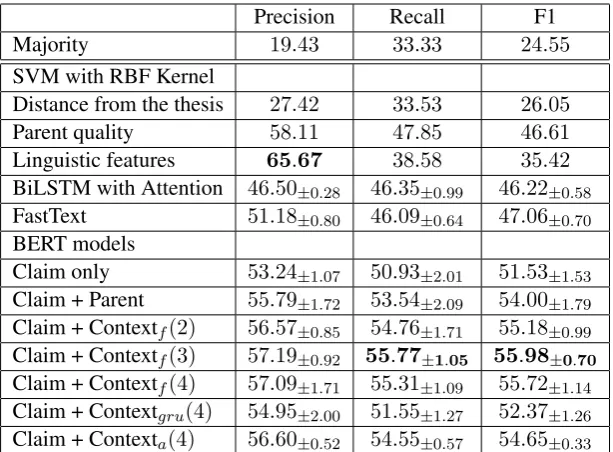
Precision Recall F1
Majority 19.43 33.33 24.55
SVM with RBF Kernel
Distance from the thesis 27.42 33.53 26.05
Parent quality 58.11 47.85 46.61
Linguistic features 65.67 38.58 35.42
BiLSTM with Attention 46.50±0.28 46.35±0.99 46.22±0.58
FastText 51.18±0.80 46.09±0.64 47.06±0.70
BERT models
Claim only 53.24±1.07 50.93±2.01 51.53±1.53
Claim + Parent 55.79±1.72 53.54±2.09 54.00±1.79
Claim + Contextf(2) 56.57±0.85 54.76±1.71 55.18±0.99
Claim + Contextf(3) 57.19±0.92 55.77±1.05 55.98±0.70 Claim + Contextf(4) 57.09±1.71 55.31±1.09 55.72±1.14
Claim + Contextgru(4) 54.95±2.00 51.55±1.27 52.37±1.26
[image:7.595.146.453.61.287.2]Claim + Contexta(4) 56.60±0.52 54.55±0.57 54.65±0.33
Table 5: Results for the baselines and the BERT models with and without the context. Best performing model is BERT with the representation of previous3claims in the path along with the claim representation itself. We run the models5times and we report the mean and standard deviation.
to four previous claims in the discourse (for a to-tal context length of 5). We attempt to incorporate larger context into the BERT model in three differ-ent ways.
Flat representation of the path.The first, sim-ple approach is to represent the entire path (claim + context) as a single sequence, where each of the claims is separated by the [SEP] token. BERT was trained on sequence pairs, and therefore the pre-trained encoders only have two segment em-beddings (Devlin et al., 2018). So to fit multiple sequences into this framework, we indicate all to-kens of the target claim as belonging to segment A and the tokens for all the claims in the dis-course context as belonging to segment B. This way of representing the input, requires no addi-tional changes to the architecture or retraining, and we can just finetune in a similar manner as above. We refer to this representation of the con-text as a flat representation, and denote the model as Contextf(i), whereiindicates the length of the context that is incorporated into the model.
Attention over context. Recent work in incor-porating argument sequence in predicting persua-siveness (Hidey and McKeown,2018) has shown that hierarchical representations are effective in representing context. Similarly, we consider hi-erarchical representations for representing the dis-course. We first encode each claim using the pre-trained BERT model as the claim encoder, and use
the representation of the [CLS] token as claim rep-resentation. We then employ dot-product attention (Luong et al.,2015), to get a weighted representa-tion for the context. We use a learned context vec-tor as the query, for computing attention scores, similar toYang et al.(2016). The attention score
αcis computed as shown below:
αc=
exp(VcTVl)
P
c∈Dexp(VcTVl)
(2)
Where Vc is the claim representation that was computed with the BERT encoder as described above,Vlis the learned context vector that is used for computing attention scores, andDis the set of claims in the discourse. After computing the at-tention scores, the final context representationvd is computed as follows:
Vd=
X
c∈D
αcVc (3)
We then concatenate the context representation with the target claim representation [Vd, Vr] and pass it to the classification layer to predict the quality. We denote this model as Contexta(i).
Cl= 1 Cl= 2 Cl = 3 Cl= 4 BERT models
Claim only 48.61±3.16 53.15±1.95 54.51±1.91 50.89±2.95
Claim + Parent 51.49±2.63 54.78±2.95 54.94±2.72 51.94±2.59
Claim + Contextf(2) 52.84±2.55 53.77±1.00 55.24±2.52 57.04±1.19
[image:8.595.120.479.63.162.2]Claim + Contextf(3) 54.88±2.49 54.71±1.74 52.93±2.07 58.17±1.89 Claim + Contextf(4) 54.47±2.95 54.88±1.53 57.11±3.38 57.02±2.22
Table 6: F1 scores of each model for the claims with various context length values.
Unit (GRU) (Cho et al., 2014), to compute the context representation. We concatenate this with the target claim representation and use this to pre-dict the claim impact. We denote this model as Contextgru(i).
5 Results and Analysis
Table5shows the macro precision, recall and F1 scores for the baselines as well as the BERT mod-els with and without context representations9.
We see that parent quality is a simple yet ef-fective feature and SVM model with this feature can achieve significantly higher (p < 0.001)10 F1 score (46.61%) than distance from the thesis andlinguistic features. Claims with higher impact parents are more likely to be have higher impact. Similarity with the parent and thesisis not signifi-cantly better than themajoritybaseline. Although the BiLSTM model with attention and FastText baselines performs better than the SVM with dis-tance from the thesisandlinguistic features, it has similar performance to theparent qualitybaseline. We find that the BERT model with claim only representation performs significantly better (p < 0.001) than the baseline models. Incorporating the parent representation only along with the claim representation does not give significant improve-ment over representing the claim only. However, incorporating the flat representation of the larger context along with the claim representation con-sistently achieves significantly better (p <0.001) performance than the claim representation alone. Similarly, attention representation over the con-text with the learned query vector achieves signifi-cantly better performance then theclaim represen-tationonly (p <0.05).
We find that the flat representationof the
con-9
For the models that result in different scores with differ-ent random seed, we run them5times and report the mean and standard deviation.
10We perform two-sided t test for significance analysis.
text achieves the highest F1 score. It may be more difficult for the models with a larger number of parameters to perform better than the flat repre-sentationsince the dataset is small. We also ob-serve that modeling3claims on the argument path before the target claim achieves the best F1 score (55.98%).
To understand for what kinds of claims the best performing contextual model is more effective, we evaluate the BERT model with flat context rep-resentationfor claims with context length values
1, 2, 3 and 4 separately. Table 6 shows the F1 score of the BERT model without context and with flat context representation with different lengths of context. For the claims with context length1, adding Contextf(3) and Contextf(4) representa-tion along with the claim achieves significantly better (p < 0.05) F1 score than modeling the claim only. Similarly for the claims with con-text length3and4, Contextf(4)and Contextf(3) perform significantly better than BERT withclaim only ((p < 0.05) and(p < 0.01)respectively). We see that models with larger context are helpful even for claims which have limited context (e.g. Cl = 1). This may suggest that when we train the models with larger context, they learn how to represent the claims and their context better.
6 Conclusion
7 Acknowledgements
This work was supported in part by NSF grants IIS-1815455 and SES-1741441. The views and conclusions contained herein are those of the au-thors and should not be interpreted as necessarily representing the official policies or endorsements, either expressed or implied, of NSF or the U.S. Government.
References
Michael Burgoon, Stephen B Jones, and Diane Stew-art. 1975. Toward a message-centered theory of persuasion: Three empirical investigations of lan-guage intensity1. Human Communication Research, 1(3):240–256.
S. Chaiken. 1979. Communicator physical attractive-ness and persuasion.
Shelly Chaiken. 1980. Heuristic versus systematic in-formation processing and the use of source versus message cues in persuasion. Journal of Personality
and Social Psychology, 39:752–766.
Shelly Chaiken. 1987. The heuristic model of persua-sion. In Social influence: the ontario symposium, volume 5, pages 3–39. Hillsdale, NJ: Lawrence Erl-baum.
Kyunghyun Cho, Bart van Merri¨enboer, C¸ alar G¨ulc¸ehre, Dzmitry Bahdanau, Fethi Bougares, Hol-ger Schwenk, and Yoshua Bengio. 2014. Learning phrase representations using rnn encoder–decoder for statistical machine translation. InProceedings of the 2014 Conference on Empirical Methods in
Nat-ural Language Processing (EMNLP), pages 1724–
1734, Doha, Qatar. Association for Computational Linguistics.
Robert B. Cialdini. 2007. Influence: The psychology of persuasion.
Meri Coleman and T. L. Liau. 1975.A computer read-ability formula designed for machine scoring. Jour-nal of Applied Psychology, 60(2):283 – 284.
Joshua Correll, Steven J. Spencer, and Mark P. Zanna. 2004. An affirmed self and an open mind: Self-affirmation and sensitivity to argument strength.
MF Davies. 1998. Dogmatism and belief formation: Output interference in the processing of supporting and contradictory cognitions. Journal of Personality
and Social Psychology, 75:456–466.
Jacob Devlin, Ming-Wei Chang, Kenton Lee, and Kristina Toutanova. 2018. Bert: Pre-training of deep bidirectional transformers for language understand-ing. arXiv preprint arXiv:1810.04805.
James Price Dillard and Michael Pfau. 2002. The persuasion handbook: Developments in theory and practice. Sage Publications.
Amanda M Durik, M Anne Britt, Rebecca Reynolds, and Jennifer Storey. 2008. The effects of hedges in persuasive arguments: A nuanced analysis of lan-guage. Journal of Language and Social Psychology, 27(3):217–234.
Esin Durmus and Claire Cardie. 2018. Exploring the role of prior beliefs for argument persuasion. In Proceedings of the 2018 Conference of the North American Chapter of the Association for Computa-tional Linguistics: Human Language Technologies,
Volume 1 (Long Papers), pages 1035–1045, New
Orleans, Louisiana. Association for Computational Linguistics.
Esin Durmus and Claire Cardie. 2019. Modeling the factors of user success in online debate. In The
World Wide Web Conference, WWW ’19, pages
2701–2707, New York, NY, USA. ACM.
Esin Durmus, Faisal Ladhak, and Claire Cardie. 2019.
Determining relative argument specificity and stance for complex argumentative structures. In Proceed-ings of the 57th Annual Meeting of the Association
for Computational Linguistics, pages 4630–4641,
Florence, Italy. Association for Computational Lin-guistics.
Rudolph Flesch. 1948. A new readability yardstick. Journal of Applied Psychology, 32(3):221 – 233.
Charles G. Lord, Lee Ross, and Mark Lepper. 1979.
Biased assimilation and attitude polarization: The effects of prior theories on subsequently considered evidence. Journal of Personality and Social
Psy-chology, 37:2098–2109.
Ivan Habernal and Iryna Gurevych. 2016.What makes a convincing argument? empirical analysis and de-tecting attributes of convincingness in web argumen-tation. In Proceedings of the 2016 Conference on Empirical Methods in Natural Language Process-ing, pages 1214–1223, Austin, Texas. Association for Computational Linguistics.
Ivan Habernal and Iryna Gurevych. 2017. Argu-mentation mining in user-generated web discourse.
American Journal of Computational Linguistics,
43(1):125–179.
Curtis P. Haugtvedt and Duane T. Wegener. 1994.
Message Order Effects in Persuasion: An Attitude Strength Perspective. Journal of Consumer Re-search, 21(1):205–218.
Christopher Hidey and Kathleen McKeown. 2018. Per-suasive influence detection: The role of argument sequencing.
Craig R. Hullett. 2005.The impact of mood on persua-sion: A meta-analysis. Communication Research, 32(4):423–442.
C. Hutto and Eric Gilbert. 2014. Vader: A parsimo-nious rule-based model for sentiment analysis of so-cial media text.
Ken Hyland. 1998. Hedging in Scientific Research Ar-ticles. John Benjamins.
Armand Joulin, Edouard Grave, Piotr Bojanowski, and Tomas Mikolov. 2017. Bag of tricks for efficient text classification. InProceedings of the 15th Con-ference of the European Chapter of the Association for Computational Linguistics: Volume 2, Short Pa-pers, pages 427–431, Valencia, Spain. Association for Computational Linguistics.
Nick Joyce and Jake Harwood. 2014. Context and identification in persuasive mass communication. Journal of Media Psychology: Theories, Methods, and Applications, 26:50.
Herbert C Kelman. 1961. Processes of opinion change. Public opinion quarterly, 25(1):57–78.
Diederik P. Kingma and Jimmy Ba. 2015. Adam: A method for stochastic optimization. In 3rd Inter-national Conference on Learning Representations, ICLR 2015, San Diego, CA, USA, May 7-9, 2015,
Conference Track Proceedings.
Stephanie Lukin, Pranav Anand, Marilyn Walker, and Steve Whittaker. 2017. Argument strength is in the eye of the beholder: Audience effects in persuasion.
InProceedings of the 15th Conference of the
Euro-pean Chapter of the Association for Computational Linguistics: Volume 1, Long Papers, pages 742–753, Valencia, Spain. Association for Computational Lin-guistics.
Thang Luong, Hieu Pham, and Christopher D. Man-ning. 2015. Effective approaches to attention-based neural machine translation. InProceedings of the 2015 Conference on Empirical Methods in
Natu-ral Language Processing, pages 1412–1421,
Lis-bon, Portugal. Association for Computational Lin-guistics.
Franziska Marquart and Brigitte Naderer. 2016. Com-munication and Persuasion: Central and Peripheral Routes to Attitude Change, pages 231–242. Springer Fachmedien Wiesbaden, Wiesbaden.
Norman Miller, Geoffrey Maruyama, Rex J. Beaber, and Keith Valone. 1976. Speed of speech and per-suasion. Journal of Personality and Social Psychol-ogy, 34(4):615–624.
Raquel Mochales and Marie-Francine Moens. 2011. Argumentation mining. Artificial Intelligence and Law, 19(1):1–22.
Joonsuk Park and Claire Cardie. 2014. Identifying appropriate support for propositions in online user comments. InProceedings of the First Workshop
on Argumentation Mining, pages 29–38, Baltimore,
Maryland. Association for Computational Linguis-tics.
Andreas Peldszus and Manfred Stede. 2015.Joint pre-diction in MST-style discourse parsing for argumen-tation mining. InProceedings of the 2015 Confer-ence on Empirical Methods in Natural Language
Processing, pages 938–948, Lisbon, Portugal.
As-sociation for Computational Linguistics.
Jeffrey Pennington, Richard Socher, and Christopher Manning. 2014. Glove: Global vectors for word representation. In Proceedings of the 2014 Con-ference on Empirical Methods in Natural Language
Processing (EMNLP), pages 1532–1543, Doha,
Qatar. Association for Computational Linguistics.
Geetanjali Rakshit, Kevin K. Bowden, Lena Reed, Amita Misra, and Marilyn A. Walker. 2017.Debbie, the debate bot of the future. CoRR, abs/1709.03167.
Swapna Somasundaran, Josef Ruppenhofer, and Janyce Wiebe. 2007. Detecting arguing and sentiment in meetings. InProceedings of the SIGdial Workshop
on Discourse and Dialogue, volume 6.
Chenhao Tan, Vlad Niculae, Cristian Danescu-Niculescu-Mizil, and Lillian Lee. 2016. Win-ning arguments: Interaction dynamics and persua-sion strategies in good-faith online discuspersua-sions. In Proceedings of the 25th International Conference
on World Wide Web, pages 613–624. International
World Wide Web Conferences Steering Committee.
Orit Tykocinskl, E Tory Higgins, and Shelly Chaiken. 1994. Message framing, self-discrepancies, and yielding to persuasive messages: The motivational significance of psychological situations. Personality and Social Psychology Bulletin, 20(1):107–115.
Theresa Wilson, Janyce Wiebe, and Paul Hoffmann. 2005. Recognizing contextual polarity in phrase-level sentiment analysis. InProceedings of the con-ference on human language technology and
empiri-cal methods in natural language processing, pages
347–354. Association for Computational Linguis-tics.
Zichao Yang, Diyi Yang, Chris Dyer, Xiaodong He, Alex Smola, and Eduard Hovy. 2016. Hierarchi-cal attention networks for document classification.
InProceedings of the 2016 Conference of the North
American Chapter of the Association for
Computa-tional Linguistics: Human Language Technologies,
pages 1480–1489, San Diego, California. Associa-tion for ComputaAssocia-tional Linguistics.
Linguistics: Human Language Technologies, pages 136–141, San Diego, California. Association for Computational Linguistics.
Peng Zhou, Wei Shi, Jun Tian, Zhenyu Qi, Bingchen Li, Hongwei Hao, and Bo Xu. 2016. Attention-based bidirectional long short-term memory net-works for relation classification. InProceedings of the 54th Annual Meeting of the Association for
Com-putational Linguistics (Volume 2: Short Papers),