Original Article
Application of quality intima-media thickness test in
assessing carotid vascular function in obese people
at high altitudes and risk of coronary heart disease
Chuan Qin
1, Li Zhang
2, Zhou Ye
1, Mingxing Xie
21Department of Ultrasound, Karamay Central Hospital of Xinjiang, Karamay, Xinjiang Uygur Autonomous Region,
China; 2Department of Ultrasound, Union Hospital, Tongji Medical College of Huazhong University of Science and
Technology, Hubei Province Key Laboratory of Molecular Imaging, Wuhan, Hubei Province, China Received January 26, 2018; Accepted March 17, 2018; Epub June 15, 2018; Published June 30, 2018
Abstract: Objective: Our aim was to investigate application of the quality intima-media thickness (QIMT) technique in evaluating carotid vascular function in obese people who live at high altitudes and correlation between carotid artery intima-media thickness (IMT) and coronary heart disease (CHD). Methods: People living in high altitude areas were enrolled in our study. There were 228 obese people (obese group) and 150 healthy normal people (normal group). Participants from both groups received measurements of IMT using QIMT method and risks of CHD were evaluated using the 10-year risk prediction model for ischemic cardiovascular diseases (ICVD) in Chinese popula-tion. Association between IMT and risk of CHD was studied. Results: We found that the value of common carotid artery IMT in obese group (0.67±0.11 mm) was higher than in normal group (0.55±0.07 mm). Compared to people in normal group, those in obese group had higher risk of CHD with greater risk score (all P<0.05). Logistic regression analysis showed that IMT>0.9 mm was an independent risk factor for CHD (P=0.028, after adjustment OR=3.631, 95% CI=1.152-11.441). Conclusion: QIMT method can effectively measure IMT and assist in predicting risk of CHD for obese people living at high altitudes.
Keywords: Quality intima-media thickness test, high altitude, obese people, carotid vascular function, risk of coro-nary heart disease
Introduction
Obese people, especially those living at high
altitudes, are more likely to have chronic
dis-eases such as ischemic heart disease and
dia-betes [1-3]. Quality intima-media thickness
(QIMT) is a new technique that uses radio
fre-quency signals for a dynamic and real-time
measurement and imaging of changes of
vas-cular intima-media thickness (IMT) [4-6].
Indices from QIMT, especially those relating to
carotid artery, may be associated with risk of
coronary heart disease (CHD). However, this
association in obese population living at high
altitudes has not yet been verified [7-10].
Therefore, we conducted the present study and
selected 228 obese people (obese group) and
150 healthy normal people (normal group)
liv-ing at high altitudes to investigate the
applica-tion value of QIMT in assessing carotid vascular
function in obese people at high altitudes and
Materials and methods
Participants
People living at high altitudes were selected for
the study. There were 228 obese people (obese
group, body mass index (BMI): 28-32) and 150
healthy normal people (normal group). The
study was approved by the Ethics Committee of
Karamay Central Hospital of Xinjiang and
informed consent was obtained.
All participants received a carotid ultrasound
check and QIMT test. Patients with
cerebrovas-cular disease, heart disease, or diabetes were
excluded from the study.
QIMT test
examination required that participants had an
empty stomach or didn’t eat or drink anything
for at least 2 hours before the procedure.
Examinees couldn’t wear clothes with
turtle-necks and removed necklaces or other
acces-sories before the test. During the test,
examin-ees lied in supine position without pillow in a
quiet and relaxed state for over 15 minutes.
Diastolic and systolic blood pressure was first
measured, to make sure it was stable. Next,
information including gender and blood
pres-sure was entered into the ultrasound device.
Frequency of the ultrasound probe was set at
7-12 MHz. In the long-axis view of carotid artery,
the bifurcation area was first located. The probe
was adjusted to make sure ultrasound beam
was perpendicular to the anterior and posterior
wall of the artery and their intima and media
were exposed. Afterward, QIMT function was
turned on and the area which was about 1.0 cm
away from the common carotid artery (CCA)
bifurcation was measured. Frame length was
set at 15 mm and probe was placed in the
region of interest. QIMT was able to
automati-cally measure IMT of carotid artery in one to six
cardiac cycles. QIMT image can be seen in
Figure 1
.
Other indices
Information including CCA-IMT, BMI,
high-densi-ty lipoprotein cholesterol (HDL-C), and total
cho-lesterol (TC) was collected. During the
biochem-ical test, 3 mL of venous blood sample was
taken from each participant who hadn’t eaten
or drank for at least 2 hours prior. Blood sample
was placed in room temperature for 30
min-utes with no addition of anticoagulant. After
value was between 10% and 20%, it was
con-sidered medium risk. Subject had high risk if
the value was >20% [11].
Main outcome measures
Main outcome measures included difference in
IMT value between two groups and whether or
not IMT>0.9 mm was an independent risk
fac-tor for CHD.
Statistical analysis
SPSS 22.0 was applied for statistical analysis.
Count data were expressed as number and
per-centage (n, %) and comparison between groups
was conducted by χ
2test. Measurement data
are presented as mean ± standard deviation
and t-test for two independent samples was
used for comparison between two groups.
Multiple logistic regression analysis was
con-ducted to analyze independent risk factor for
CHD. Initial variants included those that were
found to have statistical significance in univari
-ate analysis. Forward stepwise regression was
applied for variant selection. The alpha-to-enter
significance level was 0.05, while
alpha-to-remove significance level was 0.10. A value of
P
<0.05 was considered statistically
signifi-cant.
Results
BMI, HDL-C, and TC in the two groups
There was significant difference in BMI between
two groups (P<0.001). However, there was no
significant difference in level of HDL-C and TC
(both P>0.05). See
Table 1
.
Figure 1. QIMT image. QIMT, quality intima-media thickness.
that, it was centrifuged at 3,000 rpm
for 15 minutes. Serum was collected
and kept at -20°C for later detection.
Values of HDL-C and TC were detected
using an enzyme test kit.
CHD risk assessment
Table 1.
Comparison of BMI, HDL-C, and TC in the two
groups
Group Case BMI (kg/m2) HDL-C (mmol/L) TC (mmol/L) Obese 228 30.16±2.56 1.29±0.27 1.08±0.56 Normal 150 22.57±2.12 1.32±0.28 0.99±0.52
t 30.140 1.041 1.572
P <0.001 0.298 0.117
Note: BMI, body mass index; HDL-C, high-density lipoprotein cho-lesterol; TC, total cholesterol.
Risk assessment of CHD in the two groups
There was significant difference in risk score
between the two groups (P<0.05,
Table 2
).
Correlation between IMT and risk of CHD
The value of CCA-IMT in obese group was
high-er than in normal group (obese group 0.67±0.11
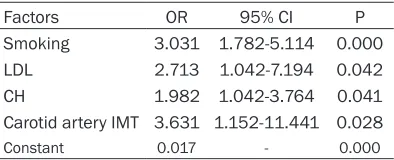
ysis showed that smoking, low-density
lipopro-tein, cholesterol, and carotid artery IMT were all
independent risk factors for CHD. See
Tables 3
and
4
.
Discussion
Due to colder weather at high altitudes, people
living there tend to consume more meat and
alcohol to stay warm. Large consumption of
foods rich in fat can cause disorder of lipid
metabolism and obesity, increasing the
inci-dence rate of atherosclerosis [12, 13].
In the present study, we assessed the 10-year
risk of CHD in both obese and normal groups.
We found that CHD risk score in obese group
was higher than in normal group. This finding
was consistent with previous studies [14, 15].
Therefore, in order to control incidence rate of
CHD in obese people living at high altitudes
with low oxygen levels, preventative
interven-tions should be given to these people during
early stages so that their quality of life can be
improved [16-18]. In the present study, there
was no difference in average incidence rate of
CHD between the two groups. The reason
behind this requires further investigation as the
sample size in our study was relatively small
[19].
[image:3.612.91.288.232.309.2]IMT in obese people didn’t reach the thickening
level in our present study. The normal value of
carotid artery IMT is no more than 0.9 mm; if
0.9<IMT≤1.2 mm, there is intima-media thick
-ening; 1.2<IMT≤1.4 mm can suggest formation
of plaque, while IMT>1.4 mm can suggest
nar-rowing of carotid artery. In the present study,
the value of CCA-IMT in obese group (0.67±0.11
mm) was higher than in normal group
(0.55±0.07 mm). Novikova et al. reported that
level of IMT between obese and non-obese
people was significantly different and was relat
-ed to risk of atherosclerosis and CHD [20]. This
Table 2.
Comparison of risk of CHD in the two
groups
Group Case Risk score Average incidence rate (%) Obese 228 4.23±4.14 12.70±7.75 Normal 150 2.13±2.93 12.51±6.20
t 5.387 0.252
P <0.001 0.801
Note: CHD, coronary heart disease.
Table 3.
Logistic regression analysis of
vari-ous clinical factors
Factors OR 95% CI P
Smoking 3.031 1.782-5.114 0.000
LDL 2.713 1.042-7.194 0.042
CH 1.982 1.042-3.764 0.041
Carotid artery IMT 3.631 1.152-11.441 0.028
Constant 0.017 - 0.000
Note: LDL, low-density lipoprotein; CH, cholesterol; IMT, intima-media thickness; OR, odds ratio; CI, confidence interval.
Table 4.
Comparison of CCA-IMT in the two
groups
Group Case CCA-IMT (mm)
Obese 228 0.67±0.11
Normal 150 0.55±0.07
t 12.138
P 0.000
Note: CCA, common carotid artery; IMT, intima-media thickness.
[image:3.612.91.288.365.445.2] [image:3.612.91.288.524.590.2]anal-finding is consistent with results of our present
study.
There are, however, some limitations to the
present study. Due to small sample size, the
accuracy of our study results may have been
affected to some extent. Also, since cases
selected for the study were all related to people
living at high altitudes, our results cannot be
applied for all populations.
In conclusion, QIMT test can effectively
mea-sure IMT and help predict risk of CHD. It can be
used as a reliable method for early detection of
arteriosclerosis.
Disclosure of conflict of interest
None.
Address correspondence to: Mingxing Xie, Depart- ment of Ultrasound, Union Hospital, Tongji Medical College of Huazhong University of Science and Technology, Hubei Province Key Laboratory of Mole- cular Imaging, No.1277 Jiefang Avenue, Wuhan 430- 022, Hubei Province, China. Tel: +86-13607108938, E-mail: [email protected]
References
[1] Liu DS, Wang SL, Li JM, Liang ES, Yan MZ and Gao W. Allicin improves carotid artery intima-media thickness in coronary artery disease patients with hyperhomocysteinemia. Exp Ther Med 2017; 14: 1722-1726.
[2] Turner AW, Martinuk A, Silva A, Lau P, Nikpay M, Eriksson P, Folkersen L, Perisic L, Hedin U, Soubeyrand S and McPherson R. Functional analysis of a novel genome-wide association study signal in SMAD3 that confers protection from coronary artery disease. Arterioscler Thromb Vasc Biol 2016; 36: 972-983.
[3] Byrkjeland R, Stensaeth KH, Anderssen S,
Njerve IU, Arnesen H, Seljeflot I and Solheim S.
Effects of exercise training on carotid intima-media thickness in patients with type 2
diabe-tes and coronary artery disease. Influence of
carotid plaques. Cardiovasc Diabetol 2016; 15: 13.
[4] Vasudeva Chetty P, Rajasekhar D, Vanajak- shamma V, Ranganayakulu KP and Kranthi Chaithanya D. Aortic velocity propagation: a novel echocardiographic method in predicting atherosclerotic coronary artery disease bur-den. J Saudi Heart Assoc 2017; 29: 176-184. [5] Iwamoto A, Kajikawa M, Maruhashi T, Iwamoto
Y, Oda N, Kishimoto S, Matsui S, Kihara Y, Chayama K, Goto C, Noma K, Aibara Y,
Nakashima A and Higashi Y. Vascular function and intima-media thickness of a leg artery in peripheral artery disease: a comparison of buerger disease and atherosclerotic peripher-al artery disease. J Atheroscler Thromb 2016; 23: 1261-1269.
[6] Li H, Zhang S, Ma R, Chen H, Xi S, Zhang J and Fang J. Ultrasound intima-media thickness measurement of the carotid artery using ant colony optimization combined with a
curvelet-based orientation-selective filter. Med Phys
2016; 43: 1795.
[7] Zhang Y, Zhong J, Niu L, Zhang H, Zheng H and Zheng R. GW27-e0712 non-invasive evaluation of carotid IMT, elasticity and presence or ab-sence of plaque predicts of carotid heart dis-ease risk. Journal of The American College of Cardiology 2016; 68: C124-C124.
[8] Pereira L, Soares GM, Dias MA, Ribeiro P, Pinheiro MM and Luz K. AB0959 the automat-ed software-guidautomat-ed ultrasound assessment of bilateral common carotids intima-media thick-ness for investigation of cardiovascular risk: comparison between psoriatic and rheumatoid arthritis patients. Annals of The Rheumatic Diseases 2016; 75: 1229.1-1229.
[9] Lee JH, Dong PC, Shim JS, Kim DJ, Park SH and Kim HC. Inter-rater reliability of carotid intima-media thickness measurements in a multi-center cohort study. J Health Info Stat 2016; 41: 49-56.
[10] Dangardt F, Bhowruth D, Rapala A, Charakida
M, Thurn D, Schaefer F, Deanfield J and Shroff
R. Very high resolution ultrasound reveals inti-mal and medial vascular remodelling in dialy-sis and transplant patients. Pediatric Ne- phrology 2016; 31: 1733-1734.
[11] Ring M, Eriksson MJ, Jogestrand T and Caidahl K. Ultrasound measurements of carotid inti-ma-media thickness by two semi-automated analysis systems. Clin Physiol Funct Imaging 2016; 36: 389-395.
[12] Belen E, Karaman O, Caliskan G, Atamaner O and Aslan O. Impaired aortic elastic properties in primary osteoarthritis. Vascular 2016; 24: 70-77.
[13] Ogura M, Hori M and Harada-Shiba M.
Association between cholesterol efflux capaci -ty and atherosclerotic cardiovascular disease in patients with familial hypercholesterolemia. Arterioscler Thromb Vasc Biol 2016; 36: 181-188.
[14] Zhao L, Zhai Z and Hou W. Analysis of carotid color ultrasonography and high sensitive C-reactive protein in patients with atheroscle-rotic cerebral infarction. Pak J Med Sci 2016; 32: 931-934.
inti-ma-media thickness of temporal, facial and axillary arteries in giant cell arteritis. Rheumatology (Oxford) 2017; 56: 1632. [16] Mu F, Rich-Edwards J, Rimm EB, Spiegelman D
and Missmer SA. Endometriosis and risk of coronary heart disease. Circ Cardiovasc Qual Outcomes 2016; 9: 257-264.
[17] Enhesari A, Ahmadi A, Maleki E and Mohammdi A. Comparison of the intima-media thickness of carotid artery in children with diabetes type one and control group using ultrasound. Journal of Kerman University of Medical Sciences 2016; 23: 261-270.
[18] Song L, Maehara A, Finn MT, Kalra S, Moses JW, Parikh MA, Kirtane AJ, Collins MB, Nazif TM, Fall KN, Hatem R, Liao M, Kim T, Green P, Ali ZA, Batres C, Leon MB, Mintz GS and Karmpaliotis D. Intravascular ultrasound anal-ysis of intraplaque versus subintimal tracking in percutaneous intervention for coronary chronic total occlusions and association with procedural outcomes. JACC Cardiovasc Interv 2017; 10: 1011-1021.
[19] Bhat V, Prasad TN, Ananthalakshmi S, Karthik GA, Cherian G and Dayananda Y. Clinical & ra-diological evaluation of atherosclerotic chang-es in carotid & coronary arterichang-es in asymptom-atic & clinically symptomasymptom-atic individuals as a tool for pre-symptomatic diagnosis of cardio-vascular disease. Indian J Med Res 2016; 143: 197-204.