3868
Addressing Word-order Divergence in Multilingual Neural Machine
Translation for Extremely Low Resource Languages
Rudra Murthy V†, Anoop Kunchukuttan‡, Pushpak Bhattacharyya† †Center for Indian Language Technology (CFILT)
Department of Computer Science and Engineering IIT Bombay, India.
‡Microsoft AI & Research, Hyderabad, India.
{rudra,pb}@cse.iitb.ac.in, [email protected]
Abstract
Transfer learning approaches for Neural Ma-chine Translation (NMT) trains a NMT model on an assisting language-target language pair (parent model) which is later fine-tuned for the source language-target language pair of in-terest (child model), with the target language being the same. In many cases, the assisting language has a different word order from the source language. We show that divergent word order adversely limits the benefits from trans-fer learning when little to no parallel corpus be-tween the source and target language is avail-able. To bridge this divergence, we propose to pre-order the assisting language sentences to match the word order of the source language and train the parent model. Our experiments on many language pairs show that bridging the word order gap leads to major improve-ments in the translation quality in extremely low-resource scenarios.
1 Introduction
Transfer learning for multilingual Neural Machine Translation (NMT) (Zoph et al.,2016;Dabre et al., 2017;Nguyen and Chiang,2017) attempts to im-prove the NMT performance on thesourceto tar-get language pair (child task) using an assisting sourcelanguage (assisting to target language trans-lation is the parent task). Here, the parent model is trained on the assisting and target language paral-lel corpus and the trained weights are used to ini-tialize the child model. If source-target language pair parallel corpus is available, the child model can further be fine-tuned. The weight initialization reduces the requirement on the training data for the source-target language pair by transferring knowl-edge from the parent task, thereby improving the performance on the child task.
However, the divergence between the source and the assisting language can adversely impact
the benefits obtained from transfer learning. Mul-tiple studies have shown that transfer learning works best when the languages are related (Zoph et al., 2016; Nguyen and Chiang, 2017; Dabre et al., 2017). Zoph et al. (2016) studied the in-fluence of language divergence between languages chosen for training the parent and the child model, and showed that choosing similar languages for training the parent and the child model leads to bet-ter improvements from transfer learning.
Several studies have tried to address the lex-ical divergence between the source and the tar-get languages either by using Byte Pair Encoding (BPE) as basic input representation units (Nguyen and Chiang, 2017) or character-level NMT sys-tem (Lee et al.,2017) or bilingual embeddings (Gu et al.,2018). However, the effect ofword order di-vergenceand its mitigation has not been explored. In a practical setting, it is not uncommon to have source and assisting languages with different word order. For instance, it is possible to find parallel corpora between English (SVO word order) and some Indian (SOV word order) languages, but very little parallel corpora between Indian languages. Hence, it is natural to use English as an assisting language for inter-Indian language translation.
To address the word order divergence, we pro-pose to pre-order the assisting language sentences (SVO) to match the word order of the source lan-guage (SOV). We consider an extremely resource-constrained scenario, where there is no parallel corpus for the child task. From our experiments, we show that there is a significant increase in the translation accuracy for the unseen source-target language pair.
2 Related Work
for multilingual NMT. However, some work ex-ists for other NLP tasks in a multilingual setting. For Named Entity Recognition (NER),Xie et al. (2018) use a self-attention layer after the Bi-LSTM layer to address word-order divergence for Named Entity Recognition (NER) task. The approach does not show any significant improvements, pos-sibly because the divergence has to be addressed before/during construction of the contextual em-beddings in the Bi-LSTM layer. Joty et al.(2017) use adversarial training for cross-lingual question-question similarity ranking. The adversarial train-ing tries to force the sentence representation gener-ated by the encoder of similar sentences from dif-ferent input languages to have similar representa-tions.
Pre-ordering the source language sentences to match the target language word order has been found useful in addressing word-order divergence for Phrase-Based SMT (Collins et al., 2005; Ra-manathan et al.,2008;Navratil et al.,2012; Chat-terjee et al.,2014). For NMT,Ponti et al. (2018) and Kawara et al. (2018) have explored pre-ordering. Ponti et al. (2018) demonstrated that by reducing the syntactic divergence between the source and the target languages, consistent im-provements in NMT performance can be obtained. On the contrary, Kawara et al. (2018) reported drop in NMT performance due to pre-ordering. Note that these works address source-target diver-gence, not divergence between source languages in multilingual NMT scenario.
3 Proposed Solution
Consider the task of translating for an extremely low-resource language pair. The parallel corpus between the two languages, if available may be too small to train an NMT model. Similar to Zoph et al. (2016), we use transfer learning to over-come data sparsity between the source and the target languages. We choose English as the as-sisting language in all our experiments. In our resource-scarce scenario, we have no parallel cor-pus for training the child model. Hence, at test time, the source language sentence is translated us-ing the parent model after performus-ing a word-by-word translation from source to the assisting lan-guage using a bilingual dictionary.
Since the source language and the assisting lan-guage (English) have different word order, we hy-pothesize that it leads to inconsistencies in the
con-Before Reordering After Reordering
S
NP0 VP
V NP1
S
NP0 VP
NP1 V
S
NP
NNP
Anurag VP
MD
will VP
VB
meet NP
NNP
Thakur
S
NP
NNP
Anurag VP
NP
NNP
Thakur VP
MD
will VP
VB
[image:2.595.310.522.65.241.2]meet
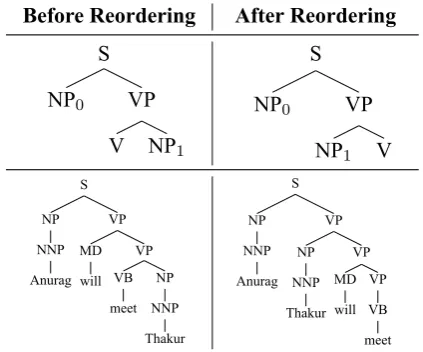
Table 1: Example showing transitive verb before and after reordering (Adapted fromChatterjee et al.(2014))
textual representations generated by the encoder for the two languages. Specifically, given an En-glish sentence (SVO word order) and its transla-tion in the source language (SOV word order), the encoder representations for words in the two sen-tences will be different due to different contexts of synonymous words. This could lead to the at-tention and the decoder layers generating differ-ent translations from the same (parallel) sdiffer-entence in the source or assisting language. This is unde-sirable as we want the knowledge to be transferred from the parent model (assisting source→ target) to the child model (source→target).
In this paper, we propose to pre-order English sentences (assisting language sentences) to match the source language word-order and train the par-ent model on the pre-ordered corpus. Table 1 shows one of the pre-ordering rules (Ramanathan et al.,2008) used along with an example sentence illustrating the effect of pre-ordering. This will en-sure that context of words in the parallel source and assisting language sentences are similar, leading to consistent contextual representations across the source languages. Pre-ordering may also be ben-eficial for other word order divergence scenarios (e.g., SOV to SVO), but we leave verification of these additional scenarios for future work.
4 Experimental Setup
In this section, we describe the languages exper-imented with, datasets used, the network hyper-parameters used in our experiments.
the assisting source language. Bengali, Gujarati, Marathi, Malayalam and Tamil are the source lan-guages, and translation from these to Hindi consti-tute the child tasks. Hindi, Bengali, Gujarati and Marathi are Indo-Aryan languages, while Malay-alam and Tamil are Dravidian languages. All these languages have a canonical SOV word order.
Datasets: For training English-Hindi NMT sys-tems, we use the IITB English-Hindi parallel cor-pus (Kunchukuttan et al.,2018) (1.46M sentences from the training set) and the ILCI English-Hindi parallel corpus (44.7K sentences). The ILCI (Indian Language Corpora Initiative) multilingual parallel corpus (Jha,2010)1spans multiple Indian languages from the health and tourism domains. We use the520-sentence dev-set of the IITB par-allel corpus for validation. For each child task, we use2Ksentences from ILCI corpus as test set.
Network: We use OpenNMT-Torch (Klein et al., 2018) to train the NMT system. We use the stan-dard encoder-attention-decoder architecture ( Bah-danau et al., 2015) with input-feeding approach (Luong et al.,2015). The encoder has two layers of bidirectional LSTMs with 500 neurons each and the decoder contains two LSTM layers with 500 neurons each. We use a mini-batch of size50and a dropout layer. We begin with an initial learning rate of1.0and continue training with exponential decay till the learning rate falls below0.001. The English input is initialized with pre-trained fast-Textembeddings (Grave et al.,2018)2.
English and Hindi vocabularies consists of 0.27M and 50K tokens appearing at least2 and 5 times in the English and Hindi training corpus respectively. For representing English and other source languages into a common space, we trans-late each word in the source language into En-glish using a bilingual dictionary (we usedGoogle Translate to get single word translations). In an end-to-end solution, it would be ideal to use bilin-gual embeddings or obtain word-by-word transla-tionsviabilingual embeddings (Xie et al.,2018). However, publicly available bilingual embeddings for English-Indian languages are not good enough for obtaining good-quality, bilingual representa-tions (Smith et al.,2017;Jawanpuria et al.,2019) and publicly available bilingual dictionaries have limited coverage. The focus of our study is the
in-1
The corpus is available on request from http:// tdil-dc.in/index.php?lang=en
2https://github.com/facebookresearch/
fastText/blob/master/docs/crawl-vectors.md
Language BLEU LeBLEU
No Pre-Order
Pre-Ordered No Pre-Order
Pre-Ordered
HT G HT G
[image:3.595.306.527.63.151.2]Bengali 6.72 8.83 9.19 37.10 41.50 42.01 Gujarati 9.81 14.34 13.90 43.21 47.36 47.60 Marathi 8.77 10.18 10.30 40.21 41.49 42.22 Malayalam 5.73 6.49 6.95 33.27 33.69 35.09 Tamil 4.86 6.04 6.00 29.38 30.77 31.33
Table 2: Transfer learning results for X-Hindi pair, trained onEnglish-Hindicorpus and sentences fromX word translated to English.
Language No Pre-Order
Pre-Ordered
HT G
[image:3.595.332.500.208.296.2]Bengali 1324 1139 1146 Gujarati 1337 1190 1194 Marathi 1414 1185 1178 Malayalam 1251 1067 1059 Tamil 1488 1280 1252
Table 3: Number of UNK tokens generated by each model on the test set.
fluence of word-order divergence on Multilingual NMT. We do not want bilingual embeddings qual-ity or bilingual dictionary coverage to influence the experiments, rendering our conclusions unre-liable. Hence, we use the above mentioned large-coverage bilingual dictionary.
Pre-ordering: We use CFILT-preorder3 for reordering English sentences. It contains two pre-ordering configurations: (1)genericrules (G) that apply to all Indian languages (Ramanathan et al., 2008), and (2)hindi-tuned rules (HT) which im-proves generic rules by incorporating improve-ments found through error analysis of English-Hindi reordering (Patel et al.,2013). The Hindi-tuned rules improve translation for other English to Indian language pairs too (Kunchukuttan et al., 2014).
5 Results
We experiment with two scenarios: (a) an ex-tremely resource scarce scenario with no parallel corpus for child tasks, (b) varying amounts of par-allel corpora available for child task.
5.1 No Parallel Corpus for Child Task
The results from our experiments are presented in the Table2. We report BLEU scores and LeBLEU4
3https://github.com/anoopkunchukuttan/
cfilt_preorder
English the treatment of migraine is done in two ways
Gujarati
(Original) માઈ ેનની સારવાર બે રીતે કરી શકાય છે.
Gujarati
(Word Translate) migraine treatment two the way doing be done is there .
Hindi
(Reference) माइगर्ेन का टर्ीटमेंट दो तरह से िकया जाता है ।
(Word Translate) migraine of treatment two kind from did go is .
No Pre-Order <unk> उपचार दो पर्कार से िकया जाता है ।
upachAra do prakAra se kiyA jAtA hai . <unk> treatment two kind from did go is .
[image:4.595.91.508.75.260.2]Pre-ordered (HT) माइगर्ेन का उपचार दो तरह से िकया जाता है। mAigrena kA upachAra do prakAra se kiyA jAtA hai. migraine of treatment two kind from did go is .
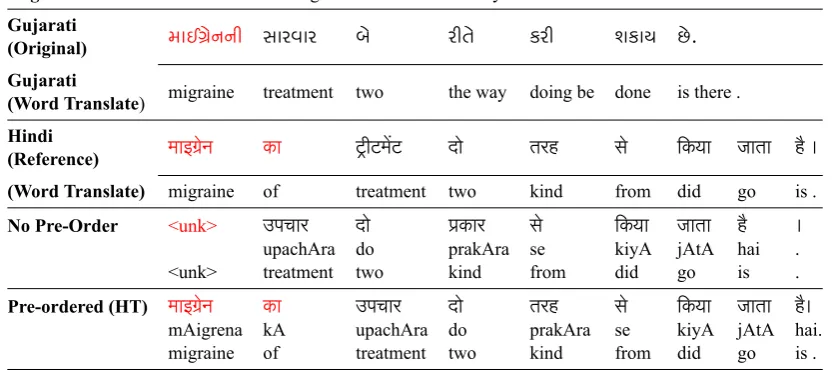
Table 4: Sample Hindi translation generated by the Gujarati-Hindi NMT model. Text in red indicates phrase dropped by the no pre-ordered model.
scores. We observe that both the pre-ordering models significantly improve the translation qual-ity over the no-preordering models for all the lan-guage pairs. The results support our hypothesis that word-order divergence can limit the benefits of multilingual translation. Thus, reducing the word order divergence improves translation in ex-tremely low-resource scenarios.
An analysis of the outputs revealed that pre-ordering significantly reduced the number of UNK tokens (placeholder for unknown words) in the test output (Table3). We hypothesize that due to word order divergence between English and Indian languages, the encoder representation generated is not consistent leading to decoder generating unknown words. However, the pre-ordered models generate better encoder representations leading to lesser number of UNK tokens and better translation, which is also reflected in the BLEU scores and Table4.
5.2 Parallel Corpus for Child Task
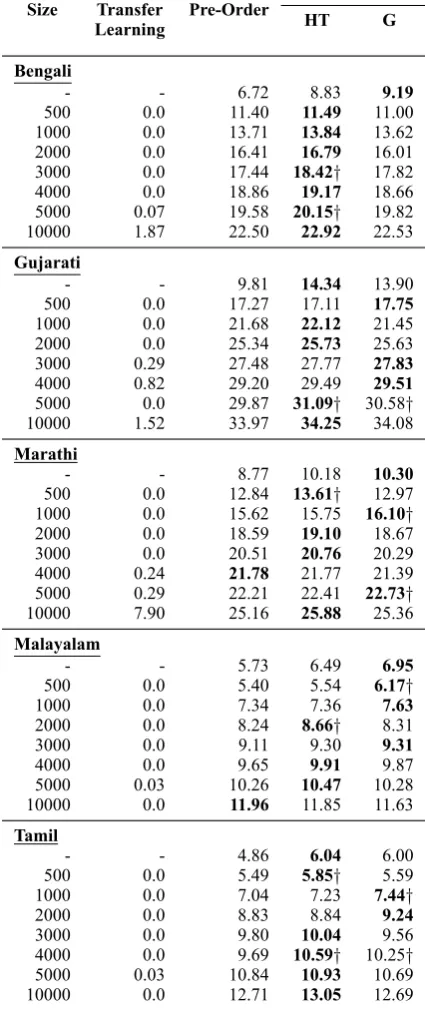
We study the impact of child task parallel cor-pus on pre-ordering. To this end, we fine-tune the parent task model with the child task parallel corpus. Table 5 shows the results for
Bengali-Hindi, Gujarati-Hindi, Marathi-Hindi,
Malayalam-Hindi, and Tamil-Hindi translation. We observe that pre-ordering is beneficial when almost no child task corpus is available. As the child task corpus increases, the model learns the
on edit distance, hence it can handle morphological variations and cognates (Virpioja and Grönroos,2015).
word order of the source language; hence, the non pre-ordering models perform almost as good as or sometimes better than the pre-ordered ones. The non pre-ordering model is able to forget the word-order of English and learn the word word-order of Indian languages. We attribute this behavior of the non pre-ordered model to the phenomenon of catas-trophic forgetting (McCloskey and Cohen, 1989; French,1999) which enables the model to learn the word-order of the source language when sufficient child task parallel corpus is available.
We also compare the performance of the fine-tuned model with the model trained only on the available source-target parallel corpus with ran-domly initialized weights (No Transfer Learning). Transfer learning, with and without pre-ordering, is better compared to training only on the small source-target parallel corpus.
6 Conclusion
Corpus Size
No Transfer Learning
No Pre-Order
Pre-Ordered
HT G
Bengali
- - 6.72 8.83 9.19
500 0.0 11.40 11.49 11.00 1000 0.0 13.71 13.84 13.62 2000 0.0 16.41 16.79 16.01 3000 0.0 17.44 18.42† 17.82 4000 0.0 18.86 19.17 18.66 5000 0.07 19.58 20.15† 19.82 10000 1.87 22.50 22.92 22.53
Gujarati
- - 9.81 14.34 13.90 500 0.0 17.27 17.11 17.75 1000 0.0 21.68 22.12 21.45 2000 0.0 25.34 25.73 25.63 3000 0.29 27.48 27.77 27.83 4000 0.82 29.20 29.49 29.51 5000 0.0 29.87 31.09† 30.58† 10000 1.52 33.97 34.25 34.08
Marathi
- - 8.77 10.18 10.30
500 0.0 12.84 13.61† 12.97 1000 0.0 15.62 15.75 16.10† 2000 0.0 18.59 19.10 18.67 3000 0.0 20.51 20.76 20.29 4000 0.24 21.78 21.77 21.39 5000 0.29 22.21 22.41 22.73† 10000 7.90 25.16 25.88 25.36
Malayalam
- - 5.73 6.49 6.95
500 0.0 5.40 5.54 6.17† 1000 0.0 7.34 7.36 7.63 2000 0.0 8.24 8.66† 8.31 3000 0.0 9.11 9.30 9.31 4000 0.0 9.65 9.91 9.87 5000 0.03 10.26 10.47 10.28 10000 0.0 11.96 11.85 11.63
Tamil
- - 4.86 6.04 6.00
500 0.0 5.49 5.85† 5.59 1000 0.0 7.04 7.23 7.44† 2000 0.0 8.83 8.84 9.24 3000 0.0 9.80 10.04 9.56 4000 0.0 9.69 10.59† 10.25† 5000 0.03 10.84 10.93 10.69 10000 0.0 12.71 13.05 12.69
Table 5: Transfer learning results (BLEU) for
In-dian Language-Hindi pair, fine-tuned with varying
number ofIndian Language-Hindiparallel sentences. †Indicates statistically significant difference between
Pre-ordered and No Pre-ordered results using paired
bootstrap resampling (Koehn,2004) for ap-value less
than 0.05. No Transfer Learning model refers to
training the model on varying number ofIndian
Lan-guage-Hindi parallel sentences with randomly
initial-ized weights.
would also like to explore alternative methods to address word-order divergence which do not
re-quire expensive parsing of the assisting language corpus. Further, use of pre-ordering to address word-order divergence for multilingual training of other NLP tasks can be explored.
Acknowledgements
We would like to thank Raj Dabre for his helpful suggestions and comments.
References
Dzmitry Bahdanau, Kyunghyun Cho, and Yoshua Bengio. 2015. Neural Machine Translation by Jointly Learning to Align and Translate. In Inter-national Conference on Learning Representations, ICLR 2015.
Rajen Chatterjee, Anoop Kunchukuttan, and Pushpak Bhattacharyya. 2014. Supertag Based Pre-ordering in Machine Translation. InProceedings of the 11th International Conference on Natural Language Pro-cessing, ICON 2014.
Michael Collins, Philipp Koehn, and Ivona Kucerova. 2005. Clause Restructuring for Statistical Machine Translation. In Proceedings of the 43rd Annual Meeting of the Association for Computational Lin-guistics, ACL 2005.
Raj Dabre, Tetsuji Nakagawa, and Hideto Kazawa. 2017. An Empirical Study of Language Relatedness for Transfer Learning in Neural Machine Transla-tion. InProceedings of the 31st Pacific Asia Confer-ence on Language, Information and Computation.
Robert M. French. 1999. Catastrophic forgetting in connectionist networks. Trends in Cognitive Sci-ences, 3(4):128 – 135.
Edouard Grave, Piotr Bojanowski, Prakhar Gupta, Ar-mand Joulin, and Tomas Mikolov. 2018. Learning Word Vectors for 157 Languages. InProceedings of the Eleventh International Conference on Language Resources and Evaluation, LREC 2018.
Jiatao Gu, Hany Hassan, Jacob Devlin, and Victor O.K. Li. 2018. Universal Neural Machine Translation for Extremely Low Resource Languages. In Proceed-ings of the 2018 Conference of the North American Chapter of the Association for Computational Lin-guistics: Human Language Technologies, Volume 1 (Long Papers), NAACL 2018.
Pratik Jawanpuria, Arjun Balgovind, Anoop Kunchukuttan, and Bamdev Mishra. 2019. Learning Multilingual Word Embeddings in Latent Metric Space: A Geometric Approach. Transactions of the Association for Computational Linguistics, TACL.
[image:5.595.74.287.76.582.2]Shafiq Joty, Preslav Nakov, Lluís Màrquez, and Is-raa Jaradat. 2017. Cross-language Learning with Adversarial Neural Networks. In Proceedings of the 21st Conference on Computational Natural Lan-guage Learning, CoNLL 2017.
Yuki Kawara, Chenhui Chu, and Yuki Arase. 2018. Recursive Neural Network Based Preordering for English-to-Japanese Machine Translation. In Pro-ceedings of ACL 2018, Student Research Workshop.
Guillaume Klein, Yoon Kim, Yuntian Deng, Vincent Nguyen, Jean Senellart, and Alexander Rush. 2018. OpenNMT: Neural Machine Translation Toolkit. In Proceedings of the 13th Conference of the Associa-tion for Machine TranslaAssocia-tion in the Americas (Vol-ume 1: Research Papers).
Philipp Koehn. 2004. Statistical Significance Tests for Machine Translation Evaluation. InProceedings of the 2004 Conference on Empirical Methods in Nat-ural Language Processing, EMNLP 2004.
Anoop Kunchukuttan, Pratik Mehta, and Pushpak Bhattacharyya. 2018. The IIT Bombay English-Hindi Parallel Corpus. In Proceedings of the Eleventh International Conference on Language Re-sources and Evaluation, LREC 2018.
Anoop Kunchukuttan, Abhijit Mishra, Rajen Chatter-jee, Ritesh Shah, and Pushpak Bhattacharyya. 2014. Shata-Anuvadak: Tackling Multiway Translation of Indian Languages. InProceedings of the Ninth In-ternational Conference on Language Resources and Evaluation, LREC 2014.
Jason Lee, Kyunghyun Cho, and Thomas Hofmann. 2017. Fully Character-Level Neural Machine Trans-lation without Explicit Segmentation. Transactions of the Association for Computational Linguistics, TACL, 5.
Thang Luong, Hieu Pham, and Christopher D. Man-ning. 2015. Effective Approaches to Attention-based Neural Machine Translation. InProceedings of the 2015 Conference on Empirical Methods in Natural Language Processing, EMNLP 2015.
Michael McCloskey and Neal J. Cohen. 1989. Catas-trophic Interference in Connectionist Networks: The Sequential Learning Problem. volume 24 of Psy-chology of Learning and Motivation, pages 109 – 165. Academic Press.
Jiri Navratil, Karthik Visweswariah, and Ananthakr-ishnan Ramanathan. 2012. A Comparison of Syn-tactic Reordering Methods for English-German Ma-chine Translation. InProceedings of COLING 2012, The 24th International Conference on Computa-tional Linguistics, COLING 2012.
Toan Q. Nguyen and David Chiang. 2017. Trans-fer learning across low-resource, related languages for neural machine translation. In Proceedings of the Eighth International Joint Conference on Natu-ral Language Processing (Volume 2: Short Papers), IJCNLP 2017.
Raj Nath Patel, Rohit Gupta, Prakash B. Pimpale, and Sasikumar M. 2013. Reordering rules for English-Hindi SMT. InProceedings of the Second Workshop on Hybrid Approaches to Translation.
Edoardo Maria Ponti, Roi Reichart, Anna Korhonen, and Ivan Vulić. 2018. Isomorphic transfer of syn-tactic structures in cross-lingual nlp. In Proceed-ings of the 56th Annual Meeting of the Association for Computational Linguistics (Volume 1: Long Pa-pers), ACL 2018.
Ananthakrishnan Ramanathan, Jayprasad Hegde, Ritesh M. Shah, Pushpak Bhattacharyya, and Sasikumar M. 2008. Simple Syntactic and Mor-phological Processing Can Help English-Hindi Statistical Machine Translation. In Proceedings of the Third International Joint Conference on Natural Language Processing: Volume-I.
Samuel L. Smith, David H. P. Turban, Steven Hamblin, and Nils Y. Hammerla. 2017. Aligning the fastText vectors of 78 languages.
Sami Virpioja and Stig-Arne Grönroos. 2015. LeBLEU: N-gram-based Translation Evaluation Score for Morphologically Complex Languages. In Proceedings of the Tenth Workshop on Statistical Machine Translation.
J. Xie, Z. Yang, G. Neubig, N. A. Smith, and J. Car-bonell. 2018. Neural Cross-Lingual Named Entity Recognition with Minimal Resources. In Proceed-ings of the 2018 Conference on Empirical Methods in Natural Language Processing, EMNLP 2018.