2212
Simple Attention-Based Representation Learning for
Ranking Short Social Media Posts
Peng Shi,1Jinfeng Rao,2∗ and Jimmy Lin1
1 David R. Cheriton School of Computer Science, University of Waterloo 2 Facebook AI
{peng.shi, jimmylin}@uwaterloo.ca,[email protected]
Abstract
This paper explores the problem of ranking short social media posts with respect to user queries using neural networks. Instead of start-ing with a complex architecture, we proceed from the bottom up and examine the effective-ness of a simple, word-level Siamese architec-ture augmented with attention-based mecha-nisms for capturing semantic “soft” matches between query and post tokens. Extensive experiments on datasets from the TREC Mi-croblog Tracks show that our simple models not only achieve better effectiveness than ex-isting approaches that are far more complex or exploit a more diverse set of relevance sig-nals, but are also much faster. Implemen-tations of our samCNN (Simple A ttention-basedMatching CNN) models are shared with the community to support future work.1
1 Introduction
Despite a large body of work on neural rank-ing models for “traditional”ad hocretrieval over web pages and newswire documents (Huang et al.,
2013;Shen et al., 2014;Guo et al., 2016;Xiong
et al.,2017;Mitra et al.,2017;Pang et al.,2017;
Dai et al.,2018;McDonald et al.,2018), there has
been surprisingly little work (Rao et al.,2017) on applying neural networks to searching short social media posts such as tweets on Twitter. Rao et al.
(2019) identified short document length, informal-ity of language, and heterogeneous relevance sig-nals as main challenges in relevance modeling, and proposed the first neural model specifically designed to handle these characteristics. Eval-uation on a number of datasets from the TREC Microblog Tracks demonstrates state-of-the-art ef-fectiveness as well as the necessity of different model components to capture a multitude of rel-evance signals.
∗
Work done at the University of Maryland, College Park.
1https://github.com/Impavidity/samCNN
Query Embeddings
Post Embeddings
𝑔" 𝑔#
ℎ% 𝑣
General Sentence Encoder : QAtt or PAtt : Avg Aggregation :
[image:1.595.312.522.220.340.2]𝑜
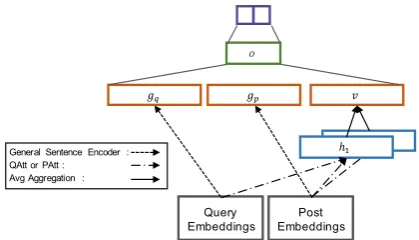
Figure 1: Our model architecture: a general sentence encoder is applied on query and post embeddings to generate gq and gp; an attention encoder is applied on post embeddings to generate variable-length query-aware features hi. These features are further aggre-gated to yieldv, which feeds into the final prediction.
In this paper, we also examine the problem of modeling relevance for ranking short social me-dia posts, but from a complementary perspective.
As Weissenborn et al. (2017) notes, most
sys-tems are built in atop-downprocess: authors pro-pose a complex architecture and then validate de-sign decisions with ablation experiments. How-ever, such experiments often lack comparisons to strong baselines, which raises the question as to whether model complexity is empirically justified. As an alternative, they advocate abottom-up ap-proach where architectural complexity is gradu-ally increased. We adopt exactly such an ap-proach, focused exclusively on word-level model-ing. As shown in Figure1, we examine variants of a simple, generic architecture that has emerged as “best practices” in the NLP community for tack-ling modetack-ling problems on two input sequences: a Siamese CNN architecture for learning representa-tions over both inputs (a query and a social media post in our case), followed by fully-connected lay-ers that produce a final relevance prediction (
hacked Evernote
has been Evernote hacked
Your
password
Query
Social Media Post
PAtt Kernel
cosine similarity
ℎ"
has been Evernote hacked
Your
password
Query
Social Media Post QAtt Kernel
ℎ"
[image:2.595.127.495.65.201.2]hacked Evernote
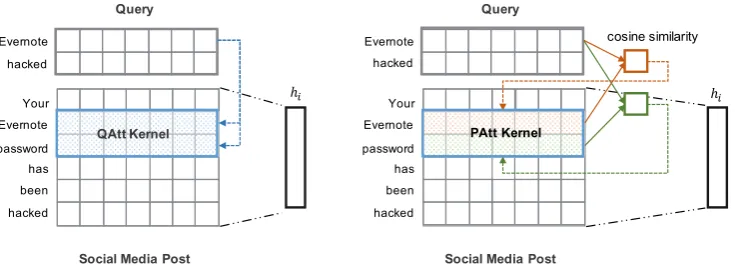
Figure 2: The Query-Aware Attention (QAtt) architecture on the left and the Position-Aware Attention (PAtt) architecture on the right. In both, we constructFconvolutional kernels foreachquery token (here, one kernel for the query token ‘Evernote’ is visualized). In QAtt, the query token embedding is directly “injected” into the kernel via element-wise product (blue dotted arrows). In PAtt, cosine similarity between the query token and tokens in the post within the convolution window are used as attention weights in the kernel.
et al.,2016), which we refer to as a General
Sen-tence Encoder in Section 2.1. Further adopting best practices, we incorporate query-aware convo-lutions with an average aggregation layer in the representation learning process.
Recently, a number of researchers (Conneau
et al.,2017;Mohammed et al.,2018) have started
to reexamine simple baselines and found them to be highly competitive with the state of the art, es-pecially with proper tuning. For example, the In-ferSent approach (Conneau et al., 2017) uses a simple BiLSTM with max pooling that achieves quite impressive accuracy on several classifica-tion benchmarks. Our contribuclassifica-tion is along sim-ilar lines, where we explore simple yet highly ef-fective models for ranking social media posts, to gain insights into query–post relevance matching using standard neural architectures. Experiments with TREC Microblog datasets show that our best model not only achieves better effectiveness than existing approaches that leverage more signals, but also demonstrates 4×speedup in model train-ing and inference compared to a recently-proposed neural model.
2 Model
Our model comprises a representation learning layer with convolutional encoders and another simple aggregation layer. These architectural components are described in detail below.
2.1 Representation Learning Layer
General Sentence Encoder: The general
sen-tence encoder uses a standard convolutional layer
with randomly initialized kernels to learn seman-tic representations for text. More formally, given queryqand postpas sentence inputs, we first con-vert them to embedding matricesQandPthrough an embedding lookup layer, whereQ∈Rn×dand P ∈ Rm×d, d is the dimension of embeddings,
and nand m are the number of tokens in q and
p, respectively. Then we apply a standard convo-lution operation with kernel window size k over the embedding matrix Q and P. The convolu-tion operaconvolu-tion is parameterized by a weight term
W∈RF×k×dand a bias termb
w ∈RF, whereF
is the number of convolutional kernels. This gen-erates semantic representation Oq ∈ Rn×F and Op ∈Rm×F, on which max pooling and an MLP
are applied to obtain query representationgq ∈Rd
and post representationgp ∈Rd.
The weakness of the kernels in the general sentence encoder is that they do not incorporate knowledge from the query when attempting to capture feature patterns from the post. Inspired by attention mechanisms (Bahdanau et al.,2014), we propose two novel approaches to incorporate query information when encoding the post repre-sentation, which we introduce below.
Query-Aware Attention Encoder (QAtt): In
QAtt (Figure 2, left), for each query token, we construct a token-specific convolutional kernel to “inject” the query information. Unlike methods that apply attention mechanisms after the sentence representations are generated (Bahdanau et al.,
2014; Seo et al., 2016), our approach aims to
Formally, for each query tokentq, the QAtt
ker-nelWtq
QAttis composed as follows:
Wtq
QAtt=U⊗Qtq (1)
whereU∈ RF×k×drepresents trainable
parame-ters,Qtqis the embedding of tokentqwith sizeR
d
andWtq QAtt∈R
F×k×d. The element-wise product
⊗ is applied between the token embedding Qtq
and the last dimension of kernel weights U. In other words, we create F convolutional kernels for each query token, where each kernel is “in-jected” with the embedding of that query token via element-wise product. Figure 2 (left) illustrates one kernel for the query token ‘Evernote’, where element-wise product is represented by blue dot-ted arrows. When a QAtt token-specific kernel is applied, a window slides across the post embed-dingsPand learns soft matches to each query to-ken to generate query-aware representations.
On top of the QAtt kernels, we apply max-pooling and an MLP to produce a set of post rep-resentations{hi}, with eachhi ∈Rdstanding for
the representation learned from query tokentqi. Position-Aware Attention Encoder (PAtt): In the QAtt encoder, token-specific kernels learn soft matches to the query. However, they still ignore positional information when encoding the post se-mantics, which has been shown to be effective for sequence modeling (Gehring et al.,2017). To overcome this limitation, we propose an alterna-tive attention encoder that captures positional in-formation through interactions between query em-beddings and post emem-beddings.
Given a query token tqand thej-th position in
postp, we compute the interaction scores by tak-ing the cosine similarity between the word embed-dings of token tq and post tokens tpj:j+k−1 from
positionjtoj+k−1:
Sj = [cos(tq, tpj);...;cos(tq, tpj+k−1)] (2)
whereSj ∈Rk×1andkis the width of the
convo-lutional kernel we are learning. That is, for each token in the post within the window, we compute its cosine similarity with query tokentq. We then
convert the similarity vectorSj into a matrix:
ˆ
Sj =Sj·1,Sˆj ∈Rk×d (3)
where1 ∈ R1×d with each element set to 1.
Fi-nally, the PAtt convolutional kernel for query to-kentqat thej-th position is constructed as:
Wtq,j
PAtt=V⊗Sˆj (4)
whereV ∈ RF×k×d represents the trainable
pa-rameters. The element-wise product⊗is applied between the attention weightsSˆj and the last two
dimensions of kernel weightsV.
Conceptually, this operation can be thought as adding a soft attention weight (with values in the range of[0,1]) to each convolutional kernel, where the weight is determined by the cosine similarity between the token from the post and a particular query token; since cosine similarity is a scalar, we fill in the value in all d dimensions of the ker-nel, whered is the size of the word embedding. This is illustrated in Figure 2 (right), where we show one kernel of width two for the query to-ken ‘Evernote’. The brown (green) arrows capture cosine similarity between the query token ‘Ever-note’ and the first (second) token from the post in the window. These values then serve as weights in the kernels, shown as the hatched areas. Sim-ilar to QAtt, the PAtt encoder with max-pooling and an MLP generates a set of post representations
{hi}, with each histanding for the representation
learned from query tokentqi.
It is worth noting that both the QAtt and PAtt encoders have no extra parameters over a gen-eral sentence encoder. However, incorporating the query-aware and position-aware information en-ables more effective representation learning, as our experiments show later. The QAtt and PAtt en-coders can also be used as plug-in modules in any standard convolutional architecture to learn query-biased representations.
2.2 Aggregation Layer
After the representation layer, a set of vectors
{gq,gp,{hi}} is obtained. Because our model
yields different numbers ofhi with queries of
dif-ferent lengths, further aggregation is needed to output a global featurev. We directly average all vectors v = N1
q
P
hi as the aggregated feature,
whereNqis the length of the query.
2.3 Training
Year 2011 2012 2013 2014
# queries 49 60 60 55
# tweets 39,780 49,879 46,192 41,579
# relevant 1,940 4,298 3,405 6,812
[image:4.595.315.519.60.112.2]%relevant 4.87 8.62 7.37 16.38
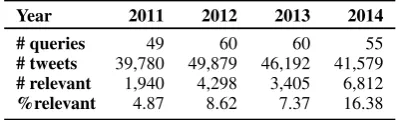
Table 1: Statistics of TREC MB 2011–2014 datasets.
Param Value Param Value
Embedding size 300 k 0.05
Hidden size 200 Final hidden size 100
Kernel number 250 Dropout ratio 0.5
Kernel size 2 Learning rate 0.03
Table 2: Hyperparameters for our models. GloVe (
Pen-nington et al., 2014) embeddings are used and
fine-tuned during training. Unknown words are initialized from a uniform distribution[−k, k].
3 Experimental Setup
Datasets and Hyperparameters.Our models are evaluated on four tweet test collections from the TREC 2011–2014 Microblog (MB) Tracks (
Ou-nis et al., 2011; Soboroff et al., 2012; Lin and
Efron, 2013;Lin et al.,2014). Each dataset
con-tains around 50–60 queries; detailed statistics are shown in Table 1. As withRao et al.(2019), we evaluated our models in a reranking task, where the inputs are up to the top 1000 tweets retrieved from “bag of words” ranking using query likeli-hood (QL). We ran four-fold cross-validation split by year (i.e., train on three years’ data, test on one year’s data) and followed Rao et al. (2019) for sampling validation sets. For metrics, we used average precision (AP) and precision at rank 30 (P30). We conducted Fisher’s two-sided, paired randomization tests (Smucker et al.,2007) to as-sess statistical significance atp < 0.05. The best model hyperparameters are shown in Table2.
Baselines. On top of QL, RM3 (Abdul-Jaleel
et al.,2004) provides strong non-neural results
us-ing pseudo-relevance feedback. We also compared against MP-HCNN (Rao et al.,2019), the first neu-ral model that captures specific characteristics of social media posts, which improves over many previous neural models, e.g., K-NRM (Xiong
et al., 2017) and DUET (Mitra et al., 2017), by
a significant margin. To the best of our knowl-edge,Rao et al.(2019) is the most effective neural model to date. We compared against two variants of MP-HCNN; MP-HCNN+QL includes a linear interpolation with QL scores.
Figure 3: Per-query AP differences between PAtt and QL on TREC 2013 (queries 111–170).
4 Results and Discussion
Table 3 shows the effectiveness of all variants of our model, compared against previous results copied fromRao et al.(2019). Model 1 illustrates the effectiveness of the basic BiCNN model with a kernel window size of two; combining different window sizes (Kim, 2014) doesn’t yield any im-provements. It appears that this model performs worse than the QL baseline.
Comparing Model 2 to Model 1, we find that query-aware kernels contribute significant im-provements, achieving effectiveness comparable to the QL baseline. With Model 3, which captures positional information with the position-aware en-coder, we obtain competitive effectiveness com-pared to Model 8, the full MP-HCNN model that includes interpolation with QL. Note that Model 8 leverages additional signals, including URL in-formation, character-level encodings, and external term features such as tf–idf. With Model 4, which interpolates the position-aware encoder with QL, we obtain state-of-the-art effectiveness.
Per-Query Analysis. In Figure3, we show per-query AP differences between the PAtt model and the QL baseline on the TREC 2013 dataset. As we can see, PAtt improves on most of the queries. For the best-performing query 164 “lindsey vonn sidelined”, we project the hidden states o into a low-dimensional space using t-SNE (Maaten and
Hinton, 2008), shown in Figure 4. We observe
[image:4.595.81.281.63.123.2]2011 2012 2013 2014
P30 AP P30 AP P30 AP P30 AP
Our Models
1 BiCNN 0.2129 0.1634 0.2028 0.1176 0.2367 0.1284 0.3788 0.2557
2 BiCNN+QAtt 0.39661 0.35861 0.39041 0.23761 0.48611 0.26961 0.63881 0.42261
3 BiCNN+PAtt 0.44691,2 0.413515,2 0.4017 1
5 0.24131,5 0.5167 1,2 5 0.2817
1,2
0.66421,2 0.435115,2
4 BiCNN+PAtt+QL 0.47351-3
5-7 0.434615-,36 0.4164 1,2 5,6 0.2516
1-3
5 0.525615-,36 0.296551-3 0.67521,2 0.452215-,37 Existing Models
5 QL 0.40001 0.35761 0.33111 0.20911 0.44501 0.25321 0.61821 0.39241
6 RM3 0.42111 0.38241 0.34521 0.23421 0.47331 0.27661 0.63391 0.44801
7 MP-HCNN(+URL) 0.40751,2 0.38321,2 0.36891,5 0.23371,5 0.522215,2 0.2818 1,2 5 0.6297
1
0.43041
8 MP-HCNN(+URL)+QL 0.429315,2 0.404315,,62 0.379116,5 0.24601,5 0.52941-3 5,6 0.2896
1,2 5 0.6394
[image:5.595.76.521.62.205.2]1 0.44201,5
Table 3: Results of various models on the TREC Microblog Tracks datasets. Models 5–8 are copied fromRao
et al.(2019); note that MP-HCNN exploits URL information (+URL). Models with +QL include interpolation
[image:5.595.80.519.286.384.2]with the QL baseline. BiCNN denotes our general sentence encoder architecture, with either query-aware attention (QAtt) or position-aware attention (PAtt). Superscripts and subscripts indicate the row indexes for which a metric difference is statistically significant atp <0.05.
Figure 4: t-SNE visualizations of hidden states for the best-performing query 164 “lindsey vonn sidelined” from the BiCNN (left), QAtt (middle), and PAtt (right). Black circle (grey cross) represents relevant (non-relevant) post.
Match Count
Oscars 28
snub 20
Affleck 25
Oscars snub 18
snub Affleck 15
Oscars Affleck 23
Oscars snub Affleck 13
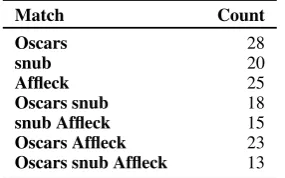
Table 4: Matching patterns for the worst-performing query 127 “Oscars snub Affleck”.
For the worst-performing query 125 “Oscars snub Affleck”, the PAtt model lost 0.47 in AP and 0.11 in P30. To diagnose what went wrong, we sampled the top 30 posts ranked by the PAtt model and counted the number of posts that con-tain different combinations of the query terms in Table4. The PAtt model indeed captures matching patterns, mostly onOscarsandAffleck. However, from the relevance judgments we see thatsnubis the dominant term in most relevant posts, while
Oscarsis often expressed implicitly. For example, QL assigns more weight to the term snub in the relevant post “argo wins retributions for the snub
of ben affleck” because of the term’s rarity; in con-trast, the position-aware encoder places emphasis on the wrong query terms.
Model Performance.Finally, in terms of training and inference speed, we compared the PAtt model with MP-HCNN on a machine with a GeForce GTX 1080 GPU (batch size: 300). In addition to being more effective (as the above results show), PAtt is also approximately 4×faster.
5 Conclusions
In this paper, we proposed two novel attention-based convolutional encoders to incorporate query-aware and position-aware information with minimal additional model complexity. Results show that our model is simpler, faster, andmore effective than previous neural models for search-ing social media posts.
Acknowledgments
[image:5.595.111.254.437.526.2]References
Nasreen Abdul-Jaleel, James Allan, W. Bruce Croft, Fernando Diaz, Leah Larkey, Xiaoyan Li, Don-ald Metzler, Mark D. Smucker, Trevor Strohman, Howard Turtle, and Courtney Wade. 2004. UMass at TREC 2004: Novelty and HARD. InTREC.
Dzmitry Bahdanau, Kyunghyun Cho, and Yoshua Ben-gio. 2014. Neural machine translation by jointly learning to align and translate. arXiv:1409.0473.
Alexis Conneau, Douwe Kiela, Holger Schwenk, Lo¨ıc Barrault, and Antoine Bordes. 2017. Supervised learning of universal sentence representations from natural language inference data. InEMNLP, pages 670–680.
Zhuyun Dai, Chenyan Xiong, Jamie Callan, and Zhiyuan Liu. 2018. Convolutional neural networks for soft-matching n-grams in ad-hoc search. In WSDM, pages 126–134.
Jonas Gehring, Michael Auli, David Grangier, Denis Yarats, and Yann N. Dauphin. 2017. Convolutional sequence to sequence learning. arXiv:1705.03122.
Jiafeng Guo, Yixing Fan, Qingyao Ai, and W. Bruce Croft. 2016. A deep relevance matching model for ad-hoc retrieval. InCIKM, pages 55–64.
Hua He, John Wieting, Kevin Gimpel, Jinfeng Rao, and Jimmy Lin. 2016. UMD-TTIC-UW at SemEval-2016 task 1: Attention-based multi-perspective con-volutional neural networks for textual similarity measurement. InSemEval-2016, pages 1103–1108.
Po-Sen Huang, Xiaodong He, Jianfeng Gao, Li Deng, Alex Acero, and Larry Heck. 2013. Learning deep structured semantic models for web search using clickthrough data. InCIKM, pages 2333–2338.
Yoon Kim. 2014. Convolutional neural networks for sentence classification. In EMNLP, pages 1746– 1751.
Jimmy Lin and Miles Efron. 2013. Overview of the TREC-2013 Microblog Track. InTREC.
Jimmy Lin, Miles Efron, Yulu Wang, and Garrick Sher-man. 2014. Overview of the TREC-2014 Microblog Track. InTREC.
Laurens van der Maaten and Geoffrey Hinton. 2008. Visualizing data using t-SNE. Journal of machine learning research, 9:2579–2605.
Ryan McDonald, George Brokos, and Ion Androut-sopoulos. 2018. Deep relevance ranking using en-hanced document-query interactions. In EMNLP, pages 1849–1860.
Bhaskar Mitra, Fernando Diaz, and Nick Craswell. 2017. Learning to match using local and distributed representations of text for web search. In WWW, pages 1291–1299.
Salman Mohammed, Peng Shi, and Jimmy Lin. 2018. Strong baselines for simple question answering over knowledge graphs with and without neural net-works. InNAACL, pages 291–296.
Iadh Ounis, Craig Macdonald, Jimmy Lin, and Ian Soboroff. 2011. Overview of the TREC-2011 Mi-croblog Track. InTREC.
Liang Pang, Yanyan Lan, Jiafeng Guo, Jun Xu, Jing-fang Xu, and Xueqi Cheng. 2017. DeepRank: A new deep architecture for relevance ranking in in-formation retrieval. InCIKM, pages 257–266.
Jeffrey Pennington, Richard Socher, and Christopher Manning. 2014. GloVe: Global vectors for word representation. InEMNLP, pages 1532–1543.
Jinfeng Rao, Hua He, and Jimmy Lin. 2016. Noise-contrastive estimation for answer selection with deep neural networks. InCIKM, pages 1913–1916.
Jinfeng Rao, Hua He, Haotian Zhang, Ferhan Ture, Royal Sequiera, Salman Mohammed, and Jimmy Lin. 2017. Integrating lexical and temporal signals in neural ranking models for searching social media streams. arXiv:1707.07792.
Jinfeng Rao, Wei Yang, Yuhao Zhang, Ferhan Ture, and Jimmy Lin. 2019. Multi-perspective relevance matching with hierarchical ConvNets for social me-dia search. InAAAI.
Minjoon Seo, Aniruddha Kembhavi, Ali Farhadi, and Hannaneh Hajishirzi. 2016. Bidirectional attention flow for machine comprehension. arXiv:1611.01603.
Aliaksei Severyn and Alessandro Moschitti. 2015. Learning to rank short text pairs with convolutional deep neural networks. InSIGIR, pages 373–382.
Yelong Shen, Xiaodong He, Jianfeng Gao, Li Deng, and Gr´egoire Mesnil. 2014. Learning semantic rep-resentations using convolutional neural networks for web search. InWWW, pages 373–374.
Mark D. Smucker, James Allan, and Ben Carterette. 2007. A comparison of statistical significance tests for information retrieval evaluation. InCIKM, pages 623–632.
Ian Soboroff, Iadh Ounis, Craig Macdonald, and Jimmy Lin. 2012. Overview of the TREC-2012 Mi-croblog Track. InTREC.
Dirk Weissenborn, Georg Wiese, and Laura Seiffe. 2017. Making neural QA as simple as possible but not simpler. InCoNLL, pages 271–280.