Proceedings of the 2019 Conference on Empirical Methods in Natural Language Processing 813
Modeling Multi-mapping Relations for Precise Cross-lingual Entity
Alignment
Xiaofei Shi1, Yanghua Xiao1,2,3
1School of Computer Science, Fudan University, China 2CETC Big Data Research Institute Co., Ltd., Guizhou, China
3Big Data Application on lmproving Government Governance Capabilities National
Engineering Laboratory, Guizhou, China {shixf18, shawyh}@fudan.edu.cn
Abstract
Entity alignment aims to find entities in differ-ent knowledge graphs (KGs) that refer to the same real-world object. An effective solution for cross-lingual entity alignment is crucial for many cross-lingual AI and NLP applications. Recently many embedding-based approaches were proposed for cross-lingual entity align-ment. However, almost all of them are based on TransE or its variants, which have been demonstrated by many studies to be unsuitable for encoding multi-mapping relations such as 1-N, N-1 and N-N relations, thus these meth-ods obtain low alignment precision. To solve this issue, we propose a new embedding-based framework. Through defining dot product-based functions over embeddings, our model can better capture the semantics of both 1-1 and multi-mapping relations. We calibrate em-beddings of different KGs via a small set of pre-aligned seeds. We also propose a weighted negative sampling strategy to generate valu-able negative samples during training and we regard prediction as a bidirectional problem in the end. Experimental results (especially with the metricHits@1) on real-world multilingual datasets show that our approach significantly outperforms many other embedding-based ap-proaches with state-of-the-art performance.
1 Introduction
Knowledge bases in the form of knowledge graphs (KGs) contain lots of facts of the real world. In recent years, KGs have been successfully ex-plored to serve many AI and NLP applications such as question answering, information extrac-tion, semantic search and recommender systems. Multilingual KGs such as BabelNet (Navigli and Ponzetto, 2012), YAGO3 (Mahdisoltani et al., 2013) and DBpedia (Lehmann et al., 2015) play essential roles in many cross-lingual applications. However, for multilingual KGs, each language-specific part is constructed by different parties
with different data sources. Thus these language-specific KGs contain different but complementary facts. To support cross-lingual applications, it is essential for us to integrate these language-specific KGs into a unified KG. Fortunately, existing inter-lingual links (ILLs) that link equivalent entities or relations can help us to achieve this goal. How-ever, asChen et al. (2017) and Sun et al. (2017) pointed out, the existing cross-lingual alignments usually account for a small proportion of the total. Therefore, it is valuable to find more cross-lingual entity alignment pairs to bridge the language gap in multilingual KGs.
Entity alignment is the task of finding entity pairs in different KGs that refer to the same real-world object. An effective solution for entity alignment is vital for integrating multiple KGs. In this paper, we focus on cross-lingual entity align-ment. Our goal is to find more cross-lingual entity alignments based on existing alignment seeds.
Though these methods have made great progress in cross-lingual entity alignment, there are still several key issues worth study. To the best of our knowledge, almost all of the existing methods encode knowledge in KGs based on the well-known TransE (Bordes et al., 2013) and its variants (Sun et al.,2017;Zhu et al.,2017). Given a relational triple τ = (h, r, t), where r repre-sents a specific relation between the head entity
hand the tail entityt, TransE and its variants ex-pect v~h +v~r−v~t ≈ ~0, wherev~h, v~r and v~t de-note the embeddings forh, r andt, respectively. However, as Wang et al. (2014) and Ebisu and Ichise(2018) pointed out: 1) TransE and its vari-ants neglect some mapping properties of relations; and 2) TransE and its variants force entity embed-dings to be on a sphere in the embedding space, which conflicts with the expectation of TransE and warps embeddings obtained by TransE. Thus TransE and its variants don’t do well in modeling multi-mapping relations, such as 1-N, 1 and N-N relations.
As the majority of relations in real KGs are multi-mapping relations, previous entity align-ment approaches obtain low accuracy, especially with the metric Hits@1. And the gap between alignment results with the metric Hits@1 and Hits@10 in these methods is large. This means previous methods can cluster similar entities to-gether, however, they don’t have enough ability to distinguish which is the true counterpart. Al-though following works such as TransH (Wang et al., 2014), TransR (Lin et al., 2015b) and TransD (Ji et al.,2015) have extended TransE on modeling multi-mapping relations, we experimen-tally found these methods also have low perfor-mances for cross-lingual entity alignment. And though the GCN-based approach avoids the flaw in TransE and its variants, GCN-EA (Wang et al., 2018) only encodes entities in KGs. It doesn’t dis-tinguish among relations and the absence of rela-tion embeddings results in low alignment preci-sion, too.
Besides, most previous works use uniform sam-pling to generate negative samples during train-ing, which often generates too many easy exam-ples that contribute little to learning embeddings. Although Boot-EA (Sun et al., 2018) proposes a truncated method to select hard negative samples based on the semantic similarity, it only consid-ers hard examples (easy ones are truncated) that
only account for a small proportion of all exam-ples, which can lead to overfitting and low accu-racy in practice (since easy examples are also use-ful).
To address the above issues, we propose a new embedding-based framework to do cross-lingual entity alignment in this paper. Motivated by the success of multiplicative approaches (Yang et al., 2015; Trouillon et al., 2016) in knowledge rep-resentation learning, we propose a new embed-ding approach for multilingual KGs. The score function of our method is based on multiplica-tion instead of subtracmultiplica-tion. Unlike TransE and its variants giving a strong constraint to embed-dings, dot products of embeddings in our method scale well and can naturally handle both 1-1 and multi-mapping relations. Besides, we propose a weighted sampling strategy to pay more attention to harder examples than easier ones during the pro-cess of negative samples generating. We summa-rize the main contributions of this paper as fol-lows:
• We propose a new KG embedding framework to jointly embed entities and relations from different KGs into a unified embedding space using a small set of pre-aligned alignment pairs obtained from inter-lingual links.
• We discuss the problem that generating too many easy negative examples during train-ing hurts alignment performance and then we propose a weighted sampling strategy for hard negative example generation.
• We regard the alignment prediction as a bidi-rectional selection problem, and we propose to combine ranking matrices from both direc-tions to align entities.
• We evaluate the proposed approach on three real-world cross-lingual datasets. Experi-mental results (especially with the metric Hits@1) show that our approach significantly outperforms four representative embedding-based methods for cross-lingual entity align-ment.
2 Related Work
2.1 KG Embedding
interprets a relation as the translation from its head entity to its tail entity and achieves great success in many AI-related tasks. Following TransE, TransH (Wang et al.,2014), TransR (Lin et al., 2015b) and TransD (Ji et al., 2015) were proposed to extend TransE on modeling multi-mapping relations. PTransE (Lin et al., 2015a) and RTransE (Garc´ıa-Dur´an et al., 2015) extend TransE on modeling multi-step relation paths. There are also non-translation-based methods. ComplEx (Trouillon et al., 2016) learns embed-dings via defining product-based functions over embeddings. And some methods utilizing extra re-sources, i.e. visual information (Xie et al.,2017) and entity descriptions (Xie et al., 2016; Xiao et al.,2017), were also proposed to improve em-bedding performance.
2.2 Cross-lingual Entity Alignment
Conventional methods for cross-lingual entity alignment rely on machine translation and hand-crafted features, which often need extra resources as input and are difficult to reuse. By contrast, embedding-based approaches are simple and easy to reuse. In recent years, many embedding-based methods have been proposed and achieved promis-ing results in cross-lpromis-ingual entity alignment.
Due to the simplicity and effectiveness of TransE, almost all of the existing cross-lingual en-tity alignment works employ TransE or its vari-ants to encode knowledge. JE (Hao et al.,2016) employs a modified TransE to encode entities and relations. It bridges different KGs by adding a loss of alignment seeds in its objective function. MTransE (Chen et al.,2017) encodes entities and relations for each language-specific KG separately based on TransE, and then employs five strate-gies to learn cross-lingual transitions through pre-aligned triples. JAPE (Sun et al., 2017) learns structure embedding using a variant of TransE which adds weight to negative samples in its ob-jective function. It also borrows the idea from Skip-gram model to learn attribute correlations and then leverages attribute correlations to refine structure embedding. To overcome the hetero-geneity and language gap between different KGs, JAPE only considers the range types of attribute values, with the specific attribute values discarded. There are also some efforts have been devoted to solving the problem of lacking enough train-ing data. IPTransE (Zhu et al., 2017) and
Boot-EA (Sun et al., 2018) propose to expand train-ing set from alignment results iteratively. KD-CoE (Chen et al., 2018) performs co-training of a KG embedding model and an entity description embedding model.
Besides, GCN-EA (Wang et al.,2018) employs GCNs to embed entities and attributes as low-dimensional vectors.
Different from the above methods, in this paper, we propose a new approach to jointly learn embed-dings for both entities and relations from different KGs.
3 Problem Formulation
We begin with the problem definition. A knowl-edge graph (KG) usually contains a large number of triples in the form of(h, r, t), wherer repre-sents a relation between the head entityhand the tail entityt. Formally, a KG can be represented as
KG = (E, R, T), where E, R, T are the set of
entities, relations and triples respectively.
Now suppose we have two heterogenous and language-specific KGs to be aligned, where
KG1 = (E1, R1, T1) andKG2 = (E2, R2, T2).
And in many cases, we already have a set of pre-aligned entitiesSe ={(e1, e2)|e1∈E1, e2∈E2} and relationsSr = {(r1, r2)|r1 ∈ R1, r2 ∈ R2} as alignment seeds. The task of entity alignment is to automatically find new entity alignments based on the existing alignment seeds.
4 The Proposed Approach
Our approach consists of two steps. The first step is to learn embeddings for entities and relations, and we will introduce a new method to do this task. The second step is to align entities between the two input KGs based on the learned embed-dings. In this section, we will introduce the two parts in details.
4.1 Multilingual KG Embedding
DistMA: The goal of KG embedding is to embed entities and relations into a unified vector space such that low-dimensional vectors of entities or relations can represent their semantics. A power-ful KG embedding approach should embed similar entities or relations to have similar embeddings, such that the semantics of knowledge graphs can be well captured.
TransE (Bordes et al., 2013) and its variants. Given one triple τ = (h, r, t) in a knowledge graph, TransE and its variants define the energy function for this triple asE(τ) =kv~h+v~r−v~tk1/2, wherev~h, ~vr, ~vt ∈ Rdrepresent thed-length
vec-tors forh,randtrespectively. Then they optimize margin-based ranking losses so that the energy for positive triples is lower than negative ones. As dis-cussed in Section1, they don’t do well in model-ing multi-mappmodel-ing relations, we need to explore new approaches to better capture the semantics of multi-mapping relations.
In this paper, we propose a new approach to encode both entities and relations in knowledge graphs. Our approach defines the energy function for a tripleτ as:
E1(h, r, t) =hv~h, ~vri+hv~r, ~vti+hv~h, ~vti (1)
whereh·,·idenotes the inner product.
Besides, instead of using a margin-based loss function, we employ the logistic loss withL2 reg-ularization on model parametersΘ. The objective function is defined as:
O1 =−
X
(h,r,t)∈T+
logσ(E1(h, r, t))
− X
(h0,r,t0)∈
T−
logσ(−1·E1(h0, r, t0)) +λkΘk22
(2)
whereσ is the sigmoid function. T+ andT−are
positive and negative triples set, respectively. λ
is a hyper-parameter that controls the influence of regularization. The value of σ(E(h, r, t)) mea-sures the plausibility of the triple (h, r, t). This means our method expects positive triples to have high energy scores and negative ones to have low scores. Compared with TransE and its variants, dot products of embeddings scale well and can naturally handle both 1-1 and multi-mapping rela-tions, which is helpful for capturing the semantics of KGs. We define the negative triples setT−as:
T−={(h0, r, t)|h0∈E} ∪
{(h, r, t0)|t0∈E},(h, r, t)∈T+ (3)
whereEdenotes the set of entities.
ComplEx: The energy function of DistMA doesn’t distinguish between head entities and tail entities. This means DistMA can model symmet-ric relations likesimilar to,has f riendwell but maybe unfriendly to some antisymmetric relations
likeis f ather of,part of. To improve the
abil-ity of our model to encode such relations, we uti-lize the ComplEx (Trouillon et al.,2016). Instead of real-valued vectors, ComplEx gives complex-valued vectors to entities and relations. That is, for each entityeor relationr, letw~e∈Ckorw~r∈Ck
be the corresponding complex-valued vector, i.e.
~
we = Re(w~e) +iIm(w~e) with Re(w~e) ∈ Rk
andIm(w~e) ∈ Rk being the real and imaginary
parts of w~e, where R, C represent the real and
complex vector spaces respectively, andidenotes the square root of -1. Then the energy for a triple
(h, r, t)is defined as follows:
E2(h, r, t) =Re(hw~h, ~wr, ~w¯ti) (4)
whereh·,·,·idenotes the generalized inner prod-uct andw~¯t represents the conjugate ofw~t: w~¯t =
Re(w~t) − iIm(w~t). One can easily verify that Equation (4) can be expanded and written as:
E2(h, r, t) =hRe(w~h), Re(w~r), Re(w~t)i
+hRe(w~h), Im(w~r), Im(w~t)i
+hIm(w~h), Re(w~r), Im(w~t)i
− hIm(w~h), Im(w~r), Re(w~t)i (5)
With this energy function, we use the same Equa-tion (2) to calculate lossO2asO1.
Joint Embedding: With ComplEx, we refine the final energy function for each triple as:
E(h, r, t) =E1(h, r, t) +E2(h, r, t) (6)
Then the final lossO to optimize can be defined by Equation (2) using Equation (6) as the energy function.
We will evaluate each part of our method in the experiments.
4.2 Weighted Negative Sampling
Most previous works (Bordes et al., 2013; Sun et al., 2017;Zhu et al.,2017;Wang et al.,2018) use uniform sampling to generate negative triples
T−, that is, replacing the head or tail entity of
a positive triple with a random entity. Despite the simplicity of this method, it can be blind in many cases. For example, suppose we have a positive triple (David Hilbert, nationality,
Germany) and randomly replace the tail
en-tity with an arbitrary enen-tity. Maybe we can get one negative triple(David Hilbert, nationality,
Barack Obama). This is not a good choice
be-cause such a ridiculous triple contributes little to learning embeddings. Since such an obviously false triple is “too easy” and can easily obtain low plausibility during training. In contrast, a negative triple like(David Hilbert, nationality,
F rance)is more valuable, sinceF rancehas
sim-ilar semantics withGermany, butF rancecan’t replaceGermany. Such a negative triple can help the model to learn the underlying semantics differ-ence between entities rather than types solely.
We propose a weighted sampling strategy to generate valuable negative samples. Take the tail entity for example, given a positive triple(h, r, t), we replacet with t0 obtained from the following probability distribution:
P((h, r, t0)|(h, r, t)) = exp(sim(t, t
0))
P
e∈Eexp(sim(t, e)) (7) whereEdenotes the entity set andsim(·,·) calcu-lates the similarity between two entities. Here we employ the cosine similarity measure. This means our sampling method is more likely to replace one entity with its similar entities. Since these entities have strong semantic correlations with the original entity but don’t express the original entity, which helps the model learn to distinguish. Note that our method also generates a few easy examples, which are also useful for learning embeddings.
4.3 Bidirectional Alignment
We regard alignment prediction as a ranking prob-lem. That is, suppose we need to align the entities inKG1 toKG2, for each entity ei inKG1 , we rank each entityej inKG2 based on the similar-ity betweenei andej. The similarity can be cal-culated via their embeddings, which we define by cosine similarity measure as follows:
sim(ei, ej) =h[v~ei]1,[v~ej]1i (8)
where[·]1 denotes the normalized vector. Finally, we will get a similarity matrix S12 between the two KGs. Then we can get a ranking matrixM12 forKG1 withM12(i, j)denoting the index ofej in the ranking list ofei.
One thing that hurts the alignment precision is the difference of knowledge distribution between different KGs. Considering the following fact dur-ing the entity alignment process. Suppose we se-lect the first ranked entityej in the ranking list of
eito be the counterpart ofei. It is reasonable be-cause, from the view ofei, ej is the most similar entity in KG2. However, this can be misleading sometimes. For example, from the view ofej, ei may not rank first in the ranking list of ej, and even rank at dozens. In such a case, we don’t think
ej is the desired candidate forei. This means, in-stead of single direction in previous works, that the alignment prediction process should consider both directions of KGs. We combine ranking matrices from both directions to accomplish this goal.
From both views of KG1 andKG2, we refine the ranking matrixM12as:
M12=M12+MT21 (9)
whereMT21 denotes the transpose of the ranking matrix ofKG2.
4.4 Implementation Details
We initialize all embeddings for both DistMA and ComplEx based on the uniform distribution. We set d = 150 for DistMA and k = 75 for ComplEx so that the length of embeddings in DistMA and ComplEx are all equal to 150. Be-fore predicting, we concatenate the embeddings in DistMA and ComplEx such that each entity is represented as a 300-dimensional vector in the end. Besides, during training, we sample ten negative triples for each positive one. Since the weighted negative sampling is time-consuming, to speed it up, we calculate Equation (7) every five epochs. We use the self-adaptive optimiza-tion method Adam (Kingma and Ba,2015) for all trainings and we implement our model with Ten-sorflow1.
5 Evaluation
5.1 Datasets
We evaluate our proposed method on DBP15K datasets (Sun et al., 2017; Wang et al., 2018).
The datasets contain three cross-lingual real-world datasets: DBPZH−EN(Chinese to English), DBPF R−EN (French to English), DBPJ A−EN (Japanese to English). In which each was built with 15 thousand ILLs from multilingual versions of DBpedia. The average number of entities, rela-tions and relational triples of the three datasets are 166,255/4,291/420,025 respectively.
5.2 Baseline Methods
We select four representative methods as baselines for cross-lingual entity alignment. These methods can be categorized as:
• Translation-based methods where relations are modeled as translation operators in the embedding space, including JE (Hao et al., 2016), MTransE (Chen et al., 2017) and JAPE (Sun et al.,2017). For MTransE, it de-velops five variants in its alignment model, where the fourth obtains the best results ac-cording to the experiments of its authors. Thus, we choose this variant to represent MTransE. For JAPE, it learns both structure and attribute embeddings. We report the re-sults of its full model.
• To the best of our knowledge, GCN-EA (Wang et al., 2018) is the only one method employing non-translation-based embedding technique. GCN-EA uses GCNs as its encoding network to encode entities and attributes. We report the results of its full model.
5.3 Evaluation Metrics
By convention, we useHits@kandMean Recipro-cal Rank (MRR)as our metrics.Hits@kmeasures the percentage of correctly aligned entities ranked in the top-k. Generally, Hits@1 indicates preci-sion. MRRis the average of the reciprocal ranks of all test instances. HigherHits@kandMRR in-dicate better performance.
5.4 Model Selection
We select hyper-parameters with the following values: learning rate η ∈ {0.001, 0.003, 0.005,
0.01, 0.1}, L2 regularization factor λ ∈ {1e−5, 1e−4, 5e−4, 1e−3}, batch size B ∈ {2000,
5000,10000,20000,30000}. The optimal hyper-parameters are: η = 0.005,λ = 1e−4andB = 20000. We use these values in all experiments.
The total number of epochs is set to 3000, within which we test alignment every ten epochs and save embeddings when obtaining betterHits@1 perfor-mances.
5.5 Results and Analysis
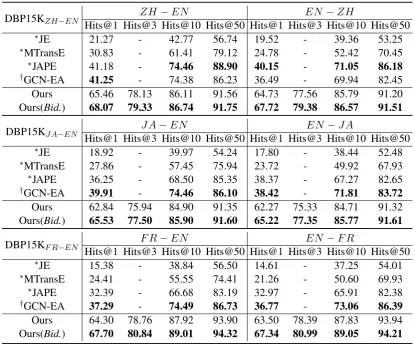
Following Sun et al. (2017) and Wang et al. (2018), we use 30% of the gold standards for training and the rest 70% for testing. The results of four compared baselines and our approach are shown in Table1. Among the four baselines, JAPE and GCN-EA obtain better results, since seman-tic loss happens when learning the translations be-tween embedding spaces in the other two methods. GCN-EA is the most powerful method. It doesn’t encode relations but it achieves a better perfor-mance except for the dataset DBP15KZH−EN.
However, we can easily see our method sig-nificantly outperforms all the four baselines, es-pecially with the metricHist@1, which indicates our method can better capture the semantics of different KGs. As discussed in Section 1, base-line methods all obtain low performance. And theHits@3results of our method are comparable to the Hits@10 results of all the baselines. Be-sides, we observe that the gap between the results with metricsHits@1andHits@10of our method is much smaller than the other methods (average 20.24% vs. 29.34%), which means our method has stronger ability to distinguish between target counterparts and error ones which have strong se-mantic similarity with target counterparts.
We also find the results after applying bidirec-tional alignment have a large improvement com-pared with single directional alignment under all the metrics, especially forHits@1. This is due to the fact that entity alignment is essentially a bidi-rectional selection process. Bidibidi-rectional selection can soften the impact of unbalanced data distribu-tion between different KGs, making the alignment prediction more reasonable.
Evaluation of Weighted Negative Sampling: Here we come to evaluate the effectiveness of our proposed weighted negative sampling strat-egy. We compare with uniform sampling with the negative sampling rate neg = 1 and neg = 10 (1 and 10 negative triples per positive triple), respec-tively. Table2shows the testing results with met-ricsHits@1andMRR.
DBP15KZH−EN
ZH−EN EN−ZH
Hits@1 Hits@3 Hits@10 Hits@50 Hits@1 Hits@3 Hits@10 Hits@50
∗JE 21.27 - 42.77 56.74 19.52 - 39.36 53.25
∗MTransE 30.83 - 61.41 79.12 24.78 - 52.42 70.45
∗JAPE 41.18 - 74.46 88.90 40.15 - 71.05 86.18
†GCN-EA 41.25 - 74.38 86.23 36.49 - 69.94 82.45
Ours 65.46 78.13 86.11 91.56 64.73 77.56 85.79 91.20
Ours(Bid.) 68.07 79.33 86.74 91.75 67.72 79.38 86.57 91.51
DBP15KJ A−EN J A
−EN EN −J A
Hits@1 Hits@3 Hits@10 Hits@50 Hits@1 Hits@3 Hits@10 Hits@50
∗JE 18.92 - 39.97 54.24 17.80 - 38.44 52.48
∗MTransE 27.86 - 57.45 75.94 23.72 - 49.92 67.93
∗JAPE 36.25 - 68.50 85.35 38.37 - 67.27 82.65
†GCN-EA 39.91 - 74.46 86.10 38.42 - 71.81 83.72
Ours 62.84 75.94 84.90 91.35 62.27 75.33 84.71 91.32
Ours(Bid.) 65.53 77.50 85.90 91.60 65.22 77.35 85.77 91.61
DBP15KF R−EN
F R−EN EN−F R
Hits@1 Hits@3 Hits@10 Hits@50 Hits@1 Hits@3 Hits@10 Hits@50
∗JE 15.38 - 38.84 56.50 14.61 - 37.25 54.01
∗MTransE 24.41 - 55.55 74.41 21.26 - 50.60 69.93
∗JAPE 32.39 - 66.68 83.19 32.97 - 65.91 82.38
†GCN-EA 37.29 - 74.49 86.73 36.77 - 73.06 86.39
Ours 64.30 78.76 87.92 93.90 63.50 78.39 87.83 93.94
[image:7.595.91.507.61.406.2]Ours(Bid.) 67.70 80.84 89.01 94.32 67.34 80.99 89.05 94.21
Table 1: Results comparison. (* marks the results copied fromSun et al.(2017). †marks the results reported by its authors. - marks the unreported results.Bid.indicates bidirectional alignment.)
better performance with the increase of the ative sampling rate. This shows that more neg-ative samples can assist model to better capture the semantics of KGs. Secondly, we can find that, compared with uniform negative sampling, our weighted sampling strategy gets better perfor-mance for all the three datasets. This is because our sampling method can generate more valuable negative samples to assist model to learn correct embeddings. Besides, we observe our method is more effective with a smaller negative sampling rate (neg = 1). Because when neg is large, it is likely to generate a few valuable negative samples though using uniform sampling. But when neg
is small, the uniform sampling method can’t gen-erate enough valuable samples, which seriously hurts the final performance. However, our sam-pling strategy can pay more attention to valuable samples, generating many valuable negative sam-ples even when the amount of total samsam-ples is small.
Ablation Study: For ablation study, we
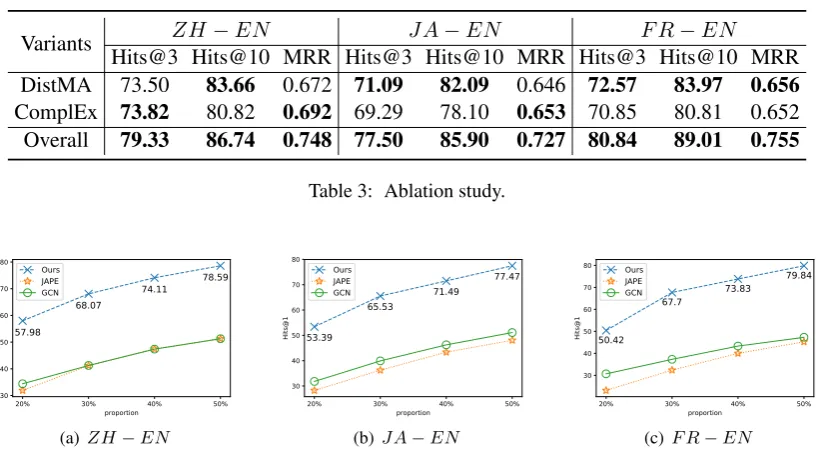
sepa-rate two variants from our approach. The first one only optimizes the objective function O1, called DistMA. And the second one only optimizesO2, called ComplEx. Table3shows the results of the two variants and the overall method.
As expected, Table 3 shows that each variant gets better results compared with four baselines. The DistMA can model symmetric relations well and the ComplEx can improve the ability in mod-eling antisymmetric relations. The overall method gets the best results due to its strong ability in modeling both relations.
Training with Different Sizes of Seed Align-ment: We further investigate how the size of the training data affects the performance of our pro-posed approach. Here we use different proportions of seed alignment, which ranges from 20% to 50% with step 10%. And we choose two strong base-lines JAPE and GCN-EA for comparison. Fig-ure1illustrates theHits@1results of the three ap-proaches.
Variants ZH−EN EN −ZH J A−EN EN−J A F R−EN EN−F R Hits@1 MRR Hits@1 MRR Hits@1 MRR Hits@1 MRR Hits@1 MRR Hits@1 MRR
neg=1,unif. 62.36 0.709 62.14 0.707 59.79 0.686 59.78 0.686 59.69 0.697 59.66 0.697
neg=1,weig. 63.85 0.716 63.96 0.716 62.23 0.701 61.91 0.698 61.17 0.705 61.10 0.704
neg=10,unif. 66.86 0.742 66.41 0.740 64.98 0.726 64.60 0.724 66.11 0.747 65.56 0.743
[image:8.595.95.512.192.421.2]neg=10,weig. 68.07 0.748 67.72 0.746 65.53 0.727 65.22 0.725 67.70 0.755 67.34 0.752
Table 2: Evaluation of weighted negative sampling. (unif. indicates the uniform negative sampling and weig. indicates our weighted sampling strategy)
Variants ZH−EN J A−EN F R−EN
Hits@3 Hits@10 MRR Hits@3 Hits@10 MRR Hits@3 Hits@10 MRR
DistMA 73.50 83.66 0.672 71.09 82.09 0.646 72.57 83.97 0.656
ComplEx 73.82 80.82 0.692 69.29 78.10 0.653 70.85 80.81 0.652
Overall 79.33 86.74 0.748 77.50 85.90 0.727 80.84 89.01 0.755
Table 3: Ablation study.
20% 30% 40% 50%
proportion 30
40 50 60 70 80
Hits@1 57.98
68.07 74.11 78.59
Ours JAPE GCN
(a) ZH−EN
20% 30% 40% 50%
proportion 30
40 50 60 70 80
Hits@1 53.39
65.53 71.49 77.47
Ours JAPE GCN
(b)J A−EN
20% 30% 40% 50%
proportion 30
40 50 60 70 80
Hits@1 50.42
67.7 73.83 79.84
Ours JAPE GCN
(c) F R−EN
Figure 1:[email protected]. proportion of seed alignment.
all the three approaches become better with the increase of proportion of training data, because more seed alignment can provide more informa-tion to bridge different KGs. And we can also see that our approach consistently outperforms the other two methods under different proportions. Moreover, only with 20% seed alignment, our ap-proach achieves comparable performances for all the three datasets with the other two methods us-ing 50% seed alignment. When usus-ing 30% seed alignment, our approach largely outperforms the other two methods using 50% seed alignment. All these results show the robustness and effectiveness of our method.
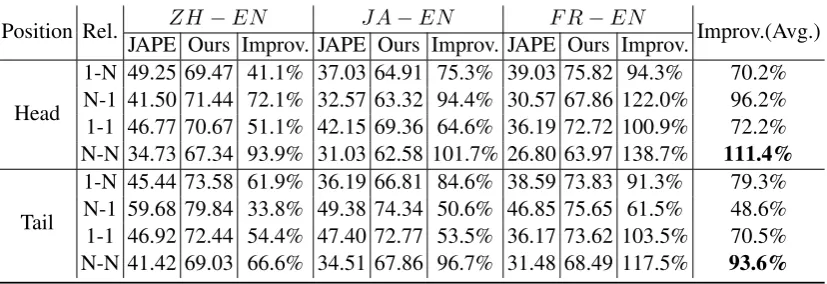
Hits@1 Results by Mapping Properties of Relations: To better know how effective our method is for different relations, compared with JAPE (Sun et al.,2017), we evaluate the improve-ment ofHits@1results by mapping properties of relations. To do this, we first divide all relations into 1-N, N-1, 1-1 and N-N relations2. Then we
2Following Wang et al.(2014), for each relation r, we
evaluate theHits@1alignment results for head en-tities and tail enen-tities of the four kinds of relations respectively.
The results are shown in Table 4. We can see that the result of N-N relations has the greatest im-provement (with 111.4% average relative increase for head entities and 93.6% for tail entities). In addition, there are two points are also remarkable: the head entities of N-1 relations (96.2%) and the tail entities of 1-N relations (79.3%), which sug-gests the superiority of our method in modeling multi-mapping relations.
6 Conclusion and Future Work
This paper presents a simple and effective em-bedding framework for multilingual KGs which successfully improves the performance of
cross-compute the average number of tails per head (tphr) and the average number of head per tail (hptr). Iftphr ≥1.5and
Position Rel. ZH−EN J A−EN F R−EN Improv.(Avg.) JAPE Ours Improv. JAPE Ours Improv. JAPE Ours Improv.
Head
1-N 49.25 69.47 41.1% 37.03 64.91 75.3% 39.03 75.82 94.3% 70.2% N-1 41.50 71.44 72.1% 32.57 63.32 94.4% 30.57 67.86 122.0% 96.2% 1-1 46.77 70.67 51.1% 42.15 69.36 64.6% 36.19 72.72 100.9% 72.2% N-N 34.73 67.34 93.9% 31.03 62.58 101.7% 26.80 63.97 138.7% 111.4%
Tail
[image:9.595.93.507.64.206.2]1-N 45.44 73.58 61.9% 36.19 66.81 84.6% 38.59 73.83 91.3% 79.3% N-1 59.68 79.84 33.8% 49.38 74.34 50.6% 46.85 75.65 61.5% 48.6% 1-1 46.92 72.44 54.4% 47.40 72.77 53.5% 36.17 73.62 103.5% 70.5% N-N 41.42 69.03 66.6% 34.51 67.86 96.7% 31.48 68.49 117.5% 93.6%
Table 4: Comparison of JAPE and our model inHits@1results by mapping properties of relations.
lingual entity alignment. We also propose a weighted sampling strategy to generate hard nega-tive examples during training. Moreover, we pro-pose to align entities from both directions. Exper-imental results on real-world datasets show that our method significantly outperforms four com-petitors, especially with the metricHits@1.
Our proposed embedding framework can be easily applied to other tasks, i.e. link prediction and triple classification. And the idea of weighted negative sampling can be helpful for many AI and NLP tasks such as relation extraction and classifi-cation. For future work, we plan to explore more powerful KG embedding methods. And we also have the idea of using categorical attributes or hi-erarchical types to guide the negative sampling process.
Acknowledgments
This work was supported by Big Data Application on lmproving Government Governance Capabili-ties National Engineering Laboratory Open Fund Project.
References
Antoine Bordes, Nicolas Usunier, Alberto Garcia-Duran, Jason Weston, and Oksana Yakhnenko. 2013. Translating embeddings for modeling multi-relational data. In Advances in neural information processing systems, pages 2787–2795.
Muhao Chen, Yingtao Tian, Kai-Wei Chang, Steven Skiena, and Carlo Zaniolo. 2018. Co-training em-beddings of knowledge graphs and entity descrip-tions for cross-lingual entity alignment. In Proceed-ings of the 27th International Joint Conference on Artificial Intelligence, IJCAI’18, pages 3998–4004. AAAI Press.
Muhao Chen, Yingtao Tian, Mohan Yang, and Carlo Zaniolo. 2017. Multilingual knowledge graph em-beddings for cross-lingual knowledge alignment. In IJCAI, pages 1511–1517.
Takuma Ebisu and Ryutaro Ichise. 2018. Toruse: Knowledge graph embedding on a lie group. In Thirty-Second AAAI Conference on Artificial Intel-ligence.
Alberto Garc´ıa-Dur´an, Antoine Bordes, and Nicolas Usunier. 2015. Composing relationships with trans-lations. InProceedings of the 2015 Conference on Empirical Methods in Natural Language Process-ing, pages 286–290.
Yanchao Hao, Yuanzhe Zhang, Shizhu He, Kang Liu, and Jun Zhao. 2016. A joint embedding method for entity alignment of knowledge bases. InChina Con-ference on Knowledge Graph and Semantic Comput-ing, pages 3–14. Springer.
Guoliang Ji, Shizhu He, Liheng Xu, Kang Liu, and Jun Zhao. 2015. Knowledge graph embedding via dynamic mapping matrix. In Proceedings of the 53rd Annual Meeting of the Association for Compu-tational Linguistics and the 7th International Joint Conference on Natural Language Processing (Vol-ume 1: Long Papers), volume 1, pages 687–696.
Diederik P Kingma and Jimmy Ba. 2015. Adam: A method for stochastic optimization. In The 3rd International Conference on Learning Representa-tions.
Jens Lehmann, Robert Isele, Max Jakob, Anja Jentzsch, Dimitris Kontokostas, Pablo N Mendes, Sebastian Hellmann, Mohamed Morsey, Patrick Van Kleef, S¨oren Auer, et al. 2015. Dbpedia–a large-scale, multilingual knowledge base extracted from wikipedia. Semantic Web, 6(2):167–195.
Yankai Lin, Zhiyuan Liu, Maosong Sun, Yang Liu, and Xuan Zhu. 2015b. Learning entity and rela-tion embeddings for knowledge graph complerela-tion. InTwenty-ninth AAAI conference on artificial intel-ligence.
Farzaneh Mahdisoltani, Joanna Biega, and Fabian M Suchanek. 2013. Yago3: A knowledge base from multilingual wikipedias. InCIDR.
Roberto Navigli and Simone Paolo Ponzetto. 2012. Babelnet: The automatic construction, evaluation and application of a wide-coverage multilingual se-mantic network. Artificial Intelligence, 193:217– 250.
Zequn Sun, Wei Hu, and Chengkai Li. 2017. Cross-lingual entity alignment via joint attribute-preserving embedding. In International Semantic Web Conference, pages 628–644. Springer.
Zequn Sun, Wei Hu, Qingheng Zhang, and Yuzhong Qu. 2018. Bootstrapping entity alignment with knowledge graph embedding. In IJCAI, pages 4396–4402.
Th´eo Trouillon, Johannes Welbl, Sebastian Riedel, ´Eric Gaussier, and Guillaume Bouchard. 2016. Com-plex embeddings for simple link prediction. In In-ternational Conference on Machine Learning, pages 2071–2080.
Zhen Wang, Jianwen Zhang, Jianlin Feng, and Zheng Chen. 2014. Knowledge graph embedding by trans-lating on hyperplanes. InTwenty-Eighth AAAI con-ference on artificial intelligence.
Zhichun Wang, Qingsong Lv, Xiaohan Lan, and Yu Zhang. 2018. Cross-lingual knowledge graph alignment via graph convolutional networks. In Pro-ceedings of the 2018 Conference on Empirical Meth-ods in Natural Language Processing, pages 349– 357.
Han Xiao, Minlie Huang, Lian Meng, and Xiaoyan Zhu. 2017. Ssp: semantic space projection for knowledge graph embedding with text descriptions. InThirty-First AAAI Conference on Artificial Intel-ligence.
Ruobing Xie, Zhiyuan Liu, Jia Jia, Huanbo Luan, and Maosong Sun. 2016. Representation learning of knowledge graphs with entity descriptions. In Thir-tieth AAAI Conference on Artificial Intelligence.
Ruobing Xie, Zhiyuan Liu, Huanbo Luan, and Maosong Sun. 2017. Image-embodied knowledge representation learning. InIJCAI.
Bishan Yang, Wen-tau Yih, Xiaodong He, Jianfeng Gao, and Li Deng. 2015. Embedding entities and relations for learning and inference in knowledge bases. In International Conference on Learning Representations.