Proceedings of the 2019 Conference on Empirical Methods in Natural Language Processing 219
Open Relation Extraction: Relational Knowledge Transfer from
Supervised Data to Unsupervised Data
Ruidong Wu1∗, Yuan Yao1∗, Xu Han1, Ruobing Xie2, Zhiyuan Liu1†, Fen Lin2, Leyu Lin2, Maosong Sun1
1Department of Computer Science and Technology, Tsinghua University, Beijing, China Institute for Artificial Intelligence, Tsinghua University, Beijing, China
State Key Lab on Intelligent Technology and Systems, Tsinghua University, Beijing, China 2Search Product Center, WeChat Search Application Department, Tencent, China
Abstract
Open relation extraction (OpenRE) aims to extract relational facts from the open-domain corpus. To this end, it discovers relation pat-terns between named entities and then clusters those semantically equivalent patterns into a united relation cluster. Most OpenRE meth-ods typically confine themselves to unsuper-vised paradigms, without taking advantage of existing relational facts in knowledge bases (KBs) and their high-quality labeled instances. To address this issue, we propose Relational Siamese Networks (RSNs) to learn similar-ity metrics of relations from labeled data of pre-defined relations, and then transfer the relational knowledge to identify novel rela-tions in unlabeled data. Experiment results on two real-world datasets show that our frame-work can achieve significant improvements as compared with other state-of-the-art methods. Our code is available athttps://github. com/thunlp/RSN.
1 Introduction
Relation extraction (RE) aims to extract relational facts between two entities from plain texts. For example, with the sentence “Hayao Miyazaki is the director of the film ‘The Wind Rises’", we can extract a relation “director_of" between two entities “Hayao Miyazaki" and “The Wind Rises".
Recent progress in supervised methods to RE has achieved great successes. Supervised meth-ods can effectively learn significant relation se-mantic patterns based on existing labeled data, but the data constructions are time-consuming and human-intensive. To lower the level of super-vision, several semi-supervised approaches have been developed, including bootstrapping, active learning, label propagation (Pawar et al., 2017).
∗ indicates equal contribution
† Corresponding author: Z.Liu([email protected])
Relational Siamese Network
Novel Relations (Unlabeled)
Pre-defined Relations (Auto-labeled/Labeled)
1
…
2
…
n
…
…
Testing Instances
Novel Relations (Extracted)
n+1
…
n+2
…
n+m
…
…
clustering …
every rectangle indicates an unlabeled instance of a novel relation
…
metric learning
every rectangle indicates a pre-defined relation instance
[image:1.595.307.523.223.385.2]relational knowledge transfer
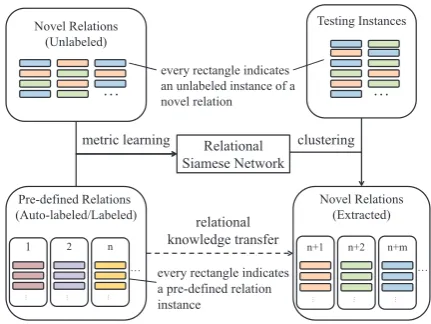
Figure 1: A flowchart of our framework. Our model RSN learns from both labeled instances of pre-defined relations and unlabeled instances of new relations, and tries to cluster testing instances of new relations.1
Mintz (2009) also proposes distant supervision to generate training data automatically. It assumes that if two entities have a relation in KBs, all sen-tences that contain these two entities will express this relation. Still, all these approaches can only extract pre-defined relations that have already ap-peared either in human-annotated datasets or KBs. It is hard for them to cover the great variety of novel relational facts in the open-domain corpora. Open relation extraction (OpenRE) aims to ex-tract relational facts on the open-domain cor-pus, where the relation types may not be pre-defined. There are some efforts concentrating on extracting triples with new relation types. Banko (2008) directly extracts words or phrases in sen-tences to represent new relation types. How-ever, some relations cannot be explicitly repre-sented with tokens in sentences, and it is hard to align different relational tokens that exactly have the same meanings. Yao (2011)
consid-1
ers OpenRE as a clustering task for extracting triples with new relation types. However, previ-ous clustering-based OpenRE methods (Yao et al., 2011,2012;Marcheggiani and Titov,2016; Elsa-har et al.,2017) are mostly unsupervised, and can-not effectively select meaningful relation patterns and discard irrelevant information.
In this paper, we propose to take advantage of high-quality supervised data of pre-defined rela-tions for OpenRE. The approach is non-trivial, however, due to the considerable gap between the pre-defined relations and novel relations of inter-est in open domain. To bridge the gap, we propose Relational Siamese Networks (RSNs) to learn transferable relational knowledge from supervised data for OpenRE. Specifically, RSNs learn re-lational similarity metrics from labeled data of pre-defined relations, and then transfer the met-rics to measure the similarity of unlabeled sen-tences for open relation clustering. We describe the flowchart of our framework in Figure1.
Moreover, we show that RSNs can also be generalized to various weakly-supervised scenar-ios. We propose Semi-supervised RSNto learn from both supervised data of pre-defined rela-tions and unsupervised data with novel relarela-tions, and Distantly-supervised RSN to learn from distantly-supervised data and unsupervised data.
We conduct experiments on real-world RE datasets, FewRel and FewRel-distant, by split-ting relations into seen and unseen set, and eval-uate our models in supervised, semi-supervised, and distantly-supervised scenarios. The results demonstrate that our models significantly outper-form state-of-the-art baseline methods in all sce-narios without using external linguistic tools. To summarize, the main contributions of this work are as follows:
(1) We develop a novel relational knowledge transfer framework RSN for OpenRE, which can effectively transfer existing relational knowledge to novel-relation data and accurately identify novel relations. To the best of our knowledge, RSN is the first model to consider knowledge transfer in clustering-based OpenRE task.
(2) We further propose Semi-supervised RSNs and Distantly-supervised RSNs that can learn from various weakly supervised scenarios. The experimental results show that all these RSN mod-els achieve significant improvements in F-measure compared with state-of-the-art baselines.
2 Related Work
Open Relation Extraction. Relation extraction (RE) is an important task in NLP. Traditional RE methods mainly concentrate on classifying rela-tional facts into pre-defined relation types (Mintz et al.,2009;Yu et al.,2017). Zeng (2014) utilizes CNN encoders to build sentence representations with the help of position embeddings. Lin (2016) further improves RE performance on distantly-supervised data via instance-level attention. These methods take advantage of supervised or distantly-supervised data to learn neural sentence encoders for distributed representations, and have achieved promising results. However, these methods can-not handle the open-ended growth of new relation types in the open-domain corpora.
To solve this problem, recently many efforts have been invested in exploring methods for open relation extraction (OpenRE), which aims to discover new relation types from unsupervised open-domain corpora. OpenRE methods can be roughly divided into two categories: tagging-based and clustering-tagging-based. Tagging-tagging-based meth-ods cast OpenRE as a sequence labeling prob-lem, and extract relational phrases consisting of words from sentences in unsupervised (Banko et al., 2007; Banko and Etzioni, 2008) or super-vised paradigms (Jia et al.,2018;Cui et al.,2018; Stanovsky et al., 2018). However, tagging-based methods often extract multiple overly-specific re-lational phrases for the same relation type, and cannot be readily utilized for downstream tasks.
In comparison, conventional clustering-based OpenRE methods extract rich features for relation instances via external linguistic tools, and clus-ter semantic patclus-terns into several relation types (Lin and Pantel, 2001; Yao et al., 2011, 2012). Marcheggiani (2016) proposes a reconstruction-based model discrete-state variational autoencoder for OpenRE via unlabeled instances. Elsahar (2017) utilizes a clustering algorithm over lin-guistic features. In this paper, we focus on the clustering-based OpenRE methods, which have the advantage of discovering highly distinguish-able relation types.
Convolu-Twain was a writer of America
FC
distance classifier 0.7
vl
vr
vd p max
word embeddings
position embeddings
FC max Kenji
[image:3.595.82.282.64.214.2]was a poet of Japan
Figure 2: The architecture of Relational Siamese Net-works. The output is the similarity between two rela-tional instances.
tional Siamese Neural Network for image metric learning, which inspires us to learn relational sim-ilarity metrics for OpenRE.
Semi-supervised Clustering. Semi-supervised clustering aims to cluster semantic patterns given instance seeds of target categories (Bair, 2013;
Hongtao Lin, 2019). Differently, our proposed Semi-supervised RSN only leverages labeled in-stances of pre-defined relations, and does not need any seed of new relations.
3 Methodology
Our OpenRE framework mainly consists of two modules, the relation similarity calculation mod-ule and the relation clustering modmod-ule. For rela-tion similarity calcularela-tion, we propose Relarela-tional Siamese Networks (RSNs), which learn to pdict whether two sentences mention the same re-lation. To utilize large-scale unsupervised data and distantly-supervised data, we further propose Semi-supervised RSN and Distantly-supervised RSN. Finally, in the relation clustering module, with the learned relation metric, we utilize hierar-chical agglomerative clustering (HAC) and Lou-vain clustering algorithms to cluster target relation instances of new relation types.
3.1 Relational Siamese Network (RSN)
The architecture of our Relational Siamese Net-works is shown in Figure2. CNN modules encode a pair of relational instances into vectors, and sev-eral shared layers compute their similarity.
Sentence Encoder. We use a CNN module as the sentence encoder. The CNN module in-cludes an embedding layer, a convolutional layer,
a max-pooling layer, and a fully-connected (FC) layer. The embedding layer transforms the words in a sentencex and the positions of entitiesehead and etail into pre-trained word embeddings and random-initialized position embeddings. Follow-ing (Zeng et al.,2014), we concatenate these em-beddings to form a vector sequence. Next, a one-dimensional convolutional layer and a max-pooling layer transform the vector sequence into features. Finally, an FC layer with sigmoid ac-tivation maps features into a relational vector v. To summarize, we obtain a vector representation
vfor a relational sentence with our CNN module:
v= CNN(s), (1)
in which we denote the joint information of a sen-tencexand two entities in itehead andetail as a data sample s. And with paired input relational instances, we have:
vl= CNN(sl),vr= CNN(sr), (2)
in which two CNN modules are identical and share all the parameters.
Similarity Computation. Next, to measure the similarity of two relational vectors, we calculate their absolute distance and transform it into a real-number similarityp∈[0,1]. First, a distance layer computes the element-wise absolute distance of two vectors:
vd=|vl−vr|. (3)
Then, a classifier layer calculates a metric p for relation similarity. The layer is a one-dimensional-output FC layer with sigmoid activation:
p=σ(kvd+b), (4)
in whichσdenotes the sigmoid function, kandb denote the weights and bias. To summarize, we obtain a good similarity metricpof relational in-stances.
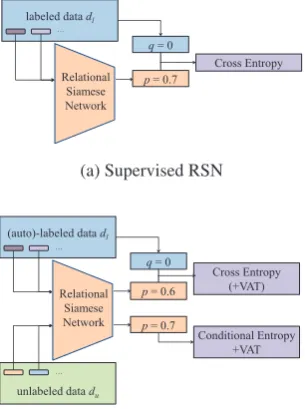
Cross Entropy Loss.The output of RSNpcan also be explained as the probability of two sen-tences mentioning two different relations. Thus, we can use binary labels q and binary cross en-tropy loss to train our RSN:
Ll=Edl∼Dl[qln(pθ(dl)) + (1−q) ln(1−pθ(dl))], (5)
labeled data dl
p = 0.7 q = 0
Cross Entropy Relational
Siamese Network
…
(a) Supervised RSN
(auto)-labeled data dl
q = 0
Cross Entropy (+VAT) Relational
Siamese Network
…
unlabeled data du
…
p = 0.7 p = 0.6
Conditional Entropy +VAT
(b) Weakly-supervised RSNs
Figure 3: The comparison of (a) Supervised RSN and (b) Weakly-supervised RSNs. Weakly-supervised RSNs, including Semi-supervised RSN and Distantly-supervised RSN, further learn from unlabeled data with conditional entropy minimization and virtual adversar-ial training (VAT). In figures,pindicates the predicted similarity of two relational sentences, whileqindicates the ground-truth label between them.
3.2 Semi-supervised RSN
To discover relation clusters in the open-domain corpus, it is beneficial to not only learn from la-beled data, but also capture the manifold of unla-beled data in the semantic space. To this end, we need to push the decision boundaries away from high-density areas, which is known as the cluster assumption (Chapelle and Zien,2005).
We try to achieve this goal with several addi-tional loss functions. In the following paragraphs, we denote the labeled training dataset asDland a couple of labeled relational instances asdl. Sim-ilarly, we denote the unlabeled training dataset as Duand a couple of unlabeled instances asdu.
Conditional Entropy Loss. In classification problems, a well-classified embedding space usu-ally reserves large margins between different clas-sified clusters, and optimizing margin can be a promising way to facilitate training. However, in clustering problems, type labels are not available during training. To optimize margin without ex-plicit supervision, we can push the data points away from the decision boundaries. Intuitively, when the distance similarity pbetween two rela-tional instances equals 0.5, there is a high
prob-ability that at least one of two instances is near the decision boundary between relation clusters. Thus, we use the conditional entropy loss ( Grand-valet and Bengio,2005), which reaches the max-imum whenp = 0.5, to penalize close-boundary distribution of data points:
Lu=Edu∼Du[pθ(du) ln(pθ(du))+
(1−pθ(du)) ln(1−pθ(du))].
(6)
Virtual Adversarial Loss. Despite its theo-retical promise, conditional entropy minimization suffers from shortcomings in practice. Due to neu-ral networks’ strong fitting ability, a very complex decision hyperplane might be learned so as to keep away from all the training samples, which lacks generalizability. As a solution, we can smooth the relational representation space with locally-Lipschitz constraint.
To satisfy this constraint, we introduce virtual adversarial training (Miyato et al.,2016) on both branches of RSN. Virtual adversarial training can search through data point neighborhoods, and pe-nalize most sharp changes in distance prediction. For labeled data, we have
Lvl=Edl∼Dl[DKL(pθ(dl)||pθ(dl,t1,t2))], (7)
in which DKL indicates the Kullback-Leibler di-vergence,pθ(dl,t1,t2)indicates a new distance es-timation with perturbationst1 andt2 on both in-put instances respectively. Specifically,t1 andt2 are worst-case perturbations that maximize the KL divergence betweenpθ(dl)andpθ(dl,t1,t2)with a limited length. Empirically, we approximate the perturbations the same as the original paper ( Miy-ato et al.,2016). Specifically, we first add a ran-dom noise to the input, and calculate the gradient of the KL-divergence between the outputs of the original input and the noisy input. We then add the normalized gradient to the original input and get the perturbed input. And for unlabeled data, we have
Lvu=Edu∼Du[DKL(pθ(du)||pθ(du,t1,t2))], (8)
in which the perturbations t1 and t2 are added to word embeddings rather than the words them-selves.
To summarize, we use the following loss func-tion to train Semi-supervised RSN, which learns from both labeled and unlabeled data:
Lall=Ll+λvLvl+λu(Lu+λvLvu), (9)
[image:4.595.105.259.65.270.2]3.3 Distantly-supervised RSN
To alleviate the intensive human labor for annota-tion, the topic of distantly-supervised learning has attracted much attention in RE. Here, we propose Distantly-supervised RSN, which can learn from both distantly-supervised data and unsupervised data for relational knowledge transfer. Specifi-cally, we use the following loss function:
Lall=Ll+λu(Lu+λvLvu), (10)
which treats auto-labeled data as labeled data but removes the virtual adversarial loss on the auto-labeled data.
The reason to remove the loss is simple: vir-tual adversarial training on auto-labeled data can amplify the noise from false labels. Indeed, we do find that the virtual adversarial loss on auto-labeled data can harm our model’s performance in experiments.
We do not use more denoising methods, since we think RSN has some inherent advantages of tolerating such noise. Firstly, the noise will be overwhelmed by the large proportion of negative sampling during training. Secondly, during clus-tering, the prediction of a new relation cluster is based on areas where the density of relational in-stances is high. Outliers from noise, as a result, will not influence the prediction process so much.
3.4 Open Relation Clustering
After RSN is learned, we can use RSN to calculate the similarity matrix of testing instances. With this matrix, several clustering methods can be applied to extract new relation clusters.
Hierarchical Agglomerative Clustering. The first clustering method we adopt is hierarchical ag-glomerative clustering (HAC). HAC is a bottom-up clustering algorithm. At the start, every testing instance is regarded as a cluster. For every step, it agglomerates two closest instances. There are sev-eral criteria to evaluate the distance between two clusters. Here, we adopt the complete-linkage cri-terion, which is more robust to extreme instances. However, there is a significant shortcoming of HAC: it needs the exact number of clusters in ad-vance. A potential solution is to stop agglomerat-ing accordagglomerat-ing to an empirical distance threshold, but it is hard to determine such a threshold. This problem leads us to consider another clustering al-gorithm Louvain (Blondel et al.,2008).
Louvain. Louvain is a graph-based clustering algorithm traditionally used for detecting commu-nities. To construct the graph, we use the binary approximation of RSN’s output, with 0 indicat-ing an edge between two nodes. The advantage of Louvain is that it does not need the number of potential clusters beforehand. It will automatically find proper sizes of clusters by optimizing commu-nity modularity. According to the experiments we conduct, Louvain performs better than HAC.
After running, Louvain might produce a number of singleton clusters with few instances. It is not proper to call these clusters new relation types, so we label these instances the same as their closest labeled neighbors.
Finally, we want to explain the reason why we do not use some other common clustering methods like K-Means, Mean-Shift and Ward’s (Ward Jr, 1963) method of HAC: these methods calculate the centroid of several points during clustering by merely averaging them. However, the relation vec-tors in our model are high-dimensional, and the distance metric described by RSN is non-linear. Consequently, it is not proper to calculate the cen-troid by simply averaging the vectors.
4 Experiments
In this section, we conduct several experiments on real-world RE datasets to show the effectiveness of our models, and give a detailed analysis to show its advantages.
4.1 Dataset
In experiments, we use FewRel (Han et al.,2018) as our first dataset. FewRel is a human-annotated dataset containing80types of relations, each with
700instances. An advantage of FewRel is that ev-ery instance contains a unique entity pair, so RE models cannot choose the easy way to memorize the entities.
an-notation. We follow the split of FewRel to obtain the auto-labeled train set and unlabeled train set. For evaluation, we use the human-annotated test set of FewRel with1,600instances. Unlabeled in-stances already existing in this test set are removed from the unlabeled train set of FewRel-distant. Fi-nally, the auto-labeled train set contains323,549 relational instances, and the unlabeled train set contains60,581instances.
A previous OpenRE work reports performance on an unpublic dataset called NYT-FB ( Marcheg-giani and Titov, 2016). However, it has sev-eral shortcomings compared with FewRel-distant. First, NTY-FB’s test set is distantly-supervised and is noisy for instance-level RE. Moreover, in-stances in NYT-FB often share entity pairs or re-lational phrases, which makes it much easier for relation clustering. Therefore, we think the re-sults on FewRel-distant are convincing enough for Distantly-supervised OpenRE.
4.2 Implementation Details
Data Sampling. The input of RSN should be a pair of sampled instances. For the unlabeled set, the only possible sampling method is to select two instances randomly. For the labeled set, how-ever, random selection would result in too many different-relation pairs, and cause severe biases for RSN. To solve this problem, we use down-sampling. In our experiments, we fix the percent-age of same-relation pairs in every labeled data batch as6%.
Let us denote this percentage number as the sample ratio for convenience. Experimental re-sults show that the sample ratio decides RSN’s tendency to predict larger or smaller clusters. In other words, it controls the granularity of the pre-dicted relation types. This phenomenon suggests a potential application of our model in hierarchical relation extraction. However, we leave any serious discussion to future work.
Hyperparameter Settings. Following (Lin et al., 2016) and (Zeng et al., 2014), we fix the less influencing hyperparameters for sentence en-coding as their reported optimal values. For word embeddings, we use pre-trained 50-dimensional Glove (Pennington et al., 2014) word embed-dings. For position embeddings, we use random-initialized 5-dimensional position embeddings. During training, all the embeddings are trainable. For the neural network, the number of feature
maps in the convolutional layer is230. The fil-ter length is 3. The activation function after the max-pooling layer is ReLU, and the activation functions after FC layers are sigmoid. Besides, we adopt two regularization methods in the CNN module. We put a dropout layer right after the embedding layer as (Miyato et al., 2016). The dropout rate is0.2. We also impose L2 regulariza-tion on the convoluregulariza-tional layer and the FC layer, with parameters of0.0002and0.001respectively. Hyperparameters for virtual adversarial training are just the same as (Miyato et al.,2016) proposed. At the same time, major hyperparameters are selected with grid search according to the model performance on a validation set. Specifically, the validation set contains 10,000 randomly chosen sentence pairs from the unlabeled set (i.e. 16 novel relations) and does not overlap with the test set. The model is evaluated according to the precision of binary classification of sentence pairs on the validation set, which is an estimation for models’ clustering ability. We do not use F1 during model validation because the clustering steps are time-consuming.
For optimization, we use Adam opti-mizer (Kingma and Ba, 2014) with a learn-ing rate of 0.0001, which is selected from {0.1,0.01,0.001,0.0001,0.00001}. The batch size is 100selected from {25,50,100}. For hy-perparameters in Equation9and Equation10,λv is1.0selected from{0.1,0.5,1.0,2.0}andλu is
0.03selected from{0.01,0.02,0.03,0.04,0.05}. For baseline models, original papers do grid search for all possible hyperparameters and report the best result during testing. We follow their set-tings and do grid search directly on the test set.
4.3 Experiment Results on OpenRE
In this section, we demonstrate the effective-ness of our RSN models by comparing our mod-els with state-of-the-art clustering-based OpenRE methods. We also conduct ablation experiments to detailedly investigate the contributions of dif-ferent mechanisms of Semi-supervised RSN and Distantly-supervised RSN.
the effectiveness of our RSN models, we compare our models with two state-of-the-art models:
(1) HAC with re-weighted word embeddings (RW-HAC) (Elsahar et al., 2017): RW-HAC is the state-of-the-art feature clustering model for OpenRE. The model first extracts KB types and NER tags of entities as well as re-weighted word embeddings from sentences, then adopts principal component analysis (PCA) to reduce feature di-mensionality, and finally uses HAC to cluster the concatenation of reduced feature representations.
(2) Discrete-state variational autoencoder (VAE) (Marcheggiani and Titov, 2016): VAE is the state-of-the-art reconstruction-based model for OpenRE via unlabeled instances. It optimizes a relation classifier by reconstructing entities from pairing entities and predicted relation types. Rich features including entity words, context words, trigger words, dependency paths, and context POS tags are used to predict the relation type.
RW-HAC and VAE both rely on external lin-guistic tools to extract rich features from plain texts. Specifically, we first align entities to Wiki-data and get their KB types. Next, we preprocess the instances with part-of-speech (POS) tagging, named-entity recognition (NER), and dependency parsing with Stanford CoreNLP (Manning et al., 2014). It is worth noting that these features are only used by baseline models. Our models, in con-trast, only use sentences and entity pairs as inputs. Evaluation Protocol. In evaluation, we useB3
metric (Bagga and Baldwin, 1998) as the scor-ing function. B3 metric is a standard measure to balance the precision and recall of clustering tasks, and is commonly used in previous OpenRE works (Marcheggiani and Titov, 2016; Elsahar et al.,2017). To be specific, we useF1 measure, the harmonic mean of precision and recall.
First, we report the result of supervised RSN with different clustering methods. Specifically, SN represents the original RSN structure, HAC andLindicate HAC and Louvain clustering intro-duced in Sec. 3.3. The result shows that Louvain performs better than HAC, so in the following ex-periments we focus on using Louvain clustering.
Next, for Semi-supervised and Distantly-supervised RSN, we conduct various combina-tions of different mechanisms to verify the contri-bution of each part. (+C)indicates that the model is powered up with conditional entropy minimiza-tion, while(+V) indicates that the model is
pow-FewRel FewRel-distant
Approach P R F1 P R F1
VAE 17.9 69.7 28.5 17.9 69.7 28.5 RW-HAC 31.8 46.0 37.6 31.8 46.0 37.6
[image:7.595.307.525.64.171.2]SN-HAC 36.2 53.3 43.1 34.5 53.3 41.5 SN-L 36.5 69.2 47.8 34.6 59.8 43.9 SN-L+V 46.1 77.3 57.8 40.7 52.4 45.8 SN-L+C 47.1 78.1 58.8 42.3 66.0 51.5 SN-L+CV1 48.9 77.5 59.9 40.8 74.0 52.6
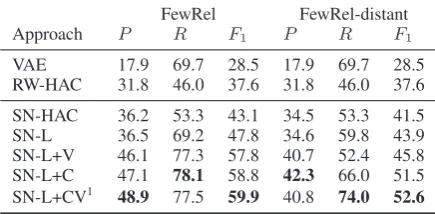
Table 1: Precision, recall and F1 results (%) for differ-ent models. The first two models are baselines. The next five models are different variants of our model.
ered up with virtual adversarial training.
Experimental Result Analysis. Table1shows the experimental results, from which we can ob-serve that:
(1) RSN models outperform all baseline models on precision, recall, and F1-score, among which Weakly-supervised RSN (SN-L+CV) achieves state-of-the-art performances. This indicates that RSN is capable of understanding new relations’ semantic meanings within sentences.
(2) Supervised and distantly-supervised rela-tional representations improve clustering perfor-mances. Compared with RW-HAC, SN-HAC achieves better clustering results because of its supervised relational representation and similar-ity metric. Specifically, unsupervised baselines mainly use sparse one-hot features. RW-HAC uses word embeddings, but integrates them in a rule-based way. In contrast, RSN uses distributed fea-ture representations, and can optimize information integration process according to supervision.
(3) Louvain outperforms HAC for clustering with RSN, comparing SN-HAC with SN-L. One explanation is that our model does not put addi-tional constraints on the prior distribution of rela-tional vectors, and therefore the relation clusters might have odd shapes in violation of HAC’s as-sumption. Moreover, when representations are not distinguishable enough, forcing HAC to find fine-grained clusters may harm recall while contribut-ing minimally to precision. In practice, we do ob-serve that the number of relations SN-L extracts is constantly less than the true number16.
(4) Both SN-L+V and SN-L+C improve the performance of supervised or distantly-supervised
1
Here for FewRel-distant we use Equation 10 rather than Equation 9 as loss, which corresponds to Distantly-supervised RSN, and this brings a minor improvement onF1
(a) RSN (b) Semi-supervised RSN (c) Supervised CNN
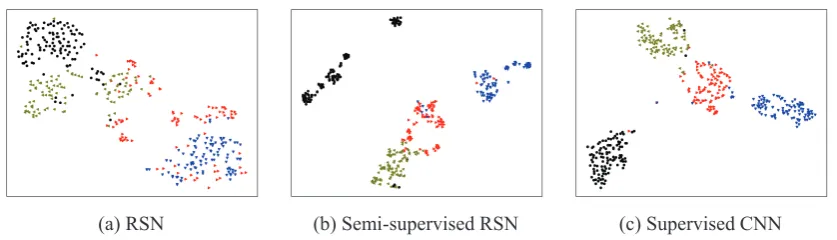
Figure 4: The t-SNE visualization of the output vectors of CNN modules in our (a) OpenRE model RSN, (b) Semi-supervised RSN facilitated by unlabeled novel-relation data and in (c) a classical RE baseline trained with labeled novel-relation data. All figures visualize the clustering result for402instances of4novel relations.
40 48 56 64
Number of Pre-defined Training Relations 40.0
42.5 45.0 47.5 50.0 52.5 55.0 57.5 60.0
F1 Score
SN-L+CV SN-L+V SN-L+C SN-L
Figure 5: The clustering results with different numbers of pre-defined training relations.
RSN by further utilizing unsupervised corpora. Both semi-supervised approaches bring significant improvements forF1scores by increasing the pre-cision and recall, and combining both can further increase theF1score.
(5) One interesting observation is that SN-L+V does not outperform SN-L so much on FewRel-distant. This is probably because VAT on the noisy data might amplify the noise. In further exper-iments, we perform VAT only on unlabeled set and observe improvements on F1, with SN-L+V from45.8%to49.2%and SN-L+CV from52.0%
to52.6%, which proves this conjecture.
4.4 The Influence of Pre-defined Relation Diversity on Generalizability
In this subsection, we mainly focus on analyzing the influence of pre-defined relation diversity, i.e., the number of relations in the labeled train set. To study this influence, we use FewRel for evaluation and change the number of relations in the labeled train set from40to64while fixing the total
num-ber of labeled instances to25,000, and report the clustering results in Figure5.
Several conclusions can be drawn according to Figure 5. Firstly, a rich variety of labeled rela-tions do improve the performance of our models, especially RSN. The models trained on 64 rela-tions perform better than those trained on40 rela-tions constantly. Secondly, while the performance of supervised RSN is very sensitive to pre-defined relation diversity, its semi-supervised counterparts suffer much less from the relation number limit. This phenomenon suggests that Semi-supervised RSNs succeed in learning from unlabeled novel-relation data and are more generalizable to novel relations.
4.5 Relational Knowledge Representation Visualization
To intuitively evaluate the knowledge transfer ef-fects of RSN and Semi-supervised RSN, we vi-sualize their relational knowledge representation spaces in the last layer of CNN encoders with t-SNE(Maaten and Hinton,2008) in Figure4. We also compare with a supervised CNN trained on
9,600labeled instances of novel relations, which suggests the optimal relational knowledge repre-sentation. In each figure, we plot402relation in-stances of4randomly-chosen relation types in the test set, and points are colored according to their ground-truth labels.
relational knowledge representation ability with supervised CNN.
5 Conclusions and Future Work
In this paper, we propose a new model Rela-tional Siamese Network (RSN) for OpenRE. Dif-ferent from conventional unsupervised models, our model learns to measure relational similarity from supervised/distantly-supervised data of pre-defined relations, as well as unsupervised data of novel relations. There are mainly two innovative points in our model. First, we propose to transfer relational similarity knowledge with RSN struc-ture. To the best of our knowledge, we are the first to propose knowledge transfer for OpenRE. Sec-ond, we propose Semi/Distantly-supervised RSN, to further perform semi-supervised and distantly-supervised transfer learning. Experiments show that our models significantly surpass conventional OpenRE models and achieve new state-of-the-art performance.
For future research, we plan to explore the following directions: (1) Besides CNN, there are some other popular sentence encoder struc-tures like piecewise convolutional neural network (PCNN) and Long Short-Term Memory (LSTM) for RE. In the future, we can try different sentence encoders in our model. (2) As mentioned above, our model has the potential ability to discover the hierarchical structure of relations. In the future, we will try to explore this application with addi-tional experiments.
6 Acknowledgement
This work is supported by the National Key Re-search and Development Program of China (No. 2018YFB1004503) and the National Natural Sci-ence Foundation of China (NSFC No. 61572273, 61661146007). Ruidong Wu is also supported by Tsinghua University Initiative Scientific Research Program.
References
Amit Bagga and Breck Baldwin. 1998. Algorithms for scoring coreference chains. In Proceedings of the First Iternational Conference on Language Re-sources and Evaluation Workshop on Linguistics Coreference.
Eric Bair. 2013. Semi-supervised clustering meth-ods. Wiley Interdisciplinary Reviews: Computa-tional Statistics.
Michele Banko, Michael J Cafarella, Stephen Soder-land, Matthew Broadhead, and Oren Etzioni. 2007. Open information extraction from the web. In Pro-ceedings of IJCAI.
Michele Banko and Oren Etzioni. 2008. The tradeoffs between open and traditional relation extraction. In Proceedings of ACL-HLT.
Vincent D Blondel, Jean Loup Guillaume, Renaud Lambiotte, and Etienne Lefebvre. 2008. Fast un-folding of communities in large networks. Journal of Statistical Mechanics.
Olivier Chapelle and Alexander Zien. 2005. Semi-supervised classification by low density separation. InProceedings of AISTATS.
Lei Cui, Furu Wei, and Ming Zhou. 2018. Neural open information extraction.arXiv.
Hady Elsahar, Elena Demidova, Simon Gottschalk, Christophe Gravier, and Frederique Laforest. 2017. Unsupervised open relation extraction. In Proceed-ings of European Semantic Web Conference.
Yves Grandvalet and Yoshua Bengio. 2005. Semi-supervised learning by entropy minimization. In Proceedings of NIPS.
Xu Han, Hao Zhu, Pengfei Yu, Ziyun Wang, Yuan Yao, Zhiyuan Liu, and Maosong Sun. 2018. Fewrel: A large-scale supervised few-shot relation classifica-tion dataset with state-of-the-art evaluaclassifica-tion. In Pro-ceedings of EMNLP.
Meng Qu Xiang Ren Hongtao Lin, Jun Yan. 2019. Learning dual retrieval module for semi-supervised relation extraction. InProceedings of WWW.
Shengbin Jia, Yang Xiang, and Xiaojun Chen. 2018. Supervised neural models revitalize the open rela-tion extracrela-tion. arXiv.
Diederik P Kingma and Jimmy Ba. 2014. Adam: A method for stochastic optimization.arXiv.
Gregory Koch, Richard Zemel, and Ruslan Salakhut-dinov. 2015. Siamese neural networks for one-shot image recognition. InProceedings of ICML Deep Learning Workshop, volume 2.
Dekang Lin and Patrick Pantel. 2001. Dirt - discovery of inference rules from text. InProceedings of KDD.
Yankai Lin, Shiqi Shen, Zhiyuan Liu, Huanbo Luan, and Maosong Sun. 2016. Neural relation extraction with selective attention over instances. In Proceed-ings of ACL.
Laurens van der Maaten and Geoffrey Hinton. 2008. Visualizing data using t-sne. JMLRJournal of Sta-tistical Mechanics.
Diego Marcheggiani and Ivan Titov. 2016. Discrete-state variational autoencoders for joint discovery and factorization of relations. Transactions of ACL.
Mike Mintz, Steven Bills, Rion Snow, and Daniel Ju-rafsky. 2009. Distant supervision for relation extrac-tion without labeled data. InProceedings of ACL-IJCNLP.
Takeru Miyato, Andrew M Dai, and Ian Goodfel-low. 2016. Adversarial training methods for semi-supervised text classification. arXiv.
Sachin Pawar, Girish K. Palshikar, and Pushpak Bhat-tacharyya. 2017. Relation extraction : A survey. arXiv.
Jeffrey Pennington, Richard Socher, and Christoper Manning. 2014. Glove: Global vectors for word representation. InProceedings of EMNLP.
Gabriel Stanovsky, Julian Michael, Luke Zettlemoyer, and Ido Dagan. 2018. Supervised open information extraction. InProceedings of NAACL.
Joe H Ward Jr. 1963. Hierarchical grouping to opti-mize an objective function. Journal of the American Statistical Association.
Limin Yao, Aria Haghighi, Sebastian Riedel, and An-drew Mccallum. 2011. Structured relation discov-ery using generative models. In Proceedings of EMNLP.
Limin Yao, Sebastian Riedel, and Andrew McCallum. 2012. Unsupervised relation discovery with sense disambiguation. InProceedings of ACL.
Dian Yu, Lifu Huang, and Heng Ji. 2017. Open re-lation extraction and grounding. InProceedings of IJCNLP.
Jianbo Yuan, Han Guo, Zhiwei Jin, Hongxia Jin, Xian-chao Zhang, and Jiebo Luo. 2017. One-shot learn-ing for fine-grained relation extraction via convolu-tional siamese neural network. In Proceedings of BigData.