Analysis and Prediction of Unalignable Words in Parallel Text
Frances Yung Kevin Duh
Nara Institute of Science and Technology 8916-5 Takayama, Ikoma, Nara, 630-0192 Japan pikyufrances-y|kevinduh|[email protected]
Yuji Matsumoto
Abstract
Professional human translators usually do not employ the concept of word align-ments, producing translations ‘sense-for-sense’ instead of ‘word-for-word’. This suggests that unalignable words may be prevalent in the parallel text used for ma-chine translation (MT). We analyze this phenomenon in-depth for Chinese-English translation. We further propose a sim-ple and effective method to improve au-tomatic word alignment by pre-removing unalignable words, and show improve-ments on hierarchical MT systems in both translation directions.
1 Motivation
It is generally acknowledged that absolute equiva-lence between two languages is impossible, since concept lexicalization varies across languages. Major translation theories thus argue that texts should be translated ‘sense-for-sense’ instead of
‘word-for-word’(Nida, 1964). This suggests that unalignable words may be an issue for the parallel text used to train current statistical machine trans-lation (SMT) systems. Although existing auto-matic word alignment methods have some mech-anism to handle the lack of exact word-for-word alignment (e.g. null probabilities, fertility in the IBM models (Brown et al., 1993)), they may be too coarse-grained to model the ’sense-for-sense’ translations created by professional human trans-lators.
For example, the Chinese term ‘tai-yang’ liter-ally means ‘sun’, yet the concept it represents is equivalent to the English term‘the sun’. Since the concept of a definite article is not incorporated in the morphology of ‘tai yang’, the added ‘the’is not aligned to any Chinese word. Yet in another context like’the man’,‘the’can be the translation
of the Chinese demonstrative pronoun‘na’, liter-ally means‘that’. A potential misunderstanding is that unalignable words are simply function words; but from the above example, we see that whether a word is alignable depends very much on the con-cept and the linguistic context.
As the quantity and quality of professionally-created parallel text increase, we believe there is a need to examine the question of unalignable words in-depth. Our goal is to gain a better understand-ing of what makes a fluent human translation and use this insight to build better word aligners and MT systems. Our contributions are two-fold: 1) We analyze 13000 sentences of manually word-aligned Chinese-English parallel text, quantifying the characteristics of unalignable words.
2) We propose a simple and effective way to im-prove automatic word alignment, based on pre-dicting unalignable words and temporarily remov-ing them durremov-ing the alignment trainremov-ing procedure.
2 Analysis of Unalignable Words
Our manually-aligned data, which we call OR-ACLE data, is a Chinese-to-English corpus re-leased by the LDC (Li et al., 2010)1. It
con-sists of∼13000 Chinese sentences fromnewsand
blogdomains and their English translation . En-glish words are manually aligned with the Chinese characters. Characters without an exact counter-part are annotated with categories that state the functions of the words. These characters are ei-ther aligned to ‘NULL’, or attached to their depen-dency heads, if any, and aligned together to form a multi-word alignment. For example,‘the’is an-notated as [DET], for ‘determiner’, and aligned to
‘tai-yang’together with‘sun’.
In this work, any English word or Chinese char-acter without an exact counterpart are called un-alignable words, since they are not core to the
1LDC2012T16, LDC2012T20 and LDC2012T24
word unalignable core
types tokens tokens
core or 3581 146,693 562,801
unalignable (12%) (17%) (66%)
always 25320 / 147,373
core (88%) (17%)
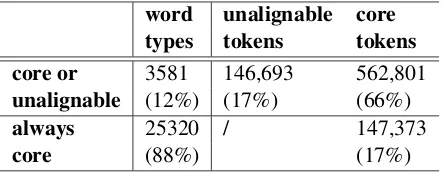
Table 1: Number of core and unalignable words in hand aligned ORACLE corpus
multi-word alignment. All other English words or Chinese characters are referred to ascore words.
2.1 What kind of words are unalignable?
Analyzing the hand aligned corpus, we find that words annotated as unalignable do not come from a distinct list. Table 1 reveals that 88% of the word types are unambiguously core words. Yet these word types, including singletons, account for only 17% of the word tokens. On the other hand, another 17% of the total word tokens are annotated as unalignable. So, most word types are possibly unalignable but only in a small portion of their occurrence, such as the following examples:
(1a) Chi: yi ge di fang
one (measure word) place
Eng: one place
(1b) Chi: ge ren
personal Eng: personal
(2a) Chi: ming tian zhong wu
(tomorrow) (midday)
Eng: tomorrow at midday
(2b) Chi: zai jia
at/in/on home
Eng: at home
In example (1a),‘ge’is a measure word that is exclusive in Chinese, but in (1b), it is part of the multiword unit’ge-ren’for’personal’. Similarly, prepositions, such as‘at’, can either be omitted or translated depending on context.
Nonetheless, unalignable words are by no means evenly distributed among word types. Ta-ble 2 shows that the top 100 most frequent un-alignable word types already covers 78% and 94% of all Chinese and English unalignable instances, respectively. Word type is thus an important clue.
Intuitively, words with POS defined only in one of the languages are likely to be unalignable. To examine this, we automatically tagged the ORA-CLE data using the Standford Tagger (Toutanova
Most frequent Token count
unalignableword types Chinese English
Top 50 34,987 83,905
(68%) (88%)
Top 100 40,121 89,609
(78%) (94%)
Table 2: Count ofunalignablewords by types
et al., 2003). We find that the unalignable words include all POS categories of either language, though indeed some POS are more frequent. Ta-ble 3 lists the top 5 POS categories that most un-alignable words belong to and the percentage they are annotated as unalignable. Some POS cate-gories like DEG are mostly unalignable regardless of context, but other POS tags such as DT and IN depend on context.
Chi. No. and % of Eng. No. and % of
POS unalign. POS unalign.
DEG 7411(97%) DT 27715 (75%)
NN 6138 (4%) IN 19303 (47%)
AD 6068 (17%) PRP 5780 (56%)
DEC 5572 (97%) TO 5407 (62%)
[image:2.595.72.293.62.148.2]VV 4950 (6%) CC 4145 (36%)
Table 3: Top 5 POS categories of Chinese and En-glish unalignable words
Note also that many Chinese unalignable words are nouns (NN) and verbs (VV). Clearly we cannot indiscriminately consider all nouns as unalignable. Some examples of unalignable content words in Chinese are:
(3) Chi: can jia hui jian huo dong
participate meeting activity Eng: participate in the meeting
(4) Chi: hui yi de yuan man ju xing
meeting ’s successful take place Eng: success of the meeting
English verbs and adjectives are often nomi-nalized to abstract nouns (such as’meeting’from
’meet’, or ’success’ from ’succeed’), but such derivation is rare in Chinese morphology. Since POS is not morphologically marked in Chinese,
’meeting’and’meet’are the same word. To reduce the processing ambiguity and produce more nat-ural translation, extra content words are added to mark the nominalization of abstract concepts. For example,‘hui jian’is originally‘to meet’. Adding
[image:2.595.305.516.62.147.2](example 3), similar to the the addition of ‘ju sing’(take place) to the adjective‘yuan man’ (ex-ample 4). These unalignable words are not lexi-cally dependent but are inferred from the context, and thus do not align to any source words.
To summarize, a small number of word types cover 17% of word tokens that are unalignable, but whether these words are unalignable depends significantly on context. Although there is no list of‘always unalignable’words types or POS cat-egories, our analysis shows there are regularities that may be exploited by an automatic classifier.
3 Improved Automatic Word Alignment
We first propose a classifier for predicting whether a word is unalignable. Let(eJ
1, f1K) be a pair of sentence with length J and K. For each word in (eJ
1, f1K) that belongs to a predefined list2 of po-tentially unalignable words, we run a binary clas-sifier. A separate classifier is built for each word type in the list, and an additional classifier for all the remaining words in each language.
We train an SVM classifier based on the fol-lowing features: Local context: Unigrams and POS in window sizes of 1, 3, 5, 7 around the word in question. Top token-POS pairs: This feature is defined by whether the token in ques-tion and its POS tag is within the top n frequent token-POS pairs annotated as unalignable like in Tables 2 and 3. Four features are defined withn= 10,30,50,100. Since the top frequent unalignable words cover most of the counts as shown in the previous analysis, being in the topnlist is a strong positive features. Number of likely unalignable words per sentence: We hypothesize that the translator will not add too many tokens to the translation and delete too many from the source sentence. In the ORACLE data, 68% sentences have more than 2 unalignable words. We approx-imate the number of likely unalignable words in the sentence by counting the number of words within the top 100 token-POS pairs annotated as unalignable. Sentence length and ratio: Longer sentences are more likely to contain unalignable words than shorter sentences. Also sentence ra-tios that deviate significantly from the mean are likely to contain unalignable words. Presence of alignment candidate: This is a negative feature defined by whether there is an alignment
candi-2We define the list as the top 100 word types with the highest count of unalignable words per language according to the hand annotated data.
date in the target sentence for the source word in question, or vice versa. The candidates are ex-tracted from the top n frequent words aligned to a particular word according to the manual align-ments of the ORACLE data. Five features are de-fined withn= 5,10,20,50,100and one ’without limit’, such that a more possible candidate will be detected by more features.
Next, we propose a simple yet effective mod-ification to the word alignment training pipeline:
1. Predict unalignable words by the classifier 2. Remove these words from the training corpus 3. Train word alignment model (e.g. GIZA++)3
4. Combine the word alignments in both direc-tions with heuristics (grow-diag-final-and) 5. Restore unaligned words to original position 6. Continue with rule extraction and the rest of
the MT pipeline.
The idea is to reduce the difficulty for the word alignment model by removing unaligned words.
4 End-to-End Translation Experiments
In our experiments, we first show that removing manually-annotated unaligned words in ORACLE data leads to improvements in MT of both trans-lation directions. Next, we show how a classifier trained on ORACLE data can be used to improve MT in another large-scale un-annotated dataset.4
4.1 Experiments on ORACLE data
We first performed an ORACLE experiment us-ing gold standard unaligned word labels. Follow-ing the trainFollow-ing pipeline in Section 3, we removed gold unalignable words before running GIZA++ and restore them afterwards. 90% of the data is used for alignment and MT training, while 10% of the data is reserved for testing.
The upper half of Table 4 list the alignment precision, recall and F1 of the resulting align-ments, and quality of the final MT outputs. Base-line is the standard MT training pipeline with-out removal of unaligned words. Our Proposed
approach performs better in alignment, phrase-based (PBMT) and hierarchical (Hiero) systems. The results, evaluated by BLEU, METEOR and TER, support our hypothesis that removing gold unalignable words helps improve word alignment and the resulting SMT.
Align PBMT Hiero
acc. C-E E-C C-E E-C
ORACLE P .711 B 11.4 17.4 10.3 15.8
Baseline R .488 T 70.9 69.0 75.9 72.3
F1.579 M 21.8 23.9 21.08 23.7
ORACLE P .802 B 11.8+18.3+ 11.0+17.2+
Proposed R .509 T 71.4−65.7+ 74.7+68.7+ (gold) F1.623 M 22.1+24.1+ 22.0+24.0+
REAL B 18.2 18.5 17.0 17.2
Baseline T 63.4 67.2 68.0 71.4
M 22.9 24.6 22.9 24.8
REAL B 18.6 18.5 17.6+18.1+
Proposed T 63.8−66.5+ 67.6 69.7+
(predict) M 23.2+24.5 23.4+24.7
Table 4: MT results of ORACLE and REAL ex-periments. Highest score per metric is bolded.
{+/−}indicates statistically significant improve-ment/degradation,p < 0.05. (P: precision; R: re-call; B: BLEU; M: METEOR; T:TER)
For comparison, a naive classifier that labels all top-30 token-POS combinations as unalignable performs poorly as expected (PBMT BLEU: 9.87 in C-E direction). We also evaluated our proposed classifier on this task: the accuracy is 92% and it achieves BLEU of 11.55 for PBMT and 10.84 for Hiero in C-E direction, which is between the re-sults of gold-unalign and baseline.
4.2 Experiments on large-scale REAL data
We next performed a more realistic experiment: the classifier trained on ORACLE data is used to automatically label a large data, which is then used to train a MT system. This REAL data consists of parallel text from the NIST OpenMT2008.5 MT
experiments are performed in both directions. The lower half of Table 4 shows the perfor-mance of the resulting MT systems. We observe that our proposed approach is still able to improve over the baseline. In particular, Hiero achieved statistical significant improvements in BLEU and METEOR. 6 Comparing to the results of PBMT,
this suggests our method may be most effective in improving systems where rule extraction is
sen-5We use the standard MT08 test sets; the training data includes LDC2004T08, 2005E47, 2005T06, 2007T23, 2008T06, 2008T08, 2008T18, 2009T02, 2009T06, 2009T15, and 2010T03 (34M English words and 1.1M sentences). Since we do not have access to all OpenMT data, e.g. FBIS, our results may not be directly comparable to other systems in the evaluation.
6Interestingly, PBMT did better than Hiero in this setup.
Chinese English lexical translation
word Baseline only Propose only
xie (bring) him bringing
xing (form) and model
[image:4.595.72.301.60.258.2]dan (but) it, the, they yet, nevertheless pa (scare) that, are, be fears, worried Table 5: Examples of translations exclusively found in the top15lexical translation.
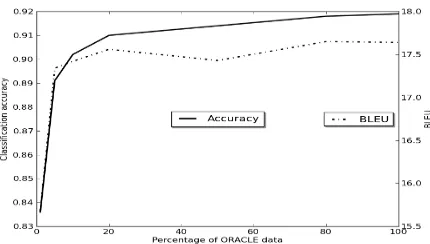
Figure 1: Classifier accuracy and MT results V.S. proportion of ORACLE data
sitive to the underlying alignments, such as Hi-ero and Syntax-based MT. Table 5 shows the lex-ical translations for some rare Chinese words: the baseline tends to incorrectly align these to func-tion words (garbage collecfunc-tion), while the pro-posed method’s translations are more reasonable.
To evaluate how much annotation is needed for the classifier, we repeat experiments using differ-ent proportions of the ORACLE data. Figure 1 shows training by 20% of the data (2600 sents.) already leads to significant improvements (p < 0.05), which is a reasonable annotation effort.
5 Conclusion
[image:4.595.318.533.194.316.2]References
Peter F. Brown, Stephen A. Della Pietra, Vincent J. Della Pietra, and Robert L. Mercer. 1993. The mathematics of statistical machine translation: Parameter estimation. Computational Linguistics, 19(2).
Chih-Chung Chang and Chih-Jen Lin. 2011. Lib-svm : a library for support vector machines. ACM Transactions on Intelligent Systems and Technology, 2(27).
Tagyoung Chung and Daniel Gildea. 2010. Effects of empty categories on machine translation. Pro-ceedings of the Conference on Empirical Methods on Natural Language Processing.
Victoria Fossum, Kevin Knight, and Steven Abney. 2008. Using syntax to improve word alignment pre-cision for syntax-based machine translation. Pro-ceedings of the Workshop on Statistical Machine Translation.
Philipp Koehn, Hieu Hoang, Alexandra Birch, Chris Callison-Burch, Marcello Federico, Nicola Bertoldi, Brooke Cowan, Wade Shen, Christine Moran, Richard Zens, Chris Dyer, Ondrej Bojar, Alexan-dra Constantin, and Evan Herbst. 2007. Moses: Open source toolkit for statistical machine transla-tion. Proceedings of the Annual Meeting of the As-sociation for Computational Linguistics.
Xuansong Li, Niyu Ge, Stephen Grimes, Stephanie M. Strassel, and Kazuaki Maeda. 2010. Enriching word alignment with linguistic tags. Proceedings of International Conference on Language Resources and Evaluation.
Toshiaki Nakazawa and Sado Kurohashi. 2012. Alignment by bilingual generation and monolingual derivation.Proceedings of the International Confer-ence on Computational Linguistics.
Eugene A Nida. 1964. Toward a Science of Translat-ing: with Special Reference to Principles and Pro-cedures Involved in Bible Translating. BRILL. Hendra Setiawan, Chris Dyer, and Philip Resnik. 2010.
Discriminative word alignment with a function word reordering model. Proceedings of the Conference on Empirical Methods on Natural Language Process-ing.
Kristina Toutanova, Dan Klein, Christopher Manning, and Yoram Singer. 2003. Feature-rich part-of-speech tagging with a cyclic dependency network.