Abstract—In this research a supplier evaluation framework
based on Balanced Scorecard (BSC) with integrated Corporate Social Responsibility (CSR) has been developed from literature review of 76 related papers. It was found that quality, delivery, and cost are the most significant criteria. Moreover, some criteria are changed according to shorten product life cycle, technologies, improvement of service, evolution of production system, and emergence of supply chain management (SCM). Based on BSC and CSR, 5 perspectives namely financial, customer, internal business process, learning and growth, and corporate social responsibility are proposed for categorizing supplier selection criteria. Measures for each criterion are also collected for decision makers. This framework is presented in the form of a table in which both criteria and measures are contained, this would be facilitated to use. Moreover, its BSC basis verifies suitability of a supplier with the corporate strategies. As a consequence, evaluating supplier using the proposed framework can be helpful for decision makers to qualify the most eligible supplier who can meet qualifications and buyer’s strategies as well as environmental and social responsibility issues.
Index Terms—Balanced Scorecard (BSC), Corporate Social
Responsibility (CSR), Strategic Supplier Selection, Supplier Evaluation, Supplier Selection Criteria
I.
INTRODUCTION
Supplier selection and evaluation is one of the most critical
activities in purchasing or procurement process [1]. This
evaluation process consists of 4 stages i.e., defining
objective, formulating the selection criteria, qualifying the
suitable alternatives, and final selection. To qualify the
prospective suppliers, the effective defining of selection
criteria is necessary [2],[3]. Beyond the high significance on
the product cost and partners relationship, it has considerable
impacts on the buyer’s corporate competencies [4],[5].
The early research by Dickson (1966) conducted a
questionnaire and sent to 273 purchasing agents and
managers selected from the list of the National Association of
Purchasing Managers, cover USA and Canada. There are 170
mails regarding the 23 important criteria that were ranked
Manuscript received December 30, 2008.
W. Thanaraksakul is a Graduate Student of Industrial Engineering Department, Faculty of Engineering, Thammasat University Rangsit Campus, Klong Luang, Pathum Thani 12120, Thailand (corresponding author; e-mail: [email protected], [email protected]).
B. Phruksaphanrat is an Assistant Professor of Industrial Engineering Department, Faculty of Engineering, Thammasat University Rangsit Campus, Klong Luang, Pathum Thani 12120, Thailand (e-mail: [email protected]).
with respect to the observation. He found that quality,
delivery, performance history, and warranty policies are the
most critical criteria for 1960s [6]. Afterward, there are many
of researchers have conducted their research in this domain.
In Weber
et al.
(1991) [2], based on 74 reviewed papers they
found that price, delivery, production capacity, and location
are the most often treated criteria. In other researches, many
of them found that the cost, quality, and delivery are the most
important criteria [2],[6]-[11]. Some paper noted that the
choice of criteria may differ as a result of one culture to
another [12]. However, it has been found that the 23 criteria
presented in [6] still cover the majority of those presented in
the literature until nowadays though some of them have been
changed according to time [2],[13],[14].
The Balanced Scorecard (BSC) model was presented by
Robert S. Kaplan and David P. Norton since 1992. It has been
proposed to be a strategic approach and an organizational
performance evaluation which can be used for strategy and
policy implementation [15]. It is included by 4 perspectives
i.e., financial, customer, internal business process, and
learning and growth. Nevertheless, some authors recommend
to charge the Corporate Social Responsibility (CSR)
perspective, in term of environmental viewpoint, in a supplier
selection process as a result of recent massive emergence of
global warming and social responsibility issues [16]-[18].
To obtain the supplier whose strategies and qualifications
harmonize with the buyer’s objectives, an intensive study of
criteria is needed. So, the 76 existing research papers are
studied and compared. Next, BSC and CSR are used to create
a proposed framework of a supplier evaluation for
categorizing supplier selection criteria.
In this research, the 23 criteria in [6] are served as a
principal for categorizing criteria. Some criteria those are not
exactly match with the principal but hereabout relevant
would be adopted into implicated categories and proper
renamed e.g., formerly the communication systems criterion
was renamed to information technology and communication
systems likes the attitude criterion was changed as attitude
and strategic fit and so on. Other criteria which could not be
classified in any category of the principal will be added into
the principal as new criteria namely, safety awareness,
environmental and social responsibility, economical factors,
terrorism risk, domestic political stability, quality system,
innovation and R&D, customer relationship, product
reliability, and cultural congruence. For this research, there
are 76 relevant research papers containing “Selection
criteria”, “Supplier evaluation”, “Supplier selection”, and
“Vendor selection” in their titles or keywords.
Supplier Evaluation Framework Based on
Balanced Scorecard with Integrated
Corporate Social Responsibility Perspective
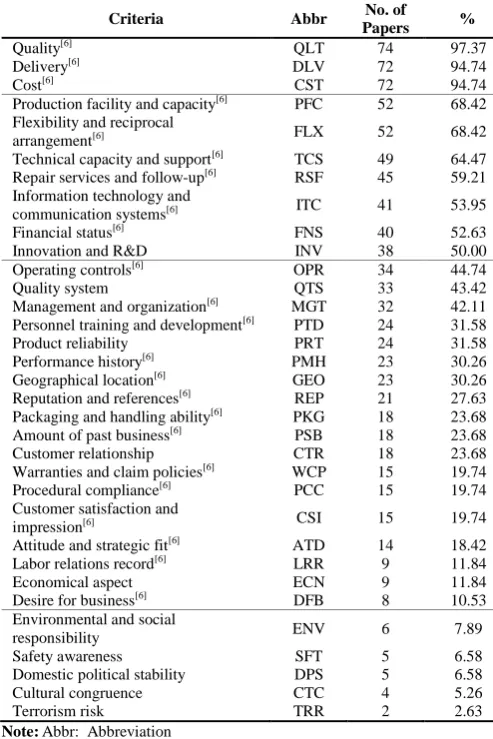
Table I Rank of supplier selection criteria
Criteria Abbr No. of
Papers %
Quality[6] QLT 74 97.37
Delivery[6] DLV 72 94.74
Cost[6] CST 72 94.74
Production facility and capacity[6] PFC 52 68.42
Flexibility and reciprocal
arrangement[6] FLX 52 68.42
Technical capacity and support[6] TCS 49 64.47
Repair services and follow-up[6] RSF 45 59.21
Information technology and
communication systems[6] ITC 41 53.95
Financial status[6] FNS 40 52.63
Innovation and R&D INV 38 50.00
Operating controls[6] OPR 34 44.74
Quality system QTS 33 43.42
Management and organization[6] MGT 32 42.11
Personnel training and development[6] PTD 24 31.58
Product reliability PRT 24 31.58
Performance history[6] PMH 23 30.26
Geographical location[6] GEO 23 30.26
Reputation and references[6] REP 21 27.63
Packaging and handling ability[6] PKG 18 23.68
Amount of past business[6] PSB 18 23.68
Customer relationship CTR 18 23.68
Warranties and claim policies[6] WCP 15 19.74
Procedural compliance[6] PCC 15 19.74
Customer satisfaction and
impression[6] CSI 15 19.74
Attitude and strategic fit[6] ATD 14 18.42
Labor relations record[6] LRR 9 11.84
Economical aspect ECN 9 11.84
Desire for business[6] DFB 8 10.53
Environmental and social
responsibility ENV 6 7.89
Safety awareness SFT 5 6.58
Domestic political stability DPS 5 6.58
Cultural congruence CTC 4 5.26
Terrorism risk TRR 2 2.63
Note: Abbr: Abbreviation
No. of Papers: Number of papers that appeared the criterion %: Counted fractions of the criterion to the overall in percentages
[6]: The criteria relating to those 23 criteria which appeared in [6]
II.
SUPPLIER SELECTION CRITERIA
The papers related to supplier selection criteria were
conducted in various contexts. Some were studied in global
supplier selection context [19]-[21]. Meanwhile, some were
conducted under advanced technology manufacturers
[22],[23], developing country [9],[24], supply chain
management system [5],[11],[25]-[29], buyer-supplier
relationship and integration [30]-[36], and other conditions
so far [1],[37]-[41]. These contexts are different in both
criteria and their priorities. The basic criteria are quality,
delivery, cost, systems, processes, flexibility, and service.
Risk factors including domestic political stability,
economical aspects, and terrorism risk should be also
included [19],[20]. In the developing country scene, it is
necessary to focus on product reliability and the supplier’s
capacity in both technical and production [9],[24]. Whereas
the
advanced
technology
manufacturing
increases
emphasizing on supplier’s flexibility and capability in the
field of R&D [22],[23]. Moreover, there are many of other
contexts that affect the selection of criteria e.g., type of
industry, corporate strategy, etc. Another approach of study is
an empirical study, most of them usually consider in
quantitative criteria based on operations research and
computational techniques for finding out the numerical
solutions that prioritize the selection criteria such as Activity
Based Costing
Approach (ABC) [42],[43], Linear
Programming (LP) [7],[29],[44], Linear Mixed Integer
Programming (LMIP) [30],[45], Fuzzy Multiple Objective
Linear Programming (FMOLP) [46],[47], and Genetic
Algorithm (GA) [48] as well. The approaches that applied to
determine the qualitative criteria namely, Analytic Hierarchy
Process (AHP) [22],[35],[49]-[56], Fuzzy-AHP (FAHP)
[26],[48],[57] Analytic Network Process (ANP) [4],[58],
weights assessment approach [59], and Multi-Attribute
Utility Theory (MAUT) [60],[61] are used in supplier
evaluation process to figure out the best alternative.
In this research, 76 relevant papers were reviewed and
summarized as shown in Table I. It is shown the rank of
selected criteria by the number of paper counted in
percentages. It indicates that the most considered criteria in
the high level ranking with the percentages over 90 are
quality (QLT), delivery (DLV), and cost (CST). This result is
similar to existing works [2], [6]-[11]. The medium level
ranking range from 50 to 70 percentages contains production
facility and capacity (PFC), flexibility and reciprocal
arrangement (FLX), technical capacity and support (TCS),
repair services and follow-up (RSF), information technology
and communication systems (ITC), financial status (FNS),
and innovation and R&D (INV), respectively. The criteria in
which fall between 10 and 50 percentages are considered as
the low level ranking criteria. They are operating control
(OPR), quality system (QTS), management and organization
(MGT), personnel training and development (PTD), product
reliability (PRT), performance history (PMH), geological
location (GEO), reputation and reference (REP), packaging
and handling ability (PKG), amount of past business (PSB),
customer relationship (CTR), warranties and claim policies
(WCP), procedural compliance (PCC), customer satisfaction
and impression (CSI), attitude and strategic fit (ATD), labor
relations record (LRR), economical aspect (ECN), and desire
for business (DFB). The remainders of those criteria are 5
criteria that their percentages are less than 10. These are
environmental and social responsibility (ENV), safety
awareness (SFT), domestic political stability (DPS), cultural
congruence (CTC), and terrorism risk (TRR), resulting from
the emersion of new issues i.e., global warming, safety, CSR,
and stability.
Table II Comparison of selection criteria
Abbr [6] [2] New
Rank Abbr [6] [2]
New Rank
QLT 1 3 1 REP 11 8 18
DLV 2 2 2 PKG 18 13 19
CST 6 1 3 PSB 21 22 20
PFC 5 4 4 CTR - - 21
FLX 23 19 5 WCP 4 23 22
TCS 7 6 6 PCC 9 16 23
RSF 15 11 7 CSI 17 20 24
ITC 10 18 8 ATD 16 12 25
FNS 8 9 9 LRR 19 17 26
INV - - 10 ECN - - 27
OPR 14 14 11 DFB 12 21 28
QTS - - 12 ENV - - 29
MGT 13 7 13 SFT - - 30
PTD 22 15 14 DPS - - 31
PRT - - 15 CTC - - 32
PMH 3 10 16 TRR - - 33
GEO 20 5 17
Note: Abbr : Abbreviation
[2] : Criteria ranking from [2]
[image:2.595.306.547.580.777.2]Afterward, all of criteria were compared with two
distinguish papers of Dickson (1966) and Weber
et al.
(1991). Reference [6] is the pioneer paper on supplier
selection. Whereas in [2], the 74 related papers are classified
and investigated the change during twenty years after [6].
Both [2] and [6] also have been cited by many researchers
[5],[10],[19],[45],[46],[63]-[86].
Then, the rank from the investigation is compared with [2]
and [6] as shown in Table II. There are several remarkable
points that should be noted.
Firstly, the QLT, DLV, CST, PFC, TCS, and FNS are basic
significant criteria that have been generally used for last four
decades. Secondly, the FLX criterion has been massively
increased significant from prior, from the rank of 23
rdin [6],
19
thin [2], and 5
thin the new rank. That might resulting from
a shorten product life cycle, obsolescence
speed, change of
production system, and emergence of supply chain
management (SCM). Thirdly, increasing of customer service
and customer’s bargaining power cause the RSF criterion
more importance. In addition, ITC criterion has also
increased more meaning as a result of the IT era. Then, there
are 10 criteria that have not been taken into account before.
Those criteria can be classified into two groups. The first
ones contained the criteria which have cooperated in the other
criteria. These criteria are PRT, ECN, ENV, and SFT.
Another is the criteria that have emerged in the latter time.
There are INV, QTS, CTR, DPS, CTC, and TRR criteria. In
contrast, the 8 criteria are apparently diminished significance
on account of advanced in production and SCM together with
global quality standard equality i.e., PMH, GEO, REP, PCC,
CSI, ATD, LRR, and DFB. Anyway, there are 6 criteria,
OPR, MGT, PTD, PKG, PSB, and WCP, which have a steady
significance on supplier evaluation process for range of time.
III.
BALANCED SCORECARD AND
CORPORATE SOCIAL RESPONSIBILITY
A.
Balanced Scorecard (BSC)
The Balanced Scorecard (BSC) model was first introduced
and proposed to be a framework for performance evaluation
by Robert S. Kaplan and David P. Norton in 1992 [15],[87].
It can be used for strategy and policy implementation. The
BSC represents a translation of business strategy into set of
measures by defining long term strategy, objectives, and the
mechanism for achieving and obtaining feedback regarding
those objectives. It is composed of 4 perspectives that can be
briefly expressed as follows: [15],[88]-[90].
Financial Perspective: To indicate whether firm strategy,
implementation, and execution contribute to bottom line
improvement. The measures are profits, Return on
Investment (ROI), and Economical Value Added (EVA).
Customer Perspective: To identify the outcomes
associated with delivering differentiate value to satisfy the
source of business profit. The customer satisfaction,
customer retention, new customer acquisition, market
position, and market share are considered as measures.
Internal Business Process Perspective: To satisfy
shareholders and customers by excellence at some business
internal process. Generic measures are quality, response
time, cost, and new product to market lead time.
CSR
Financial Customer
Internal Business
Process
Learning and Growth
Fig.1 BSC with integrated CSR
Learning and Growth Perspective: To capture the ability of
resources to manage a business and adapt to change and
provide the infrastructure for achieving the objectives of the
other three perspectives. Common measures are including
employee satisfaction and information system availability.
B.
Corporate Social Responsibility (CSR)
Corporate Social Responsibility (CSR) aspects are rapidly
emerging as a substantial issue for business and management.
Legal and public pressures on the attainment of good
environmental practice are mounting [16],[17],[91].
These reasons cause some business and public sectors to
include the CSR into its consideration framework. Although
the CSR related criterion that is ENV criterion which has a
fraction of 7.89 percentages, under the low level ranking, it
cannot be disregarded to take CSR perspective into the
consideration caused by those continual increased pressures
of both conscience and legislation [17],[18].
IV.
SUPPLIER EVALUATION BASED ON
BSC WITH INTEGRATED CSR
The results from reviewing of supplier selection criteria
are extracted into BSC framework which CSR perspective is
integrated as shown in Fig.1. This proposed framework
composed of 5 perspectives which are financial, customer,
internal business process, learning and growth, and corporate
social responsibility. It is a supplier evaluation framework
based on BSC with integrated CSR. Even though significance
of CSR is lower than those 4 exists perspectives, the CSR
perspective is still necessary to be satisfied because of the
civil and legislative enforcements. The measures for each
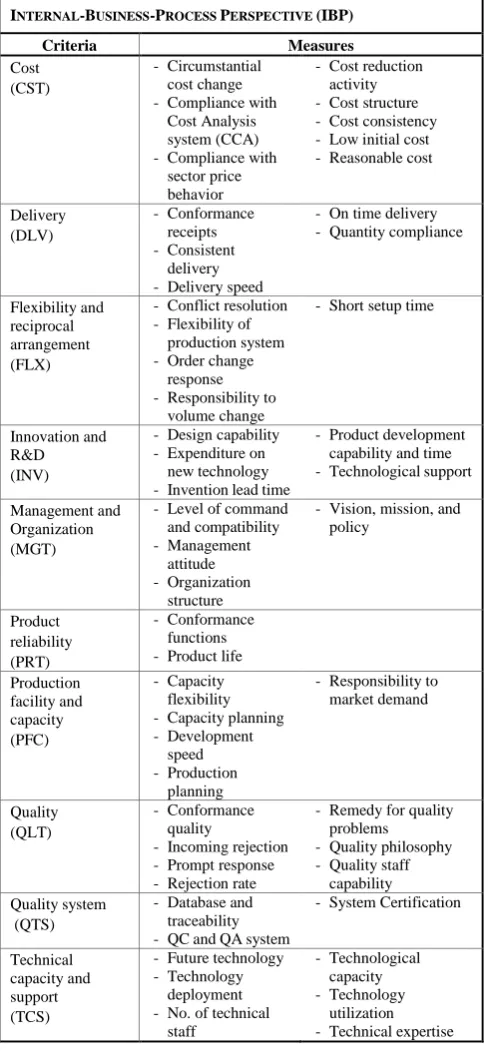
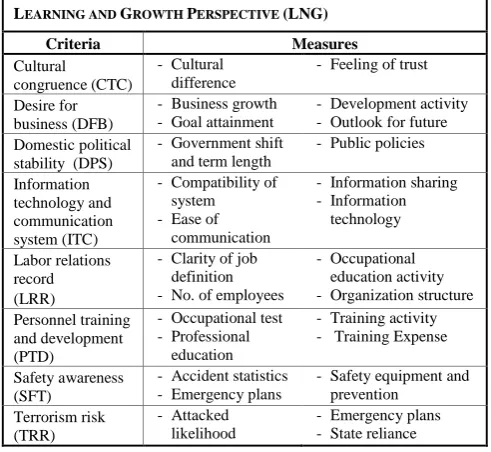
perspective can be shown as Table III, IV, V, VI, and VII in
an alphabetical order of criteria.
From observation, it was found that the internal business
process perspective contains maximum number of criteria
and all of the high level ranking criteria. However, the
medium level ranking was contributed to financial, customer,
internal business process and learning and growth
perspectives. Although the CSR perspective contains the low
level ranking, it cannot be eliminated because of expanding
realization of environmental and social responsibility aspects
as well as civil and legislative enforcements.
Table III The Proposed BSC for supplier evaluation: Financial
FINANCIAL PERSPECTIVE
Criteria Measures
Economical aspect (ECN)
- Currency
fluctuation
- Economical policies
- GDP growth
- Growth deferring
- Local price control
- Tax and custom
duties Financial status
(FNS)
- Annual profit and
growth
- Annual revenue and
growth
- Financial stability
- Fiscal outlook
[image:4.595.48.292.197.500.2]- Market share
Table IV The Proposed BSC for supplier evaluation: Customer
CUSTOMER PERSPECTIVE
Criteria Measures
Amount of past business (PSB)
- Core competency
- Customer base
- No. of customers
- Renowned
customers
Attitude and strategic fit (ATD)
- Management viewpoint - Strategic compatibility Customer relationship (CTR)
- Customer database
- CRM activities
- Customer retention
- Marketing
campaign
Customer satisfaction and impression (CSI)
- Brand royalty
- Customer reliance
- Customer feedback
- Market position
- Market share
Geographical location (GEO) - Accessibility - Information technology - Distance
- Trade barrier and
tariff Packaging and
handling ability (PKG)
- Product carrying
- Standard package
compliance Performance
history (PMH)
- Awards and expertise
- Commercial Ability
- Production schedule
- Response to
market
Repair, services and follow-up (RSF)
- Convenience
- Problems solving
- Response to change
- Satisfaction on
service
- Service speed
Reputation and references (REP)
- Customer references
- Firm prestige
- Position in industry Warranties and
claim policies (WCP)
- Warranty time range
- Satisfaction on
claims
evaluate the score for alternative suppliers. The comparative
process is the fourth step, benchmarking with the standards or
best practices and the alternative suppliers performance.
Finally, selecting the best supplier whose specifications meet
the buyer’s requirements.
V.
CONCLUSION
The 76 research papers which containing corresponding
keywords of supplier selection were reviewed, investigated
and reclassified into the framework based on BSC with
integrated CSR. It is required a judgment effort to classify
the selection criteria those often not clear regarding
categories and they have been categorized and renamed.
From investigation, it was found that quality, delivery, and
cost are the most considered criteria with percentages over
90. Quality, delivery, cost, production facility and capability,
technical capability and support, and financial criteria are
significant basic criteria generally used for last forty years.
And the flexibility and reciprocal arrangement criterion has
massively increased significant in the same time. That might
resulting from a shorten product life cycle, obsolescence
speed, and change of production system, whereas some
criteria are diminished significant. Then, all of related criteria
are classified in the framework of BSC with integrated CSR.
All of the high level ranking criteria are contained in the
internal business process perspective. Meanwhile, the
medium level ranking criteria were contributed to financial,
customer, internal business process, and learning and growth
perspectives. Only CSR perspective contains the low level
ranking criteria, which is the necessary condition for an
organization.
[image:4.595.306.551.267.797.2]Further researches are recommended to extensively
consider which criteria are significant for a specific context
or area of industry. Then, identify the tangible Key
Performance Index (KPIs), targets and initiative activities.
And set as a framework for evaluating supplier for a
particular condition.
Table V The Proposed BSC for supplier evaluation: IBP
INTERNAL-BUSINESS-PROCESS PERSPECTIVE (IBP)
Criteria Measures
Cost (CST)
- Circumstantial
cost change
- Compliance with
Cost Analysis system (CCA)
- Compliance with
sector price behavior
- Cost reduction
activity - Cost structure
- Cost consistency
- Low initial cost
- Reasonable cost
Delivery (DLV) - Conformance receipts - Consistent delivery
- Delivery speed
- On time delivery
- Quantity compliance
Flexibility and reciprocal arrangement (FLX)
- Conflict resolution
- Flexibility of production system
- Order change
response
- Responsibility to
volume change
- Short setup time
Innovation and R&D (INV)
- Design capability
- Expenditure on
new technology
- Invention lead time
- Product development
capability and time
- Technological support
Management and Organization (MGT)
- Level of command
and compatibility
- Management
attitude
- Organization
structure
- Vision, mission, and
policy Product reliability (PRT) - Conformance functions - Product life
Production facility and capacity (PFC) - Capacity flexibility
- Capacity planning
- Development
speed
- Production
planning
- Responsibility to
market demand
Quality (QLT)
- Conformance
quality
- Incoming rejection
- Prompt response
- Rejection rate
- Remedy for quality
problems
- Quality philosophy
- Quality staff capability Quality system
(QTS)
- Database and
traceability
- QC and QA system
- System Certification
Technical capacity and support (TCS)
- Future technology
- Technology
deployment
- No. of technical
staff
- Technological
capacity
- Technology
utilization
Table VI The Proposed BSC for supplier evaluation: LNG
LEARNING AND GROWTH PERSPECTIVE (LNG)
Criteria Measures
Cultural congruence (CTC)
- Cultural
difference
- Feeling of trust
Desire for business (DFB)
- Business growth
- Goal attainment
- Development activity
- Outlook for future
Domestic political stability (DPS)
- Government shift
and term length
- Public policies
Information technology and communication system (ITC)
- Compatibility of
system
- Ease of
communication
- Information sharing
- Information
technology
Labor relations record (LRR)
- Clarity of job definition
- No. of employees
- Occupational
education activity
- Organization structure
Personnel training and development (PTD)
- Occupational test
- Professional
education
- Training activity
- Training Expense
Safety awareness (SFT)
- Accident statistics
- Emergency plans
- Safety equipment and
prevention Terrorism risk
(TRR)
- Attacked
likelihood
- Emergency plans
- State reliance
Table VII The Proposed BSC for supplier evaluation: CSR
CORPORATE SOCIAL RESPONSIBILITY PERSPECTIVE (CSR)
Criteria Measures
Environmental and social responsibility (ENV)
- Design for
environment
- Environmental
competency
- Environmental
policies
- Pollution discharge
and management
- Pollution reduction
activity
- Social expense and
donation
REFERENCES
[1] O. Bayazit, B. Karpak, and A. Yagci, "A purchasing decision: Selecting a supplier for a construction company," Journal of Systems Science and Systems Engineering, vol. 15, pp. 217-231, 2006. [2] C. A. Weber, J. R. Current, and W. C. Benton, "Vendor selection
criteria and methods," European Journal of Operational Research, vol. 50, pp. 2-18, 1991.
[3] C. Droge, R. Germain, and J. R. Stock, "Dimensions Underlying Retail Logistics and Their Relationship to Supplier Evaluation Criteria," International Journal of Logistics Management, vol. 2, pp. 19-25, 1991. [4] J. Sarkis and S. Talluri, "A Model for Strategic Supplier Selection," The journal of Supply Chain Management: A Global Review of Purchasing and Supply, pp. 18-28, 2002.
[5] S. H. Ha and R. Krishnan, "A hybrid approach to supplier selection for the maintenance of a competitive supply chain," Expert Systems with Applications, vol. 34, pp. 1303-11, 2008.
[6] G. W. Dickson, "An analysis of vendor selection systems and decisions," Journal of Purchasing, vol. 2, pp. 5-17, 1966.
[7] S. H. Ghodsypour and C. O'Brien, "A decision support system for supplier selection using an integrated AHP and LP," International Journal of Production Economics, vol. 56-57, pp. 199-212, 1998. [8] R. M. Monczka, K. J. Petersen, R. B. Handfield, and G. L. Ragatz,
"Success factors in strategic supplier alliances: The buying company perspective," Decision Sciences, vol. 29, pp. 553-573, 1998. [9] J. Motwani, M. Youssef, Y. Kathawala, and E. Futch, "Supplier
selection in developing countries: a model development," Integrated Manufacturing Systems, vol. 10, pp. 154-161, 1999.
[10] R. Verma and M. E. Pullman, "An analysis of the supplier selection process," Omega, vol. 26, pp. 739-750, 1998.
[11] M. A. Vonderembse, M. Uppal, S. H. Huang, and J. P. Dismukes, "Designing supply chains Towards theory development," International Journal of Production Economics, vol. 100, pp. 223-238, 2006. [12] M. A. Cusumano and T. A., "Supplier relations and management: a
survey of Japanese, Japanese-transplant, U.S. auto plants," Strategic Management Journal, vol. 1, pp. 5-17, 1991.
[13] L. Benyoucef, H. Ding, and X. Xie, "Supplier selection problem: selection criteria and methods," INRIA Lorraine LORIA, Technopole de Nancy-Brabois, France, Rapport de recherche 2003.
[14] M. Sonmez, "A Review and Critique of Supplier Selection Process and Practices," Occasional Papers Series, Business School, Loughborough University, vol. 1, pp. 1-34, 2006.
[15] R. S. Kaplan and D. P. Norton, The balanced scorecard: translating strategy into action. Harvard Business School Press, 1996.
[16] P. K. Humphreys, Y. K. Wong, and F. T. S. Chan, "Integrating environmental criteria into the supplier selection process," Journal of Materials Processing Technology, vol. 138, pp. 349-356, 2003. [17] G. Noci, "Designing 'green' vendor rating systems for the assessment
of a supplier's environmental performance," European Journal of Purchasing and Supply Management, vol. 3, pp. 103-114, 1997. [18] Q. Zhu and Y. Geng, "Integrating environmental issues into supplier
selection and management: A study of large and medium-sized state-owned enterprises in China," Greener Management International, pp. 27-40, 2001.
[19] F. T. S. Chan and N. Kumar, "Global supplier development considering risk factors using fuzzy extended AHP-based approach," Omega, vol. 35, pp. 417-431, 2007.
[20] J. M. Smith, "Item selection for global purchasing," European Journal of Purchasing & Supply Management, vol. 5, pp. 117-127, 1999. [21] I. Thaver and A. Wilcock, "Identification of overseas vendor selection
criteria used by Canadian apparel buyers," Journal of Fashion Marketing and Management, vol. 10, pp. 56-70, 2006.
[22] F. T. S. Chan and H. K. Chan, "Development of the supplier selection model - A case study in the advanced technology industry," Proceedings of the Institution of Mechanical Engineers, Part B: Journal of Engineering Manufacture, vol. 218, pp. 1807-1824, 2004. [23] M. A. Youssef, "1996," Benchmarking for Quality Management and
Technology, vol. 3, pp. 60-72, 1996.
[24] K. Shahadat, "Supplier choice criteria of executing agencies in developing country," The International Journal of Public Sector Management, vol. 16, pp. 261-285, 2003.
[25] P. Pal and B. Kumar, ""16T": Toward a dynamic vendor evaluation model in integrated SCM processes," Supply Chain Management, vol. 13, pp. 391-397, 2008.
[26] A. N. Haq and G. Kannan, "Fuzzy analytical hierarchy process for evaluating and selecting a vendor in a supply chain model," International Journal of Advanced Manufacturing Technology, vol. 29, pp. 826-835, 2006.
[27] T. Y. Choi and J. L. Hartley, "An exploration of supplier selection practices across the supply chain," Journal of Operations Management, vol. 14, pp. 333-343, 1996.
[28] K. G. Gulen, "Supplier Selection and Outsourcing Strategies in Supply Chain Management," Journal of Aeronautics and Space Technologies, vol. 3, pp. 1-6, 2007.
[29] C. T. Chen, C. T. Lin, and S. F. Huang, "A fuzzy approach for supplier evaluation and selection in supply chain management," International Journal of Production Economics, vol. 102, pp. 289-301, 2006. [30] G. H. Hong, S. C. Park, D. S. Jang, and H. M. Rho, "An effective
supplier selection method for constructing a competitive
supply-relationship," Expert Systems with Applications, vol. 28, 2005. [31] S. Percin, "Use of fuzzy AHP for evaluating the benefits of information-sharing decisions in a supply chain," Journal of Enterprise Information Management, vol. 21, pp. 263-284, 2008.
[32] I. L. Wu and Y. C. Shen, "A model for exploring the impact of purchasing strategies on user requirements determination of e-SRM," Information and Management, vol. 43, pp. 411-422, 2006.
[33] S. Sen, H. Basligil, C. G. Sen, and H. Barali, "A framework for defining both qualitative and quantitative supplier selection criteria considering the buyer-supplier integration strategies," International Journal of Production Research, vol. 46, pp. 1825-1845, 2008. [34] V. R. Kannan and K. C. Tan, "Buyer-supplier relationships: The
impact of supplier selection and buyer-supplier engagement on relationship and firm performance," International Journal of Physical Distribution and Logistics Management, vol. 36, pp. 755-775, 2006. [35] C. Masella and A. Rangone, "A contingent approach to the design of
vendor selection systems for different types of co-operative customer/supplier relationships," International Journal of Operations and Production Management, vol. 20, pp. 70-84, 2000.
[36] S. E. Chick, T. L. Olsen, and e. al, "A descriptive multi-attribute model
for reconfigurable machining system selection examining
buyer-supplier relationship," International Journal of Agile
Manufacturing Systems, vol. 2, p. 2000, 2000.
[37] J. W. Schmitz and K. W. KPlatts, "Roles of supplier performance measurement: indication from a study in the automotive industry," Management Decision, vol. 41, pp. 711-721, 2003.
[39] M. E. Gonzalez, G. Quesada, and C. A. M. Monge, "Determining the importance of the supplier selection process in manufacturing: a case study," Interanational Journal of Physical Distribution and Logistics Management, vol. 34, pp. 492-504, 2004.
[40] G. Micheli, "A decision-maker-centred supplier selection approach for critical supplies," Management Decision, vol. 46, pp. 918-932, 2008. [41] N. O. Ndubisi, M. Jantan, L. C. Hing, and M. S. Ayub, "Supplier
selection and management strategies and manufacturing flexibility," Journal of Enterprise Information Management, vol. 18, pp. 330, 2005. [42] F. Roodhooft and J. Konings, "Vendor selection and evaluation an activity based costing approach," European Journal of Operational Research, vol. 96, pp. 97-102, 1997.
[43] I. Dogan, "Supplier selection using activity-based costing and fuzzy present-worth technique," Logistics Information Management, vol. 16, pp. 420-6, 2003.
[44] S. C. Ting and D. I. Cho, "An integrated approach for supplier selection and purchasing decisions," Supply Chain Management, vol. 13, 2008. [45] W. Y. Wu, B. M. Sukoco, C. Y. Li, and S. H. Chen, "An integrated
multi-objective decision-making process for supplier selection with bundling problem," Expert Systems with Applications, vol. 36, 2009. [46] A. Amid, S. H. Ghodsypour, and C. O'Brien, "Fuzzy multiobjective
linear model for supplier selection in a supply chain," International Journal of Production Economics, vol. 104, pp. 394-407, 2006. [47] J. L. Yang, H. N. Chiu, G. H. Tzeng, and R. H. Yeh, "Vendor selection
by integrated fuzzy MCDM techniques with independent and interdependent relationships," Information Sciences, vol. 178, 2008. [48] C. Kubat and B. Yuce, "Supplier Selection with Genetic Algorithm and
Fuzzy AHP," in Proceedings of 5th International Symposium on Intelligent Manufacturing Systems, Sakarya university, Turkey, 2006, [49] R. Narasimhan, S. Talluri, and S. K. Mahapatra, "Multiproduct, multicriteria model for supplier selection with product life-cycle considerations," Decision Sciences, vol. 37, pp. 577-603, 2006. [50] G. Barbarosoglu and T. Yazgac, "An application of the analytic
hierarchy process to the supplier selection problem," Production and Inventory Management Journal, vol. 38, pp. 14-21, 1997.
[51] M. C. Y. Tam and V. M. R. Tummala, "An application of the AHP in vendor selection of a telecommunications system," Omega, 2001. [52] A. H. I. Lee, "A fuzzy supplier selection model with the consideration
of benefits, opportunities, costs and risks," Expert Systems with Applications, vol. 36, pp. 2879-93, 2009.
[53] M. Sevkli, S. C. L. Koh, S. Zaim, M. Demirbag, and E. Tatoglu, "Hybrid analytical hierarchy process model for supplier selection," Industrial Management and Data Systems, vol. 108, pp. 122-142, 2008. [54] M. Sevkli, S. C. L. Koh, S. Zaim, M. Demirbag, and E. Tatoglu, "An application of data envelopment analytic hierarchy process for supplier selection: A case study of BEKO in Turkey," International Journal of Production Research, vol. 45, pp. 1973-2003, 2007.
[55] F. Cebi and D. Bayraktar, "An integrated approach for supplier selection," Logistics Information Management, vol. 16, pp. 395, 2003. [56] L. Mikhailov, "Fuzzy analytic approach to partnership selection in formation of virtual enterprises," Omega The International Journal of Management Science, vol. 30, pp. 393-401, 2002.
[57] C. Kahraman, U. Cebeci, and Z. Ulukan, "Multi-criteria supplier selection using fuzzy AHP," Logistics Information Management, vol. 16, pp. 382-394, 2003.
[58] O. Bayazit, "Use of analytic network process in vendor selection decisions," Benchmarking, vol. 13, pp. 566-579, 2006.
[59] R. Dulmin and V. Mininno, "Supplier selection using a multi-criteria decision aid method," Journal of Purchasing and Supply Management, vol. 9, pp. 177-187, 2003.
[60] H. Min, "International Supplier Selection: A Multi-attribute Utility Approach," International Journal of Physical Distribution and Logistics Management, vol. 24, pp. 24-33, 1993.
[61] A. Sanayei, S. F. Mousavi, M. R. Abdi, and A. Mohaghar, "An integrated group decision-making process for supplier selection and order allocation using MAUT and LP," Journal of the Franklin Institute, vol. 345, pp. 731-747, 2008.
[62] M. Bevilacqua, F. E. Ciarapica, and G. Giacchetta, "A fuzzy-QFD approach to supplier selection," Journal of Purchasing and Supply Management, vol. 12, pp. 14-27, 2006.
[63] J. W. Wang, C. H. Cheng, and K. C. Huang, "Fuzzy hierarchical TOPSIS for supplier selection," Applied Soft Computing Journal, vol. 9, pp. 377-386, 2009.
[64] W. Li, Y. Wang, and A. Chen, "Grey relational evaluation on vendor selection based on e-business," pp. 509-513, 2008.
[65] J. Rezaei and M. Davoodi, "A deterministic, multi-item inventory model with supplier selection and imperfect quality," Applied Mathematical Modelling, vol. 32, pp. 2106-16, 2008.
[66] Y. Yu, "Research on vendor selection under fuzzy situation," in Proceedings - 2nd Asia International Conference on Modelling and Simulation, AMS 2008, 2008, pp. 744-8.
[67] W. L. Ng, "An efficient and simple model for multiple criteria supplier selection problem," European Journal of Operational Research, vol. 186, pp. 1059-67, 2008.
[68] S. Y. Chou and Y. H. Chang, "A decision support system for supplier selection based on a strategy-aligned fuzzy SMART approach," Expert Systems with Applications, vol. 34, pp. 2241-53, 2008.
[69] M. A. Hasan, R. Shankar, and J. Sarkis, "Supplier selection in an agile manufacturing environment using Data Envelopment Analysis and Analytical Network Process," International Journal of Logistics Systems and Management, vol. 4, pp. 523-550, 2008.
[70] N. Aissaoui, M. Haouari, and E. Hassini, "Supplier selection and order lot sizing modeling: A review," Computers and Operations Research, vol. 34, pp. 3516-40, 2007.
[71] L. De Boer, E. Labro, and P. Morlacchi, "A review of methods supporting supplier selection," European Journal of Purchasing and Supply Management, vol. 7, pp. 75-89, 2001.
[72] L. De Boer, L. Van Der Wegen, and J. Telgen, "Outranking methods in support of supplier selection," European Journal of Purchasing and Supply Management, vol. 4, pp. 109-118, 1998.
[73] L. De Boer and L. L. M. Van Der Wegen, "Practice and promise of formal supplier selection: A study of four empirical cases," Journal of Purchasing and Supply Management, vol. 9, pp. 109-118, 2003. [74] S. H. Cheraghi, et al "Critical Success Factors for Supplier Selection:
An Update," Journal of Applied Business Research, vol. 20, 2004. [75] S. B. Barla, "A case study of supplier selection for lean supply by using
a mathematical model," Logistics Information Management, vol. 16, pp. 451-9, 2003.
[76] M. Braglia and A. Petroni, "A quality assurance-oriented methodology for handling trade-offs in supplier selection," International Journal of Physical Distribution and Logistics Management, pp. 96-111, 2000. [77] J. Liu, F. Y. Ding, and V. Lall, "Using data envelopment analysis to
compare suppliers for supplier selection and performance improvement," Supply Chain Management, vol. 5, pp. 143-150, 2000. [78] R. Lasch and C. G. Janker, "Supplier selection and controlling using multivariate analysis," International Journal of Physical Distribution and Logistics Management, vol. 35, pp. 409-425, 2005.
[79] F. A. Frost and F. Long, "Quality Management Standards Their Importance In Supplier Selection Criteria," in ANZMAC 2000 Visionary Marketing for the 21st Century: Facing the Challenge, 2000. [80] J. H. van Mossel and A. Straub, "Procurement of Dutch housing associations' technical management services: A decision framework," Property Management, vol. 25, pp. 487-501, 2007.
[81] M. Tracey and C. L. Tan, "Empirical analysis of supplier selection and involvement, customer satisfaction, and firm performance," Supply Chain Management, vol. 6, pp. 174-188, 2001.
[82] C. A. Weber, "A data envelopment analysis approach to measuring vendor performance," Supply Chain Management, pp. 28-39, 1996. [83] B. van der Rhee, R. Verma, and G. Plaschka, "Understanding
trade-offs in the supplier selection process: The role of flexibility, delivery, and value-added services/support," International Journal of Production Economics, 2008.
[84] J. Seydel, "Supporting the paradigm shift in vendor selection: Multicriteria methods for sole sourcing," Managerial Finance, vol. 31, pp. 49-64, 2005.
[85] C. C. Yang and B. S. Chen, "Supplier selection using combined analytical hierarchy process and grey relational analysis," Journal of Manufacturing Technology Management, vol. 17, pp. 926-941, 2006. [86] D. Zhang, J. Zhang, K. K. Lai, and Y. Lu, "An novel approach to
supplier selection based on vague sets group decision," Expert Systems with Applications, 2008.
[87] R. S. Kaplan and D. P. Norton, Focusing Your Organization on Strategy with the Balanced Scorecard: H B R Press, 2004.
[88] A. H. I. Lee, W. C. Chen, and C. J. Chang, "A fuzzy AHP and BSC approach for evaluating performance of IT department in the manufacturing industry in Taiwan," Expert Systems with Applications, vol. 34, pp. 96-107, 2008.
[89] H. C. Huang, "Designing a knowledge-based system for strategic planning: A balanced scordcard perspective," Expert Systems with Applications, vol. 36, pp. 209-218, 2009.
[90] F. C. Yuan and C. Chui, "A hierarchical design of case-based reasoning in the balanced scorecard application," Expert Systems with Applications, vol. 36, pp. 333-342, 2009.