PP-attachment disambiguation using large context
Marian Olteanu and Dan Moldovan
Human Language Technology Research Institute The University of Texas at Dallas
Richardson, TX 75080
[email protected] [email protected]
Abstract
Prepositional Phrase-attachment is a com-mon source of ambiguity in natural lan-guage. The previous approaches use lim-ited information to solve the ambiguity – four lexical heads – although humans disambiguate much better when the full sentence is available. We propose to solve the PP-attachment ambiguity with a Support Vector Machines learning model that uses complex syntactic and seman-tic features as well as unsupervised in-formation obtained from the World Wide Web. The system was tested on several datasets obtaining an accuracy of 93.62% on a Penn Treebank-II dataset; 91.79% on a FrameNet dataset when no manually-annotated semantic information is pro-vided and 92.85% when semantic infor-mation is provided.
1 Problem description
1.1 PP-attachment ambiguity problem
Prepositional Phrase-attachment is a source of ambi-guity in natural language that generates a significant number of errors in syntactic parsing. For example the sentence “I saw yesterday the man in the park with a telescope” has 5 different semantic interpre-tations based on the way the prepositional phrases “in the park” and “with the telescope” are attached:
I saw yesterday [the man [in the park [with a tele-scope]]]; I saw yesterday [the man [in the park]
[with a telescope]];I saw yesterday [the man [in the park]] [with a telescope];I saw yesterday [the man] [in the park [with a telescope]]andI saw yesterday [the man] [in the park] [with a telescope].
The problem can be viewed as a decision of at-taching a prepositional phrase (PP) to one of the preceding head nouns or verbs. The ambiguity ex-pressed by the number of potential parse trees gener-ated by Context-Free Grammars increases exponen-tially with the number of PPs. For a PP that follows the object of a verb there are 2 parse trees, for a chain of 2, 3, 4 and 5 PPs there are respectively 5, 14, 42 and 132 parse trees. Usually the average number of consecutive PPs in a sentence increases linearly with the length of the sentence.
Lexical and syntactic information alone is not suf-ficient to resolve the PP-attachment problem; of-ten semantic and/or contextual information is nec-essary. For example, in “I ate a pizza with an-chovies”, “with anchovies” attaches to the noun “pizza”, where as in “I ate a pizza with friends.”,
“with friends”attaches to the verb “eat” – example found in (McLauchlan, 2001). There are instances of PP-attachment, like the one in“I saw the car in the picture”that can be disambiguated only by using contextual discourse information.
Usually, people don’t have much trouble in find-ing the right way to attach PPs. But if one limits the information used for disambiguation of the PP-attachment to include only the verb, the noun repre-senting its object, the preposition and the main noun in the PP, the accuracy for human decision degrades from 93.2% to 88.2% (Ratnaparkhi et al., 1994) on a dataset extracted from Penn Treebank (Marcus et
al., 1993).
1.2 Motivation
Syntactic parsing is essential for many natural lan-guage applications such as Machine Translation, Question Answering, Information Extraction, Infor-mation Retrieval, Automatic Speech Recognition. Since parsing occurs early in the chain of NLP processing steps it has a large impact on the over-all system performance.
2 Approach
Our approach to solve the PP-attachment ambigu-ity is based on a Support Vector Machines learner (Cortes and Vapnik, 1995). The feature set contains complex information extracted automatically from candidate syntax trees generated by parsing (Char-niak, 2000), trees that will be improved by more ac-curate PP-attachment decisions. Some of these fea-tures were proven efficient for semantic information labeling (Gildea and Jurafsky, 2002). The feature set also includes unsupervised information obtained from a very large corpus (World Wide Web). Fea-tures containing manually annotated semantic infor-mation about the verb and about the objects of the verb have also been used. We adopted the standard approach to distinguish between verb and noun at-tachment; thus the classifier has to choose between two classes: V when the prepositional phrase is at-tached to the verb and N when the prepositional phrase is attached to the preceding head noun.
3 Data
To be able to extract the required features from a dataset instance, one must identify the verb, the phrase identifying the object of the verb that pre-cedes the prepositional phrase in question (np1) which usually is part of the predicate-argument structure of the verb, its head noun, the prepositional phrase (np2), its preposition and its head noun (the second most important word in the PP).
We have adopted the notation from (Collins and Brooks, 1995), wherev is the verb, n1 is the head noun of object phrase,pis the preposition andn2is the head noun of the prepositional phrase.
Compared to our datasets, Ratnaparkhi’s dataset (Ratnaparkhi et al., 1994) contains only the lexical headsv,n1,pandn2. Thus, our methodology can-not be applied to Ratnaparkhi’s dataset (RRR).
In our experiments we used two datasets:
• FN– extracted from FrameNet II 1.1 (Baker et al., 1998)
• TB2– extracted from Penn Treebank-II
Table 1 presents the datasets1. The creation of the
datasets is described in details in (Olteanu, 2004).
4 Features
The experiments described in this paper use a set of discrete (alphanumeric) and continuous (numeric) features. All features are fully deterministic, except the featurescount-ratioandpp-countthat are based on information provided by an external resource - Google search engine (http://www.google. com).
In describing the features, we will use the Penn Treebank-II parse tree associated with the sentence
“The Lorillard spokeswoman said asbestos was used in “very modest amounts” in making paper for the filters in the early 1950s and replaced with a dif-ferent type of filter in 1956”.
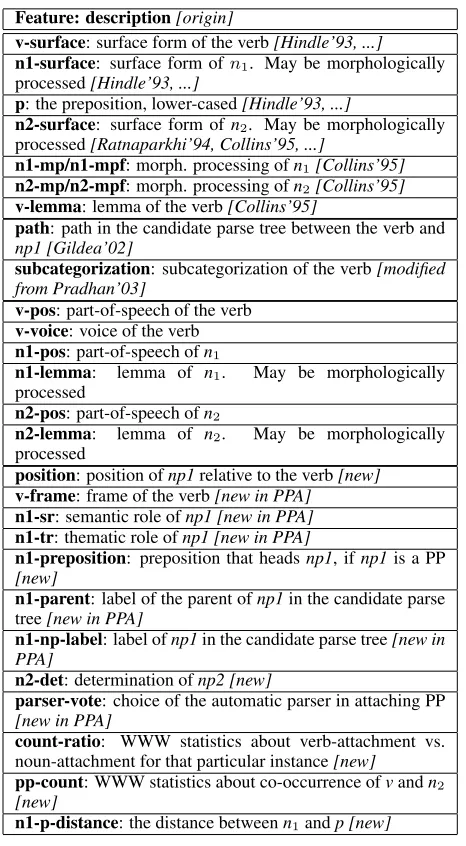
Table 2 describes the features and the origin of each feature. The preposition is the feature with the most discriminative power, because of prefer-ences of particular prepositions to attach to verbs or nouns. Table 3 shows the distribution of top 10 most frequently used prepositions in the FN and TB2 datasets.
The features were carefully designed so that, when they are extracted from gold parse trees, they don’t provide more information useful for disam-biguation than when they are automatically gener-ated using a parser. This claim is validgener-ated by the experimental results that show a strong correlation between the results on the two datasets – one based on automatically generated parse trees (FN) and one based on gold parse trees (TB2).
Next, we describe in further detail the features presented in Table 2.
v-frame represents the frame of the verb – the frame to which the verb belongs, as it is present in FrameNet (manually annotated). We used this fea-ture because the frame of the verb describes very well the semantic behavior of the verb including the predicate-argument structure of the verb, which en-tails the affinity of the verb for certain prepositions.
1The datasets are available athttp://www.utdallas.
FN TB2
Source FrameNet annotation samples (British National Corpus)
Penn Treebank-II (WSJ articles) Instance
identifica-tion
Semantic-centered (related to Frame Elements) Syntactic-centered (related to the structure of the parse tree)
Parse trees Automatically generated (Charniak) Gold standard
Total size 27,421 instances 60,699 instances
Distribution statistics 70.28% ambiguous verb attachments 2.36:1 v-attch:n-attch
35.71% ambiguous verb attachments 1:1.8 v-attch:n-attch
Training / test sets 90% - 10% – homogenously distributed (one in every 10 instances is selected for the test set) Location of PP Both before and after verb Only after verb
[image:3.612.84.545.52.210.2]Other properties – Partial identification of ambiguous PP-attachment instances in the corpus, derived from manual annotation of FEs (Olteanu, 2004) – Semantic information readily available
Table 1: The datasets and their characteristics
Feature: description[origin]
v-surface: surface form of the verb[Hindle’93, ...]
n1-surface: surface form ofn1. May be morphologically
processed[Hindle’93, ...]
p: the preposition, lower-cased[Hindle’93, ...]
n2-surface: surface form ofn2. May be morphologically
processed[Ratnaparkhi’94, Collins’95, ...]
n1-mp/n1-mpf: morph. processing ofn1[Collins’95]
n2-mp/n2-mpf: morph. processing ofn2[Collins’95]
v-lemma: lemma of the verb[Collins’95]
path: path in the candidate parse tree between the verb and np1 [Gildea’02]
subcategorization: subcategorization of the verb[modified from Pradhan’03]
v-pos: part-of-speech of the verb
v-voice: voice of the verb
n1-pos: part-of-speech ofn1
n1-lemma: lemma of n1. May be morphologically
processed
n2-pos: part-of-speech ofn2
n2-lemma: lemma of n2. May be morphologically
processed
position: position ofnp1relative to the verb[new]
v-frame: frame of the verb[new in PPA]
n1-sr: semantic role ofnp1 [new in PPA]
n1-tr: thematic role ofnp1 [new in PPA]
n1-preposition: preposition that headsnp1, ifnp1is a PP [new]
n1-parent: label of the parent ofnp1in the candidate parse tree[new in PPA]
n1-np-label: label ofnp1in the candidate parse tree[new in PPA]
n2-det: determination ofnp2 [new]
[image:3.612.334.535.254.380.2] [image:3.612.79.312.257.680.2]parser-vote: choice of the automatic parser in attaching PP [new in PPA]
count-ratio: WWW statistics about verb-attachment vs. noun-attachment for that particular instance[new]
pp-count: WWW statistics about co-occurrence ofvandn2
[new]
n1-p-distance: the distance betweenn1andp [new]
Table 2: Features
% of % v-att % of % v-att
Prep. FN FN TB2 TB2
of 13.47% 6.17% 30.14% 2.74%
to 13.27% 80.14% 9.55% 60.49%
in 12.42% 73.64% 16.94% 42.58%
for 6.87% 82.44% 8.95% 39.72%
on 6.21% 75.51% 5.16% 47.73%
with 6.17% 86.30% 3.79% 46.92%
from 5.37% 75.90% 5.76% 52.76%
at 4.09% 76.63% 3.21% 66.02%
as 3.95% 86.51% 2.49% 51.69%
by 3.53% 88.02% 3.27% 68.11%
Table 3: Distribution of the first 10 most-frequent prepositions in the FN and TB2 datasets
n1-sr represents the semantic role of the object phrase np1 – the label attached to the Frame Ele-ment (manual semantic annotation that can be found in FrameNet). This feature was introduced because of the relation between the underlying meaning of
np1and its semantic role.
n1-tr represents the thematic role of the object phrase np1– a coarse-grained role based on the la-bel attached to the Frame Element (manual semantic annotation that can be found in FrameNet). It was introduced to reduce data sparseness for then1-sr
feature. The conversion from fine-grained semantic role to coarse-grained semantic role is done auto-matically using a table that maps a pair of a frame-level semantic role (FE label) and a frame to a the-matic role.
predicate argument structure and to the underlying meaning of the verb. It contains an ordered set of all the phrase labels that are siblings of the verb, plus a marker for the verb. If the child phrase of the verb is a PP, then the label will also contain the prepo-sition (the headword of the PP). This feature is a modified form of the sub-categorization feature de-scribed in (Pradhan et al., 2003): the differences in various part-of-speeches for the verb were ignored and the preposition that heads a prepositional phrase is also attached to the label. Therefore, for the sen-tence “The stock declined in June by 4%”, the value for this feature is*-PPin-PPby.
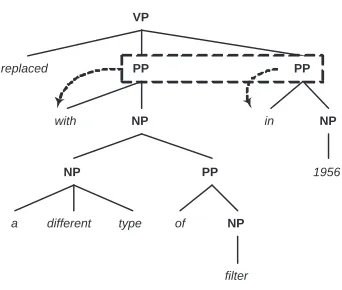
In the TB2 dataset the parse trees are gold stan-dard (contain the expected output value for PP-ambiguity resolution). In the case of a verb attach-ment, if the selected PP is a child of the selected VP, then by applying the algorithm, the value of the fea-ture will contain the PP label plus the preposition. This clearly is a clue for the learner that the instance is averb attachment. To overcome this problem for datasets based on gold-standard parse trees, when computing the value of thesubcategorization fea-ture the selected PP will not be used. Figure 1 shows the subcategorization for the phrase“replaced with a different type of filter in 1956”.
VP
replaced PP
with NP
NP
different
a type
PP
of NP
filter
PP
in NP
[image:4.612.344.517.194.338.2]1956
Figure 1: Subcategorization feature:*-PPin-PPby
pathexpresses the syntactic relation between the verb v and the object phrase np1. Its purpose is to describe the syntactic relation of np1 to the rest of the clause by the syntactic relation ofnp1 with the head of the clause –v. We adopted this feature from (Gildea and Jurafsky, 2002). path describes the chain of labels in the tree fromvtonp1,
includ-ing the label ofv andnp1. Ascending movements and descending movements are depicted separately. We used two variants of this feature to determine the optimum version for our problem – one with full POS of the verb and one with POS reduced to “VB”. The experiments proved that the second variant pro-vides a better performance. Figure 2 depicts the path between “replaced” and “a different type of filter”: VBN↑VP↓PP↓NP or VB↑VP↓PP↓NP.
VP
replaced PP
with NP
NP
different
a type
PP
of NP
filter
PP
in NP
[image:4.612.105.276.424.569.2]1956
Figure 2: Example of a path feature
positionindicates theposition of then1-p-n2
con-struction relative to the verb, i.e. whether the prepo-sitional phrase in question lies before the verb or af-ter the verb in the sentence. Position is very impor-tant in deciding the type of attachment, considering the totally different distribution of PPs constructions preceding the verb and PPs constructions following the verb.
Morphological processing applied to n1 and n2 was inspired by the algorithm described in (Collins and Brooks, 1995). We analyzed the impact of dif-ferent levels of morphological processing by using two types: partial morphological processing (only numbers and years are converted) – identified by adding-mpas a suffix to the name of this feature – and full morphological processing (numbers, years and capitalized names) – identified by adding-mpf
as a suffix to the name of this feature. The purpose of morphological processing is data sparseness re-duction by clustering similar values for this feature.
n2-detis called thedetermination of the preposi-tional phrase np2. This novel feature tells if n2 is preceded innp2by a possessive pronoun or by a de-terminer. This is used to differentiate between“buy books for children” (which is probably a noun at-tachment) and“buy books for her children”(which very probably is a verb attachment).
parser-vote feature represents the choice of the parser (Charniak’s parser) in the PP-attachment res-olution. It cannot be used with gold-standard parse trees because it will provide the right answer.
count-ratio represents the estimated ratio be-tween the frequency of an unambiguous verb attach-ment construction based onv,pandn2 and the fre-quency of a probably unambiguous noun attachment construction based on n1, p andn2 in a very large corpus. A very large corpus is required to overcome the data sparseness inherent for complex construc-tions like those described above.
We chose the World Wide Web as a corpus and Google as a query interface (see (Olteanu, 2004) for details).
Let’s consider the estimated frequency of un-ambiguous verb-attachments and respectively noun-attachments defined as:
fv = cv−p−n2
cv·cp−n2
fn= ccn1−p−n2 n1·cp−n2 where:
• cv−p−n2 is the number of occurrences of the phrase “v p n2”, “v p∗n2” (where * symbolizes any word), “v-lemma p n2” or “v-lemma p * n2” in World Wide Web, as reported by Google
• cvis the number of occurrences of the word “v”
or “v-lemma” in WWW
• cp−n2 is the number of occurrences of the phrase “p n2” or “p∗n2” in WWW
• cn1−p−n2 is the number of occurrences of the phrase “n1 p n2” or “v p∗n2” in WWW
• cn1 is the number of occurrences of the word “n1” in WWW
The value for this feature is:
count−ratio= log10fv
fn = log10
cv−p−n2·cn1 cn1−p−n2·cv
We chose logarithmic values for this feature be-cause experiments showed that logarithmic values provide a higher accuracy than linear values. Also, by experimentation we concluded that value bound-ing is helpful, and the feature was bounded to values between -3 and 3 on the logarithmic scale, unless specified otherwise in the experiment description.
This feature resembles the approach adopted in (Volk, 2001).
pp-count depicts the estimated count of occur-rences in World Wide Web of the prepositional phrases based onpandn2. The count is estimated by cp−n2. Therefore pp-count = log10(cp−n2 + cp−∗−n2).
n1-p-distancedepicts the distance (in tokens) be-tween n1 and p. Let dn1−p be the distance
be-tween n1 and p (d = 1 if there is no other to-ken between n1 and p). Thus n1-p-distance =
log10(1 + log10dn1−p).
5 Learning model and procedure
We used in our experiments a Support Vector Machines learner with Radial Basis Function kernel as implemented in the LIBSVM toolkit (http://www.csie.ntu.edu.tw/∼cjlin/ libsvm/).
We converted the feature tuples (containing dis-crete alphanumeric and continuous values) to multi-dimensional vectors using the following procedure:
• Discrete features: assign to each possible value of each feature a dimension in the vector space, and to each feature value in each training or test example put 1 in the dimension corresponding to the feature value and 0 in all other dimen-sions associated with that feature.
• Continuous features: assign a dimension and put the scaled value in the multi-dimensional vector (all examples in training data will span between 0 and 1 for that particular dimension).
SVM training was preceded by finding the opti-malγ andC parameters required for training using 2-fold cross validation, which was found to be supe-rior in model accuracy and training time over higher folds cross-validations (Olteanu, 2004).
on the training set, which acted also as a develop-ment set. We later computed the accuracy on the test set on some representative models.
6 Experiments, results and analysis
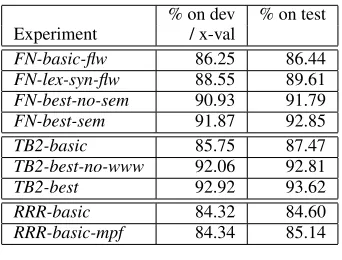
For each dataset, we conducted experiments to de-termine an efficient combination of features and the accuracy on test data for the best combination of fea-tures. We also run the experimental procedure on the original Ratnaparkhi’s dataset in order to com-pare SVM with other machine learning techniques applied to PP-attachment problem. Table 4 summa-rizes the experiments performed on all datasets.
% on dev % on test
Experiment / x-val
[image:6.612.109.280.246.376.2]FN-basic-flw 86.25 86.44 FN-lex-syn-flw 88.55 89.61 FN-best-no-sem 90.93 91.79 FN-best-sem 91.87 92.85 TB2-basic 85.75 87.47 TB2-best-no-www 92.06 92.81 TB2-best 92.92 93.62 RRR-basic 84.32 84.60 RRR-basic-mpf 84.34 85.14
Table 4: Results
FN-basic-flw uses v-surface, n1-surface, p and
n2-surfaceon examples that follow the verb. FN-lex-syn-flw uses v-surface, v-pos, v-lemma, sub-categorization, path (full POS), position, n1-preposition, n1-surface, n1-pos, n1-lemma, n1-parent, p, n2-surface, n2-pos, n2-lemma, n2-det and parser-vote on examples that follow the verb. FN-best-no-sem uses v-surface, v-pos, v-lemma, subcategorization, path (reduced POS),
position, n1-preposition, n1-surface, n1-pos, n1-lemma-mpf, n1-parent, p, n2-surface, n2-pos,
n2-lemma-mpf, n2-det, parser-vote, count-ratio
and pp-count on all examples. FN-best-sem uses the same set of features asFN-best-no-sem plus v-frameandn1-sr.
TB2-basic uses v-surface, n1-surface-mpf, p
and n2-surface-mpf. TB2-best-no-www uses v-surface,v-pos,v-lemma,subcategorization,path
(reduced POS), n1-preposition, n1-surface, n1-mpf, n1-pos, n1-lemma, n1-np-label, p, n2-surface,n2-mpfandn1-p-distance. TB2-bestalso usescount-ratioandpp-count.
RRR-basic uses v-surface, n1-surface, p and
n2-surface. RRR-basic-mpf uses v-surface, n1-surface-mpf,pandn2-surface-mpf.
On the FN dataset, all features except v-voice
have a positive contribution to the system (n2-det, choice between semantic vs. thematic role and how should morphological processing be applied is ques-tionable). The negative impact for thev-voice fea-ture may be explained by the fact that the only sit-uation in which it may potentially help is extremely rare: passive voice and the agent headed by“by” ap-pears after another argument of the verb (i.e.: “The painting was presented to the audience by its au-thor.”). Moreover the PP-attachment based on the preposition“by”is not highly ambiguous; as seen in Table 3 in the FrameNet dataset, 88% of the“by”
ambiguity instances are verb-attachments.
The experiment with the highest cross-validation accuracy has an accuracy of 92.85% on the test data. The equivalent experiment that doesn’t include man-ually annotated semantic information has an accu-racy of 91.79% on the test data.
On TB2 dataset, the results are close to the results obtained on the FrameNet corpus, although the dis-tribution of noun and verb attachment differs consid-erably between the two data sets (70.28% are verb-attachments in FN2 and 35.71% in TB2). The best accuracy in cross-validation is 92.92%, which leads to an accuracy on test set of 93.62%.
7 Comparison with previous work
Because we couldn’t use the standard dataset used in PP-attachment resolution (Ratnaparkhi’s), we im-plemented back-off algorithm developed by Collins and Brooks (1995) and applied it to our TB2 dataset. Both RRR and TB2 datasets are extracted from Penn Treebank. This algorithm, trained on TB2 training set, obtains an accuracy on TB2 test set of 86.1% (85.8% when no morphological processing is ap-plied). The same algorithm provides an accuracy on RRR dataset of 84.5% (84.1% without morphologi-cal processing). The difference in accuracy between the two datasets is 1.6% (1.7% without morpholog-ical processing when using Collins and Brooks’s al-gorithm.
TB2-Description Accuracy Data Extra Supervision
Always noun 55.0 RRR
Most likely for each P 72.19 RRR
Most likely for each P 72.30 TB2
Most likely for each P 81.73 FN
Average human, headwords (Ratnaparkhi et al., 1994) 88.2 RRR Average human, whole sentence (Ratnaparkhi et al., 1994) 93.2 RRR Maximum Likelihood-based (Hindle and Rooth, 1993) 79.7 AP Maximum entropy, words (Ratnaparkhi et al., 1994) 77.7 RRR Maximum entropy, words & classes (Ratnaparkhi et al., 1994) 81.6 RRR
Decision trees (Ratnaparkhi et al., 1994) 77.7 RRR
Transformation-Based Learning (Brill and Resnik, 1994) 81.8 WordNet Maximum-Likelihood based (Collins and Brooks, 1995) 84.5 RRR
Maximum-Likelihood based (Collins and Brooks, 1995) 86.1 TB2
Decision trees & WSD (Stetina and Nagao, 1997) 88.1 RRR WordNet Memory-based Learning (Zavrel et al., 1997) 84.4 RRR LexSpace Maximum entropy, unsupervised (Ratnaparkhi, 1998) 81.9
Maximum entropy, supervised (Ratnaparkhi, 1998) 83.7 RRR
Neural Nets (Alegre et al., 1999) 86.0 RRR WordNet
Boosting (Abney et al., 1999) 84.4 RRR
Semi-probabilistic (Pantel and Lin, 2000) 84.31 RRR Maximum entropy, ensemble (McLauchlan, 2001) 85.5 RRR LSA
SVM (Vanschoenwinkel and Manderick, 2003) 84.8 RRR
Nearest-neighbor (Zhao and Lin, 2004) 86.5 RRR DWS
[image:7.612.114.516.52.344.2]FN dataset, w/o semantic features (FN-best-no-sem) 91.79 FN PR-WWW FN dataset, w/ semantic features (FN-best-sem) 92.85 FN PR-WWW TB2 dataset, best feature set (TB2-best) 93.62 TB2 PR-WWW
Table 5: Accuracy of PP-attachment ambiguity resolution (our results in bold)
basicexperiment) is 2.9%. Also, the baseline – the most probable PP type for each preposition – is ap-proximately the same for the two datasets (72.19% on RRR and 72.30% on TB2).
One may hypothesize that the majority of the al-gorithms for PP-attachment disambiguation obtain no more than 4% increase in accuracy on the TB2 compared to the results on the RRR dataset. One important difference between the two datasets is the size – 20,801 training examples in RRR vs. 54,629 training examples in TB2. We plan to implement more algorithms described in literature in order to verify this statement.
Table 5 summarizes the results in PP-attachment ambiguity resolution found in literature along with our best results.
Other acronyms used in this table:
• AP – dataset of 13 million word sample of As-sociated Press news stories from 1999 (Hindle and Rooth, 1993).
• LexSpace - Lexical Space – a method to mea-sure the similarity of the words (Zavrel et al., 1997).
• LSA – Latent Semantic Analysis – measure the lexical preferences between a preposition and a noun or a verb (McLauchlan, 2001)
• DWS – Distributional Word Similarity. Words that tend to appear in the same contexts tend to have similar meanings (Zhao and Lin, 2004)
• PR-WWW – the probability ratio between verb-preposition-noun and noun-preposition-noun constructs measured using World Wide Web searching.
8 Conclusions
from a very large corpus; this method proved to be efficient to overcome the data sparseness problem.
By analyzing the results from the FrameNet dataset, we conclude that the contribution of the gold semantic features (frame and semantic role) is sig-nificant (1.05% difference in accuracy; 12.8% re-duction in the error). We will further investigate this issue by replacing gold semantic information with automatically detected semantic information. Our additional lexico-syntactic features increase the ac-curacy of the system from 86.44% to 89.61% for PPs following the verb. This suggests that on the FrameNet dataset the proposed syntactic features have a considerable impact on the accuracy.
The best TB2 feature set is approximately the same as the best FN feature set in spite of the dif-ferences between the datasets (Parse trees: TB2 – gold standard; FN – automatically generated. PP-attachment ambiguity identification: TB2 – parse trees; FN – a combination of trees and FE annota-tion. Data source: TB2 – WSJ articles; FN – BNC). This fact suggests that the selected feature sets do not exploit particularities of the datasets and that the features are relevant to the PP-attachment ambiguity problem.
References
Steven Abney, Robert E. Schapire, and Yoram Singer. 1999. Boosting applied to tagging and PP Attachment. In Proceed-ings of EMNLP/VLC-99, pages 38–45.
Martha A. Alegre, Josep M. Sopena, and Agusti Lloberas. 1999. Pp-attachment: A committee machine approach. In Proceedings of EMNLP/VLC-99, pages 231–238.
Collin F. Baker, Charles J. Fillmore, and John B. Lowe. 1998. The Berkeley FrameNet Project. In Proceedings of the 17th international conference on Computational Linguistics, pages 86–90.
Eric Brill and Philip Resnik. 1994. A rule-based approach to prepositional phrase attachment disambiguation. In Pro-ceedings of the 15th conference on Computational Linguis-tics, pages 1198–1204.
Eugene Charniak. 2000. A Maximum-Entropy-Inspired Parser. InProceedings of NAACL-2000, pages 132–139.
Michael Collins and James Brooks. 1995. Prepositional Phrase Attachment through a Backed-Off Model. InProceedings of the Thirds Workshop on Very Large Corpora, pages 27–38. Corinna Cortes and Vladimir Vapnik. 1995. Support-Vector
Networks.Machine Learning, 20(3):273–297.
Daniel Gildea and Daniel Jurafsky. 2002. Automatic Labeling of Semantic Roles. Computational Linguistics, 28(3):245– 288.
Donald Hindle and Mats Rooth. 1993. Structural Ambi-guity and Lexical Relations. Computational Linguistics, 19(1):103–120.
Mitchell Marcus, Beatrice Santorini, and Mary Ann Marcinkiewicz. 1993. Building a large annotated cor-pus of English: the Penn Treebank. Computational Linguistics, 19(2):313–330.
Mark McLauchlan. 2001. Maximum Entropy Models and Prepositional Phrase Ambiguity. Master’s thesis, University of Edinburgh.
Marian G. Olteanu. 2004. Prepositional Phrase Attachment ambiguity resolution through a rich syntactic, lexical and semantic set of features applied in support vector machines learner. Master’s thesis, University of Texas at Dallas. Patrick Pantel and Dekang Lin. 2000. An unsupervised
ap-proach to Prepositional Phrase Attachment using contextu-ally similar words. InProceedings of the 38th Meeting of the Association for Computational Linguistic, pages 101–108. Sameer Pradhan, Kadri Hacioglu, Wayne Ward, James H.
Mar-tin, and Daniel Jurafsky. 2003. Semantic Role Parsing: Adding Semantic Structure to Unstructured Text. In Pro-ceedings of the International Conference on Data Mining, pages 629–632.
Adwait Ratnaparkhi, Jeff Reynar, and Salim Roukos. 1994. A Maximum Entropy Model for Prepositional Phrase Attach-ment. InProceedings of the Human Language Technology Workshop, pages 250–255.
Adwait Ratnaparkhi. 1998. Statistical Models for Unsuper-vised Prepositional Phrase Attachment. InProceedings of the 36th conference on Association for Computational Lin-guistics, pages 1079–1085.
Jiri Stetina and Makoto Nagao. 1997. Corpus based PP attach-ment ambiguity resolution with a semantic dictionary. In Proceedings of the Fifth Workshop on Very Large Corpora, pages 66–80.
Bram Vanschoenwinkel and Bernard Manderick. 2003. A weighted polynomial information gain kernel for resolving Prepositional Phrase attachment ambiguities with Support Vector Machines. InProceedings of the Eighteenth Inter-national Joint Conference on Artificial Intelligence, pages 133–140.
Martin Volk. 2001. Exploiting the WWW as a corpus to re-solve PP attachment ambiguities. InProceedings of Corpus Linguistics, pages 601–606.
Jakub Zavrel, Walter Daelemans, and Jorn Veenstra. 1997. Resolving PP attachment Ambiguities with Memory-Based Learning. InProceedings of CoNLL-97, pages 136–144. Shaojun Zhao and Dekang Lin. 2004. A Nearest-Neighbor