Using Word-Sense Disambiguation Methods to Classify Web Queries by
Intent
Emily Pitler
Computer and Information Science University of Pennsylvania Philadelphia, PA 19104, USA [email protected]
Ken Church Johns Hopkins University
Human Language Technology Center of Excellence Baltimore, MD 21211
Abstract
Three methods are proposed to classify queries by intent (CQI), e.g., navigational, informational, commercial, etc. Follow-ing mixed-initiative dialog systems, search engines should distinguish navigational queries where the user is taking the ini-tiative from other queries where there are more opportunities for system initiatives (e.g., suggestions, ads). The query in-tent problem has a number of useful appli-cations for search engines, affecting how many (if any) advertisements to display, which results to return, and how to ar-range the results page. Click logs are used as a substitute for annotation. Clicks on ads are evidence for commercial in-tent; other types of clicks are evidence for other intents. We start with a simple Na¨ıve Bayes baseline that works well when there is plenty of training data. When train-ing data is less plentiful, we back off to nearby URLs in a click graph, using a method similar to Word-Sense Disam-biguation. Thus, we can infer that de-signer trenchis commercial because it is close towww.saksfifthavenue.com, which is known to be commercial. The baseline method was designed for precision and the backoff method was designed for call. Both methods are fast and do not re-quire crawling webpages. We recommend a third method, a hybrid of the two, that does no harm when there is plenty of train-ing data, and generalizes better when there isn’t, as a strong baseline for the CQI task.
1 Classify Queries By Intent (CQI) Determining query intent is an important prob-lem for today’s search engines. Queries are short
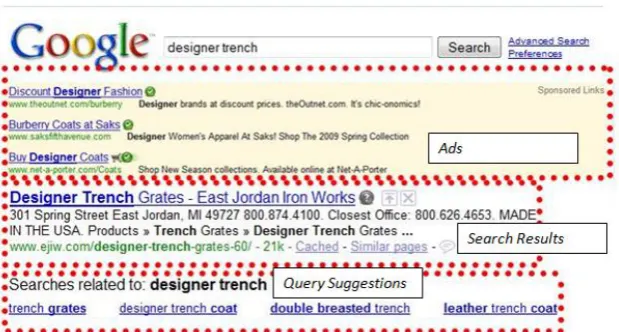
(consisting of 2.2 terms on average (Beitzel et al., 2004)) and contain ambiguous terms. Search en-gines need to derive what users want from this lim-ited source of information. Users may be search-ing for a specific page, browssearch-ing for information, or trying to buy something. Guessing the correct intent is important for returning relevant items. Someone searching for designer trench is likely to be interested in results or ads for trench coats, while someone searching for world war I trench
might be irritated by irrelevant clothing advertise-ments.
Broder (2002) and Rose and Levinson (2004) categorized queries into those withnavigational,
informational, and transactional or resource-seeking intent. Navigational queries are queries for which a user has a particular web page in mind that they are trying to navigate to, such as grey-hound bus. Informational queries are those like
San Francisco, in which the user is trying to gather information about a topic. Transactional queries are those likedigital camera ordownload adobe reader, where the user is seeking to make a trans-action or access an online resource.
Knowing the intent of a query greatly affects the type of results that are relevant. For many queries, Wikipedia articles are returned on the first page of results. For informational queries, this is usu-ally appropriate, as a Wikipedia article contains summaries of topics and links to explore further. However, for navigational or transactional queries, Wikipedia is not as appropriate. A user looking for thegreyhound bus homepage is probably not interested in facts about the company. Similarly, someone looking todownload adobe reader will not be interested in Wikipedia’s description of the product’s history. Conversely, for informational queries, Wikipedia articles tend to be appropriate while advertisements are not. The user searching for world war I trenchmight find the Wikipedia article on trench warfare useful, while he is
(a) The advertisements and related searches are probably more likely to be clicked on than the top result fordesigner trench.
[image:2.595.145.455.62.228.2](b) The top result will receive more clicks than the spelling suggestion. Wikipedia often receives lots of clicks, but not for commercial queries likebestbuy.
Figure 1: Results pages from two major search engines. A search results page has limited real estate that must be divided between search results, spelling suggestions, query suggestions, and ads.
ably not interested in purchasing clothing, or even World War I related products. We noticed empiri-cally that queries in the logs tend to have a high proportion of clicks on the Wikipedia article or the ads, but almost never both. The Wikipedia page for Best Buy in Figure 1(b) is probably a waste of space. Knowing whether a particular query is navigational, informational, or transac-tional would improve search and advertising rel-evance.
After a query is issued, search engines return a list of results, and possibly also advertisements, suggestions of related searches, and spelling sug-gestions. For different queries, these alternatives have varying utilities to the users. Consider the
queries in Figures 1(a) and 1(b). For designer trench, the advertisements may well be more use-ful to the user than the standard set of results. The query suggestions for designer trench all would help refine the query, whereas the suggestions for
bestbuy are less useful, as they would either re-turn the same set of results or take the user to Best Buy’s competitors’ sites. The spelling suggestion forbest buyinstead ofbestbuyis also unnecessary. Devoting more page space to the content that is likely to be clicked on could help improve the user experience.
sug-gestions) are likely to be clicked on? Typos will tend to have more clicks on the spelling sugges-tions, informational queries will have more clicks on Wikipedia pages, and commercial queries will have more clicks on the ads. The observed behav-ior of where users click tells us something about the hidden intentions of the users when they issue that query.
We focus on commercial intent (Dai et al., 2006), the intent to purchase a product or service, to illustrate our method of predicting query intent. The business model of web search today is heav-ily dependent on advertising. Advertisers bid on queries, and then the search results page also con-tains “sponsored” sites by the advertisers who won the auction for that query. It is thus advantageous for the advertisers to bid on queries which are most likely to result in a commercial transaction. If a query is classified as likely implying commer-cial intent, but the advertisers have overlooked this query, then the search engine may want to sug-gest that advertisers bid on that query. The search engine may also want to treat queries classified as having commercial intent differently, by rear-ranging the appearance of the page, or by showing more or fewer advertisements.
This paper starts with a simple Na¨ıve Bayes baseline to classify queries by intent (CQI). Super-vised methods work well, especially when there is plenty of annotated data for testing and training. Unfortunately, since we don’t have as much anno-tated data as we might like, we propose two work-arounds:
1. Use click logs as a substitute for annotated data. Clicks on ads are evidence for commer-cial intent; other types of clicks are evidence for other intents.
2. We propose a method similar to Yarowsky (1995) to generalize beyond the training set.
2 Related Work
Click logs have been used for a variety of tasks involved in information retrieval, including pre-dicting which pages are the best results for queries (Piwowarski and Zaragoza, 2007; Joachims, 2002; Xue et al., 2004), choosing relevant advertise-ments (Chakrabarti et al., 2008), suggesting re-lated queries (Beeferman and Berger, 2000), and personalizing results (Tan et al., 2006). Queries that have a navigational intent tended to have
a highly skewed click distribution, while users clicked on a wider range of results after issuing informational queries. Lee et al. (2005) used the click distributions to classify navigational versus informational intents.
While navigational, informational, and resource-seeking are very broad intentions, other researchers have looked at personalization and intent on a per user basis. Downey et al. (2008) use the last URL visited in a session or the last search engine result visited as a proxy for the user’s information goal, and then looked at the correspondence between information needs and queries (how the goals are expressed).
We are interested in a granularity of intent in between navigational/informational/resource-seeking and personalized intents. For these sorts of intents, the web pages associated with queries provide useful information. To classify queries into an ontology of commercial queries, Broder et al. (2007) found that a classifier that used the text of the top result pages performed much bet-ter than a classifier that used only the query string. While the results are quite good on their hierarchy of 6000 types of commercial intents, they manu-ally constructed about 150 hand-picked examples each for each of the 6000 intents. Beitzel et al. (2005) do semi-supervised learning over the query logs to classify queries into topics, but also train with hundreds of thousands of manually annotated queries. Thus, while we also use the query logs and the identities of web pages of associated with each query, we are interested in finding methods that can be applied when that much annotation is prohibitive.
deci-sion lists of URLs. In addition, we evaluate our method automatically by using user click rates, rather than assembling hand-labeled examples for training and testing.
Dai et al. (2006) also classified queries by com-mercial intent, but their method involved crawling the top landing pages for each query, which can be quite time-consuming. In this paper we investi-gate the commercial intent problem when crawling pages is not feasible, and use only the identities of the top URLs.
3 Using Click Logs as a Substitute for Annotation
Prior work has used click logs in lieu of manual annotations of relevance ratings, either of web-pages (Joachims, 2002) or of sponsored search ad-vertisements (Ciaramita et al., 2008). Here we use the click logs as a large-scale source of intents. Logs from Microsoft’s Live Search are used for training and test purposes. Logs from May 2008 were used for training, and logs from June 2008 were used for testing.
The logs distinguish four types of clicks: (a) search results, (b) ads, (c) spelling suggestions and (d) query suggestions. Some prototypical queries of each type are shown in Table 1. As mentioned above, clicks on ads are evidence for commercial intent; other types of clicks are evidence for other intents. The query,ebay official, is assumed to be commercial intent, because a large fraction of the clicks are on ads. In contrast, typos tend to have relatively more clicks on “did-you-mean” spelling suggestions.
The query logs contain over a terabyte of data for each day, and our experiments were done using months of logs at a time. We used SCOPE (Chaiken et al., 2008), a script-ing programmscript-ing language designed for doscript-ing Map-Reduce (Dean and Ghemawat, 2004) style computations, to distribute the task of aggre-gating the counts of each query over thousands of servers. As the same query is often issued several times by multiple users across an en-tire month of search logs, we summarize each query with four ratios–search results clicks:overall clicks, ad clicks:overall clicks, spelling sugges-tion clicks:overall clicks, and query suggessugges-tion clicks:overall clicks.
A couple of steps were taken to ensure reliable ratios. We are classifying types, not tokens, and
so limited ourselves to those queries with 100 or more clicks. This still leaves us with over half a million distinct queries for training and for test-ing, yet allows us to use click ratios as a substitute for annotating these huge data sets. If a query was only issued once and the user clicked on an ad, that may be more a reflection of the user, rather than reflecting that the query is 100% commer-cial. In addition, the ratios compare clicks of one type with clicks of another, rather than compar-ing clicks with impressions. There is less risk of a failure to find fallacy if we count events (clicks) in-stead of non-events (non-clicks). There are many reasons for non-clicks, only some of which tell us about the meaning of the query. There are bots that crawl pages and never click. Many links can’t be seen (e.g., if they are below the fold).
Queries are labeled as positive examples of commercial intent if their ratio is in the top half of the training set, and negative otherwise. A similar procedure is used to label queries with the three other intents.
Our task is to predict future click patterns based on past click patterns. Note that a query may ap-pear in both the test set and the training set, al-though not necessarily with the same label. In fact, because of the robustness requirement of 100+ clicks, many queries appear in both sets; 506,369 out of 591,122 of the test queries were also present in the training month. The overlap reflects natural processes on the web, with a long tail (of queries that will never be seen again) and a big fat head (of queries that come up again and again). Throwing away the overlap would both drastically reduce the size of the data and make the problem less realistic for a commercial application.
Click Type Query Type Example (Area on Results Page) (Intent)
Spelling Suggestion Typo www.lastmintue.com.au Ad Commercial Intent ebay official
Query Suggestion Suggestible sears employees (where there are some popular query suggestions indicating how current employees can navigate to the benefits site, as well as how others can apply for employment)
[image:5.595.85.515.61.144.2]Search Result Standard Search craigslist, denver, co
Table 1: Queries with a high percentage of clicks in each category
4 Three CQI Methods
4.1 Method 1: Look-up Baseline
The baseline method checks if a query was present in the training set, and if so, outputs the label from the training set. If the query was not present, it backs off to the appropriate default label: “non-commercial” for the commercial intent task (and “non-suggestible”, “not a typo”, etc. for the other CQI tasks). This very simple baseline method is effective because the ratios tend to be fairly stable from one month to the next. The query,
ebay official, for example, has relatively high ad clicks in both the training month as well as the test month. The next section will propose an al-ternative method to address the main weakness of the baseline method, the inability to generalize be-yond the queries in the training set.
Figure 2: saksandbluefly trench coatsare known to be commercial, while world war I trench is known to be non-commercial. What about de-signer trench? We can classify it as commercial because it shares URLs with the known commer-cial queries.
4.2 Method 2: Using Click Graph Context to Generalize Beyond the Queries in the Training Set
To address the generalization concern, we propose a method inspired by Yarowsky (1994). Word sense disambiguation is a classic problem in nat-ural language processing. Some words have mul-tiple senses; for instance, bank can either mean a riverbank or a financial institution, and for var-ious tasks such as information retrieval, parsing, or information extraction, it is useful to be able to differentiate between the possible meanings.
When a word is being used in each sense, it tends to appear in a different context. For exam-ple, if the wordmuddyis nearbybank, the author is probably using the riverbank sense of the term, while if the word deposit is nearby, the word is probably being used with the financial sense.
Yarowksy (1995) thus creates a list of each pos-sible context, sorted by how strong the evidence is for a particular sense. To classify a new example, Yarowsky (1994) finds the most informative collo-cation pattern that applies to the test example.
In this work, rather than using the surrounding words as context as in text classification, we con-sider the surrounding URLs in the click graph as context. A sample portion of the click graph is shown in figure 2. The figure shows queries on the left and URLs on the right. The click graph was computed on a very large sample of logs com-puted well before the training period. There is an edge from a queryqto a URLuif at least 10 users issuedqand then clicked onu.
[image:5.595.78.293.475.647.2]argmaxUi∈Nbr(q)logPr(Pr(¬IntentIntent|U|Ui)
i)
If the neighboring opinion is positive (that is,
Pr(Intent|URL∗)>Pr(¬Intent|URL∗)), then the queryqis assigned a positive label. Otherwise, qis assigned a negative label.
In Figure 2, we classify designer trench as a commercial query based on the neighbor with the strongest opinion. In this case, there was a tie between two neighbors with equally strong opinions: www.saksfifthavenue.com and
www.bluefly.com/Designer-Trench-Coats. Both neighbors are associated with queries that were labeled commercial in the training set: saks and
bluefly trench coats, respectively.
This method allows the labels of training set queries to propagate through the URLs to new test set queries.
4.3 Method 3: Hybrid (“Better Together”)
We recommend a hybrid of the two methods:
• Method 1: the look-up baseline
• Method 2: use click graph context to gener-alize beyond the queries in the training set Method 1 is designed for precision and method 2 is designed for recall. The hybrid uses method 1 when applicable, and otherwise, backs off to method 2.
5 Results
5.1 Commercial Intent
Table 2 and Figures 3(a) and 3(b) compare the per-formance on the proposed hybrid method with the baseline. When there is plenty of training mate-rial, both methods perform about equally well (the look-up baseline has an F-score of 84.1%, com-pared with the hybrid method’s F-score of 85.3%), but generalization becomes important when train-ing data is severely limited. Figure 3(a) shows that the proposed method does no harm and might even help a little when there is plenty of training data. The hybrid’s main benefit is generalization to queries beyond the training set. If we severely limit the size of the training set to just 20% of the month, as in Figure 3(b), then the proposed hybrid method is substantially better than the baseline. In this case, the proposed hybrid method’s F-score is 65.8%, compared with the look-up method’s F-score of 28.4%.
5.2 Other types of clicks
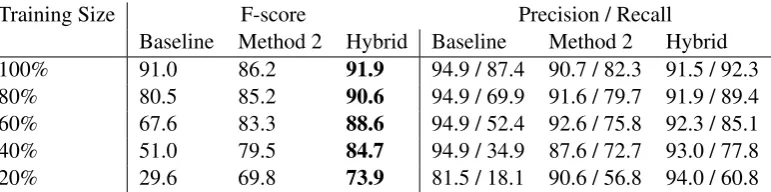
Table 3 and Figures 4(a) and 4(b) show a similar pattern for the query suggestion task. In fact, the pattern is perhaps even stronger for the query sug-gestion task than commercial intent. When the full training set is used, the hybrid method achieves an F-score of 91.9% (precision = 91.5%, recall = 92.3%). When only 20% of the training data is used, the hybrid method has an F-score of 73.9%, compared with the baseline’s F-score of 29.6%. A similar pattern was observed for clicks on search results.
The one exception is the spelling suggestion task, where the context heuristic proved ineffec-tive, for reasons that should not be surprising in retrospect. Click graph distance is an effective heuristic for many intents, but not for typos. Users who issue misspelled the query have the same goals as users who correctly spell the query, so we shouldn’t expect URLs to be able to differ-entiate them. For misspelled queries, for exam-ple, yuotube, there are correctly spelled queries, likeyoutube, with the same intent that will tend to be associated with the same set of URLs (such as
www.youtube.com).
6 Conclusion and Future Work
We would like to be able to distinguish web queries by intent. Unfortunately, we don’t have annotated data for query intent, but we do have access to large quantities of click logs. The logs distinguish four types of clicks: (a) search results, (b) ads, (c) spelling suggestions and (d) query sug-gestions. Clicks on ads are evidence for commer-cial intent; other types of clicks are evidence for other intents. Click logs are huge sources of data, and while there are privacy concerns, anonymized logs are beginning to be released for research pur-poses (Craswell et al., 2009).
Besides commercial intent, queries can also be divided into two broader classes: queries in which the user is browsing and queries for which the user is navigating. Clicks on the ads and query sug-gestions indicate that users are browsing and will-ing to look at these alternative suggestions, while clicks on the search results indicate that the users were navigating to what they were searching for. Clicks on typos indicate neither, as presumably the users are not entering typos on purpose.
(a) (b)
Figure 3: Better together: proposed hybrid is no worse than baseline (left) and generalizes better to unseen tail queries (right). The two panels are the same, except that the training set was reduced on the right to test generalization error.
(a) (b)
Figure 4: Similar to Figures 3(a) and 3(b), adding the decision list method generalizes over the look-up method for the “suggestible” task.
can respond in an open way) versus system ini-tiative (the system asks the user questions with a restricted set of possible answers) (Rela˜no et al., 1999; Scheffler and Young, 2002; Singh et al., 2002), search engines may want to learn policies for when the user just wants the search results or when the user is open to suggestions. When users want help (they want the search engine to suggest results), more space on the page should be devoted to the ads and the query suggestions. When the users know what it is they want, more of the page should be given to the search results they asked for.
We started with a simple baseline for predicting click location that had great precision, but didn’t generalize well beyond the queries in the
train-ing set. To improve recall, we proposed a con-text heuristic that backs off in the click graph. The backoff method is similar to Yarowsky’s Word Sense Disambiguation method, except that context is defined in terms of URLs nearby in click graph distance, as opposed to words nearby in the text.
Our third method, a hybrid of the baseline method and the backoff method, is the strongest baseline we have come up with. The evaluation showed that the hybrid does no harm when there is plenty of training data, and generalizes better when there isn’t.
[image:7.595.101.499.327.489.2]Training Size F-score Precision / Recall Baseline Method 2 Hybrid Baseline Method 2 Hybrid 100% 84.1 75.6 85.3 88.2 / 80.4 76.6 / 74.6 85.7 / 85.0 80% 74.4 74.8 83.5 88.2 / 64.3 79.3 / 70.7 86.7 / 80.6 60% 62.4 72.9 80.7 88.3 / 48.2 82.5 / 65.3 87.9 / 74.6 40% 47.9 70.1 76.0 77.5 / 34.7 78.5 / 63.3 80.7 / 66.0 20% 28.4 62.5 65.8 77.6 / 17.4 75.9 / 53.1 74.3 / 59.1
Table 2: The baseline and hybrid methods have comparable F-scores when there is plenty of training data, but generalization becomes important when training data is severely limited. The proposed hybrid method generalizes better as indicated by the widening gap in F-scores with smaller and smaller training sets.
Training Size F-score Precision / Recall
Baseline Method 2 Hybrid Baseline Method 2 Hybrid 100% 91.0 86.2 91.9 94.9 / 87.4 90.7 / 82.3 91.5 / 92.3 80% 80.5 85.2 90.6 94.9 / 69.9 91.6 / 79.7 91.9 / 89.4 60% 67.6 83.3 88.6 94.9 / 52.4 92.6 / 75.8 92.3 / 85.1 40% 51.0 79.5 84.7 94.9 / 34.9 87.6 / 72.7 93.0 / 77.8 20% 29.6 69.8 73.9 81.5 / 18.1 90.6 / 56.8 94.0 / 60.8
Table 3: F-scores on the query suggestion task. As in the commercial intent task, the proposed hybrid method does no harm when there is plenty of training data, but generalizes better when training data is severely limited.
Antonellis et al., 2008) improves classification. Similar methods could be applied in future work to many other applications such labeling queries and URLs by: language, market, location, time, intended for a search vertical (such as medicine, recipes), intended for a type of answer (maps, pic-tures), as well as inappropriate intent (porn, spam). In addition to click type, there are many other features in the logs that could prove useful for classifying queries by intent, e.g., who issued the query, when and where. Similar methods could also be used to personalize search (Teevan et al., 2008); for queries that mean different things to dif-ferent people, the Yarowsky method could be ap-plied to variables such as user, time and place, so the results reflect what a particular user intended in a particular context.
7 Acknowledgments
We thank Sue Dumais for her helpful comments on an early draft of this work. We would also like to thank the members of the Text Mining, Search, and Navigation (TMSN) group at Microsoft Re-search for useful discussions and the anonymous reviewers for their helpful comments.
References
I. Antonellis, H. Garcia-Molina, and C.C. Chang. 2008. Simrank++: query rewriting through link analysis of the clickgraph (poster). WWW.
S. Baluja, R. Seth, D. Sivakumar, Y. Jing, J. Yagnik, S. Kumar, D. Ravichandran, and M. Aly. 2008. Video suggestion and discovery for youtube: taking random walks through the view graph. WWW. D. Beeferman and A. Berger. 2000. Agglomerative
clustering of a search engine query log. InSIGKDD, pages 407–416.
S.M. Beitzel, E.C. Jensen, A. Chowdhury, D. Gross-man, and O. Frieder. 2004. Hourly analysis of a very large topically categorized web query log. SI-GIR, pages 321–328.
S.M. Beitzel, E.C. Jensen, O. Frieder, D.D. Lewis, A. Chowdhury, and A. Kolcz. 2005. Improving automatic query classification via semi-supervised learning.ICDM, pages 42–49.
A.Z. Broder, M. Fontoura, E. Gabrilovich, A. Joshi, V. Josifovski, and T. Zhang. 2007. Robust classifi-cation of rare queries using web knowledge. SIGIR, pages 231–238.
A. Broder. 2002. A taxonomy of web search. SIGIR, 36(2).
[image:8.595.79.465.228.324.2]Easy and efficient parallel processing of massive data sets. Proceedings of the VLDB Endowment archive, 1(2):1265–1276.
D. Chakrabarti, D. Agarwal, and V. Josifovski. 2008. Contextual advertising by combining relevance with click feedback. WWW.
M. Ciaramita, V. Murdock, and V. Plachouras. 2008. Online learning from click data for sponsored search.
N. Craswell and M. Szummer. 2007. Random walks on the click graph. InProceedings of the 30th an-nual international ACM SIGIR conference on Re-search and development in information retrieval, pages 239–246.
N. Craswell, R. Jones, G. Dupret, and E. Viegas (Con-ference Chairs). 2009. Wscd ’09: Proceedings of the 2009 workshop on web search click data.
H.K. Dai, L. Zhao, Z. Nie, J.R. Wen, L. Wang, and Y. Li. 2006. Detecting online commercial intention (OCI). WWW, pages 829–837.
J. Dean and S. Ghemawat. 2004. MapReduce: Sim-plified Data Processing on Large Clusters. OSDI, pages 137–149.
D. Downey, S. Dumais, D. Liebling, and E. Horvitz. 2008. Understanding the relationship between searchers’ queries and information goals. InCIKM.
T. Joachims. 2002. Optimizing search engines using clickthrough data. InProceedings of the ACM Con-ference on Knowledge Discovery and Data Mining (KDD), ACM.
U. Lee, Z. Liu, and J. Cho. 2005. Automatic identifi-cation of user goals in Web search. InWWW, pages 391–400.
X. Li, Y.Y. Wang, and A. Acero. 2008. Learning query intent from regularized click graphs. In SI-GIR, pages 339–346.
B. Piwowarski and H. Zaragoza. 2007. Predictive user click models based on click-through history. In Pro-ceedings of the sixteenth ACM conference on Con-ference on information and knowledge management, pages 175–182.
J. Rela˜no, D. Tapias, M. Rodr´ıguez, M. Charfuel´an, and L. Hern´andez. 1999. Robust and flexible mixed-initiative dialogue for telephone services. In Proceedings of EACL.
D.E. Rose and D. Levinson. 2004. Understanding user goals in web search. WWW, pages 13–19.
K. Scheffler and S. Young. 2002. Automatic learn-ing of dialogue strategy uslearn-ing dialogue simulation and reinforcement learning. InProceedings of HLT, pages 12–19.
S. Singh, D. Litman, M. Kearns, and M. Walker. 2002. Optimizing dialogue management with reinforce-ment learning: Experireinforce-ments with the NJFun sys-tem. Journal of Artificial Intelligence Research, 16(1):105–133.
Bin Tan, Xuehua Shen, and ChengXiang Zhai. 2006. Mining long-term search history to improve search accuracy. pages 718–723. KDD.
J. Teevan, S.T. Dumais, and D.J. Liebling. 2008. To personalize or not to personalize: modeling queries with variation in user intent.SIGIR, pages 163–170. Gui-Rong Xue, Hua-Jun Zeng, Zheng Chen, Yong Yu, Wei-Ying Ma, WenSi Xi, and WeiGuo Fan. 2004. Optimizing web search using web click-through data. InCIKM ’04: Proceedings of the thir-teenth ACM international conference on Informa-tion and knowledge management, pages 118–126. D. Yarowsky. 1994. Decision lists for lexical
ambigu-ity resolution: Application to accent restoration in Spanish and French.ACL, pages 88–95.
D. Yarowsky. 1995. Unsupervised word sense disam-biguation rivaling supervised methods. ACL, pages 189–196.