Supervised Domain Adaption for WSD
Eneko Agirre and Oier Lopez de Lacalle IXA NLP Group
University of the Basque Country Donostia, Basque Contry
{e.agirre,oier.lopezdelacalle}@ehu.es
Abstract
The lack of positive results on super-vised domain adaptation for WSD have cast some doubts on the utility of hand-tagging general corpora and thus devel-oping generic supervised WSD systems. In this paper we show for the first time that our WSD system trained on a general
source corpus (BNC) and the target corpus,
obtains up to 22% error reduction when compared to a system trained on the tar-get corpus alone. In addition, we show that as little as 40% of the target corpus (when supplemented with the source cor-pus) is sufficient to obtain the same results as training on the full target data. The key for success is the use of unlabeled data
with SVD, a combination of kernels and
SVM.
1 Introduction
In many Natural Language Processing (NLP) tasks we find that a large collection of manually-annotated text is used to train and test supervised
machine learning models. While these models
have been shown to perform very well when tested on the text collection related to the training data
(what we call the source domain), the
perfor-mance drops considerably when testing on text
from other domains (calledtargetdomains).
In order to build models that perform well in new (target) domains we usually find two settings (Daum´e III, 2007). In the semi-supervised setting, the training hand-annotated text from the source domain is supplemented with unlabeled data from the target domain. In the supervised setting, we use training data from both the source and target domains to test on the target domain.
In (Agirre and Lopez de Lacalle, 2008) we studied semi-supervised Word Sense
Disambigua-tion (WSD) adaptaDisambigua-tion, and in this paper we fo-cus on supervised WSD adaptation. We compare the performance of similar supervised WSD
sys-tems on three different scenarios. In the source
to target scenariothe WSD system is trained on the source domain and tested on the target
do-main. In the target scenario the WSD system
is trained and tested on the target domain (using
cross-validation). In theadaptation scenariothe
WSD system is trained on both source and target domain and tested in the target domain (also using cross-validation over the target data). The source to target scenario represents a weak baseline for domain adaptation, as it does not use any exam-ples from the target domain. The target scenario represents the hard baseline, and in fact, if the do-main adaptation scenario does not yield better re-sults, the adaptation would have failed, as it would mean that the source examples are not useful when we do have hand-labeled target examples.
Previous work shows that current state-of-the-art WSD systems are not able to obtain better re-sults on the adaptation scenario compared to the target scenario (Escudero et al., 2000; Agirre and Mart´ınez, 2004; Chan and Ng, 2007). This would mean that if a user of a generic WSD system (i.e. based on hand-annotated examples from a generic corpus) would need to adapt it to a specific do-main, he would be better off throwing away the generic examples and hand-tagging domain exam-ples directly. This paper will show that domain adaptation is feasible, even for difficult domain-related words, in the sense that generic corpora can be reused when deploying WSD systems in specific domains. We will also show that, given the source corpus, our technique can save up to 60% of effort when tagging domain-related occur-rences.
nouns which are highly relevant in the SPORTS
and FINANCES domains, with 300 examples for
each. The use of two target domains strengthens the conclusions of this paper.
Our system uses Singular Value
Decomposi-tion (SVD) in order to find correlations between
terms, which are helpful to overcome the scarcity of training data in WSD (Gliozzo et al., 2005).
This work explores how this ability of SVD and
a combination of the resulting feature spaces im-proves domain adaptation. We present two ways to combine the reduced spaces: kernel
combina-tion with Support Vector Machines (SVM), andk
Nearest-Neighbors (k-NN) combination.
The paper is structured as follows. Section 2 re-views prior work in the area. Section 3 presents
the data sets used. In Section 4 we describe
the learning features, including the application of
SVD, and in Section 5 the learning methods and
the combination. The experimental results are pre-sented in Section 6. Section 7 presents the discus-sion and some analysis of this paper and finally Section 8 draws the conclusions.
2 Prior work
Domain adaptation is a practical problem attract-ing more and more attention. In the supervised setting, a recent paper by Daum´e III (2007) shows that a simple feature augmentation method for
SVM is able to effectively use both labeled
tar-get and source data to provide the best domain-adaptation results in a number of NLP tasks. His method improves or equals over previously ex-plored more sophisticated methods (Daum´e III and Marcu, 2006; Chelba and Acero, 2004). The feature augmentation consists in making three ver-sion of the original features: a general, a source-specific and a target-source-specific versions. That way the augmented source contains the general and source-specific version and the augmented target data general and specific versions. The idea be-hind this is that target domain data has twice the influence as the source when making predictions
about test target data. We reimplemented this
method and show that our results are better. Regarding WSD, some initial works made a ba-sic analysis of domain adaptation issues. Escud-ero et al. (2000) tested the supervised adaptation scenario on the DSO corpus, which had examples from the Brown corpus and Wall Street Journal corpus. They found that the source corpus did
not help when tagging the target corpus, show-ing that tagged corpora from each domain would suffice, and concluding that hand tagging a large general corpus would not guarantee robust broad-coverage WSD. Agirre and Mart´ınez (2000) used the DSO corpus in the supervised scenario to show that training on a subset of the source corpora that is topically related to the target corpus does allow for some domain adaptation.
More recently, Chan and Ng (2007) performed supervised domain adaptation on a manually se-lected subset of 21 nouns from the DSO corpus. They used active learning, count-merging, and predominant sense estimation in order to save tar-get annotation effort. They showed that adding just 30% of the target data to the source exam-ples the same precision as the full combination of target and source data could be achieved. They also showed that using the source corpus allowed to significantly improve results when only 10%-30% of the target corpus was used for training. Unfortunately, no data was given about the target corpus results, thus failing to show that domain-adaptation succeeded. In followup work (Zhong et al., 2008), the feature augmentation approach was combined with active learning and tested on the OntoNotes corpus, on a large domain-adaptation
experiment. They reduced significantly the
ef-fort of hand-tagging, but only obtained domain-adaptation for smaller fractions of the source and target corpus. Similarly to these works we show that we can save annotation effort on the target corpus, but, in contrast, we do get domain adap-tation when using the full dataset. In a way our approach is complementary, and we could also ap-ply active learning to further reduce the number of target examples to be tagged.
Though not addressing domain adaptation,
other works on WSD also used SVD and are
closely related to the present paper. Ando (2006)
used Alternative Structured Optimization. She
first trained one linear predictor for each target
word, and then performed SVDon 7 carefully
se-lected submatrices of the feature-to-predictor ma-trix of weights. The system attained small but consistent improvements (no significance data was given) on the Senseval-3 lexical sample datasets
usingSVDand unlabeled data.
Gliozzo et al. (2005) used SVD to reduce the
instances using a mapping to the reduced space
(similar to ourSMAmethod in Section 4.2). They
combined other knowledge sources into a complex
kernel using SVM. They report improved
perfor-mance on a number of languages in the Senseval-3 lexical sample dataset. Our present paper dif-fers from theirs in that we propose an additional
method to use SVD (the OMT method), and that
we focus on domain adaptation.
In the semi-supervised setting, Blitzer et al. (2006) used Structural Correspondence Learning and unlabeled data to adapt a Part-of-Speech
tag-ger. They carefully select so-called ‘pivot
fea-tures’ to learn linear predictors, perform SVD on
the weights learned by the predictor, and thus learn correspondences among features in both source
and target domains. Our technique also usesSVD,
but we directly apply it to all features, and thus avoid the need to define pivot features. In prelim-inary work we unsuccessfully tried to carry along the idea of pivot features to WSD. On the contrary, in (Agirre and Lopez de Lacalle, 2008) we show that methods closely related to those presented in this paper produce positive semi-supervised do-main adaptation results for WSD.
The methods used in this paper originated in (Agirre et al., 2005; Agirre and Lopez de Lacalle,
2007), where SVD over a feature-to-documents
matrix improved WSD performance with and
without unlabeled data. The use of several k
-NNclassifiers trained on a number of reduced and
original spaces was shown to get the best results in the Senseval-3 dataset and ranked second in the SemEval 2007 competition. The present paper ex-tends this work and applies it to domain adapta-tion.
3 Data sets
The dataset we use was designed for domain-related WSD experiments by Koeling et al. (2005),
and is publicly available. The examples come
from the BNC(Leech, 1992) and the SPORTSand
FINANCES sections of the Reuters corpus (Rose et al., 2002), comprising around 300 examples (roughly 100 from each of those corpora) for each of the 41 nouns. The nouns were selected
be-cause they were salient in either the SPORTS or
FINANCES domains, or because they had senses
linked to those domains. The occurrences were
hand-tagged with the senses from WordNet (WN)
version 1.7.1 (Fellbaum, 1998). In our
experi-ments the BNCexamples play the role of general
source corpora, and the FINANCES and SPORTS
examples the role of two specific domain target
corpora.
Compared to the DSO corpus used in prior work (cf. Section 2) this corpus has been explicitly
cre-ated for domain adaptation studies. DSO
con-tains texts coming from the Brown corpus and the Wall Street Journal, but the texts are not classi-fied according to specific domains (e.g. Sports, Finances), which make DSO less suitable to study
domain adaptation. The fact that the selected
nouns are related to the target domain makes the (Koeling et al., 2005) corpus more demanding than the DSO corpus, because one would expect the performance of a generic WSD system to drop when moving to the domain corpus for domain-related words (cf. Table 1), while the performance would be similar for generic words.
In addition to the labeled data, we also use unlabeled data coming from the three sources used in the labeled corpus: the ’written’ part
of the BNC (89.7M words), the FINANCES part
of Reuters (32.5M words), and the SPORTS part
(9.1M words).
4 Original andSVDfeatures
In this section, we review the features and two
methods to applySVDover the features.
4.1 Features
We relied on the usual features used in previous
WSD work, grouped in three main sets. Local
collocations comprise the bigrams and trigrams formed around the target word (using either lem-mas, word-forms, or PoS tags) , those formed with the previous/posterior lemma/word-form in
the sentence, and the content words in a±4-word
window around the target. Syntactic
dependen-ciesuse the object, subject, noun-modifier,
prepo-sition, and sibling lemmas, when available.
Fi-nally, Bag-of-words features are the lemmas of
the content words in the whole context, plus the salient bigrams in the context (Pedersen, 2001).
We refer to these features asoriginal features.
4.2 SVDfeatures
Apart from the original space of features, we have
used the so called SVD features, obtained from
we set a term-by-document or feature-by-example
matrixM from the corpus (see section below for
more details). SVDdecomposesM into three
ma-trices, M = UΣVT. If the desired number of
dimensions in the reduced space isp, we selectp
rows from ΣandV, yielding Σp andVp
respec-tively. We can map any feature vector~t(which
represents either a train or test example) into the
p-dimensional space as follows: tp~ = ~tTVpΣ−p1.
Those mapped vectors have p dimensions, and
each of the dimensions is what we call aSVD
fea-ture. We have explored two different variants in order to build the reduced matrix and obtain the
SVDfeatures, as follows.
Single Matrix for All target words (SVD
-SMA). The method comprises the following steps:
(i) extract bag-of-word features (terms in this case) from unlabeled corpora, (ii) build the
term-by-document matrix, (iii) decompose it withSVD, and
(iv) map the labeled data (train/test). This
tech-nique is very similar to previous work on SVD
(Gliozzo et al., 2005; Zelikovitz and Hirsh, 2001). The dimensionality reduction is performed once, over the whole unlabeled corpus, and it is then ap-plied to the labeled data of each word. The re-duced space is constructed only with terms, which correspond to bag-of-words features, and thus dis-cards the rest of the features. Given that the WSD literature shows that all features are necessary for optimal performance (Pradhan et al., 2007), we propose the following alternative to construct the matrix.
One Matrix per Target word (SVD-OMT). For each word: (i) construct a corpus with its occur-rences in the labeled and, if desired, unlabeled cor-pora, (ii) extract all features, (iii) build the
feature-by-example matrix, (iv) decompose it with SVD,
and (v) map all the labeled training and test data for the word. Note that this variant performs one
SVDprocess for each target word separately, hence
its name.
When building the SVD-OMT matrices we can
use only the training data (TRAIN) or both the train
and unlabeled data (+UNLAB). When building the
SVD-SMAmatrices, given the small size of the
in-dividual word matrices, we always use both the
train and unlabeled data (+UNLAB). Regarding the
amount of data, based also on previous work, we
used 50% of the available data for OMT, and the
whole corpora for SMA. An important parameter
when doing SVD is the number of dimensions in
the reduced space (p). We tried two different
val-ues for p (25 and 200) in the BNC domain, and
set a dimension for each classifier/matrix combi-nation.
4.3 Motivation
The motivation behind our method is that although the train and test feature vectors overlap suffi-ciently in the usual WSD task, the domain
dif-ference makes such overlap more scarce. SVD
implicitly finds correlations among features, as it maps related features into nearby regions in the
re-duced space. In the case ofSMA, SVDis applied
over the joint term-by-document matrix of labeled (and possibly unlabeled corpora), and it thus can find correlations among closely related words (e.g.
catanddog). These correlations can help reduce
the gap among bag-of-words features from the
source and target examples. In the case of OMT,
SVD over the joint feature-by-example matrix of
labeled and unlabeled examples of a word allows to find correlations among features that show sim-ilar occurrence patterns in the source and target corpora for the target word.
5 Learning methods
k-NNis a memory based learning method, where
the neighbors are thekmost similar labeled
exam-ples to the test example. The similarity among in-stances is measured by the cosine of their vectors. The test instance is labeled with the sense obtain-ing the maximum sum of the weighted vote of the
k most similar contexts. We setk to 5 based on
previous results published in (Agirre and Lopez de Lacalle, 2007).
Regarding SVM, we used linear kernels, but
also purpose-built kernels for the reduced spaces and the combinations (cf. Section 5.2). We used the default soft margin (C=0). In previous ex-periments we learnt that C is very dependent on
the feature set and training data used. As we
will experiment with different features and train-ing datasets, it did not make sense to optimize it across all settings.
We will now detail how we combined the
origi-nal andSVDfeatures in each of the machine
learn-ing methods.
5.1 k-NN combinations
Our k-NN combination method (Agirre et al.,
advantage of the properties ofk-NNclassifiers and exploit the fact that a classifier can be seen as
k points (number of nearest neighbor) each
cast-ing one vote. This makes easy to combine sev-eral classifiers, one for each feature space. For
in-stance, taking twok-NNclassifiers of k = 5, C1
andC2, we can combine them into a singlek= 10
classifier, where five votes come fromC1 and five
fromC2. This allows to smoothly combine
classi-fiers from different feature spaces.
In this work we built three single k-NN
classi-fiers trained on OMT, SMA and the original
fea-tures, respectively. In order to combine them we weight each vote by the inverse ratio of its position
in the rank of the single classifier,(k−ri+ 1)/k,
whereri is the rank.
5.2 Kernel combination
The basic idea of kernel methods is to find a
suit-able mapping function (φ) in order to get a better
generalization. Instead of doing this mapping ex-plicitly, kernels give the chance to do it inside the algorithm. We will formalize it as follows. First,
we define the mapping functionφ:X → F. Once
the function is defined, we can use it in the kernel function in order to become an implicit function
K(x,z) = hφ(x)·φ(z)i, whereh·idenotes a in-ner product between vectors in the feature space. This way, we can very easily define mappings representing different information sources and use this mappings in several machine learning
algo-rithm. In our work we useSVM.
We defined three individual kernels (OMT,SMA
and original features) and the combined kernel. Theoriginal feature kernel(KOrig) is given by
the identity function over the featuresφ:X → X,
defining the following kernel:
KOrig(xi,xj) =
hxi·xji
p
hxi·xii hxj·xji
where the denominator is used to normalize and avoid any kind of bias in the combination.
The OMT kernel (KOmt) and SMA kernel
(KSma) are defined using OMTand SMA
projec-tion matrices, respectively (cf. Secprojec-tion 4.2). Given
the OMT function mapping φomt : Rm → Rp,
where m is the number of the original features
andpthe reduced dimensionality, then we define
KOmt(xi,xj) as follows (KSma is defined
simi-larly):
hφomt(xi)·φomt(xj)i
p
hφomt(xi)·φomt(xi)i hφomt(xj)·φomt(xj)i
BNC→ X SPORTS FINANCES
MFS 39.0 51.2
k-NN 51.7 60.4
[image:5.595.334.499.61.116.2]SVM 53.9 62.9
Table 1: Source to target results: Train on BNC,
test on SPORTSand FINANCES.
Finally, we define the kernel combination:
KComb(xi,xj) = n
X
l=1
Kl(xi,xj)
p
Kl(xi,xi)Kl(xj,xj)
wherenis the number of single kernels explained
above, andlthe index for the kernel type.
6 Domain adaptation experiments
In this section we present the results in our two ref-erence scenarios (source to target, target) and our reference scenario (domain adaptation). Note that all methods presented here have full coverage, i.e. they return a sense for all test examples, and there-fore precision equals recall, and suffices to com-pare among systems.
6.1 Source to target scenario:BNC→ X
In this scenario our supervised WSD systems are
trained on the general source corpus (BNC) and
tested on the specific target domains separately (SPORTSand FINANCES). We do not perform any kind of adaptation, and therefore the results are those expected for a generic WSD system when applied to domain-specific texts.
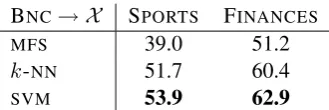
Table 1 shows the results for k-NN and SVM
trained with the original features on the BNC. In
addition, we also show the results for the Most
Frequent Sense baseline (MFS) taken from the
BNC. The second column denotes the accuracies
obtained when testing on SPORTS, and the third
column the accuracies for FINANCES. The low
ac-curacy obtained with MFS, e.g. 39.0 of precision
in SPORTS, shows the difficulty of this task. Both
classifiers improve overMFS. These classifiers are
weak baselines for the domain adaptation system.
6.2 Target scenarioX → X
In this scenario we lay the harder baseline which the domain adaptation experiments should im-prove on (cf. next section). The WSD systems are trained and tested on each of the target
cor-pora (SPORTSand FINANCES) using 3-fold
SPORTS FINANCES
X → X TRAIN +UNLAB TRAIN +UNLAB
MFS 77.8 - 82.3
-k-NN 84.5 - 87.1
-SVM 85.1 - 87.0
-k-NN-OMT 85.0 86.1 87.3 87.6
SVM-OMT 82.9 85.1 85.3 86.4
k-NN-SMA - 81.1 - 83.2
SVM-SMA - 81.3 - 84.1
k-NN-COMB 86. 0 86.7 87.9 88.6
[image:6.595.308.531.62.206.2]SVM-COMB - 86.5 - 88.5
Table 2: Target results: train and test on SPORTS,
train and test on FINANCES, using 3-fold
cross-validation.
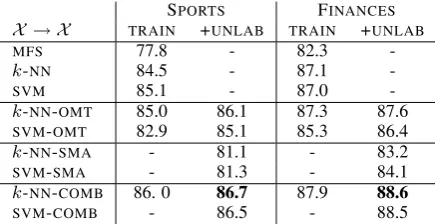
Table 2 summarizes the results for this scenario.
TRAIN denotes that only tagged data was used to
train, +UNLAB denotes that we added unlabeled
data related to the source corpus when computing
SVD. The rows denote the classifier and the feature
spaces used, which are organized in four sections. On the top rows we show the three baseline clas-sifiers on the original features. The two sections below show the results of those classifiers on the
reduced dimensions, OMT and SMA (cf. Section
4.2). Finally, the last rows show the results of the combination strategies (cf. Sections 5.1 and 5.2). Note that some of the cells have no result, because that combination is not applicable (e.g. using the train and unlabeled data in the original space).
First of all note that the results for the
base-lines (MFS, SVM, k-NN) are much larger than
those in Table 1, showing that this dataset is spe-cially demanding for supervised WSD, and partic-ularly difficult for domain adaptation experiments. These results seem to indicate that the examples from the source general corpus could be of little use when tagging the target corpora. Note
spe-cially the difference inMFSperformance. The
pri-ors of the senses are very different in the source and target corpora, which is a well-known short-coming for supervised systems. Note the high re-sults of the baseline classifiers, which leave small room for improvement.
The results for the more sophisticated methods
show that SVD and unlabeled data helps slightly,
except for k-NN-OMT on SPORTS. SMA
de-creases the performance compared to the classi-fiers trained on original features. The best im-provements come when the three strategies are
combined in one, as both the kernel and k-NN
combinations obtain improvements over the
re-spective single classifiers. Note that both thek-NN
BNC+ X SPORTS FINANCES
→ X TRAIN +UNLAB TRAIN +UNLAB
BNC→ X 53.9 - 62.9
-X → -X 86.0 86.7 87.9 88.5
MFS 68.2 - 73.1
-k-NN 81.3 - 86.0
-SVM 84.7 - 87.5
-k-NN-OMT 84.0 84.7 87.5 86.0
SVM-OMT 85.1 84.7 84.2 85.5
k-NN-SMA - 77.1 - 81.6
SVM-SMA - 78.1 - 80.7
k-NN-COMB 84.5 87.2 88.1 88.7
SVM-COMB - 88.4 - 89.7
SVM-AUG 85.9 - 88.1
-Table 3: Domain adaptation results: Train on
BNC and SPORTS, test on SPORTS(same for FI
-NANCES).
andSVMcombinations perform similarly.
In the combination strategy we show that unla-beled data helps slightly, because instead of only
combiningOMTand original features we have the
opportunity to introduceSMA. Note that it was not
our aim to improve the results of the basic classi-fiers on this scenario, but given the fact that we are going to apply all these techniques in the domain adaptation scenario, we need to show these results as baselines. That is, in the next section we will try to obtain results which improve significantly over the best results in this section.
6.3 Domain adaptation scenario
BNC+X → X
In this last scenario we try to show that our WSD
system trained on both source (BNC) and
tar-get (SPORTSand FINANCES) data performs better
than the one trained on the target data alone. We also use 3-fold cross-validation for the target data, but the entire source data is used in each turn. The unlabeled data here refers to the combination of unlabeled source and target data.
The results are presented in table 3. Again, the columns denote if unlabeled data has been used in the learning process. The rows correspond to clas-sifiers and the feature spaces involved. The first rows report the best results in the previous
scenar-ios: BNC → X for the source to target scenario,
and X → X for the target scenario. The rest of the table corresponds to the domain adaptation
scenario. The rows below correspond toMFSand
the baseline classifiers, followed by theOMT and
SMAresults, and the combination results. The last
[image:6.595.72.290.63.175.2]SPORTS FINANCES
BNC→ X
MFS 39.0 51.2
SVM 53.9 62.9
X → X
MFS 77.8 82.3
SVM 85.1 87.0
k-NN-COMB(+UNLAB) 86.7 88.6
BNC+X → X
MFS 68.2 73.1
SVM 84.7 87.5
SVM-AUG 85.9 88.1
[image:7.595.310.523.61.214.2]SVM-COMB(+UNLAB) 88.4 89.7
Table 4: The most important results in each sce-nario.
Focusing on the results, the table shows that
MFS decreases with respect to the target scenario
(cf. Table 2) when the source data is added, prob-ably caused by the different sense distributions in
BNC and the target corpora. The baseline
classi-fiers (k-NNandSVM) are not able to improve over
the baseline classifiers on the target data alone, which is coherent with past research, and shows that straightforward domain adaptation does not work.
The following rows show that our reduction
methods on themselves (OMT, SMA used by k
-NN and SVM) also fail to perform better than in
the target scenario, but the combinations using
unlabeled data (k-NN-COMB and specially SVM
-COMB) do manage to improve the best results for
the target scenario, showing that we were able to attain domain adaptation. The feature
augmenta-tion approach (SVM-AUG) does improve slightly
overSVM in the target scenario, but not over the
best results in the target scenario, showing the dif-ficulty of domain adaptation for WSD, at least on this dataset.
[image:7.595.85.278.62.194.2]7 Discussion and analysis
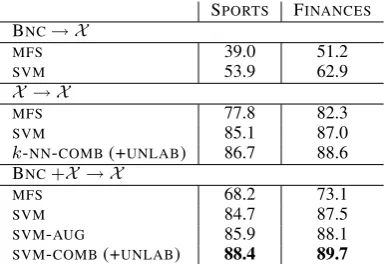
Table 4 summarizes the most important results. The kernel combination method with unlabeled data on the adaptation scenario reduces the error
on 22.1% and 17.6% over the baseline SVM on
the target scenario (SPORTS and FINANCES
re-spectively), and 12.7% and 9.0% over the k-NN
combination method on the target scenario. These gains are remarkable given the already high base-line, specially taking into consideration that the 41 nouns are closely related to the domains. The
differences, including SVM-AUG, are statistically
significant according to the Wilcoxon test with
%25 %32 %50 %62 %75 %82 %100
sports (%)
80 82 84 86 88
accuracy (%)
[image:7.595.312.521.282.434.2]SVM-COMB (+UNLAB, BNC + SPORTS -> SPORTS) SVM-AUG (BNC + SPORTS -> SPORTS) SVM-ORIG (SPORTS -> SPORTS) y=85.1
Figure 1: Learning curves for SPORTS. The X
axis denotes the amount of SPORTS data and the
Y axis corresponds to accuracy.
%25 %32 %50 %62 %75 %82 %100 finances (%)
84 86 88 90
accuracy (%)
SVM-COMB (+UNLAB, BNC + FIN. -> FIN.) SVM-AUG (BNC + FIN. -> FIN.) SVM-ORIG (FIN. -> FIN.) y=87.0
Figure 2: Learning curves for FINANCES. TheX
axis denotes the amount of FINANCESdata andY
axis corresponds to the accuracy.
p <0.01.
In addition, we carried extra experiments to ex-amine the learning curves, and to check, given the source examples, how many additional ex-amples from the target corpus are needed to ob-tain the same results as in the target scenario us-ing all available examples. We fixed the source data and used increasing amounts of target data.
We show the originalSVMon the target scenario,
andSVM-COMB(+UNLAB) andSVM-AUG as the
domain adaptation approaches. The results are
shown in figure 1 for SPORTSand figure 2 for FI
-NANCES. The horizontal line corresponds to the
performance of SVM on the target domain. The
point where the learning curves cross the horizon-tal line show that our domain adaptation method needs only around 40% of the target data in order
to get the same performance as the baselineSVM
that the domain adaptation kernel combination ap-proach, no matter the amount of target data, is al-ways above the rest of the classifiers, showing the robustness of our approach.
8 Conclusion and future work
In this paper we explore supervised domain adap-tation for WSD with positive results, that is, whether hand-labeling general domain (source) text is worth the effort when training WSD sys-tems that are to be applied to specific domains (tar-gets). We performed several experiments in three scenarios. In the first scenario (source to target scenario), the classifiers were trained on source
domain data (the BNC) and tested on the target
do-mains, composed by the SPORTS and FINANCES
sections of Reuters. In the second scenario (tar-get scenario) we set the main baseline for our do-main adaptation experiment, training and testing our classifiers on the target domain data. In the last scenario (domain adaptation scenario), we com-bine both source and target data for training, and test on the target data.
We report results in each scenario fork-NNand
SVM classifiers, for reduced features obtained
us-ingSVD over the training data, for the use of
un-labeled data, and fork-NNandSVMcombinations
of all.
Our results show that our best domain
adap-tation strategy (using kernel combination of SVD
features and unlabeled data related to the training data) yields statistically significant improvements:
up to 22% error reduction compared to SVM on
the target domain data alone. We also show that our domain adaptation method only needs 40% of the target data (in addition to the source data) in
order to get the same results asSVMon the target
alone.
We obtain coherent results in two target scenar-ios, and consistent improvement at all levels of the learning curves, showing the robustness or our findings. We think that our dataset, which com-prises examples for 41 nouns that are closely re-lated to the target domains, is specially demand-ing, as one would expect the performance of a generic WSD system to drop when moving to
the domain corpus, specially on domain-related
words, while we could expect the performance to be similar for generic or unrelated words.
In the future we would like to evaluate
our method on other datasets (e.g. DSO or
OntoNotes), to test whether the positive results are confirmed. We would also like to study word-by-word behaviour, in order to assess whether target examples are really necessary for words which are less related to the domain.
Acknowledgments
This work has been partially funded by the EU Commission (project KYOTO ICT-2007-211423) and Spanish Research Department (project KNOW TIN2006-15049-C03-01). Oier Lopez de Lacalle has a PhD grant from the Basque Govern-ment.
References
Eneko Agirre and Oier Lopez de Lacalle. 2007. Ubc-alm: Combining k-nn with svd for wsd. In Pro-ceedings of the Fourth International Workshop on Semantic Evaluations (SemEval-2007), pages 342– 345, Prague, Czech Republic, June. Association for Computational Linguistics.
Eneko Agirre and Oier Lopez de Lacalle. 2008. On robustness and domain adaptation using SVD for word sense disambiguation. InProceedings of the 22nd International Conference on Computational Linguistics (Coling 2008), pages 17–24, Manch-ester, UK, August. Coling 2008 Organizing Com-mittee.
Eneko Agirre and David Mart´ınez. 2004. The effect of bias on an automatically-built word sense corpus.
Proceedings of the 4rd International Conference on Languages Resources and Evaluations (LREC).
E. Agirre, O.Lopez de Lacalle, and David Mart´ınez. 2005. Exploring feature spaces with svd and un-labeled data for Word Sense Disambiguation. In
Proceedings of the Conference on Recent Advances on Natural Language Processing (RANLP’05), Borovets, Bulgaria.
Rie Kubota Ando. 2006. Applying alternating struc-ture optimization to word sense disambiguation. In
Proceedings of the 10th Conference on Computa-tional Natural Language Learning (CoNLL), pages 77–84, New York City.
John Blitzer, Ryan McDonald, and Fernando Pereira. 2006. Domain adaptation with structural correspon-dence learning. In Proceedings of the 2006 Con-ference on Empirical Methods in Natural Language Processing, pages 120–128, Sydney, Australia, July. Association for Computational Linguistics.
Ciprian Chelba and Alex Acero. 2004. Adaptation of maximum entropy classifier: Little data can help a lot. In Proceedings of of th Conference on Em-pirical Methods in Natural Language Processing (EMNLP), Barcelona, Spain.
Hal Daum´e III and Daniel Marcu. 2006. Domain adap-tation for statistical classifiers. Journal of Artificial Intelligence Research, 26:101–126.
Hal Daum´e III. 2007. Frustratingly easy domain adap-tation. InProceedings of the 45th Annual Meeting of the Association of Computational Linguistics, pages 256–263, Prague, Czech Republic, June. Associa-tion for ComputaAssocia-tional Linguistics.
Scott Deerwester, Susan Dumais, Goerge Furnas, Thomas Landauer, and Richard Harshman. 1990. Indexing by Latent Semantic Analysis. Journal of the American Society for Information Science, 41(6):391–407.
Gerard Escudero, Lluiz M´arquez, and German Rigau. 2000. An Empirical Study of the Domain Depen-dence of Supervised Word Sense Didanbiguation Systems. Proceedings of the joint SIGDAT Con-ference on Empirical Methods in Natural Language Processing and Very Large Corpora, EMNLP/VLC.
C. Fellbaum. 1998. WordNet: An Electronic Lexical Database. MIT Press.
Alfio Massimiliano Gliozzo, Claudio Giuliano, and Carlo Strapparava. 2005. Domain Kernels for Word Sense Disambiguation. 43nd Annual Meeting of the Association for Computational Linguistics. (ACL-05).
R. Koeling, D. McCarthy, and J. Carroll. 2005. Domain-specific sense distributions and predomi-nant sense acquisition. In Proceedings of the Hu-man Language Technology Conference and Confer-ence on Empirical Methods in Natural Language Processing. HLT/EMNLP, pages 419–426, Ann Ar-bor, Michigan.
G. Leech. 1992. 100 million words of English: the British National Corpus. Language Research, 28(1):1–13.
David Mart´ınez and Eneko Agirre. 2000. One Sense per Collocation and Genre/Topic Variations. Con-ference on Empirical Method in Natural Language.
T. Pedersen. 2001. A Decision Tree of Bigrams is an Accurate Predictor of Word Sense. InProceedings of the Second Meeting of the North American Chap-ter of the Association for Computational Linguistics (NAACL-01), Pittsburgh, PA.
Sameer Pradhan, Edward Loper, Dmitriy Dligach, and Martha Palmer. 2007. Semeval-2007 task-17: En-glish lexical sample, srl and all words. In Proceed-ings of the Fourth International Workshop on Se-mantic Evaluations (SemEval-2007), pages 87–92, Prague, Czech Republic.
Tony G. Rose, Mark Stevenson, and Miles Whitehead. 2002. The reuters corpus volumen 1 from yester-day’s news to tomorrow’s language resources. In
Proceedings of the Third International Conference on Language Resources and Evaluation (LREC-2002), pages 827–832, Las Palmas, Canary Islands.
Sarah Zelikovitz and Haym Hirsh. 2001. Using LSI for text classification in the presence of background text. In Henrique Paques, Ling Liu, and David Grossman, editors, Proceedings of CIKM-01, 10th ACM International Conference on Information and Knowledge Management, pages 113–118, Atlanta, US. ACM Press, New York, US.