Proceedings of the 12th Conference of the European Chapter of the ACL, pages 576–584,
Syntactic and Semantic Kernels for Short Text Pair Categorization
Alessandro Moschitti
Department of Computer Science and Engineering University of Trento
Via Sommarive 14 38100 POVO (TN) - Italy [email protected]
Abstract
Automatic detection of general relations between short texts is a complex task that cannot be carried out only relying on lan-guage models and bag-of-words. There-fore, learning methods to exploit syntax and semantics are required. In this pa-per, we present a new kernel for the repre-sentation of shallow semantic information along with a comprehensive study on ker-nel methods for the exploitation of syntac-tic/semantic structures for short text pair categorization. Our experiments with Sup-port Vector Machines on question/answer classification show that our kernels can be used to greatly improve system accuracy.
1 Introduction
Previous work on Text Categorization (TC) has shown that advanced linguistic processing for doc-ument representation is often ineffective for this task, e.g. (Lewis, 1992; Furnkranz et al., 1998; Allan, 2000; Moschitti and Basili, 2004). In con-trast, work in question answering suggests that syntactic and semantic structures help in solving TC (Voorhees, 2004; Hickl et al., 2006). From these studies, it emerges that when the categoriza-tion task is linguistically complex, syntax and se-mantics may play a relevant role. In this perspec-tive, the study of the automatic detection of re-lationships between short texts is particularly in-teresting. Typical examples of such relations are given in (Giampiccolo et al., 2007) or those hold-ing between question and answer, e.g. (Hovy et al., 2002; Punyakanok et al., 2004; Lin and Katz, 2003), i.e. if a text fragment correctly responds to a question.
In Question Answering, the latter problem is mostly tackled by using different heuristics and classifiers, which aim at extracting the best an-swers (Chen et al., 2006; Collins-Thompson et al., 2004). However, for definitional questions, a more effective approach would be to test if a cor-rect relationshipbetween the answer and the query holds. This, in turns, depends on the structure of the two text fragments. Designing language mod-els to capture such relation is too complex since probabilistic models suffer from (i) computational complexity issues, e.g. for the processing of large bayesian networks, (ii) problems in effectively es-timating and smoothing probabilities and (iii) high sensitiveness to irrelevant features and processing errors. In contrast, discriminative models such as Support Vector Machines (SVMs) have theoreti-cally been shown to be robust to noise and irrele-vant features (Vapnik, 1995). Thus, partially cor-rect linguistic structures may still provide a rel-evant contribution since only the relrel-evant infor-mation would be taken into account. Moreover, such a learning approach supports the use of kernel methods which allow for an efficient and effective representation of structured data.
SVMs and Kernel Methods have recently been applied to natural language tasks with promising results, e.g. (Collins and Duffy, 2002; Kudo and Matsumoto, 2003; Cumby and Roth, 2003; Shen et al., 2003; Moschitti and Bejan, 2004; Culotta and Sorensen, 2004; Kudo et al., 2005; Toutanova et al., 2004; Kazama and Torisawa, 2005; Zhang et al., 2006; Moschitti et al., 2006). In particular, in question classification, tree kernels, e.g. (Zhang and Lee, 2003), have shown accuracy comparable to the best models, e.g. (Li and Roth, 2005).
2008) have shown that shallow semantic informa-tion in the form of Predicate Argument Structures (PASs) (Jackendoff, 1990; Johnson and Fillmore, 2000) improves the automatic detection of cor-rect answers to a target question. In particular, in (Moschitti et al., 2007) kernels for the process-ing of PASs (in PropBank1format (Kingsbury and
Palmer, 2002)) extracted from question/answer pairs were proposed. However, the relatively high kernel computational complexity and the limited improvement on bag-of-words (BOW) produced by this approach do not make the use of such tech-nique practical for real world applications.
In this paper, we carry out a complete study on the use of syntactic/semantic structures for rela-tional learning from questions and answers. We designed sequence kernels for words and Part of Speech Tags which capture basic lexical seman-tics and basic syntactic information. Then, we de-sign a novel shallow semantic kernel which is far more efficient and also more accurate than the one proposed in (Moschitti et al., 2007).
The extensive experiments carried out on two different corpora of questions and answers, de-rived from Web documents and the TREC corpus, show that:
• Kernels based on PAS, POS-tag sequences and syntactic parse trees improve the BOW approach on both datasets. On the TREC data the improve-ment is interestingly high, e.g. about 61%, making its application worthwhile.
•The new kernel for processing PASs is more ef-ficient and effective than previous models so that it can be practically used in systems for short text pair categorization, e.g. question/answer classifi -cation.
In the remainder of this paper, Section 2 presents well-known kernel functions for struc-tural information whereas Section 3 describes our new shallow semantic kernel. Section 4 reports on our experiments with the above models and,fi -nally, a conclusion is drawn in Section 5.
2 String and Tree Kernels
Feature design, especially for modeling syntactic and semantic structures, is one of the most dif-ficult aspects in defining a learning system as it requires efficient feature extraction from learning objects. Kernel methods are an interesting rep-resentation approach as they allow for the use of
1
www.cis.upenn.edu/˜ace
all object substructures as features. In this per-spective, String Kernel (SK) proposed in (Shawe-Taylor and Cristianini, 2004) and the Syntactic Tree Kernel (STK) (Collins and Duffy, 2002) al-low for modeling structured data in high dimen-sional spaces.
2.1 String Kernels
The String Kernels that we consider count the number of substrings containing gaps shared by two sequences, i.e. some of the symbols of the original string are skipped. Gaps modify the weight associated with the target substrings as shown in the following.
LetΣbe afinite alphabet,Σ∗ =!∞n=0Σnis the
set of all strings. Given a strings∈Σ∗,|s|denotes the length of the strings and si its compounding
symbols, i.e s= s1..s|s|, whereas s[i : j]selects the substring sisi+1..sj−1sj from the i-th to the
j-th character. u is a subsequence of s if there is a sequence of indexes !I = (i1, ..., i|u|), with
1 ≤i1 < ... < i|u| ≤ |s|, such thatu =si1..si|u|
oru=s[I!]for short.d(!I)is the distance between thefirst and last character of the subsequenceuin
s, i.e. d(I!) =i|u|−i1 + 1. Finally, givens1, s2
∈Σ∗,s1s2indicates their concatenation.
The set of all substrings of a text corpus forms a feature space denoted byF = {u1, u2, ..} ⊂ Σ∗.
To map a string s in R∞ space, we can use the following functions: φu(s) = P!I:u=s[!I]λ
d(!I) for
some λ ≤ 1. These functions count the num-ber of occurrences ofu in the stringsand assign them a weightλd(I!) proportional to their lengths. Hence, the inner product of the feature vectors for two strings s1 ands2 returns the sum of all
com-mon subsequences weighted according to their frequency of occurrences and lengths, i.e.
SK(s1, s2) =
X
u∈Σ∗
φu(s1)·φu(s2) =
X
u∈Σ∗ X
!
I1:u=s1[!I1]
λd(I!1)
X
! I2:u=t[I!2]
λd(I!2)= X
u∈Σ∗ X
!
I1:u=s1[!I1]
X
! I2:u=t[!I2]
λd(I!1)+d(I!2),
whered(.)counts the number of characters in the substrings as well as the gaps that were skipped in the original string.
2.2 Syntactic Tree Kernel (STK)
Tree kernels compute the number of common sub-structures between two trees T1 and T2 without
explicitly considering the whole fragment space.
S
NP
NNP
Anxiety VP
VBZ
is NP
D
a N
disease
⇒
VP
VBZ
is NP
D
a N
disease VP
VBZ NP
D
a N
disease VP
VBZ
is NP
D N
disease VP
VBZ
is NP
D N VP
VBZ
is NP
VP
VBZ NP NP
D
a N
disease NP
NNP
Anxiety NNP
Anxiety VBZ
is D
a N
[image:3.595.106.512.60.116.2]disease . . .
Figure 1:A tree for the sentence ”Anxiety is a disease” with some of its syntactic tree fragments.
fragments and χi(n) be an indicator function,
equal to 1 if the target fi is rooted at node n
and equal to 0 otherwise. A tree kernel func-tion over T1 and T2 is defined as T K(T1, T2) =
"
n1∈NT1
"
n2∈NT2 ∆(n1, n2), where NT1 and
NT2 are the sets of nodes in T1 and T2,
respec-tively and∆(n1, n2) ="|F|i=1χi(n1)χi(n2).
∆ function counts the number of subtrees rooted in n1 andn2 and can be evaluated as
fol-lows (Collins and Duffy, 2002):
1. if the productions atn1andn2are different then
∆(n1, n2) = 0;
2. if the productions at n1 and n2 are the same,
and n1 and n2 have only leaf children (i.e. they
are pre-terminal symbols) then∆(n1, n2) =λ;
3. if the productions atn1andn2are the same, and
n1 andn2 are not pre-terminals then ∆(n1, n2) =
λQl(n1)
j=1 (1 + ∆(cn1(j), cn2(j))), where l(n1) is the
number of children of n1, cn(j) is the j-th child
of nodenandλis a decay factor penalizing larger structures.
Figure 1 shows some fragments of the subtree on the left part. These satisfy the constraint that grammatical rules cannot be broken. For exam-ple, [VP [VBZ NP]] is a valid fragment which has two non-terminal symbols,VBZ andNP, as leaves whereas[VP [VBZ]]is not a valid feature.
3 Shallow Semantic Kernels
The extraction of semantic representations from text is a very complex task. For it, tradition-ally used models are based on lexical similarity and tends to neglect lexical dependencies. Re-cently, work such as (Shen and Lapata, 2007; Sur-deanu et al., 2008; Moschitti et al., 2007; Mos-chitti and Quarteroni, 2008; Chali and Joty, 2008), uses PAS to consider such dependencies but only the latter three researches attempt to completely exploit PAS with Shallow Semantic Tree Kernels (SSTKs). Unfortunately, these kernels result com-putational expensive for real world applications. In the remainder of this section, we present our new kernel for PASs and compare it with the pre-vious SSTK.
PAS
A1
Disorder rel
characterize A0
fear
(a)
PAS
R-A0
that rel
causes A1
anxiety
(b)
Figure 2: Predicate Argument Structure trees associated with the sentence: ”Panic disorder is characterized by unex-pected and intense fear that causes anxiety.”.
PAS
rel
characterize A0
fear PAS
rel
characterize PAS
A1 rel A0 PAS
A1 rel
characterize PAS
rel
[image:3.595.344.488.136.183.2]characterize A0
Figure 3: Some of the tree substructures useful to capture shallow semantic properties.
3.1 Shallow Semantic Structures
Shallow approaches to semantic processing are making large strides in the direction of efficiently and effectively deriving tacit semantic informa-tion from text. Large data resources annotated with levels of semantic information, such as in the FrameNet (Johnson and Fillmore, 2000) and Prop-Bank (PB) (Kingsbury and Palmer, 2002) projects, make it possible to design systems for the auto-matic extraction of predicate argument structures (PASs) (Carreras and M`arquez, 2005). PB-based systems produce sentence annotations like: [A1Panic disorder] is [relcharacterized] [A0by unexpected
and intense fear] [R−A0that] [relcauses] [A1anxiety].
A tree representation of the above semantic in-formation is given by the two PAS trees in Fig-ure 2, where the argument words are replaced by the head word to reduce data sparseness. Hence, the semantic similarity between sentences can be measured in terms of the number of substructures between the two trees. The required substructures violate the STK constraint (about breaking pro-duction rules), i.e. since we need any set of nodes linked by edges of the initial tree. For example, interesting semantic fragments of Figure 2.a are shown in Figure 3.
Unfortunately, STK applied to PAS trees cannot generate such fragments. To overcome this prob-lem, a Shallow Semantic Tree Kernel (SSTK) was designed in (Moschitti et al., 2007).
3.2 Shallow Semantic Tree Kernel (SSTK)
of SLOT nodes as many as the number of possi-ble argument types, where each slot is assigned to an argument following afixed ordering (e.g. rel,
A0,A1,A2, . . . ). For example, if an A1 is found in the sentence annotation it will be always posi-tioned under the third slot. This is needed to “arti-ficially” allow SSTK to generate structures con-taining subsets of arguments. For example, the tree in Figure 2.a is transformed into thefirst tree of Fig. 4, where ”null” just states that there is no corresponding argument type.
Second, to discard fragments only containing slot nodes, in the STK algorithm, a new step 0 is added and the step 3 is modified (see Sec. 2.2): 0. ifn1(orn2) is a pre-terminal node and its child
label isnull,∆(n1, n2) = 0;
3. ∆(n1, n2) =Qlj(=1n1)(1 + ∆(cn1(j), cn2(j)))−1.
For example, Fig. 4 shows the fragments gen-erated by SSTK. The comparison with the ideal fragments in Fig. 3 shows that SSTK well approx-imates the semantic features needed for the PAS representation. The computational complexity of SSTK isO(n2), wherenis the number of the PAS
nodes (leaves excluded). Considering that the tree including all the PB arguments contains 52 slot nodes, the computation becomes very expensive. To overcome this drawback, in the next section, we propose a new kernel to efficiently process PAS trees with no addition of slot nodes.
3.3 Semantic Role Kernel (SRK)
The idea of SRK is to produce all child subquences of a PAS tree, which correspond to se-quences of predicate arguments. For this purpose, we can use a string kernel (SK) (see Section 2.1) for which efficient algorithms have been devel-oped. Once a sequence of arguments is output by SK, for each argument, we account for the poten-tial matches of its children, i.e. the head of the argument (or more in general the argument word sequence).
More formally, given two sequences of argu-ment nodes, s1 and s2, in two PAS trees and
considering the string kernel in Sec 2.1, the SRK(s1, s2)is defined as:
X
! I1:u=s1[I!1]
! I2:u=s2[!I2]
Y
l=1..|u|
(1 +σ(s1[I$1l], s2[I$2l]))λd( !
I1)+d(I!2), (1)
where u is any subsequence of argument nodes,
!
Il is the index of the l-th argument node, s[I!l]is
the corresponding argument node in the sequence
sandσ(s1[I!1l], s2[I!2l])is 1 if the heads of the
ar-guments are identical, otherwise is 0.
Proposition 1 SRK computes the number of all possible tree substructures shared by the two eval-uating PAS trees, where the considered substruc-tures of a treeTare constituted by any set of nodes (at least two) linked by edges ofT.
Proof The PAS trees only contain three node lev-els and, according to the proposition’s thesis, sub-structures contain at least two nodes. The num-ber of substructures shared by two trees, T1 and
T2, constituted by the root node (PAS) and the
subsequences of argument nodes is evaluated by
"
!
I1:u=s1[I!1],!I2:u=s2[I!2]λd(
!
I1)+d(I!2)(whenλ= 1).
Given a node in a shared subsequenceu, its child (i.e. the head word) can be both in T1 and T2,
originating two different shared structures (with or without such head node). The matches on the heads (for each shared node of u) are combined together generating different substructures. Thus the number of substructures originating fromuis the product,#l=1..|u|(1+σ(s1[I!1l], s2[I!2l])). This
number multiplied by all shared subsequences
leads to Eq. 1. !
We can efficiently compute SRK by following a similar approach to the string kernel evaluation in (Shawe-Taylor and Cristianini, 2004) by defining the following dynamic matrix:
Dp(k, l) = k X
i=1
l X
r=1
λk−i+l−r×γp−1(s1[1 :i], s2[1 :r]),
(2)
whereγp(s1, s2)counts the number of shared
sub-structures of exactlypargument nodes betweens1
ands2 and again,s[1 : i]indicates the sequence
portion from argument 1 toi. The above matrix is then used to evaluateγp(s1a, s2b) =
(
λ2(1 +σ(h(a), h(b)))D
p(|s1|,|s2|)ifa=b;
0 otherwise. (3)
where s1a and s2b indicate the concatenation of
the sequences sandtwith the argument nodes,a
and b, respectively and σ(h(a), h(b)) is 1 if the children ofaandbare identical (e.g. same head). The interesting property is that:
Dp(k, l) =γp−1(s1[1 :k], s2[1 :l]) +λDp(k, l−1)
+λDp(k−1, l)−λ2Dp(k−1, l−1).
(4)
To obtain the final kernel, we need to con-sider all possible subsequence lengths. Let
m be the minimum between |s1| and |s2|,
SRK(s1, s2) =
m X
p=1
PAS
SLOT
rel
characterize SLOT
A0
fear
* SLOT
A1
disorder
* SLOT
null . . .
PAS
SLOT
rel
characterize SLOT
A0
fear
* SLOT
null . . .
PAS
SLOT
rel
characterize SLOT
null SLOT
null . . .
PAS
SLOT
rel SLOT
A0 SLOT
A1 . . .
PAS
SLOT
rel
characterize SLOT
A1 SLOT
[image:5.595.83.520.59.117.2]null . . .
Figure 4: Fragments of Fig. 2.a produced by the SSTK (similar to those of Fig. 3).
Regarding the processing time, ifρis the max-imum number of arguments in a predicate struc-ture, the worst case computational complexity of SRK isO(ρ3).
3.4 SRK vs. SSTK
A comparison between SSTK and SRK suggests the following points: first, although the computa-tional complexity of SRK is larger than the one of SSTK, we will show in the experiment section that the running time (for both training and test-ing) is much lower. The worse case is not really informative since as shown in (Moschitti, 2006), we can design fast algorithm with a linear average running time (we use such algorithm for SSTK).
Second, although SRK uses trees with only three levels, in Eq.1, the function σ (defined to give 1 or 0 if the heads match or not) can be sub-stituted by any kernel function. Thus, σ can re-cursively be an SRK (and evaluate Nested PASs (Moschitti et al., 2007)) or any other potential ker-nel (over the arguments). The very interesting as-pect is that the efficient algorithm that we provide (Eqs 2, 3 and 4) can be accordingly modified to efficiently evaluate new kernels obtained with the
σsubstitution2.
Third, the interesting difference between SRK and SSTK (in addition to efficiency) is that SSTK requires an ordered sequence of arguments to eval-uate the number of argument subgroups (argu-ments are sorted before running the kernel). This means that the natural order is lost. SRK instead is based on subsequence kernels so it naturally takes into account the order which is very important: without it, syntactic/semantic properties of pred-icates cannot be captured, e.g. passive and active forms have the same argument order for SSTK.
Finally, SRK gives a weight to the predicate substructures by considering their length, which also includes gaps, e.g. the sequence (A0, A1) is more similar to (A0, A1) than (A0, A-LOC, A1), in turn, the latter produces a heavier match than (A0, A-LOC, A2, A1) (please see Section 2.1).
2For space reasons we cannot discuss it here.
This is another important property for modeling shallow semantics similarity.
4 Experiments
Our experiments aim at studying the impact of our kernels applied to syntactic/semantic structures for the detection of relations between short texts. In particular, wefirst show that our SRK is far more efficient and effective than SSTK. Then, we study the impact of the above kernels as well as se-quence kernels based on words and Part of Speech Tags and tree kernels for the classification of ques-tion/answer text pairs.
4.1 Experimental Setup
The task used to test our kernels is the classifi -cation of the correctness of %q, a& pairs, where a
is an answer for the query q. The text pair ker-nel operates by comparing the content of ques-tions and the content of answers in a separate fash-ion. Thus, given two pairs p1 = %q1, a1& and
p2 = %q2, a2&, a kernel function is defined as
K(p1, p2) = "τKτ(q1, q2) + "τKτ(a1, a2),
where τ varies across different kernel functions described hereafter.
As a basic kernel machine, we used our SVM-Light-TK toolkit, available atdisi.unitn.
it/moschitti (which is based on SVM-Light
(Joachims, 1999) software). In it, we imple-mented: the String Kernel (SK), the Syntactic Tree Kernel (STK), the Shallow Semantic Tree Kernel (SSTK) and the Semantic Role Kernel (SRK) de-scribed in sections 2 and 3. Each kernel is associ-ated with the above linguistic objects: (i) the linear kernel is used with the bag-of-words (BOW) or the bag-of-POS-tags (POS) features. (ii) SK is used with word sequences (i.e. the Word Sequence Ker-nel, WSK) and POS sequences (i.e. the POS Se-quence Kernel, PSK). (iii) STK is used with syn-tactic parse trees automatically derived with Char-niak’s parser; (iv) SSTK and SRK are applied to two different PAS trees (see Section 3.1), automat-ically derived with our SRL system.
con-0 20 40 60 80 100 120 140 160 180 200 220 240
200 400 600 800 1000 1200 1400 1600 1800
Time in Seconds
Training Set Size
SRK (training) SRK (test)
[image:6.595.59.294.60.209.2]SSTK (test) SSTK (training)
Figure 5: Efficiency of SRK and SSTK
tain more than one PAS, we applied SRK or SSTK to all pairsP1 ×P2 and sum the obtained
contri-bution, whereP1andP2are the set of PASs of the
first and second answer3. Although different
ker-nels can be used for questions and for answers, we used (and summed together) the same kernels ex-cept for those based on PASs, which are only used on answers.
4.1.1 Datasets
To train and test our text QA classifiers, we adopted the two datasets of question/answer pairs available at disi.unitn.it/˜silviaq, contain-ing answers to only definitional questions. The datasets are based on the 138 TREC 2001 test questions labeled as “description” in (Li and Roth, 2005). Each question is paired with all the top 20 answer paragraphs extracted by two basic QA systems: one trained with the web documents and the other trained with the AQUAINT data used in TREC’07.
The WEB corpus (Moschitti et al., 2007) of QA pairs contains 1,309 sentences, 416 of which are positive4 answers whereas the TREC corpus con-tains 2,256 sentences, 261 of which are positive.
4.1.2 Measures and Parameterization
The accuracy of the classifiers is provided by the average F1 over 5 different samples using 5-fold cross-validation whereas each plot refers to a sin-gle fold. We carried out some preliminary experi-ments of the basic kernels on a validation set and
3More formally, letP
t andPt" be the sets of PASs
ex-tracted from text fragmentstandt$; the resulting kernel will
beKall(Pt, Pt") =Pp∈PtPp"∈Pt"SRK(p, p
$).
4For instance, given the question “What are
inverte-brates?”, the sentence “At least 99% of all animal species are invertebrates, comprising . . . ” was labeled “-1” , while “Invertebrates are animals without backbones.” was labeled “+1”.
we noted that the F1 was maximized by using the default cost parameters (option -c of SVM-Light),
λ = 0.04 (see Section 2). The trade-off parame-ter varied according to different kernels on WEB data (so it needed an ad-hoc estimation) whereas a value of 10 was optimal for any kernel on the TREC corpus.
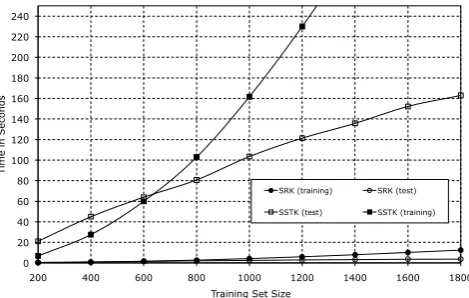
4.2 Shallow Semantic Kernel Efficiency
Section 2 has illustrated that SRK is applied to more compact PAS trees than SSTK, which runs on large structures containing as many slots as the number of possible predicate argument types. This impacts on the memory occupancy as well as on the kernel computation speed. To empiri-cally verify our analytical findings (Section 3.3), we divided the training (TREC) data in 9 bins of increasing size (200 instances between two con-tiguous bins) and we measured the learning and test time5 for each bin. Figure 5 shows that in
both the classification and learning phases, SRK is much faster than SSTK. With all training data, SSTK employs 487.15 seconds whereas SRK only uses 12.46 seconds, i.e. it is about 40 times faster, making the experimentation of SVMs with large datasets feasible. It is worth noting that to imple-ment SSTK we used the fast version of STK and that, although the PAS trees are smaller than syn-tactic trees, they may still contain more than half million of substructures (when they are formed by seven arguments).
4.3 Results for Question/Answer Classification
In these experiments, we tested different kernels and some of their most promising combinations, which are simply obtained by adding the different kernel contributions6 (this yields the joint feature space of the individual kernels).
Table 1 shows the average F1±the standard de-viation7 over 5-folds on Web (and TREC) data of SVMs using different kernels. We note that: (a) BOW achieves very high accuracy, comparable to the one produced by STK, i.e. 65.3 vs 65.1; (b) the BOW+STK combination achieves 66.0,
im-5Processing time in seconds of a Mac-Book Pro 2.4 Ghz. 6All adding kernels are normalized to have a
sim-ilarity score between 0 and 1, i.e. K$(X1, X2) =
K(X1,X2)
√
K(X1,X1)×K(X2,X2).
7The Std. Dev. of the difference between two classifier
WEB Corpus
BOW POS PSK WSK STK SSTK SRK BOW+POS BOW+STK PSK+STK WSK+STK STK+SSTK STK+SRK 65.3±2.9 56.8±0.8 62.5±2.3 65.7±6.0 65.1±3.9 52.9±1.7 50.8±1.2 63.7±1.6 66.0±2.7 65.3±2.4 66.6±3.0 (+WSK)68.0±2.7(+WSK)68.2±4.3
TREC Corpus
[image:7.595.70.534.66.115.2]24.2±5.0 26.5±7.9 31.6±6.8 14.0±4.2 33.1±3.8 21.8±3.7 23.6±4.7 31.9±7.1 30.3±4.1 36.4±7.0 23.7±3.9 (+PSK)37.2±6.9 (+PSK)39.1±7.3
Table 1: F1±Std. Dev. of the question/answer classifier according to several kernels on the WEB and TREC corpora.
proving both BOW and STK; (c) WSK (65.7) im-proves BOW and it is enhanced by WSK+STK (66.6), demonstrating that word sequences and STKs are very relevant for this task; and fi -nally, WSK+STK+SSTK is slightly improved by WSK+STK+SRK, 68.0% vs 68.2% (not signifi -cantly) and both improve on WSK+STK.
The abovefindings are interesting as the syntac-tic information provided by STK and the semansyntac-tic information brought by WSK and SRK improve on BOW. The high accuracy of BOW is surprising if we consider that at classification time, instances of the training models (e.g. support vectors) are compared with different test examples since ques-tions cannot be shared between training and test set8. Therefore the answer words should be dif-ferent and useless to generalize rules for answer classification. However, error analysis reveals that although questions are not shared between train-ing and test set, there are common words in the answers due to typical Web page patterns which indicate if a retrieved passage is an incorrect an-swer, e.g.Learn more about X.
Although the ability to detect these patterns is beneficial for a QA system as it improves its over-all accuracy, it is slightly misleading for the study that we are carrying out. Thus, we experimented with the TREC corpus which does not contain Web extra-linguistic texts and it is more complex from a QA task viewpoint (it is more difficult to find a correct answer).
Table 1 also shows the classification results on the TREC dataset. A comparative analysis sug-gests that: (a) the F1 of all models is much lower than for the Web dataset; (b) BOW shows the low-est accuracy (24.2) and also the accuracy of its combination with STK (30.3) is lower than the one of STK alone (33.1); (c) PSK (31.6) improves POS (26.5) information and PSK+STK (36.4) im-proves on PSK and STK; and (d) PAS adds further
8Sharing questions between test and training sets would
be an error from a machine learning viewpoint as we cannot expect new questions to be identical to those in the training set.
information as the best model is PSK+STK+SRK, which improves BOW from 24.2 to 39.1, i.e. 61%. Finally, it is worth noting that SRK provides a higher improvement (39.1-36.4) than SSTK (37.2-36.4).
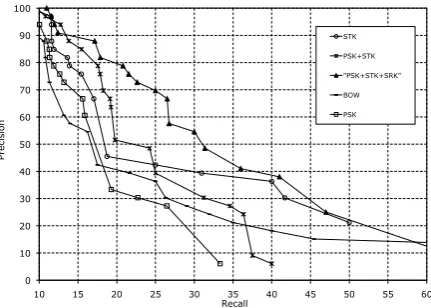
4.4 Precision/Recall Curves
To better study the benefit of the proposed linguis-tic structures, we also plotted the Precision/Recall curves (one fold for each corpus). Figure 6 shows the curve of some interesting kernels applied to the Web dataset. As expected, BOW shows the lowest curves, although, its relevant contribution is evident. STK improves BOW since it pro-vides a better model generalization by exploit-ing syntactic structures. Also, WSK can gener-ate a more accurgener-ate model than BOW since it uses n-grams (with gaps) and when it is summed to STK, a very accurate model is obtained9. Finally, WSK+STK+SRK improves all the models show-ing the potentiality of PASs.
Such curves show that there is no superior model. This is caused by the high contribution of BOW, which de-emphasize all the other mod-els’s result. In this perspective, the results on TREC are more interesting as shown by Figure 7 since the contribution of BOW is very low making the difference in accuracy with the other linguis-tic models more evident. PSK+STK+SRK, which encodes the most advanced syntactic and semantic information, shows a very high curve which out-performs all the others.
The analysis of the above results suggests that: first as expected, BOW does not prove very rel-evant to capture the relations between short texts from examples. In the QA classification, while BOW is useful to establish the initial ranking by measuring the similarity between question and an-swer, it is almost irrelevant to capture typical rules suggesting if a description is valid or not. Indeed, since test questions are not in the training set, their words as well as those of candidate answers will be different, penalizing BOW models. In these
9Some of the kernels have been removed from thefigures
0 10 20 30 40 50 60 70 80 90 100
30 40 50 60 70 80 90 100
Precision
Recall STK
WSK+STK
WSK+STK+SRK
BOW
[image:8.595.72.295.62.216.2]WSK
Figure 6: Precision/Recall curves of some kernel combinations on the WEB dataset.
0 10 20 30 40 50 60 70 80 90 100
10 15 20 25 30 35 40 45 50 55 60
Precision
Recall
STK PSK+STK "PSK+STK+SRK" BOW PSK
Figure 7: Precision/Recall curves of some kernel combinations on the TREC dataset.
conditions, we need to rely on syntactic structures which at least allow for detecting well formed de-scriptions.
Second, the results show that STK is important to detect typical description patterns but also POS sequences provide additional information since they are less sparse than tree fragments. Such pat-terns improve on the bag of POS-tags by about 6% (see POS vs PSK). This is a relevant result consid-ering that in standard text classification bigrams or trigrams are usually ineffective.
Third, although PSK+STK generates a very rich feature set, SRK significantly improves the classi-fication F1 by about 3%, suggesting that shallow semantics can be very useful to detect if an an-swer is well formed and is related to a question. Error analysis revealed that PAS can provide pat-terns like:
-A0(X) R-A0(that) rel(result) A1(Y)
-A1(X) rel(characterize) A0(Y),
where X and Y need not necessarily be matched. Finally, the best model, PSK+STK+SRK,
im-proves on BOW by 61%. This is strong evidence that complex natural language tasks require ad-vanced linguistic information that should be ex-ploited by powerful algorithms such as SVMs and using effective feature engineering techniques such as kernel methods.
5 Conclusion
In this paper, we have studied several types of syntactic/semantic information: bag-of-words (BOW), bag-of-POS tags, syntactic parse trees and predicate argument structures (PASs), for the design of short text pair classifiers. Our learn-ing framework is constituted by Support Vector Machines (SVMs) and kernel methods applied to automatically generated syntactic and semantic structures.
In particular, we designed (i) a new Semantic Role Kernel (SRK) based on a very fast algorithm; (ii) a new sequence kernel over POS tags to en-code shallow syntactic information; (iii) many ker-nel combinations (to our knowledge no previous work uses so many different kernels) which allow for the study of the role of several linguistic levels in a well defined statistical framework.
The results on two different question/answer classification corpora suggest that (a) SRK for pro-cessing PASs is more efficient and effective than previous models, (b) kernels based on PAS, POS-tag sequences and syntactic parse trees improve on BOW on both datasets and (c) on the TREC data the improvement is remarkably high, e.g. about 61%.
Promising future work concerns the definition of a kernel on the entire argument information (e.g. by means of lexical similarity between all the words of two arguments) and the design of a dis-course kernelto exploit the relational information gathered from different sentence pairs. A closer relationship between questions and answers can be exploited with models presented in (Moschitti and Zanzotto, 2007; Zanzotto and Moschitti, 2006). Also the use of PAS derived from FrameNet and PropBank (Giuglea and Moschitti, 2006) appears to be an interesting research line.
Acknowledgments
[image:8.595.74.290.264.418.2]References
J. Allan. 2000. Natural Language Processing for Information Retrieval. InNAACL/ANLP (tutorial notes).
X. Carreras and L. M`arquez. 2005. Introduction to the CoNLL-2005 shared task: SRL. InCoNLL-2005.
Y. Chali and S. Joty. 2008. Improving the performance of the random walk model for answering complex questions. InProceedings of ACL-08: HLT, Short Papers, Columbus, Ohio.
Y. Chen, M. Zhou, and S. Wang. 2006. Reranking answers from definitional QA using language models. InACL’06.
M. Collins and N. Duffy. 2002. New ranking algorithms for parsing and tagging: Kernels over discrete structures, and the voted perceptron. InACL’02.
K. Collins-Thompson, J. Callan, E. Terra, and C. L.A. Clarke. 2004. The effect of document retrieval quality on factoid QA performance. InSIGIR’04.
Aron Culotta and Jeffrey Sorensen. 2004. Dependency Tree Kernels for Relation Extraction. InACL04, Barcelona, Spain.
C. Cumby and D. Roth. 2003. Kernel Methods for Rela-tional Learning. InProceedings of ICML 2003, Washing-ton, DC, USA.
J. Furnkranz, T. Mitchell, and E. Rilof. 1998. A case study in using linguistic phrases for text categorization on the www. InWorking Notes of the AAAI/ICML, Workshop on Learning for Text Categorization.
D. Giampiccolo, B. Magnini, I. Dagan, and B. Dolan. 2007. The third pascal recognizing textual entailment challenge. InProceedings of the ACL-PASCAL Workshop, Prague.
A.-M. Giuglea and A. Moschitti. 2006. Semantic role label-ing via framenet, verbnet and propbank. InProceedings of ACL 2006, Sydney, Australia.
A. Hickl, J. Williams, J. Bensley, K. Roberts, Y. Shi, and B. Rink. 2006. Question answering with lccs chaucer at trec 2006. InProceedings of TREC’06.
E. Hovy, U. Hermjakob, C.-Y. Lin, and D. Ravichandran. 2002. Using knowledge to facilitate factoid answer pin-pointing. In Proceedings of Coling, Morristown, NJ, USA.
R. Jackendoff. 1990.Semantic Structures. MIT Press.
T. Joachims. 1999. Making large-scale SVM learning prac-tical. In B. Sch¨olkopf, C. Burges, and A. Smola, editors,
Advances in Kernel Methods.
C. R. Johnson and C. J. Fillmore. 2000. The framenet tagset for frame-semantic and syntactic coding of predicate-argument structures. InANLP-NAACL’00, pages 56–62.
J. Kazama and K. Torisawa. 2005. Speeding up Train-ing with Tree Kernels for Node Relation LabelTrain-ing. In
Proceedings of EMNLP 2005, pages 137–144, Toronto, Canada.
P. Kingsbury and M. Palmer. 2002. From Treebank to Prop-Bank. InLREC’02.
T. Kudo and Y. Matsumoto. 2003. Fast Methods for Kernel-Based Text Analysis. In Erhard Hinrichs and Dan Roth, editors,Proceedings of ACL.
T. Kudo, J. Suzuki, and H .Isozaki. 2005. Boosting-based parse reranking with subtree features. InProceedings of ACL’05, US.
D. D. Lewis. 1992. An evaluation of phrasal and clustered representations on a text categorization task. In Proceed-ings of SIGIR-92.
X. Li and D. Roth. 2005. Learning question classifiers: the role of semantic information.JNLE.
J. Lin and B. Katz. 2003. Question answering from the web using knowledge annotation and knowledge mining tech-niques. InCIKM ’03.
A. Moschitti and R. Basili. 2004. Complex linguistic fea-tures for text classification: A comprehensive study. In
ECIR, Sunderland, UK.
A. Moschitti and C. Bejan. 2004. A semantic kernel for pred-icate argument classification. In CoNLL-2004, Boston, MA, USA.
A. Moschitti and S. Quarteroni. 2008. Kernels on linguistic structures for answer extraction. InProceedings of ACL-08: HLT, Short Papers, Columbus, Ohio.
A. Moschitti and F. Zanzotto. 2007. Fast and effective ker-nels for relational learning from texts. In Zoubin Ghahra-mani, editor,Proceedings of ICML 2007.
A. Moschitti, D. Pighin, and R. Basili. 2006. Semantic role labeling via tree kernel joint inference. InProceedings of CoNLL-X, New York City.
A. Moschitti, S. Quarteroni, R. Basili, and S. Manandhar. 2007. Exploiting syntactic and shallow semantic kernels for question/answer classification. In ACL’07, Prague, Czech Republic.
A. Moschitti. 2006. Making Tree Kernels Practical for Nat-ural Language Learning. InProceedings of EACL2006.
V. Punyakanok, D. Roth, and W. Yih. 2004. Mapping depen-dencies trees: An application to question answering. In
Proceedings of AI&Math 2004.
J. Shawe-Taylor and N. Cristianini. 2004. Kernel Methods for Pattern Analysis. Cambridge University Press. D. Shen and M. Lapata. 2007. Using semantic roles to
im-prove question answering. InProceedings of EMNLP-CoNLL.
L. Shen, A. Sarkar, and A. k. Joshi. 2003. Using LTAG Based Features in Parse Reranking. InEMNLP, Sapporo, Japan.
M. Surdeanu, M. Ciaramita, and H. Zaragoza. 2008. Learn-ing to rank answers on large online QA collections. In
Proceedings of ACL-08: HLT, Columbus, Ohio.
K. Toutanova, P. Markova, and C. Manning. 2004. The Leaf Path Projection View of Parse Trees: Exploring String Kernels for HPSG Parse Selection. InProceedings of EMNLP 2004, Barcelona, Spain.
V. Vapnik. 1995. The Nature of Statistical Learning Theory. Springer.
E. M. Voorhees. 2004. Overview of the trec 2001 question answering track. InProceedings of the Thirteenth Text REtreival Conference (TREC 2004).
F. M. Zanzotto and A. Moschitti. 2006. Automatic learning of textual entailments with cross-pair similarities. In Pro-ceedings of the 21st Coling and 44th ACL, Sydney, Aus-tralia.
D. Zhang and W. Lee. 2003. Question classification using support vector machines. InSIGIR’03, Toronto, Canada. ACM.