CoNLL-2012 Shared Task:
Modeling Multilingual Unrestricted Coreference in OntoNotes
Sameer Pradhan Raytheon BBN Technologies,
Cambridge, MA 02138 USA
Alessandro Moschitti University of Trento,
38123 Povo (TN) Italy
Nianwen Xue Brandeis University, Waltham, MA 02453
USA
Olga Uryupina University of Trento,
38123 Povo (TN) Italy [email protected]
Yuchen Zhang Brandeis University, Waltham, MA 02453
USA
Abstract
The CoNLL-2012 shared task involved pre-dicting coreference in English, Chinese, and Arabic, using the final version, v5.0, of the OntoNotes corpus. It was a follow-on to the English-only task organized in 2011. Un-til the creation of the OntoNotes corpus, re-sources in this sub-field of language process-ing were limited to noun phrase coreference, often on a restricted set of entities, such as theACEentities. OntoNotes provides a
large-scale corpus of general anaphoric coreference not restricted to noun phrases or to a spec-ified set of entity types, and covers multi-ple languages. OntoNotes also provides ad-ditional layers of integrated annotation, cap-turing additional shallow semantic structure. This paper describes the OntoNotes annota-tion (coreference and other layers) and then describes the parameters of the shared task in-cluding the format, pre-processing informa-tion, evaluation criteria, and presents and dis-cusses the results achieved by the participat-ing systems. The task of coreference has had a complex evaluation history. Potentially many evaluation conditions, have, in the past, made it difficult to judge the improvement in new algorithms over previously reported re-sults. Having a standard test set and stan-dard evaluation parameters, all based on a re-source that provides multiple integrated anno-tation layers (syntactic parses, semantic roles, word senses, named entities and coreference) and in multiple languages could support joint modeling and help ground and energize on-going research in the task of entity and event coreference.
1 Introduction
The importance of coreference resolution for the entity/event detection task, namely identifying all mentions of entities and events in text and clustering them into equivalence classes, has been well recog-nized in the natural language processing community.
Early work on corpus-based coreference resolu-tion dates back to the mid-90s by McCarthy and Lenhert (1995) where they experimented with deci-sion trees and hand-written rules. Corpora to support supervised learning of this task date back to the Mes-sage Understanding Conferences (MUC) (Hirschman and Chinchor, 1997; Chinchor, 2001; Chinchor and Sundheim, 2003). The de facto standard datasets
for current coreference studies are theMUC and the
ACE1(Doddington et al., 2004) corpora. These
cor-pora were tagged with coreferring entities in the
form of noun phrases in the text. TheMUCcorpora
cover all noun phrases in text but are relatively small
in size. TheACE corpora, on the other hand, cover
much more data, but the annotation is restricted to a small subset of entities.
Automatic identification of coreferring entities and events in text has been an uphill battle for sev-eral decades, partly because it is a problem that re-quires world knowledge to solve and word knowl-edge is hard to define, and partly owing to the lack of substantial annotated data. Aside from the fact that resolving coreference in text is simply a very hard problem, there have been other hindrances that further contributed to the slow progress in this area:
(i) Smaller sized corporasuch asMUCwhich cov-ered coreference across all noun phrases.
Cor-pora such as ACEwhich are larger in size,but
cover a smaller set of entities; and
(ii) low consistency in existing corporaannotated
with coreference — in terms of inter-annotator agreement (ITA) (Hirschman et al., 1998) — owing to attempts at covering multiple coref-erence phenomena that are not equally anno-tatable with high agreement which likely less-ened the reliability of statistical evidence in the form of lexical coverage and semantic related-ness that could be derived from the data and 1http://projects.ldc.upenn.edu/ace/data/
used by a classifier to generate better predic-tive models. The importance of a well-defined tagging scheme and consistent ITA has been well recognized and studied in the past (Poe-sio, 2004; Poesio and Artstein, 2005; Passon-neau, 2004). There is a growing consensus that in order to take language understanding appli-cations such as question answering or distilla-tion to the next level, we need more consistent annotation for larger amounts of broad cover-age data to train better automatic models for entity and event detection.
(iii) Complex evaluation with multiple evaluation
metrics and multiple evaluation scenarios, complicated with varying training and test partitions, led to situations where many re-searchers report results with only one or a few of the available metrics and under a subset of evaluation scenarios. This has made it hard to gauge the improvement in algorithms over the years (Stoyanov et al., 2009), or to determine which particular areas require further attention. Looking at various numbers reported in litera-ture can greatly affect the perceived difficulty of the task. It can seem to be a very hard prob-lem (Soon et al., 2001) or one that is relatively easy (Culotta et al., 2007).
(iv) the knowledge bottleneck which has been a
well-accepted ceiling that has kept the progress in this task at bay.
These issues suggest that the following steps might take the community in the right direction to-wards improving the state of the art in coreference resolution:
(i) Create a large corpus with high
inter-annotator agreement possibly by restricting
the coreference annotating to phenomena that can be annotated with high consistency, and
covering an unrestricted set of entities and events; and
(ii) Create astandard evaluation scenariowith an
official evaluation setup, and possibly several ablation settings to capture the range of perfor-mance. This can then be used as a standard benchmark by the research community.
(iii) Continue to improve learning algorithms that
better incorporate world knowledge and jointly incorporate information from other layers of syntactic and semantic annotation to improve the state of the art.
One of the many goals of the OntoNotes
project2(Hovy et al., 2006; Weischedel et al., 2011)
2http://www.bbn.com/nlp/ontonotes
was to explore whether it could fill this void and help push the progress further — not only in coreference, but with the various layers of semantics that it tries to capture. As one of its layers, it has created a corpus for general anaphoric coreference that cov-ers entities and events not limited to noun phrases or a subset of entity types. The coreference layer in OntoNotes constitutes just one part of a multi-layered, integrated annotation of shallow semantic structures in text with high inter-annotator agree-ment. This addresses the first issue.
In the language processing community, the field of speech recognition probably has the longest
his-tory of shared evaluations held primary by NIST3
(Pallett, 2002). In the past decade machine trans-lation has been a topic of shared evaluations also
by NIST4. There are many syntactic and semantic
processing tasks that are not quite amenable to such continued evaluation efforts. The CoNLL shared tasks over the past 15 years have filled that gap, help-ing establish benchmarks and advance the state of the art in various sub-fields within NLP. The impor-tance of shared tasks is now in full display in the domain of clinical NLP (Chapman et al., 2011) and recently a coreference task was organized as part of the i2b2 workshop (Uzuner et al., 2012). The computational learning community is also witness-ing a shift towards joint inference based evaluations, with the two previous CoNLL tasks (Surdeanu et al., 2008; Hajiˇc et al., 2009) devoted to joint learning of syntactic and semantic dependencies. A SemEval-2010 coreference task (Recasens et al., SemEval-2010) was the first attempt to address the second issue. It included six different Indo-European languages — Catalan, Dutch, English, German, Italian, and
Span-ish. Among other corpora, a small subset (∼120K)
of English portion of OntoNotes was used for this purpose. However, the lack of a strong participa-tion prevented the organizers from reaching any firm conclusions. The CoNLL-2011 shared task was an-other attempt to address the second issue. It was well
received, but the shared task was onlylimited to the
English portion of OntoNotes.In addition, the
coref-erence portion of OntoNotes did not have a concrete baseline prior to the 2011 evaluation, thereby mak-ing it challengmak-ing for participants to gauge the per-formance of their algorithms in the absence of es-tablished state of the art on this flavor of annotation. The closest comparison was to the results reported by Pradhan et al. (2007b) on the newswire portion of OntoNotes. Since the corpus also covers two other languages from completely different language fami-lies, Chinese and Arabic, it provided a great
oppor-tunity to have afollow-on task in 2012 covering all
three languages. As we will see later, peculiarities
of each of these languages had to be considered in creating the evaluation framework.
The first systematic learning-based study in
coref-erence resolution was conducted on the MUC
cor-pora, using a decision tree learner, by Soon et al. (2001). Significant improvements have been made in the field of language processing in general, and improved learning techniques have pushed the state of the art in coreference resolution forward (Mor-ton, 2000; Harabagiu et al., 2001; McCallum and Wellner, 2004; Culotta et al., 2007; Denis and Baldridge, 2007; Rahman and Ng, 2009; Haghighi and Klein, 2010). Researchers have continued to find novel ways of exploiting ontologies such as WordNet. Various knowledge sources from shallow semantics to encyclopedic knowledge have been ex-ploited (Ponzetto and Strube, 2005; Ponzetto and Strube, 2006; Versley, 2007; Ng, 2007). Given that WordNet is a static ontology and as such has limitation on coverage, more recently, there have been successful attempts to utilize information from much larger, collaboratively built resources such as Wikipedia (Ponzetto and Strube, 2006). More re-cently researchers have used graph based algorithms (Cai et al., 2011a) rather than pair-wise classifica-tions. For a detailed survey of the progress in this field, we refer the reader to a recent article (Ng, 2010) and a tutorial (Ponzetto and Poesio, 2009) dedicated to this subject. In spite of all the progress, current techniques still rely primarily on surface level features such as string match, proximity, and edit distance; syntactic features such as apposition; and shallow semantic features such as number, gen-der, named entities, semantic class, Hobbs’ distance, etc. Further research to reduce the knowledge gap is essential to take coreference resolution techniques to the next level.
The rest of the paper is organized as follows: Sec-tion 2 presents an overview of the OntoNotes cor-pus. Section 3 describes the range of phenomena annotated in OntoNotes, and language-specific is-sues. Section 4 describes the shared task data and the evaluation parameters, with Section 4.4.2 exam-ining the performance of the state-of-the-art tools on all/most intermediate layers of annotation. tion 5 describes the participants in the task. Sec-tion 6 briefly compares the approaches taken by var-ious participating systems. Section 7 presents the system results with some analysis. Section 8 com-pares the performance of the systems on the a subset of the Engish test set that corresponds with the test set used for the CoNLL-2011 evaluation. Section 9 draws some conclusions.
2 The OntoNotes Corpus
The OntoNotes project has created a large-scale corpus of accurate and integrated annotation of mul-tiple levels of the shallow semantic structure in text. The English and Chinese language portion com-prises roughly one million words per language of newswire, magazine articles, broadcast news, broad-cast conversations, web data and conversational speech data. The English subcorpus also contains an additional 200K words of the English translation of the New Testament as Pivot Text. The Arabic por-tion is smaller, comprising 300K words of newswire articles. The hope is that this rich, integrated an-notation covering many layers will allow for richer, cross-layer models and enable significantly better automatic semantic analysis. In addition to coref-erence, this data is also tagged with syntactic trees, propositions for most verb and some noun instances, partial verb and noun word senses, and 18 named en-tity types. Manual annotation of a large corpus with multiple layers of syntax and semantic information is a costly endeavor. Over the years in the devel-opment of this corpus, there were various priorities that came into play, and therefore not all the data in the corpus could be annotated with all the different layers of annotation. However, such multi-layer an-notations, with complex, cross-layer dependencies, demands a robust, efficient, scalable storage mech-anism while providing efficient, convenient, inte-grated access to the the underlying structure. To this effect, it uses a relational database representa-tion that captures both the inter- and intra-layer de-pendencies and also provides an object-oriented API for efficient, multi-tiered access to this data (Prad-han et al., 2007a). This facilitates the extraction of cross-layer features in integrated predictive models that will make use of these annotations.
OntoNotes comprises the following layers of an-notation:
• Syntax — A layer of syntactic annotation for
English, Chinese and Arabic based on a revised guidelines for the Penn Treebank (Marcus et al., 1993; Babko-Malaya et al., 2006), the Chi-nese Treebank (Xue et al., 2005) and the Arabic Treebank (Maamouri and Bies, 2004).
• Propositions — The proposition structure of
verbs based on revised guidelines for the En-glish PropBank (Palmer et al., 2005; Babko-Malaya et al., 2006), the Chinese PropBank (Xue and Palmer, 2009) and the Arabic Prop-Bank (Palmer et al., 2008; Zaghouani et al., 2010).
• Word Sense — Coarse-grained word senses
coverage. The word sense granularity is tai-lored to achieve 90% inter-annotator agreement as demonstrated by Palmer et al. (2007). These senses are defined in the sense inventory files. In case of English and Arabic languages, the sense-inventories (and frame files) are defined separately for each part of speech that is real-ized by the lemma in the text. For Chinese, however the sense inventories (and frame files) are defined per lemma — independent of the part of speech realized in the text. For the English portion of OntoNotes, each individual sense has been connected to multiple WordNet senses. This provides users direct access to the WordNet semantic structure. There is also a mapping from the OntoNotes word senses to PropBank frames and to VerbNet (Kipper et al., 2000) and FrameNet (Fillmore et al., 2003). Unfortunately, owing to lack of comparable re-sources as comprehensive as WordNet in Chi-nese or Arabic, neither language has any inter-resource mappings available.
• Named Entities — The corpus was tagged
with a set of 18 well-defined proper named en-tity types that have been tested extensively for inter-annotator agreement by Weischedel and Burnstein (2005).
• Coreference — This layer captures general
anaphoric coreference that covers entities and events not limited to noun phrases or a lim-ited set of entity types (Pradhan et al., 2007b).
It considers all pronouns (PRP, PRP$), noun
phrases (NP) and heads of verb phrases (VP) as potential mentions. Unlike English, Chinese and Arabic have dropped subjects and objects which were also considered during coreference
annotation5. We will take a look at this in detail
in the next section.
3 Coreference in OntoNotes
General anaphoric coreference that spans a rich set of entities and events — not restricted to a few types, as has been characteristic of most coreference data available until now — has been tagged with a high degree of consistency in the OntoNotes corpus. Two different types of coreference are distinguished: Identity (IDENT), and Appositive (APPOS). Identity coreference (IDENT) is used for anaphoric corefer-ence, meaning links between pronominal, nominal, and named mentions of specific referents. It does not include mentions of generic, underspecified, or ab-stract entities. Appositives (APPOS) are treated sep-arately because they function as attributions, as de-scribed further below. Coreference is annotated for all specific entities and events. There is no limit on
5As we will see later these are not used during the task.
the semantic types ofNPentities that can be
consid-ered for coreference, and in particular, coreference
is not limited toACEtypes. The guidelines are fairly
language independent. We will look at some salient aspects of the coreference annotation in OntoNotes. For more details, and examples, we refer the reader to the release documentation. We will primarily use English examples to describe various aspects of the annotation and use Chinese and Arabic examples es-pecially to illustrate phenomena not observed in En-glish, or that have some language specific peculiari-ties.
3.1 Noun Phrases
The mentions over whichIDENT coreference
ap-plies are typically pronominal, named, or definite nominal. The annotation process begins by
automat-ically extracting all of theNP mentions from parse
trees in the syntactic layer of OntoNotes annotation, though the annotators can also add additional men-tions when appropriate. In the following two exam-ples (and later ones), the phrases in bold form the
links of anIDENTchain.
(1) She hada good suggestion anditwas
unani-mously accepted by all.
(2) Elco Industries Inc.saiditexpects net income
in the year ending June 30, 1990, to fall below a
recent analyst’s estimate of $ 1.65 a share.The
Rockford, Ill. maker of fastenersalso saidit
expects to post sales in the current fiscal year that are “slightly above” fiscal 1989 sales of $ 155 million.
Noun phrases (NPs) in Chinese can be complex noun phrases or bare nouns (nouns that lack a de-terminer such as “the” or “this”). Complex noun phrases contain structures modifying the head noun, as in the following examples:
(3)
(
他担任总统任内最后 一次 的(
亚 太经济合作 会议
(
高峰会)))
.((
His last APEC(
summit meeting))
as thePresident
)
(4)
(
越南 统一 后(
第一 位前往 当地 访问 的(
美国总统)))
((
The first(
U.S. president))
who went to visitVietnam after its unification
)
In these examples, the smallest phrase in paren-theses is the bare noun. The longer phrase in paran-theses includes modifying structures. All the expres-sions in the parantheses, however, share the same
head noun, i.e., “高峰会 (summit meeting)”, and
“美国总统 (U.S. president)” respectively. Nested
longer noun phrases. In the above example,
“sum-mit meeting” and “U.S. president” are nested NPs.
WhereverNPs are nested, the largest logical span is
used in coreference.
3.2 Verbs
Verbs are added as single-word spans if they can be coreferenced with a noun phrase or with another
verb. The intent is to annotate theVP, but the
single-word verb head is marked for convenience. This includes morphologically related nominalizations as in (5) and noun phrases that refer to the same event, even if they are lexically distinct from the verb as in (6). In the following two examples, only the chains
related to the growthevent are shown in bold. The
Arabic translation of the same example identifies mentions using parantheses.
(5) The European economygrewrapidly over the
past years,this growthhelped raising ....
H@ñ JË@ ÈC g
é«Qå. úG.ðPð
B@ XAJ
¯B
@
(
AÖ
ß
)
Y
®Ë
... ©
¯P ú
¯ ÑëA
(
ñÒ JË@ @
Yë
)
,
éJ
AÖÏ@
(6) Japan’s domestic sales of cars, trucks and buses
in October rose 18% from a year earlier to
500,004 units, a record for the month, the Japan Automobile Dealers’ Association said. The
stronggrowthfollowed year-to-year increases
of 21% in August and 12% in September.
3.3 Pronouns
All pronouns and demonstratives are linked to anything that they refer to, and pronouns in quoted speech are also marked. Expletive or pleonastic
pro-nouns (it, there) are not considered for tagging, and
genericyouis not marked. In the following
exam-ple, the pronounyouanditwould not be marked. (In
this and following examples, an asterisk (*) before a
boldface phrase identifies entity/event mentions that
wouldnotbe tagged in the coreference annotation.)
(7) Senate majority leader Bill Frist likes to tell a story from his days as a pioneering heart surgeon back in Tennessee. A lot of times,
Frist recalls, *you’d have a critical patient
ly-ing there waitly-ing for a new heart, and *you’d
want to cut, but*youcouldn’t start unless*you
knew that the replacement heart would make
*itto the operating room.
In Chinese, all the following pronouns —你,
我,他, 她, 它, 你们,我们,他们,它们,
我, 您, 咱们 (you, me, he, she, and so on), and
demonstrative pronouns —这个,那个,这些,那
些(this, that, these, those) in singular, plural or
pos-sessive forms are linked to anything they refer to.
Pronouns from classical Chinese such as 其 中
(among which),其(he/she/it),之(he/she/it) are also
linked with other mentions to which they refer. In Arabic, the following pronouns are corefer-enced – nominative personal pronouns (subject) and demonstrative pronouns which are detached. Sub-ject pronouns are often null in Arabic; overt subSub-ject pronouns are rare, but do occur.
á K@ / Õæ K@ / AÒJ K@ / ám ' / áë / Ñë / AÒë
(We, you, they)
ù
ë / ñë /
(I, you, she, heI K@ / A K@
)Object pronouns are attached to the verb (direct objects) or preposition (indirect objects)
Aë / é / ¼ / ø
(Me, you, him, her)á ë / Ñ ë / AÒ
» / á
» / Õ
» / A K
(Us, you, them)
and, possessive (adjectival) pronouns are identical to object pronouns, but are attached to nouns.
Aë / é / ¼ / ø
(My, your, his, her)á ë / Ñ ë / AÒ
» / á
» / Õ
» / A K
(Our, your, their)
Pronouns such as你,您,你们,大家,各位
can be considered generic. In this case, they are not linked to other generic mentions in the same dis-course. For example,
(8) 请 *大大大家家家带好自己的随身物品。*大家请
下车。
Please take your belongings with*you. Please
get off the train,*everyone.
In Chinese, if the subject or object can be recov-ered from the context, or if it is of little interest for the reader/listener to know, it can be omitted. In the Chinese Treebank, a small *pro* in inserted in positions where the subject or object is omitted. A
*pro* can be replaced by overtNPs if they refer to
the same entity or event, and the *pro* and its overt
NP antecedent do not have to be in the same
sen-tence. Exactly what *pro* stands for is determined by the linguistic context in which it appears.
(9) 吉林省主管经贸工作的副省长全哲洙说:“
(
*pro*)
欢迎国际社会同(
我我我们们们)一一一道道道,,,共共共同同同推进图门江开发事业,促进区域经济发
展,造福东北亚人民。
Quan Zhezhu, Vice Governor of Jinlin Province who is in charge of economics and
trade, said: “
(
*pro*)
Welcome internationalsocieties to join
(
us)
in the development ofSometimes, *pro*s cannot be recovered in the
text—i.e., an overtNP cannot be identified as their
antecedent in the same text — and therefore they are not linked. For instance, the *pro* in existential sen-tences usually cannot be recovered or linked in the annotation, as in the following example:
(10)
(
*pro*)
有二十三顶高新技术项目进区开发。
There are 23 high-tech projects under develop-ment in the zone.
Also, if *pro* does not refer to a specific entity or event, it is considered generic *pro* and not linked as in (11).
(11) 肯德基、 麦当劳 等速食店全大陆 都推
出了
(
*pro*)
买套餐赠送布质或棉质圣诞老人玩具的促销.
In Mainland China, fast food restaurants such as Kentucky Fried Chicken and McDonald’s have launched their promotional packages by providing free cotton Santa toys for each
combo
(
*pro*)
purchased.Finally, *pro*s in idiomatic expressions are not linked. Similar to Chinese, Arabic null subjects and objects are also eligible for coreference and treated similarly. In the Arabic Treebank, these are marked with just an “*”. There exists few of these instances in English — marked (yet differently) with a *PRO* in the treebank and which are connected in Prop-Bank annotation but not in coreference.
3.4 Generic mentions
Generic nominal mentions can be linked with re-ferring pronouns and other definite mentions, but not with other generic nominal mentions.
This would allow linking of the bolded mentions in (12) and (13), but not in (14).
(12) Officials said they are tired of making the
same statements.
(13) Meetings are most productive whenthey are
held in the morning. Those meetings,
how-ever, generally have the worst attendance. (14) Allergan Inc. said it received approval to
sell the PhacoFlex intraocular lens, the first
foldable silicone lens available for *cataract
surgery. The lens’ foldability enables it to be
inserted in smaller incisions than are now
pos-sible for *cataract surgery.
Bare plurals, as in (12) and (13), are always con-sidered generic. In example (15) below, there are
three generic instances ofparents. These are marked
as distinct IDENT chains (with separate chains
dis-tinguished by subscriptsX,YandZ), each
contain-ing a generic and the related referrcontain-ing pronouns.
(15) ParentsX should be involved with theirX
children’s education at home, not in school.
TheyX should see to it that theirX kids don’t
play truant; theyX should make certain that
the children spend enough time doing
home-work; theyX should scrutinize the report card.
ParentsYare too likely to blame schools for the
educational limitations of theirY children. If
parentsZare dissatisfied with a school,theyZ
should have the option of switching to another.
In (16) below, the verb “halve” cannot be linked to “a reduction of 50%”, since “a reduction” is indefi-nite.
(16) Argentina said it will ask creditor banks to
*halve its foreign debt of $64 billion — the
third-highest in the developing world .
Ar-gentina aspires to reach*a reduction of 50%
in the value of its external debt.
3.5 Pre-modifiers
Proper pre-modifiers can be coreferenced, but proper nouns that are in a morphologically adjectival form are treated as adjectives, and are not
corefer-enced. For example, adjectival forms ofGPEs such
as Chinese in “the Chinese leader”, would not be
linked. Thus we could coreferenceUnited Statesin
“the United States policy” with another referent, but
notAmerican in “the American policy.” GPEs and
Nationality acronyms (e.g. U.S.S.R. or U.S.). are
also considered adjectival. Pre-modifier acronyms can be coreferenced unless they refer to a
national-ity. Thus in the examples below,FBIcan be
corefer-enced to other mentions, butU.S.cannot.
(17) FBIspokesman
(18) *U.S.spokesman
In Chinese adjectival and nominal forms ofGPEs
are not morphologically distinct, and in such cases the annotator decides whether it is an adjectival
us-age. Usually if something is tagged asNORPthen it
is not considered as a mention.
Dates and monetary amounts can be considered part of a coreference chain even when they occur as pre-modifiers.
(19) The current account deficit on France’s balance of payments narrowed to 1.48 billion French francs ($236.8 million) in August from a
re-vised 2.1 billion francs in July, the Finance
Ministry said. Previously, the Julyfigure was
estimated at a deficit of 613 million francs.
(20) The company’s $150 offer was unexpected.
3.6 Copular verbs
Attributes signaled by copular structures are not marked; these are attributes of the referent they mod-ify, and their relationship to that referent will be cap-tured through word sense and proposition annota-tion.
(21) JohnX is a linguist. PeopleY are nervous
around JohnX, because heX always corrects
theirY grammar.
Copular (or ’linking’) verbs are those verbs that function as a copula and are followed by a subject
complement. Some common copular verbs are: be,
appear, feel, look, seem, remain, stay, become, end up, get. Subject complements following such verbs
are considered attributes and are not linked. Since
Calledis copular, neitherIDENTnorAPPOS corefer-ence is marked in the following case.
(22) Called Otto’s Original Oat Bran Beer, the brew costs about $12.75 a case.
Some examples of copular verbs in Chinese are
是 (to be) and为 (to be, to serve as). In addition,
other verbs (particularly so-called light verbs) that
trigger an attributive reading on the followingNP:成
为(become), (当)选为(is elected),称为(is called),
(好)像(looks like),叫做(is called), etc.
(23)
(上
海海海)
是是是*(中
中中国国国最最最大大大的的的城城城市市市)
。。。(上
上上海海海)
发发发展展展得得得很很很快快快。。。
(
Shanghai)
is *(
the largest city in China)
.(
Shanghai)
develops fast.In the above example, the two mentions of 上上上
海 海
海 (Shanghai) co-refer with each other, but the
en-tity does not co-refer with中中中国国国最最最大大大的的的城城城 市市市 (the
largest city in China).
3.7 Small clauses
Like copulas, small clause constructions are not marked as coreferent. The following example is treated as if the copula were present (“John consid-ers Fred to be an idiot”):
(24) John considers*Fred *an idiot.
Note that the mentionFred, however, can be
con-nected to other mentions ofFredin the text.
3.8 Temporal expressions
Temporal expressions such as the following are linked:
(25) John spentthree yearsin jail. Inthat time...
Deictic expressions such asnow, then, today,
tomor-row, yesterday,etc. can be linked, as well as other
temporal expressions that are relative to the time of the writing of the article, and which may therefore require knowledge of the time of the writing to re-solve the coreference. Annotators were allowed to use knowledge from outside the text in resolving
these cases. In the following example, the end of
this periodandthat timecan be coreferenced, as can this periodandfrom three years to seven years.
(26) The limit could range from three years to
seven yearsX, depending on the composition
of the management team and the nature of its
strategic plan. At(the end of (this period)X)Y,
the poison pill would be eliminated automati-cally, unless a new poison pill were approved by the then-current shareholders, who would have an opportunity to evaluate the
corpora-tion’s strategy and management team at that
timeY.
In multi-date temporal expressions, embedded dates are not separately connected to other mentions
of that date. For example in Nov. 2, 1999, Nov.
would not be linked to another instance ofNovember
later in the text.
3.9 Appositives
Because they logically represent attributions, ap-positives are tagged separately from Identity coref-erence. They consist of a head, or referent (a noun phrase that points to a specific object/concept in the world), and one or more attributes of that referent. An appositive construction contains a noun phrase that modifies an immediately-adjacent noun phrase (separated only by a comma, colon, dash, or paren-thesis). It often serves to rename or further define the first mention. Marking appositive constructions allows capturing the attributed property even though there is no explicit copula.
(27) Johnhead,a linguistattribute
The head of each appositive construction is distin-guished from the attribute according to the following heuristic specificity scale, in a decreasing order from top to bottom:
Type Example
Proper noun John
Pronoun He
DefiniteNP the man Indefinite specificNP a man I know Non-specificNP man
This leads to the following cases: (28) Johnhead,a linguistattribute
Type Description
Annotator Error An annotator error. This is a catch-all category for cases of errors that do not fit in the other categories.
Genuine Ambiguity This is just genuinely ambiguous. Often the case with pronouns that have no clear an-tecedent (especially this & that)
Generics One person thought this was a generic mention, and the other person didn’t Guidelines The guidelines need to be clear about this example
Callisto Layout Something to do with the usage/design of Callisto
Referents Each annotator thought this was referring to two completely different things Possessives One person did not mark this possessive
Verb One person did not mark this verb Pre Modifiers One person did not mark this Pre Modifier Appositive One person did not mark this appositive
Copula Disagreement arose because this mention is part of a copular structure a) Either each annotator marked a different half of the copula b) Or one annotator unnecessarily marked both
[image:8.612.196.417.233.357.2]Figure 1: Description of various disagreement types.
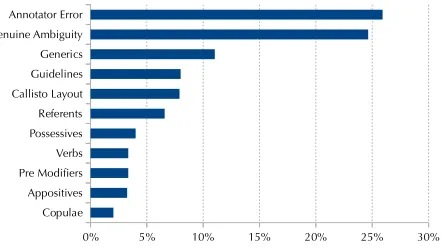
Figure 1: The distribution of disagreements across the various types in Table 2
Sheet1
Page 1 Copulae 2%
Appositives 3% Pre Modifiers 3% Verbs 3% Possessives 4% Referents 7% Callisto Layout 8% Guidelines 8% Generics 11% Genuine Ambiguity 25% Annotator Error 26%
Copulae Appositives Pre Modifiers Verbs Possessives Referents Callisto Layout Guidelines Generics Genuine Ambiguity Annotator Error
0% 5% 10% 15% 20% 25% 30%
Figure 2: The distribution of disagreements across the various types in Table 1 for a sample of 15K disagreements in the English portion of the corpus.
(30) a principal of the firmattribute,J. Smithhead
In cases where the two members of the appositive are equivalent in specificity, the left-most member of the appositive is marked as the head/referent.
Defi-niteNPs includeNPs with a definite marker (the) as
well asNPs with a possessive adjective (his). Thus
the first element is the head in all of the following cases:
(31) The chairman, the man who never gives up (32) The sheriff, his friend
(33) His friend, the sheriff
In the specificity scale, specific names of diseases and technologies are classified as proper names, whether they are capitalized or not.
(34) A dangerous bacteria, bacillium, is found
When the entity to which an appositive refers is also mentioned elsewhere, only the single span con-taining the entire appositive construction is included
in the larger IDENT chain. None of the nested NP
spans are linked. In the example below, the
en-tire span can be linked to later mentions toRichard
Godown.
The sub-spans are not included separately in the
IDENTchain.
(35) Richard Godown, president of the Indus-trial Biotechnology Association
Ages are tagged as attributes (as if they were
el-lipses of, for example,a 42-year-old):
(36) Mr.Smithhead,42attribute,
Similar rules apply for Chinese and Arabic. Un-like English, where most appositives have a punctu-ation marker, in Chinese that is not necessarily the frequent case. In the following example we can see an appositive construction without any punctuations between the head and the attribute.
(37) 上上上图图图 左左左 起起起 :::
(
无无无锡锡锡市市市市市市长长长)
X[attribute](
王王王宏宏宏民民民)
X[head],,,(
副副副市市市长长长)
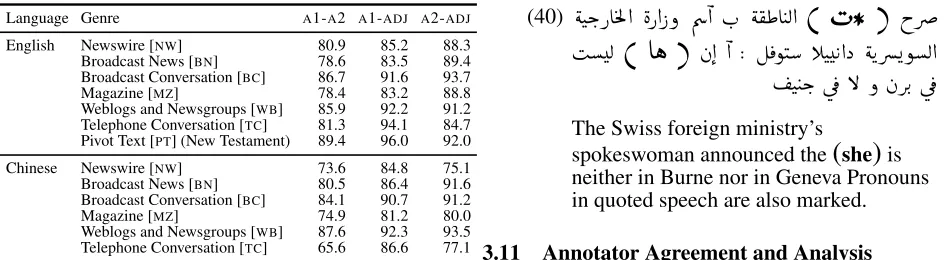
Y[attribute]Language Genre A1-A2 A1-ADJ A2-ADJ English Newswire [NW] 80.9 85.2 88.3 Broadcast News [BN] 78.6 83.5 89.4 Broadcast Conversation [BC] 86.7 91.6 93.7 Magazine [MZ] 78.4 83.2 88.8 Weblogs and Newsgroups [WB] 85.9 92.2 91.2 Telephone Conversation [TC] 81.3 94.1 84.7 Pivot Text [PT] (New Testament) 89.4 96.0 92.0 Chinese Newswire [NW] 73.6 84.8 75.1 Broadcast News [BN] 80.5 86.4 91.6 Broadcast Conversation [BC] 84.1 90.7 91.2 Magazine [MZ] 74.9 81.2 80.0 Weblogs and Newsgroups [WB] 87.6 92.3 93.5 Telephone Conversation [TC] 65.6 86.6 77.1
Table 1: Inter Annotator (A1 and A2) and Adjudicator
(ADJ) agreement for the Coreference Layer in OntoNotes
measured in terms of the MUC score.
Figure above from left :Wuxi
MayorX[attribute]Wang HongminX[head],
Deputy MayorsY[attribute]Hong Jin, Zhang
HuaixiY[head], ...
3.10 Special Issues
In addition to the ones above, there are some spe-cial cases such as:
• No coreference is marked between an
organi-zation and its members.
• GPEs are linked to references to their
govern-ments, even when the references are nested
NPs, or the modifier and head of a singleNP.
• In extremely rare cases, metonymic mentions
can be co-referenced. This is done only when the two mentions clearly and without a doubt refer to the same entity. For example:
(38) In a statement released this afternoon,10
Downing Street called the bombings in
Casablanca “a strike against all peace-loving people.”
(39) In a statement, Britain called the
Casablanca bombings “a strike against all peace-loving people.”
In this case, it is obvious that “10 Down-ing Street” and “Britain” are beDown-ing used inter-changeably in the text. Again, if there is any ambiguity, however, these terms are not coref-erenced with each other.
• In Arabic, verbal inflections are not considered
pronominal and are not coreferenced. The por-tion marked with an * in the example below is an inflection and not a pronoun, and so should not be marked.
(40)
éJk.PA
mÌ'@
èP@ Pð Õæ
@ H.
é
®£A JË@
(
H*
)
hQå
IË
(
Aë
)
à@
@ : É
¯ñJ CJ K@X éKQåñË@
J Jk. ú
¯ B ð àQK. ú
¯
The Swiss foreign ministry’s
spokeswoman announced the
(
she)
isneither in Burne nor in Geneva Pronouns in quoted speech are also marked.
3.11 Annotator Agreement and Analysis
Table 1 shows the inter-annotator and annotator-adjudicator agreement on all the genres and lan-guages of OntoNotes. A 15K disagreements in var-ious parts of the English data was analyzed, and grouped into one of the categories shown in Figure 1. Figure 2 shows the distribution of these differ-ent types that were found in that sample. It can be seen that genuine ambiguity and annotator error are the biggest contributors — the latter of which is usu-ally captured during adjudication, thus showing the increased agreement between the adjudicated ver-sion and the individual annotator verver-sion. Interest-ingly, this mirrors the annotator disagreement
analy-sis on theMUCcorpus provided by Hirschman et al.
(1998).
4 CoNLL-2012 Coreference Task
The CoNLL-2012 shared task was held across all three languages — English, Chinese and Arabic — of the OntoNotes v5.0 data. The task was to auto-matically identify mentions of entities and events in text and to link the coreferring mentions together to form entity/event chains. The coreference decisions had to be made using automatically predicted infor-mation on other structural and semantic layers in-cluding the parses, semantic roles, word senses, and named entities. Given various factors, such as the lack of resources and state-of-the-art tools, and time constraints, we could not provide some layers of in-formation for the Chinese and Arabic portion of the data.
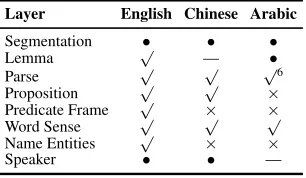
— Arabic more so than Chinese. Given this fact, plus the fact that the CoNLL format cannot handle multiple segmentations, and that it would compli-cate scoring since we are using exact token bound-aries (as discussed later in Section 4.5), we decided to allow the use of gold, treebank segmentation for all languages. In the case of Chinese, the words themselves are lemmas, so no additional informa-tion needs to be provided. For Arabic, by default written text is unvocalised, so we decided to also provide correct, gold standard lemmas, along with the correct vocalized version of the tokens. Table 2 lists which layers were available and quality of the provided layers (when provided.)
Layer English Chinese Arabic Segmentation • • •
Lemma √ — •
Parse √ √ √6
Proposition √ √ ×
Predicate Frame √ × ×
Word Sense √ √ √
Name Entities √ × ×
[image:10.612.110.263.240.329.2]Speaker • • —
Table 2: Summary of predicted layers provided for each language. A “•” indicates gold annotation, a “√”
indi-cates predicted, a “×” indicates an absence of the
pre-dicted layer, and a “—” indicates that the layer is not ap-plicable to the language.
As is customary for CoNLL tasks, there were two
primarytracks —closedandopen. For theclosed
track, systems were limited to using the distributed resources, in order to allow a fair comparison of
al-gorithm performance, while theopentrack allowed
for almost unrestricted use of external resources in
addition to the provided data. Within each closed
andopen track, we had an optionalsupplementary
track which allowed us to run some ablation studies over a few different input conditions. This allowed us to evaluate the systems given: i) Gold mention boundaries (GB), ii) Gold mentions (GM), and iii) Gold parses (GS). We will refer to the main task –
where no mention boundaries are provided – asNB.
4.1 Primary Evaluation
The primary evaluation comprises theclosedand
opentracks where predicted information is provided
on all layers of the test set other than coreference. As mentioned earlier, we provide gold lemma and vo-calization information for Arabic, and we use gold standard treebank segmentation for all three lan-guages.
6The predicted part of speech for Arabic are a mapped down
version of the richer gold version present in the treebank
4.1.1 Closed Track
In theclosed track, systems were limited to the
provided data. For the training and test data, in
addition to the underlying text, predicted versions
of all the supplementary layers of annotation were provided using off-the-shelf tools (parsers, semantic role labelers, named entity taggers, etc.) retrained on the training portion of the OntoNotes data — as de-scribed in Section 4.4.2. For the training data, how-ever, in addition to predicted values for the other
lay-ers, we also provided manual,gold-standard
anno-tations for all the layers. Participants were allowed to use either the gold-standard or predicted annota-tion to train their systems. They were also free to use the gold-standard data to train their own models for the various layers of annotation, if they judged that those would either provide more accurate pre-dictions or alternative prepre-dictions for use as multiple views, or if they wished to use a lattice of predic-tions.
More so than previous CoNLL shared tasks, coreference predictions depend on world knowl-edge, and many state-of-the-art systems use infor-mation from external resources such as WordNet, which provides a layer of information that could help a system recognize semantic connections be-tween the various lexicalized mentions in the text. Therefore, in the case of English, similar to the pre-vious year’s task, we allowed the use of WordNet in the closed track. Since word senses in OntoNotes
are predominantly7 coarse-grained groupings of
WordNet senses, systems could also map from the predicted or gold-standard word senses to the sets of underlying WordNet senses. Another significant piece of knowledge that is particularly useful for coreference but that is not available in the layers of
OntoNotes is that ofnumberandgender. There are
many different ways of predicting these values, with differing accuracies, so in order to ensure that
par-ticipants in theclosedtrack were working from the
same data, thus allowing clearer algorithmic com-parisons, we specified a particular table of number and gender predictions generated by Bergsma and Lin (2006), for use during both training and test-ing. Unfortunately neither Arabic, nor Chinese have comparable resources available that we could allow participants to use. Chinese, in particular, does not have number or gender inflections for nouns, but (Baran and Xue, 2011) look at a way to infer such information.
4.1.2 Open Track
In addition to resources available in the closed
track, in theopentrack, systems were allowed to use
7There are a few instances of novel senses introduced in
Algorithm 1 Procedure used to create OntoNotes training, development and test partitions.
Procedure: Generate Partitions(OntoNotes)returnsTrain,Dev,Test
1: Train← ∅ 2: Dev← ∅ 3: Test← ∅
4: for allSource∈OntoNotesdo
5: if Source=Wall Street Journalthen 6: Train←Train∪Sections 02 – 21 7: Dev←Dev∪Sections 00, 01, 22, 24 8: Test←Test∪Section 23
9: else
10: if Number of files inSource≥10then 11: Train←Train∪File IDsending in 1 – 8 12: Dev←Dev∪File IDsending in 0 13: Test←Test∪File IDsending in 9 14: else
15: Dev←Dev∪File IDsending in 0
16: Test←Test∪File IDending in the highest number 17: Train←Train∪RemainingFile IDsfor theSource 18: end if
19: end if 20: end for
21: return Train, Dev, Test
1
external resources such as Wikipedia, gazetteers etc. The purpose of this track is mainly to get an idea of the performance ceiling on the task at the cost of not being able to perform a fair comparison across
all systems. Another advantage of theopentrack is
that it might reduce the barriers to participation by allowing participants to field existing research sys-tems that already depend on external resources — especially if there were hard dependencies on these resources — so they can participate in the task with minimal, or no modification to their existing system.
4.2 Supplementary Evaluation
In addition to the option of selecting between the
primary closedor the opentracks, the participants
also had an option to run their systems in the follow-ing ablation settfollow-ings.
Gold Mention Boundaries (GB) In this case, we
provided all possible correct mention boundaries in
the test data. This essentially entails all NPs, and
PRPs in the data extracted from the gold parse trees, as well as the mentions that do not align with any parse constituent, for example, non-existent con-stituents in the predicted parse owing to errors, some named entities, etc.
Gold Mentions (GM) In this dataset, we provided
only and all the correct mentions for the test sets,
thereby reducing the task to one of pure mention clustering, and eliminating the task of mention
de-tection and anaphoricity determination8. These also
include potential spans that do not align with any constituent in the predicted parse tree.
Gold Parses (GS) In this case, for each language,
we replaced the predicted parses in theclosedtrack
data with manual, gold parses.
4.3 Train, Development and Test Splits
For various reasons, not all the documents in OntoNotes have been annotated with all the different
layers of annotation, with full coverage.9 There is a
core portion, however, which is roughly 1.6M En-glish words, 950K Chinese words, and 300K Arabic words which has been annotated with all the layers. This is the portion that we used for the shared task.
We used the same algorithm as in CoNLL-2011 to
8Mention detection interacts with anaphoricity
determina-tion since the corpus does not contain any singleton mendetermina-tions.
9As mentioned earlier, large scale manual annotation of
var-ious layers of syntax and semantics is an expensive endeavor. Adding to this, the fact that word sense annotation is most ef-ficiently done one lemma at a time, ideally all instances of the same across the entire corpus, or as large a portion as possi-ble, full coverage across all lemma instances is hard to achieve given the long tail of low frequency lemmas with a Zipfian dis-tribution. Similar issue affects PropBank annotation, but fur-thermore, currently it only covers mostly verb predicates, and a few eventive noun predicates.
10http://projects.ldc.upenn.edu/ace/data/
11These numbers are for the part of OntoNotes v5.0 that have
Corpora Language Words Documents
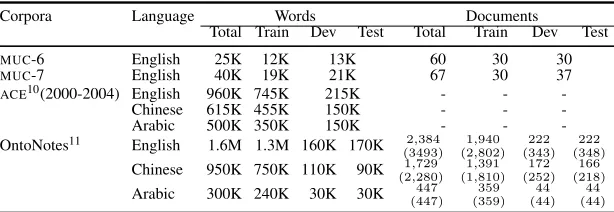
Total Train Dev Test Total Train Dev Test MUC-6 English 25K 12K 13K 60 30 30 MUC-7 English 40K 19K 21K 67 30 37 ACE10(2000-2004) English 960K 745K 215K - -
-Chinese 615K 455K 150K - -
-Arabic 500K 350K 150K - -
-OntoNotes11 English 1.6M 1.3M 160K 170K 2,384 (3493)
1,940 (2,802)
222 (343)
222 (348) Chinese 950K 750K 110K 90K 1,729
(2,280) 1,391 (1,810)
172 (252)
166 (218) Arabic 300K 240K 30K 30K 447
(447) 359 (359)
44 (44)
[image:12.612.154.461.60.166.2]44 (44)
Table 3: Number of documents in the OntoNotes v5.0 data, and some comparison with theMUCandACEdata sets. The
numbers in parenthesis for the OntoNotes corpus indicate the total number ofpartsthat correspond to the documents.
Each part was considered a separate document for evaluation purposes.
create the train/development/test partitions for En-glish, Chinese and Arabic. We tried to reuse pre-viously established partitions for Chinese and Ara-bic, but either they were not in the selection used for OntoNotes, or were partially overlapping, or had a very small portion of OntoNotes covered in the test set. Unfortunately, unlike English WSJ partitions, there was no clean way of reusing those partitions. Algorithm 1 details this procedure. The list of train-ing/development/test document IDs can be found on
the task webpage12. Following the recent CoNLL
tradition, participants were allowed to use both the training and the development data to train their final model(s).
The number of documents in the corpus for this task, for each of the different languages, and for each of the training/development/test portions, are shown in Table 3. For comparison purposes, it also
lists the number of documents in theMUC-6,
MUC-7, andACE (2000-2004) corpora. TheMUC-6 data
was taken from the Wall Street Journal, whereas the
MUC-7 data was from the New York Times. TheACE
data spanned many different languages and genres similar to the ones in OntoNotes. In fact, there is
some overlap between ACE and OntoNotes source
documents.
4.4 Data Preparation
This section gives details of the different annota-tion layers including the automatic models that were used to predict them, and describes the formats in which the data was provided to the participants.
12http://conll.cemantix.org/2012/download/ids/
For each language there are two sub-directories — “all” contains more general lists which include documents that had at least one of the layers of an-notation, and “coref” contains the lists that include document that have coreference annotation. The former were used to generate training/development/test sets for layers other than coreference, and the latter was used to generate training/development/test sets for the coreference layer used in this shared task.
4.4.1 Manual AnnotationGoldLayers
Let us take a look at the manually annotated, or
goldlayers of information that were made available
for the training data.
Coreference The manual coreference annotation
is stored as chains of linked mentions connecting multiple mentions of the same entity. Coreference is the only document-level phenomenon in OntoNotes, and the complexity of annotation increases non-linearly with the length of a document. Unfortu-nately, some of the documents — especially the ones in the broadcast conversation, weblogs, and telephone conversation genre — are very long and that prohibited efficient annotation in their entirety. These had to be split into smaller parts. A few passes to join some adjacent parts were conducted, but since some documents had as many as 17 parts, there are still multi-part documents in the corpus. Since the coreference chains are coherent only within each of these document parts, for the purpose of this task, each such part is treated as a separate document. An-other thing to note is that there were some cases of sub-token annotation in the corpus owing to the fact that tokens were not split at hyphens. Cases
such as pro-WalMart had the sub-span WalMart linked
with another instance of WalMart. The recent
Tree-bank revision split tokens atmosthyphens and made
of 55 with automatic parses and roughly 65 using
gold parses13. Considering the level of prediction
accuracy of these tokens, and the relative frequency of the same, plus the fact that the CoNLL tabular format is not amenable to a variable number of to-kens, we decided not to consider them as part of the task. In other words, we removed the manually
identified traces (*pro*and*) respectively in
Chi-nese and Arabic Treebanks. We also do not consider the links that are formed by these tokens in the gold evaluation key.
Tables 4 and 5 shows the distribution of mentions by the syntactic categories, and the counts of enti-ties, links and mentions in the corpus respectively. Interestingly the mentions formed by these dropped pronouns total roughly about 11% for both Chinese and Arabic. All of this data has been Treebanked and PropBanked either as part of the OntoNotes ef-fort, or some previous effort.
Language Syntactic Train Development Test category Count % Count % Count % English Noun Phrase 61.8K 39.46 9.7K 45.57 9.2K 42.97
Pronoun 66.7K 42.61 7.8K 36.66 8.2K 38.69 Proper Noun 18.1K 11.60 2.2K 10.66 2.3K 10.96
Dropped Pro. - - -
[image:13.612.313.549.62.166.2]-Other Noun 2.636 1.68 546 2.55 500 2.33 Verb 2.522 1.61 299 1.40 342 1.60 Other 4.761 3.04 676 3.16 738 3.45 Chinese Noun Phrase 40.7K 34.23 5.4K 32.53 5.1K 35.31 Pronoun 20.8K 17.50 3.3K 19.88 2.5K 17.65 Dropped Pro. 13.5K 11.39 1.9K 12.04 1.5K 10.71 Proper Noun 19.0K 15.96 2.8K 17.24 2.2K 15.54 Other Noun 23.6K 19.88 2.8K 17.08 2.8K 19.71 Verb 244 0.20 51 0.31 20 0.14 Other 994 0.83 153 0.92 139 0.95 Arabic Noun Phrase 10.8K 34.93 1.3K 35.02 1.3K 36.51 Pronoun 8.9K 28.77 1.0K 28.33 1.1K 30.58 Dropped Pro. 3.5K 11.52 477 12.57 429 11.78 Proper Noun 4.0K 13.01 450 11.86 390 10.71 Other Noun 3.3K 10.90 439 11.57 345 9.47 Verb 25 0.08 4 0.11 0 0.00 Other 247 0.79 21 0.55 35 0.96
Table 4: Distribution of mentions in the data by their syn-tactic category.
Parse Trees These represent the syntactic layer
that is a revised version of the treebanks in English, Chinese and Arabic. Arabic treebank has probably seen the most revision over the past few years, in an effort to increase consistency. For purposes of this task, traces were removed from the syntactic trees, since the CoNLL-style data format, being indexed by tokens, does not provide any good means of con-veying that information. As mentioned in the previ-ous section, these include the cases of traces in Chi-nese and Arabic which are dropped subjects/objects
13These numbers are not in the thesis, but we received them
in an email communication with the Ryan Gabbard.
Language Type Train Development Test All English Entities/Chains 35,143 4,546 4,532 44,221
[image:13.612.72.308.296.501.2]Links 120,417 14,610 15,232 150,259 Mentions 155,560 19,156 19,764 194,480 Chinese Entities/Chains 28,257 3,875 3,559 35,691 Links 74,597 10,308 9,242 94,147 Mentions 102,854 14,183 12,801 129,838 Arabic Entities/Chains 8,330 936 980 10,246 Links 19,260 2,381 2,255 23,896 Mentions 27,590 3,313 3,235 34,138
Table 5: Number of entities, links and mentions in the OntoNotes v5.0 data.
that are legitimate targets for coreference annota-tion. Function tags were also removed, since the parsers that we used for the predicted syntax layer did not provide them. One thing that needs to be dealt with in conversational data is the presence of disfluencies (restarts, etc.). In the English parses of the OntoNotes, the disfluencies are marked using
a special EDITED14 phrase tag — as was the case
for the Switchboard Treebank. Given the frequency of disfluencies and the performance with which one
can identify them automatically,15 a probable
pro-cessing pipeline would filter them out before pars-ing. Since we did not have a readily available tag-ger for tagging disfluencies, we decided to remove them using oracle information available in the En-glish Treebank, and the coreference chains were remapped to trees without disfluencies. Owing to various constraints, we decided to retain the disflu-encies in the Chinese data. Since Arabic portion of the corpus is all newswire, this had no impact on it. However, for both Chinese and Arabic, since we remove trace tokens corresponding to dropped pro-nouns, all the other layers of annotation had to be remapped to the remaining sequence of tree tokens.
Propositions The propositions in OntoNotes are
PropBank-style semantic roles for English, Chinese and Arabic. Most of the verb predicates in the cor-pus have been annotated with their arguments. As part of the OntoNotes effort, some enhancements were made to the English PropBank and Treebank to make them synchronize better with each other (Babko-Malaya et al., 2006). One of the outcomes
of this effort was that two types ofLINKs that
rep-resent pragmatic coreference (LINK-PCR) and
selec-14There is another phrase type —EMBEDin the telephone
conversation genre which is similar to theEDITEDphrase type,
and sometimes identifies insertions, but sometimes contains logical continuation of phrases by different speakers, so we de-cided not to remove that from the data.
15A study by Charniak and Johnson (2001) shows that one
tional preferences (LINK-SLC) were added to Prop-Bank. More details can be found in the addendum to
the PropBank guidelines16in the OntoNotes v5.0
re-lease. Since the community is not used to this repre-sentation which relies heavily on the trace structure in the Treebank which we are excluding, we decided tounfoldthe LINKs back to their original
represen-tation as in the PropBank 1.0 release. This
function-ality is part of the OntoNotes DB Tool.17
Word Sense Gold standard word sense annotation
was supplied using sense numbers (along with the sense inventories) as specified in the OntoNotes list of senses for each lemma. The coverage of the word sense annotation varies among the languages. En-glish has the most coverage, while coverage for Chi-nese and Arabic is more sporadic. Even for English, the coverage for word sense annotation is not com-plete. Only some of the verbs and nouns are anno-tated with word sense information.
Named Entities Named Entities in OntoNotes
data are specified using a catalog of 18 Name types.
Other Layers Discourse plays a vital role in
coreference resolution. In the case of broadcast con-versation, or telephone conversation data, it partially manifests itself in the form of speakers of a given ut-terance, whereas in weblogs or newsgroups it does so as the writer, or commenter of a particular article or thread. This information provides an important clue for correctly linking anaphoric pronouns with the right antecedents. This information could be au-tomatically deduced, but since it would add addi-tional complexity to the already complex task, we decided to provide oracle information of this meta-data both during training and testing. In other words, speaker and author identification was not treated as an annotation layer that needed to be predicted. This information was provided in the form of another
col-umn in the .conllfile. There were some cases of
interruptions and interjections that led to a sentence associated with two different speakers, but since the frequency of this was quite small, we decided to make an assumption of one speaker/writer per sen-tence.
4.4.2 Predicted Annotation Layers
The predicted annotation layers were derived us-ing automatic models trained usus-ing cross-validation
on other portions of OntoNotes v5.0 data. As
mentioned earlier, there are some portions of the OntoNotes corpus that have not been annotated for coreference but that have been annotated for other layers. For training models for each of the layers, where feasible, we used all the data that we could
16doc/propbank/english-propbank.pdf 17http://cemantix.org/ontonotes.html
[image:14.612.329.522.62.105.2]Layer English Chinese Arabic Verb Noun All Verb Noun Sense Inventories 2702 2194 763 150 111 Frames 5672 1335 20134 2743 532
Table 7: Number of senses defined for English, Chinese and Arabic in the OntoNotes v5.0 corpus.
for that layer from the training portion of the entire OntoNotes v5.0 release.
Parse Trees Predicted parse trees for English were
produced using the Charniak parser18(Charniak and
Johnson, 2005). Some additional tag types used in the OntoNotes trees were added to the parser’s
tagset, including theNMLtag that has recently been
added to capture internalNPstructure, and the rules
used to determine head words were extended corre-spondingly. Chinese and Arabic parses were gen-erated using the Berkeley parser (Petrov and Klein, 2007). In the case of Arabic, the parsing commu-nity uses a mapping from rich Arabic part of speech tags, to Penn-style part of speech tags. We used the mapping that is included with the Arabic treebank.
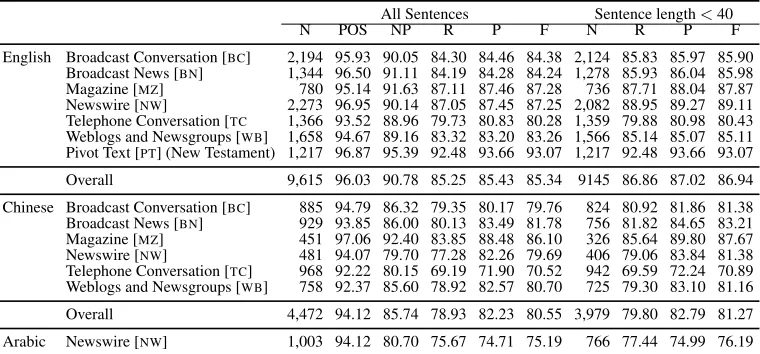
The predicted parses for the training portion of the data were generated using 10-fold (5-fold for Arabic) cross-validation. The development and test parses were generated using a model trained on the entire training portion. We used OntoNotes v5.0 training data for training the Chinese and Arabic parser models, but the OntoNotes v4.0 subset of OntoNotes v5.0 data was used for training the En-glish model. We decided to do the latter to be able to better compare the scores to the CoNLL-2011 eval-uation given that parser is a central component to a coreference system, and the fact that OntoNotes v5.0 adds a small fraction of gold parses on top of those provided by OntoNotes v4.0. Table 6 shows the per-formance of the re-trained parsers on the CoNLL-2012 test set. We did not get a chance to re-train the re-ranker available for English, and since the stock
re-ranker crashes when run onn-best parses
contain-ingNMLs, because it has not seen that tag in
train-ing, we could not make use of it. In addition to the parser scores and part of speech accuracy, we have
also added a column for the accuracy for the NPs
because they are particularly relevant to the corefer-ence task.
18
http://bllip.cs.brown.edu/download/reranking-parserAug06.tar.gz
19There was an error in processing the test set, therefore the
All Sentences Sentence length<40
N POS NP R P F N R P F
[image:15.612.117.497.61.238.2]English Broadcast Conversation [BC] 2,194 95.93 90.05 84.30 84.46 84.38 2,124 85.83 85.97 85.90 Broadcast News [BN] 1,344 96.50 91.11 84.19 84.28 84.24 1,278 85.93 86.04 85.98 Magazine [MZ] 780 95.14 91.63 87.11 87.46 87.28 736 87.71 88.04 87.87 Newswire [NW] 2,273 96.95 90.14 87.05 87.45 87.25 2,082 88.95 89.27 89.11 Telephone Conversation [TC 1,366 93.52 88.96 79.73 80.83 80.28 1,359 79.88 80.98 80.43 Weblogs and Newsgroups [WB] 1,658 94.67 89.16 83.32 83.20 83.26 1,566 85.14 85.07 85.11 Pivot Text [PT] (New Testament) 1,217 96.87 95.39 92.48 93.66 93.07 1,217 92.48 93.66 93.07 Overall 9,615 96.03 90.78 85.25 85.43 85.34 9145 86.86 87.02 86.94 Chinese Broadcast Conversation [BC] 885 94.79 86.32 79.35 80.17 79.76 824 80.92 81.86 81.38 Broadcast News [BN] 929 93.85 86.00 80.13 83.49 81.78 756 81.82 84.65 83.21 Magazine [MZ] 451 97.06 92.40 83.85 88.48 86.10 326 85.64 89.80 87.67 Newswire [NW] 481 94.07 79.70 77.28 82.26 79.69 406 79.06 83.84 81.38 Telephone Conversation [TC] 968 92.22 80.15 69.19 71.90 70.52 942 69.59 72.24 70.89 Weblogs and Newsgroups [WB] 758 92.37 85.60 78.92 82.57 80.70 725 79.30 83.10 81.16 Overall 4,472 94.12 85.74 78.93 82.23 80.55 3,979 79.80 82.79 81.27 Arabic Newswire [NW] 1,003 94.12 80.70 75.67 74.71 75.19 766 77.44 74.99 76.19
Table 6: Parser performance on the CoNLL-2012 test set.
Accuracy
R P F
English Broadcast Conversation [BC] 81.3 81.2 81.2 Broadcast News [BN] 81.5 82.0 81.7 Magazine [MZ] 78.8 79.1 79.0 Newswire [NW] 85.7 85.7 85.7 Weblogs and Newsgroups [WB] 77.6 77.5 77.5 Overall 82.5 82.5 82.5 Chinese Broadcast Conversation [BC] - - 80.5 Broadcast News [BN] - - 85.4 Magazine [MZ] - - 82.4 Newswire [NW] - - 89.1
Overall - - 84.3
Arabic Newswire [NW]19 75.2 75.9 75.6
Table 8: Word sense performance over both verbs and nouns in the CoNLL-2012 test set.
Word Sense This year we used the IMS (It Makes
Sense) (Zhong and Ng, 2010) word sense tagger.20
Word sense information, unlike syntactic parse in-formation is not central to approaches taken by cur-rent coreference systems and so we decided to use a better word sense tagger to get a good state of the art accuracy estimate, at the cost of a completely fair (but, still close enough) comparison with English CoNLL-2011 results. This will also allow potential future uses to benefit from it. IMS was trained on all the word sense data that is present in the train-ing portion of the OntoNotes corpus ustrain-ing cross-validated predictions on the input layers similar to the proposition tagger. During testing, for English and Arabic, IMS must first uses the automatic POS information to identify the nouns and verbs in the test data, and then assign senses to the automatically
20We offer special thanks to Hwee Tou Ng and his student
Zhi Zhong for training IMS models and providing output for the development and test sets.
identified nouns and verbs. In case of Arabic, IMS uses gold lemmas. Since automatic POS tagging is not perfect, IMS does not always output a sense to all word tokens that need to be sense tagged due to wrongly predicted POS tags. As such, recall is not the same as precision on the English and Arabic test data. Recall that in Chinese, the word senses are
defined againstlemmas and are independent of the
part of speech. Since we provide gold word seg-mentation, IMS attempts to sense tag all correctly segmented Chinese words, so recall and precision
are same and so is F1. Table 7 gives the number of
lemmas covered by the word sense inventory in the English, Chinese and Arabic portion of OntoNotes.
Table 8 shows the performance of this classifier
aggregated over both the verbs and nouns in the
CoNLL-2012 test set. For English, genres PT and
TC, and for Chinese genresTCandWB, no gold