Coreference Resolution with Loose Transitivity Constraints
Xinxin Li, Xuan Wang, Shuhan Qi
Shenzhen Graduate School
Harbin Institute of Technology, ShenZhen, China
[email protected], [email protected] shuhan [email protected]
Abstract
Our system treats coreference resolution as an integer linear programming (ILP) problem. Extending Denis and Baldridge (2007) and Finkel and Manning (2008)’s work, we exploit loose transitivity constraints on coreference pairs. Instead of enforcing transitivity closure constraints, which bringsO(n
3
) complexity,
we employ a strategy to reduce the number of constraints without large performance de-crease, i.e., eliminating coreference pairs with probability below a threshold. Experimental
results show that it achieves a better perfor-mance than pairwise classifiers.
1 Introduction
This paper describes our coreference resolution sys-tem participating in the close track of CoNLL 2011 shared task (Pradhan et al., 2011). The task aims to identify all mentions of entities and events and clus-ter them into equivalence classes in OntoNotes Cor-pus (Pradhan et al., 2007a). During the last decade, several machine learning methods for coreference resolution have been developed, from local pair-wise classifiers (Soon et al., 2001) to global learn-ing methods (Luo et al., 2004; Ng, 2005; Denis and Baldridge, 2007), from simple morphological, grammatical features to more liguistically rich fea-tures on syntactic strucfea-tures and semantic relations (Pradhan et al., 2007b; Haghighi and Klein, 2009).
Our system supports both local classifiers and global learning. Maximum entropy model is used for anaphoricity and coreference, because it assigns probability mass to mentions and coreference pairs
directly. In global phase, instead of determining each coreference pair independently in a greedy fashion, we employ an integer linear programming (ILP) formulation for this problem. Extending (De-nis and Baldridge, 2007) and (Finkel and Manning, 2008)’s work, we introduce a loose selection strat-egy for transitivity constraints, attempting to over-come huge computation complexity brought by tran-sitivity closure constraints. Details are described in section 2.3.
2 System Description
2.1 Mention Detection
Mention detection is a method that identifies the anaphoricity and non-anaphoricity mentions before coreference resolution. The non-anaphoric men-tions usually influence the performance of corefer-ence resolution as noises. Corefercorefer-ence resolution can benefit from accurate mention detection since it might eliminate the non-anaphoric mentions. We take mention detection as the first step, and then combine coreference classifier into one system.
Total 70 candidate features are used for mention detection, including lexical, syntactic, semantic fea-tures (Ng and Cardie, 2002). Feafea-tures are selected according to the information gain ratio (Han and Kamber, 2006)
GainR ation(A)=
Gain(A)
SplitInfo(A)
The top 10 features with highest gain ratio are: string match, head word match, all uppercase, pro-noun, starting with article, number, following prepo-sition, nesting in verb phrase, nesting in prepoprepo-sition,
and starting with definite article. Many string fea-tures that cannot be calculated by gain ratio method are also added.
2.2 Coreference Determination
For coreference determination, we first build sev-eral baseline systems with different training in-stance generation methods and clustering algo-rithms. These strategies are shown below. Detailed description can be found in Ng (2005).
training instance generation methods: Mc-Carthy and Lehnerts method, Soon et al.’s method, Ng and Cardie’s method.
clustering algorithms: closest-first clustering, best-first clustering, and aggressive merge clus-tering.
Overall 65 features are considered in our system. Features are extracted from various linguistic infor-mation, including:
distance: sentence distance, minimum edit dis-tance (Strube et al., 2002)
lexical: string match, partial match, head word match (Daum´e III and Marcu, 2005)
grammar: gender agreement, number agree-ment(Soon et al., 2001)
syntactic: same head, path (Yang et al., 2006)
semantic: semantic class agreement, predicate (Ponzetto and Strube, 2006; Ng, 2007)
Combining different training instance generation methods and clustering algorithms, we get total 9 baseline systems. For each system, we use a greedy forward approach to select features. Starting from a base feature set (Soon et al., 2001), each feature out of the base set is added one by one according to the performance change on development data. Fi-nally, the procedure is ended until the performance is not improved. The baseline system with best per-formance is selected for further improvement.
2.3 ILP with Loose Transitivity Constraints
Previous systems usually take coreference resolu-tion as binary classificaresolu-tion problem, and build the coreference chain by determining each coreference pair indepedently. The binary classifier is easily implemented, but may cause inconsistency between coreference pairs. Several work have been devel-oped to overcome the problem, e.g., Bell trees (Luo et al., 2004), conditional random fields (McCallum and Wellner, 2004) and reranker (Ng, 2005).
Denis and Baldridge (2007) proposed an ILP for-mulation to find the optimal solution for the prob-lem. It utilizes the output of other local classifiers and performs global learning. The objective func-tion for their conference-only model takes the form:
min X
hi;ji2M 2
h i;ji
x hi;ji
+ hi;ji
(1 x hi;ji
)
where h i;ji
= log (P C
), h i;ji
= log (1 P C
). M is the candidate mention set for each document.
P
C refers to the probability of coreference link be-tween two mentions produced by our maximum en-tropy model, andx
h i;jiis a binary variable that is set to 1 if two mentions are coreferent, 0 otherwise.
However, as Finkel and Manning showed, D&B’s coreference-only model without transitivity con-straints is not really necessary, because they only se-lect the coreference links with probabilityP
C >0:5. Klenner (2007) and Finkel and Manning (2008)’s work extended the ILP framework to support tran-sitivity constraints. The trantran-sitivity constraints are formulated as
8i;j;k 2M(i<j<k)
x hi;ji
x hj;ki
+x hi;ki
1
x hj;ki
x h i;ji
+x hi;ki
1
x hi;ki
x hi;ji
+x h j;ki
1
These constraints ensure that when any two core-frent links (e.g., xh i;ji, xhi;ki) among three men-tions exist, the third one x
h j;kimust also be a link. However, these constraints also bring huge time and space complexity withn
3
Ratio Recall Precision F-value 0.4 84.03 43.75 57.54 0.6 70.6 70.85 70.72
[image:3.612.325.530.55.155.2] [image:3.612.99.272.57.127.2]0.8 64.24 74.35 68.93 1.0 58.63 76.13 66.25
Table 1: Results of mention dection
below a probability threshold. The constraints are transformed as
x hi;ki
+x hj;ki
1 (1)
x h i;ji
=0 (2)
whenP C
(i;j)<. The thresholdis tuned on de-velopment data for faster computation without large performance decrease.
3 Experiments and Analysis
In the paper we mainly take noun phrases (NPs) and pronouns as candidate mentions, and ignore other phrases since more than 91% of the mentions are NPs and pronouns.
3.1 Mention Detection
We observe that the ratio of positive examples and negative examples is about 1:3 in training data. To balance the bias, we propose a ratio control method which sets a ratio to limit the number of negative examples. Our system will select all positive exam-ples, and part of negative examples according to the ratio. By tuning the ratio, we can control the propor-tion of positive and negative examples. With differ-ent ratios for negative feature selection, the results on development data are shown in table 1.
From table 1, we can see that as the ratio in-creases, recall becomes smaller and precision be-comes larger. Small threshold means less negative examples are generated in training procedure, and the classifier tends to determine a mention as posi-tive. Finally, we choose the ratio 0.6 for our model because it gets the best F-value on the development data.
3.2 Coreference Resolution
Our system participates in the close track with auto mention and gold boundary annotation. The
TIGM Soon Soon Soon Ng
CA A B C B
MUC 44.29 46.18 46.18 45.33
B 3
59.76 61.39 60.03 60.93 CEAF(M) 42.77 44.43 43.01 44.41 CEAF(E) 35.77 36.37 36.08 36.54
BLANC 60.22 63.94 59.9 63.96
Official 46.6 47.98 46.76 47.6
Table 2: Results of baseline systems
the performance is evaluated on MUC, B-CUBED, CEAF(M), CEAF(E), BLANC metrics. The official metric is calculated as(MUC+B
3
+CEAF) =3.
Table 2 summarizes the performance of top 4 of 9 baseline systems with different training instance generation methods and clustering algorithms on de-velopment data. In the table, TIGM means training instance generation method, and CA denotes clus-tering algorithm, which includes C as closest-first, B as best-first, and A as aggressive-merge clustering algorithm. The results in Table 2 show that the sys-tem with Soon’s training instance generation method and best-first clustering algorithm achieves the best performance. We take it as baseline for further im-provement.
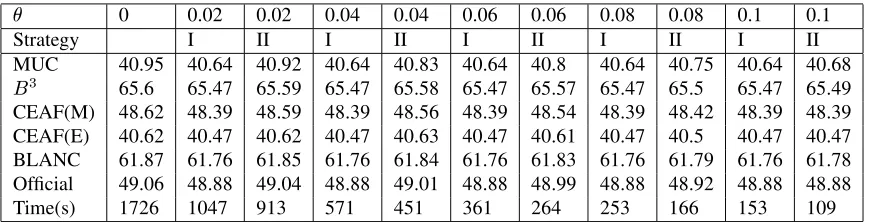
In ILP model, we perform experiments on docu-ments with less than 150 candidate mentions to find the suitable probability threshold for loose tran-sitivity constraints. There are totol 181 documents meeting the condition in development data. We take two strategies to loose transitivity constraints: (I) formula 1 and 2, and (II) formula 2 only. Glpk pack-age is used to solve our ILP optimization problems.1 Table 3 shows that as threshold increases, the running time reduces dramatically with a small per-formance decrease from 49.06 to 48.88. Strategy I has no benefit for the performance. Finally strategy II and=0:06are used in our system.
We also combine mentions identified in first phase into coreference resolution. Two strategies are used: feature model and cascaded model. For feature model, we add two features which indicate whether the two candidate mentions of a coreference pair are mentions identified in first phase or not. For cas-caded model, we take mentions identified in first phase as inputs for coreference resolution. For ILP
0 0.02 0.02 0.04 0.04 0.06 0.06 0.08 0.08 0.1 0.1
Strategy I II I II I II I II I II
MUC 40.95 40.64 40.92 40.64 40.83 40.64 40.8 40.64 40.75 40.64 40.68
B 3
65.6 65.47 65.59 65.47 65.58 65.47 65.57 65.47 65.5 65.47 65.49 CEAF(M) 48.62 48.39 48.59 48.39 48.56 48.39 48.54 48.39 48.42 48.39 48.39 CEAF(E) 40.62 40.47 40.62 40.47 40.63 40.47 40.61 40.47 40.5 40.47 40.47 BLANC 61.87 61.76 61.85 61.76 61.84 61.76 61.83 61.76 61.79 61.76 61.78 Official 49.06 48.88 49.04 48.88 49.01 48.88 48.99 48.88 48.92 48.88 48.88
Time(s) 1726 1047 913 571 451 361 264 253 166 153 109
Table 3: Results on different probability thresholds and strategies
Model Feature Cascade ILP MUC 41.08 47.41 45.89
B 3
[image:4.612.90.526.56.167.2]59.74 57.67 61.85 CEAF(M) 41.9 42.04 44.52 CEAF(E) 34.72 32.33 36.85 BLANC 61.1 62.99 63.92 Official 45.18 45.81 48.19
Table 4: Results of coreference resolution systems.
model, we perform experiments on coreference-only system with our loose transitivity constraints. The results on development data are shown in Table 4.
In Core Quad 2.40G CPU and 2G memory ma-chine, our ILP model can optimize one document per minute on average. From table 4, we can see that the ILP model achieves the best F-value, implying the benefit of our algorithm. It also shows that tra-ditional coreference resolution methods combining mention detection decrease the performance. For restricted time deadline, other constraints strategies (Klenner, 2007) and joint anaphoricity-coreference ILP model are not used in our system. It would be in our future work.
3.3 Test
Table 5 shows the performance of our system for both development and test data, with auto mention and gold boundary annotation.
The results in table 5 show that in auto mention annotation, the performance on test data is a little bit better than development data. The reason might be that the system on test data uses more data to train, including development data. A phenomenon surprises us is that the performance on test data with gold annotation is less than on development data,
Data Dev Dev Test Test Mention Auto Gold Auto Gold MUC 45.89 46.75 46.62 44.00
B 3
61.85 61.48 61.93 57.42 CEAF(M) 44.52 45.17 44.75 42.36 CEAF(E) 36.85 37.19 36.83 34.22 BLANC 63.92 63.83 64.27 62.96 Official 48.19 48.47 48.46 45.21
Table 5: Results for development and test data
even than auto annotation. It turns out that the mis-take is made because we confuse the the definition of gold bourdaries as gold mentions, which are ”all” and ”only” mentions in coreference chains.
4 Conclusion
In this paper, we present a coreference resolution system which employs an ILP formulation for global optimization. To reduce computation complexity, our system employs loose transitivity constraints to the ILP model. Experimental results show that it achieves a better performance than pairwise classi-fiers.
References
Hal Daum´e III and Daniel Marcu. 2005. A large-scale exploration of effective global features for a joint en-tity detection and tracking model. InProceedings of Human Language Technology Conference and Confer-ence on Empirical Methods in Natural Language Pro-cessing, pages 97–104, Vancouver, British Columbia, Canada, October. Association for Computational Lin-guistics.
[image:4.612.92.281.211.309.2]us-ing integer programmus-ing. InHuman Language Tech-nologies 2007: The Conference of the North Ameri-can Chapter of the Association for Computational Lin-guistics; Proceedings of the Main Conference, pages 236–243, Rochester, New York, April. Association for Computational Linguistics.
Jenny Rose Finkel and Christopher D. Manning. 2008. Enforcing transitivity in coreference resolution. In Proceedings of ACL-08: HLT, Short Papers, pages 45– 48, Columbus, Ohio, June. Association for Computa-tional Linguistics.
Aria Haghighi and Dan Klein. 2009. Simple coreference resolution with rich syntactic and semantic features. In Proceedings of the 2009 Conference on Empiri-cal Methods in Natural Language Processing, pages 1152–1161, Singapore, August. Association for Com-putational Linguistics.
J. Han and M. Kamber. 2006. Data mining: concepts and techniques. Morgan Kaufmann.
Manfred Klenner. 2007. Enforcing consistency on coref-erence sets. InRecent Advances in Natural Language Processing (RANLP), pages 323–328.
Xiaoqiang Luo, Abe Ittycheriah, Hongyan Jing, Nanda Kambhatla, and Salim Roukos. 2004. A mention-synchronous coreference resolution algorithm based on the bell tree. In Proceedings of the 42nd Meet-ing of the Association for Computational LMeet-inguistics (ACL’04), Main Volume, pages 135–142, Barcelona, Spain, July.
Andrew McCallum and Ben Wellner. 2004. Conditional models of identity uncertainty with application to noun coreference. InNIPS 2004.
Vincent Ng and Claire Cardie. 2002. Identifying anaphoric and non-anaphoric noun phrases to improve coreference resolution. InProceedings of the 19th international conference on Computational linguistics -Volume 1, COLING ’02, pages 1–7, Stroudsburg, PA, USA. Association for Computational Linguistics. Vincent Ng. 2005. Machine learning for coreference
res-olution: From local classification to global ranking. In Proceedings of the 43rd Annual Meeting of the Asso-ciation for Computational Linguistics (ACL’05), pages 157–164, Ann Arbor, Michigan, June. Association for Computational Linguistics.
Vincent Ng. 2007. Shallow semantics for coreference resolution. In Proceedings of IJCAI, pages 1689– 1694.
Simone Paolo Ponzetto and Michael Strube. 2006. Ex-ploiting semantic role labeling, wordnet and wikipedia for coreference resolution. InProceedings of the Hu-man Language Technology Conference of the NAACL, Main Conference, pages 192–199, New York City, USA, June. Association for Computational Linguis-tics.
Sameer Pradhan, Eduard Hovy, Mitch Marcus, Martha Palmer, Lance Ramshaw, and Ralph Weischedel. 2007a. Ontonotes: A unified relational semantic rep-resentation. International Journal of Semantic Com-puting (IJSC), 1(4):405–419.
Sameer Pradhan, Lance Ramshaw, Ralph Weischedel, Jessica MacBride, and Linnea Micciulla. 2007b. Un-restricted coreference: Identifying entities and events in ontonotes. In in Proceedings of the IEEE Inter-national Conference on Semantic Computing (ICSC), September 17-19.
Sameer Pradhan, Lance Ramshaw, Mitchell Marcus, Martha Palmer, Ralph Weischedel, and Nianwen Xue. 2011. Conll-2011 shared task: Modeling unrestricted coreference in ontonotes. InProceedings of the Fif-teenth Conference on Computational Natural Lan-guage Learning (CoNLL 2011), Portland, Oregon, June.
Wee Meng Soon, Hwee Tou Ng, and Daniel Chung Yong Lim. 2001. A machine learning approach to coref-erence resolution of noun phrases. Comput. Linguist., 27:521–544, December.
Michael Strube, Stefan Rapp, and Christoph M¨uller. 2002. The influence of minimum edit distance on reference resolution. In Proceedings of the ACL-02 conference on Empirical methods in natural language processing - Volume 10, EMNLP ’02, pages 312–319, Stroudsburg, PA, USA. Association for Computational Linguistics.